
China Hydroponics Market Size and Share
Market Overview
| Study Period | 2021 - 2031 |
|---|---|
| Forecast Data Period | 2026 - 2031 |
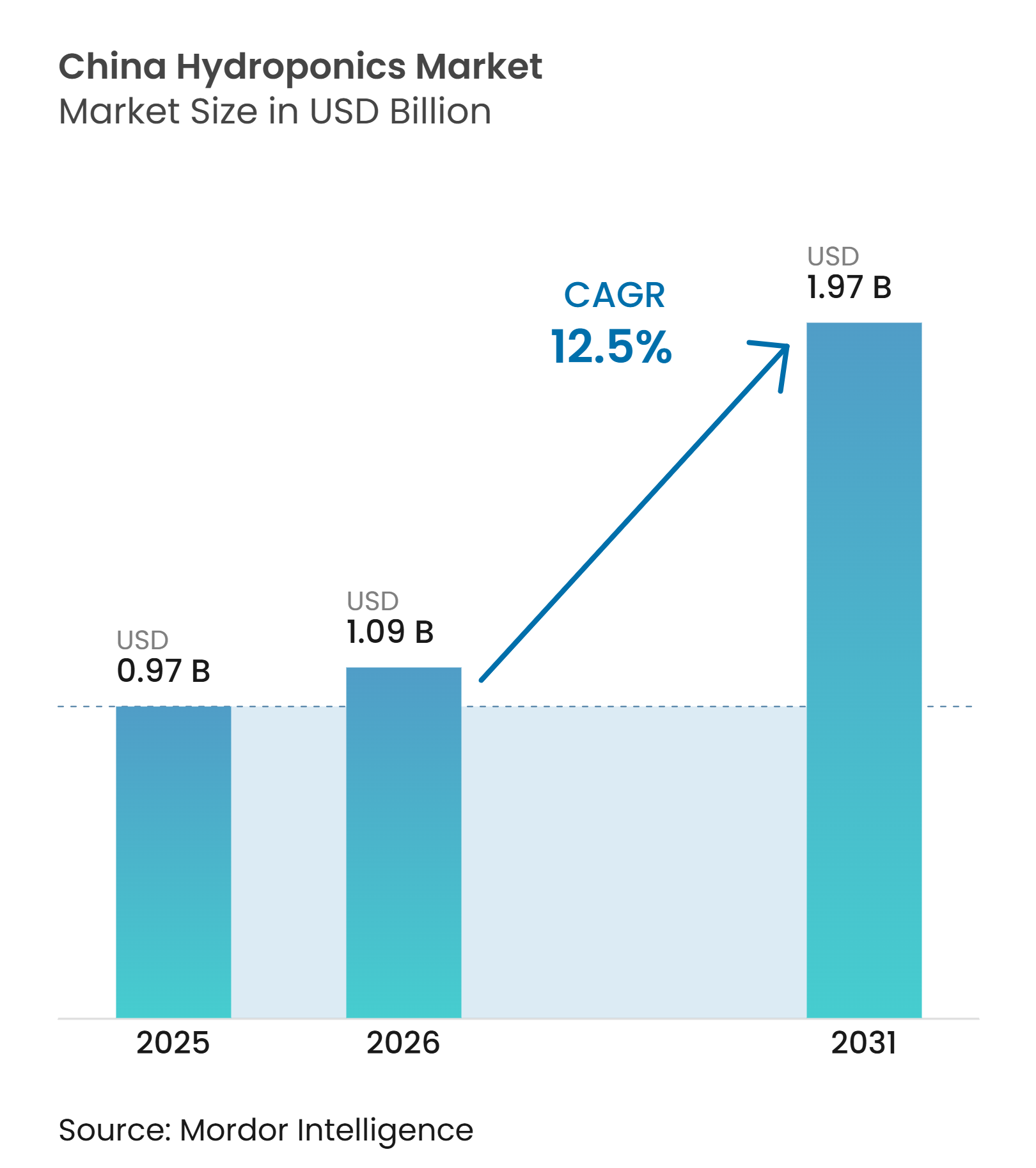
| Base Year Market Size (2025) | USD 0.97 Billion |
| Market Size (2026) | USD 1.09 Billion |
| Market Size (2031) | USD 1.97 Billion |
| Growth Rate (2026 - 2031) | 12.50 % |
| Market Concentration | Low |
Major Players *Disclaimer: Major Players sorted in no particular order Image © Mordor Intelligence. Reuse requires attribution under CC BY 4.0. | |
China Hydroponics Market Analysis by Mordor Intelligence
The China Hydroponics Market was valued at USD 0.97 billion in 2025, is estimated to be USD 1.09 billion in 2026, and is projected to reach USD 1.97 billion by 2031, growing at a CAGR of 12.5% from 2026 to 2031. China's 15th Five-Year Plan identifies facility agriculture, the adoption of artificial intelligence, and soilless cultivation as tools for protecting the domestic food supply[1]. The China hydroponics market benefits from this policy direction, as plant factories are increasingly treated as commercial food-supply assets rather than pilot projects. Limited arable land and stronger food safety expectations support demand for controlled production close to cities. Companies with engineering capabilities, crop management data, and recurring support services are better positioned to compete for larger projects. However, the China hydroponics market also faces challenges, including high energy use, capital requirements, and shortages of trained technicians, which can limit project profitability.
Key Report Takeaways
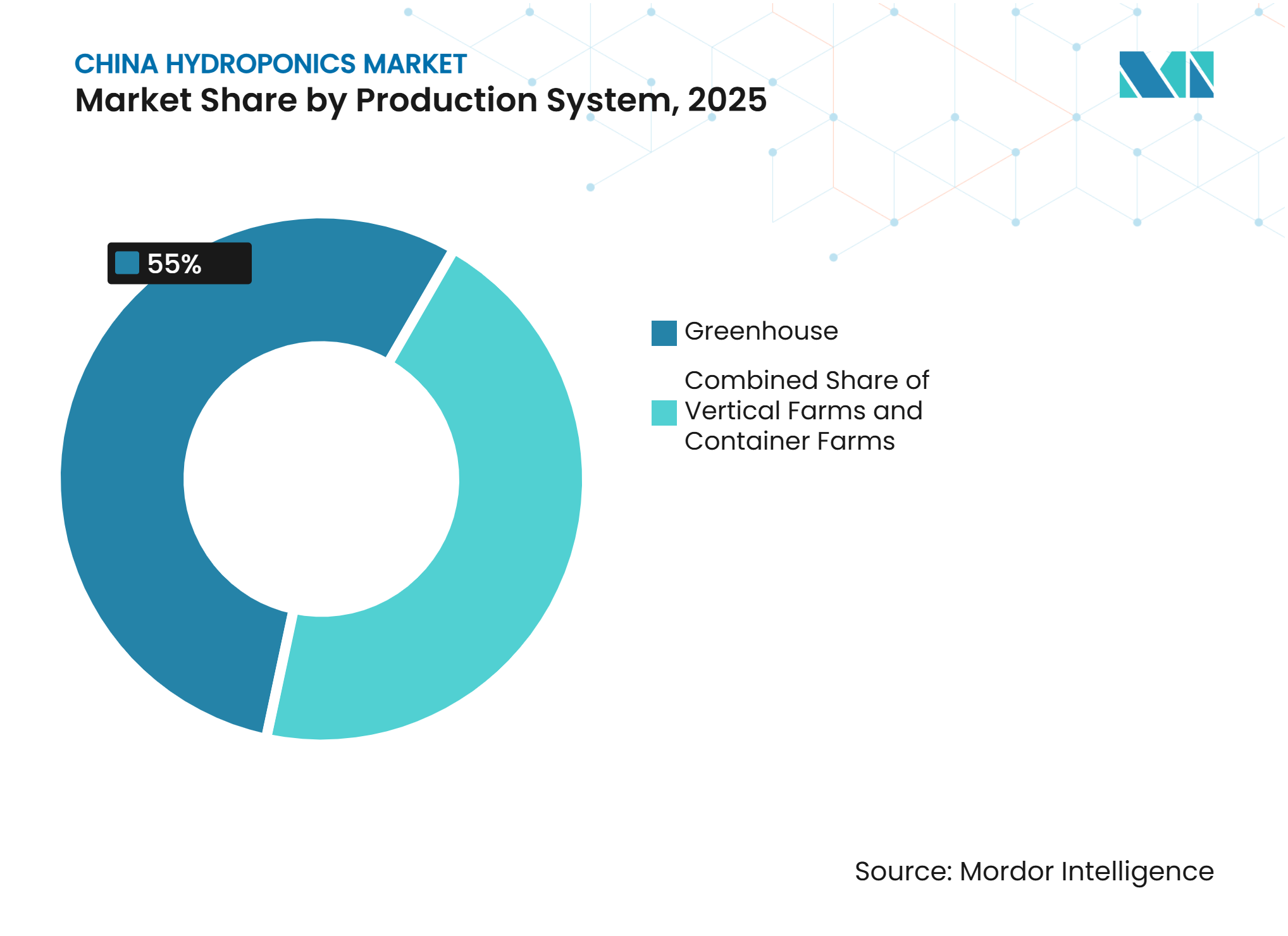
- By production system, greenhouses held 55% of China hydroponics market share in 2025, while vertical farms are forecast to be the fastest-growing at a 16.5% CAGR through 2031.
- By crop type, leafy greens accounted for 48% of the China hydroponics market size in 2025, while herbs and microgreens are projected to expand fastest at a 15% CAGR through 2031.
- By equipment, lighting systems held 31% share in 2025, while automation and control systems are projected to be fastest growing at a 15.5% CAGR through 2031.
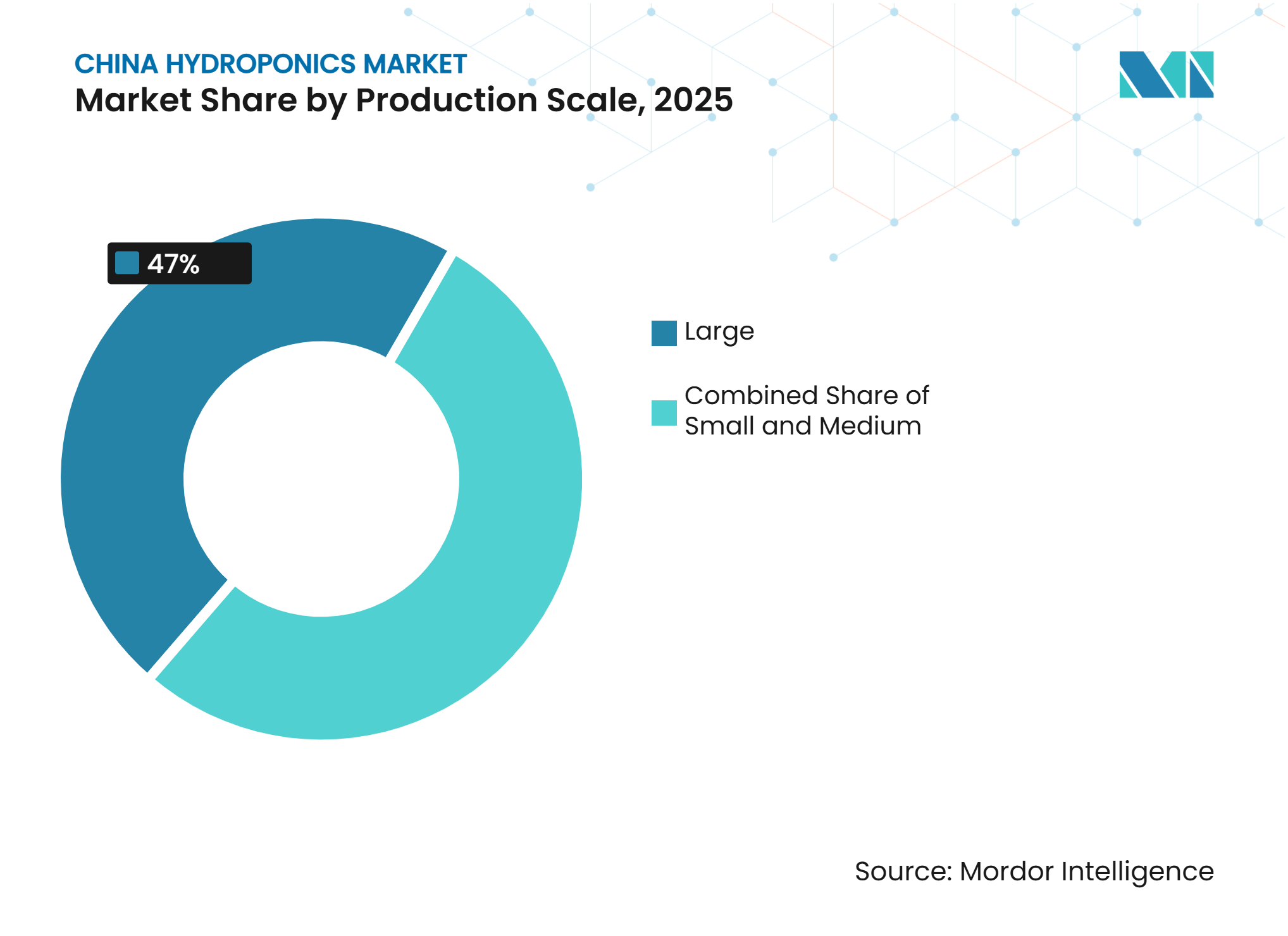
- By production scale, large accounted for 47%in 2025, while small is estimated to grow fastest at a 14.2% CAGR through 2031.
Note: Market size and forecast figures in this report are generated using Mordor Intelligence’s proprietary estimation framework, updated with the latest available data and insights as of January 2026.
Market Trends and Insights
Drivers Impact Analysis of China Hydroponics Market*
| Driver | (~) % Impact on CAGR Forecast | Geographic Relevance | Impact Timeline |
|---|---|---|---|
| Food security and agricultural modernization priorities | 3.50% | National, with emphasis on northern and northwestern provinces | Short term (≤ 2 years) |
| Urban demand for local, safe, and traceable produce | 2.00% | National, led by Tier 1 and Tier 2 cities in the Yangtze River Delta and Jing-Jin-Ji | Medium term (2–4 years) |
| Commercial greenhouse and plant factory expansion | 2.50% | National, concentrated in Shandong, Yunnan, Fujian, and Jiangsu | Short term (≤ 2 years) |
| Water saving and land use efficiency requirements | 1.50% | National, especially water-stressed northern and northwestern provinces | Medium term (2–4 years) |
| Domestic smart farming hardware and software localization | 1.00% | National, led by Yangtze River Delta and Pearl River Delta technology clusters | Long term (≥ 4 years) |
| Hydroponic production in climate-stressed agricultural zones | 1.00% | National, with early gains in Xinjiang, Gansu, Tibet, and Inner Mongolia | Long term (≥ 4 years) |
| Source: Mordor Intelligence | |||
Food Security and Agricultural Modernization Priorities
China's 15th Five-Year Plan for 2026 to 2030 identifies facility agriculture and soilless cultivation as strategic priorities for domestic food supply. The plan also supports artificial intelligence, smart-farming platforms, and domestic agricultural technology development[2]. This provides the China hydroponics market with a clearer policy framework compared to earlier development plans. Local authorities can apply these priorities when selecting food-security infrastructure for support. Plant factories near major cities can therefore transition from demonstration facilities to regular procurement opportunities. Digital agriculture requirements also encourage integrators to offer traceability and reporting features. Suppliers that can document water use, output, and cultivation conditions may gain an advantage in public projects. The policy supports both new facilities and upgrades to existing controlled-environment sites.
Urban Demand for Local, Safe, and Traceable Produce
Urban consumers increasingly value verified origin and production conditions for fresh vegetables. Hydroponic farms can provide controlled growing conditions and records that track produce from seed to shelf. Fast, fresh-food delivery networks in Shanghai, Shenzhen, and Beijing strengthen the operating case for farms located close to buyers. This model supports the China hydroponics market in serving retail customers and institutional food-service buyers. HydroBlue's AI Pocket Farm combines blockchain traceability with Internet of Things monitoring in compact nutrient-film technique systems. The product targets institutional buyers who require clear supply records. Hotel groups, hospital chains, and airline caterers can use batch-level records to manage food-safety procedures. This requirement can convert traceability from a marketing feature into a practical purchasing condition.
Commercial Greenhouse and Plant Factory Expansion
China added 5.05 million hectares of newly built or upgraded high-standard farmland in 2025, according to Xinhua News Agency. This construction activity supports demand for controlled growing equipment and integrated systems. According to Starfarm Technology, the China hydroponics market had 493 commercial plant factories in 2024. Construction investment reached CNY 2.747 billion (USD 379 million), with average build costs of CNY 5,780 (USD 797) per square meter. Premium urban projects can exceed CNY 10,000 (USD 1,380) per square meter. The Chinese Academy of Agricultural Sciences demonstrated a 20-story vertical plant factory in Chengdu with land-use efficiency 120 times that of open-field farming. Greenhouse engineering firms can capture more value by combining structures, climate systems, hydroponics, and controls within a single project. This approach also generates follow-on revenue from commissioning, maintenance, and crop-support services.
Water Saving and Land Use Efficiency Requirements
China holds 21% of the global population but only 6% of global freshwater resources. Per-capita renewable water availability stands at 2,100 cubic meters, approximately one-quarter of the global average. Northern China accounts for 65% of national cropland but holds only 20% of water resources. These conditions make efficient irrigation a key consideration for the China hydroponics market. Closed-loop hydroponic systems can reduce water consumption by 70% to 90% compared with soil-based farming. Diversified greenhouse systems produced 37.2% of China's vegetable output from 1.4% of arable land. The same study supports the case for facility-based production where usable land is limited. Provinces with water-withdrawal controls can use hydroponic projects to meet agricultural efficiency targets.
Restraints Impact Analysis of China Hydroponics Market*
| Restraint | (~) % Impact on CAGR Forecast | Geographic Relevance | Impact Timeline |
|---|---|---|---|
| High capital and operating costs | -2.50% | National, most acute in Tier 2 and Tier 3 cities with limited subsidy access | Short term (≤ 2 years) |
| Electricity exposure in indoor and vertical systems | -1.50% | National, most severe in northeastern China where grid costs are higher | Medium term (2–4 years) |
| Shortage of qualified hydroponic technicians | -1.00% | National, with pronounced gaps in inland and northwestern provinces | Medium term (2–4 years) |
| Inconsistent local standards and approval requirements | -0.50% | National, particularly in cross-provincial deployments | Long term (≥ 4 years) |
| Source: Mordor Intelligence | |||
High Capital and Operating Costs
High upfront costs remain a central barrier to commercial entry. Enclosed plant factories require investment in structures, lighting, climate systems, and nutrient-management equipment, with typical break-even periods ranging from 5 to 8 years under standard operating assumptions. In the latest assessment period, more than 90% of China's plant-factory operators were not profitable. Lighting and climate systems account for 60% of total energy expenditure in these facilities. Domestic LED components have reduced the cost of multi-layer racks, though this benefit is more pronounced for large standardized projects than for smaller mixed-crop operations. Smaller operators may still require imported controls for precise electrical conductivity and pH management.
Electricity Exposure in Indoor and Vertical Systems
Artificial lighting and climate control can account for 50% to 65% of operating expenses in enclosed vertical farms. Higher power prices can reduce crop margins without increasing output. This risk is particularly relevant for the China hydroponics market, where grid-powered indoor facilities are expanding. A study across 21 Chinese cities found that grid-solar hybrid systems reduced net present energy costs by 40.87% to 65.68% compared with grid-only systems. The Chinese Academy of Agricultural Sciences tested photovoltaic direct-supply systems in Beijing, Pinggu, and the Nanjing National Agricultural High-Tech Zone. Operators can also use off-peak rates to reduce effective energy costs. Herbs and microgreens may require tighter light settings than leafy greens. Power disruption can therefore create quality risks and contract risks alongside higher costs.
*Our forecasts treat driver/restraint impacts as directional, not additive. The impact forecasts reflect baseline growth, mix effects, and variable interactions.
China Hydroponics Market Segment Analysis
By Production System:
Greenhouses Lead While Vertical Farms Grow FasterGreenhouses held a 55% share in the China hydroponics market in 2025. They provide an established, lower-cost path to controlled production at commercial scale. Shandong, Fujian, Yunnan, and Xinjiang have built multi-span glass and film greenhouses over many years. These facilities use nutrient-film technique, deep-flow technique, and Dutch-bucket systems. Greenhouses remain central to the China hydroponics market because they balance environmental control with lower energy demand. Vertical farms are projected to grow at a 16.5% CAGR through 2031, supported by improved lighting efficiency and lower domestic control hardware costs. Beijing Kingpeng International Hi-Tech Corporation completed a Crop Breeding Accelerator in Beijing in September 2024. The site includes 1,400 square meters of lighted growth rooms and 9,200 square meters of glass greenhouse propagation rooms. The facility demonstrates how breeding and commercial hydroponic production can be combined.
Container farms formed a smaller production-system segment in 2025. They offer rapid deployment where fixed greenhouse infrastructure is limited. SANANBIO's ARK container farm combines vertical hydroponics, climate control, LED lighting, and farm-management software. Saudi Arabia's National Irrigation Organization selected the 40-foot high-cube system in May 2024, demonstrating that China-origin container-farm technology can compete in international procurement. Within China, deployments in Xinjiang and Tibet serve areas where conventional growing conditions are unreliable, which differs from systems designed primarily for premium urban produce. Facility agriculture standards increasingly guide greenhouse design and performance reporting. Providers that document yield, traceability, and water recycling are better positioned to meet growing customer and public-sector requirements.



By Crop Type:
Leafy Greens Lead While Herbs and Microgreens ExpandLeafy greens accounted for a 48% share in China's hydroponics market in 2025. This position reflects short growing cycles, high turnover, and urban demand for pesticide-free produce. Fully controlled plant factories can grow leafy greens in 18 to 21 days, whereas conventional soil cultivation can require 60 days for comparable crops. SANANBIO's plant factory in Anxi, Fujian, produces 1.5 metric tons of leafy vegetables per day. The facility is fully automated and covers 10,000 square meters. Tomatoes with rockwool and Dutch-bucket systems supporting tomato production in commercial greenhouses. Cucumbers and peppers also hold notable positions in greenhouse-based production.
Herbs and microgreens are forecast to grow at a 15% CAGR through 2031, supported by culinary diversification, health-conscious purchasing, and premium prices for certified-organic varieties. Basil, cilantro, and specialty microgreens are becoming more common in hospitality purchasing. Controlled lighting makes these crops suitable for modular, multi-tier vertical systems. Herbs respond better to managed light recipes than larger fruiting crops, making them a practical fit for vertical systems in the Yangtze River Delta. Food-service demand provides a reliable outlet for specialized varieties, and the crop mix allows operators to target higher-value buyers in segments where basic leafy-greens pricing is more competitive.
By Equipment:
Lighting Systems Lead While Automation Changes OperationsLighting systems accounted for 31% of the China hydroponics market in 2025. LED arrays are a major physical component of artificial-light plant factories, representing a large share of total facility spending. Chinese LED plant lights have achieved photon efficacy of 2.8 μmol/J. Domestic production has reduced multi-layer rack costs by 40% in recent years. SANANBIO supplies proprietary LED lighting with integrated RADIX hydroponic modules, giving turnkey buyers a single source for key system components. Irrigation components, pumps, and climate systems form the other established equipment categories, with an important role in both greenhouse and vertical-farm installations.
Automation and control systems are forecast to grow at a 15.5% CAGR through 2031, as operators shift from manual checks to sensor-based monitoring of electrical conductivity and pH. Automated irrigation scheduling and crop-growth forecasting are also gaining adoption. Patent activity increased between 2024 and 2026 in nutrient management, lighting control, and climate optimization. The hydroponics industry in China uses these tools to reduce manual intervention and improve operational consistency. Solar direct-supply systems can be paired with smart load-management tools, an approach relevant in Xinjiang, Sichuan, and Yunnan, where solar resources are favorable. Automation can also provide operators with better records for traceability and regulatory reporting, though the value of these systems depends on reliable maintenance and staff capable of acting on operating data.
By Production Scale:
Large Operations Lead While Small Systems ExpandLarge held a 47% share in China's hydroponic market in 2025. Centralized nutrient management and climate infrastructure support their operating model, and large buyers also have stronger procurement leverage with equipment suppliers. Beijing Kingpeng International Hi-Tech Corporation's Cuihu Smart Agriculture Innovation Center Phase 2 began planting in May 2024. The project covers 112,000 square meters and includes 57,000 square meters of high-efficiency fruit and vegetable greenhouses and 35,000 square meters of semi-closed controlled-environment infrastructure. Medium supply peri-urban produce markets and institutional food-service channels, commonly using standardized nutrient-film technique or flood-and-drain systems from domestic suppliers.
Small is projected to expand at a 14.2% CAGR through 2031, driven by container farms, compact nutrient-film technique systems, school installations, and household kits. HydroBlue reported 48 confirmed orders and 93 serious inquiries during a three-day 2025 exhibition, related to its low-energy nutrient-film technique kit and modular seedling beds, indicating demand for smaller commercial applications. E-commerce channels are also improving access to hydroponic equipment for entry-level users, and the distinction between hobby use and smaller commercial use is becoming less defined. Improved unit economics could support recurring nutrient supply and technical-service models, though smaller systems will still require accessible training and maintenance support to scale reliably.

Geography Analysis
The Yangtze River Delta is a major commercial center for the China hydroponics market. Shanghai, Jiangsu, and Zhejiang combine dense urban demand with access to technology suppliers. Shanghai hosts vertical farm startups, nutrient-film technique providers, and research programs linked to agricultural universities. Jiangsu is home to Starfarm Technology and Skyplant Farm, and its Nanjing National Agricultural High-Tech Zone operates a major commercial plant factory. Zhejiang has strong cold-chain logistics and urban food-safety priorities, which support produce flows from nearby and inland facilities. The region is also benefiting from national support for urban food resilience and smart farming.
The Jing-Jin-Ji corridor serves as an important research and development hub for the China hydroponics market. Beijing hosts the Chinese Academy of Agricultural Sciences, Beijing Kingpeng International Hi-Tech Corporation projects, and Alesca Life Technologies' China operations base. Beijing Kingpeng International Hi-Tech Corporation's Beijing Crop Breeding Accelerator entered trial operation in September 2024. Shandong is transitioning from open-field and conventional greenhouse production toward drip hydroponics and nutrient-film technique systems. The Pearl River Delta and Fujian coastal cluster function as important technology showcases. SANANBIO's Anxi facility exports LED-enabled production and crop-recipe technology to more than 33 countries. These locations bring together production sites, equipment suppliers, and buyers for controlled-environment systems.
Northwestern and southwestern provinces are emerging demand areas for the China hydroponics market. Xinjiang, Gansu, Tibet, Inner Mongolia, Sichuan, and Yunnan face soil, climate, water, or seasonal constraints that make outdoor production less predictable, and controlled systems can deliver vegetables in these conditions. Kuqa City in Xinjiang operates a provincially supported smart plant factory using shallow-liquid hydroponics. In August 2024, Yunnan hosted Beijing Kingpeng International Hi-Tech Corporation's planting ceremony for 140,000 tomato seedlings in a multi-span glass greenhouse with the project using real-time sensors for light, heat, water, gas, and fertilizer. These regions are estimatedto generate future demand as subsidy programs mature and crop recipes improve for local conditions.
Competitive Landscape
Market Concentration
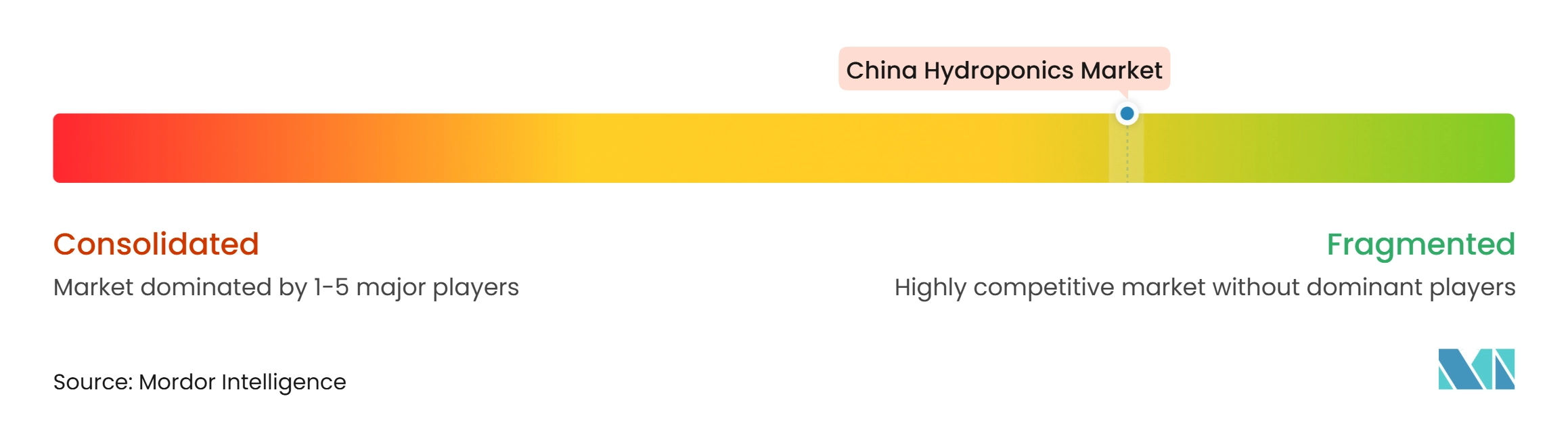
The China hydroponics market is fragmented in 2025. The top five companies are SANANBIO, Beijing Kingpeng International Hi-Tech Corporation, Zhengzhou Lyine Agriculture Technology Co., Ltd., Prasada Agricultural, and Hydroblue Technology Shanghai Co., Ltd., while more than 50 smaller domestic enterprises compete in standard system segments. Turnkey engineering, procurement, and construction capability distinguishes larger integrators from equipment-only suppliers. Buyers value firms that can design structures, install climate systems, commission nutrient systems, and provide crop support. Beijing Kingpeng International Hi-Tech Corporation and Starfarm hold National High-tech Enterprise designations, which provide research and development tax credits and preferential access to government procurement.
SANANBIO has a joint-venture relationship with the Chinese Academy of Sciences, giving the company access to publicly funded light-recipe research. Its proprietary lighting and RADIX modules also support an integrated project offering. HydroBlue has integrated blockchain traceability and artificial intelligence monitoring into its nutrient-film technique product range[3]. The company targets food-service buyers that require batch-level origin documentation. In November 2024, Alesca Life Technologies partnered with UAE-based Crysp Farms to deploy more than 500 modular vertical farms across the Middle East over five years. This Farming-as-a-Service model generates multi-year operating contracts rather than relying solely on equipment sales.
Companies are also developing patents for LED dimming, nutrient monitoring, climate control, and container-farm energy management. These capabilities support product differentiation in the China hydroponics market. Automated post-harvest logistics and data services remain less developed, and modular solutions for small and medium commercial growers also lack specialized support. Ziyang Wish Agricultural Technology, Shenzhen Aokang Technology, and BEO Technology Group serve narrower segments and may grow through technology licensing or acquisition by larger integrators.
China Hydroponics Industry Leaders
-
SANANBIO
-
Beijing Kingpeng International Hi-Tech Corporation
-
Zhengzhou Lyine Agriculture Technology Co.,Ltd.
-
Prasada Agricultural
-
Hydroblue Technology Shanghai Co., Ltd.
- *Disclaimer: Major Players sorted in no particular order
China Hydroponics Market Companies Covered in this Report
- Fujian SANANBIO Technology Co., Ltd.
- Beijing Kingpeng International Hi-Tech Corporation
- Zhengzhou Lyine Agriculture Technology Co., Ltd.
- Prasada (Xiamen) Agricultural Engineering Co., Ltd.
- HydroBlue (Shanghai) Technology Co., Ltd.
- Shanghai Nongke Greenhouse Co., Ltd.
- Shanghai Nongsen Greenhouse Engineering Co., Ltd.
- Shanghai Urban Green Engineering Co., Ltd.
- Starfarm Technology
- Wuxi Liford Import and Export Co., Ltd.
- Wuxi Zewo Special Steel Co., Ltd.
- Skyplant Farm
- GrowSpec Biotech
- Ziyang Wish Agricultural Technology Co., Ltd.
- AGROW
Recent Industry Developments in China Hydroponics Market
- January 2026: Jiangsu Skyplant Greenhouse Technology Co., Ltd. led the launch of the Belt and Road Initiative Agricultural Cooperation Development Professional Committee Operation Center in Xinghua, Jiangsu. The center promotes Chinese greenhouse and hydroponic technologies in Belt and Road Initiative countries, with Skyplant designated as the lead operating unit.
- December 2025: Beijing Kingpeng International Hi-Tech Corporation completed a greenhouse project for a potato virus-free propagation base. The project combined potato virus-free technology, custom greenhouse facilities, and scientific planting models to address potato degeneration in commercial seed stock.
- September 2025: Fujian SANANBIO Technology Co., Ltd. attended FlowersExpo 2025. The company introduced supplemental greenhouse lighting for horticultural production alongside its ARK and RADIX product lines
China Hydroponics Market Report Scope
Hydroponics is the technique of growing plants using a water-based nutrient solution rather than soil. These production systems are used by small farmers, hobbyists, and commercial enterprises.
China hydroponics market is segmented by production system (greenhouse, vertical farms, and container hydroponic farms), by crop type (leafy greens, tomatoes, cucumbers, peppers, and herbs and microgreens), by equipment (lighting, irrigation, climate systems, automation and control systems, and others, and by production scale (small, medium, and large). The market forecasts are in terms of value in USD.
Segmentation Overview
| Greenhouse |
| Vertical Farms |
| Container Hydroponic Farms |
| Leafy Greens |
| Tomatoes |
| Cucumbers |
| Peppers |
| Herbs and Microgreens |
| Lighting Systems |
| Irrigation Components and Pumps |
| Climate Systems |
| Automation and Control Systems |
| Other Equipment |
| Large |
| Medium |
| Small |
| By Production System | Greenhouse |
| Vertical Farms | |
| Container Hydroponic Farms | |
| By Crop Type | Leafy Greens |
| Tomatoes | |
| Cucumbers | |
| Peppers | |
| Herbs and Microgreens | |
| By Equipment | Lighting Systems |
| Irrigation Components and Pumps | |
| Climate Systems | |
| Automation and Control Systems | |
| Other Equipment | |
| By Production Scale | Large |
| Medium | |
| Small |
Key Questions Answered in the Report
What is the forecast growth rate for hydroponics in China?
The China hydroponics market is forecast to grow at a 12.5% CAGR from 2026 to 2031, reaching USD 1.97 billion by 2031.
Which production system leads hydroponic cultivation in China?
Greenhouses led with 55% share in 2025 because they provide controlled production with lower energy needs than fully enclosed facilities.
Which crops offer the strongest growth opportunity in China’s hydroponics sector?
Herbs and microgreens are forecast to grow at a 15% CAGR through 2031, supported by food-service demand and fit with vertical systems.
What is the main cost challenge for vertical farms in China?
Artificial lighting and climate control account for 50% to 65% of operating expenses in enclosed vertical farms.
Which Chinese regions offer growing demand for hydroponic systems?
The Yangtze River Delta remains a commercial center, while Xinjiang, Gansu, Tibet, Inner Mongolia, Sichuan, and Yunnan are emerging demand areas.