
China Food Enzymes Market Size and Share
Market Overview
| Study Period | 2021 - 2031 |
|---|---|
| Forecast Data Period | 2026 - 2031 |
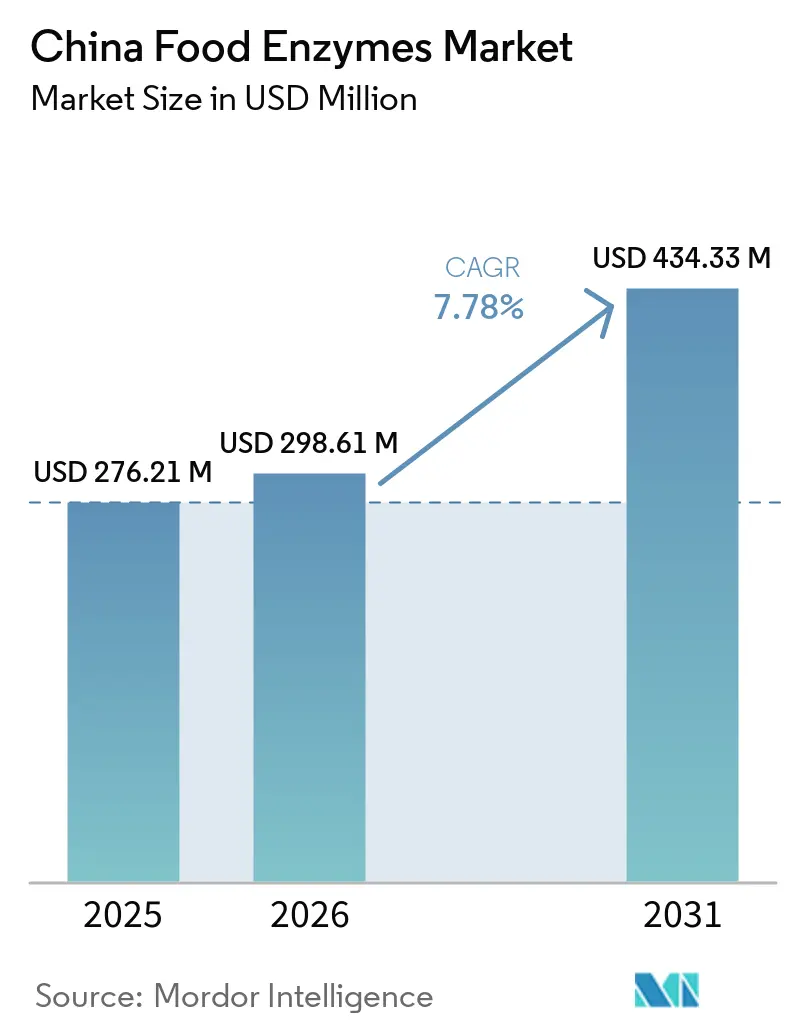
| Base Year Market Size (2025) | USD 276.21 Million |
| Market Size (2026) | USD 298.61 Million |
| Market Size (2031) | USD 434.33 Million |
| Growth Rate (2026 - 2031) | 7.78 % |
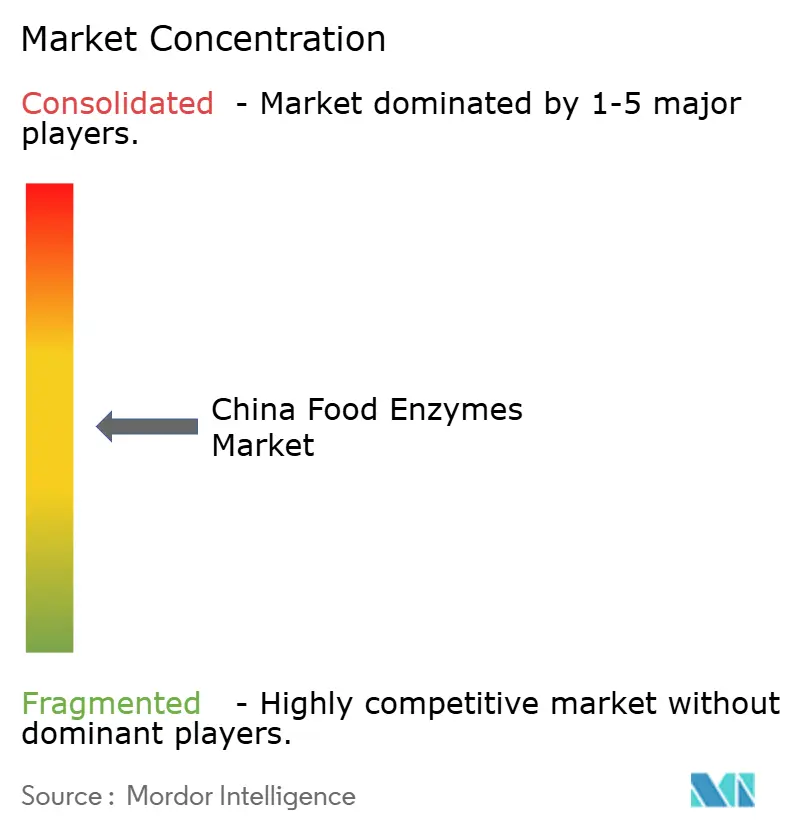
| Market Concentration | Medium |
Major Players *Disclaimer: Major Players sorted in no particular order Image © Mordor Intelligence. Reuse requires attribution under CC BY 4.0. | |
China Food Enzymes Market Analysis by Mordor Intelligence
The China food enzymes market size is expected to grow from USD 276.21 million in 2025 to USD 298.61 million in 2026 and is forecast to reach USD 434.33 million by 2031 at 7.78% CAGR over 2026-2031. The market is supported by the expansion of industrial food processing, which requires consistent texture, yield, and shelf life across high-volume production. Pre-prepared meals, bakery products, beverages, dairy products, and processed meat each use enzymes to manage starch, protein, and fat during production. Policy support for nutritious and lower-additive food systems also favors enzyme-enabled formulations. The China food enzymes market is becoming more demanding as quality standards, clean-label requirements, and customer expectations rise. Suppliers with application expertise, dependable quality systems, and products suited to local processing conditions have a clearer path to premium accounts.
Key Report Takeaways
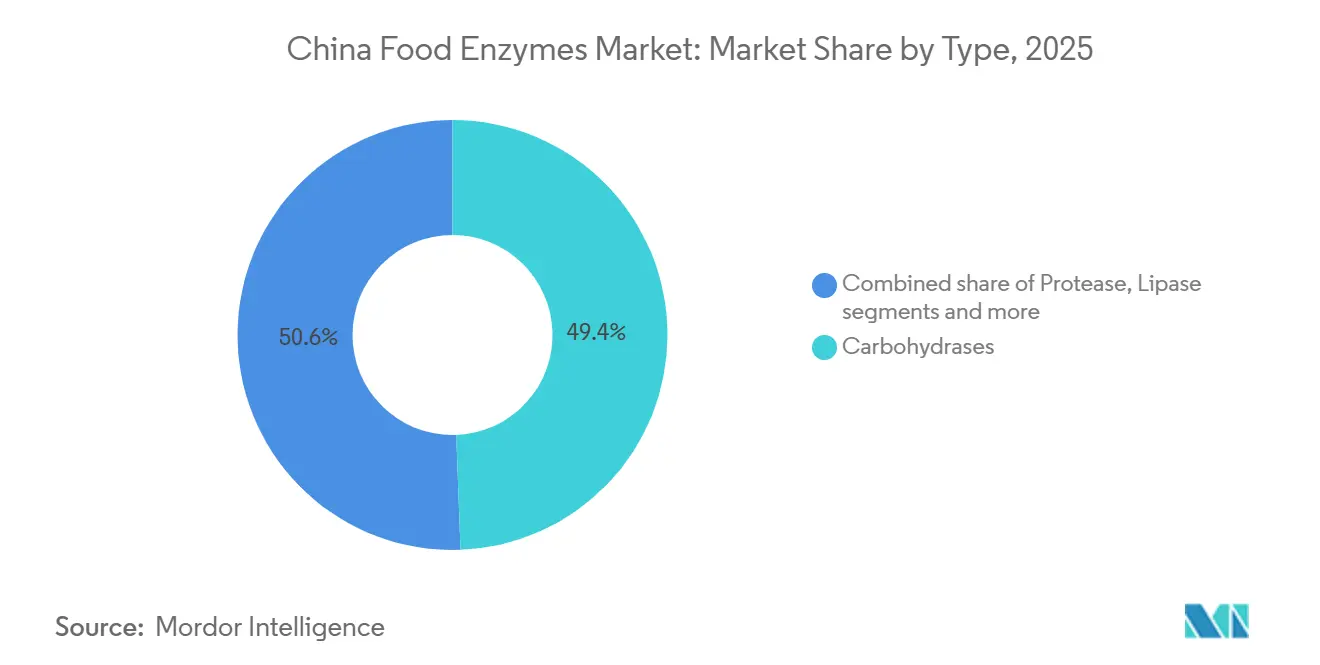
- By enzyme type, carbohydrases held 49.41% of the China food enzymes market share in 2025, while lipase is forecast to grow at a CAGR of 8.76% through 2031.
- By form, powder accounted for 61.38% of revenue in 2025 and is forecast to advance at a CAGR of 8.46% through 2031.
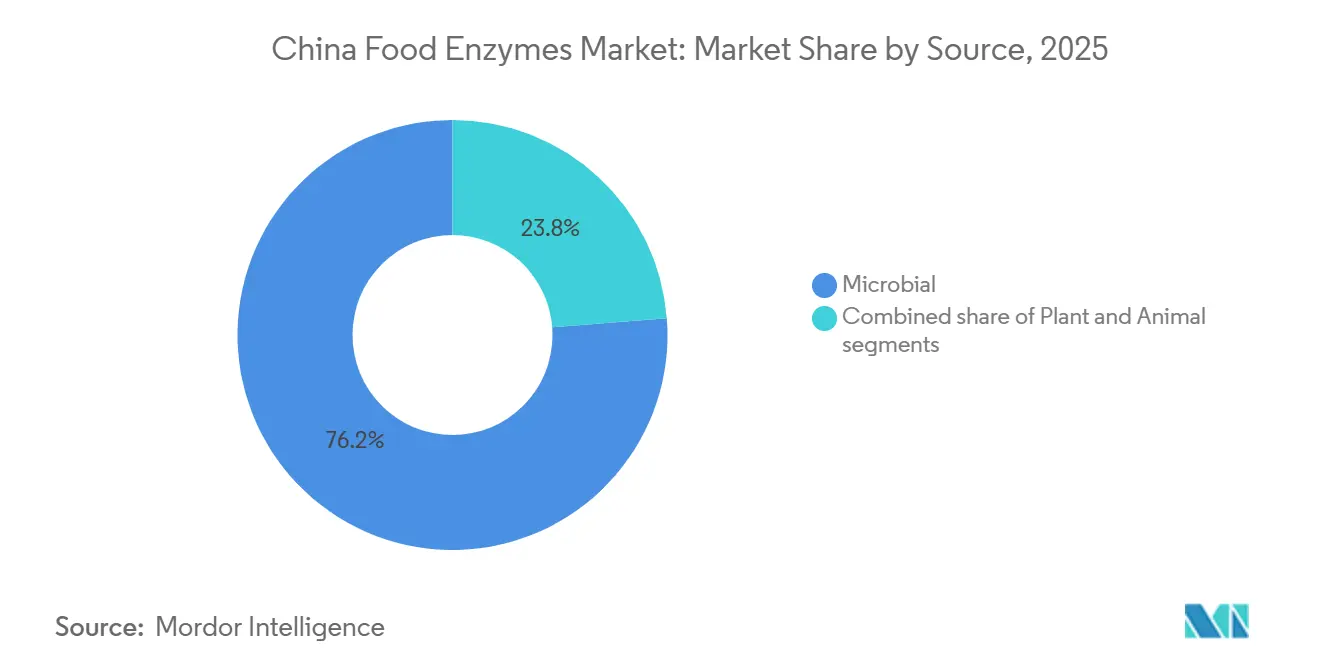
- By source, microbial enzymes held 76.24% of revenue in 2025, while plant-derived enzymes are forecast to grow at a CAGR of 8.61% through 2031.
- By application, bakery and confectionery accounted for 34.73% of revenue in 2025, while beverages are forecast to expand at a CAGR of 8.87% through 2031.
Note: Market size and forecast figures in this report are generated using Mordor Intelligence’s proprietary estimation framework, updated with the latest available data and insights as of January 2026.
China Food Enzymes Market Trends and Insights
Drivers Impact Analysis*
| Driver | (~) % Impact on CAGR Forecast | Geographic Relevance | Impact Timeline |
|---|---|---|---|
| Growing Demand for Processed and Convenience Foods | +2.1% | National, with strongest activity in the Yangtze River Delta, Pearl River Delta, and Beijing-Tianjin corridor | Short term (≤ 2 years) |
| Expansion of Bakery and Confectionery Industry | +1.4% | National, strongest in Guangdong, Jiangsu, Zhejiang, Shandong, Sichuan, and Chongqing | Short term (≤ 2 years) |
| Increasing Adoption of Enzymes in Dairy Processing | +0.9% | Inner Mongolia, Heilongjiang, Guangdong, and tier-2 cities | Medium term (2-4 years) |
| Growing Application of Enzymes in Meat and Seafood Processing | +0.7% | Shandong, Guangdong, Fujian, and national packaged meat production | Medium term (2-4 years) |
| Increasing Focus on Production Efficiency and Yield Optimization | +0.8% | National, with the strongest effect in large processors in East and Central China | Medium term (2-4 years) |
| Shift Toward Cleaner-Label Food Processing Solutions | +1.0% | National, especially premium urban retail and export-oriented processors | Long term (≥ 4 years) |
| Source: Mordor Intelligence | |||
Growing Demand for Processed and Convenience Foods
Changing lifestyles, urbanization, and the need for convenient meal options are encouraging Chinese consumers to purchase more packaged and processed food products. According to China's National Bureau of Statistics, retail sales of grain, oil, and food products by enterprises above the designated size increased by 9.3% in 2025, indicating continued growth in food-related consumer spending[1]. This shift is creating opportunities for food enzymes used to improve texture, flavor, shelf life, and processing efficiency across bakery, confectionery, dairy, and ready-to-eat food applications. Enzymes such as amylases, proteases, and lipases help manufacturers optimize production processes and maintain consistent product quality. The expansion of industrial food manufacturing is also encouraging the adoption of enzyme-based solutions to improve raw material utilization and production yields.
Expansion of Bakery and Confectionery Industry
China is the world’s second-largest bakery market, and baked food retail sales were estimated at USD 50 billion to USD 83 billion in 2025[2]. The baking ingredients segment was valued at USD 18 billion in 2024 and is projected to grow at a CAGR of 7.8% through 2030. More than 338,000 bakery outlets operated nationwide in 2025, which increases the need for stable dough handling and repeatable product quality. Amylases support moisture retention, lipases support volume and crumb structure, and xylanases improve dough extensibility. The China food enzymes market benefits as bakery chains seek ingredient solutions that can support standardized production across many sites. Frozen dough adds demand for thermostable systems that remain effective after freeze-thaw cycles.
Increasing Adoption of Enzymes in Dairy Processing
Food processors face cost pressure from labor expenses and competition from imported finished foods. Enzymes can reduce chemical inputs, support reactions at milder temperatures, and improve raw-material extraction yields. These gains are particularly important for larger processors that must protect margins without compromising product consistency. Sunson Industry Group has invested more than 30% of annual profit in research and development and secured a patent with East China Normal University for engineered thermostable pepsin. This activity indicates that local suppliers are pursuing product performance as well as production cost advantages. The China food enzymes market gains depth when processors can adopt products that solve yield and quality issues in the same production line.
Shift Toward Cleaner-Label Food Processing Solutions
China’s clean-label demand connects consumer preferences with the policy focus on lower-additive food systems. NHC Announcement No. 1 of 2025 approved several GMM-derived food enzymes, including lipase from Komagataella phaffi and phosphodiesterase I, as common food-processing enzymes without special labeling requirements. These approvals give processors access to enzymes that can replace some emulsifiers and chemical preservatives. The China food enzymes market can benefit where such products help preserve texture, stability, and shelf life while supporting cleaner ingredient statements. Clean-label requirements also raise expectations for purity, allergen controls, and dependable technical documentation. This favors suppliers able to provide strong application support for premium retail and export-oriented processors.
Restraints Impact Analysis*
| Restraint | (~) % Impact on CAGR Forecast | Geographic Relevance | Impact Timeline |
|---|---|---|---|
| Stringent Food Safety and Enzyme Approval Requirements | -1.2% | National, particularly relevant to foreign suppliers and novel GMM-derived preparations | Short term (≤ 2 years) |
| High Research and Development Costs for Specialized Enzymes | -0.7% | National, with a stronger effect on smaller domestic producers | Long term (≥ 4 years) |
| Dependence on Imported High-Performance Enzyme Technologies | -0.9% | National, particularly dairy, beverage, and plant-based applications | Medium term (2-4 years) |
| Limited Enzyme Stability Under Certain Food Processing Conditions | -0.5% | National, particularly high-temperature and high-acidity applications | Medium term (2-4 years) |
| Source: Mordor Intelligence | |||
Stringent Food Safety and Enzyme Approval Requirements
The regulatory framework for food enzyme preparations is comprehensive and can demand substantial resources from applicants. New production license rules released by SAMR in 2026 created a dedicated licensing category for enzyme preparations, which increases requirements for facility inspection, quality-control documentation, and repackaging practices. The China food enzymes market consequently presents higher entry hurdles for new enzyme types and suppliers without established compliance capability. Foreign producers also need to align product dossiers with local requirements before reaching customers. The review system can process approvals, but the quality of submitted documentation remains critical. Established suppliers with regulatory knowledge and reliable quality systems are better positioned to manage these requirements.
High Research and Development Costs for Specialized Enzymes
Specialty enzyme development requires strain engineering, fermentation work, formulation development, and regulatory documentation. Each stage increases the resources required before a product can reach commercial scale. Advanced Enzyme Technologies submitted 15 food enzyme dossiers to EFSA and had received positive opinions for 9 by May 2025[3]. The result illustrates the level of effort associated with qualifying specialized products. Smaller producers may find it difficult to sustain equivalent investment, especially in engineered enzymes for plant-based foods, functional beverages, and traditional fermented products. This cost gap can slow the breadth of innovation even while it rewards suppliers with established research capacity.
*Our forecasts treat driver/restraint impacts as directional, not additive. The impact forecasts reflect baseline growth, mix effects, and variable interactions.
Segment Analysis
By Enzyme Type: Carbohydrases Support Broad Food Processing Demand
Carbohydrases accounted for 49.41% of the China food enzymes market share in 2025, making them the leading enzyme type. Their dominant position is supported by their extensive use in food processing applications, particularly in the breakdown of carbohydrates into simpler sugars. These enzymes are widely used in bakery products to improve dough handling, enhance texture, support fermentation, and maintain product consistency. In the starch processing industry, carbohydrases facilitate the conversion of starch into glucose syrups and other carbohydrate-derived ingredients. Their applications also extend to brewing, dairy processing, and the production of sweeteners and other processed food ingredients.
Lipase is projected to be the fastest-growing enzyme type in the China food enzymes market, registering a CAGR of 8.76% through 2031. The segment's growth is supported by the increasing use of lipases to modify fats and oils and improve the functional properties of food ingredients. In dairy processing, lipases contribute to the development of characteristic flavors in cheese and other dairy products. They are also used in bakery applications to improve dough properties, support texture development, and enhance product quality. The expansion of China's processed food industry and increasing demand for premium bakery and dairy products are creating opportunities for lipase applications.

By Form: Powder Retains Practical Advantages Across China
The powder form accounted for 61.38% of the China food enzymes market revenue in 2025, making it the leading segment by form. Its dominance is supported by its storage stability, ease of handling, and suitability for large-scale food processing operations. Powdered enzymes are widely used in bakery and confectionery, dairy, starch processing, and other food manufacturing applications. Their concentrated formulation facilitates transportation, storage, and accurate dosing during industrial production. Additionally, powdered enzymes can be incorporated into dry ingredient blends and premixes, supporting their use in standardized manufacturing processes.
The powder segment is forecast to grow at a CAGR of 8.46% through 2031, supported by increasing demand for efficient and stable enzyme formulations across China's food processing industry. The expansion of packaged food production and industrial bakery operations is creating opportunities for powdered enzyme applications. Advances in drying and formulation technologies are also helping manufacturers improve enzyme stability and retain activity during storage. Furthermore, powdered formulations offer logistical advantages by reducing handling complexity and facilitating distribution to food processing facilities.
By Source: Microbial Enzymes Hold Scale Advantages
Microbial enzymes accounted for 76.24% of the China food enzymes market revenue in 2025, making them the leading segment by source. Their dominant position is supported by the ability of microorganisms, including bacteria, fungi, and yeasts, to produce enzymes efficiently under controlled fermentation conditions. Microbial production offers scalability, consistent enzyme quality, and flexibility in developing formulations for different food processing applications. These enzymes are widely used in bakery, dairy, starch processing, brewing, and other food manufacturing operations.
Plant-derived enzymes are projected to register a CAGR of 8.61% through 2031, making them the fastest-growing segment by source in the China food enzymes market. Their growth is supported by the increasing use of plant-based ingredients and growing interest in enzyme sources derived from natural materials. Plant enzymes such as papain, bromelain, and ficin are used in food processing applications, particularly for protein breakdown and texture modification. These enzymes are applied in meat tenderization, protein hydrolysis, and selected food ingredient manufacturing processes.
By Application: Bakery Leads While Beverages Expand Faster
Bakery and confectionery accounted for 34.73% of the China food enzymes market revenue in 2025, making it the largest segment by application. The segment's leading position is supported by the extensive use of enzymes to improve dough handling, enhance product texture, and maintain consistency across baked goods. Enzymes such as amylases, proteases, and xylanases help optimize dough processing, support fermentation, and improve the quality of bread, cakes, biscuits, and other bakery products. In confectionery manufacturing, enzymes are used in selected applications to modify sugars, improve ingredient functionality, and support product formulation.
The beverages segment is projected to register a CAGR of 8.87% through 2031, making it the fastest-growing application in the China food enzymes market. Its growth is supported by the increasing use of enzymes in juice processing, brewing, and the production of other beverage formulations. Enzymes such as pectinases and cellulases help improve juice extraction, reduce viscosity, and facilitate clarification, supporting processing efficiency and product quality. In brewing, amylases and related enzymes assist in starch conversion and fermentation, contributing to consistent production outcomes.
Geography Analysis
China's food enzymes market is supported by the country's large food processing industry, expanding packaged food production, and growing demand for ingredients that improve processing efficiency and product consistency. The market benefits from the widespread use of enzymes across bakery and confectionery, dairy, beverages, starch processing, and other food manufacturing applications. Eastern China represents an important regional hub for food enzyme consumption due to its concentration of food manufacturing facilities, developed industrial infrastructure, and established logistics networks. Provinces and municipalities such as Jiangsu, Zhejiang, Shanghai, and Shandong host significant food processing and ingredient manufacturing activities, supporting demand for enzymes used in bakery, beverages, dairy, and starch-based products. The presence of large food manufacturers and ingredient suppliers also encourages the adoption of advanced processing technologies.
Meanwhile, southern China benefits from established beverage, confectionery, and packaged food industries, creating demand for enzymes that support product formulation and manufacturing efficiency. These industrial clusters provide enzyme suppliers with access to a broad customer base and established distribution channels. Continued investment in food processing capacity is expected to support regional market development.
Northern and central China also contribute to the country's food enzymes market through grain processing, starch production, bakery manufacturing, and other food processing activities. The availability of agricultural raw materials supports the production of starch-derived ingredients and creates opportunities for enzymes used in carbohydrate conversion and food formulation. Growing demand for processed foods in inland urban centers is encouraging manufacturers to improve production efficiency and maintain consistent product quality. At the same time, increased attention to food safety, manufacturing standards, and product quality is supporting the use of controlled processing technologies.
Competitive Landscape
The China food enzymes market has moderate concentration, with Novonesis, DSM-Firmenich, and Kerry Group active in the technology-intensive premium tier. Sunson Industry Group, Jiangsu Boli Bioproducts, and XIKE Enzymes compete more closely on price-performance in broad-use categories. Global suppliers emphasize proprietary strains, application development, and specialized products. Domestic suppliers emphasize fermentation scale, cost efficiency, and certifications that support export sales. This creates a market where technology leadership and operational efficiency both influence customer selection.
Novonesis agreed in February 2025 to acquire DSM-Firmenich’s share of the Feed Enzyme Alliance for EUR 1.5 billion, consolidating development, production, sales, and distribution under one company. While the transaction concerns feed enzymes, it illustrates the company’s wider focus on scale and consolidated biotechnology capabilities. Kerry Group has stated that it will deploy sugar, salt, and fat reduction technologies in China in 2026. AB Enzymes has expanded its research and development team by one-third since 2020. These actions show continued investment in specialized formulation support and lower-additive food systems.
Open opportunities remain in thermostable enzymes for ready-to-eat foods, enzyme solutions for traditional fermented foods, and enzyme-culture systems for plant-based dairy alternatives. A 2025 study reported a novel transglutaminase from Krasilnikovia cinnamomea with a 60°C optimum temperature and specific activity of 42.17 U/mg. Novonesis’ Strategy 2030 includes AI-based enzyme discovery across more than 100,000 strains and 10 million unique enzyme structures. Such capabilities are difficult for smaller suppliers to replicate at the same scale. The China food enzymes market therefore continues to reward technically differentiated products in premium processing applications.
China Food Enzymes Industry Leaders
-
Novonesis A/S
-
DSM-Firmenich AG
-
International Flavors & Fragrances Inc.
-
Kerry Group plc
-
Kemin Industries, Inc.
- *Disclaimer: Major Players sorted in no particular order
Recent Industry Developments
- June 2026: GB/T 23527.2-2025 came into effect on June 1, 2026, replacing GB/T 23535-2009. The standard addresses the quality requirements for lipase preparations, including product classification, declared enzyme activity, testing, labeling, packaging, transportation, and storage. Its implementation provides an updated technical reference for manufacturers and suppliers of lipase preparations serving China's food processing industry.
- May 2026: China's National Center for Food Safety Risk Assessment (CFSA) issued a proposal concerning lipase as a new food enzyme preparation for public consultation. The proposal identifies lipase produced using Burkholderia ubonensis. This regulatory development is relevant to enzyme suppliers because the review process is a step toward potential authorization for specified food uses, subject to the applicable assessment and approval process.
- March 2024: China's National Health Commission (NHC) approved three food enzyme preparations: D-psicose 3-epimerase, cyclodextrin glucanotransferase, and cellulase, under Announcement No. 2 of 2024. These approvals expanded the list of permitted enzyme preparations for food applications, supporting innovation in carbohydrate conversion and other food processing applications.
China Food Enzymes Market Report Scope
Food enzymes are biological catalysts derived from microbial, plant, or animal sources that accelerate biochemical reactions during food processing and production. The China food enzymes market is segmented by enzyme type, form, source, and application. By enzyme type, the market is segmented into carbohydrase, protease, lipase and other enzymes. By form, the market is segmented into powder and liquid. By source, the market is segmented into plant, microbial and animal. By application, the market is segmented into bakery and confectionery, dairy and desserts, beverages, meat and meat products, soups, sauces and dressings, and other applications. For each segment, the market sizing and forecasting have been done in value terms (USD million).
| Carbohydrase | Amylases |
| Pectinases | |
| Cellulases | |
| Other | |
| Protease | |
| Lipase | |
| Other Enzymes |
| Powder |
| Liquid |
| Plant |
| Microbial |
| Animal |
| Bakery and Confectionery |
| Dairy and Desserts |
| Beverages |
| Meat and Meat Products |
| Soups, Sauces, and Dressings |
| Other Applications |
| By Enzyme Type | Carbohydrase | Amylases |
| Pectinases | ||
| Cellulases | ||
| Other | ||
| Protease | ||
| Lipase | ||
| Other Enzymes | ||
| By Form | Powder | |
| Liquid | ||
| By Source | Plant | |
| Microbial | ||
| Animal | ||
| By Application | Bakery and Confectionery | |
| Dairy and Desserts | ||
| Beverages | ||
| Meat and Meat Products | ||
| Soups, Sauces, and Dressings | ||
| Other Applications |
Key Questions Answered in the Report
What is the projected growth rate for food enzymes in China?
The China food enzymes market is projected to grow at a 7.78% CAGR from 2026 to 2031, reaching USD 434.33 million.
Which enzyme type holds the largest share in China?
Carbohydrases lead with 49.41% revenue share in 2025 because they are widely used in starch processing, baking, juice clarification, and fermentation.
Which application is expanding fastest for food enzymes in China?
Beverages are forecast to expand at an 8.87% CAGR through 2031, supported by juice processing, brewing, and lactose-free dairy beverages.
Why are powdered enzyme products widely used in China?
Powder products held 61.38% share in 2026 because ambient stability and shelf life suit China’s broad food-processing and logistics network.