
China Fixed Wireless Access Market Size and Share
Market Overview
| Study Period | 2020 - 2031 |
|---|---|
| Forecast Data Period | 2026 - 2031 |
| Base Year Market Size (2025) | USD 5.72 Billion |
| Market Size (2026) | USD 6.66 Billion |
| Market Size (2031) | USD 14.01 Billion |
| Growth Rate (2026 - 2031) | 16.04 % |
| Market Concentration | Medium |
Major Players *Disclaimer: Major Players sorted in no particular order Image © Mordor Intelligence. Reuse requires attribution under CC BY 4.0. | |
China Fixed Wireless Access Market Analysis by Mordor Intelligence
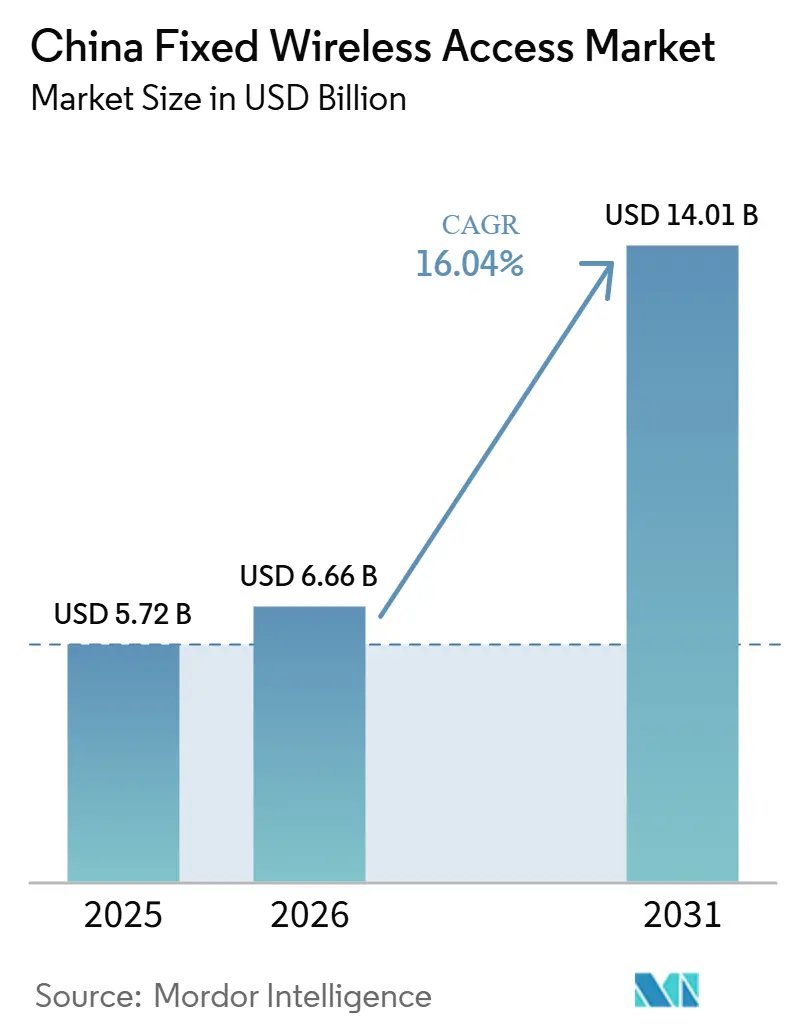
The China Fixed Wireless Access Market size is projected to expand from USD 5.72 billion in 2025 and USD 6.66 billion in 2026 to USD 14.01 billion by 2031, registering a CAGR of 16.04% from 2026 to 2031. The China fixed wireless access market is expanding on the back of two parallel needs: broader digital access in rural counties and stronger enterprise-grade connectivity in urban and industrial locations. The country’s large base of fixed broadband subscribers and its dense 5G network footprint gave operators a practical foundation for scaling wireless last-mile access without relying solely on new fiber construction. That network depth also improved the operating case for semi-urban and peri-urban deployments, where trenching costs can undermine the economics of full-fiber expansion. The China fixed wireless access market is also benefiting from faster device upgrades, localized supply chains, and service models that combine connectivity with managed performance commitments. At the same time, strong fiber penetration in dense cities continues to limit conversion potential in the most saturated urban pockets, which keeps competitive focus on selective use cases rather than blanket substitution.
Key Report Takeaways
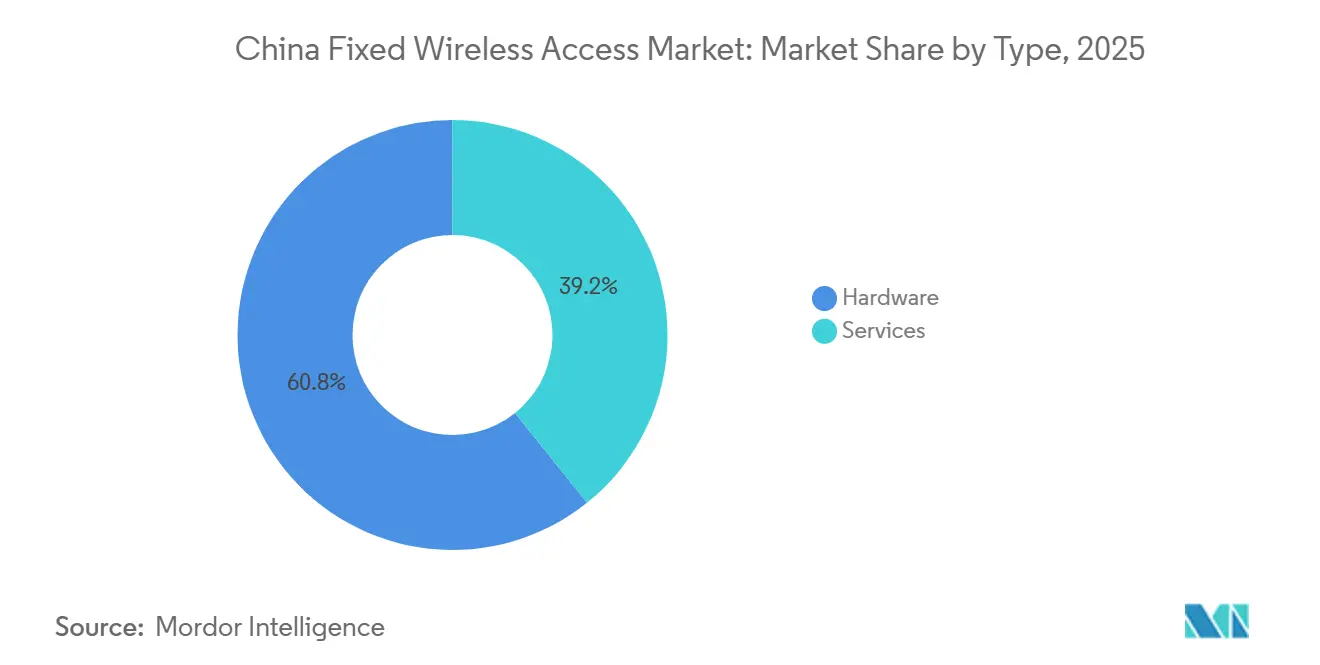
- By type, hardware held 60.76% of revenue share in the China fixed wireless access market in 2025, while services are projected to expand at a 16.86% CAGR through 2031.
- By application, residential connections accounted for 64.22% of revenue share in the China fixed wireless access market in 2025, while government and public safety are projected to expand at a 16.98% CAGR through 2031.
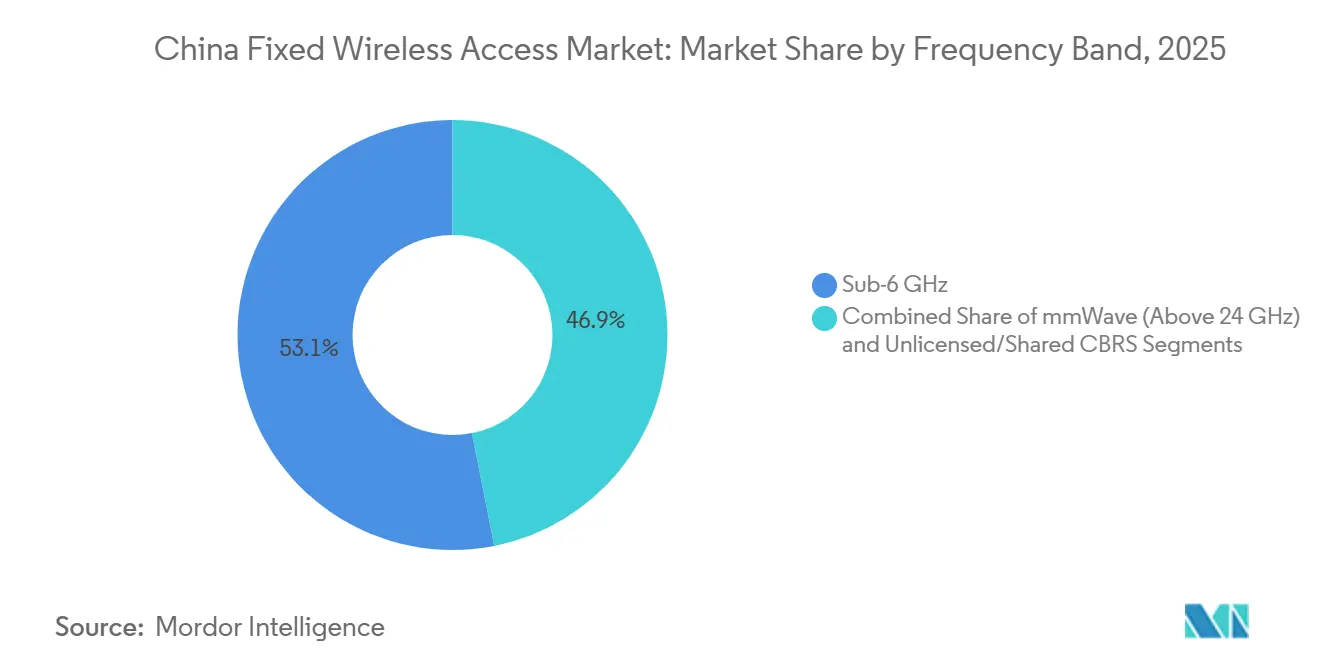
- By frequency band, sub-6 GHz held 53.11% of revenue share in the China fixed wireless access market in 2025, while mmWave is projected to grow at a 17.12% CAGR through 2031.
- By deployment mode, indoor CPE captured 63.12% of revenue share in the China fixed wireless access market in 2025, while self-install window-mount CPE is projected to advance at a 17.76% CAGR through 2031.
Note: Market size and forecast figures in this report are generated using Mordor Intelligence’s proprietary estimation framework, updated with the latest available data and insights as of January 2026.
China Fixed Wireless Access Market Trends and Insights
Drivers Impact Analysis*
| Driver | (~) % Impact on CAGR Forecast | Geographic Relevance | Impact Timeline |
|---|---|---|---|
| 5G and 5G-Advanced Rollout Expanding Gigabit-Class FWA Coverage | +5.5% | National, with dense deployment in eastern provinces and select western tier-2 cities | Medium term (2-4 years) |
| County-Level Broadband Economics Favor Wireless Last Mile Over Full Fiber Buildout | +3.5% | Rural and semi-urban regions, particularly western and central provinces | Short term (≤ 2 years) |
| AI-Driven Uplink Demand Increasing the Value of Deterministic Home and Enterprise Broadband | +2.5% | Coastal megalopolises, Yangtze River Delta, Pearl River Delta | Medium term (2-4 years) |
| Enterprise Backup Connectivity Demand From Retail, Logistics, and Branch Networks | +1.5% | National, with early gains in logistics hubs, Shanghai, Guangzhou, Chengdu | Short term (≤ 2 years) |
| Domestic CPE, Chipset, and RAN Localization Shortening Deployment Cycles and Lowering Unit Costs | +1.5% | National | Short term (≤ 2 years) |
| Flexible Pricing and Bundling By Operators Improving FWA Adoption | +1.0% | National | Short term (≤ 2 years) |
| Source: Mordor Intelligence | |||
5G and 5G-Advanced Rollout Expanding Gigabit-Class FWA Coverage
China’s 3 major telecom operators had already extended 5G-Advanced services across more than 300 cities by mid-2025, and more than 30 provincial-level regions had introduced related service plans with over 10 million users enrolled. That rollout matters for the China fixed wireless access market because gigabit-class wireless performance makes the service more credible for homes and businesses that previously defaulted to fiber. Once that performance threshold is met, operators can position FWA on service tier and reliability rather than only on price. The migration path also supports stronger refresh demand for higher-specification customer premises equipment, especially as newer platforms move into broader production cycles. It also gives operators room to align broadband expansion with local digital infrastructure projects, which improves the return profile of shared network investments. The result is a stronger commercial case for premium FWA plans in both semi-urban households and enterprise locations.
County-Level Broadband Economics Favor Wireless Last Mile Over Full Fiber Buildout
Rural broadband users in China reached 204 million by the end of 2025, and China Mobile stated that its dual-gigabit-per-township initiative had already reached all township-level administrative units ahead of schedule.[1]China Mobile Communications Group, “Digital Village ‘Five New Upgrades’ Action Plan,” Sina Finance, finance.sina.com.cn That coverage base changed the economics of the China fixed wireless access market in areas where mountain passes, river valleys, and scattered settlements make trenching expensive and slow. When existing 5G base stations can serve last-mile broadband demand, operators avoid most civil works and speed up subscriber activation. Xinhua also reported that the 15th Five-Year Plan agenda continued to emphasize signal upgrades in rural and border regions, which supports ongoing demand for outdoor CPE and access equipment.[2]Xinhua News Agency, “Signal Over Mountains and Seas, 15th Five-Year Plan Period Network Upgrade Plans,” Xinhua News Agency, news.cn In practice, this keeps FWA attractive in counties where tower assets are already in place, and user density is too low to justify fresh fiber buildouts. It also shifts capital allocation toward wireless expansion in townships where payback periods depend on low incremental connection costs.
AI-Driven Uplink Demand Increasing the Value of Deterministic Home and Enterprise Broadband
Consumer and business traffic patterns are no longer centered only on downloads, because live streaming, connected surveillance, cloud rendering, and AI-enabled workloads increasingly depend on stronger uplink performance. China Mobile has already packaged 5G-Advanced high-uplink plans for short-video creators and live streamers who pay more for stable uplink speeds. That shift gives the China fixed wireless access market a clearer role in use cases where symmetric or uplink-heavy traffic matters more than simple access speeds. In the enterprise setting, on-premise AI inference and hosted applications are raising interest in service-level-backed uplink capacity without the cost and delay of dedicated fiber. As operators gain better application-aware traffic management inside newer FWA platforms, they can sell performance stability as part of the offer rather than treat wireless broadband as a lower-tier substitute. This makes FWA more relevant for creators, branch offices, and connected premises that need predictable performance at the edge.
Enterprise Backup Connectivity Demand From Retail, Logistics, and Branch Networks
Business continuity needs have become more important for retail chains, logistics networks, and multi-site service firms that cannot tolerate even short fixed-line disruptions. That has increased the value of secondary wireless links that can switch quickly in dual-WAN architectures and restore service without new civil works. China Mobile International’s first 5G private network smart factory project in France demonstrated that enterprise-grade wireless connectivity was already delivering measurable operating benefits, including nearly 30% improvement in production efficiency and nearly 50% reduction in labor costs for the client.[3]State-owned Assets Supervision and Administration Commission, “China Mobile Delivers Groundbreaking 5G Smart Factory in France,” State-owned Assets Supervision and Administration Commission, en.sasac.gov.cn In June 2026, 5 Chinese government ministries also announced a national industrial 5G private network expansion plan, which widened the spending case across manufacturing and logistics clusters. In the China fixed wireless access market, policy direction supports backup and managed access links that sit alongside existing fixed infrastructure rather than replacing it everywhere. It also broadens demand beyond homes into distributed commercial estates, where service resilience delivers direct operating value.
Restraints Impact Analysis*
| Restraint | (~) % Impact on CAGR Forecast | Geographic Relevance | Impact Timeline |
|---|---|---|---|
| FTTR and Fiber Price Compression Reducing FWA Conversion in Dense Urban Areas | -1.8% | Tier-1 cities, Beijing, Shanghai, Shenzhen, Guangzhou | Short term (≤ 2 years) |
| Mid-Band Spectrum Coordination and Planning Constraints in High-Density Cities | -1.0% | Urban cores of tier-1 and tier-2 cities | Medium term (2-4 years) |
| Power, Thermal, and Installation Constraints for Outdoor and High-Gain CPE in Large-Scale Rollout | -0.7% | National, with acute impact in western mountainous regions | Short term (≤ 2 years) |
| Rain Fade and Obstruction Losses in Higher Frequency Deployments | -0.4% | Southern coastal provinces, Guangdong, Fujian, Guangxi, and mmWave deployments | Long term (≥ 4 years) |
| Source: Mordor Intelligence | |||
FTTR and Fiber Price Compression Reducing FWA Conversion in Dense Urban Areas
China’s urban broadband base remained heavily fiber-saturated, and FTTR users reached 59.39 million by the end of 2025. That installed base limits how far the China fixed wireless access market can convert existing urban subscribers, because bundled FTTR packages already come with low switching appeal in tier-1 cities. In dense apartment clusters, professional fiber installation and mature operator bundles continue to reduce the urgency to shift core household access to wireless. Fiber cost inflation did provide some relief at the project level, with G.652D single-mode fiber rising from CNY 20 (already shown as USD 2.76 in the input) to above CNY 50 (already shown as USD 6.90 in the input) per fiber-kilometer between mid-2025 and early 2026. Even so, that mainly affects new greenfield builds and does not weaken the position of already connected fiber subscribers. As a result, urban FWA remains strongest in temporary setups, new complexes, and enterprise backup scenarios rather than mass migration from established fiber lines.
Mid-Band Spectrum Coordination and Planning Constraints in High-Density Cities
Mid-band holdings in China’s urban cores must support mobile broadband, private enterprise networks, FWA traffic, and 5G-Advanced feature layers simultaneously. That makes spectrum planning more difficult in high-density areas where multiple services compete for the same radio resources. The China fixed wireless access market, therefore, faces a structural limit in cities where carrier aggregation pools are shared, and congestion management affects latency consistency. The operating challenge is not only technical, because FWA capacity is not licensed independently and must sit within broader operator mobile allocations. China Unicom’s large-scale 5G-Advanced certification trial at Beijing’s Workers’ Stadium illustrated both the potential of dense multi-service networks and the complexity of coexistence planning in those settings. As network densification continues, urban FWA growth will depend more on granular cell-level planning, service prioritization tools, and tighter traffic control than on simple coverage expansion.
*Our forecasts treat driver/restraint impacts as directional, not additive. The impact forecasts reflect baseline growth, mix effects, and variable interactions.
Segment Analysis
By Type: Hardware Dominance Sustained As Services Scale Rapidly
Hardware accounted for 60.76% of the market in 2025, reflecting strong demand for CPE and access units as operators expanded 5G-based last-mile coverage. The hardware layer remained the main revenue anchor for the China fixed wireless access market, as residential, enterprise, and government deployments all required device-side upgrades before service monetization could deepen. CPE shipments covered indoor sub-6 GHz devices, outdoor high-gain units, and window-mount formats, while access units supported densification and last-mile backhaul across operator networks. ZTE strengthened that performance benchmark in March 2026 when it launched the G6 Ultra and G6 Max, described as the first 5G-Advanced devices with Wi-Fi 8 and peak throughputs of 10 Gbps and 12.5 Gbps. Those launches matter because they raise the expected specification level for the next phase of operator procurement. They also support stronger pricing power at the premium end, even as broader hardware competition intensifies.
Services are projected to grow at a 16.86% CAGR through 2031, making them the faster-moving part of the China fixed wireless access industry. That growth shows that the market is shifting from a pure equipment cycle to a more recurring service model built around managed performance and support. Operator-managed offers increasingly combine remote firmware control, quality-of-service tuning, and service-level-backed uplink commitments for enterprise and public-sector users. China Unicom and ZTE moved further in that direction in June 2026 with the UniMAX 1.0+ launch, which positioned 5G-Advanced deterministic connectivity as a managed enterprise service. As hardware becomes easier to compare across vendors, service layering becomes more important for differentiation. That supports more stable revenue visibility for operators and reduces the risk of simple device commoditization over time.


By Application: Residential Scale Enables Enterprise and Public Safety Momentum
Residential connections accounted for 64.22% of the China fixed wireless access market in 2025, indicating that household demand remained the largest installed base for the category. This lead came mainly from rural and semi-urban households, where wireless access still played a primary role rather than a backup one. China Mobile’s township-level 5G and gigabit broadband coverage milestone established the radio footprint needed for this residential-scale-up before the market entered its current growth phase. The residential segment also benefited from plug-and-play device formats that lowered installation friction and improved adoption among users who preferred quick activation. That made the China fixed wireless access market more volume-driven at the consumer level, even while urban fiber competition remained strong.
Government and public safety are projected to grow at a 16.98% CAGR through 2031, making them the fastest-growing application area. Emergency response, border surveillance, transport monitoring, and utility oversight all require resilient access that can be deployed faster than wired alternatives in mobile or time-sensitive scenarios. In June 2026, 5 ministries formally included public safety and critical infrastructure connectivity within the industrial 5G private network expansion framework. That policy support should strengthen procurement for outdoor CPE, redundant radio paths, and managed connectivity packages built for continuity and uptime. Commercial users also remain important, especially for retail, hospitality, and small-business campuses that want backup links alongside primary fiber. Industrial users still account for a smaller share, yet their role is rising in smart manufacturing and automated logistics environments, where deterministic wireless links are increasingly valuable.
By Frequency Band: Sub-6 GHz Scale Anchors Today While mmWave Gains Precision Roles
Sub-6 GHz held 53.11% of the China fixed wireless access market share in 2025, which kept it at the center of current deployment economics. The segment’s lead reflected the broad-area coverage and indoor penetration advantages of 2.6 GHz and 3.5 GHz spectrum across rural townships and peri-urban districts. Those characteristics matter for households and small businesses that want reliable indoor performance without complex outdoor installation. They also better align with operator economics in low-density zones, because sub-6 GHz supports wider coverage footprints and more practical scaling from existing mobile assets. This is why the China fixed wireless access market continues to depend on sub-6 GHz as its main coverage foundation, even as premium use cases evolve. It also explains why basic indoor CPE remains viable in areas where coverage quality is already sufficient.
mmWave is projected to grow at a 17.12% CAGR through 2031, which makes it the fastest-expanding frequency segment. Its role is more targeted than sub-6 GHz, because it fits enterprise campuses, stadiums, venues, and fixed transport links that need multi-gigabit throughput. ZTE’s G6 Max demonstrated this commercial direction by supporting 800 MHz of mmWave and 400 MHz of sub-6 GHz aggregation for a 12.5 Gbps peak rate. Ericsson also stated that global FWA connections are expected to rise from 185 million at the end of 2025 to 350 million by the end of 2031, with strong 5G mid-band and mmWave execution shaping the fastest-growing markets. In China, that suggests mmWave will move first through high-value, precision use cases rather than nationwide mass coverage. Unlicensed and shared CBRS remained a small opportunity area, mostly tied to industrial park interest in private wireless models with lower spectrum overhead.

By Deployment Mode: Indoor Volumes Lead While Self-Install Economics Gain Ground
Indoor CPE accounted for 63.12% of the market in 2025, indicating that plug-and-play formats still anchored most active deployments. That share reflected the preferences of households and smaller businesses seeking simple installation and smooth integration with existing Wi-Fi networks. Indoor devices also enabled the broadest immediate scale in the China fixed wireless access market by reducing friction at the point of purchase and activation. In May 2026, ZTE launched the G5 Pro 5G AI CPE mobile router in China at CNY 2,099, which was already shown as USD 289 in the input, with Wi-Fi 7, Multi-Link Operation, and dual 2.5G ethernet ports. That launch reflects the product direction for indoor upgrades, where device capability is increasingly tied to whole-home wireless expectations rather than simple internet access alone.
Self-install window-mount CPE is projected to grow at a 17.76% CAGR through 2031, making it the fastest-moving deployment mode. It eliminates technician visits, lowers operator rollout costs, and still improves antenna performance through window-facing placement. This format is particularly useful in rural provinces and semi-urban districts where installation logistics can slow subscriber activation and weaken margins. Fibocom reinforced that opportunity in October 2025 when it launched a broader 5G FWA portfolio across modules, indoor CPE, outdoor ODU, and mobile hotspot designs based on Qualcomm X85 and X82 modems. Outdoor CPE will still matter where building materials, distance, and terrain weaken indoor signal quality, especially on industrial sites and in mountainous counties. Even so, self-install formats stand out because they improve unit economics without forcing operators to compromise too much on service quality.
Geography Analysis
China’s eastern and coastal provinces accounted for the highest-value revenue zone in the China fixed wireless access market in 2025, as enterprise density, logistics infrastructure, and high-value service activity were concentrated there. In the Yangtze River Delta, the Pearl River Delta, and the Beijing-Tianjin-Hebei corridor, FWA typically served as a backup layer or supplemental link rather than a full-fiber replacement. China Unicom’s 2025 annual results showed near-90% gigabit-ready broadband port penetration and 5G-Advanced deployments in more than 300 cities, which supports the strength of the infrastructure base in these regions. That environment favored commercial and industrial connectivity packages in which downtime incurs a direct operating cost. It also kept pricing power stronger in enterprise accounts than in mass urban households, because reliability and continuity mattered more than simple access substitution.
Western and central provinces showed a different demand pattern, because the China fixed wireless access market often served as the primary broadband route rather than a secondary connection in these areas. In provinces such as Sichuan, Guizhou, Yunnan, Gansu, and Guangxi, wireless access remained more practical, where terrain and distance made the expansion of fixed infrastructure harder to justify. Xinhua reported that the 15th Five-Year Plan period would continue to support network upgrades in rural and border regions, helping reduce investment risk for operators expanding into lower-ARPU locations. This policy supports sustained demand for outdoor CPE and access units, and localized supply chains that can serve remote deployments more efficiently. It also strengthened the case for aligning public funding with coverage obligations in difficult service areas.
Northeastern provinces and the central plains formed a middle tier, where the China fixed wireless access market benefited from gradual digitization in agricultural and manufacturing supply chains. CNNIC stated that China’s mobile internet traffic reached 395.8 billion GB in 2025, while rural internet users numbered 322 million and penetration reached 69.2% as of June 2025. That rising traffic base strengthened the case for broader FWA investment beyond the most developed coastal clusters. These provinces also showed growing relevance for agri-tech and industrial applications that needed dependable wireless links for monitoring, automation, and connected operations. As a result, geographic growth in China is not driven by a single regional model, because mature coastal enterprise demand and coverage-led adoption in the inland are advancing for different reasons at the same time.
Competitive Landscape
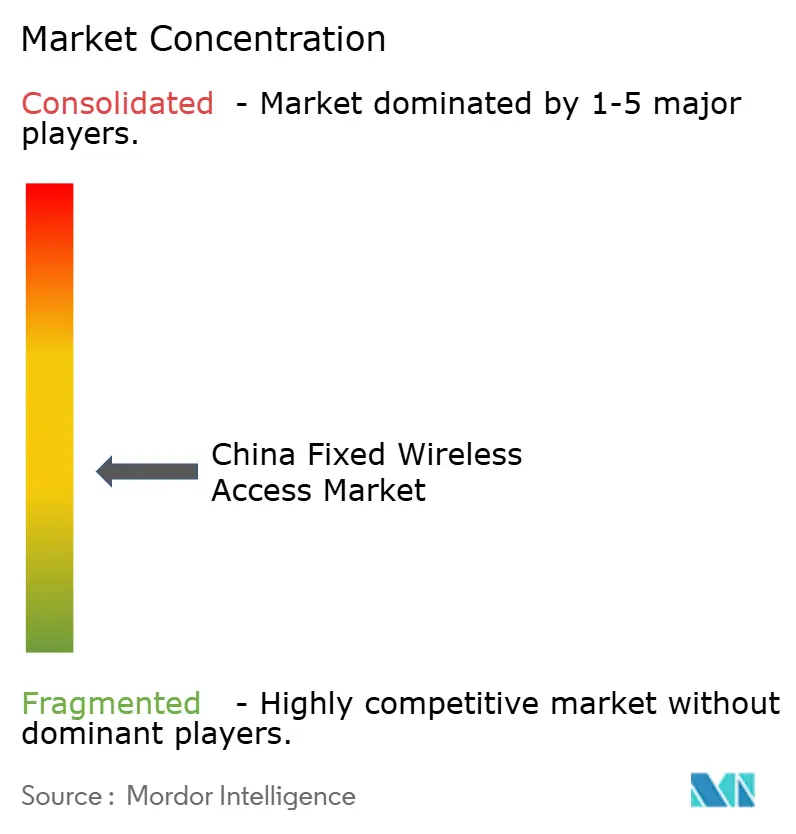
The China fixed wireless access market showed a moderately concentrated structure in 2026, with Huawei Technologies and ZTE Corporation anchoring the hardware tier through deep ties to domestic operator procurement systems. ZTE stated that it had held the global number-one position in FWA and mobile broadband markets for 5 consecutive years and had shipped more than 300 million cumulative units worldwide. That scale matters in China because it improves production economics, shortens design cycles, and supports faster rollout across multiple device formats. Huawei remained equally important at the strategic level because its device, network, and service capabilities allowed it to compete beyond CPE into broader access architecture and service management layers. FiberHome, H3C, and Datang continued to form the next tier of domestic providers, especially in operator rollouts outside the most premium contracts. Module and IoT specialists such as Fibocom Wireless, Quectel Wireless Solutions, and Meig Smart Technology also held meaningful positions in enterprise and specialized connectivity niches.
Competition is now moving beyond radio specifications into service quality, integration depth, and the ability to support differentiated connectivity tiers. Huawei’s Next Generation FAN solution, introduced in March 2026, was built around device-edge-cloud coordination and targeted smart home, enterprise campus, and rural broadband scenarios. That move showed that leading vendors were trying to build value above the access device itself through automation and intelligence. ZTE and China Unicom made a similar strategic move with UniMAX 1.0+, which framed 5G-Advanced deterministic connectivity as a managed service rather than only a hardware-driven product. These steps matter because they widen the competitive field from procurement price to operational outcomes. They also improve the position of vendors that can support networks, devices, analytics, and lifecycle management together.
The market still leaves room for secondary and white-label suppliers, especially when operators want sourcing diversity or when government procurement prioritizes local supply resilience. Smaller contenders such as Sercomm, Arcadyan, and Askey were active in ODM and white-label volumes for buyers who did not want to rely solely on the Huawei-ZTE pairing. Localization also added a strategic layer, with domestically sourced chipsets and components gaining relevance in procurement discussions tied to supply security. That trend helped open space for newer domestic technology combinations in specialized channels rather than only in mainstream volume contracts. The effect is not a fragmented free-for-all, because leading vendors still carry scale and integration advantages that smaller players cannot easily match. However, it does mean the China fixed wireless access market is broad enough to support a clear second tier in modules, ODM design, and targeted enterprise deployments.
China Fixed Wireless Access Industry Leaders
Huawei Technologies Co., Ltd.
ZTE Corporation
China Mobile Limited
China Telecom Corporation Limited
Ruijie Networks Co., Ltd.
- *Disclaimer: Major Players sorted in no particular order

Recent Industry Developments
- June 2026: China Unicom and ZTE Corporation jointly released the UniMAX 1.0+ ubiquitous deterministic connectivity solution at MWC Shanghai 2026, encompassing 5G-A and AI-native network capabilities, and simultaneously launched a joint innovation demonstration zone in Henan province. The solution offered enterprises guaranteed uplink throughput and sub-millisecond latency management across shared 5G networks, advancing the managed FWA services tier.
- June 2026: 5 Chinese government ministries, including the Ministry of Industry and Information Technology and the National Development and Reform Commission, announced a national pilot expansion plan for industrial 5G private and dedicated networks. The initiative covered manufacturing clusters, port logistics, and critical infrastructure, all high-value FWA enterprise connectivity segments, and was expected to drive multi-billion yuan procurement cycles through 2029.
- May 2026: China’s Ministry of Industry and Information Technology approved trial spectrum in the 6 GHz band for 6G technology development, granted to the IMT-2030 promotion group for testing in selected regions. While the approval targeted 6G RandD, the 6 GHz band identification also validated mid-band spectrum continuity for FWA platforms transitioning toward next-generation standards from 2030 onward.


China Fixed Wireless Access Market Report Scope
The China fixed wireless access (FWA) market's revenue is generated through the sale of FWA hardware, including customer premises equipment (CPE) and access units, as well as recurring subscription fees, installation and activation services, managed connectivity services, maintenance, and network support provided by fixed wireless service providers operating across Sub-6 GHz, mmWave, and CBRS frequency bands. The China fixed wireless access market report is segmented by type (hardware and services), application (residential, commercial, industrial, and government and public safety), frequency band (Sub-6 GHz, mmWave (above 24 GHz), and unlicensed/shared CBRS), and deployment mode (indoor CPE, outdoor CPE, and self-install window-mount CPE). The market forecasts are provided in value (USD).
| Hardware | Consumer Premise Equipment (CPE) |
| Access Units (Femto and Picocells) | |
| Services |
| Residential |
| Commercial |
| Industrial |
| Government and Public Safety |
| Sub-6 GHz |
| mmWave (Above 24 GHz) |
| Unlicensed/Shared CBRS |
| Indoor CPE |
| Outdoor CPE |
| Self-Install Window-Mount CPE |
| By Type | Hardware | Consumer Premise Equipment (CPE) |
| Access Units (Femto and Picocells) | ||
| Services | ||
| By Application | Residential | |
| Commercial | ||
| Industrial | ||
| Government and Public Safety | ||
| By Frequency Band | Sub-6 GHz | |
| mmWave (Above 24 GHz) | ||
| Unlicensed/Shared CBRS | ||
| By Deployment Mode | Indoor CPE | |
| Outdoor CPE | ||
| Self-Install Window-Mount CPE |


Key Questions Answered in the Report
What is the 2026 size of the China fixed wireless access space?
The China fixed wireless access market was estimated at USD 6.66 billion in 2026 and is projected to reach USD 14.01 billion by 2031 at a 16.04% CAGR.
What is driving growth in China fixed wireless access through 2031?
Growth is being supported by 5G-Advanced rollout, favorable rural last-mile economics, rising uplink demand from AI-enabled use cases, and enterprise demand for backup connectivity.
Which type category leads revenue in China fixed wireless access?
Hardware led in 2025 with a 60.76% share, supported by strong CPE and access unit procurement tied to operator rollout activity.
Which application area is growing the fastest in China fixed wireless access?
Government and public safety is projected to grow the fastest, with a 16.98% CAGR through 2031, supported by critical infrastructure and resilient connectivity needs.
Why does sub-6 GHz remain important even as mmWave grows?
Sub-6 GHz held 53.11% of the market in 2025 because it offers wider coverage and better indoor performance, while mmWave is growing faster in high-capacity enterprise and venue use cases.
Which deployment mode is expanding the fastest in China fixed wireless access?
Self-install window-mount CPE is projected to grow the fastest at a 17.76% CAGR, mainly because it lowers operator installation costs while improving signal quality versus standard indoor devices.
Page last updated on:





