
China Enterprise Content Management (ECM) Market Size and Share
Market Overview
| Study Period | 2020 - 2031 |
|---|---|
| Forecast Data Period | 2026 - 2031 |
| Base Year Market Size (2025) | USD 3.43 Billion |
| Market Size (2026) | USD 3.88 Billion |
| Market Size (2031) | USD 7.58 Billion |
| Growth Rate (2026 - 2031) | 14.33% CAGR |
| Market Concentration | Medium |
Major Players *Disclaimer: Major Players sorted in no particular order Image © Mordor Intelligence. Reuse requires attribution under CC BY 4.0. | |
China Enterprise Content Management (ECM) Market Analysis by Mordor Intelligence
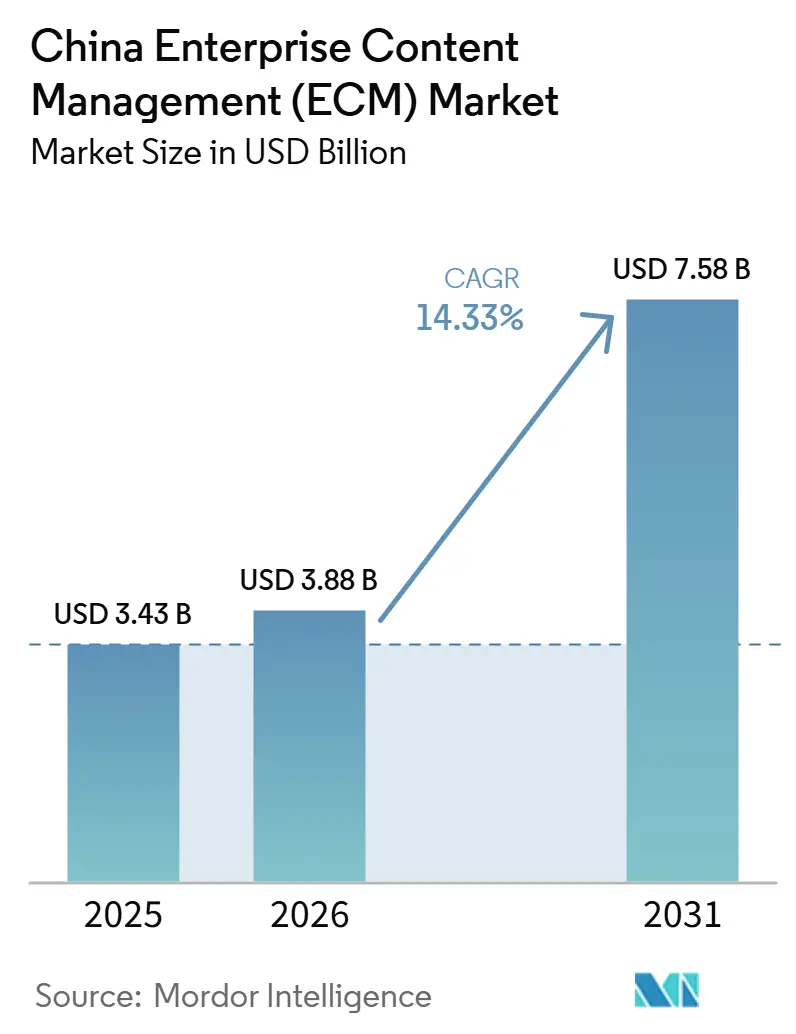
The China Enterprise Content Management (ECM) Market size is projected to be USD 3.43 billion in 2025, USD 3.88 billion in 2026, and reach USD 7.58 billion by 2031, growing at a CAGR of 14.33% from 2026 to 2031. Growth is being supported by a large backlog of paper records, wider use of digital workflows, and stronger demand for auditable information control. AI is changing buying criteria because enterprises now expect classification, search, deduplication, and workflow support within a single platform. Compliance rules are also making content governance a more urgent issue in banking, healthcare, government, and other regulated settings. Domestic cloud and productivity vendors are moving quickly with localized deployments and AI-led products, while global suppliers are leaning on integration depth and compliance features. The next phase of growth in the China Enterprise Content Management (ECM) Market is likely to come from buyers that need faster deployment, local hosting, and simpler migration from older repositories.
Key Report Takeaways
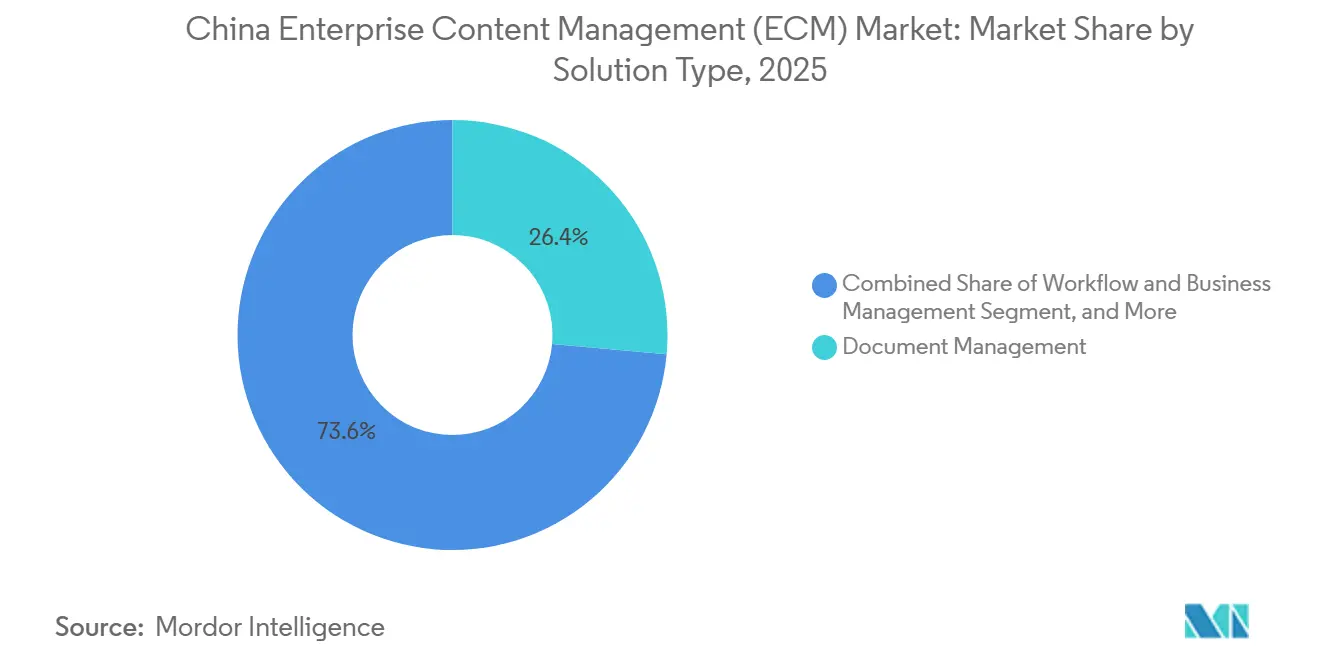
- By solution type, Document Management held 26.42% of China Enterprise Content Management (ECM) market share in 2025, while Workflow and Business Process Management is forecast to expand at a 16.94% CAGR through 2031.
- By deployment mode, Cloud accounted for 71.28% of the China Enterprise Content Management (ECM) market size in 2025 and is advancing at a 17.31% CAGR through 2031.
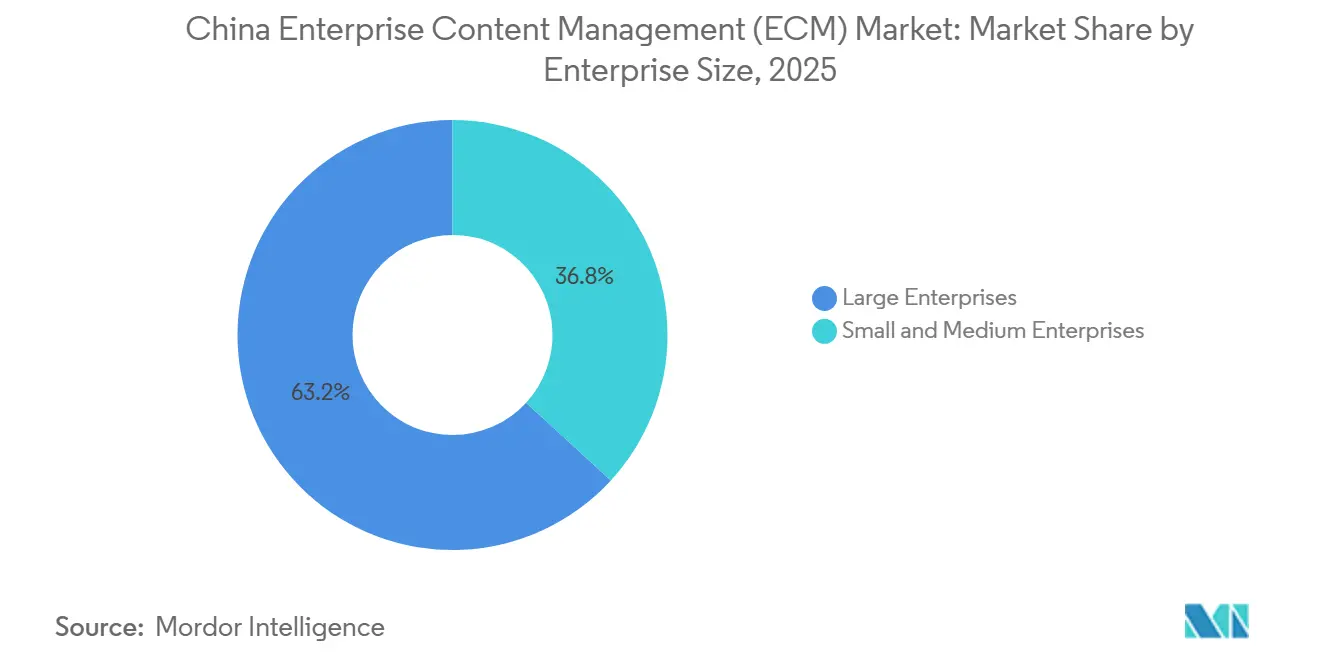
- By enterprise size, Large Enterprises held 63.18% of the China Enterprise Content Management (ECM) market share in 2025, while SMEs are projected to grow at a 16.57% CAGR through 2031.
- By end-user industry, Manufacturing accounted for 24.16% of the China Enterprise Content Management (ECM) market size in 2025, while Healthcare is forecast to expand at a 17.82% CAGR through 2031.
Note: Market size and forecast figures in this report are generated using Mordor Intelligence’s proprietary estimation framework, updated with the latest available data and insights as of January 2026.
China Enterprise Content Management (ECM) Market Trends and Insights
Drivers Impact Analysis*
| Driver | (~) % Impact on CAGR Forecast | Geographic Relevance | Impact Timeline | |
|---|---|---|---|---|
| Accelerating Digital Records Migration | +3.1% | National, with early gains in Beijing, Shanghai, Guangdong, and Zhejiang | Medium term (2-4 years) | |
| AI-Driven Content Classification and Retrieval | +2.9% | APAC core, with concentration in Tier-1 and Tier-2 cities | Medium term (2-4 years) | |
| Cloud-First Enterprise Software Procurement | +2.7% | National, accelerated by public support in central and western regions | Short term (≤ 2 years) | |
| Regulatory Demand for Audit-Ready Information Retention | +2.3% | National, with BFSI and government sector as early anchors | Medium term (2-4 years) | |
| Workflow Automation for High-Volume Document Operations | +1.8% | Manufacturing corridors in the Yangtze River Delta and Pearl River Delta | Medium term (2-4 years) | |
| Cross-Platform Integration With ERP, CRM, and Case Systems | +1.2% | National, skewed toward large enterprises with established ERP stacks | Long term (≥ 4 years) | |
| Source: Mordor Intelligence | ||||
Accelerating Digital Records Migration in Chinese Enterprises
Chinese enterprises still carry a large volume of paper-heavy records that limit access, slow response times, and increase retention risk. This pressure is strongest in regulated fields such as banking, energy, and pharmaceuticals, where archive volumes often stretch across many years. Migration work is therefore becoming a practical buying trigger, not just a modernization project. It also underscores the importance of capture, scanning, indexing, and metadata preparation, as these steps determine how useful digitized content will be after migration. Vendors that can pair repository control with faster ingest and better industry-specific document structures are likely to benefit as the China Enterprise Content Management (ECM) Market expands.
AI-Driven Content Classification and Retrieval Efficiency
AI is shifting the role of enterprise content systems from storage toward active decision support. Buyers now expect platforms to classify files, detect duplication, flag conflicts, and surface relevant content without long manual review cycles. WPS 365’s Smart Document Library upgrade in January 2026 reported 95% duplicate-detection accuracy and 80% conflict-identification accuracy, demonstrating how content control is becoming more operational in daily work. This change matters in the China Enterprise Content Management (ECM) Market because Chinese-language business records, procurement files, and regulatory documents require robust local-language support. IBM’s November 2025 preview of its Core Content Services MCP Server also showed that global vendors are linking AI models directly to content repositories, raising the bar for AI-ready information management.
Cloud-First Enterprise Software Procurement
Cloud buying has become the default path for many enterprise software decisions in China, and that shift is supporting the China Enterprise Content Management (ECM) Market. Buyers want faster rollout, simpler upgrades, and lower infrastructure overhead than traditional on-premises projects usually allow. At the same time, regulated organizations are not moving toward one common cloud model. Many still prefer private managed environments or hybrid structures that give them stronger operational control over content and access rules. Recent product launches and deployment strategies from both domestic and global suppliers show that controlled cloud adoption, not pure public cloud standardization, is shaping the next stage of demand.
Regulatory Demand for Audit-Ready Information Retention
The compliance burden on enterprise content operations rose in 2025 and 2026, and that is creating durable demand across the China Enterprise Content Management (ECM) Market. China’s Network Data Security Management Regulations require data classification, protection measures, and risk controls, which push enterprises toward more structured retention and audit trails. This makes content systems more central to business operations, as records must be retrievable, traceable, and governed throughout their full life cycle. In healthcare, the National Healthcare Insurance Administration stated in December 2025 that the Medical Insurance Imaging Cloud had connected 31 provinces and had accumulated more than 170 million imaging index records, demonstrating the scale of content that now requires enterprise-grade control. As a result, enterprises are placing more value on retention engines, permissions, audit logs, and workflow controls rather than viewing content repositories as passive storage.
Restraints Impact Analysis*
| Restraint | (~) % Impact on CAGR Forecast | Geographic Relevance | Impact Timeline |
|---|---|---|---|
| Complex Localization and Data Residency Requirements | -0.5% | National, most acute for multinationals and cross-border data handlers | Short term (≤ 2 years) |
| High Switching Costs From Legacy Document Repositories | -0.4% | National, concentrated in state-owned enterprises and large financial institutions | Long term (≥ 4 years) |
| Cybersecurity and Sensitive Data Exposure Risks | -0.4% | National, highest sensitivity in BFSI, healthcare, and government | Medium term (2-4 years) |
| Fragmented Buyer Readiness Across Mid-Market Enterprises | -0.3% | Central and western China, manufacturing clusters, and lower-tier cities | Medium term (2-4 years) |
| Source: Mordor Intelligence | |||
Complex Localization and Data Residency Requirements
Localization remains a meaningful barrier in the China Enterprise Content Management (ECM) Market because data governance rules affect architecture, hosting, and release management. Foreign suppliers often need separate local environments, tighter data segregation, and China-specific operating practices to compete effectively. That adds cost and can slow the rollout of new features when compared with their global product cycles. Domestic vendors have a clearer path in these situations because their platforms are already aligned with local deployment expectations. The launch of the WPS Xinhua Intelligent Security Version for government office use in May 2026 highlights how fully localized stacks are being positioned as a practical advantage in sensitive environments.
High Switching Costs from Legacy Document Repositories
Legacy repositories remain one of the strongest sources of friction in the China Enterprise Content Management (ECM) Market. Large institutions often have years of custom workflows, archive rules, and system links tied to older on-premises environments. That means a migration project can affect compliance files, HR records, procurement content, and transaction histories simultaneously. Industrial Bank’s December 2025 disclosure on the deployment of its digital archive system for Huawei Securities shows that enterprise-grade archive infrastructure can take years to build and extend, even for capable institutions. This is one reason many vendors see faster wins in greenfield or lightly digitized accounts than in large replacement projects.
*Our forecasts treat driver/restraint impacts as directional, not additive. The impact forecasts reflect baseline growth, mix effects, and variable interactions.
Segment Analysis
By Solution Type: Document Management Anchors a Workflow-Driven Expansion
Document Management accounted for 26.42% of the China Enterprise Content Management (ECM) Market in 2025, making it the largest solution category. It remains the starting point for many buyers because version control, central storage, and file access rules are usually the first steps in formal content governance. This leadership also reflects a common purchase path in which enterprises stabilize documents first, then move to broader retention, review, and process control. Records Management and Web Content Management usually expand after that first layer is in place, especially when compliance or publishing needs become harder to manage manually.
Workflow and Business Process Management is projected to grow at a 16.94% CAGR through 2031, making it the fastest-moving solution segment in the China Enterprise Content Management (ECM) Market. Demand is rising because enterprises want approvals, reviews, and content-based decisions to move faster across departments. Digital Asset Management and Case Management remain smaller but important layers, with Digital Asset Management gaining relevance where enterprises handle media libraries and branded files, while Case Management matters more in government, legal, and healthcare settings. The wider pattern is that buyers now expect content systems to support review paths, retention logic, AI-supported search, and better visibility across teams rather than function as stand-alone repositories. IBM’s 2025 MCP Server preview reflects this direction because it links AI models with document and metadata operations, helping turn stored content into actionable workflow input.



By Deployment Mode: Cloud Dominance Coexists With a Sovereign-Private Hybrid Reality
Cloud accounted for 71.28% of the China Enterprise Content Management (ECM) Market in 2025 and is forecast to grow at a 17.31% CAGR through 2031. That combination shows that cloud adoption is still in an active expansion stage rather than a mature replacement cycle. Buyers are choosing cloud deployments because they reduce setup time, simplify updates, and enable broader access across distributed teams. The leading position of cloud in the China Enterprise Content Management (ECM) Market also reflects the fact that many new deployments are starting from digital workflow goals rather than from infrastructure ownership preferences.
The shape of demand is still more nuanced than a simple shift away from local infrastructure. Many enterprises in sensitive sectors are choosing controlled cloud models that support local hosting and tighter governance over access and data flow, while hybrid deployment remains relevant for organizations that need to separate sensitive records from broader collaboration content. On-premises environments still hold an important place in state-owned enterprises, government bodies, and security-sensitive organizations where physical isolation and internal control remain central to procurement. Global suppliers are adapting with sovereign and compliance-focused deployment strategies, while local suppliers are using domestic stacks to reduce trust barriers. In July 2025, a Guangxi smart archive platform developed with Huawei passed compatibility certifications for the Ascend AI and Kunpeng 920 architectures, demonstrating how infrastructure localization and content platform validation are increasingly linked.
By Enterprise Size: Large Enterprises Lead While SMEs Accelerate Into a Wider Adoption Window
Large Enterprises accounted for 63.18% of revenue in the China Enterprise Content Management (ECM) Market in 2025. Their lead reflects earlier spending on document control, compliance systems, and integration with major business software environments. These buyers usually plan content investments as part of broader multiyear transformation programs rather than as isolated software purchases. Large accounts are attractive because they offer broader platform scope across departments, business units, and archive types, but they also require deeper localization, tighter service support, and stronger links to ERP, HR, and financial platforms.
SMEs are forecast to expand at a 16.57% CAGR through 2031, making them the fastest-growing buyer group in the China Enterprise Content Management (ECM) Market. Smaller firms are increasingly reaching the point where basic cloud storage is no longer enough for approval flows, contract records, customer files, and internal controls. They usually prefer packaged platforms that are easier to deploy, manage, and price than large, custom projects, making the segment attractive to SaaS-focused suppliers with prebuilt workflows, templates, and guided migration. This shift is also changing the competitive mix because vendors no longer need the same level of consulting depth to win smaller accounts if onboarding is fast and the product is clear. A large part of future volume is therefore likely to come from solutions built for practical adoption rather than from the most feature-heavy platforms.
By End-User Industry: Manufacturing Commands Share While Healthcare Extends the Growth Lead
Manufacturing accounted for 24.16% of the China Enterprise Content Management (ECM) Market in 2025, making it the largest end-user segment. The sector generates a heavy stream of drawings, specifications, quality files, supplier records, and production-related approvals. Those documents move across engineering, procurement, compliance, and plant operations, so structured control becomes essential as scale rises. This makes manufacturing one of the clearest use cases for content systems that combine storage, lifecycle management, and workflow routing. The sector’s needs also explain why workflow and document control often advance together, while BFSI, government and public sector, and IT and telecommunications also remain strong demand centers because their document obligations are broad, recurring, and closely tied to compliance.
Healthcare is forecast to grow at a 17.82% CAGR through 2031, which makes it the fastest-growing end-user segment in the China Enterprise Content Management (ECM) Market. Hospitals and healthcare networks are dealing with rising volumes of electronic medical records, imaging files, and access-controlled information that cannot be managed efficiently through fragmented systems. The National Healthcare Insurance Administration said in December 2025 that the Medical Insurance Imaging Cloud had connected 31 provinces and had accumulated more than 170 million imaging index records, indicating the scale of structured content now moving through healthcare systems. Vendor activity also supports this direction, as Kingsoft Cloud’s August 2025 launch of a new-generation intelligent electronic medical record system was already operating across 3 major hospital campuses, more than 150 clinical departments, and over 8,000 patient visits per day. Retail, media and entertainment, and education remain smaller in total value, but they continue to support demand for digital asset and web content management use cases.
Geography Analysis
Eastern and coastal China accounted for the largest share of spending in the China Enterprise Content Management (ECM) Market in 2025. Beijing, Shanghai, Shenzhen, Hangzhou, and Guangzhou host a dense base of multinational firms, leading financial institutions, and technology-heavy manufacturers. These buyers tend to have more complex governance needs and a greater willingness to invest in integrated content platforms. They also move earlier in AI-enabled document workflows, keeping the region ahead of the national average.
Central China and inland manufacturing provinces are becoming the next important demand centers in the China Enterprise Content Management (ECM) Market. Provinces such as Hubei, Hunan, Sichuan, and Chongqing are seeing broader digitalization in industrial and energy operations. As those programs deepen, document control is becoming more closely tied to plant processes, approvals, and compliance handling. Western provinces still represent a longer-horizon opportunity, but public-sector digitalization is creating a more structured starting point for adoption. In April 2026, Xinhua reported that Zhongshan City’s WPS AI government platform covered 34,000 civil servants and had gathered 600,000 policy documents and work reports into a single repository, illustrating how city-level deployments can create meaningful content volumes and repeatable use cases.
Tier-3 and Tier-4 cities remain the most underpenetrated areas of the China Enterprise Content Management (ECM) Market. Smaller IT teams, tighter budgets, and lower awareness have historically slowed adoption outside the main commercial hubs. Even so, the spread of SaaS delivery, domestic support networks, and lower-friction implementation models is improving access. This suggests the geographic revenue mix should become broader during the forecast period, even if coastal China remains the largest center of demand.
Competitive Landscape
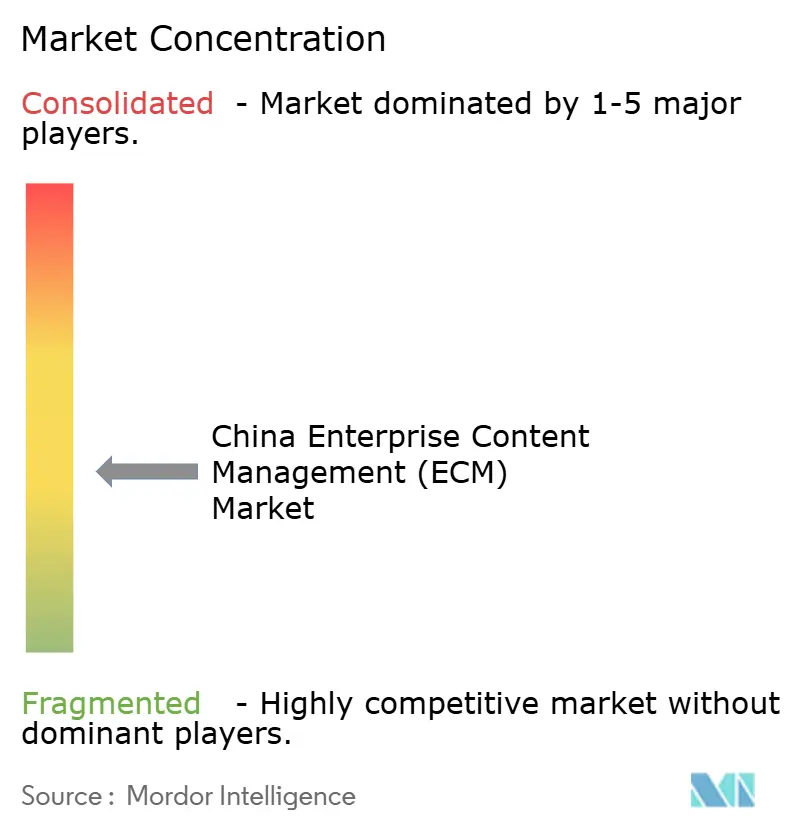
The China Enterprise Content Management (ECM) Market is moderately fragmented, with global enterprise software vendors and domestic cloud and productivity providers competing from different positions. Global suppliers such as Microsoft, OpenText, IBM, Hyland, Box, and Oracle tend to compete on integration depth, platform maturity, and compliance-oriented architecture. OpenText’s November 2025 SAP Solution Extensions certification for SAP S/4HANA Cloud Public Edition strengthened its position with enterprises that need content controls embedded into major ERP environments. This matters because large buyers often prefer platforms that fit into broader enterprise software estates rather than stand apart from them.
Another clear theme is that global vendors are leaning into partnerships to keep pace with AI and controlled cloud demand in the China Enterprise Content Management (ECM) Market. Hyland’s June 2026 partnership with Microsoft to deploy the Content Innovation Cloud on Azure shows how vendors are tying governed content services to larger AI and productivity ecosystems. IBM’s 2025 MCP Server preview also points in the same direction by connecting AI models more directly to enterprise repositories. These moves show that competition is no longer centered only on repository depth. It is increasingly centered on how well vendors can turn controlled content into usable workflow input for people and AI systems.
Domestic competitors hold strong advantages in government, healthcare, and SME-oriented parts of the China Enterprise Content Management (ECM) Market. Alibaba Cloud, Tencent Cloud, Huawei Cloud, and Kingsoft Office benefit from local deployment readiness, a tighter fit with domestic operating conditions, and faster release cycles around AI-enabled document work. In May 2026, Beijing Kingsoft Office Software and Xinhua News Agency launched the WPS Xinhua Intelligent Security Version for government office scenarios, which reinforced the local push toward controlled, full-stack domestic content platforms. The same pattern appeared in Guangxi in July 2025, where a smart archive platform developed with Huawei achieved architecture-level compatibility certification on local hardware and software stacks.
China Enterprise Content Management (ECM) Industry Leaders
Microsoft Corporation
OpenText Corporation
IBM Corporation
Hyland Software, Inc.
Box, Inc.
- *Disclaimer: Major Players sorted in no particular order

Recent Industry Developments
- June 2026: Hyland announced a strategic partnership with Microsoft to bring the Hyland Content Innovation Cloud to Microsoft Azure, enabling governed AI content management with data residency options across geographies and native integration into Microsoft 365 and Azure AI infrastructure. The collaboration positions Hyland as a key platform for the agentic enterprise phase, where AI agents require governed, context-rich content to operate reliably in regulated workflows
- May 2026: Beijing Kingsoft Office Software and Xinhua News Agency jointly launched the "WPS Xinhua Intelligent Security Version," a document management and AI platform specifically designed for government and public-sector offices, incorporating access control, transmission encryption, and compliance auditing in a full-stack domestic technology configuration
- April 2026: OpenText announced that several enterprise data and AI solutions, including OpenText Content Management and Documentum Content Management, would be made available on the AWS European Sovereign Cloud, extending its sovereign-cloud deployment strategy to regulated European workloads and reinforcing its global multi-cloud content governance positioning
- January 2026: Box, Inc. announced the general availability of Box Extract, an AI-powered data extraction solution that uses generative AI models from Google, Anthropic, and OpenAI combined with agentic capabilities to extract structured metadata and key information from documents, images, and scanned PDFs at enterprise scale


China Enterprise Content Management (ECM) Market Report Scope
The China enterprise content management (ECM) market refers to the ecosystem of software solutions and services designed to systematically capture, manage, store, preserve, and deliver an organization's unstructured and structured content and documents within the country. This includes technologies such as document management, records management, workflow, business process management, case management, digital asset management, and web content management. Deployed on-premises, in the cloud, or in hybrid models, these solutions cater to organizations of all sizes across diverse industries in China, including BFSI, government, healthcare, IT, and manufacturing. Driven by the country's rapid digital transformation, government-led initiatives (such as "Digital China"), the modernization of state-owned and private enterprises, and the growing need for data security and compliance with stringent local data privacy regulations (such as the Personal Information Protection Law or PIPL), ECM solutions enable Chinese businesses to streamline complex workflows, enhance enterprise-wide collaboration, ensure information governance, and transition from legacy paper-based systems to highly efficient, digitized operations.
The China Enterprise Content Management (ECM) Market Report is Segmented by Solution Type (Document Management, Records Management, Workflow and Business Process Management, Case Management, Digital Asset Management, Web Content Management, and Other Solutions), Deployment Mode (On-Premises, Cloud, and Hybrid), Enterprise Size (Small and Medium Enterprises, and Large Enterprises), and End-User Industry (BFSI, Government and Public Sector, Healthcare, IT and Telecommunications, Manufacturing, Retail, Media and Entertainment, Education, Energy and Utilities, and Other End-User Industries). The Market Forecasts are Provided in Terms of Value (USD).
| Document Management |
| Records Management |
| Workflow and Business Process Management |
| Case Management |
| Digital Asset Management |
| Web Content Management |
| Other Solutions |
| On-Premises |
| Cloud |
| Hybrid |
| Small and Medium Enterprises |
| Large Enterprises |
| BFSI |
| Government and Public Sector |
| Healthcare |
| IT and Telecommunications |
| Manufacturing |
| Retail |
| Media and Entertainment |
| Education |
| Energy and Utilities |
| Other End-User Industries |
| By Solution Type | Document Management |
| Records Management | |
| Workflow and Business Process Management | |
| Case Management | |
| Digital Asset Management | |
| Web Content Management | |
| Other Solutions | |
| By Deployment Mode | On-Premises |
| Cloud | |
| Hybrid | |
| By Enterprise Size | Small and Medium Enterprises |
| Large Enterprises | |
| By End-User Industry | BFSI |
| Government and Public Sector | |
| Healthcare | |
| IT and Telecommunications | |
| Manufacturing | |
| Retail | |
| Media and Entertainment | |
| Education | |
| Energy and Utilities | |
| Other End-User Industries |


Key Questions Answered in the Report
What is the projected value of the China Enterprise Content Management (ECM) Market by 2031?
The China Enterprise Content Management (ECM) Market is projected to reach USD 7.58 billion by 2031, rising from USD 3.88 billion in 2026 at a 14.33% CAGR.
Which solution category leads revenue in China?
Document Management led with a 26.42% share in 2025 because many enterprises still begin with file control, versioning, and centralized storage before adding broader workflow layers.
Which deployment model is growing the fastest?
Cloud is both the largest and fastest-growing deployment mode, with 71.28% share in 2025 and a 17.31% CAGR through 2031.
Why is healthcare becoming an important growth area?
Healthcare is forecast to grow at a 17.82% CAGR because hospitals are handling rising volumes of electronic medical records and imaging files that need stronger lifecycle control and access governance.
What is holding back wider adoption across enterprises?
The main barriers are localization requirements, data residency needs, and the high switching cost of moving away from deeply embedded legacy repositories.
How are domestic vendors competing with global suppliers in China?
Domestic vendors are benefiting from local deployment readiness, faster AI feature rollout, and stronger fit with government and regulated operating requirements, while global suppliers rely more on integration depth and enterprise platform maturity.
Page last updated on:






