
Children's Sunglasses Market Size and Share
Market Overview
| Study Period | 2021 - 2031 |
|---|---|
| Market Size (2026) | USD 3.53 Billion |
| Market Size (2031) | USD 4.78 Billion |
| Growth Rate (2026 - 2031) | 6.27 % |
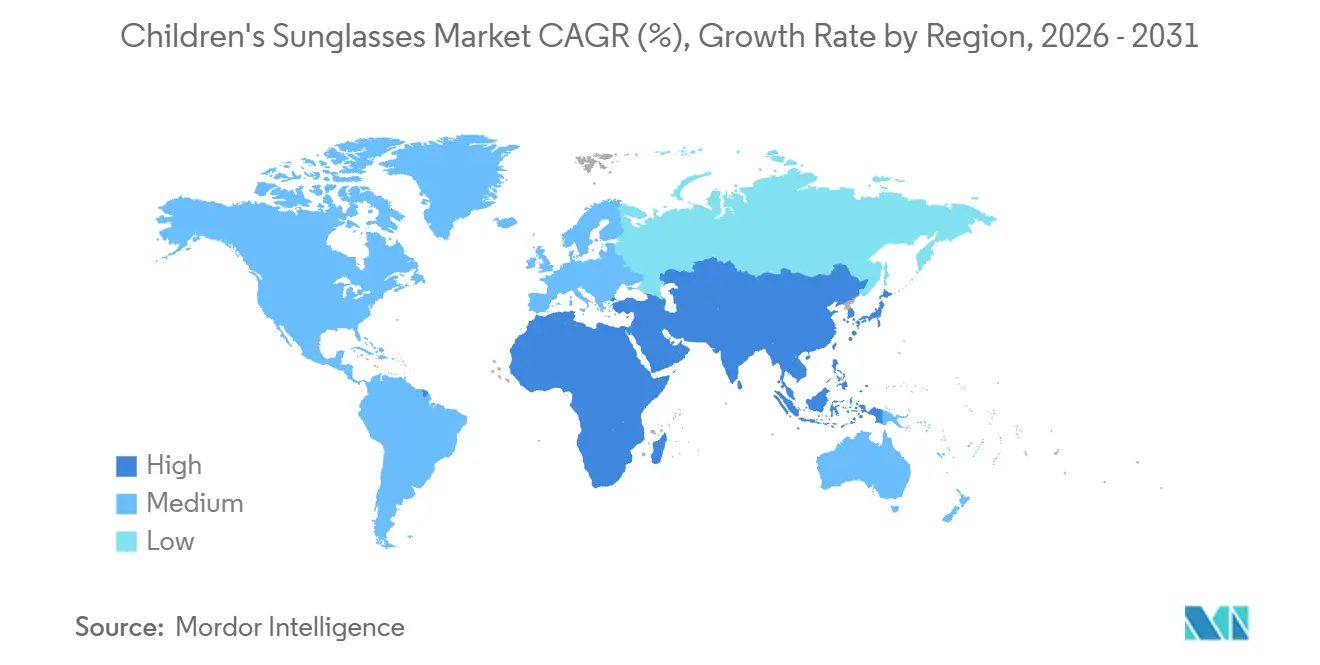
| Fastest Growing Market | Middle East and Africa |
| Largest Market | Europe |
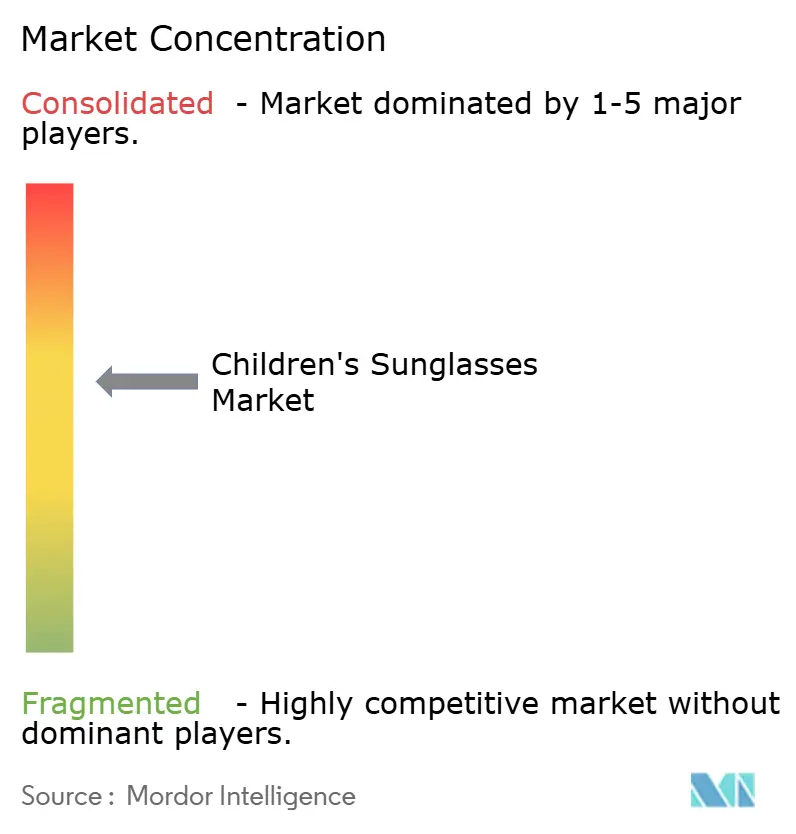
| Market Concentration | Medium |
Major Players *Disclaimer: Major Players sorted in no particular order Image © Mordor Intelligence. Reuse requires attribution under CC BY 4.0. | |
Children's Sunglasses Market Analysis by Mordor Intelligence
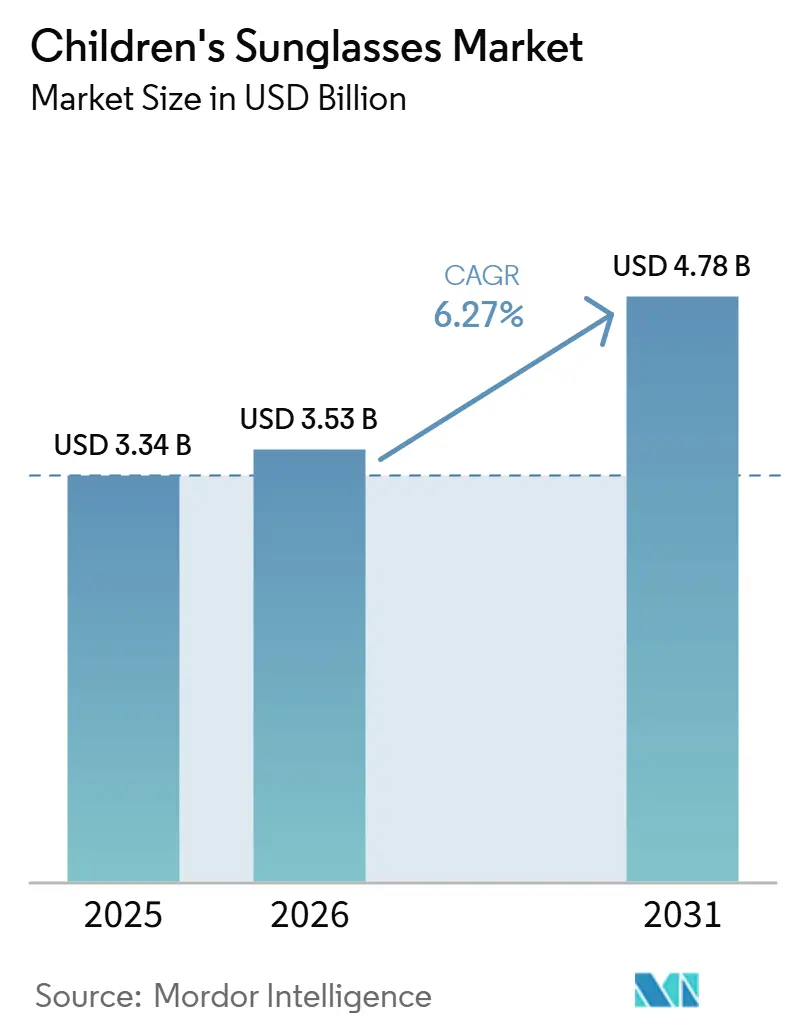
The children's sunglasses market size is projected to reach USD 3.34 billion in 2025 and USD 3.53 billion in 2026, before reaching USD 4.78 billion by 2031, registering a CAGR of 6.27% from 2026 to 2031. Rising awareness of UV-related eye damage supports demand, as parents increasingly buy protective eyewear for regular use. Children's eyes allow more UV radiation to reach the retina than adult eyes, making medical guidance important in purchase decisions. Higher outdoor participation also increases replacement demand as frames wear out or children outgrow them. Europe is expected to remain the largest regional cluster in 2025. Premium designs, polarized lenses, and improved materials are strengthening certified brands, while counterfeit and uncertified products continue to affect trust in online channels.
Key Report Takeaways
- By product type, non-polarized sunglasses held 66.71% of the children's sunglasses market share in 2025, while polarized sunglasses will forecast at a CAGR of 7.83% through 2031.
- By product category, the mass segment accounted for 75.23% of the children's sunglasses market size in 2025, while the premium segment will forecast at a CAGR of 8.56% through 2031.
- By distribution channel, offline retail stores led with 76.52% share in 2025, while online retail stores will forecast at a CAGR of 9.23% through 2031.
- By geography, Europe held 33.56% of the children's sunglasses market share in 2025, while the Middle East and Africa will forecast at a CAGR of 8.21% through 2031.
Note: Market size and forecast figures in this report are generated using Mordor Intelligence’s proprietary estimation framework, updated with the latest available data and insights as of January 2026.
Market Trends and Insights
Drivers Impact Analysis of Children's Sunglasses Market*
| Drivers | (~) % Impact on CAGR Forecast | Geographic Relevance | Impact Timeline |
|---|---|---|---|
| Rising Awareness Of UV Protection | +1.5% | Global, with early gains in Europe, North America, Australia | Medium term (2-4 years) |
| More Outdoor Recreational Activity | +1.2% | North America, Europe, APAC core | Long term (≥ 4 years) |
| Influence Of Fashion And Style Trends | +0.9% | North America, Europe, APAC urban centers | Short term (≤ 2 years) |
| Demand For Flexible And Durable Frames | +0.7% | Global, with strong pull in Asia-Pacific | Medium term (2-4 years) |
| Growing Use Of Polarized And Protective Lenses | +0.9% | North America, Europe, Australia, Japan | Medium term (2-4 years) |
| Rise In Sports Participation | +0.5% | North America, Europe, APAC | Long term (≥ 4 years) |
| Source: Mordor Intelligence | |||
Rising Awareness Of UV Protection
Awareness of pediatric UV exposure is becoming a stronger purchase driver in the children's sunglasses market, as health and regulatory guidance is clearer and more visible to parents. The WHO SPECS 2030 program has set minimum quality expectations for lenses and frames, creating a stronger baseline for protective eyewear across many markets[1]. In the United States, ANSI Z80.3-2025 introduced updated requirements for spectral transmittance claims and UV attenuation labeling, improving product communication and compliance. In Australia and New Zealand, RANZCO continues to recommend close-fitting and wraparound sunglasses for children to reduce UV exposure around the frame. These measures are helping parents view certified eyewear as a health product rather than a fashion accessory. They are also increasing compliance expectations for brands seeking access to organized retail in the children's sunglasses market.
More Outdoor Recreational Activity
Rising outdoor participation supports the children's sunglasses market, as children spend more time in bright settings during daily play, swimming, travel, and organized sports. Outdoor Industry Association data cited for 2025 indicates that 22.6 million children aged 6 to 12 participated in outdoor recreation, up 5% from the prior year[2]. The same report showed total U.S. outdoor participation at 183.2 million people in 2025, reflecting strong family involvement in outdoor activities. Statistics Norway also reported high participation among children, including frequent outdoor swimming and organized sports among those aged 6 to 15. This trend supports the children's sunglasses market through first-time purchases and repeat demand, as children often lose, damage, or outgrow frames. As outdoor activity becomes part of daily routines, parents are more likely to include functional eye protection in year-round spending.
Influence Of Fashion And Style Trends
Fashion continues to influence the children's sunglasses market as children increasingly shape purchase decisions alongside their parents. Licensed designs, character themes, bold colors, and adult-inspired frames are helping brands move beyond purely functional positioning. Ray-Ban Kids is expected to introduce Disney-linked collections in 2025, highlighting how brands use storytelling and familiarity to make children's eyewear more appealing at the point of purchase. Julbo is also expected to expand its Little Heroes range in 2025 with new models designed for outdoor use, reflecting the closer alignment of youth style and performance features. This trend supports trade-up behavior in the children's sunglasses market, as branded designs can reduce price sensitivity when parents also recognize safety, durability, and certified protection. It also gives large companies another way to refresh demand without relying solely on seasonal promotions.
Demand For Flexible And Durable Frames
Material selection is becoming increasingly important in the children's sunglasses market as parents seek frames that can withstand repeated drops, bending, and rough daily use. Brands are adopting lightweight and flexible constructions that encourage children to wear the product consistently. EssilorLuxottica highlighted materials, flex features, and child-friendly design adjustments in its 2025 children's eyewear range, indicating that frame engineering has become part of the sales message. Julbo has also positioned its children's offerings around active use, reinforcing the view that technical durability and youth comfort now matter beyond sports-specific products. This trend is important in the children's sunglasses market because frame failure can limit repeat purchases if parents perceive the product quality as poor. Better materials help brands protect margins, strengthen trust, and support premium pricing in a market where certification alone is no longer sufficient.
Restraints Impact Analysis of Children's Sunglasses Market*
| Restraint | (~) % Impact on CAGR Forecast | Geographic Relevance | Impact Timeline |
|---|---|---|---|
| High Competition From Unorganized Players | -0.8% | Asia-Pacific, Africa, South America | Long term (≥ 4 years) |
| Counterfeit And Uncertified Products | -0.5% | Global, strongest in online channels and APAC-sourced goods | Medium term (2-4 years) |
| Seasonal Demand Fluctuations | -0.3% | Europe, North America, summer-concentrated demand | Short term (≤ 2 years) |
| Regulatory Compliance Requirements | -0.2% | Global, most acute in EU and US markets | Medium term (2-4 years) |
| Source: Mordor Intelligence | |||
High Competition From Unorganized Players
Unorganized supply remains a restraint on the children's sunglasses market because low-cost sellers can move volume without carrying the same certification, retail, and branding burden as established companies. This pressure is strongest where parent purchasing is led by price and where enforcement is uneven across open marketplaces and informal retail. The effect is not limited to lost premium sales, because it also narrows price bands in the mass segment and makes it harder for organized brands to explain value. It can also weaken category trust when poor-quality products shape a family's first experience with children's eyewear. For the children's sunglasses market, this means formal brands must compete on price, safety, and reliability at the same time. That combination slows margin improvement even when end-demand stays healthy.
Counterfeit And Uncertified Products
Counterfeit and uncertified products are a direct risk to the children's sunglasses market because they are concentrated in digital channels that are otherwise growing quickly. Which? reported in June 2025 that all 20 sampled pairs of children's sunglasses bought from large online platforms lacked the legal markings required for sale in the UK, and 2 pairs had dangerously low UV protection despite UV400 claims. The OECD has also noted that small parcel flows create major enforcement challenges for counterfeit trade, which makes online screening harder to scale. This problem matters beyond safety because it can reduce confidence in the online route that many brands are counting on for growth in the children's sunglasses market. It also creates unfair price comparisons between compliant products and unsafe products that look similar to parents at first glance. Unless enforcement improves, the fastest-growing channel will continue to carry the clearest trust risk.
*Our forecasts treat driver/restraint impacts as directional, not additive. The impact forecasts reflect baseline growth, mix effects, and variable interactions.
Children's Sunglasses Market Segment Analysis
By Product Type:
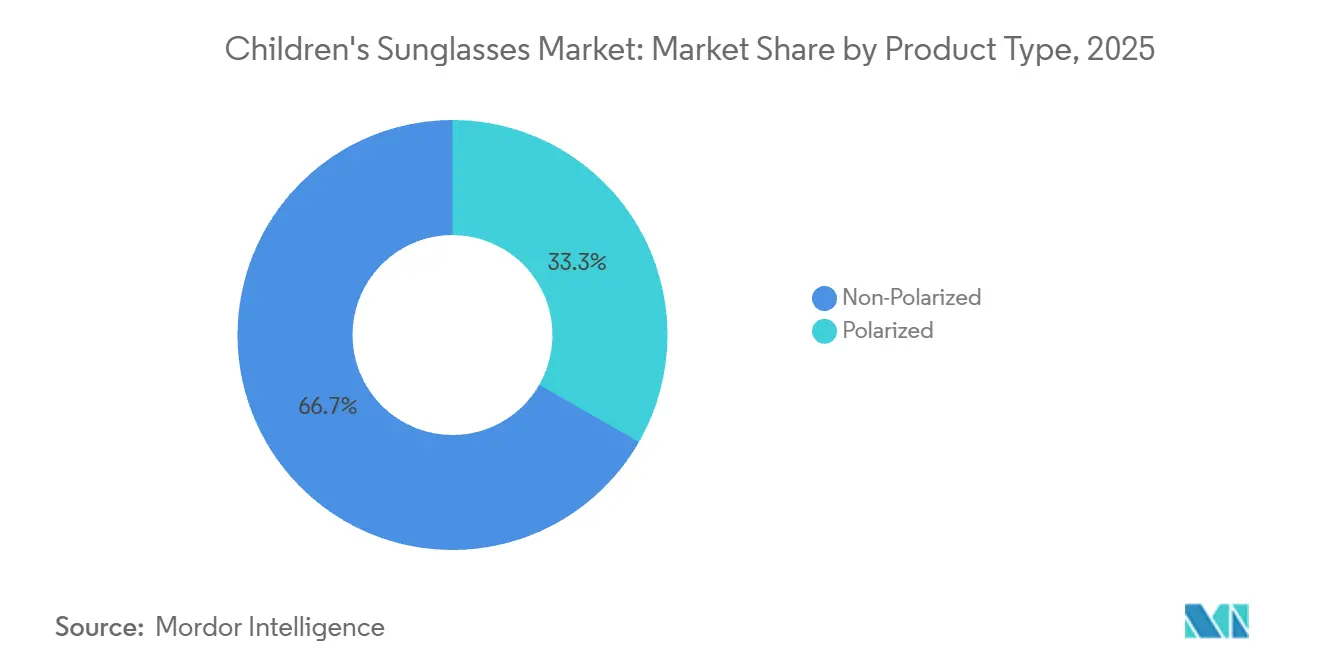
Non-Polarized Leads as Polarized Lenses AccelerateNon-polarized sunglasses held 66.71% of the children's sunglasses market share in 2025, making them the volume leader within product type. Their lead reflects lower prices, easier availability, and stronger familiarity among parents buying for toddlers and younger school-age children. The children's sunglasses market has long leaned toward non-polarized styles because many parents first focus on basic UV protection and simple replacement. Mass retailers and online sellers also offer wider design variety in this group, which supports impulse buying and gift purchases. Bright colors, character themes, and easy-access price points keep the segment visible across a broad shopper base.
The segment also benefits from the way parents manage risk in early-stage purchases. Many families prefer to start with a simpler product because children can lose or break frames quickly. That behavior keeps reorder volumes steady even when the per-unit price remains low. At the same time, the children's sunglasses industry is beginning to show a clearer upgrade path as awareness improves. Polarized sunglasses are projected to grow at a 7.83% CAGR through 2031 in the children's sunglasses market size profile for product type. Brands are pushing this shift by framing glare reduction as useful in sports, beach settings, and high-reflection environments. As a result, polarized options are moving from specialist use toward broader everyday relevance.
By Product Category:
Mass Segment Drives Volume, Premium Segment Commands GrowthThe mass segment accounted for 75.23% of the children's sunglasses market size in 2025, which shows how strongly affordability shapes demand. This category serves the widest parent base because it balances basic protection with accessible pricing. Supermarkets, department stores, discount chains, and broad online assortments continue to support its scale. The children's sunglasses market still depends on this tier for unit volume, especially in price-sensitive households and developing retail systems. It also remains the part of the market most exposed to competition from informal sellers and low-compliance imports.
Premium products, however, are forecast to grow at an 8.56% CAGR through 2031, the fastest pace among product categories. That growth reflects a steady shift toward certified quality, stronger materials, and more design-led products. Premium brands are also benefiting from licensed collections, better fit systems, and parent interest in longer-lasting purchases. Reuters reported Marcolin signed an exclusive licensing agreement with Abercrombie & Fitch in 2024 that included Abercrombie Kids eyewear, showing that lifestyle labels see room for premium expansion in the children's space. The children's sunglasses industry is therefore showing a split pattern, where mass holds the base and premium captures faster value growth. That split is likely to stay in place as certified products, branded design, and better durability become easier for parents to compare.
By Distribution Channel:
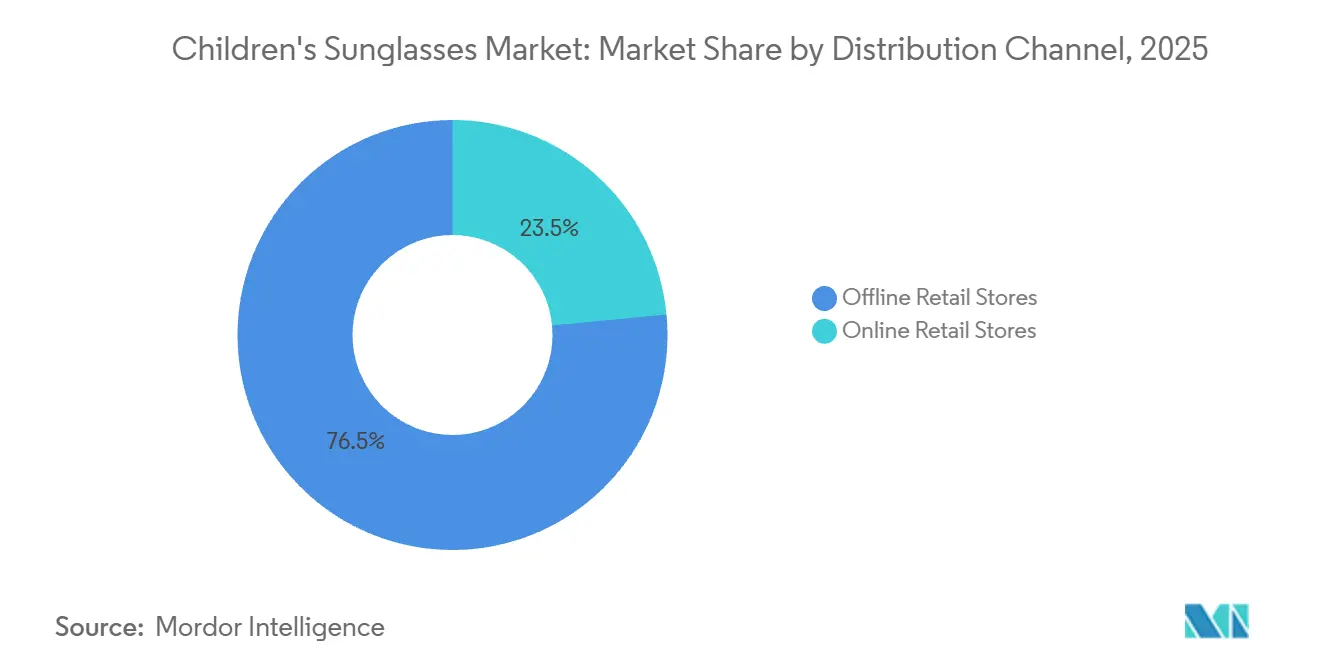
Offline Retail Holds the Volume, Online Channels SurgeOffline retail stores accounted for 76.52% of distribution in 2025, which gave them the largest share in the children's sunglasses market. Parents still value in-person fitting, physical inspection, and the ability to confirm comfort before purchase. Optical chains, specialty stores, department stores, and sports retailers also give added confidence around product legitimacy. This matters in the children's sunglasses market because proper fit, lens quality, and frame strength are harder to judge from a listing image. Many offline sellers also provide adjustments and guidance that families see as useful, especially for younger children.
Online retail stores are projected to grow at a 9.23% CAGR through 2031, making them the fastest-growing distribution channel in the children's sunglasses market size outlook. Convenience, wider assortment, and easier repeat ordering explain much of that rise. Direct-to-consumer brands are using digital channels to tell clearer safety stories and build trust with parents. Large marketplaces also extend reach into locations where specialty optical retail is limited. The same channel, however, carries the largest product safety risk because uncertified items are harder to filter at scale. This means online growth in the children's sunglasses market will depend not only on convenience, but also on stronger screening, certification visibility, and seller accountability.
Geography Analysis
Europe Children's Sunglasses Market
Europe held 33.56% of the children's sunglasses market share in 2025, securing the leading regional position. Strong consumer awareness, established optical retail networks, and clear demand for certified UV protection support the region. In Germany, the Allensbach study released in 2025 found that 71% of consumers considered UV protection the main purchase criterion for sunglasses, reinforcing safety-led buying. Europe’s strong premium brand base helps the children's sunglasses market maintain higher-value product ranges. Organized retail, clearer labeling, and product standards help parents identify trusted options. These factors support repeat demand and steady premiumization.
North America Children's Sunglasses Market
North America remained the second-largest regional bloc in the children's sunglasses market. Consumer spending on children's health products is strong, and the region has broad retail coverage across specialty and mass channels. Medical guidance also influences parents’ choices, especially when linked to early UV protection. Outdoor activity supports demand, with millions of children taking part in recreation that increases sun exposure year-round. These factors make North America a commercially attractive region for performance products, licensed collections, and repeat replacement sales in the children's sunglasses market.
APAC, South America and MEA Children's Sunglasses Market
Asia-Pacific shows a mixed profile in the children's sunglasses market because awareness, income, and retail development differ by country. Japan, South Korea, and Australia have stronger parental awareness and organized distribution. China, India, Indonesia, and much of Southeast Asia remain price-sensitive, keeping the mass segment dominant in many markets. However, premium brands are gaining traction in major cities through digital channels and wider access to international labels. South America remains smaller, but coastal and high-altitude conditions support the need for UV protection. The Middle East and Africa are forecast to grow at a CAGR of 8.21% through 2031, the fastest regional pace in the children's sunglasses market. A young population, higher UV intensity, and expanding formal retail are moving the region from underpenetrated demand toward more organized growth.
Competitive Landscape
The children's sunglasses market shows moderate concentration. Large international groups lead the premium segment, while regional and unbranded suppliers shape the mass segment. EssilorLuxottica and Safilo remain key benchmarks in branded eyewear, especially where UV protection certification, licensing, and distribution scale matter most. Their strength comes from broad portfolios, strong retail access, and frequent product updates through brand partnerships. However, the market remains far from fully consolidated, as many smaller suppliers compete aggressively on price. This keeps the category divided between trusted premium labels and a fragmented value supply base.
EssilorLuxottica continues to use product launches and pediatric eye-health extensions to strengthen its position in children's eyewear. In November 2025, the company is expected to unveil the Essilor Stellest 2.0 platform and link it to smart glasses and pre-myopia solutions for children, showing how pediatric eyewear is moving closer to digital health. Safilo is expected to strengthen its sports and premium optical offering by completing the USD 24.6 million acquisition of SPY+ and Serengeti in July 2026, adding brands that widen its reach in active-use eyewear. Marcolin has also expanded its children's positioning through licensed partnerships, including Abercrombie Kids. These moves show that scale players are adding licensing, technology, and portfolio breadth to capture more value.
Smaller specialists and direct-to-consumer brands also remain active. Julbo maintains a strong performance position and has expanded its Little Heroes line for outdoor-focused families. Online-first brands such as Knockaround, Roshambo Eyewear, and WeeStyle Co. use design, parent trust, and simple safety messages to enter the children's sunglasses market without relying heavily on wholesale channels. Sustainability is also becoming a competitive lever, especially as brands use bio-based materials to appeal to parents. The market still offers growth opportunities because needs differ by age, price tier, and retail setting. However, companies that cannot prove certification and consistent quality will struggle as scrutiny rises.
Children's Sunglasses Industry Leaders
-
EssilorLuxottica SA
-
Safilo Group S.p.A.
-
Marchon Eyewear Inc.
-
Babiators
-
BANZ
- *Disclaimer: Major Players sorted in no particular order
Children's Sunglasses Market Companies Covered in this Report
- Carter’s, Inc.
- Under Armour, Inc.
- Jonas Paul Eyewear
- Roshambo Eyewear
- Ray-Ban Junior
- Oakley Youth
- Safilo Group S.p.A.
- EssilorLuxottica SA
- Marchon Eyewear, Inc.
- Marcolin S.p.A.
- De Rigo Vision S.p.A.
- Julbo
- Uvex Sports
- Polaroid Eyewear
- Nike, Inc.
- Adidas AG
- Smith Optics
- Knockaround, Inc.
- WeeStyle Co.
- Miraflex
Recent Industry Developments in Children's Sunglasses Market
- July 2026: Safilo Group completed its USD 24.6 million acquisition of SPY+ and Serengeti from Bollé Brands, following the signing of the Share and Asset Purchase Agreement on May 11, 2026. SPY+ and Serengeti collectively generated USD 39 million in 2025 revenue, the transaction strengthens Safilo's positioning in sport-outdoor and premium optical segments alongside Smith, Carrera, Polaroid, and Blenders.
- June 2026: Ray-Ban launched the Ray-Ban | Disney Zootopia 2 Kids Collection with bio-based nylon frames and bio-based rubber temples, available from USD 119 on Ray-Ban.com in North America, Canada, Japan, and mainland China, extending the brand's strategy of combining sustainable materials with IP-driven demand for children's eyewear.
- June 2026: EssilorLuxottica launched its new Essilor Stellest Smartglasses in mainland China. The device, equipped with myopia-management lenses, tracks children's lens-wearing time and behavioral patterns to support clinical compliance, marking the first integration of digital health monitoring into a pediatric eyewear product at scale by a major eyewear group.
Global Children's Sunglasses Market Report Scope
Segmentation Overview
| Polarized |
| Non-Polarized |
| Mass |
| Premium |
| Offline Retail Stores |
| Online Retail Stores |
| North America | United States |
| Canada | |
| Mexico | |
| Rest of North America | |
| Europe | Germany |
| United Kingdom | |
| Italy | |
| France | |
| Spain | |
| Netherlands | |
| Poland | |
| Belgium | |
| Sweden | |
| Rest of Europe | |
| Asia-Pacific | China |
| India | |
| Japan | |
| Australia | |
| Indonesia | |
| South Korea | |
| Thailand | |
| Singapore | |
| Rest of Asia-Pacific | |
| South America | Brazil |
| Argentina | |
| Colombia | |
| Chile | |
| Peru | |
| Rest of South America | |
| Middle East and Africa | South Africa |
| Saudi Arabia | |
| United Arab Emirates | |
| Nigeria | |
| Egypt | |
| Morocco | |
| Turkey | |
| Rest of Middle East and Africa |
| By Product Type | Polarized | |
| Non-Polarized | ||
| By Product Category | Mass | |
| Premium | ||
| By Distribution Channel | Offline Retail Stores | |
| Online Retail Stores | ||
| By Geography | North America | United States |
| Canada | ||
| Mexico | ||
| Rest of North America | ||
| Europe | Germany | |
| United Kingdom | ||
| Italy | ||
| France | ||
| Spain | ||
| Netherlands | ||
| Poland | ||
| Belgium | ||
| Sweden | ||
| Rest of Europe | ||
| Asia-Pacific | China | |
| India | ||
| Japan | ||
| Australia | ||
| Indonesia | ||
| South Korea | ||
| Thailand | ||
| Singapore | ||
| Rest of Asia-Pacific | ||
| South America | Brazil | |
| Argentina | ||
| Colombia | ||
| Chile | ||
| Peru | ||
| Rest of South America | ||
| Middle East and Africa | South Africa | |
| Saudi Arabia | ||
| United Arab Emirates | ||
| Nigeria | ||
| Egypt | ||
| Morocco | ||
| Turkey | ||
| Rest of Middle East and Africa | ||
Key Questions Answered in the Report
What is driving growth in children's sun eyewear through 2031?
Growth is being supported by stronger awareness of UV-related eye risks, higher outdoor participation, and wider acceptance of protective eyewear as a practical purchase. The category is forecast to reach USD 4.78 billion by 2031 at a 6.27% CAGR.
Which product type leads demand today?
Non-polarized sunglasses led in 2025 with 66.71% share because they are more affordable, widely available, and familiar to parents buying for younger children.
Which product area is expanding the fastest?
Polarized sunglasses are the fastest-growing product type at a 7.83% CAGR, while the premium category is the fastest-growing product category at an 8.6% CAGR through 2031.
Why is online growth still important despite safety concerns?
Online retail is projected to grow at a 9.23% CAGR because it offers convenience, broad choice, and repeat ordering, even though uncertified products remain a major trust issue on large platforms.