
Cervical Pillows Market Size and Share
Market Overview
| Study Period | 2020 - 2031 |
|---|---|
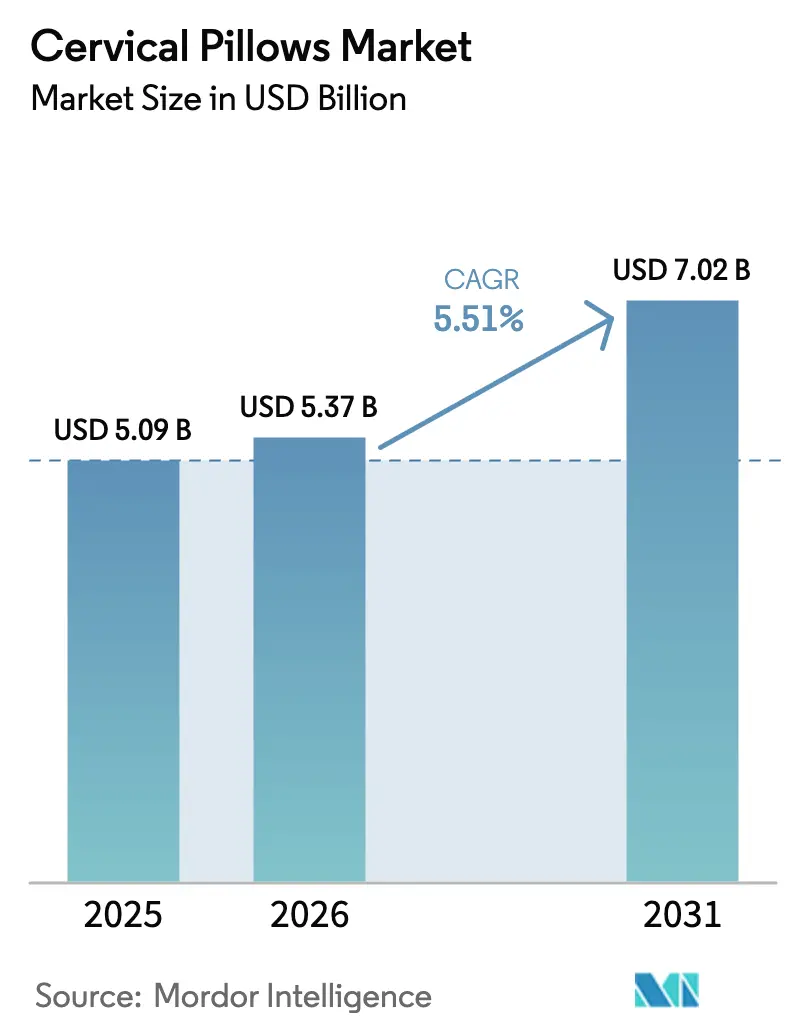
| Market Size (2026) | USD 5.37 Billion |
| Market Size (2031) | USD 7.02 Billion |
| Growth Rate (2026 - 2031) | 5.51 % |
| Fastest Growing Market | Asia Pacific |
| Largest Market | North America |
| Market Concentration | Medium |
Major Players *Disclaimer: Major Players sorted in no particular order Image © Mordor Intelligence. Reuse requires attribution under CC BY 4.0. | |
Cervical Pillows Market Analysis by Mordor Intelligence
The cervical pillows market size was valued at USD 5.09 billion in 2025 and is estimated to grow from USD 5.37 billion in 2026 to reach USD 7.02 billion by 2031, at a CAGR of 5.51% during the forecast period (2026-2031). Growth is fueled by the rising global prevalence of neck pain, the rapid diffusion of e-commerce channels, and continuous material innovation that incorporates cooling gels, water chambers, and low-cost sensors. Manufacturers emphasize clinical endorsements to differentiate from commodity bedding, and direct-to-consumer models shorten feedback loops that guide iterative design updates. Corporate wellness budgets, assisted-living procurement, and institutional adherence to ergonomic guidelines expand addressable volume beyond household purchasers. Innovative pillow patents from technology majors hint at an imminent convergence between sleep surfaces and connected diagnostics, a transition that could lift average selling prices across the cervical pillows market.
Key Report Takeaways
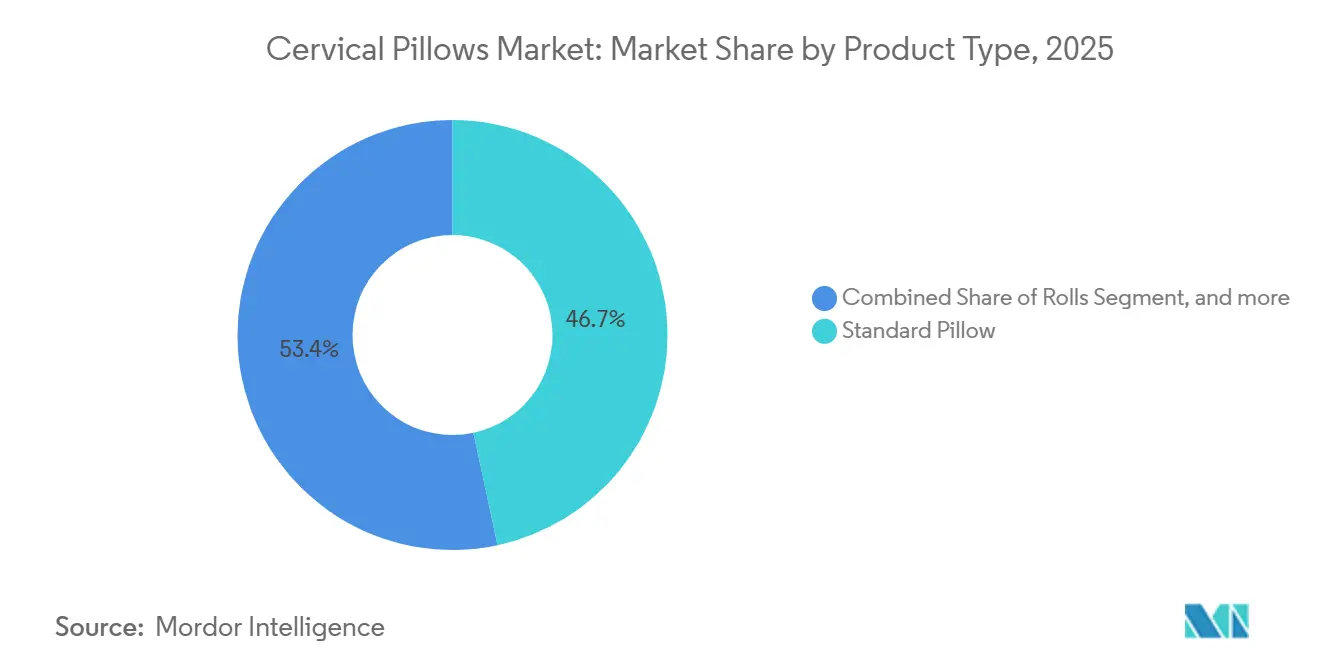
- By product type, standard pillows held 46.65% of the cervical pillows market share in 2025, while water-based designs are forecast to lead growth at a 7.54% CAGR through 2031.
- By application, cervical spondylosis accounted for 38.54% of demand in 2025, and temporomandibular disorders are set to advance at an 8.30% CAGR to 2031.
- By material type, polyester fiber dominated volume with 55.32% share in 2025, and gel-infused foam is expected to expand at a 7.44% CAGR over the same period.
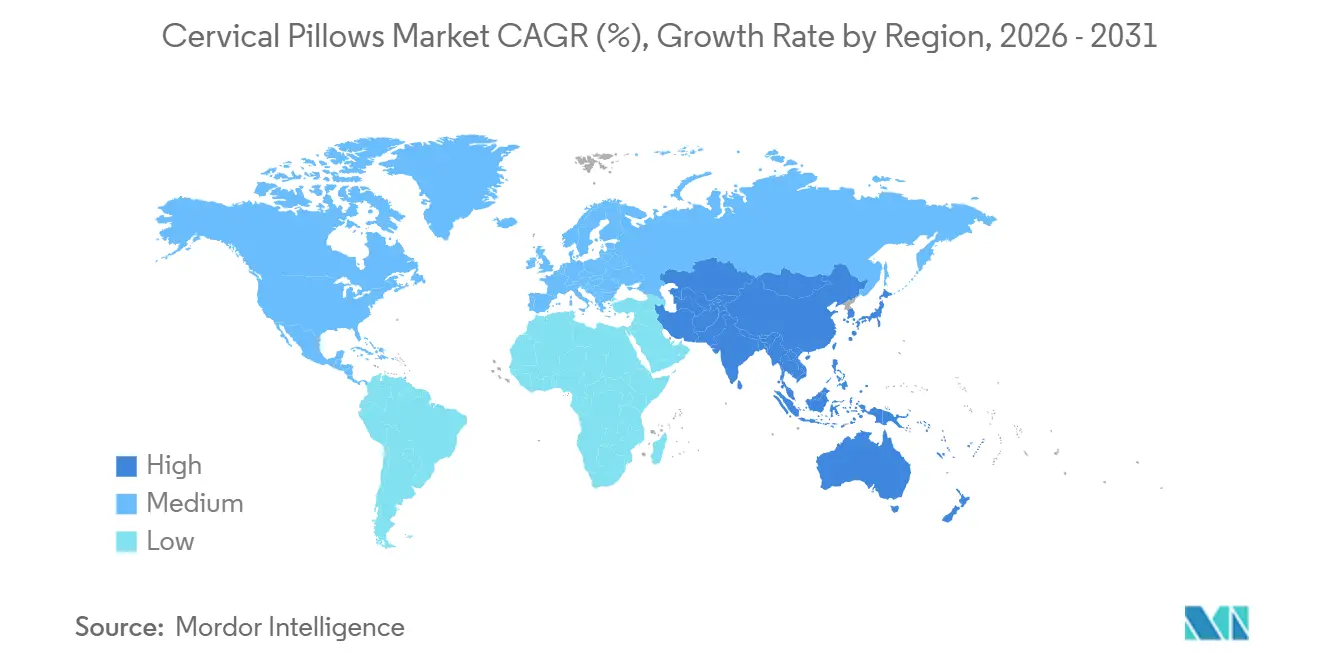
- By geography, North America contributed 43.56% of the revenue in 2025, whereas the Asia-Pacific is projected to post the fastest regional growth at a 6.43% CAGR from 2026 to 2031.
Note: Market size and forecast figures in this report are generated using Mordor Intelligence’s proprietary estimation framework, updated with the latest available data and insights as of January 2026.
Market Trends and Insights
Drivers Impact Analysis of Cervical Pillows Market*
| Driver | (~) % Impact on CAGR Forecast | Geographic Relevance | Impact Timeline |
|---|---|---|---|
| Accelerating E-Commerce Penetration in Home-Healthcare Products | +1.2% | Global, strongest in Asia-Pacific and North America | Medium term (2-4 years) |
| Growing Clinical Evidence Linking Cervical Alignment to Sleep Quality | +1.5% | North America, Western Europe, East Asia | Long term (≥4 years) |
| Adoption of Smart, Sensor-Embedded Orthopedic Pillows | +0.9% | North America, Western Europe, urban Asia-Pacific hubs | Medium term (2-4 years) |
| Rising Corporate Wellness & Ergonomic Workplace Programs | +0.8% | North America, Western Europe, select Asia-Pacific markets | Medium term (2-4 years) |
| Expansion of Assisted-Living Facilities & Geriatric Care | +1.0% | Aging societies in Japan, Western Europe, North America | Long term (≥4 years) |
| Source: Mordor Intelligence | |||
Accelerating E-Commerce Penetration in Home-Healthcare Products
Online storefronts offer manufacturers direct access to niche buyer segments, eliminating the markups that retailers previously added to inflate prices. Casper Sleep sold more than 34,000 pillow units through its proprietary site in 2025, reinforcing the appeal of free returns and 90-night trials that lower switching costs[1]Casper Sleep, “Annual Impact Report 2025,” casper.com. Precision advertising targets side sleepers, back sleepers, or patients with cervical pain with messages that match individual sleep profiles. Brands utilize real-time reviews and telemetry from companion apps to iterate on loft and firmness, a feedback loop that is impossible in traditional brick-and-mortar channels. Smart Nora demonstrates premium price tolerance with a USD 439 product that inflates a thin pad beneath the user’s pillow to mitigate snoring, proving that IoT add-ons can lift margins while working within pure-play online distribution.
Growing Clinical Evidence Linking Cervical Alignment to Sleep Quality
Peer-reviewed findings released in 2024 and 2025 have strengthened the medical acceptance of specialized cervical pillows. A January 2025 randomized trial showed that head extension via an adjustable cervical collar reduced respiratory event indices by 4.5 events per hour in moderate obstructive sleep apnea patients, a result now cited in pillow marketing materials directed at pulmonologists. A cross-sectional investigation in 2024 reported that individuals with cervical symptoms spent 185.1 minutes nightly in provocative postures compared with 83.8 minutes for controls, linking inadequate pillow support to sleep fragmentation. A Physical Therapy Korea study demonstrated that hybrid foam prototypes maintained a peak head–neck interface pressure of 57.03 mmHg, significantly lower than that of neck-support foam, thereby validating dual-layer designs that combine contouring and comfort. These data points help manufacturers translate clinical metrics—such as pain reduction, sleep efficiency, and cervical angle retention—into compelling value propositions for healthcare professionals and consumers alike.
Adoption of Smart Sensor-Embedded Orthopedic Pillows
Low-cost MEMS microphones, Wi-Fi chips, and vibration motors transform passive bedding into intelligent health companions. An Applied Sciences prototype published in December 2025 achieved 98.33% snoring-detection accuracy using components costing under USD 8 and a multi-spectrum learning algorithm, indicating a favorable bill of materials for scale manufacturing. Amazon’s October 2024 patent outlines a pillow that inflates internal air bladders when machine-learning models detect airway obstruction, signaling potential mainstream entry of adaptive sleep hardware. Early adopters pay between USD 149 and USD 439 for such devices, accepting firmware updates and cloud analytics as part of the value bundle. Regulatory ambiguity persists because therapeutic claims could trigger FDA or CE oversight; however, firms that manage compliance effectively stand to capture a formal medical-device premium.
Rising Corporate Wellness and Ergonomic Workplace Programs
Musculoskeletal disorders incur roughly USD 45 billion to USD 54 billion in annual U.S. employer costs, making preventive ergonomics a budget priority. Subsidized pillows are now standard inclusions in corporate wellness packages, alongside adjustable chairs and monitor arms. Bulk purchases deliver predictable demand and lower customer acquisition costs for suppliers, while evidence-based certifications satisfy occupational health committees. Remote work adoption after the pandemic heightened employer interest in at-home ergonomic aids, driving up pillow volumes for enterprises that cover both on-site and home offices.
Restraints Impact Analysis of Cervical Pillows Market*
| Restraint | (~) % Impact on CAGR Forecast | Geographic Relevance | Impact Timeline |
|---|---|---|---|
| Low Insurance Reimbursement for Preventive Sleep Aids | −0.6% | United States and other private-insurance markets | Medium term (2-4 years) |
| Price Sensitivity in Emerging Economies | −0.8% | Latin America, Africa, price-constrained Asia-Pacific | Short term (≤2 years) |
| Counterfeit & Low-Quality Imports Undermining Brand Value | −0.5% | Asia-Pacific, Middle East, Africa | Short term (≤2 years) |
| Source: Mordor Intelligence | |||
Low Insurance Reimbursement for Preventive Sleep Aids
Most payers classify cervical pillows as non-essential wellness items, excluding them from formularies that cover hospital beds or CPAP devices. U.S. consumers, therefore, pay retail prices ranging from USD 66 for fiber-filled models to USD 299 for cooling or sensor-enabled designs, thereby limiting prescriptions to those who can self-fund. Flexible spending and health savings accounts offer partial relief, but they require additional paperwork that can hinder clinician recommendations. The reimbursement gap narrows only when pillows prove to be cost-effective in managing sleep apnea or post-surgical recovery, a finding that remains limited in payer documentation.
Price Sensitivity in Emerging Economies
In low- and middle-income countries, healthcare budgets prioritize acute care over preventive bedding. Locally produced polyester-fiber pillows retail for USD 10 to USD 20 and undercut memory-foam or water-based offerings by up to 80%, constraining premium imports. Smartphone ownership and broadband penetration, prerequisites for smart-pillow uptake, trail global averages in rural Asia and parts of Africa, further segmenting demand.
*Our forecasts treat driver/restraint impacts as directional, not additive. The impact forecasts reflect baseline growth, mix effects, and variable interactions.
Cervical Pillows Market Segment Analysis
By Product Type:
Water-Based Designs Redefine AdjustabilityWater-based pillows have captured user attention by blending customizable firmness with clinically proven pain relief, and they are projected to deliver a 7.54% CAGR from 2026 to 2031, outperforming the overall cervical pillows market. Standard pillows, while still holding 46.65% of the cervical pillows market share in 2025, face substitution by dynamic designs that prevent permanent loft loss.
Clinical validation from Johns Hopkins University underpins Mediflow’s water-chamber product line, which has sold 7 million units and allows users to fine-tune firmness by adding water volumes that range from 2 to 5 liters. Rolls remain confined to therapeutic niches such as traction therapy, and hybrid solutions that bond memory foam cores with soft fiber layers lure buyers who want both contouring and surface comfort. Comparative studies that show hybrid prototypes lowering peak pressure to 57.03 mmHg highlight a trend toward multi-material architectures that mimic the benefits of water without fluid maintenance.



By Application:
TMJ Disorders Emerge as High-Growth IndicationCervical spondylosis remained the dominant use case, accounting for 38.54% in 2025. However, pillows designed for temporomandibular joint disorders are expected to see the fastest expansion, with an 8.30% CAGR from 2026 to 2031. Research linking jaw dysfunction to forward head posture has raised clinician awareness, opening a new specialty channel for devices that stabilize cervical alignment during sleep.
Whiplash recovery programs incorporate adjustable loft pillows to prevent chronic pain cycles. General postural strain from prolonged device use contributes to a broad category of everyday neck stiffness. Condition-specific marketing that pairs biomechanical claims with peer-reviewed data allows brands to speak directly to TMJ sufferers and whiplash patients, instead of lumping all consumers into a generic neck-support bucket.

By Material Type:
Gel-Infused Foam Captures Cooling PremiumPolyester fiber led volume with 55.32% in 2025, mainly because institutional buyers prize low cost and hypoallergenic properties. Gel-infused foam is expected to record a 7.44% CAGR through 2031, reflecting willingness to pay for active cooling among the 45% of adults who cite heat discomfort as a sleep disruptor.
CertiPUR-US certified gel foams embedded with phase-change materials dissipate heat and distribute pressure evenly, convincing consumers to move from USD 70 fiber products toward USD 100 to USD 300 performance designs. Water-filled and hybrid foam-fiber models carve out sub-segments for users prioritizing fluid responsiveness or reversible surfaces. Latex and down fill cater to natural-material preferences but lack widespread clinical differentiation, which limits their market share.
Geography Analysis
North America Cervical Pillows Market
North America accounted for 43.56% of the cervical pillows market in 2025, driven by the highest recorded age-standardized neck pain prevalence of 4,900.7 per 100,000 and employer budgets that regularly include ergonomic accessories[2]Frontiers in Neurology, “Global Trends and Regional Differences in Neck Pain Burden,” frontiersin.org. Smart-pillow prototypes and impending technology-platform entries reinforce the region’s role as the first adopter of sensor-enabled bedding. Market saturation tempers growth prospects because many households already own at least one orthopedic pillow, and upgrades rather than first purchases now drive volume.
APAC Cervical Pillows Market
The Asia-Pacific region is projected to grow at a 6.43% CAGR between 2026 and 2031, contributing the most significant absolute increase to the cervical pillows market. China alone hosts 48 million cases of neck pain, and e-commerce giants such as Alibaba and JD.com create direct paths to urban consumers who routinely purchase health devices online. Japan and South Korea exhibit a high willingness to pay for cooling gels and smart sensors, while India and Indonesia maintain demand for polyester models priced below USD 30. Brands tailor assortments by city tier, often pairing flagship products with stripped-down variants to meet diverse spending power.
EMEA and South America Cervical Pillows Market
Europe’s demand profile remains steady, driven by aging demographics and stringent safety standards that prioritize products with documented clinical benefits. Western European prevalence of 4,636.1 per 100,000 translates into consistent institutional orders for certified orthopedic pillows. Language fragmentation and varying distribution norms challenge pan-regional rollouts, prompting brands to consider country-specific partnerships. The Middle East, Africa, and South America together hold smaller shares, constrained by lower incomes and weaker enforcement against counterfeit imports. Pilot projects with local distributors or contract manufacturers help offset import tariffs and shorten delivery lead times in these regions.

Regulatory Landscape
Regulatory requirements for cervical pillows depend on intended use and associated claims, which separates general wellness bedding from products positioned for therapeutic benefit. In the United States, cervical support pillows marketed for positioning or support are commonly treated as Class I, with many configurations 510(k)-exempt under applicable FDA product classifications. When pillows are marketed for therapeutic indications, such as snoring or obstructive sleep apnea-related positioning, they can move into Class II pathways where 510(k) clearance becomes relevant, along with higher expectations for evidence, labeling, and quality-system controls.
In Europe, cervical pillows marketed with a medical purpose fall under Regulation (EU) 2017/745 (MDR). Many products are typically self-certified as Class I depending on claims and risk profile, but they still need MDR-compliant documentation, labeling, and post-market obligations. Technical and safety substantiation increasingly references recognized standards and benchmarks for positioning and tissue-integrity assistive products (for example, ISO 20342-1:2022), while country-level product standards also shape requirements in high-volume materials such as polyester fiber (for example, BIS IS 18930:2024 for polyester fibre filled pillows in India).
Value Chain Analysis
The cervical pillow value chain runs from polymer and textile inputs through shaping, assembly, and multi-channel distribution, with differentiation tied to design validation and channel strategy. Upstream inputs include polyurethane-based foams (including gel-infused variants), polyester fiber, and poly-cotton or specialty covers. Manufacturers convert these into cervical-support geometries via cutting or molding, lamination, and cover sewing, then add features such as adjustability (water chambers or modular inserts) and, for smart products, low-cost sensors and electronics integrated into the pillow system.
Midstream players include OEM or contract manufacturers and brands that position products either as consumer wellness goods or as clinically oriented positioning aids. Downstream, distribution splits across mass retail and e-commerce, plus professional or clinical pathways where chiropractors and physical therapists influence selection. Institutional procurement also weighs consistent specifications and documentation, while products positioned as medical devices require quality management alignment (commonly ISO 13485-based systems) and tighter labeling controls. Direct-to-consumer channels reduce iteration cycles for loft and firmness changes, which can accelerate commercialization of sensor-embedded features.
Competitive Landscape
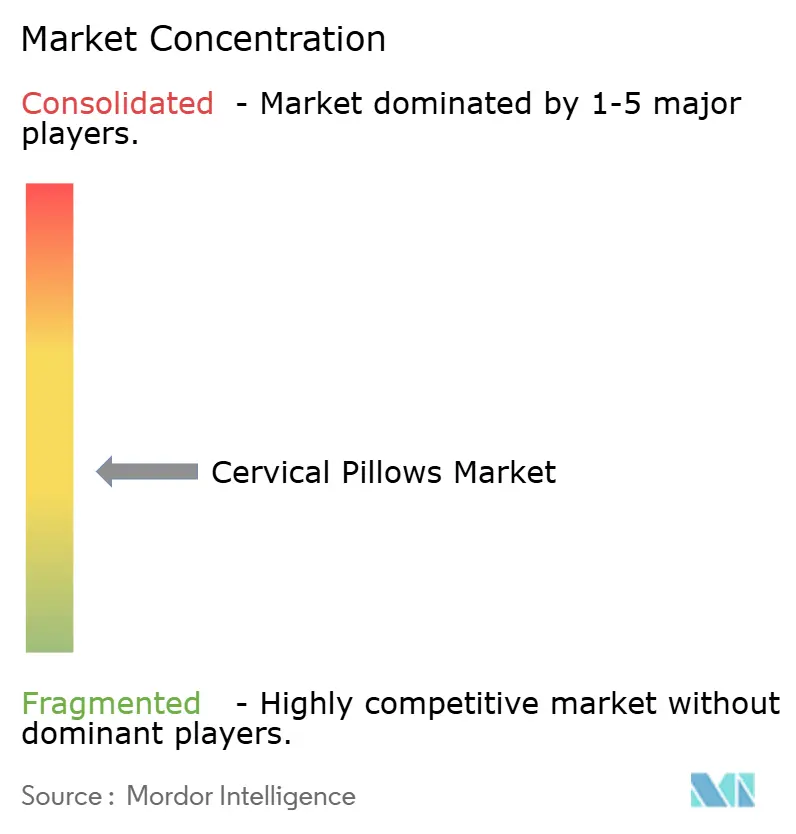
The market is moderately fragmented, with bedding conglomerates, orthopedic specialists, and direct-to-consumer startups competing across overlapping price tiers. Tempur Sealy International leverages well-known TEMPUR foam formulations and a broad retail network to maintain premium shelf space. Mediflow focuses on water-based technology validated by Johns Hopkins clinical trials, which propels uptake in healthcare channels and supported sales of 7 million units as of December 2025.
Casper Sleep operates a data-driven e-commerce model that accelerates iterative development cycles, while BEDGEAR applies sports-performance branding and interactive fit quizzes to pull in younger demographics. Amazon’s 2024 patent announcement signals that large technology companies perceive cervical support surfaces as gateways to connected sleep ecosystems, thereby elevating performance benchmarks in terms of data accuracy and automated adjustment.
Counterfeit activity and price-aggressive entrants challenge incumbents on both quality perception and margin. Leading firms respond with three-year warranties, QR-code authentication, and transparent sourcing disclosures to reassure consumers. Certification labels such as CertiPUR-US and OEKO-TEX become table stakes rather than differentiators. Adoption of MEMS sensor arrays and machine-learning firmware updates is likely to segment the competitive field, with early movers gaining data moats that convert to subscription revenues and repeat purchases across the cervical pillows market.
Cervical Pillows Industry Leaders
PharMeDoc
Coop Home Goods
DJO Global Inc.
Innocor Inc.
Malouf
- *Disclaimer: Major Players sorted in no particular order
Cervical Pillows Market Companies Covered in this Report
- Airhawk
- Alex Orthopedic
- Bedgear
- Casper Sleep
- CNH Pillow
- Contour Products
- Coop Home Goods
- Custom Craftworks
- DJO Global
- Hall Innovations
- Innocor
- J-Pillow
- Malouf
- Mediflow
- My Pillow
- PharMeDoc
- Sissel GmbH
- Tempur Sealy International
- Therapeutic Pillow International
- Xtreme Comforts

Market Opportunities and Future Outlook
The most visible whitespace is in adaptive, adjustable cervical-support systems that connect comfort with measurable posture outcomes, building on the broader shift toward sensors, pneumatic adjustment, and modular architectures. In 2026, new and emerging smart-pillow concepts highlighted pneumatic-driven designs aimed at maintaining physiological cervical curvature and adapting to user body dimensions. This supports a move toward products that can quantify sleep posture and automate support changes rather than relying only on static foam contours.
Where value can be captured is also shaped by regulatory and payer realities. Private payer policies continue to limit routine coverage for cervical pillows when framed as preventive wellness items, which creates clearer opportunities for brands that can provide more clinical positioning and documentation for professional recommendation channels or for specific indications. Materials innovation is another lever for premiumization and differentiation, including antimicrobial foam concepts disclosed in 2026 patent publications (for example, copper and silver nanoparticle-infused approaches), alongside established performance cues like cooling gels and pressure-distribution claims that support higher price tiers.
Recent Industry Developments in Cervical Pillows Market
- July 2026: Core Products International announced the nationwide launch of its ergonomic neck support and cervical sleep collection on Target.com. The expansion increases access through a major digital retail platform and supports higher-volume sell-through versus clinic-only distribution. Placement on Target.com also raises the bar for assortment readiness, consumer education content, and review-driven performance in a competitive search environment.
- June 2026: Bedsure introduced the OLoop Cervical Pillow, positioned around an O-shaped ergonomic contour and a dual-sided design for different sleep preferences. The launch reinforces product-tier segmentation around ergonomics and feature-led differentiation rather than commodity fill materials alone. It also adds competitive pressure in the mid-price range where design claims and comfort guarantees influence conversion online.
- January 2026: Malouf and Sinomax USA announced a strategic capital enterprise aimed at investing in U.S. manufacturing capabilities for sleep products. The effort strengthens the case for domestic capacity and supply-chain control amid quality, lead-time, and sourcing scrutiny in bedding and wellness categories. It also signals continued consolidation of capabilities across foam, finished-product manufacturing, and brand distribution.


Cervical Pillows Market Report Scope and Research Methodology
Market Definition and Coverage
For this methodology, the cervical pillows market includes pillows designed to support the neck and cervical spine during rest, and it is measured in value terms across consumer and institutional purchases through online and offline channels.
Scope exclusions: Decorative pillows, standard bed pillows sold without cervical support claims, and non-pillow orthopedic devices are excluded from this market sizing.
Segments Covered in This Report
- By Product Type
- Standard Pillow
- Rolls
- Water-Based Pillow
- Other Product Types
- By Application
- Cervical Spondylosis
- Whiplash Injuries
- Temporomandibular Disorders
- Other Applications
- By Material Type
- Polyester Fiber
- Gel-Infused Foam
- Water-Filled
- Other Material Types
- Geography
- North America
- United States
- Canada
- Mexico
- Europe
- Germany
- United Kingdom
- France
- Italy
- Spain
- Rest Of Europe
- Asia-Pacific
- China
- Japan
- India
- Australia
- South Korea
- Rest Of Asia-Pacific
- Middle East And Africa
- GCC
- South Africa
- Rest Of Middle East And Africa
- South America
- Brazil
- Argentina
- Rest Of South America
- North America
Data Sources, Market Sizing, and Validation
Desk Research
Desk research is used to set a clean market boundary and to anchor the model with dependable context before assumptions are built. We review public health and sleep related indicators, then map them to bedding and home textile demand signals visible across regions.
Typical references include sources such as the CDC and NIH for musculoskeletal and sleep related statistics, OECD Health Statistics for healthcare spend direction, and UN Comtrade for trade flows that help sanity check cross-border movement of home textile goods. We also use sources such as the USITC tariff schedule, patent databases for material and design activity, and peer reviewed journals for evidence on neck support and posture. Company filings, investor presentations, and reputable press releases are then used to understand pricing moves, channel expansion, and product launches, and paid subscriptions for company financials plus shipment level import/export checks are used selectively when public data is not detailed enough. The sources named here are illustrative only, and many other public and paid sources were also used for data collection, validation, and clarification.
Primary Interviews and Surveys
Primary work is used to validate the demand pool and pricing logic, because cervical pillows are affected by shifts in consumer preferences and changes in channel mix. We speak with manufacturers, material suppliers, distributors, large retailers, and healthcare oriented buyers, then compare their inputs across APAC, EMEA, and the Americas so regional assumptions do not become overly generalized.
Distribution of primary research fieldwork respondents
| Company type | Respondent position | Region |
|---|---|---|
| Top tier: 33% | CXOs: 13% | APAC: 47% |
| Mid tier: 49% | Functional/Unit leaders: 32% | EMEA: 30% |
| Smaller Players: 18% | Managers: 55% | Americas: 23% |
Market-Sizing & Forecasting
The market is first reconstructed using a top-down approach where bedding and home textile demand pools are filtered into cervical pillow eligible consumption using channel mix, product attachment, and replacement behavior. To keep totals realistic, results are corroborated with selective bottom-up approximations built from sampled price points by material, retailer channel checks, and supplier level volume signals in priority countries, and then adjusted when the two views do not align.
Key inputs used in the model include indicators such as neck pain and posture related prevalence signals, e-commerce penetration for home goods, average selling price movement by material (for example memory foam versus fiber fill), mix shift toward ergonomic and cooling features, and regional import dependence that can affect availability and pricing. Where product definitions differ across sellers, gaps are handled by applying a consistent cervical support qualifier and then mapping ambiguous listings to the nearest comparable price band so they do not inflate volumes.
For forecasting, scenario analysis is used around pricing and channel mix, and it is supported by simple multivariate regression on macro variables like disposable income trend, online retail growth, and health and wellness spend direction. Expert feedback is used to pressure test how quickly premiumization or downtrading can play out, and then the final forecast is kept within realistic adoption limits for each region.
Data Validation & Update Cycle
Validation is done through multiple checks that compare the modeled totals against independent signals like price ladders across channels, trade flow direction where relevant, and regional bedding demand indicators. If a country level output looks out of line, assumptions are revisited in steps, starting with currency timing, then price banding, and then channel mix, and respondents may be re-contacted when the variance remains unexplained.
Before sign-off, the work goes through an internal analyst review that looks for anomalies, inconsistent definitions, and math breaks across the historical years and forecast years. The report is refreshed annually, and interim updates are made when material events change pricing, supply conditions, or consumer demand. Right before delivery, a fresh pass is completed so clients receive the latest updated view rather than an older snapshot.
Mordor Intelligence's Cervical Pillows Market Size Compared Against Other Published Estimates
Published market values for cervical pillows can differ even when the topic name sounds the same, because the included products and the year anchoring are not always consistent. Differences also show up when one estimate relies more on broad bedding totals and another relies more on product level pricing and channel signals.
Retail price ladders across major online and offline channels, plus regional demand checks tied to neck support use cases, are the evidence points that keep Mordor Intelligence's estimate aligned to cervical specific purchases rather than wider pillow categories. The remaining spread usually comes from scope edges like counting generic bed pillows with minor contouring, using different currency timing, and choosing a longer forecast window that pulls assumptions further from observable price and volume signals.
Benchmark comparison
| Source | Market Size | Gaps in Research Methodology |
|---|---|---|
| Mordor Intelligence | USD 5.09 B (2025) | |
| Global Consultancy A | USD 5.17 B (2025) | Uses a similar headline category, but the public summary does not clarify how hybrid pillows are treated or how channel pricing is normalized, which can shift the counted value in premium heavy markets. |
| Industry Research Group B | USD 4.82 B (2024) | Anchors the model to a different base year and may apply a broader revenue framing with different segment mapping, which can lead to timing and definition differences when compared on a single year basis. |
The table shows that the 2025 values sit close, but the reasons behind each number are not identical. When the product boundary is kept tight to cervical support claims and price bands are validated across channels, the final total stays traceable to a repeatable set of steps that a buyer can revisit each year as conditions change.


Key Questions Answered in the Report
What is the projected revenue for cervical pillows in 2031?
The cervical pillows market size is forecast to reach USD 7.02 billion by 2031 at a 5.51% CAGR.
Which product format is expected to grow fastest over the next five years?
Water-based pillows are projected to grow at a 7.54% CAGR through 2031, outpacing all other formats.
Which region will add the most incremental demand?
Asia-Pacific will record the highest incremental demand, growing at a 6.43% CAGR and benefiting from large absolute neck-pain prevalence.
Why are gel-infused foam pillows gaining popularity?
Gel-infused foam dissipates heat and provides pressure relief, addressing thermal discomfort that disrupts sleep for 45% of adults.
How do smart pillows differ from traditional cervical pillows?
Smart pillows incorporate sensors and microcontrollers that detect snoring or airway obstruction and adjust loft or vibrate to improve breathing and sleep quality.
What limits insurance coverage for orthopedic pillows?
Insurers classify most cervical pillows as wellness products rather than medical devices, so reimbursement remains rare except for niche therapeutic indications.
Page last updated on:


 Your data is secure and never sold or shared.


