
Ceramic 3D Printing Materials Market Size and Share
Market Overview
| Study Period | 2021 - 2031 |
|---|---|
| Market Size (2026) | USD 145.73 Million |
| Market Size (2031) | USD 404.81 Million |
| Growth Rate (2026 - 2031) | 22.67 % |
| Fastest Growing Market | Asia-Pacific |
| Largest Market | Europe |
| Market Concentration | Medium |
Major Players *Disclaimer: Major Players sorted in no particular order Image © Mordor Intelligence. Reuse requires attribution under CC BY 4.0. | |
Ceramic 3D Printing Materials Market Analysis by Mordor Intelligence
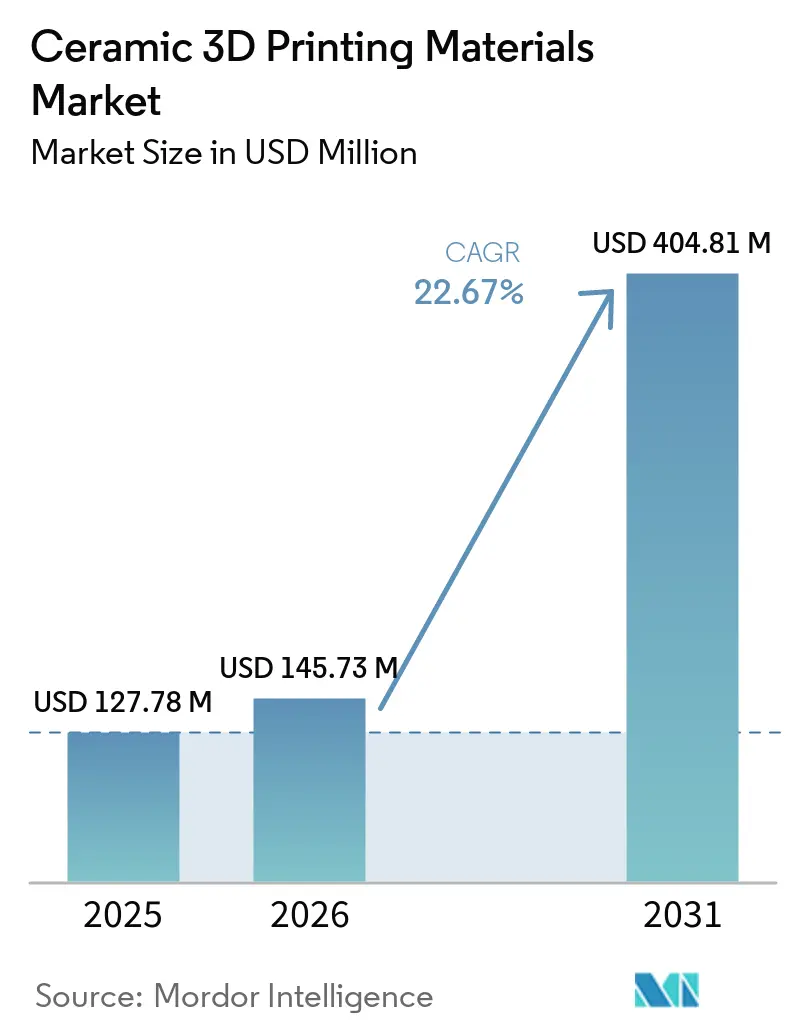
The Ceramic 3D printing materials market size was estimated at USD 127.78 million in 2025 and is estimated to grow from USD 145.73 million in 2026 to USD 404.81 million by 2031, at a CAGR of 22.67% during the forecast period (2026-2031). The ceramic 3D printing materials market is moving beyond laboratory and prototype demand as aerospace, semiconductor, and medical users qualify materials for repeated production. This shift supports recurring demand, as producers must replenish powders, resins, and slurries while maintaining narrow quality specifications. Complex cooling channels, heat-resistant parts, and semiconductor tooling are increasing the need for ceramic shapes that conventional forming methods cannot produce. Suppliers are responding by developing formulations, implementing digital process control, and offering customer-specific qualification programs. However, the market faces a practical constraint due to costly post-processing, particularly when shrinkage and component tolerances must be controlled.
Key Report Takeaways
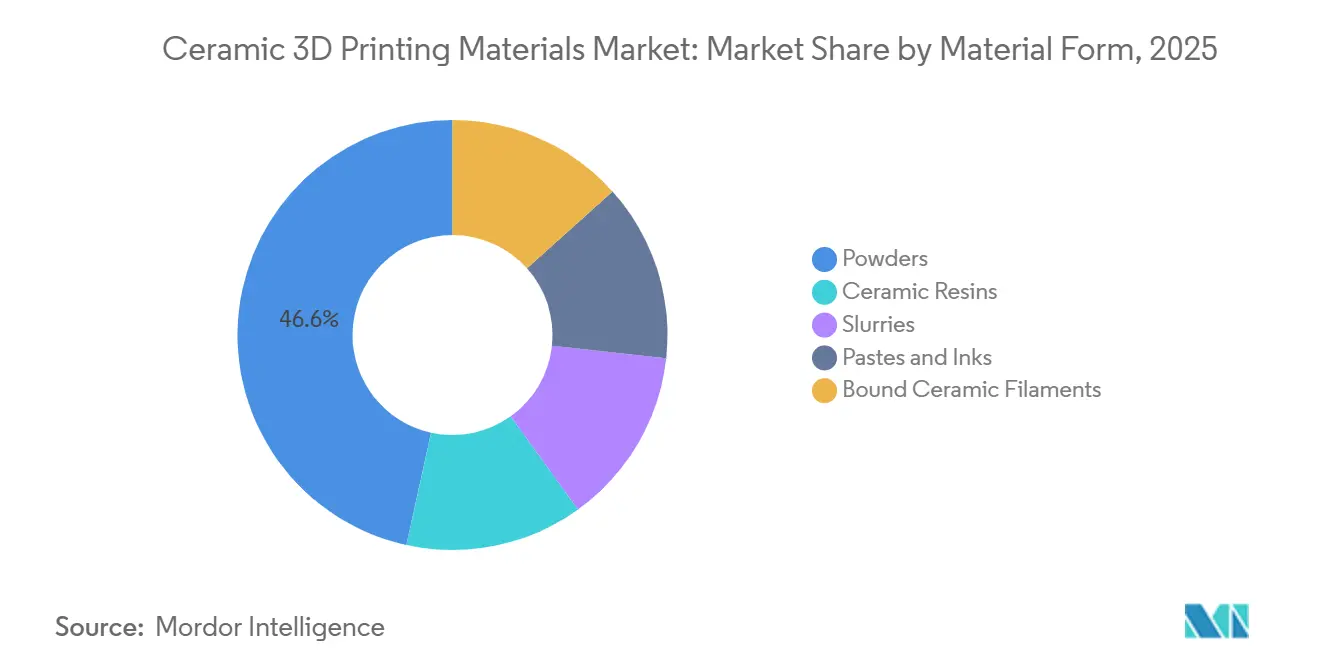
- By material form, powders held 46.56% of the Ceramic 3D printing materials market share in 2025, while ceramic resins are forecast to grow at a 24.45% CAGR through 2031.
- By ceramic type, oxide ceramics commanded 51.45% revenue share in 2025, while bioceramics are forecast to expand at a 25.17% CAGR through 2031.
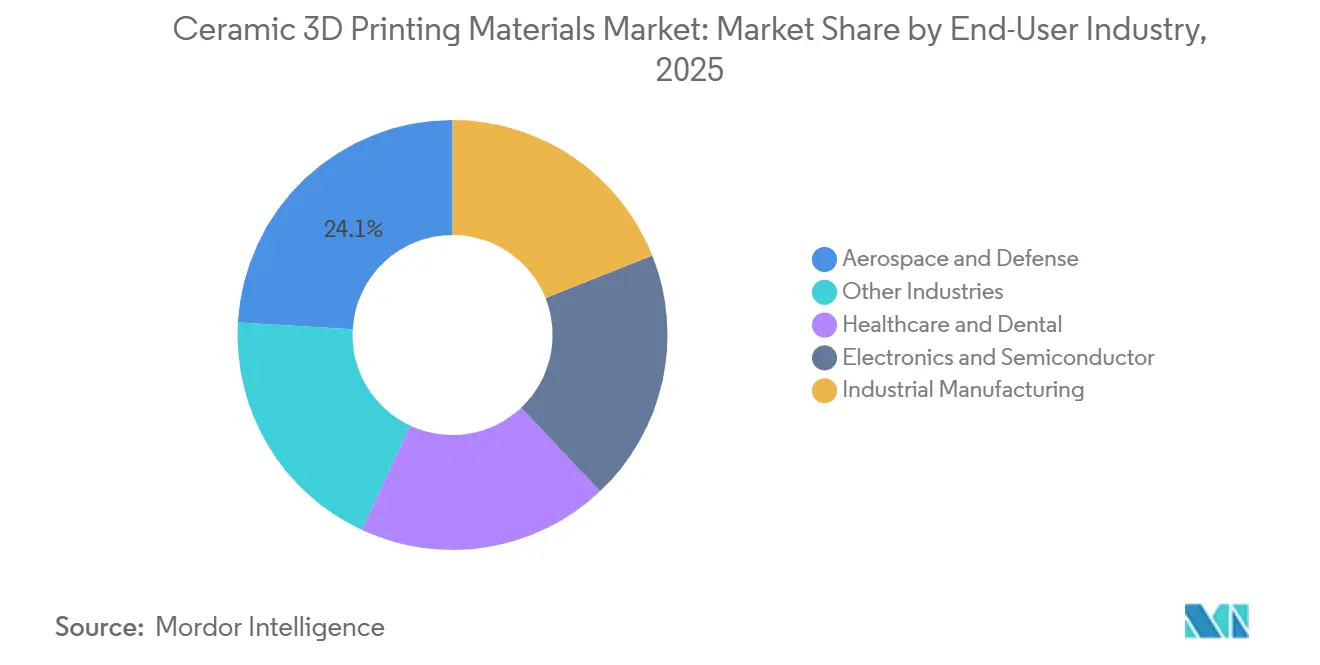
- By end-user industry, aerospace and defense held 24.07% revenue share in 2025, while healthcare and dental are forecast to advance at a 26.63% CAGR through 2031.
- By geography, Europe held 35.34% revenue share in 2025, while Asia-Pacific is forecast to grow at a 25.89% CAGR through 2031.
Note: Market size and forecast figures in this report are generated using Mordor Intelligence’s proprietary estimation framework, updated with the latest available data and insights as of January 2026.
Market Trends and Insights
Drivers Impact Analysis of Ceramic 3D Printing Materials Market*
| Drivers | (~) % Impact on CAGR Forecast | Geographic Relevance | Impact Timeline |
|---|---|---|---|
| Industrialization of High-Performance Ceramic Components | +4.50% | Global, particularly Europe and North America | Medium term (2-4 years) |
| Lightweight, High-Temperature Aerospace and Defense Parts | +4.90% | North America and Europe, with spillover to the Asia-Pacific | Medium term (2-4 years) |
| Patient-Specific Dental and Biomedical Ceramics | +4.30% | Europe and North America, expanding into the Asia-Pacific | Short term (≤ 2 years) |
| Complex Thermal-Management and Semiconductor Components | +3.80% | Asia-Pacific core, with spillover to North America and Europe | Long term (≥ 4 years) |
| AI-Assisted Process Optimization and Digital Qualification | +2.80% | Global | Medium term (2-4 years) |
| Source: Mordor Intelligence | |||
Lightweight, High-Temperature Aerospace and Defense Parts
Safran Aircraft Engines installed three Lithoz CeraFab S65 printers at its Gennevilliers facility in October 2025 to enable serial production of ceramic casting cores for next-generation turbine blades. The deployment places the printer and material system within a production environment rather than a laboratory setting, requiring repeatability across successive casting-core batches. Turbine blades need complex internal cooling channels to operate above 1,300°C, and ceramic additive manufacturing can produce channels that conventional core injection molding cannot replicate. The ceramic 3D printing materials market benefits when these applications enter serial production because qualified formulations become part of long-running component programs. This linkage makes material consistency, thermal behavior, and process documentation important alongside printer performance. In May 2026, AeroVironment received a USD 20 million CAMP contract from the U.S. Air Force Research Laboratory for ceramic and ceramic matrix composite development, covering aerodynamic vehicles, rocket propulsion, transparent armor, and thermal-protection tiles. Aerospace qualification programs can also support formulation work that transfers to space propulsion and hypersonic applications. Ceramic materials for aerospace communication systems require dielectric constants of 2 to 6 and anti-jamming capability exceeding 90%, which narrows the pool of qualified feedstocks for specialist formulators[1].
Patient-Specific Dental and Biomedical Ceramics
A five-year clinical follow-up published in April 2025 reported a 92% total success rate for patient-specific beta-tricalcium phosphate implants produced on the Lithoz CeraFab System. The reported outcomes demonstrated osteoconductivity and osteoinductivity comparable to those of autogenous bone blocks, supporting the use of these implants in regulated healthcare settings. This evidence is particularly relevant where hospital buyers require long-term outcomes before shifting from individual clinical cases to routine purchasing. ISO 13485 certification has become a procurement requirement for material suppliers serving hospital systems and dental groups that are scaling digital workflows, and Lithoz achieved this certification for its material production quality management system in 2025. The ceramic 3D printing materials market benefits from this development because clinical evidence reduces the gap between a validated material and routine purchasing, while suppliers also need documented quality systems to support material traceability, clinical review, and the repeatability required for distributed dental production. Lithoz reported that its largest medical customer produced 4 million parts in 2025, demonstrating that customized bioceramic production can operate at substantial scale. Research from Flinders University reported dimensional discrepancies of 0.21% to 0.27% for hydroxyapatite and zirconia dental scaffolds, which supports precision requirements for clinical printing.
Complex Thermal-Management and Semiconductor Components
Ceramic components used in semiconductor manufacturing equipment must operate in plasma environments, withstand process temperatures above 600°C, and limit particulate contamination. These requirements make thermal stability, chemical resistance, and dimensional control central features of any qualified feedstock. In April 2026, NGK Corporation announced JPY 70 billion (USD 440 million) for a new ceramics plant in Nomi, Japan, to increase semiconductor equipment ceramics capacity by 20% by 2029. The ceramic 3D printing materials market can benefit when semiconductor tool makers seek components with consolidated designs and demanding thermal performance. Kyocera is directing USD 4.0 billion to its components business for semiconductor manufacturing equipment and artificial intelligence (AI) data-center applications, building on its established ceramics activities, while Toto is investing JPY 80 billion (USD 495 million) over five years to expand advanced ceramic materials for electrostatic chucks and wafer-processing components. These investments reflect a broader need for ceramics in equipment that supports chip production, even when individual components are produced through different methods. Once a supplier qualifies a material for a susceptor or protective cap, its position can extend to adjacent components on the same tool platform.
AI-Assisted Process Optimization and Digital Qualification
Artificial intelligence tools address material waste from failed prints and long ramp-up periods for new operators. 3DCeram Sinto's CERIA platform uses more than 20 sensors during printing to adjust slurry deposition parameters, supporting tighter control of failed-print rates. The ceramic 3D printing materials market can benefit from this approach, as lower scrap reduces the economic barrier posed by high-value ceramic feedstocks. The operating benefit is not limited to cost alone, as a more stable process also gives users a clearer record of how a part was made. The University of Koblenz received EUR 7.8 million (~USD 9.02 million) in 2024 from the European Regional Development Fund and Rhineland-Palatinate state funds for the 3DKI project, which focuses on AI for controlling ceramic additive manufacturing processes for smaller producers. The project indicates that smaller producers are also being considered in regional efforts to improve ceramic manufacturing capabilities. Process datasets can support traceability in aerospace and medical submissions, making qualification records more useful during part certification. This approach may shorten the path from printed output to certified use without changing the underlying certification framework.
Restraints Impact Analysis of Ceramic 3D Printing Materials Market*
| Restraints | (~) % Impact on CAGR Forecast | Geographic Relevance | Impact Timeline |
|---|---|---|---|
| High Material, Equipment, and Post-Processing Costs | -2.80% | Global, most acute in North America and Europe | Short term (≤ 2 years) |
| Debinding, Sintering, and Dimensional-Shrinkage Complexity | -2.00% | Global | Medium term (2-4 years) |
| Qualification and Certification Lead Times in Regulated Industries | -1.60% | North America and Europe | Long term (≥ 4 years) |
| Source: Mordor Intelligence | |||
High Material, Equipment, and Post-Processing Costs
High-purity alumina, stabilized zirconia, and silicon carbide feedstocks cost significantly more per kilogram than conventional polymer filament. Industrial ceramic additive manufacturing systems typically cost between USD 150,000 and more than USD 500,000 per unit, before accounting for furnaces and other post-processing infrastructure. Buyers must also consider furnace capacity, energy consumption, and the time required to establish a stable post-processing route. This cost structure limits first-time adoption to organizations with verified use cases and multiyear payback expectations. In November 2025, XJet introduced the Carmel Pro with a stated upfront investment 60% to 70% lower than the Carmel 1400 series, targeting small and medium enterprises and research centers[2]. The ceramic 3D printing materials market also relies on contract production routes that help customers reach serial capacity without a direct equipment purchase. These routes can reduce the balance-sheet commitment for original equipment manufacturers while maintaining access to qualified equipment and materials. Lithoz reported that 20% of its customers account for more than 50% of installed CeraFab systems, underscoring the importance of concentrated access to contract manufacturing.
Debinding, Sintering, and Dimensional-Shrinkage Complexity
Green ceramic parts produced through vat photopolymerization, binder jetting, or material extrusion require separate debinding and sintering stages. These stages typically cause 15% to 25% linear shrinkage, and the final result varies with particle size distribution, binder formulation, and thermal profile. The ceramic 3D printing materials market must therefore manage dimensional compensation as an engineering task rather than a simple scale adjustment. Process teams need to account for the behavior of each material route before a component can move into repeatable production. As part features approach the pixel or layer-size boundary, conventional STL-based compensation becomes less effective, and print-measure-adjust cycles become necessary. Oxide ceramics can tolerate wider shrinkage windows than silicon nitride or silicon carbide, so production protocols cannot be transferred directly across material classes. Each new formulation may require a separate development cycle, slowing its commercial introduction on a production platform. These post-processing demands can offset the design advantages of additive manufacturing for short production runs that do not justify the qualification effort.
*Our forecasts treat driver/restraint impacts as directional, not additive. The impact forecasts reflect baseline growth, mix effects, and variable interactions.
Ceramic 3D Printing Materials Market Segment Analysis
By Material Form:
Powders Support Industrial Programs While Resin Demand AdvancesPowders held 46.56% of the ceramic 3D printing materials market share in 2025, driven by their compatibility with selective laser sintering, binder jetting, and direct ink writing. This broad compatibility makes powders the standard feedstock for industrial programs that require flexibility across multiple equipment routes. Alumina, zirconia, silicon carbide, and silicon nitride are routinely processed as powders, enabling the format to serve varied operating conditions. This material range gives powder suppliers exposure across aerospace, electronics, healthcare, and industrial applications. Powder-based demand in the ceramic 3D printing materials market is driven by production users who require flexible material options across multiple print platforms.
Ceramic resins are forecast to grow at a 24.45% CAGR from 2026 to 2031, the fastest rate within the material form segment. Vat photopolymerization platforms are gaining adoption in dental and medical applications, where surface quality and dimensional precision are critical for photocurable suspensions. Lithoz's Lithography-based Ceramic Manufacturing (LCM) technology processes ceramic-loaded photopolymer suspensions, and its customers produced millions of medical parts in 2025. Slurries remain important because photopolymerization systems require controlled viscosity and cure depth across each build. Pastes, inks, and bound ceramic filaments support direct-write, inkjet, and extrusion routes, with users transitioning from polymer printing and accepting higher porosity.

By Ceramic Type:
Oxide Ceramics Remain Established While Bioceramics Grow FasterOxide ceramics accounted for 51.45% of revenue in 2025, supported by material maturity, broad regulatory familiarity, and lower technical risk. Alumina combines high hardness, electrical insulation, and chemical resistance, making it suitable for semiconductor handling components, industrial wear parts, and dental restoration frameworks. Zirconia is used in digital dental workflows due to its biocompatibility and optical properties. In April 2025, Kyocera CAM Europe introduced a ceramic printing service using aluminum oxide and zirconium oxide feedstocks. Glass ceramics continue to serve specialized optical and dental applications where controlled crystallization determines final mechanical properties.
Bioceramics are forecast to expand at a 25.17% CAGR from 2026 to 2031, making them the fastest-growing ceramic type. A five-year study published in 2025 reported a 92% total success rate for 3D-printed beta-tricalcium phosphate implants used in jaw corrective surgery. This evidence supports purchasing decisions that depend on long-term patient outcomes and routine clinical use. Non-oxide ceramics, including silicon carbide, silicon nitride, and boron nitride, are receiving increased attention for high-temperature aerospace and semiconductor applications. However, their processing complexity and the requirements of ISO 13485 and the European Medical Device Regulation continue to slow broad adoption and affect development timelines for resorbable implants.
By End-User Industry:
Aerospace Holds the Largest Position, While Healthcare and Dental AccelerateAerospace and defense accounted for 24.07% of revenue in 2025, supported by casting-core slurries, ceramic matrix composite precursor materials, and non-oxide thermal-protection formulations. The segment uses multiple material formats for turbine components, hot-section parts, and ablative systems that operate under demanding thermal conditions. Safran's deployment of Lithoz LCM technology for turbine-blade casting cores included co-developing proprietary ceramic formulations. Once qualified, a formulation becomes embedded in the component certification package and requires renewed qualification before substitution. The AeroVironment CAMP program also funds ceramic materials work with applications in turbine engines, propulsion systems, armor, and thermal-protection tiles.
Healthcare and dental are forecast to grow at a 26.63% CAGR from 2026 to 2031, the highest rate among end-user industries. Digital dental workflows use intraoral scans that feed directly into additive manufacturing build files, reducing manual steps between patient data and production. As a result, zirconia crowns, alumina frameworks, and bioceramic scaffolds align with patient-specific production requirements. The ceramic 3D printing materials market benefits when production combines customized designs with repeated serial output. Lithoz reported that its largest medical customer produced 4 million ceramic parts in 2025, while NGK's semiconductor capital commitments support longer-term feedstock demand.
Geography Analysis
Europe Ceramic 3D Printing Materials Market
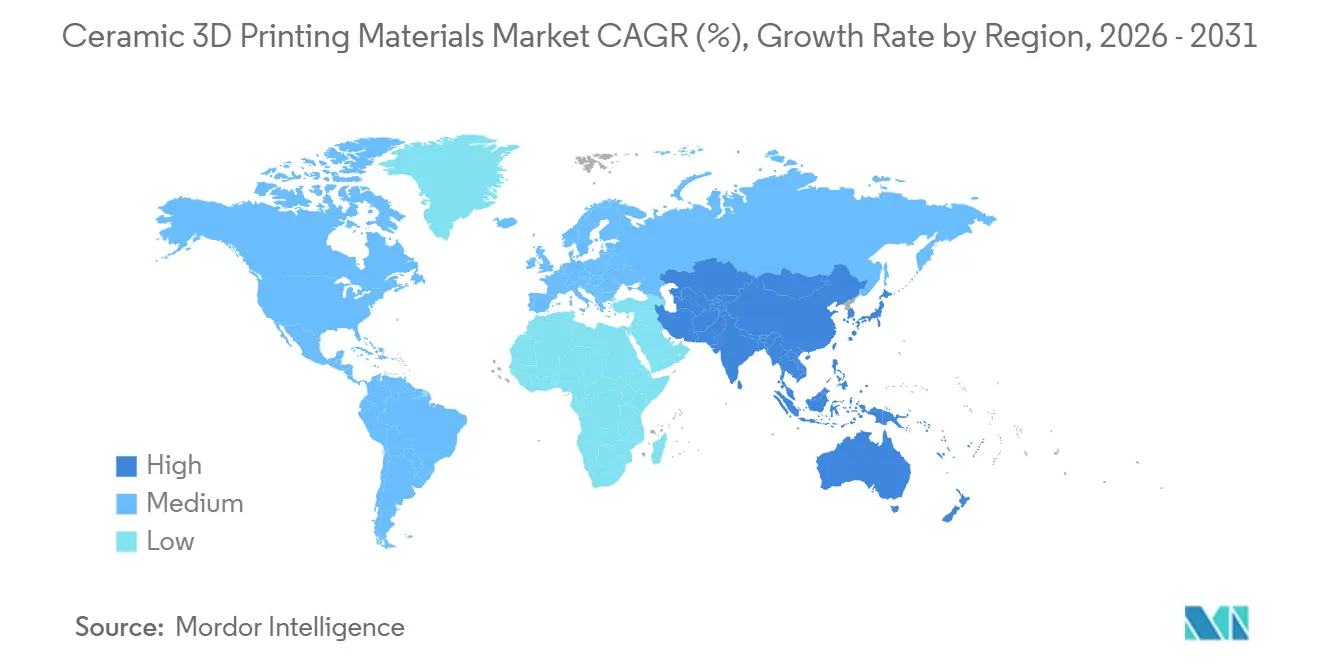
Europe accounted for 35.34% of revenue in 2025, supported by technology developers and contract manufacturers in Austria, Germany, and France. Germany remains active in transferring ceramic additive manufacturing research into production applications for industrial users. The University of Koblenz's 3DKI project is using EUR 7.8 million (~USD 9.02 million) in European and state funding to deepen the integration of artificial intelligence for ceramic producers in Rhineland-Palatinate. A Verband Deutscher Maschinen- und Anlagenbau (VDMA) survey conducted in spring 2026 found that 76% of surveyed German additive manufacturing companies expect domestic growth over the following two years. France's aerospace supply chain is generating serial demand for silica-based ceramic slurries through Safran's casting-core production, while Nordic clinical users and Italian technical-ceramics suppliers provide further regional support.
APAC Ceramic 3D Printing Materials Market
Asia-Pacific is forecast to expand at a 25.89% CAGR from 2026 to 2031, making it the fastest-growing geography in the ceramic 3D printing materials market. The region combines large-scale manufacturing, semiconductor investment, and expanding defense procurement. NGK's planned JPY 70 billion (USD 440 million) Nomi facility targets a 20% ceramics capacity increase by 2029. Kyocera's investment plan focuses on semiconductor equipment and artificial intelligence data-center ceramics, while Toto's expansion prioritizes electrostatic chucks and wafer-processing components. China is building domestic capabilities in alumina and zirconia powders, while South Korea, ASEAN countries, and India are adding demand through electronics, defense, and medical-device production.
The Americas and Middle East Ceramic 3D Printing Materials Market
North America holds a significant share of the ceramic 3D printing materials market, with the United States supported by defense-funded research and an active aerospace supply chain. The U.S. Air Force Research Laboratory's USD 20 million CAMP award to AeroVironment sustains work on advanced ceramic and ceramic matrix composite materials. The United States medical and dental sector is adopting bioceramic additive manufacturing for patient-specific orthopedic and cranio-maxillofacial implants, while Canada and Mexico provide secondary demand through electronics contract manufacturing and energy-sector wear components. Brazil offers a near-term opportunity in aerospace and energy, while Saudi Arabia's industrial diversification is driving demand for advanced materials that still require local supplier development.
Competitive Landscape
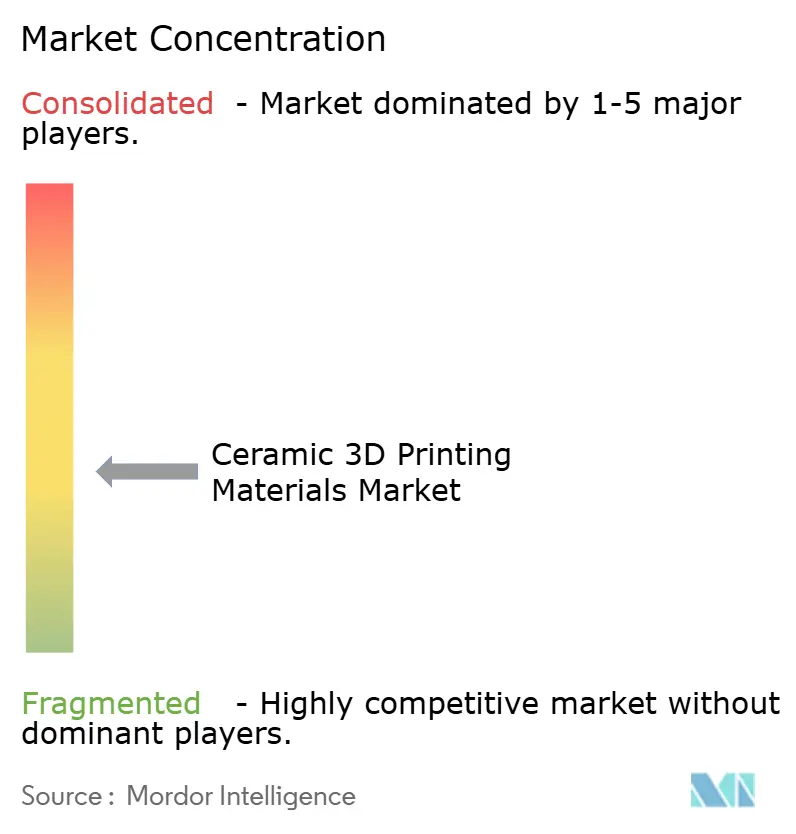
The ceramic 3D printing materials market is moderately fragmented at the material supply level, while vat photopolymerization platforms show greater concentration around Lithoz and 3DCeram Sinto. Integrated system providers bundle proprietary materials with hardware and establish qualified-material relationships through co-development programs. Independent material specialists compete by developing intellectual property and ensuring compatibility across multiple printing technologies. Upstream suppliers such as Baikowski SAS and Nanoe compete on purity, particle size distribution, and consistency. In January 2026, Sintokogio completed its acquisition of Bosch Advanced Ceramics, and Lithoz's investment in AMAREA Technology added multi-material printing capabilities to its portfolio.
The market presents opportunities in non-oxide formulations for extreme environments. Silicon carbide, aluminum nitride, and silicon nitride are important for electronics and hypersonic applications, but print-ready feedstocks require controlled stoichiometry, oxygen-free processing, and specialized sintering atmospheres. These conditions limit the supplier base to a smaller group of specialists. Polymer-derived ceramics use preceramic polymers to produce complex shapes and graded structures through additive manufacturing. Lithoz's multi-material vat photopolymerization activities and Desktop Metal's Triple ACT binder-jetting work reflect the growing importance of process intellectual property, while Ceraprint, ZRapid Tech, and Tethon3D broaden regional access.
XJet introduced the Carmel Pro in November 2025, with a stated upfront investment of 60% to 70% below the Carmel 1400 series. This targets smaller enterprises and research centers that could not justify earlier levels of system investment. Lithoz is also expanding material options for serial production, including material upgrades introduced at Ceramitec 2026. Material quality, qualification support, repeatable post-processing, and multi-supplier qualification are central to buyer selection and supply-risk management for specialty non-oxide powders.
Ceramic 3D Printing Materials Industry Leaders
-
Lithoz
-
3DCeram
-
Desktop Metal, Inc.
-
XJet Ltd.
-
Admatec
- *Disclaimer: Major Players sorted in no particular order
Ceramic 3D Printing Materials Market Companies Covered in this Report
- 3DCeram
- Admatec
- AMAREA Technology GmbH
- Baikowski SAS
- CeramTec GmbH
- Ceraprint s.r.o.
- CONCR3DE
- Desktop Metal, Inc.
- Formlabs
- Johnson Matthey
- Lithoz
- Mitsui Kinzoku Co., Ltd.
- Nanoe
- Tethon3D
- XJet Ltd.
- ZRapid Tech
Recent Industry Developments in Ceramic 3D Printing Materials Market
- June 2026: Kyocera announced a JPY 650 billion (approximately USD 4.0 billion) investment plan for its components business, focusing on ceramic parts for semiconductor manufacturing equipment and AI data center applications, which is expected to directly expand demand for precision ceramic feedstocks.
- May 2026: AeroVironment was awarded a USD 20 million CAMP contract by the U.S. Air Force Research Laboratory to develop advanced ceramic and ceramic matrix composite materials using 3D printing and sensor integration for platforms including turbine engines, rocket propulsion systems, transparent armor, and thermal protection tiles.
Global Ceramic 3D Printing Materials Market Report Scope
Ceramic 3D printing materials are inorganic, non-metallic compounds, such as technical alumina, zirconia, or traditional clay, used in additive manufacturing to build complex shapes layer by layer before being dried and fired in a kiln.
The ceramic 3D printing materials market is segmented by material form, ceramic type, end-user industry, and geography. By material form, the market is segmented into powders, ceramic resins, slurries, pastes and inks, and bound ceramic filaments. By ceramic type, the market is segmented into oxide ceramics, non-oxide ceramics, bioceramics, glass ceramics, and others. By end-user industry, the market is segmented into aerospace and defense, healthcare and dental, electronics and semiconductor, industrial manufacturing, and other industries. The report also covers market size and forecasts for ceramic 3D printing materials across 15 countries in major regions. The market sizes and forecasts are provided in terms of value (USD).
Segmentation Overview
| Powders |
| Ceramic Resins |
| Slurries |
| Pastes and Inks |
| Bound Ceramic Filaments |
| Oxide Ceramics |
| Non-Oxide Ceramics |
| Bioceramics |
| Glass Ceramics |
| Others |
| Aerospace and Defense |
| Healthcare and Dental |
| Electronics and Semiconductor |
| Industrial Manufacturing |
| Other Industries |
| Asia-Pacific | China |
| India | |
| Japan | |
| South Korea | |
| ASEAN Countries | |
| Rest of Asia-Pacific | |
| North America | United States |
| Canada | |
| Mexico | |
| Europe | Germany |
| United Kingdom | |
| France | |
| Italy | |
| NORDIC Countries | |
| Rest of Europe | |
| South America | Brazil |
| Argentina | |
| Rest of South America | |
| Middle-East and Africa | Saudi Arabia |
| South Africa | |
| Rest of Middle-East and Africa |
| By Material Form | Powders | |
| Ceramic Resins | ||
| Slurries | ||
| Pastes and Inks | ||
| Bound Ceramic Filaments | ||
| By Ceramic Type | Oxide Ceramics | |
| Non-Oxide Ceramics | ||
| Bioceramics | ||
| Glass Ceramics | ||
| Others | ||
| By End-User Industry | Aerospace and Defense | |
| Healthcare and Dental | ||
| Electronics and Semiconductor | ||
| Industrial Manufacturing | ||
| Other Industries | ||
| By Geography | Asia-Pacific | China |
| India | ||
| Japan | ||
| South Korea | ||
| ASEAN Countries | ||
| Rest of Asia-Pacific | ||
| North America | United States | |
| Canada | ||
| Mexico | ||
| Europe | Germany | |
| United Kingdom | ||
| France | ||
| Italy | ||
| NORDIC Countries | ||
| Rest of Europe | ||
| South America | Brazil | |
| Argentina | ||
| Rest of South America | ||
| Middle-East and Africa | Saudi Arabia | |
| South Africa | ||
| Rest of Middle-East and Africa | ||
Key Questions Answered in the Report
What is current market size of Ceramic 3D Printing Materials Market?
The Ceramic 3D printing materials market size was estimated at USD 127.78 million in 2025 and is estimated to grow from USD 145.73 million in 2026 to USD 404.81 million by 2031, at a CAGR of 22.67% during the forecast period (2026-2031).
Which material form held the leading position in 2025?
Powders led with a 46.56% share in 2025 because they support multiple printing technologies and ceramic chemistries. The Ceramic 3D printing materials market uses powder formats across binder jetting, selective laser sintering, and direct ink writing.
Which ceramic type is forecast to grow the fastest through 2031?
Bioceramics are forecast to grow at a 25.17% CAGR, supported by clinical evidence for patient-specific implants. The Ceramic 3D printing materials market benefits when validated implant materials meet quality-system and procurement requirements.
Why are aerospace and defense important for ceramic additive materials?
Aerospace and defense held a 24.07% share in 2025 and requires qualified materials for casting cores, hot-section parts, and thermal protection. The Ceramic 3D printing materials market is supported by programs that need proven feedstock performance for demanding component applications.