
Cellulose-Based Cosmetic Polymers Market Size and Share
Market Overview
| Study Period | 2022 - 2032 |
|---|---|
| Market Size (2027) | USD 602.11 Million |
| Market Size (2032) | USD 831.55 Million |
| Growth Rate (2027 - 2032) | 6.67 % |
| Fastest Growing Market | Asia-Pacific |
| Largest Market | Asia-Pacific |
| Market Concentration | Medium |
Major Players *Disclaimer: Major Players sorted in no particular order Image © Mordor Intelligence. Reuse requires attribution under CC BY 4.0. | |
Cellulose-Based Cosmetic Polymers Market Analysis by Mordor Intelligence
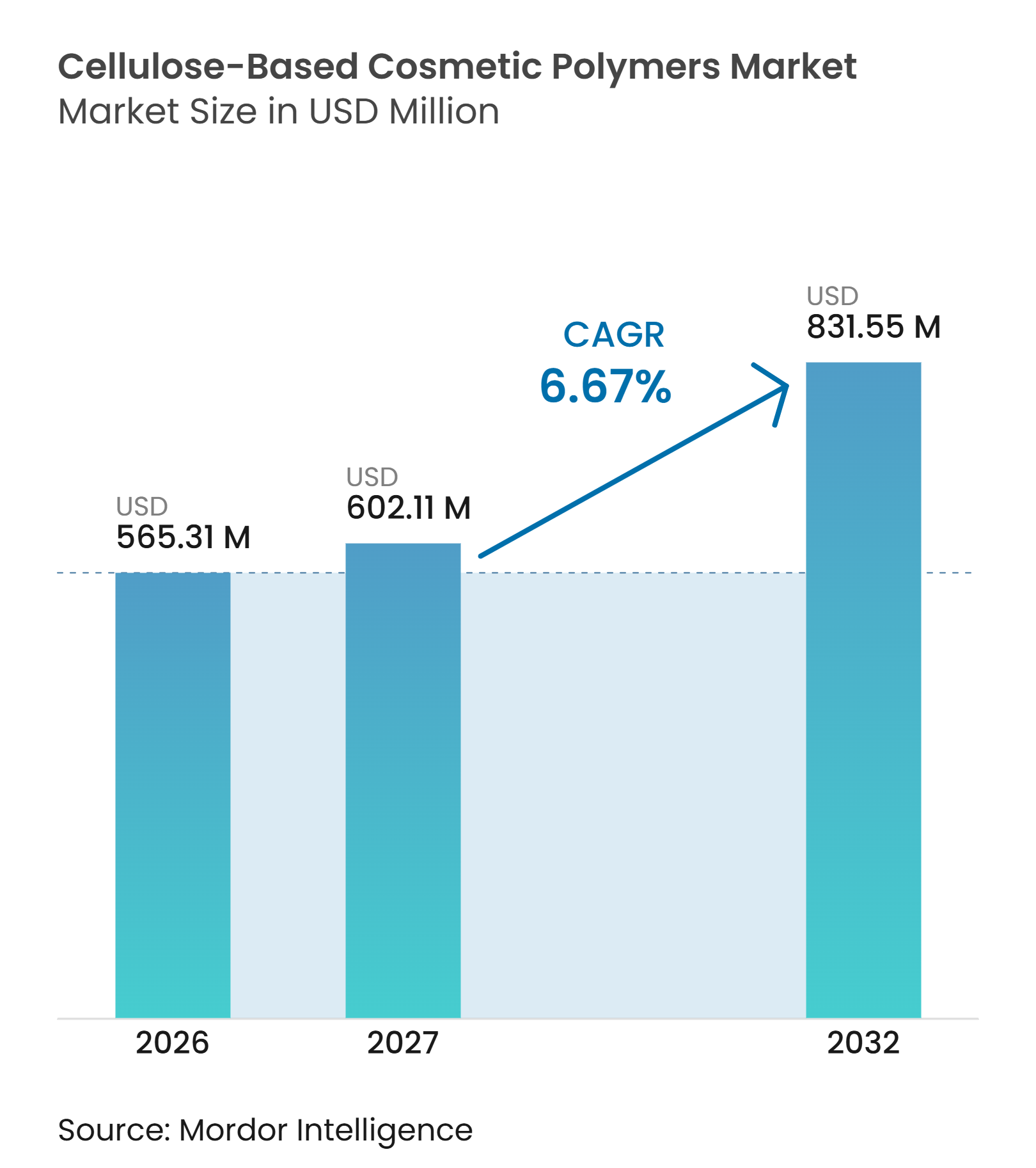
The Cellulose-Based Cosmetic Polymers Market size was valued at USD 565.31 million in 2026 and is estimated to grow from USD 602.11 million in 2027 to reach USD 831.55 million by 2032, at a CAGR of 6.67% during the forecast period (2027-2032). Regulatory action on synthetic polymer microparticles and consumer interest in plant-derived ingredients are pushing the same reformulation decisions. This alignment supports demand for biodegradable cellulose materials in both mass and prestige personal care products. Suppliers are responding with certified grades, broader technical support, and materials that perform several formulation functions. Long customer qualification cycles can delay revenue after a reformulation decision, while higher-purity cellulose, bacterial cellulose, and nanofibrillated cellulose create opportunities in specialized formats. The cellulose-based cosmetic polymers market also faces feedstock uncertainty because dissolving-pulp availability, quality, and trade measures can affect formulation costs.
Key Report Takeaways
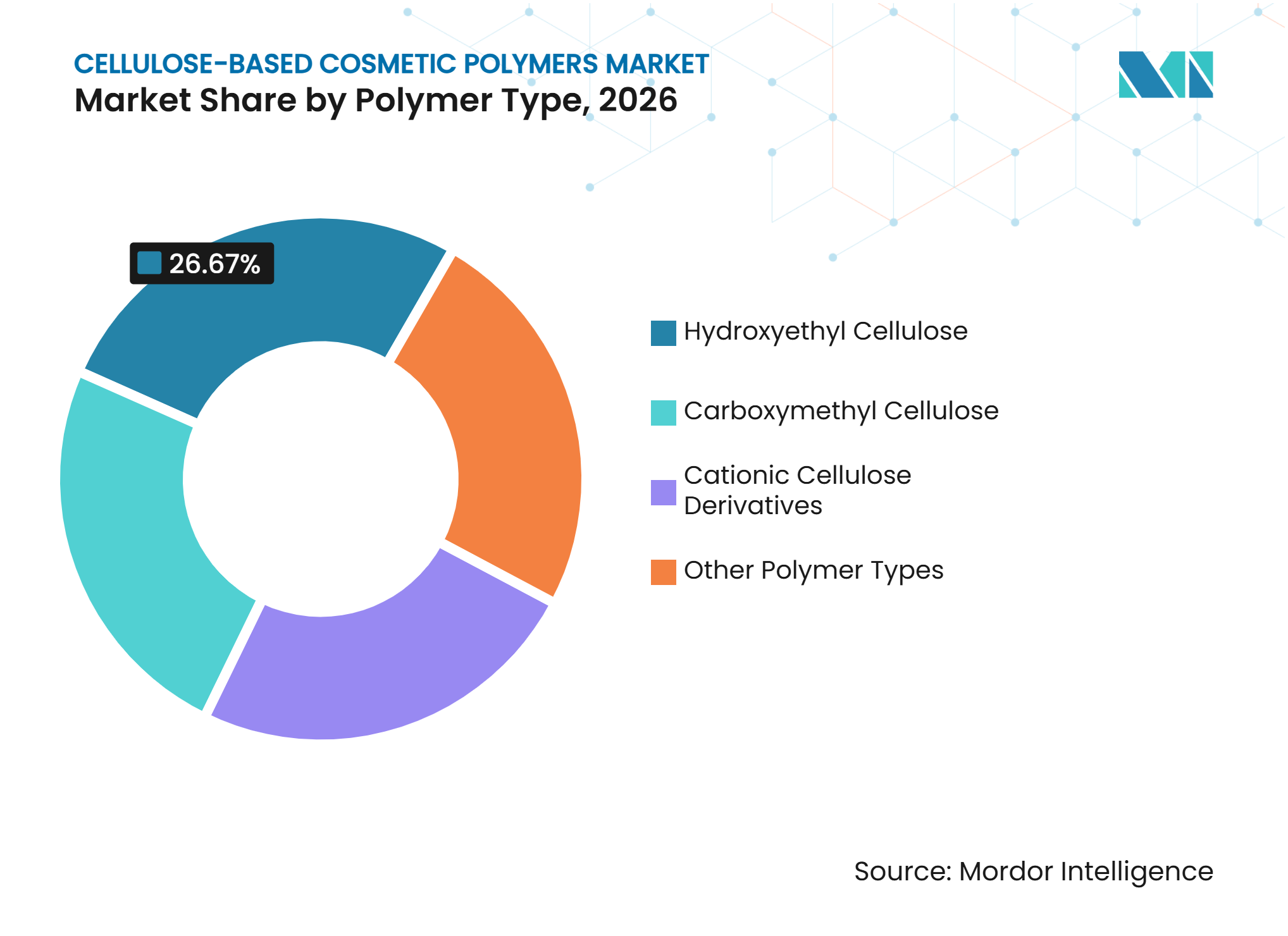
- By polymer type, hydroxyethyl cellulose held 26.67% of the cellulose-based cosmetic polymers market share in 2026, while cationic cellulose derivatives are forecast to advance at a 7.11% CAGR through 2032.
- By function, thickener and rheology modifier held 35.11% of the cellulose-based cosmetic polymers market share in 2026, while conditioning agent is forecast to advance at a 7.45% CAGR through 2032.
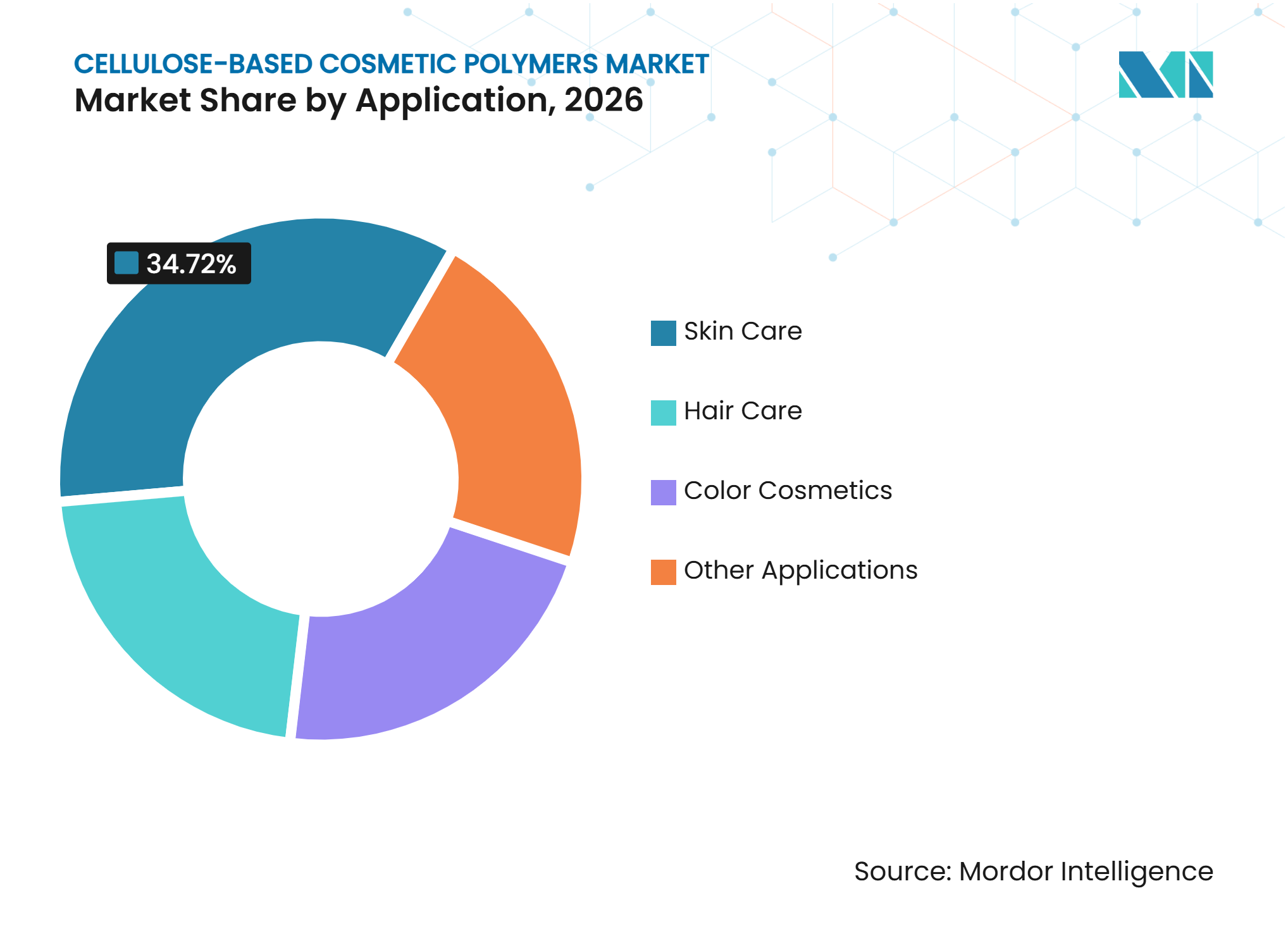
- By application, skin care held 34.72% of the cellulose-based cosmetic polymers market share in 2026, while hair care is forecast to advance at an 8.13% CAGR through 2032.
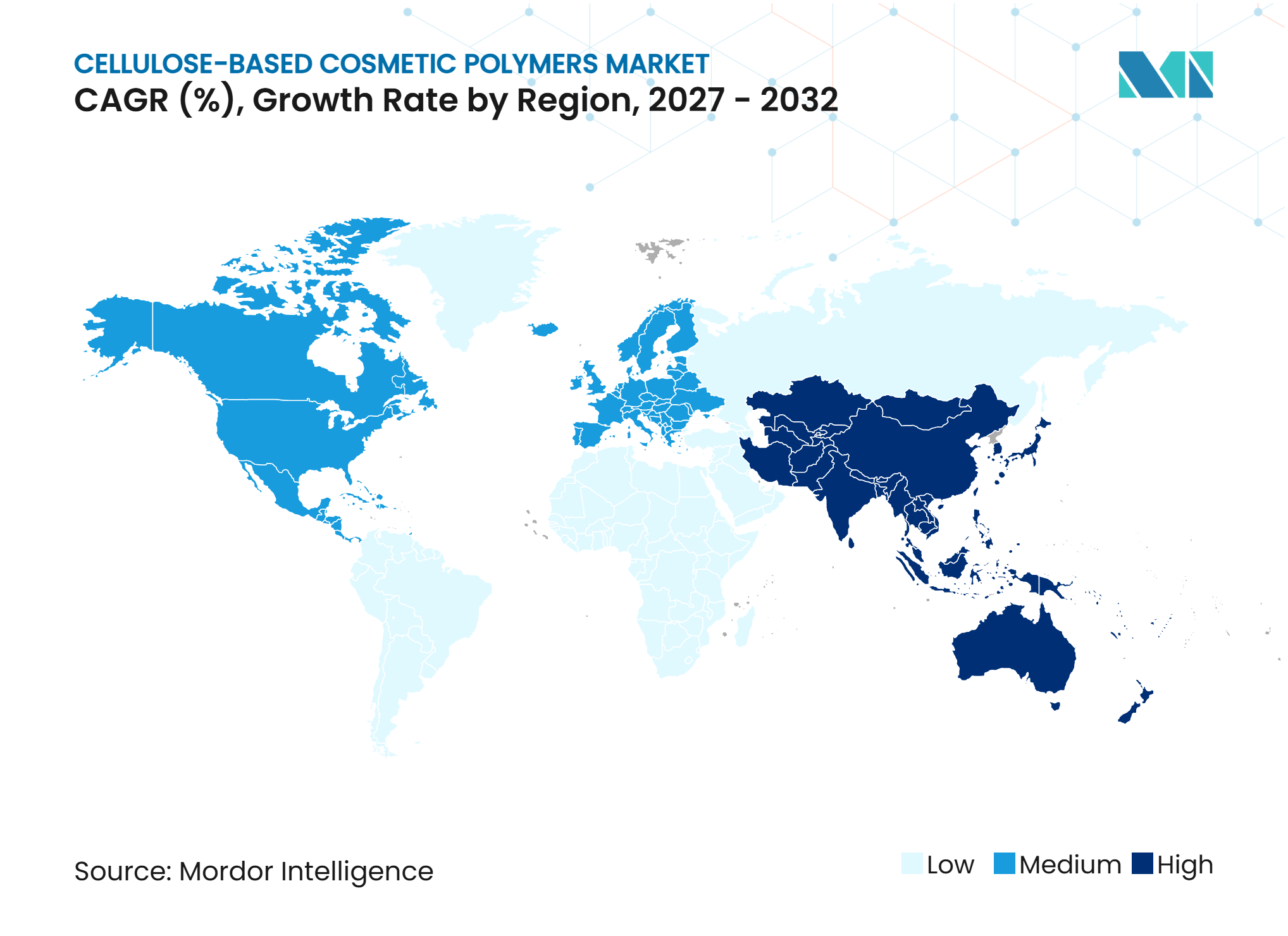
- By geography, Asia-Pacific held 52.78% of the cellulose-based cosmetic polymers market share in 2026 and is forecast to advance at a 7.78% CAGR through 2032.
Note: Market numbers in this report are based on Mordor Intelligence's proprietary estimation framework, which combines nine months of actuals with Q4 projections for base year 2026.
Market Trends and Insights
Drivers Impact Analysis of Cellulose-Based Cosmetic Polymers Market*
| Driver | (~) % Impact on CAGR Forecast | Geographic Relevance | Impact Timeline |
|---|---|---|---|
| Clean-Label and Plant-Derived Ingredient Substitution | +1.8% | Global, with intensity in Europe, North America, and APAC | Medium term (2-4 years) |
| Multifunctional Polymer Demand for Formulation Simplification | +1.5% | Global | Medium term (2-4 years) |
| Microplastics-Restriction-Led Reformulation | +1.3% | Europe core, spillover to APAC and North America | Short term (≤ 2 years) |
| Growth of Low-Surfactant and Surfactant-Free Formulations | +0.9% | APAC core, spillover to Europe | Medium term (2-4 years) |
| Premium Hair Styling and Protective-Film Applications | +0.7% | APAC, South America | Long term (≥ 4 years) |
| Source: Mordor Intelligence | |||
Clean-Label and Plant-Derived Ingredient Substitution
Clean-label requirements now influence personal care reformulation beyond specialist brands. Large consumer product companies are replacing carbomers and polyacrylic acid thickeners with cellulose ethers that can support plant-origin and Cosmetic Organic and Natural Standard (COSMOS) certification claims. The COSMOS Organic Standard version 4.2, effective from September 2025, requires at least 20% of finished-product ingredients by weight to be certified organic, which increases the value of approved cellulose derivatives in qualifying formulations. ISO 16128 gives brands a framework for calculating natural-origin indices, and naturality scores are becoming relevant in raw-material selection. Ashland introduced Natrathix bio cellulose at In-Cosmetics Global in April 2025, presenting a COSMOS-approved material intended to provide gel clarity, suspension stability, and electrolyte tolerance. The cellulose-based cosmetic polymers market benefits because plant-derived sourcing is increasingly built into product development plans that are difficult to reverse.
Multifunctional Polymer Demand for Formulation Simplification
Personal care brands are reducing ingredient counts to lower formulation complexity and improve label transparency. A cationic or hydrophobically modified cellulose grade can provide viscosity, conditioning deposition, film formation, and electrolyte stabilization in one material. Research published in 2026 found that hydroxyethyl cellulose can act as the sole carbohydrate polymer scaffold in surfactant-free serums while supporting hydration and structural stability. Dow received a U.S. patent in September 2025 for crosslinked cellulose ether films designed for personal care pods, showing the relevance of cellulose materials in dosage formats that need structural integrity and controlled release[1]. This demand supports the cellulose-based cosmetic polymers market where formulation efficiency and performance must be delivered together.
Microplastics-Restriction-Led Reformulation
European Union Regulation 2023/2055 requires rinse-off cosmetic products to comply with restrictions on synthetic polymer microparticles from October 17, 2027, with later deadlines for leave-on, lip, nail, and makeup products[2]. Formulators need time for product testing, packaging changes, and commercial launch preparation, so the 2027 and 2029 deadlines are already shaping procurement decisions. The first annual reporting deadline for microplastics emissions was May 31, 2026, covering estimated emissions during 2025, which increased internal scrutiny of synthetic polymer use. Cellulose acetate particles, nanofibrillated cellulose, and cellulose ester micropowders are suitable options for several particle-based cosmetic applications. Eastman Chemical Company launched Esmeri CC1N10 in June 2025 as a cellulose ester micropowder for color cosmetics and later launched Esmeri SK1N10 for skin care and sun protection products. The cellulose-based cosmetic polymers market is therefore gaining demand from compliance-led reformulation as well as consumer-facing sustainability claims.
Growth of Low-Surfactant and Surfactant-Free Formulations
Sulfate-free and low-surfactant shampoo products are extending from premium products into broader consumer categories in Asia-Pacific and Europe. Hydroxyethyl cellulose is used to create transparent gel systems when sulfated surfactants cannot provide their usual thickening effect. Amino-acid surfactants can form coacervates with cationized cellulose, helping deposit conditioning material on wet hair, and this supports demand for Cationic Cellulose Derivatives. Research at Aalto University also found that cellulose nanofibers can maintain foam stability and rheological performance in systems with lower surfactant loading. The cellulose-based cosmetic polymers market gains from these formats because synthetic substitutes can undermine both the mildness profile and the plant-derived positioning of the finished product.
Restraints Impact Analysis of Cellulose-Based Cosmetic Polymers Market*
| Restraint | (~) % Impact on CAGR Forecast | Geographic Relevance | Impact Timeline |
|---|---|---|---|
| Feedstock Price and Quality Volatility | -0.8% | Global, particularly North America and Europe | Short term (≤ 2 years) |
| Formulation Solubility and Viscosity Trade-Offs | -0.6% | Global | Medium term (2-4 years) |
| Inconsistent Biodegradation Evidence Across Test Environments | -0.5% | Europe (REACH/ECHA), APAC | Medium term (2-4 years) |
| Source: Mordor Intelligence | |||
Feedstock Price and Quality Volatility
Cellulose ether producers rely on high-purity dissolving pulp, and this feedstock faces supply, logistics, and trade pressures. The U.S. Department of Commerce began a countervailing duty investigation into imports of high-purity dissolving pulp from Brazil in September 2025, creating tariff uncertainty for North American buyers. Borregaard reported that cellulose-production disruptions reduced earnings before interest, taxes, depreciation, and amortization by NOK 40 million (approximately USD 3.7 million) in the third quarter of 2025. RYAM reported softer acetate demand associated with tariff effects and customer destocking. Formulators also face minimum order quantities and extended lead times when they source from primary cellulose producers. These factors can limit the cellulose-based cosmetic polymers market when buyers need predictable costs and consistent viscosity performance.
Formulation Solubility and Viscosity Trade-Offs
Cellulose ether performance depends on degree of substitution, molecular-weight distribution, and the ionic conditions of each formulation. Hydroxyethyl cellulose generally performs across a broad pH range, but poorly managed hydration can cause non-uniform gel formation during batch mixing. Some delayed-dispersibility grades require modified processing, which adds development time and cost. In cold-process production, warm-water hydration requirements for some hydroxypropyl methylcellulose grades can narrow the available material choices. Research in 2025 found that chemical substitution, which can improve thickening performance, also affects biodegradation rates. The cellulose-based cosmetic polymers market must address this balance because environmentally positioned products also require precise viscosity and dependable sensory performance.
*Our forecasts treat driver/restraint impacts as directional, not additive. The impact forecasts reflect baseline growth, mix effects, and variable interactions.
Cellulose-Based Cosmetic Polymers Market Segment Analysis
By Polymer Type:
Hydroxyethyl Cellulose Leads, While Cationic Cellulose Derivatives ExpandHydroxyethyl cellulose held 26.67% of the cellulose-based cosmetic polymers market share in 2026, reflecting its established use across personal care formulations. Its nonionic nature supports compatibility with cationic actives and conditioning materials across a broad pH range. Carboxymethyl cellulose is used as a stabilizer, film former, and thickener in color cosmetics, peel-off masks, and mild cleansing products. Ethyl cellulose, hydroxypropyl cellulose, and nanofibrillated cellulose are gaining interest in barrier films and waterless products. Cationic cellulose derivatives are projected to advance at a 7.11% CAGR through 2032 because conditioning-centered shampoo and conditioner products are expanding in emerging consumer markets.
Cationic cellulose derivatives can form coacervates with anionic and amino-acid surfactants, which help deposit conditioning agents on hair without added polymer loading. This function differentiates them from nonionic grades in hair cleansing and conditioning systems. Suppliers are adapting cellulose chemistry for conditioning deposition and structured cosmetic formats. Natural-origin scores calculated under ISO 16128 are also becoming a grade-level consideration in supplier selection. These factors support the move toward performance-focused cellulose grades.



By Function:
Thickener and Rheology Modifier Leads, While Conditioning Agent ExpandsThickener and rheology modifier held 35.11% of the cellulose-based cosmetic polymers market share in 2026 because cellulose ethers remain widely used to build viscosity in skin care emulsions, shampoos, and color cosmetics. This function has a broad demand base because most water-based cosmetic products need predictable texture and stability. Carboxymethyl Cellulose and nanocrystalline cellulose also support stabilization in Pickering emulsion systems. Research published in 2025 reported that cellulose nanocrystals can stabilize surfactant-free emulsions. Conditioning agent is projected to advance at a 7.45% CAGR through 2032, supported by premium hair care demand in Asia-Pacific.
Cationic cellulose can provide conditioning benefits at lower concentrations than several competing conditioning materials. Research published in 2025 found that cationic cellulose nanocrystals improved keratin adsorption, glossiness, and thermal-photo protection on hair. Ashland positioned Natrathix bio cellulose as a clear thickener with suspension capabilities, showing how some grades can serve more than one functional role. This combination can reduce ingredient count while maintaining product performance. Suppliers that demonstrate measurable deposition, conditioning, or film-forming benefits can sustain stronger pricing than suppliers selling viscosity alone.
By Application:
Skin Care Leads Demand, While Hair Care Outpaces GrowthSkin care held 34.72% of the cellulose-based cosmetic polymers market share in 2026, supported using hydroxyethyl cellulose and carboxymethyl cellulose in serums, hydrogel moisturizers, mineral sunscreens, and micellar cleansers. These materials provide texture, suspension, and stability in a broad group of water-based products. Color cosmetics are attracting development activity because cellulose ester micropowders can replace synthetic particles in foundations, pressed powders, and lipsticks. Oral care and body care provide additional demand through toothpaste binders, body wash thickeners, and film-forming products. Hair care is projected to advance at an 8.13% CAGR through 2032, driven by premium styling, heat protection, and damage-repair products.
Hair conditioning formats often require higher cellulose ether concentrations than skin emulsions, which supports stronger material demand per unit of product. Cationic Cellulose derivatives are used mainly in shampoos and conditioners where surfactant coacervates deposit conditioning materials onto hair. Research published in 2025 found that spheroidal cellulose powders improved emulsion viscosity, skin hydration, and consumer sensory assessments. Producers serving Asia-Pacific mass-market hair care must also maintain consistent viscosity grades at competitive prices.

Geography Analysis
Asia-Pacific
Asia-Pacific held 52.78% of the cellulose-based cosmetic polymers market share in 2026 and is projected to advance at a 7.78% CAGR through 2032. China has a large cosmetics manufacturing base that sources cellulose ethers from domestic and multinational suppliers. India is gaining demand from rising spending on premium personal care products and the expansion of contract manufacturing. A Japanese sunscreen product launched in February 2025 used bamboo-derived cellulose nanofibers from Chukoh Pulp Industry in a UV milk formulation. Nouryon opened an innovation center in Shanghai in November 2025 that includes a personal care customer experience laboratory and cellulose ether formulation capabilities.
North America
North America is mature, but demand for certified-natural and COSMOS-compliant cellulose ethers is moving faster than product volumes alone. The Modernization of Cosmetics Regulation Act of 2022 strengthens Good Manufacturing Practice expectations and increases the importance of quality documentation and stability data. ISO 22716 guidance remains relevant for suppliers that support customer compliance systems. The dissolving-pulp investigation involving Brazilian imports is encouraging U.S. formulators to consider Nordic, North American, and domestic supply options. Retailer clean-beauty requirements are also encouraging some mass-market hair care formulators to reduce synthetic conditioning polymers.
Europe, South America, and Middle East and Africa
The REACH microplastics restriction is a near-term catalyst for biodegradable cellulose materials in European color cosmetics and skin care products. South America offers demand for conditioning polymers in hair care, particularly in Brazil where textured-hair products have a significant consumer base. The Middle East and Africa are at an earlier stage of formulation development, with demand concentrated in skin-lightening emulsions and rinse-off cleansing products. Suppliers that pair regulatory evidence with locally relevant formulation support have a clear route to build presence across these varied markets.
Competitive Landscape
Market Concentration
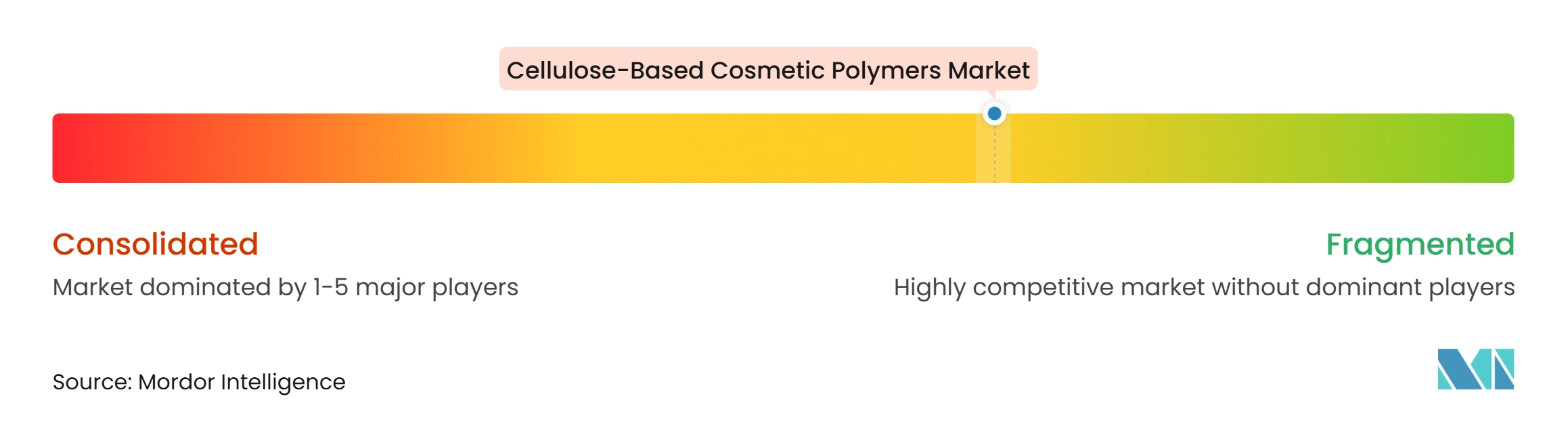
The cellulose-based cosmetic polymers market is moderately concentrated, with the top five players including Ashland, Dow, Shin-Etsu Chemical Co., Ltd., Eastman Chemical Company, and LOTTE Fine Chemical CO., Ltd. Customer qualification can take 12 to 24 months for branded skin care and hair care products, which favors suppliers with established documentation and formulation support. Certified-biodegradable grades for color cosmetics and microfibrillated cellulose platforms for skin care remain areas where specialized producers can build technical positions. Eastman Chemical Company launched Esmeri CC1N10 for color cosmetics in 2025 and Esmeri SK1N10 for skin care and sun protection products in 2026.
Nouryon introduced its BeautyCreations formulation discovery tool in April 2025 to help formulators identify suitable personal care ingredients from its portfolio. The tool may reduce the technical burden for smaller brands and shorten early formulation work. Borregaard committed NOK 308 million (approximately USD 28 million) to the second stage of specialty cellulose capacity expansion at Sarpsborg, with output expected to increase by 5% to 10% from the second half of 2026. Futamura Group and Daicel Corporation are also extending the competitive set through cellulose-based particles that can replace synthetic microbeads. Daicel Corporation introduced BELLOCEA BS7 in March 2025 for texture improvement and microbead replacement in cosmetics.
Compliance requirements increasingly influence supplier selection in premium and European-facing accounts. COSMOS certification, ISO 22716 Good Manufacturing Practice expectations, and European Chemicals Agency reporting requirements under the REACH restriction create a higher threshold for entry. Ashland has positioned Natrathix bio cellulose around COSMOS approval and biodegradable, plant-based formulation performance. Shin-Etsu Chemical Co., Ltd. has continued to invest in pharmaceutical cellulose production in Japan and Europe.
Cellulose-Based Cosmetic Polymers Industry Leaders
-
Ashland
-
Dow
-
Shin-Etsu Chemical Co., Ltd.
-
Eastman Chemical Company
-
LOTTE Fine Chemical CO.,Ltd.
- *Disclaimer: Major Players sorted in no particular order
Cellulose-Based Cosmetic Polymers Market Companies Covered in this Report
- Ashland
- Borregaard AS
- Celanese Corporation
- Colorcon, Inc.
- CP Kelco
- Daicel Corporation
- Dow
- Eastman Chemical Company
- FENCHEM
- Futamura Group
- LOTTE Fine Chemical CO.,Ltd.
- Mitsubishi Chemical Corporation
- Nouryon
- RYAM
- Shin-Etsu Chemical Co., Ltd.
Recent Industry Developments in Cellulose-Based Cosmetic Polymers Market
- October 2026: Eastman Chemical Company introduced Esmeri SK1N10, a readily biodegradable, non-nano cellulose ester micropowder designed for skincare and suncare formulations. The ingredient provides soft-focus effects, shine control, improved skin feel, and UV-filter performance, supporting the cellulose-based cosmetic polymers market through expanded applications of biodegradable cellulose-based ingredients in personal care products.
- April 2026: Weidmann Fiber Technology launched Celova Care Gel, a microfibrillated cellulose-based ingredient developed for skincare, suncare, color cosmetics and haircare formulations. The gel offers film-forming properties, smooth textures, and compatibility with standard homogenization processes, supporting the cellulose-based cosmetic polymers market through expanded use of renewable cellulose ingredients in cosmetic formulations.
Global Cellulose-Based Cosmetic Polymers Market Report Scope
Cellulose-based cosmetic polymers are plant-derived ingredients produced by modifying cellulose to achieve specific functional properties in personal care formulations. They provide viscosity control, conditioning, and formulation stability while supporting the performance and texture of cosmetic products.
The Cellulose-Based Cosmetic Polymers Market is segmented by polymer type, function, application, and geography. By polymer type, the market is segmented into hydroxyethyl cellulose, cationic cellulose derivatives, carboxymethyl cellulose, and other polymer types. By function, the market is segmented into thickener and rheology modifier, conditioning agent, stabilizer and emulsion stabilizer, and other functions. By application, the market is segmented into skin care, hair care, color cosmetics, and other applications. The report also covers the market size and forecasts for cellulose-based cosmetic polymers across 15 countries. For each segment, the market sizing and forecasts have been done on the basis of value (USD).
Segmentation Overview
| Hydroxyethyl Cellulose |
| Cationic Cellulose Derivatives |
| Carboxymethyl Cellulose |
| Other Polymer Types |
| Thickener and Rheology Modifier |
| Conditioning Agent |
| Stabilizer and Emulsion Stabilizer |
| Other Functions |
| Skin Care |
| Hair Care |
| Color Cosmetics |
| Other Applications |
| Asia-Pacific | China |
| India | |
| Japan | |
| South Korea | |
| ASEAN Countries | |
| Rest of Asia-Pacific | |
| North America | United States |
| Canada | |
| Mexico | |
| Europe | Germany |
| United Kingdom | |
| France | |
| Italy | |
| NORDIC Countries | |
| Rest of Europe | |
| South America | Brazil |
| Argentina | |
| Rest of South America | |
| Middle East and Africa | Saudi Arabia |
| South Africa | |
| Rest of Middle East and Africa |
| By Polymer Type | Hydroxyethyl Cellulose | |
| Cationic Cellulose Derivatives | ||
| Carboxymethyl Cellulose | ||
| Other Polymer Types | ||
| By Function | Thickener and Rheology Modifier | |
| Conditioning Agent | ||
| Stabilizer and Emulsion Stabilizer | ||
| Other Functions | ||
| By Application | Skin Care | |
| Hair Care | ||
| Color Cosmetics | ||
| Other Applications | ||
| By Geography | Asia-Pacific | China |
| India | ||
| Japan | ||
| South Korea | ||
| ASEAN Countries | ||
| Rest of Asia-Pacific | ||
| North America | United States | |
| Canada | ||
| Mexico | ||
| Europe | Germany | |
| United Kingdom | ||
| France | ||
| Italy | ||
| NORDIC Countries | ||
| Rest of Europe | ||
| South America | Brazil | |
| Argentina | ||
| Rest of South America | ||
| Middle East and Africa | Saudi Arabia | |
| South Africa | ||
| Rest of Middle East and Africa | ||
Key Questions Answered in the Report
What is the size of the cellulose-based cosmetic polymers market?
The cellulose-based cosmetic polymers market size was valued at USD 565.31 million in 2026 and is estimated to grow from USD 602.11 million in 2027 to reach USD 831.55 million by 2032, at a CAGR of 6.67% during the forecast period (2027-2032).
What is driving demand for cellulose-based cosmetic polymers?
Plant-derived ingredient demand, multifunctional formulation needs, microplastics restrictions, and low-surfactant product development are supporting demand.
Which polymer type held the largest share in 2026?
Hydroxyethyl cellulose held a 26.67% share in 2026 because it performed reliably across a wide range of skin care, hair care, and color cosmetic products.
Which application is projected to advance fastest through 2032?
Hair care is projected to advance at an 8.13% CAGR through 2032, supported by styling, heat-protection, and damage-repair products.