
CDN For OTT Market Size and Share
Market Overview
| Study Period | 2020 - 2031 |
|---|---|
| Market Size (2026) | USD 2.93 Billion |
| Market Size (2031) | USD 5.44 Billion |
| Growth Rate (2026 - 2031) | 13.21 % |
| Fastest Growing Market | Asia-Pacific |
| Largest Market | North America |
| Market Concentration | Medium |
Major Players *Disclaimer: Major Players sorted in no particular order Image © Mordor Intelligence. Reuse requires attribution under CC BY 4.0. | |
CDN For OTT Market Analysis by Mordor Intelligence
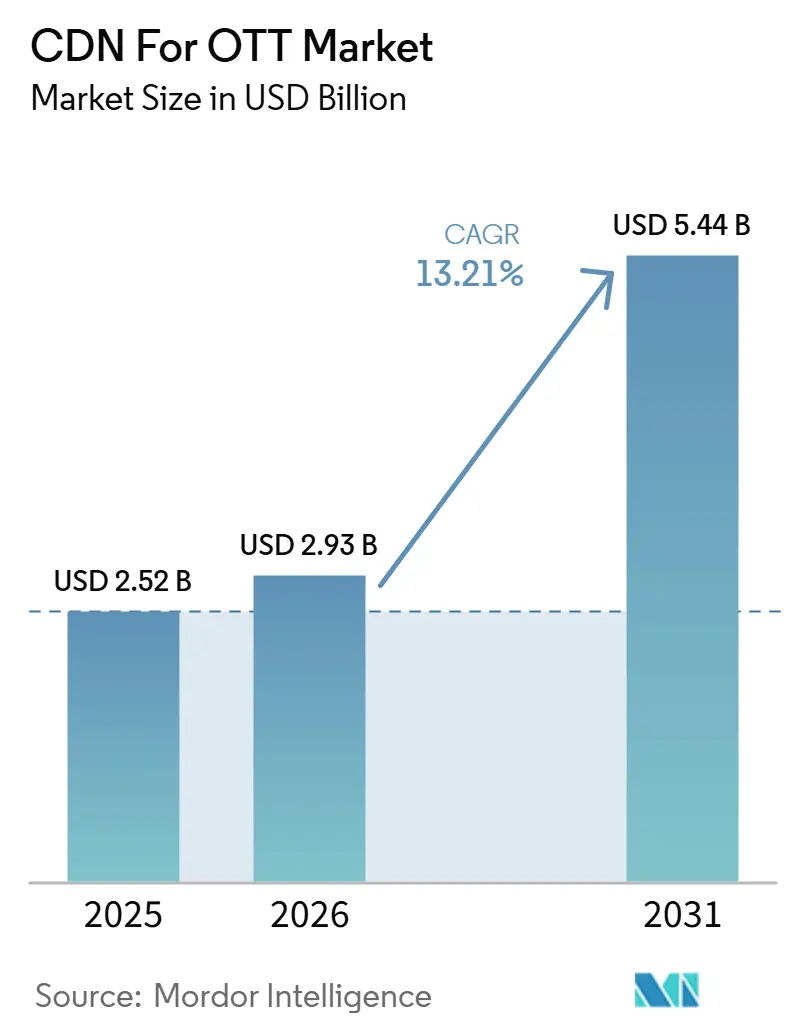
The CDN for the OTT market size is projected to expand from USD 2.52 billion in 2025 and USD 2.93 billion in 2026 to USD 5.44 billion by 2031, registering a CAGR of 13.21% between 2026 and 2031. Growth reflects changes in video delivery infrastructure rather than traffic volume alone, as streaming places substantial demands on internet capacity and delivery performance across content libraries, live events, device types, and geographically dispersed audiences. Higher expectations for video quality are raising the value of media delivery, traffic steering, security, and delivery analytics, because platforms must maintain a reliable viewing experience even when traffic rises quickly or local networks differ widely. Providers are responding by combining delivery with cloud, security, and edge capabilities, which can increase contract scope while making price competition more difficult for independent vendors without adjacent compute, storage, or protection revenue. Large streaming platforms are also reducing their reliance on external CDNs, shifting opportunities toward mid-sized and regional platforms that cannot justify proprietary networks. The CDN for the OTT market, therefore, depends on providers that can manage both delivery performance and operating costs across varied local network conditions, while helping customers handle changing video formats, uneven last-mile quality, and increasingly complex security requirements.
Key Report Takeaways
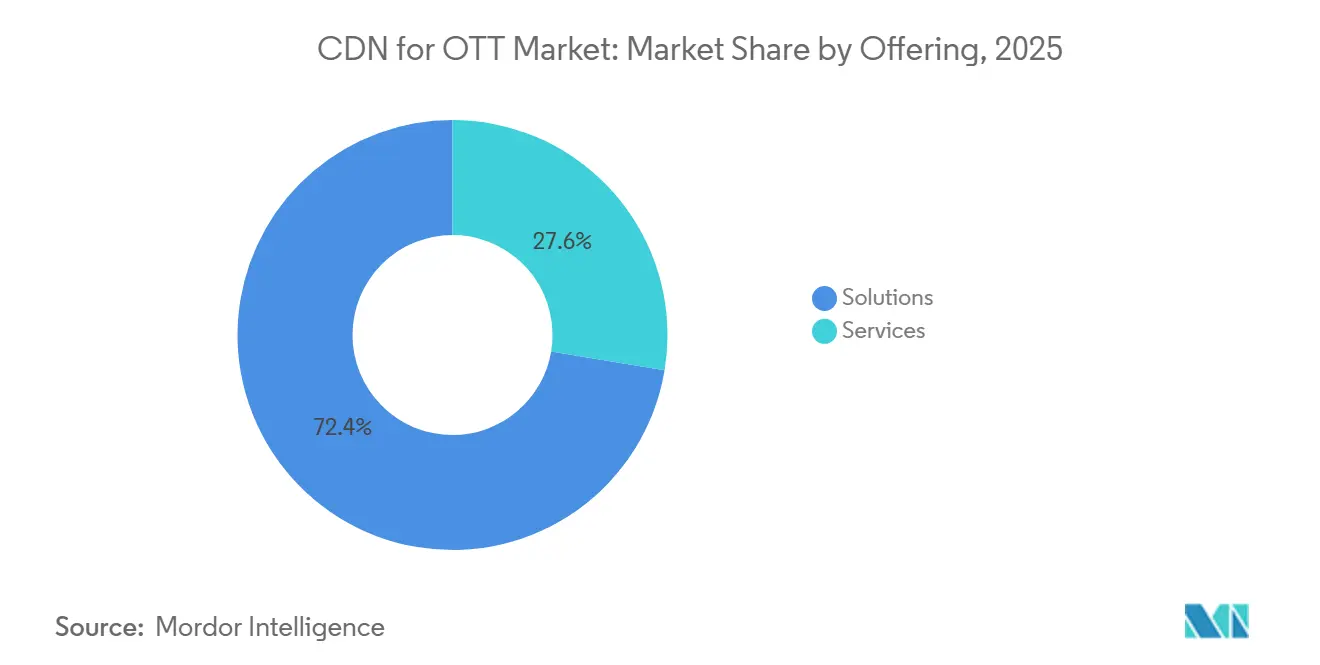
- By offering solutions held 72.38% of the CDN for the OTT market total spending in 2025, while services are projected to expand at a CAGR of 13.91% through 2031.
- By streaming type, video on demand accounted for 47.26% of revenue in 2025, while live video streaming is projected to expand at a CAGR of 13.78% through 2031.
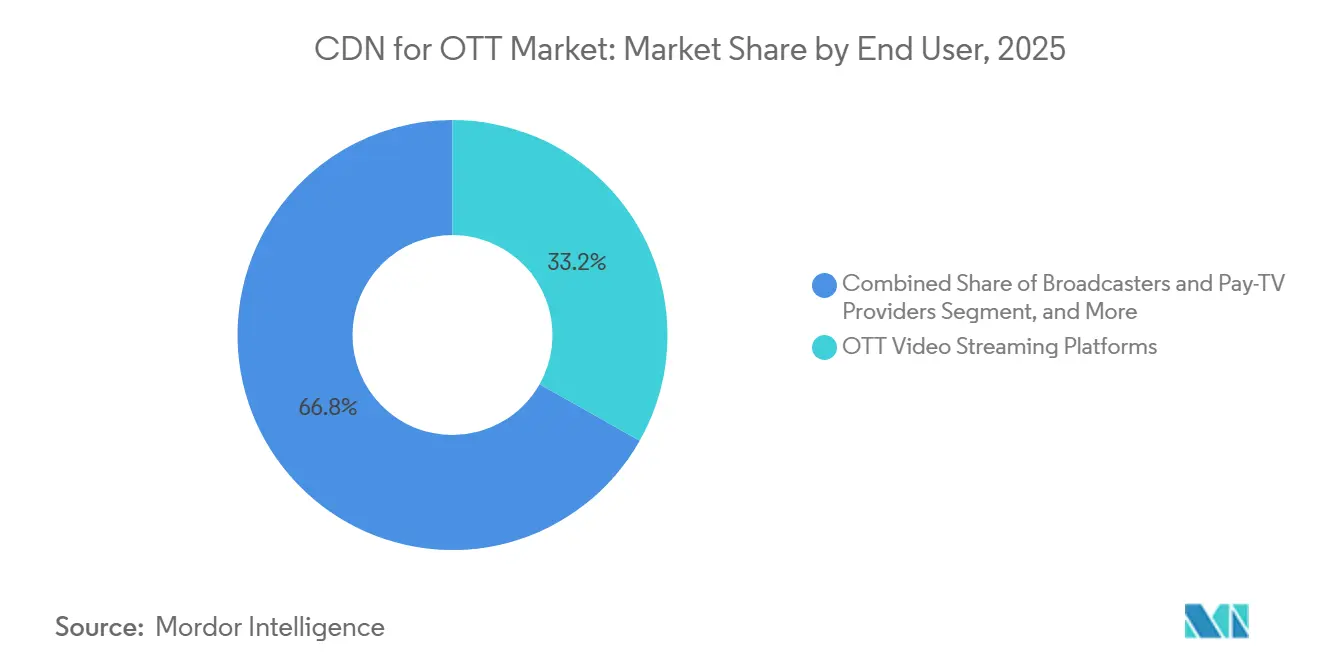
- By end user, OTT video streaming platforms held 33.18% share of spending in 2025, while broadcasters and pay-TV providers are projected to expand at a CAGR of 13.71% through 2031.
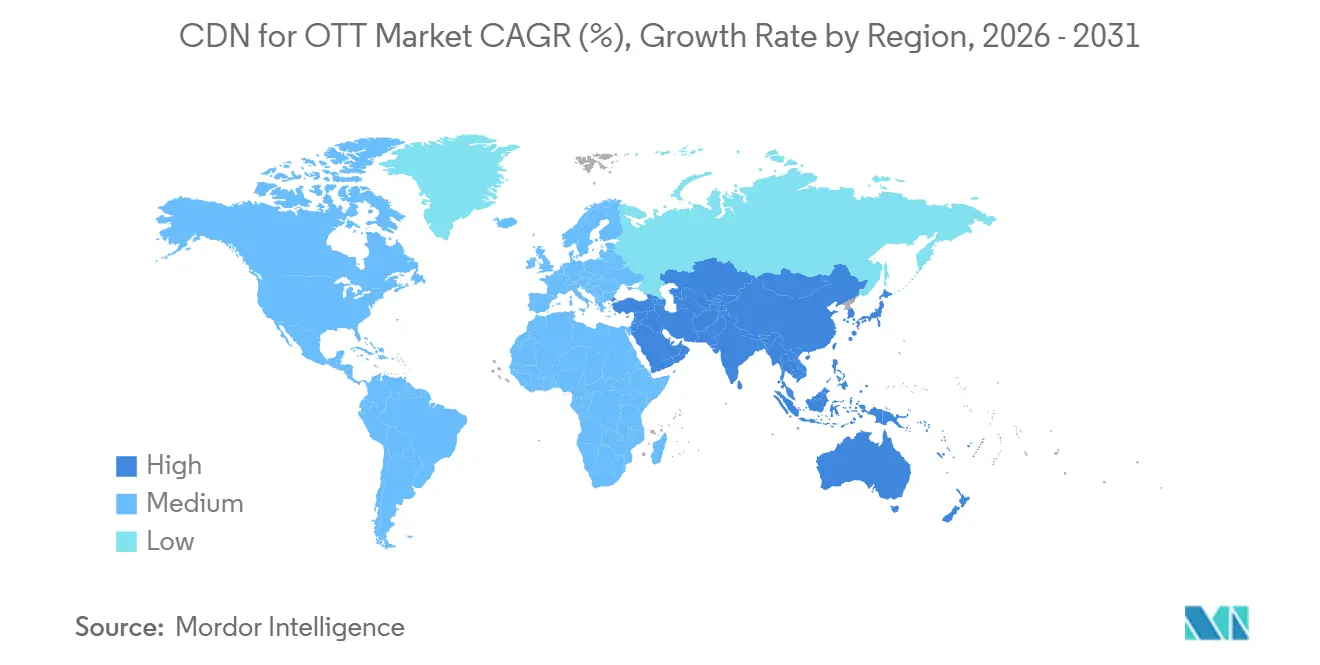
- By geography, North America accounted for 37.74% of the CDN for the over-the-top (OTT) market revenue in 2025, while Asia-Pacific is projected to expand at a CAGR of 13.96% through 2031.
Note: Market size and forecast figures in this report are generated using Mordor Intelligence’s proprietary estimation framework, updated with the latest available data and insights as of January 2026.
Market Trends and Insights
Drivers Impact Analysis of CDN For OTT Market*
| Driver | (~) % Impact on CAGR Forecast | Geographic Relevance | Impact Timeline |
|---|---|---|---|
| OTT Video Traffic and 4K and 8K Adoption | +2.8% | Global, with peak impact in North America and Asia-Pacific | Short term (≤ 2 years) |
| Low-Latency Live Streaming and Interactive Media Demand | +2.4% | Global, strongest in North America, Asia-Pacific, and Europe | Short term (≤ 2 years) |
| 5G, Fiber, and Edge Infrastructure Expansion | +2.1% | Asia-Pacific, especially China, India, and South Korea, with spillover to the Middle East and South America | Medium term (2-4 years) |
| CDN, Zero-Trust Security, and Web Application Protection Bundling | +1.8% | North America and the EU, with early gains in Japan, South Korea, and Australia | Medium term (2-4 years) |
| AI-Optimized Routing and Semantic Caching | +1.5% | Global, led by North America and Asia-Pacific cloud infrastructure deployments | Medium term (2-4 years) |
| Network API Exposure and Energy-Aware Edge Planning | +0.9% | North America and Western Europe initially, with broader Asia-Pacific rollout by 2028-2029 | Long term (≥ 4 years) |
| Source: Mordor Intelligence | |||
OTT Video Traffic and 4K and 8K Adoption
Streaming delivery is changing at the resolution and session-count layers, with direct implications for CDN cache architecture. The CDN for the OTT market is adapting as 1080p HDR became the baseline for many live events in 2025, while providers also prepare for wider use of advanced codecs. Netflix stated that nearly 30% of its streams used AV1 by 2025, a format that can reduce bandwidth per stream but requires revised cache configurations, device certification, and multiple packaging tiers.[1]Netflix Technology Blog, “Behind the Streams, Three Years of Live at Netflix, Part 1,” Netflix Technology Blog, netflixtechblog.com Providers that postponed 4K upgrades during the 2022-2024 cost-control period now face a shorter modernization window because edge caches must serve multiple codec variants. This need favors software capabilities that coordinate formats, cache placement, and performance monitoring across different devices, especially when the same program must reach connected televisions, mobile phones, browsers, and older consumer hardware. It also means that delivery quality depends on more than adding transport capacity, especially when platforms must support both legacy and newer devices.
Low-Latency Live Streaming and Interactive Media Demand
Live streaming creates a delivery requirement that differs from video on demand, as content must move closer to viewers before demand peaks. Achieving end-to-end live delivery below 5 seconds requires an edge node within 200 km of the viewer, while video on demand can tolerate a 500 ms cold-cache fetch. This constraint directs live-event contracts toward operators with dense edge footprints and dependable local capacity, since viewers respond immediately to delay during sports, creator broadcasts, and other time-sensitive programming. Sports rights holders increasingly need sub-second delivery to support in-play betting and interactive overlays, which creates a specialized procurement need. The CDN for the over-the-top (OTT) market benefits when live delivery is treated as a distinct workload with its own routing, cache keys, and failure-recovery requirements, rather than as an extension of the delivery model for on-demand catalog content.
5G, Fiber, and Edge Infrastructure Expansion
The growth of 5G, fiber, and edge infrastructure is changing the relationship between telecom operators and CDN providers. 3GPP and ETSI MEC standards support edge computing within base-station clusters, making local processing a core part of operator network designs. Operators therefore have proximity infrastructure that traditional CDN providers otherwise must build or lease, and they can make access-network relationships part of the commercial and technical delivery arrangement. The CDN for the OTT industry is seeing telecom operators become co-delivery partners or direct competitors through open caching deployments. This transition can improve local delivery performance, but it also gives network operators more influence over the placement and economics of edge capacity.
CDN, Zero-Trust Security, and Web Application Protection Bundling
Security has become a central part of CDN procurement for OTT services because credential stuffing, stream-level DDoS attacks, and token theft can directly affect rights-holder revenue. Vendors that combine zero-trust access control with delivery can offer buyers a more integrated way to manage access, traffic, and security policy, reducing the operational burden of coordinating separate suppliers during a live service or a security incident. Indonesia’s 2024 Personal Data Protection Law and Vietnam’s 2025 Cybersecurity Law require local-node data processing, which increases the value of regional delivery capacity. The CDN for the OTT market is consequently shaped by security requirements that sit alongside performance and availability criteria, particularly for services where a compromised account or interrupted live stream can immediately affect customer retention and rights-holder revenue. Providers with local infrastructure and integrated protection tools can be better positioned to meet both content security and data-processing obligations.
Restraints Impact Analysis of CDN For OTT Market*
| Restraint | (~) % Impact on CAGR Forecast | Geographic Relevance | Impact Timeline |
|---|---|---|---|
| Large OTT Platform CDN In-Sourcing | -2.2% | Global, concentrated in North America among Netflix, Amazon, and Apple | Short term (≤ 2 years) |
| Commodity Pricing Pressure and Margin Squeeze | -1.8% | Global, most acute in North America and Europe for legacy pure-play CDN vendors | Short term (≤ 2 years) |
| Last-Mile Bandwidth Bottlenecks in Emerging Economies | -0.8% | Asia-Pacific, especially India tier 2 and tier 3 cities and rural Southeast Asia, with spillover to Africa and South America | Long term (≥ 4 years) |
| Data Center Energy Caps and Sustainability Mandates | -0.5% | North America and Western Europe, with early regulatory signals in Singapore and Japan | Medium term (2-4 years) |
| Source: Mordor Intelligence | |||
Large OTT Platform CDN In-Sourcing
Large OTT platforms are reducing their reliance on commercial CDNs, creating a structural constraint for third-party delivery providers. Netflix’s Open Connect network handled 95% of its global traffic through more than 18,000 proprietary servers in more than 6,000 locations by 2025. Amazon moved a larger share of Prime Video traffic to AWS CloudFront during 2025, while Apple described a hybrid private backbone that uses selective third-party capacity alongside its own infrastructure. Large platforms also reduced vendor counts in multi-CDN stacks from 4-6 to 2-3 providers in 2025, placing retained suppliers under both volume and price pressure and making service reliability a central condition for retaining an allocation. The CDN for the OTT market still has room among publishers managing under 1 Tbps, where building a proprietary delivery network remains economically impractical and would divert management attention away from content acquisition, audience growth, and service operations. Vendors that serve this mid-market well can reduce their exposure to the loss of the largest platform accounts.
Commodity Pricing Pressure and Margin Squeeze
Delivery pricing pressure has persisted even as higher server component costs have complicated CDN providers' cost bases. Akamai announced a 3% monthly client surcharge effective April 1, 2026, with up to 10% adjustments on contract renewals. Its CDN delivery revenue declined 7% year over year in the first quarter of 2026, while cloud infrastructure revenue grew 40%.[2]Akamai Technologies, “Akamai Details Rising Supply Chain Costs and Upcoming Price Adjustments,” Akamai Technologies, akamai.com Pure-play delivery providers have fewer sources of revenue to offset hardware cost cycles than cloud-affiliated competitors, which can fund delivery through a wider customer relationship that also includes infrastructure and security services. The CDN for the OTT market has therefore become more challenging for vendors that compete mainly on bandwidth price and cannot add compute, storage, security, or managed services, because they have less flexibility when component costs change or customers renegotiate delivery commitments. Bundled cloud offerings can preserve customer relationships, but they can also make standalone delivery economics harder to sustain.
*Our forecasts treat driver/restraint impacts as directional, not additive. The impact forecasts reflect baseline growth, mix effects, and variable interactions.
CDN For OTT Market Segment Analysis
By Offering:
Solutions Support Core Delivery Architecture While Services Gain MomentumSolutions commanded 72.38% of the CDN for OTT market share in 2025 and covered media delivery and edge caching, multi-CDN management and traffic steering, streaming security and access control, and delivery analytics and performance optimization. This position reflects the need for platforms to manage delivery logic rather than simply acquire transport capacity, because performance depends on selecting routes, protecting streams, handling failures, and measuring viewer experience in real time, and the CDN for the OTT market increasingly values this coordination when platforms operate across several regions and must respond quickly to changes in audience behavior. Multi-CDN management and traffic steering are gaining in demand as mid-sized OTT operators allocate traffic at the country or individual internet service provider level. Research published at ACM IMC 2025 found that reinforcement-learning-based CDN selection improved video-on-demand quality of experience by 48% and reduced live-streaming rebuffering events by 10x. Streaming security and access control have also moved beyond a licensing function because piracy and credential-stuffing attacks can disrupt monetization during live events.
Services are projected to record a CAGR of 13.91% through 2031, making them the fastest-growing offering subsegment. The CDN market size for OTT services is projected to expand as operators need support for multi-CDN management, origin health monitoring, and real-time failover during live events. The shift is especially relevant to broadcasters and pay-TV providers that have broadcast engineering experience but limited DevOps capacity for cloud-native CDN configurations. These customers often need managed support for digital rights management, geographic restrictions, performance assurance, and incident response, particularly when a major event requires rapid changes to capacity, routing, and access policy. Their requirements can favor providers that pair operational support with a delivery platform. The CDN for the OTT industry can therefore derive greater recurring value when service teams help customers operate complex delivery environments rather than just deploy them.


By Streaming Type:
Video on Demand Provides Volume While Live Video Changes Delivery DesignVideo on demand held 47.26% of revenue in 2025, making it the largest streaming type in the CDN for the OTT market. It provides the baseline traffic that supports edge-cache utilization and can help fund infrastructure needed for live events. As platforms move long-form content to AV1, changes extend to cache sizing, device support, and tiered video-quality delivery. These needs support demand for solutions that manage packaging, formats, and quality levels at the edge, allowing platforms to match available bandwidth and device capability without changing the underlying content workflow for each viewer. Video on demand remains important because a broad content library enables sustained viewing outside major live events. The CDN for the OTT market relies on this recurring traffic because it supports stable cache utilization between periods of intense live-event demand.
Live video streaming is projected to expand at a CAGR of 13.78% through 2031, the fastest rate among streaming types. Its delivery model requires push-aware handling, chunk-level cache keys, and short time-to-live settings for low-latency HLS segments. Linear and FAST channel streaming also require always-on origin ingest, 24-hour server-side ad insertion, and playlist stitching at scale. Synamedia and SoFast announced a strategic partnership in April 2026 to speed deployments of FAST, pay-TV, and video-on-demand services. Audio streaming can use multi-CDN overlay approaches developed for video, thereby reducing marginal delivery costs for platforms that share infrastructure. These workloads show why the CDN for the OTT market must address distinct patterns of caching, scheduling, and service availability.
By End User:
OTT Platforms Lead Spending While Broadcasters and Pay-TV Providers Grow FastestOTT video streaming platforms accounted for 33.18% of spending in 2025, the largest share in the CDN for the OTT market. This concentration includes a divide between tier-1 platforms with more than 100 million subscribers and mid-tier or regional services. The largest platforms have increasingly internalized delivery, while smaller platforms have raised CDN spending as they expand across borders. Digital media, social video, and creator platforms constitute another growth cohort because live commerce requires quick viewer interaction and reliable delivery. Their demand supports the capacity to handle sudden traffic peaks and geographically dispersed audiences, while the interactive nature of live commerce makes delays or failed playback more visible to viewers and sellers. Therefore, the CDN for the over-the-top (OTT) market must support both high-volume distribution and rapid response for services where viewer interaction affects the transaction.
Broadcasters and pay-TV providers are projected to expand at a CAGR of 13.71% through 2031, the fastest end-user rate. Their position is supported by the migration from satellite and conventional broadcast distribution to Internet Protocol delivery in Europe and Asia-Pacific. Broadcasters often require turnkey delivery that includes digital rights management, geographic restriction enforcement, and broadcast-grade availability service-level agreements. These needs can favor managed-service providers over self-configured infrastructure. Music and audio platforms continue to expand as licensing reaches more mobile-first markets where low-bitrate optimization matters.

Geography Analysis
North America CDN for OTT Market
North America held 37.74% of the OTT CDN market share in 2025, supported by the presence of large OTT platforms and a deep base of hyperscaler-affiliated capacity. Contract terms set by major North American platforms can influence international allocations and delivery pricing, since the scale of these accounts affects capacity planning, vendor selection, and the commercial benchmarks used in other regions. US fiber penetration reached 27% of households in 2025, while 5G deployment exceeded 60% of major metropolitan areas, supporting more consistent 4K HDR delivery. Security and privacy requirements, including CCPA-related expectations, are driving unified edge platforms that combine delivery and protection, and this environment supports regional operational needs alongside core content delivery. Large buyer requirements and the broad availability of cloud and access-network infrastructure, therefore, shape the CDN for the OTT market in North America.
APAC CDN for OTT Market
Asia-Pacific is projected to expand at a CAGR of 13.96% through 2031, making it the fastest-growing regional market. The CDN for the over-the-top (OTT) market size in the region is supported by 5G deployment, live-commerce streaming, and underdeveloped last-mile infrastructure in several countries. China has a large domestic provider base, while regional operators can benefit from local data-processing requirements and varied network structures. These conditions increase the need for delivery models that can adapt to country-level network and compliance requirements. Southeast Asian platforms are managing more live commerce and social video activity, which requires resilient local delivery and dependable performance during sudden increases in viewer demand.
EMEA and South America CDN for OTT Market
Europe is shaped by interpretations of the GDPR on data localization and the migration from broadcast to internet protocol delivery in the UK, Germany, France, and the Nordic countries. Article 44 restrictions on cross-border transfers can require localized points of presence that process viewing data within the EU jurisdiction.[3]European Union, “Regulation (EU) 2016/679,” EUR-Lex, eur-lex.europa.eu South America faces higher CDN prices than North America because local infrastructure is more limited, though regional internet exchange investment can narrow this gap. The Middle East and Africa are gaining importance as CDNetworks achieved full network coverage in North Africa and launched points of presence in Ethiopia, Sudan, Ghana, and Togo in January 2026. These regions offer opportunities where local capacity, compliance, and network partnerships matter as much as global scale, since local points of presence can improve performance and help providers address requirements that differ from one country to another.

Competitive Landscape
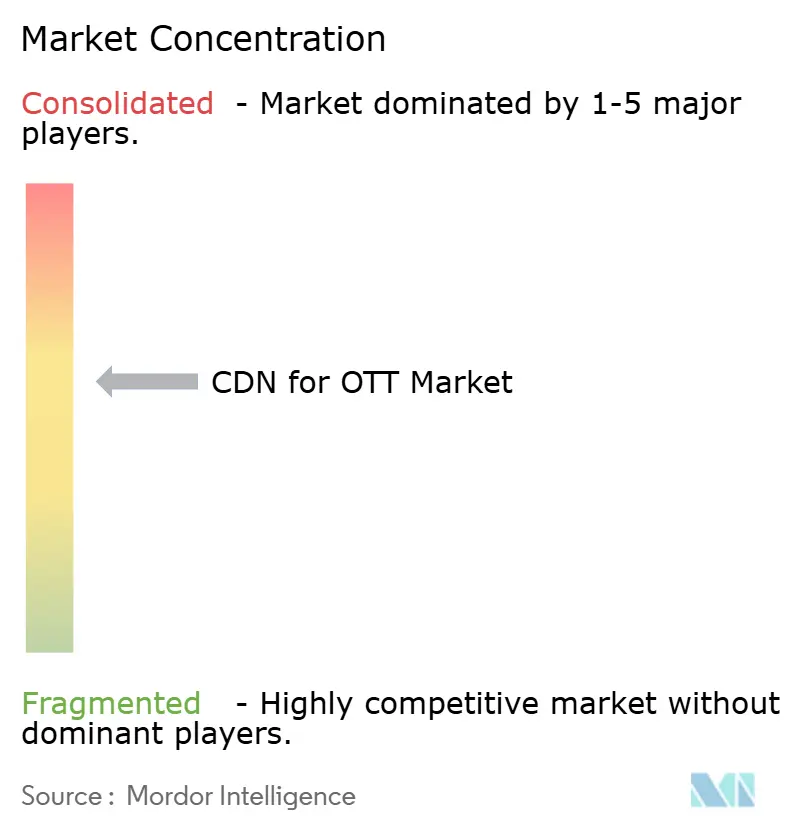
The CDN for the OTT market is moderately concentrated among the largest providers and fragmented below that level. AWS CloudFront, Google Media CDN, and Microsoft Azure CDN are strengthening their positions by combining CDN services with broader cloud agreements. This model can use compute and storage economics to support delivery offers that independent vendors may find difficult to match. Akamai’s CDN delivery revenue declined 7% year over year in the first quarter of 2026, while its cloud infrastructure services revenue increased 40%.
Akamai deployed NVIDIA RTX PRO 6000 Blackwell GPUs across 4,400 edge locations in March 2026 as part of its AI Grid Intelligent Orchestration platform.[4]Akamai Technologies, “Akamai Launches AI Grid Intelligent Orchestration for Distributed Inference Across 4,400 Edge Locations,” Akamai Technologies, akamai.com The deployment supports distributed inference, including video transcoding and real-time dubbing for OTT audiences. CDNetworks expanded to full network coverage in India and doubled CDN capacity in Vietnam in January 2026. These moves show how regional providers can pursue locations where global operators cannot serve local demand as efficiently, especially when data processing, access-network relationships, language requirements, and local traffic patterns favor a provider with established infrastructure. The CDN for the OTT market rewards both broad cloud integration and deep local infrastructure, depending on the customer’s footprint and operational needs.
Qwilt’s Open Edge platform exceeded 2,000 edge nodes across 6 continents in April 2025 and operated within internet-service-provider access networks rather than primarily at internet-exchange points. This approach was designed to place delivery closer to viewers and support low-latency streaming. CacheFly and Red5 announced a partnership in April 2026 to deliver Media over QUIC at a global scale for low-latency video services. The ongoing Media over QUIC standardization process gives providers an avenue to differentiate in sub-second interactive streaming. The CDN for the OTT market is also likely to reward operators that can place relay capacity close to users without creating a separate, costly network for every application, which may be valuable for interactive services where delay is more noticeable than in conventional on-demand viewing.
CDN For OTT Industry Leaders
Akamai Technologies, Inc.
Cloudflare, Inc.
Amazon Web Services, Inc.
Google LLC
Microsoft Corporation
- *Disclaimer: Major Players sorted in no particular order
CDN For OTT Market Companies Covered in this Report
- Akamai Technologies, Inc.
- Cloudflare, Inc.
- Amazon Web Services, Inc.
- Google LLC
- Microsoft Corporation
- Fastly, Inc.
- Wangsu Science and Technology Co., Ltd.
- CDNetworks Co., Ltd.
- Tata Communications Limited
- Verizon Communications Inc.
- AT&T Inc.
- Alibaba Cloud (Singapore) Private Limited
- Tencent Cloud Computing (Beijing) Co., Ltd.
- Gcore S.A.
- Broadpeak
- Imperva, Inc.
- Mux, Inc.
- Quantil, Inc.
- BunnyWay d.o.o.
- Qwilt, Inc.

Recent Industry Developments in CDN For OTT Market
- July 2026: Tata Communications announced USD 152 million in strategic investments to strengthen the India-Singapore digital corridor, acquiring 20 Tbps capacity on the MIST cable system and joining Project CS to add 78 Tbps between Chennai and Singapore by 2029 to support AI-ready OTT and cloud delivery across Asia.
- June 2026: CDNetworks launched a solution to accelerate and secure AI aggregation platforms globally, combining global acceleration with edge-native DDoS defense, web application firewall, bot management, and API security across its 3,000+ PoP network, extending its OTT delivery infrastructure into AI workloads.
- April 2026: CacheFly and Red5 announced a collaboration to deliver Media over QUIC at global scale, combining Red5’s real-time streaming infrastructure with CacheFly’s high-performance CDN to power ultra-low-latency video delivery for OTT platforms.
- April 2026: Synamedia and SoFast announced a strategic partnership at NAB Show 2026, integrating SoFast’s content bundles with Synamedia Go to accelerate deployment of FAST, pay-TV, and video-on-demand services for broadcasters and OTT platforms.


Global CDN For OTT Market Report Scope
The Content Delivery Network (CDN) for the Over-the-Top (OTT) Market comprises software solutions, cloud-based platforms, network infrastructure, edge delivery technologies, and associated services that enable the efficient, secure, and scalable distribution of OTT video, audio, and digital media content over the internet. CDN for OTT technologies optimizes content delivery by caching media assets at geographically distributed edge servers, reducing latency, minimizing buffering, improving streaming quality, and ensuring high availability for viewers across multiple connected devices and network environments.
The CDN for OTT Market Report is Segmented by Offering (Solutions, and Services), Streaming Type (Video on Demand, Live Video Streaming, Linear and FAST Channel Streaming, and Audio Streaming), End User (OTT Video Streaming Platforms, Broadcasters and Pay-TV Providers, Digital Media, Social Video and Creator Platforms, Music and Audio Streaming Platforms, and Enterprises and Education Providers), and Geography (North America, South America, Europe, Asia-Pacific, Middle East, and Africa). The Market Forecasts are Provided in Terms of Value (USD).
| Solutions | Media Delivery and Edge Caching |
| Multi-CDN Management and Traffic Steering | |
| Streaming Security and Access Control | |
| Delivery Analytics and Performance Optimization | |
| Services |
| Video on Demand |
| Live Video Streaming |
| Linear and FAST Channel Streaming |
| Audio Streaming |
| OTT Video Streaming Platforms |
| Broadcasters and Pay-TV Providers |
| Digital Media, Social Video and Creator Platforms |
| Music and Audio Streaming Platforms |
| Enterprises and Education Providers |
| North America | United States |
| Canada | |
| Mexico | |
| South America | Brazil |
| Argentina | |
| Rest of South America | |
| Europe | Germany |
| United Kingdom | |
| France | |
| Italy | |
| Spain | |
| Russia | |
| Rest of Europe | |
| Asia-Pacific | China |
| Japan | |
| India | |
| South Korea | |
| Indonesia | |
| Australia | |
| Rest of Asia-Pacific | |
| Middle East | Turkey |
| Saudi Arabia | |
| United Arab Emirates | |
| Rest of Middle East | |
| Africa | South Africa |
| Nigeria | |
| Egypt | |
| Rest of Africa |
| By Offering | Solutions | Media Delivery and Edge Caching |
| Multi-CDN Management and Traffic Steering | ||
| Streaming Security and Access Control | ||
| Delivery Analytics and Performance Optimization | ||
| Services | ||
| By Streaming Type | Video on Demand | |
| Live Video Streaming | ||
| Linear and FAST Channel Streaming | ||
| Audio Streaming | ||
| By End User | OTT Video Streaming Platforms | |
| Broadcasters and Pay-TV Providers | ||
| Digital Media, Social Video and Creator Platforms | ||
| Music and Audio Streaming Platforms | ||
| Enterprises and Education Providers | ||
| By Geography | North America | United States |
| Canada | ||
| Mexico | ||
| South America | Brazil | |
| Argentina | ||
| Rest of South America | ||
| Europe | Germany | |
| United Kingdom | ||
| France | ||
| Italy | ||
| Spain | ||
| Russia | ||
| Rest of Europe | ||
| Asia-Pacific | China | |
| Japan | ||
| India | ||
| South Korea | ||
| Indonesia | ||
| Australia | ||
| Rest of Asia-Pacific | ||
| Middle East | Turkey | |
| Saudi Arabia | ||
| United Arab Emirates | ||
| Rest of Middle East | ||
| Africa | South Africa | |
| Nigeria | ||
| Egypt | ||
| Rest of Africa | ||


Key Questions Answered in the Report
What is the size of CDN services for OTT delivery?
The CDN for OTT market is projected to grow from USD 2.93 billion in 2026 to USD 5.44 billion by 2031, at a CAGR of 13.21%, as platforms invest in delivery performance, security, and operational support.
Which offering leads content delivery for OTT services?
Solutions led with 72.38% share in 2025 because platforms need media delivery, traffic steering, security, and analytics capabilities that support everyday distribution and high-demand live events.
Which streaming type is expected to grow fastest?
Live video streaming is projected to expand at a CAGR of 13.78% through 2031 because it requires low-latency delivery, dense edge capacity, short cache intervals, and dependable recovery from delivery failures.
Which end users are increasing CDN spending most quickly?
Broadcasters and pay-TV providers are projected to record a CAGR of 13.71% through 2031 as they move from conventional broadcast delivery to OTT services and need managed support for reliable streaming operations.
Which region is expected to grow fastest for CDN-enabled OTT delivery?
Asia-Pacific is projected to expand at a CAGR of 13.96% through 2031, supported by 5G expansion, live commerce, varied last-mile network conditions, and demand for locally responsive delivery capacity.
Why are major OTT platforms reducing third-party CDN use?
Some large platforms can justify proprietary delivery networks, while smaller platforms continue to need third-party delivery, security, and managed services because operating a dedicated global network is resource intensive.
Page last updated on:





