
Cattle Feeder Market Size and Share
Market Overview
| Study Period | 2022 - 2032 |
|---|---|
| Market Size (2027) | USD 4.13 Billion |
| Market Size (2032) | USD 4.98 Billion |
| Growth Rate (2027 - 2032) | 3.81 % |
| Fastest Growing Market | Asia-Pacific |
| Largest Market | North America |
| Market Concentration | Medium |
Major Players *Disclaimer: Major Players sorted in no particular order Image © Mordor Intelligence. Reuse requires attribution under CC BY 4.0. | |
Cattle Feeder Market Analysis by Mordor Intelligence
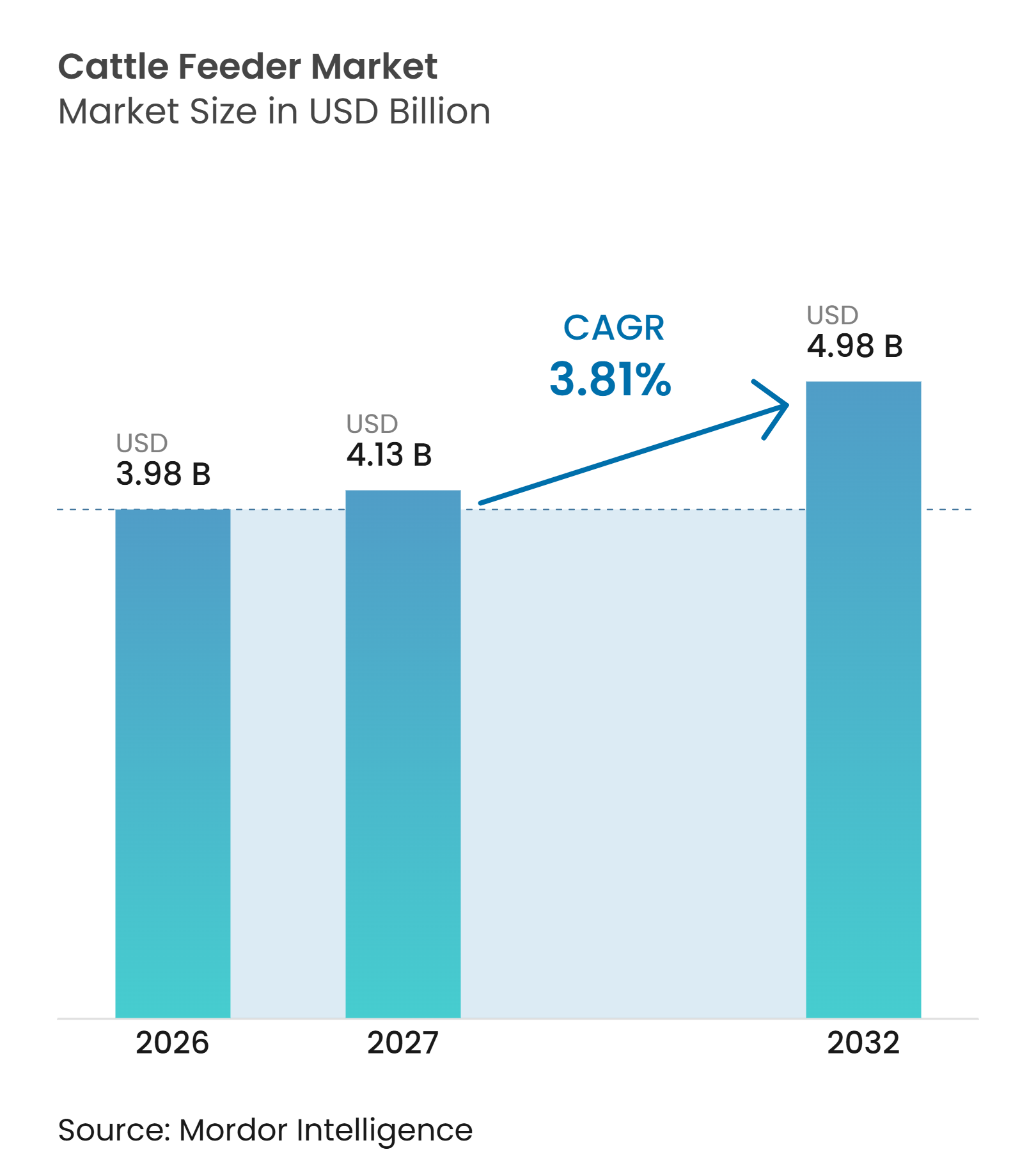
The cattle feeder market size was valued at USD 3.98 billion in 2026 and is forecast to grow from USD 4.13 billion in 2027 to USD 4.98 billion by 2032, registering a CAGR of 3.81% during the forecast period from 2027 to 2032. Market growth is supported by the modernization of dairy and beef operations, increasing emphasis on feed efficiency, and the need to maintain consistent feeding schedules amid labor shortages. Larger livestock farms are increasingly adopting mechanized feeding equipment with automated weighing, dosing, and ration-mixing capabilities to improve feeding accuracy and reduce manual workload. Equipment replacement in established livestock-producing regions and investments in larger commercial farms are anticipated to sustain demand, while compatibility with existing barns, maintenance availability, and after-sales support remain important purchasing considerations. However, high initial investment costs, volatile feed prices, and financing constraints may delay equipment upgrades among smaller livestock operators.
Key Report Takeaways
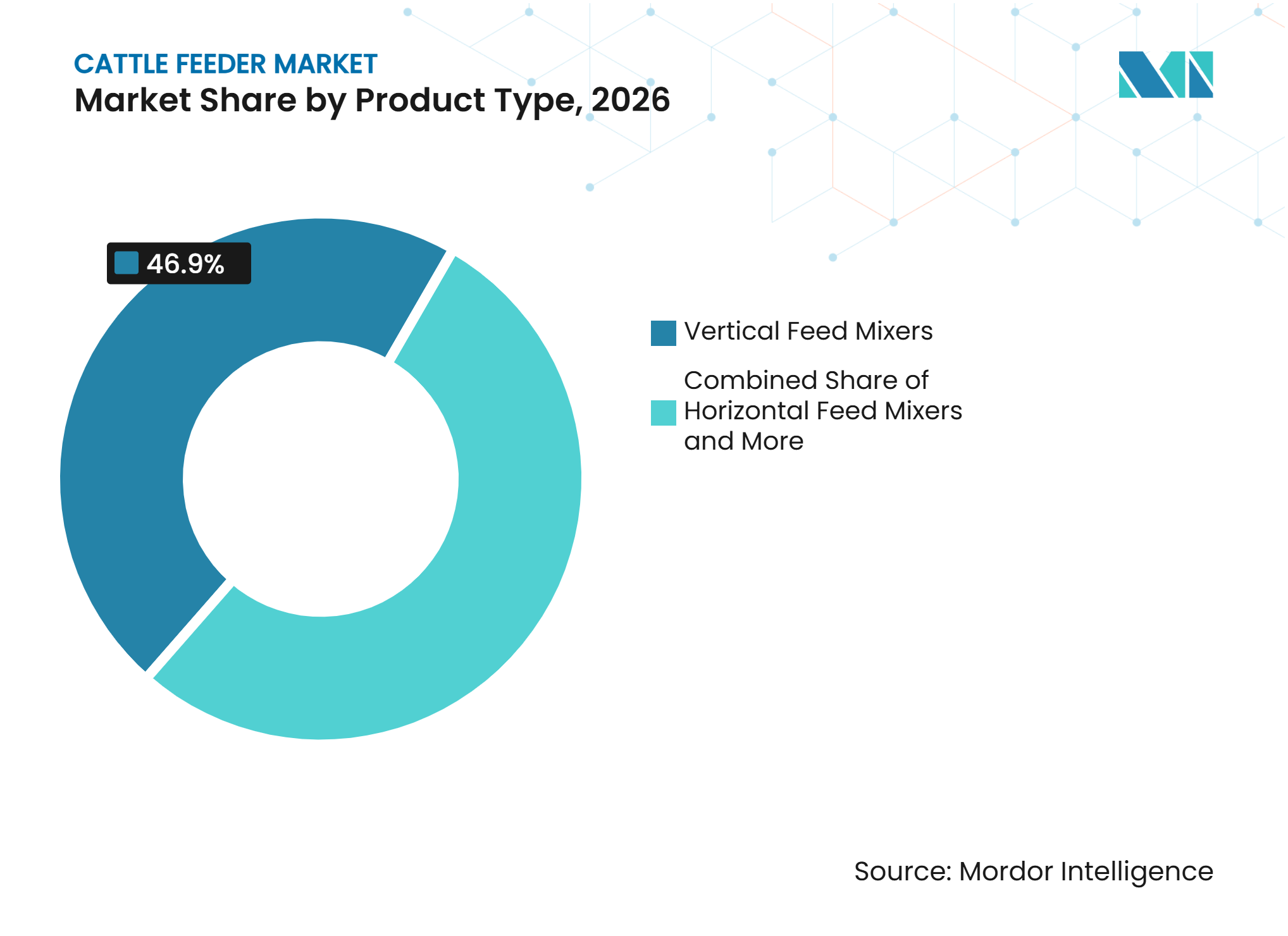
- By product type, vertical feed mixers were the largest segment and held 46.9% of the cattle feeders market share in 2026, while horizontal feed mixers are the fastest-growing segment and are forecast to grow at a 5.6% CAGR between 2027 and 2032.
- By end user, dairy farms were the largest segment and held 54.7% of the cattle feeders market size in 2026, while feedlots are the fastest-growing segment and are forecast to grow at a 5.8% CAGR between 2027 and 2032.
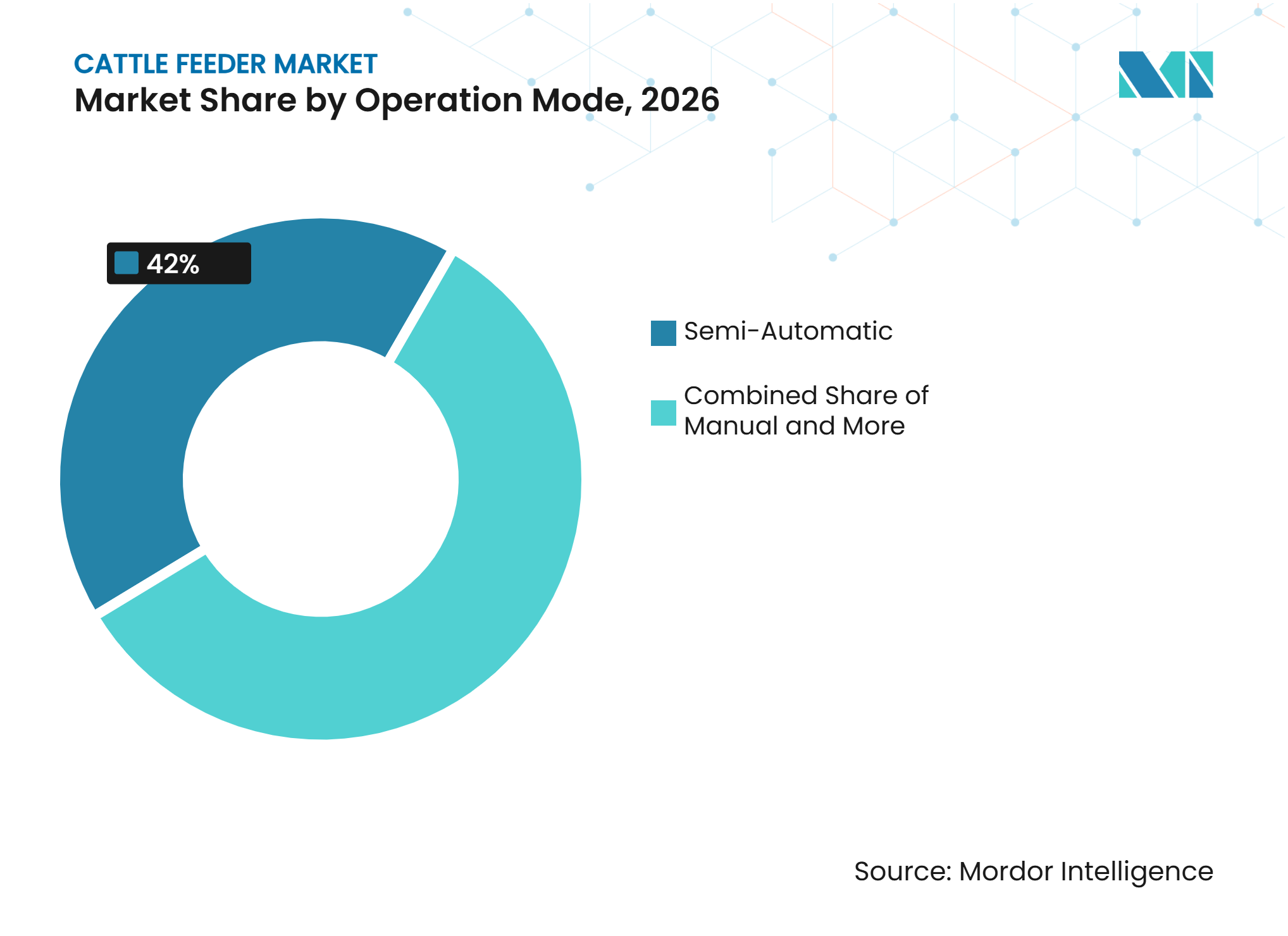
- By operation mode, semi-automatic systems were the largest segment and held 42.0% of the market share in 2026, while autonomous systems are the fastest-growing segment and are forecast to grow at a 12.4% CAGR between 2027 and 2032.
- By geography, North America was the largest region and held 36.5% of the market share in 2026, while Asia-Pacific is the fastest-growing segment and is forecast to grow at a 6.7% CAGR between 2027 and 2032.
Note: Market numbers in this report are based on Mordor Intelligence's proprietary estimation framework, which combines nine months of actuals with Q4 projections for base year 2026.
Market Trends and Insights
Drivers Impact Analysis of Cattle Feeder Market*
| Driver | (~) % Impact on CAGR Forecast | Geographic Relevance | Impact Timeline |
|---|---|---|---|
| Rising Demand for Mechanized and Ration-Controlled Feeding | +0.8% | Global, led by North America and Europe | Medium term (2-4 years) |
| Expansion of Commercial Dairy and Beef Operations | +0.7% | Global, strongest in Asia-Pacific and South America | Medium term (2-4 years) |
| Persistent Livestock-Farm Labor Shortages | +0.6% | North America and Australia, with effects in Europe and Asia-Pacific | Short term (≤ 2 years) |
| Feed Waste Reduction and Feed-Conversion Optimization | +0.5% | Global, with early gains in Germany, France, and the United States | Medium term (2-4 years) |
| Farm Consolidation in Asia-Pacific and South America | +0.5% | China, India, Brazil, and Argentina | Medium term (2-4 years) |
| Replacement Demand from Installed Mixer and Feeder Bases | +0.4% | North America and Europe | Medium term (2-4 years) |
| Source: Mordor Intelligence | |||
Rising Demand for Mechanized and Ration-Controlled Feeding
Rising labor costs and the need for consistent feed preparation are encouraging livestock operators to adopt mechanized cattle feeding systems with programmable ration controls and automated weighing. According to the United States Department of Agriculture's May 2025 Farm Labor report, average wages for hired livestock workers reached USD 18.15 per hour in January 2025, representing a 4% increase from January 2024[1]. Higher labor expenses increase the incentive to mechanize repetitive feeding activities, particularly on commercial dairy and beef farms that prepare and distribute mixed rations daily. In January 2025, Supreme International Limited introduced two Generation 3 total mixed ration (TMR) processors equipped with advanced automated hydrostatic control system for ration programming and telematics-based monitoring. These technologies help operators maintain consistent mixing routines, monitor equipment performance, and manage feeding operations more efficiently. As livestock farms prioritize labor productivity, ration consistency, and operational control, demand is likely to increase for cattle feeders that combine mechanized feed handling with weighing, programmable controls, and remote monitoring capabilities.
Expansion of Commercial Dairy and Beef Operations
The expansion and scaling of commercial dairy farms and beef feedlots are increasing demand for cattle feeders with higher mixing capacity, consistent ration preparation, and efficient feed distribution. Larger herds require substantial quantities of feed to be prepared and delivered on a regular schedule, making mechanized feeding equipment important for maintaining operational efficiency and ration consistency. According to the Food and Agricultural Policy Research Institute (FAPRI), U.S. steer prices averaged USD 227 per hundredweight in 2025, reflecting market conditions that influence beef producers' revenue anticipations and investment decisions[2]. In March 2025, JBS announced plans to invest USD 100 million in two meat-processing facilities in Vietnam, illustrating continued investment in downstream beef-processing capacity. As commercial livestock and processing systems expand, the need to manage feed preparation and delivery efficiently can support investment in larger-capacity cattle feeders. Manufacturers offering durable equipment, consistent mixing performance, and responsive after-sales service are well positioned to serve farms seeking to scale feeding operations and manage costs across larger herds.
Persistent Livestock-Farm Labor Shortages
Persistent labor constraints are encouraging livestock producers to invest in cattle feeding equipment that reduces the time required for feed preparation, mixing, and distribution. According to the U.S. Department of Agriculture's Economic Research Service, H-2A temporary agricultural worker certifications reached approximately 385,000 positions in fiscal year 2024, reflecting continued reliance on temporary foreign labor in U.S. agriculture. However, the H-2A program is primarily designed for temporary or seasonal agricultural work, limiting its suitability for livestock operations that require year-round feeding routines. Mechanized cattle feeders can reduce repetitive manual tasks by combining loading, ration mixing, and feed delivery, allowing existing workers to manage feeding operations more efficiently. Automated and self-propelled systems can further reduce routine driving and feed-out requirements, particularly on larger dairy farms and feedlots. As livestock producers seek to maintain consistent feeding schedules with limited staff, demand is likely to strengthen for cattle feeders that improve labor productivity, simplify daily operations, and reduce dependence on manual feed handling.
Feed Waste Reduction and Feed-Conversion Optimization
Rising feed costs are encouraging livestock producers to improve ration accuracy, reduce feed wastage, and maintain consistent total mixed ration (TMR) quality. Inaccurate ingredient loading, uneven mixing, and inconsistent feed discharge can affect nutrient intake and increase operating costs, making precision-feeding technologies increasingly valuable in commercial dairy and beef operations. Sensors, automated weighing systems, and mixing controls help operators monitor ingredient proportions, maintain consistent ration composition, and identify variations before feed reaches the bunk. Near-infrared (NIR) technology can further support ration management by assessing feed composition and enabling adjustments to nutrient formulations. For example, Dinamica Generale's EVONIR system uses NIR technology to support precision feeding on self-propelled mixer wagons. These capabilities can help farmers manage feed inputs more accurately, reduce avoidable losses, and improve control over daily feeding operations. Consequently, demand for cattle feeders equipped with precision-feeding technologies and compatible monitoring systems is likely to increase as livestock producers seek to optimize feed utilization and manage production costs.
Restraints Impact Analysis of Cattle Feeder Market*
| Restraint | (~) % Impact on CAGR Forecast | Geographic Relevance | Impact Timeline |
|---|---|---|---|
| High Upfront Equipment and Infrastructure Costs | -0.8% | Global, highest in India, South Africa, Mexico, and Brazil | Long term (≥ 4 years) |
| Volatile Feed Prices and Tight Farm Margins | -0.6% | Global, acute in the United States, Brazil, Argentina, and South Africa | Short term (≤ 2 years) |
| Limited Rural Service Capacity for Connected Equipment | -0.4% | Asia-Pacific and the Middle East and Africa, with effects in Latin America | Medium term (2-4 years) |
| Compatibility Constraints in Aging Barns and Feeding Layouts | -0.3% | North America and Europe, particularly Canada and Germany | Medium term (2-4 years) |
| Source: Mordor Intelligence | |||
High Upfront Equipment and Infrastructure Costs
High upfront investment can constrain cattle feeder adoption among small and medium-sized livestock farms, particularly when purchasing a new mixer wagon or self-propelled feeder also requires barn modifications, electrical upgrades, or feed-handling infrastructure. According to the United States Farm Credit Administration's August 2025 report, beginning agricultural producers had an average debt-to-asset ratio of 29%, compared with 18% for established producers[3]. This higher leverage can limit the borrowing capacity of newer operations and make capital-intensive equipment purchases more difficult to finance. Additional costs associated with maintenance, insurance, and equipment servicing further increase the financial commitment. Consequently, farms may continue using older mixer wagons or manual feeding methods rather than invest in newer systems with automated weighing, ration controls, and telematics. These financial barriers can slow equipment replacement and restrict adoption among smaller operations, particularly in regions where affordable financing, dealer support, and servicing infrastructure are limited.
Volatile Feed Prices and Tight Farm Margins
Volatility in feed prices and narrow livestock margins can constrain investment in cattle feeding equipment, particularly when producers prioritize immediate operating expenses over long-term machinery upgrades. According to the Food and Agricultural Policy Research Institute (FAPRI), the projected United States corn price for the 2025–2026 marketing year was USD 4.05 per bushel, highlighting the importance of grain prices in feed-cost planning. Changes in corn and other feed ingredient prices can affect the cost of preparing total mixed rations, while fluctuations in cattle prices influence the revenue available to cover feed, labor, and equipment expenses. When input costs rise or livestock returns weaken, producers may defer purchases of new mixer wagons, self-propelled feeders, and automated ration-management systems to preserve working capital. This can extend the replacement cycle for existing equipment, particularly among smaller farms and feedlots exposed to volatile margins. Consequently, uncertainty in feed costs and farm profitability can delay capital investment and restrain demand growth in the cattle feeder market.
*Our forecasts treat driver/restraint impacts as directional, not additive. The impact forecasts reflect baseline growth, mix effects, and variable interactions.
Cattle Feeder Market Segment Analysis
By Product Type, Vertical Feed Mixers Lead While Horizontal Feed Mixers Grow Faster
Vertical feed mixers held 46.9% of the cattle feeder market share in 2026, making them the leading product segment. Their design supports the mixing of varied forage lengths and feed ingredients into homogeneous total mixed rations (TMR), making them suitable for daily feeding operations across commercial dairy and beef farms. Their availability in different capacities allows manufacturers to serve operations ranging from smaller livestock farms to large commercial facilities. Compatibility with established feeding practices and the ability to handle diverse ration formulations further support adoption, particularly in North America and Europe, where TMR feeding is widely used.
Horizontal feed mixers are forecast to grow at a CAGR of 5.6% from 2027 to 2032, making them the fastest-growing product segment. Their relatively low-profile configurations can suit livestock facilities with restricted overhead clearance, allowing operators to mechanize feeding without major structural modifications. This makes horizontal mixers relevant to older barns and facilities where vertical equipment may be difficult to accommodate. Meanwhile, demand for high-capacity feeding systems is supporting interest in self-propelled and stationary mixer configurations across larger livestock operations. As farms seek equipment that matches their facility layouts, ration requirements, and throughput needs, horizontal mixers are positioned to gain traction in applications where design flexibility and operational fit are important purchasing considerations.



By End User, Dairy Farms Remain Central While Feedlots Expand
Dairy farms accounted for 54.7% of the cattle feeder market share in 2026, making them the leading end-user segment. Lactating dairy herds require consistent, nutrient-balanced rations delivered on a regular schedule, supporting demand for cattle feeders equipped with accurate weighing and mixing functions. The use of multiple forage and concentrate ingredients in dairy rations makes uniform mixing essential for maintaining feed consistency across the herd. These recurring requirements sustain investment in feeding equipment as farms seek to improve operational efficiency and manage feed costs. Demand also extends to equipment servicing, operator training, and digital monitoring features that help maintain consistent feeding routines and equipment performance.
Feedlots are projected to grow at a CAGR of 5.8% from 2027 to 2032. Large-scale feedlot operations require reliable, high-throughput feed preparation and distribution across multiple pens, making mechanized equipment important for maintaining consistent feeding schedules. Labor constraints further increase the value of automation that reduces manual feed handling and repetitive operational tasks. In January 2025, Te Pari reported that an automated cattle induction system installed at Teys Charlton in Australia reduced labor requirements by at least one person per shift. Although this example relates to cattle induction rather than feeding, it illustrates the potential operational benefits of automation in feedlot environments. Demand for high-capacity mixers, efficient feed delivery systems, and equipment suited to intensive operating schedules is therefore anticipated to support cattle feeder adoption as feedlots expand.
By Operation Mode, Semi-Automatic Systems Lead While Autonomous Systems Accelerate
Semi-automatic systems accounted for 42.0% of the cattle feeder market share in 2026, making them the leading operation mode. These systems combine assisted weighing, ingredient dosing, and mixing controls with direct operator supervision, helping farms improve ration accuracy without the investment and infrastructure requirements of fully autonomous equipment. This balance makes semi-automatic feeders suitable for livestock operations transitioning from manual feeding practices while retaining control over daily feeding decisions. Their compatibility with existing farm workflows and relatively straightforward integration into established feeding routines further supports adoption. Semi-automatic systems therefore remain relevant to farms seeking greater consistency and operational efficiency while managing capital expenditure and adapting to varying facility layouts.
Autonomous systems are forecast to grow at a CAGR of 12.4% from 2027 to 2032, the fastest rate among operation modes. These systems can automate recurring feeding tasks, support scheduled feed delivery, and reduce reliance on continuous operator involvement. Their adoption is particularly relevant to larger livestock operations with predictable feeding requirements, where automation can improve scheduling consistency and reduce repetitive labor. Integration with sensors, navigation technologies, and connected farm-management platforms can further support monitoring and coordination of feeding activities. However, implementation depends on suitable barn layouts, reliable connectivity, equipment servicing, and the ability to integrate autonomous systems into existing workflows. Despite these adoption requirements, the potential to improve labor productivity and standardize feeding routines is anticipated to accelerate demand for autonomous cattle feeders.

Geography Analysis
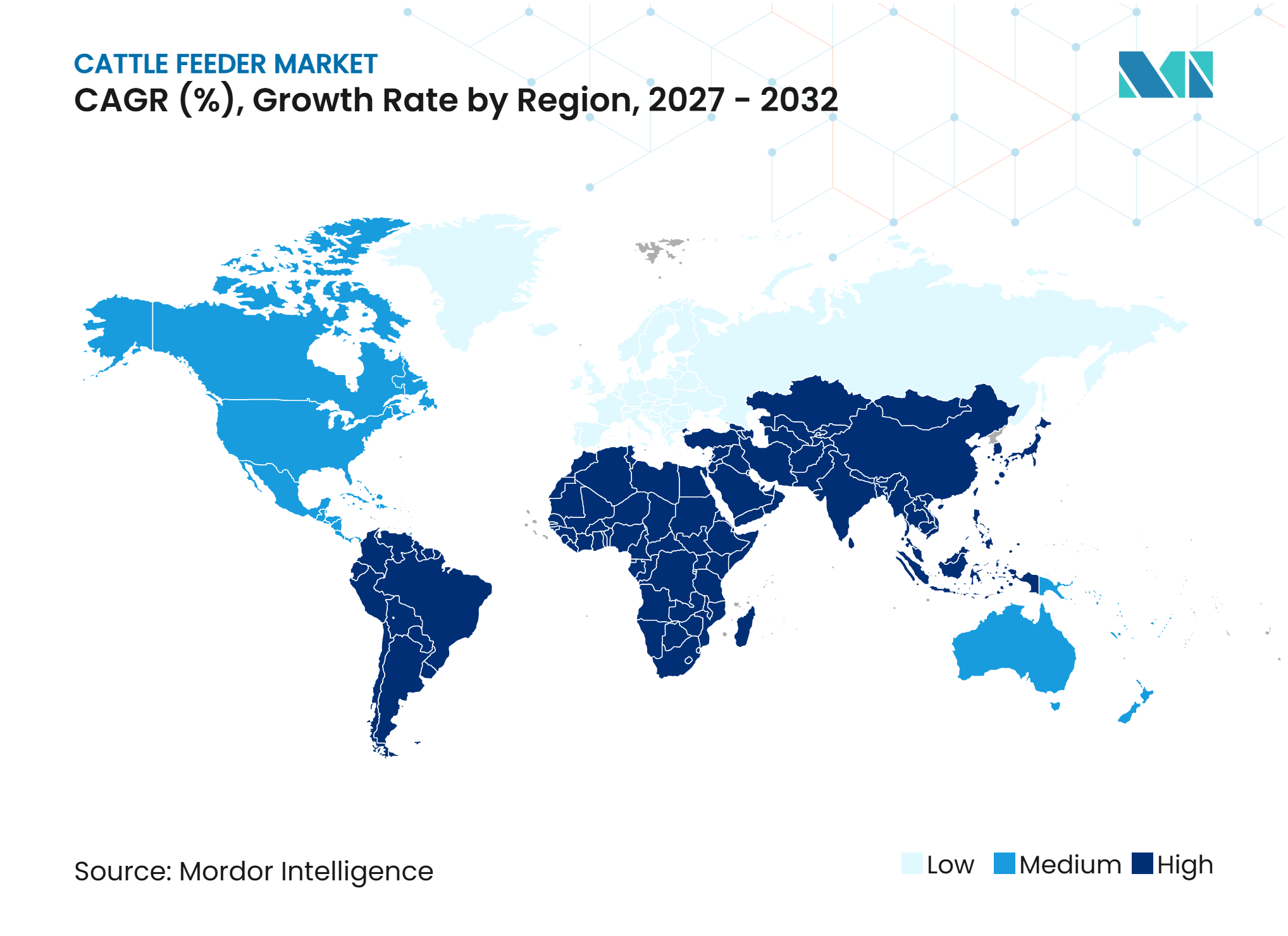
North America accounted for 36.5% of the cattle feeder market share in 2026, supported by established commercial dairy and beef operations, widespread use of total mixed ration (TMR) feeding, and mature agricultural machinery distribution networks. Dairy farms and feedlots require consistent feed preparation and regular delivery, supporting demand for mixer wagons with accurate weighing, mixing, and discharge functions. Established dealer networks and replacement-parts availability also support equipment maintenance and replacement across intensive livestock operations. Europe remains an important market, driven by mechanized dairy production, precision-feeding practices, and demand for mixer configurations suited to different barn layouts and herd sizes. Equipment replacement and investment in connected feeding technologies can further support adoption.
Asia-Pacific is forecast to grow at a CAGR of 6.7% from 2027 to 2032, the fastest rate among regions. Growth opportunities are supported by dairy-sector development, the commercialization of livestock production, and increasing emphasis on feed efficiency in China, India, and other regional markets. In India, the revised National Programme for Dairy Development supports the development of dairy infrastructure across nine states, strengthening organized milk production and creating opportunities for mechanized livestock management. Additionally, rising investments in commercial dairy farms and improvements in milk collection, chilling, and processing infrastructure are encouraging greater adoption of equipment that improves feeding efficiency and reduces manual labor. These developments are anticipated to support demand for mechanized cattle feeders.
South America offers opportunities for cattle feeders through commercial beef production and the development of larger livestock operations, particularly in Brazil and Argentina. Demand is likely to favor robust, high-capacity equipment suited to intensive feed preparation and distribution. In the Middle East and Africa, efforts to improve livestock productivity and feed management may create longer-term opportunities, although adoption will vary with farm economics, feed availability, and machinery-service infrastructure. Across these emerging markets, equipment affordability, access to financing, local dealer coverage, and the availability of spare parts will remain important factors influencing cattle feeder adoption.
Competitive Landscape
Market Concentration
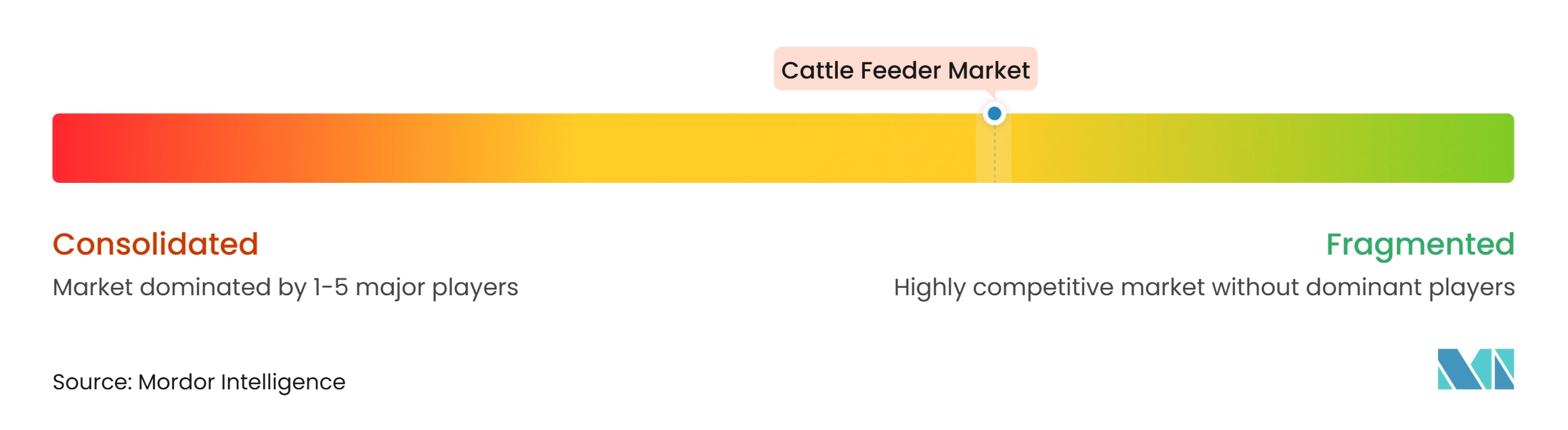
The cattle feeder market was moderately consolidated in 2026, with KUHN Group, Trioliet B.V., SILOKING Mayer Maschinenbau GmbH, Faresin Industries S.p.A., and Supreme International Limited identified as the leading players. Their competitive positions are supported by established mixer-wagon portfolios, engineering capabilities, dealer networks, and experience serving commercial dairy farms and beef operations. Manufacturers compete through mixing capacity, ration accuracy, loading and discharge performance, automation, energy efficiency, equipment durability, and after-sales service. These factors encourage product development across trailed, stationary, and self-propelled configurations suited to different herd sizes, farm layouts, and feeding requirements.
Product development and feeding automation are shaping competitive differentiation. In August 2026, KUHN Group introduced its ANTEA range of semi-autonomous, self-propelled mixer-feeders in capacities of 19, 22, 25, and 27 m³, incorporating weighing and ration-management functions. In July 2026, Trioliet B.V. introduced its Double Ended Differential Beam (DEDB) weighing system as standard equipment on tandem-axle mixer wagons, aiming to improve weighing accuracy and simplify maintenance. In November 2025, Faresin Industries S.p.A. presented its Leader PF 2.24 Full Electric mixer wagon, powered by lithium iron phosphate batteries and designed to eliminate diesel consumption and direct CO₂ emissions during operation. These developments illustrate how manufacturers are differentiating their products through semi-autonomous operation, precision ration management, and alternative power systems.
Long-term competitive positioning depends on equipment reliability, ration consistency, operating costs, dealer coverage, replacement-parts availability, and compatibility with evolving farm technologies. In November 2025, Faresin Industries S.p.A. showcased its Smart Feed Tech ecosystem, integrating near-infrared analysis, automated ingredient dosing, mixing controls, and cloud-based farm-management software. In 2025, SILOKING Mayer Maschinenbau GmbH unveiled the SelfLine 4.0 System 2000+, a self-propelled feed mixer with a 45 m³ capacity designed for large dairy farms and feedlots. These developments highlight opportunities for manufacturers to combine advanced feeding technologies with practical equipment configurations. Suppliers that balance innovation with manageable acquisition costs, accessible servicing, and dependable technical support are positioned to serve both established livestock markets and emerging regions where adoption depends on farm economics and infrastructure.
Cattle Feeder Industry Leaders
-
KUHN Group
-
Trioliet B.V.
-
SILOKING Mayer Maschinenbau GmbH
-
Faresin Industries S.p.A.
-
Supreme International Limited
- *Disclaimer: Major Players sorted in no particular order
Cattle Feeder Market Companies Covered in this Report
- KUHN Group
- Trioliet B.V.
- SILOKING Mayer Maschinenbau GmbH
- Faresin Industries S.p.A.
- Supreme International Limited
- Seko Industries S.r.l.
- RMH Lachish Industries Ltd.
- Jaylor Fabricating Inc.
- NDEco
- BvL Maschinenfabrik GmbH and Co. KG
- Storti S.p.A.
- Sgariboldi S.r.l.
- B. Strautmann and Söhne GmbH and Co. KG
- Grupo Tatoma
- Lucas G
- Laird Manufacturing
- Harsh International
- Kirby Manufacturing
- Highline Manufacturing
- Sitrex S.p.A.
- ROTO-MIX
Recent Industry Developments in Cattle Feeder Market
- August 2026: KUHN Group launched the ANTEA range of semi-autonomous, self-propelled mixer-feeders. The new range combines automated feeding functions, connectivity, and feed-management capabilities, building on technology developed for KUHN's AURA autonomous mixer-feeder. The launch expands KUHN's mechanized cattle-feeding portfolio, targeting improved feeding precision, operator comfort, and day-to-day farm efficiency.
- September 2026: Jaylor Fabricating Inc. introduced three 6000 Series single-auger stationary TMR mixers. The 6350ST, 6425ST, and 6575ST models were unveiled at Canada's Outdoor Farm Show. The range offers five standard motor options, 12 drivetrain configurations, and auger speeds from 13 to 41 rpm. Jaylor's patented Square-Cut Auger is designed to deliver consistent feed mixing, while the available configurations allow livestock producers to match equipment to their feeding systems and power requirements.
- May 2026: UHAND AgriTech released a fully electric, self-propelled 24 m³ TMR mixer. The machine features a 614-volt battery system with a stated capacity of 423.9 kWh, a 100-kW hydraulic motor, a dual-auger mixing tank, and an integrated feeding-management system. The launch expands the company's electric feed-mixing equipment portfolio and targets large-scale livestock operations seeking to automate ration preparation and feed delivery.
Global Cattle Feeder Market Report Scope
The cattle feeder market includes manual and automatic cattle feeders, feed mixers, mixer wagons, TMR preparation equipment, and feeding systems. It excludes feed ingredients and standalone feed-processing machinery
The Cattle Feeder Market is Segmented by Product Type (Vertical Feed Mixers, Horizontal Feed Mixers, Self-Propelled Feed Mixers, Stationary Feed Mixing Systems, Automatic and Robotic Feeding Systems, Bunk and Gravity Feeders, and Other Cattle Feeding Equipment), by End User (Dairy Farms, Beef Cattle Farms, Feedlots, and Cooperative and Contract Farming Operations), by Operation Mode (Manual, Semi-Automatic, Automatic, and Autonomous), and by Geography (North America, South America, Europe, Asia-Pacific, Africa, and the Middle East). The Market Forecasts are Provided in Terms of Value (USD).
Segmentation Overview
| Vertical Feed Mixers |
| Horizontal Feed Mixers |
| Self-Propelled Feed Mixers |
| Stationary Feed Mixing Systems |
| Automatic and Robotic Feeding Systems |
| Bunk and Gravity Feeders |
| Other Cattle Feeding Equipment |
| Dairy Farms |
| Beef Cattle Farms |
| Feedlots |
| Cooperative and Contract Farming Operations |
| Manual |
| Semi-Automatic |
| Automatic |
| Autonomous |
| North America | United States |
| Canada | |
| Mexico | |
| Rest of North America | |
| South America | Brazil |
| Argentina | |
| Rest of South America | |
| Europe | Germany |
| France | |
| United Kingdom | |
| Italy | |
| Spain | |
| Russia | |
| Rest of Europe | |
| Asia-Pacific | China |
| India | |
| Japan | |
| South Korea | |
| Australia | |
| Vietnam | |
| Rest of Asia-Pacific | |
| Middle East | Turkey |
| Saudi Arabia | |
| United Arab Emirates | |
| Rest of Middle East | |
| Africa | South Africa |
| Egypt | |
| Rest of Africa |
| By Product Type | Vertical Feed Mixers | |
| Horizontal Feed Mixers | ||
| Self-Propelled Feed Mixers | ||
| Stationary Feed Mixing Systems | ||
| Automatic and Robotic Feeding Systems | ||
| Bunk and Gravity Feeders | ||
| Other Cattle Feeding Equipment | ||
| By End User | Dairy Farms | |
| Beef Cattle Farms | ||
| Feedlots | ||
| Cooperative and Contract Farming Operations | ||
| By Operation Mode | Manual | |
| Semi-Automatic | ||
| Automatic | ||
| Autonomous | ||
| By Geography | North America | United States |
| Canada | ||
| Mexico | ||
| Rest of North America | ||
| South America | Brazil | |
| Argentina | ||
| Rest of South America | ||
| Europe | Germany | |
| France | ||
| United Kingdom | ||
| Italy | ||
| Spain | ||
| Russia | ||
| Rest of Europe | ||
| Asia-Pacific | China | |
| India | ||
| Japan | ||
| South Korea | ||
| Australia | ||
| Vietnam | ||
| Rest of Asia-Pacific | ||
| Middle East | Turkey | |
| Saudi Arabia | ||
| United Arab Emirates | ||
| Rest of Middle East | ||
| Africa | South Africa | |
| Egypt | ||
| Rest of Africa | ||
Key Questions Answered in the Report
What is the size of the cattle feeder market?
The cattle feeder market size was valued at USD 3.98 billion in 2026 and is forecast to grow from USD 4.13 billion in 2027 to USD 4.98 billion by 2032, registering a CAGR of 3.81% during the forecast period from 2027 to 2032.
Which cattle feeder product is forecast to grow fastest?
Horizontal feed mixers are forecast to grow at a 5.6% CAGR from 2027 to 2032. Their compact fit is useful for older barns with lower entry clearances and restricted maneuvering space.
Which end user drives demand for cattle feeders?
Dairy farms are the largest end-user group with 54.7% share in 2026. Feedlots are forecast to grow fastest at a 5.8% CAGR from 2027 to 2032 because they need dependable, high-throughput feed delivery.
What is driving automation in cattle feeding?
Labor constraints, ration consistency, and feed management needs support adoption. The commercial case improves when routine work can be scheduled without adding workers or interrupting established feeding routines.