
Canada Soil Monitoring Market Size and Share
Market Overview
| Study Period | 2022 - 2032 |
|---|---|
| Forecast Data Period | 2027 - 2032 |
| Base Year Market Size (2026) | USD 36.10 Million |
| Market Size (2027) | USD 40.01 Million |
| Market Size (2032) | USD 66.87 Million |
| Growth Rate (2027 - 2032) | 10.82 % |
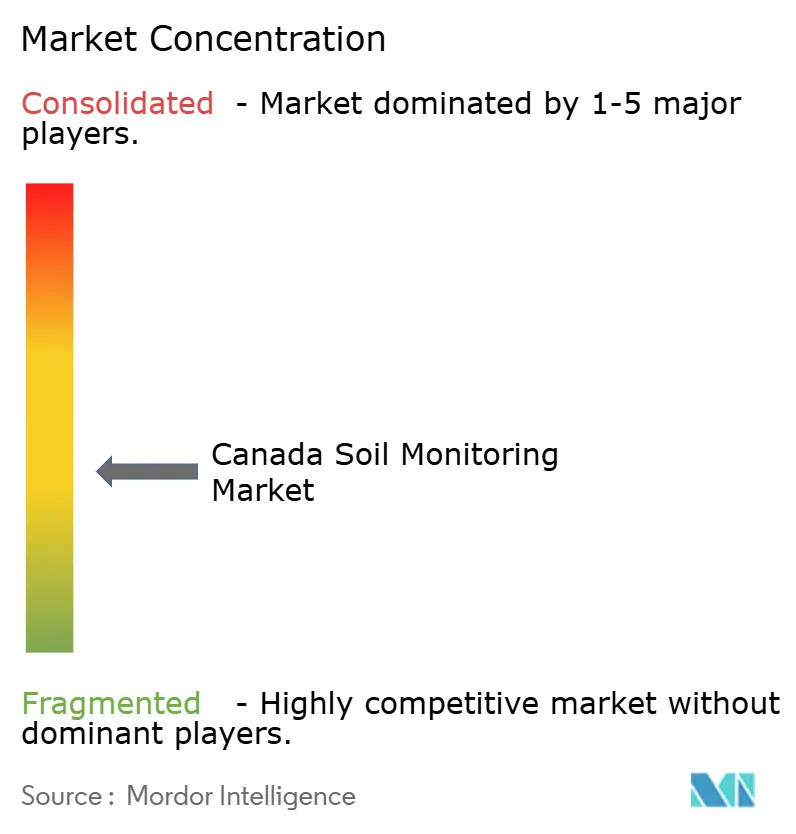
| Market Concentration | Medium |
Major Players *Disclaimer: Major Players sorted in no particular order Image © Mordor Intelligence. Reuse requires attribution under CC BY 4.0. | |
Canada Soil Monitoring Market Analysis by Mordor Intelligence
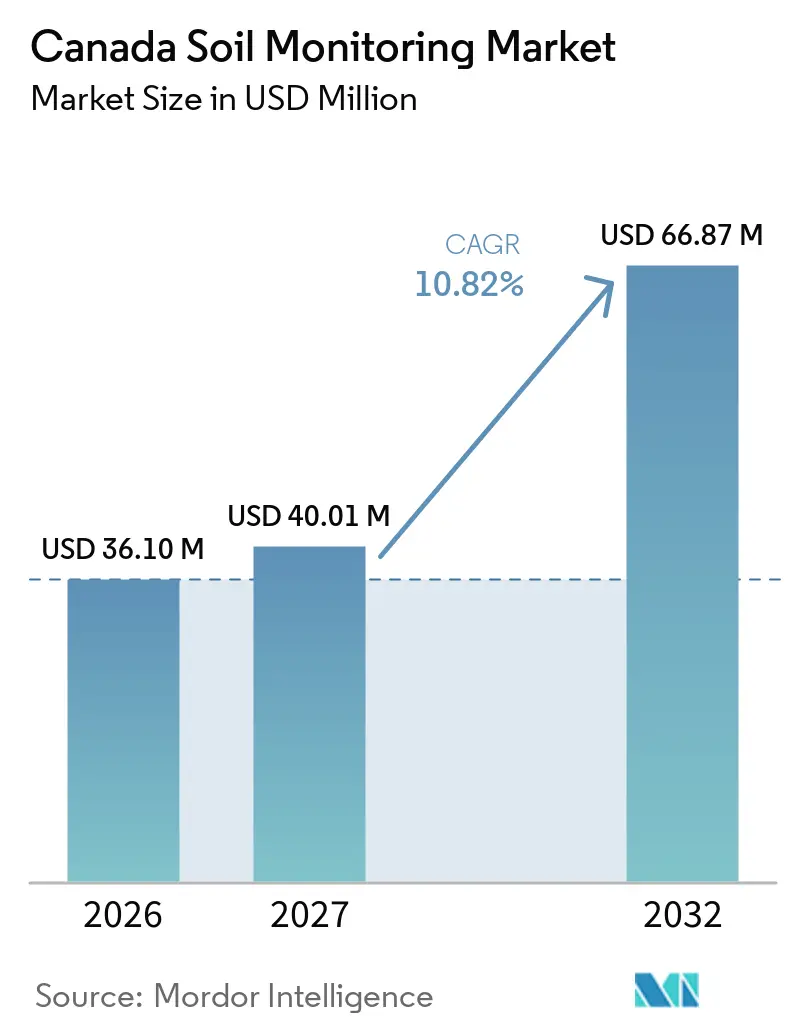
The Canada soil monitoring market was valued at USD 36.10 million in 2026 and USD 40.01 million in 2027, and is forecast to reach USD 66.87 million by 2032, growing at a CAGR of 10.82% from 2027 to 2032. The market is supported by commercial farms incorporating soil data into operational decisions, enabling more precise input management and efficient use of resources across large agricultural areas. Federal climate and soil conservation programs, including initiatives supporting sustainable agricultural practices, provide financial incentives for adopting improved soil management techniques and may encourage investment in monitoring technologies. However, adoption also depends on farm profitability, available funding, and growers' willingness to invest in measurement equipment. Provincial soil health initiatives further support awareness of soil conditions and encourage the use of monitoring tools to assess soil properties and management outcomes. Technology providers are also offering connected monitoring solutions alongside standalone devices. For example, CropX provides soil sensors integrated with a digital agronomic platform, while Sentera offers agricultural data analytics and farm management tools that can complement soil monitoring workflows. These offerings demonstrate the availability of connected data services, although adoption varies across farms and technology providers. High equipment costs, uneven rural connectivity, and calibration requirements continue to limit adoption among smaller operations, while the lack of standardized data formats across platforms remains a challenge for interoperability and wider market growth.
Key Report Takeaways
- By component, hardware was the largest segment and held 58.0% of the Canada soil monitoring market share in 2026, while services are forecast to grow at a CAGR of 16.3% from 2027 to 2032.
- By product type, in-situ sensors were the largest segment and held 46.0% of the Canada soil monitoring market size in 2026, while remote-sensing platforms are forecast to grow at a CAGR of 18.1% from 2027 to 2032.
- By connectivity technology, wireless was the largest segment and held 70.0% of the market share in 2026, while it is also forecast to grow at a CAGR of 19.8% from 2027 to 2032.
- By application, open field was the largest segment and held 63.0% of the market share in 2026, while protected cultivation is forecast to grow at a CAGR of 14.2% from 2027 to 2032.
- By end user, large commercial farms were the largest segment and held 42.0% of the market share in 2026, while research institutes and universities are forecast to grow at a CAGR of 14.6% from 2027 to 2032.
Note: Market numbers in this report are based on Mordor Intelligence's proprietary estimation framework, which combines nine months of actuals with Q4 projections for base year 2026.
Market Trends and Insights
Drivers Impact Analysis of Canada Soil Monitoring Market*
| Driver | (~) % Impact on CAGR Forecast | Geographic Relevance | Impact Timeline |
|---|---|---|---|
| Precision Agriculture Adoption in Commercial Farming | +2.2% | Ontario, Prairie Provinces, British Columbia | Medium term (2-4 years) |
| Sustainability Incentives and Soil-Conservation Programs | +1.6% | National, early gains in Ontario and Prairie Provinces | Short term (≤ 2 years) |
| Integration with Digital Farm Management Platforms | +1.4% | Ontario, Prairie Provinces | Medium term (2-4 years) |
| Climate-Related Demand for Continuous Soil Observation | +1.5% | Prairie Provinces, British Columbia, Ontario | Short term (≤ 2 years) |
| National Soil-Health Measurement Standardization | +0.9% | National | Medium term (2-4 years) |
| Soil Carbon Measurement and Monitoring, Reporting, and Verification Demand | +1.1% | Prairie Provinces, Ontario, Quebec | Medium term (2-4 years) |
| Source: Mordor Intelligence | |||
Precision Agriculture Adoption in Commercial Farming
Large commercial farms in Ontario and the Prairie provinces are increasingly incorporating soil data into farm-management decisions, creating opportunities for multi-layer monitoring systems that combine field sensors, soil mapping, and digital analytics. A March 2026 scoping review published in Smart Agricultural Technology, titled "Digital transformation in Canadian crop production: A scoping review of technologies, adoption drivers, and systemic barriers," synthesized 64 Canadian and international studies, comprising 57 technical studies and 7 stakeholder-focused studies. The review identified soil sensing, thematic soil mapping, and machine-learning-based analytics among the key technologies investigated for Canadian field-crop production. These technologies demonstrated strong predictive performance under localized conditions, particularly for soil properties, soil moisture, and yield estimation. The evidence base was predominantly focused on oilseed and grain production, reflecting the importance of field-crop systems in Ontario and the Prairie provinces. Government funding also supports investment in precision agriculture: on February 28, 2025, Agriculture and Agri-Food Canada announced more than CAD 116 million (USD 82 million) in Agricultural Clean Technology Program funding for 119 projects nationwide, with precision agriculture among the program's three priority areas[1]. This funding can encourage farm-level technology adoption.
Sustainability Incentives and Soil-Conservation Programs
Public programs are making soil characterization and outcome tracking more relevant to farm investment decisions. According to Government of Canada data, the On-Farm Climate Action Fund had total committed funding of CAD 704.1 million (USD 498 million) and supported practices that require baseline measurements and follow-up documentation[2]. In September 2024, Canada and Ontario allocated CAD 14.6 million (USD 10.3 million) under the Resilient Agricultural Landscape Program for farmland improvements linked to soil health outcomes. Ontario also has a CAD 56.7 million (USD 40.1 million) five-year program commitment under the same initiative. These programs make sensor-based records useful for farms that need to demonstrate soil management activity. The Canada soil monitoring market therefore gains a demand channel that extends beyond direct equipment purchases.
Integration with Digital Farm Management Platforms
The integration of soil monitoring systems with digital farm management platforms is increasing the value of precision agriculture technologies in Canada. Connected platforms enable soil moisture, weather, evapotranspiration, and crop data to be consolidated into a single interface, supporting more informed irrigation and nutrient management decisions. Recent product developments reflect the growing emphasis on interoperable digital ecosystems that eliminate manual data transfer and improve operational efficiency. As farms increasingly adopt connected precision agriculture technologies, demand is rising for soil monitoring solutions that integrate seamlessly with irrigation systems and broader agronomic workflows, supporting the growth of the Canada soil monitoring market.
Climate-Related Demand for Continuous Soil Observation
Changing weather conditions are increasing the operational importance of soil-moisture monitoring across drought-prone agricultural regions of Canada. In 2025, drought conditions intensified in several areas during the growing season, although their severity varied geographically. According to Agriculture and Agri-Food Canada's Canadian Drought Monitor, drought expanded in northern British Columbia, central Saskatchewan, central Manitoba, and northwestern Ontario in May 2025. In June, dry conditions spread further across British Columbia, the southern Prairies, southeastern Ontario, and Atlantic Canada. By July, exceptionally low precipitation had deepened drought in the northern and central Prairies, while persistent rainfall deficits continued in British Columbia and dry conditions expanded across southern and eastern Ontario. Southern Alberta and southwestern Saskatchewan, however, received above-normal rainfall and experienced some relief. By September 30, approximately 85% of Canada's land area was classified as abnormally dry or in drought, including around 76% of its agricultural land. These regional differences highlight the importance of tracking soil-moisture conditions rather than relying solely on historical rainfall patterns. Multi-depth soil sensors can help producers monitor moisture availability across the root zone and make more informed decisions about irrigation scheduling, crop management, and field inspections. This creates opportunities for continuous soil-monitoring solutions in drought-affected areas, particularly parts of British Columbia, the Prairie provinces, and eastern Ontario, where changing moisture conditions can influence crop water availability and farm-level resource management.
Restraints Impact Analysis of Canada Soil Monitoring Market*
| Restraint | (~) % Impact on CAGR Forecast | Geographic Relevance | Impact Timeline |
|---|---|---|---|
| High Upfront Cost of Connected Sensor Networks | -1.3% | National, concentrated among smallholder and cooperative farms | Short term (≤ 2 years) |
| Fragmented Rural Connectivity and Service Coverage | -1.1% | Northern territories, interior British Columbia, rural Saskatchewan and Manitoba | Medium term (2-4 years) |
| Soil-Specific Calibration and Interoperability Complexity | -0.7% | National, amplified in Canada’s diverse soil zones | Medium term (2-4 years) |
| Unclear Return on Investment for Low-Value Crops | -0.6% | Prairie Provinces, Atlantic Provinces | Short term (≤ 2 years) |
| Source: Mordor Intelligence | |||
High Upfront Cost of Connected Sensor Networks
A connected soil sensor network requires node hardware, gateway equipment, software subscriptions, and installation services. These combined costs are difficult for smaller farms to recover within a single growing season. The financial burden increases further when a farm requires multiple sensors to capture field-level variation across different soil types, topographies, and microclimates. While government support programs, such as grants and subsidies, can offset part of the expense, complex application requirements and lengthy approval processes often discourage small operators from pursuing them. Consequently, uptake is greater among large commercial farms that can spread costs across more hectares and absorb the upfront investment more easily. Smaller operations, by contrast, often lack the capital reserves or access to credit needed to fund such deployments. This cost barrier limits soil monitoring adoption among smallholder and cooperative users in Canada, slowing the broader diffusion of precision agriculture practices in these segments.
Fragmented Rural Connectivity and Service Coverage
Connected monitoring relies on dependable data transmission from fields to farm management systems. According to The Canadian Agri-Food Policy Institute report, Canada's Universal Broadband Fund committed more than CAD 3.225 billion (USD 2.3 billion) to connect 98% of Canadians to high-speed internet by 2026[3]. However, remote agricultural areas may still experience slower infrastructure deployment than the policy target. In locations without adequate cellular service, providers may need to deploy low-power wide-area network (LPWAN) or satellite backhaul options. These alternatives increase system cost and technical complexity for connected deployments. Uneven coverage continues to restrain the Canada soil monitoring market in northern territories, interior British Columbia, rural Saskatchewan, and Manitoba.
*Our forecasts treat driver/restraint impacts as directional, not additive. The impact forecasts reflect baseline growth, mix effects, and variable interactions.
Canada Soil Monitoring Market Segment Analysis
By Component:
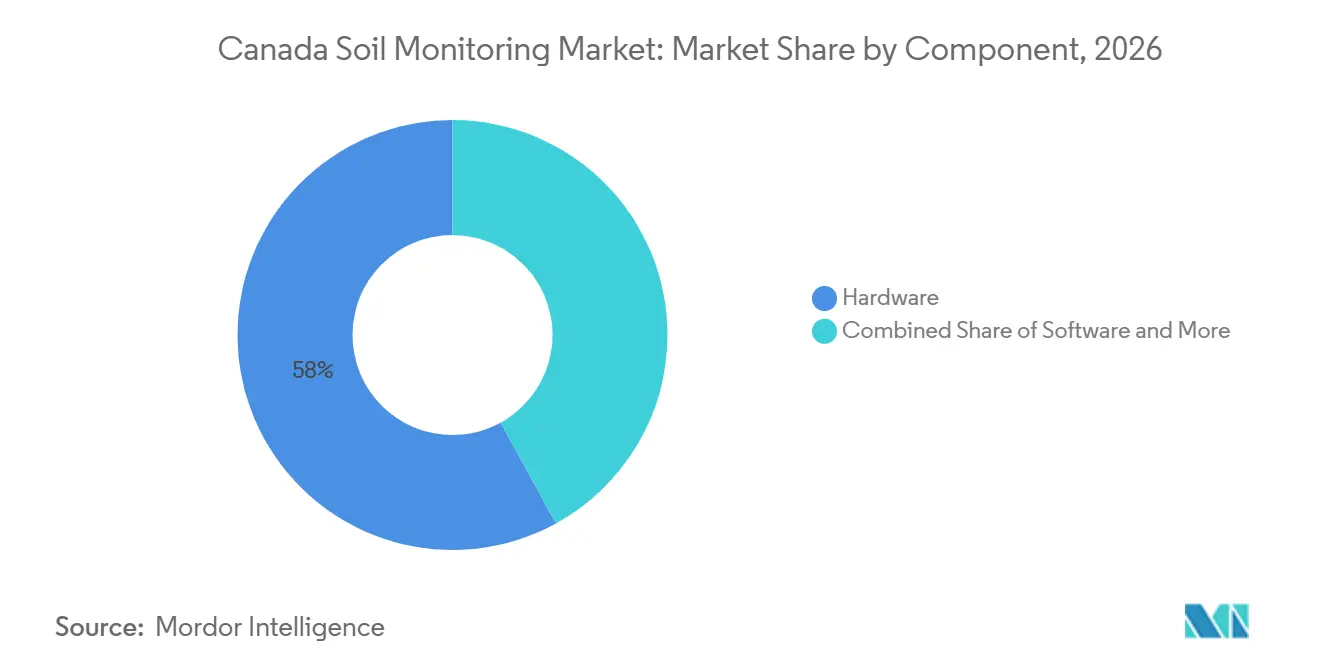
Services Support Value Beyond HardwareHardware held 58.0% of the Canada soil monitoring market share in 2026, reflecting its role as the foundation of soil monitoring systems. The deployment of sensors, data loggers, communication devices, and related field infrastructure is essential for collecting accurate soil data across large and geographically dispersed farms. Commercial producers often require multiple sensing points to capture field variability, making hardware the largest initial investment in soil monitoring. Software complements these systems by organizing, visualizing, and integrating field data into broader farm management platforms.
Services are forecast to grow at a CAGR of 16.3% from 2027 to 2032, driven by increasing demand for installation, calibration, technical support, data interpretation, and agronomic advisory services. As soil monitoring becomes more integrated into precision agriculture and sustainability initiatives, growers increasingly rely on specialized service providers to translate sensor data into actionable management decisions. Carbon measurement and environmental reporting requirements further support recurring demand for monitoring and verification services. The expansion of smart farming projects, including sensor-based greenhouse monitoring, is also contributing to the growing importance of service-based offerings in the Canada soil monitoring market.

By Product Type:
In-Situ Sensors Lead, Remote Sensing AcceleratesIn-situ sensors held 46.0% of the Canada soil monitoring market share in 2026, making them the largest product category. Their ability to provide continuous, real-time measurements of soil moisture, temperature, and nutrient conditions directly within the root zone supports efficient irrigation and nutrient management across open-field and protected cultivation systems. Unlike portable probes and test kits, which require manual intervention and periodic sampling, in-situ sensors operate autonomously, reducing labor requirements and enabling faster responses to changing soil conditions. This capability is particularly relevant in large-scale agricultural operations where timely data collection across multiple field zones is critical. Their established use in precision agriculture has reinforced their position as the preferred technology for continuous field monitoring. Data collected by in-situ sensors is increasingly integrated with farm management software and IoT platforms, allowing growers to make informed decisions on irrigation scheduling, fertilizer application, and crop stress management. Portable probes and test kits continue to serve spot-checking and field validation requirements but play a more limited role in long-term monitoring applications.
Remote sensing platforms are forecast to grow at a CAGR of 18.1% from 2027 to 2032, driven by the need to monitor large agricultural areas more efficiently. Drone- and satellite-based technologies enable growers to assess soil variability across extensive fields without requiring dense in-ground sensor deployment. Technology-development initiatives are also advancing subsurface monitoring capabilities. For example, John Deere included resonAg in its 2026 Startup Collaborator Program to explore miniaturized magnetic resonance imaging (MRI)-based technologies for subsurface sensing. This collaboration reflects ongoing innovation in soil-monitoring technology rather than confirmed commercial deployment in Canada. Such developments could broaden the range of monitoring solutions available to agricultural producers, supporting the potential growth of remote sensing and advanced subsurface monitoring alongside conventional in-situ systems in the Canada soil monitoring market.
By Connectivity Technology:
Wireless Extends Its DominanceWireless technologies held a 70.0% share of the Canada soil monitoring market in 2026. Farms favor wireless systems because wired infrastructure is difficult to extend across large and dispersed fields. Low-power wide-area networks (LPWANs) and satellite links support locations with limited wired or cellular access. Wired systems remain useful in permanent greenhouse and controlled-environment settings. Wireless connectivity is forecast to grow at a CAGR of 19.8% from 2027 to 2032, supported by satellite-hybrid internet of things (IoT) systems and lower LPWAN hardware costs.
Wireless systems allow wider sensor deployment with less physical infrastructure than wired configurations. Their low power consumption and long-range operation suit distributed farm equipment. In March 2025, Terrestar Solutions and Monogoto announced a cellular-satellite hybrid IoT partnership for Canada. The partnership aimed to support device connectivity in remote areas without cellular coverage. Wireless systems remain central to the Canada soil monitoring market as they align with the geographic realities of Canadian farming, despite the additional cost of satellite backhaul.
By Application:
Open Field Scale Meets Protected Cultivation GrowthOpen-field applications held 63.0% of the Canada soil monitoring market share in 2026, supported by the extensive cultivation of canola, wheat, barley, and soybean across the Prairie provinces. In predominantly rainfed cropping systems, particularly across Alberta, Saskatchewan, and Manitoba, soil-moisture monitoring helps farmers assess stored soil water, track moisture availability during critical crop growth stages, and identify potential water stress under variable precipitation conditions. These measurements support decisions related to seeding, fertilizer application, and other field-management practices. In irrigated open-field production, soil monitoring serves an additional purpose by helping growers determine irrigation timing and application requirements based on moisture conditions within the crop root zone. Large-scale farming operations also use soil data to identify spatial variability in moisture and soil properties, enabling more targeted nutrient management and tillage decisions across extensive cultivated areas. The need to manage soil variability, respond to changing rainfall patterns, and improve input-use efficiency continues to support demand for soil monitoring technologies in Canada's open-field agriculture sector.
Protected cultivation is forecast to grow at a CAGR of 14.2% from 2027 to 2032, supported by the increasing use of precision monitoring and automated management technologies in greenhouse production. High-value crops grown under controlled environments require close monitoring of growing conditions, including root-zone moisture, nutrient concentrations, and substrate temperature, to maintain crop productivity and resource efficiency. In January 2026, the British Columbia government announced a smart-farming development project involving Windset Farms in Delta, supported by the B.C. Centre for Agritech Innovation. The initiative brings together Simon Fraser University, Koidra, Vivent Biosignals, and Wageningen University & Research to develop a sensor-based system using data analytics and machine learning to monitor plant stress and automate greenhouse management, with applications in climate control, nutrient uptake, and early disease detection in hydroponic tomatoes. Although the project does not specifically establish the deployment of soil-moisture or electrical-conductivity sensors, it demonstrates growing investment in sensor-driven monitoring and automation in Canadian protected cultivation. These developments provide a broader indication of technology adoption in greenhouse production, supporting the potential demand for integrated monitoring solutions in the Canada soil monitoring market.
By End User:
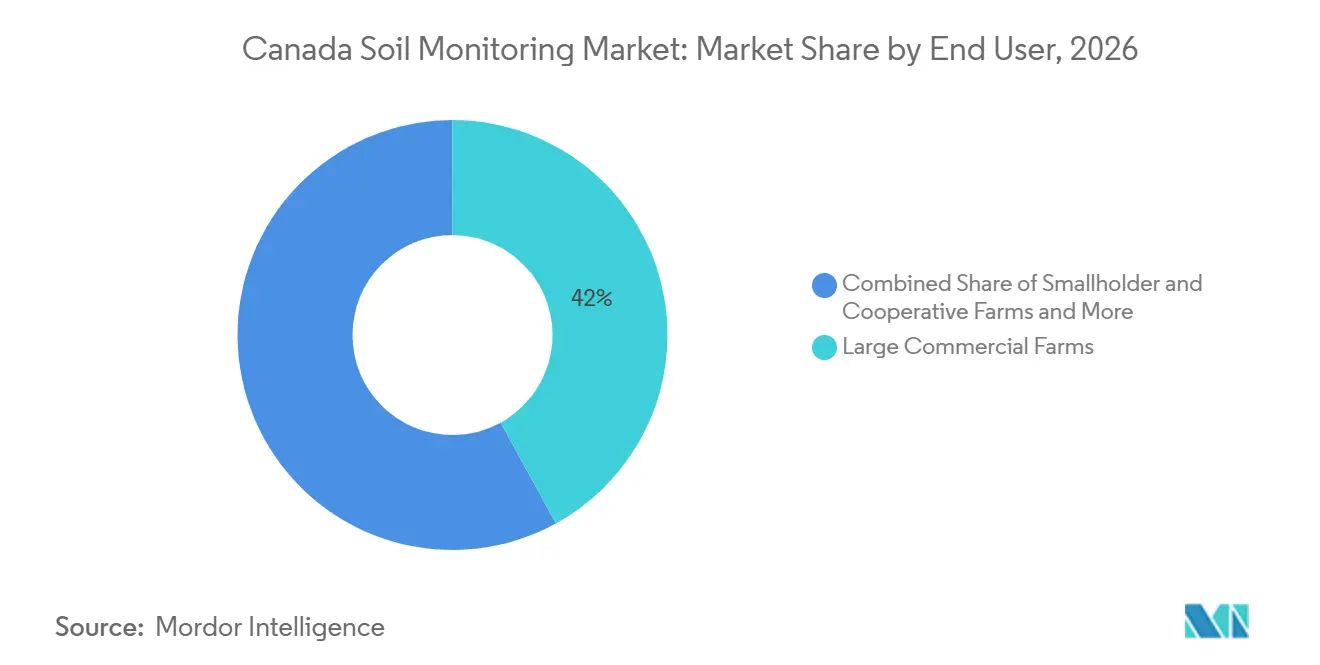
Commercial Farms Lead, Research Institutes AccelerateLarge commercial farms held 42.0% of the Canada soil monitoring market share in 2026, reflecting their greater capacity to invest in precision agriculture technologies. These farms can distribute the costs of sensors, software, installation, and maintenance across extensive cultivated areas while using soil data to optimize irrigation, nutrient management, and field operations. In comparison, adoption among smallholder and cooperative farms remains more limited due to higher upfront investment requirements and the complexity of managing digital monitoring systems.
Research institutes and universities are forecast to grow at a CAGR of 14.6% from 2027 to 2032, driven by investment in soil science, climate-smart agriculture, and digital farming research. The University of Saskatchewan is undertaking research that directly involves soil characterization and monitoring. In January 2025, the university announced two soil-carbon research projects supported by Saskatchewan's Agriculture Development Fund. The project titled "Mapping Soil Carbon Sequestration in Saskatchewan Cropland" combines field-collected soil samples, remote sensing, and predictive mapping to measure soil-carbon levels and assess changes associated with land use and climate. A related initiative, "A Sustainable Future for the Saskatchewan Soil Information System (SKSIS)," aims to expand the province's digital repository with additional soil-health and soil-composition data. These projects demonstrate research institutions' use of field sampling, soil analysis, and digital mapping to generate more detailed soil information, supporting demand for soil-monitoring services, analytical capabilities, and associated research technologies in Canada.
Geography Analysis
The Prairie provinces held the largest share of the Canada soil monitoring market in 2026, driven by the country's extensive cultivation of grain, oilseed, and other broad-acre crops. Large commercial farms across the region rely on soil monitoring technologies to optimize irrigation, nutrient management, and field operations across vast cultivated areas. Frequent drought conditions further increase the value of timely soil moisture and fertility data, supporting the adoption of both in-situ sensors and remote monitoring technologies. Alberta, Saskatchewan, and Manitoba collectively represent the core of Canadian agricultural production, with Saskatchewan alone accounting for a significant portion of the country's total cultivated farmland. The scale of farming operations in these provinces creates strong demand for precision agriculture tools, including soil sensors, satellite-based monitoring, and data analytics platforms. Government programs supporting sustainable agriculture and water conservation in the region have also encouraged farmers to invest in soil monitoring solutions, further reinforcing the Prairie provinces' dominant position in the market.
Ontario continues to strengthen its position through investments in sustainable agriculture, greenhouse production, and soil conservation initiatives. In September 2025, the Governments of Canada and Ontario allocated CAD 14.6 million (USD 10.3 million) under the Resilient Agricultural Landscape Program to support farmland improvement projects, while Ontario committed CAD 56.7 million (USD 40.1 million) over five years to promote sustainable land management and soil health practices. These initiatives are anticipated to encourage the adoption of soil monitoring technologies for farm management, reporting, and environmental stewardship.
Quebec generates demand from dairy farming, specialty crops, nutrient management, and water-quality compliance. British Columbia supports the market through irrigation-intensive vineyards, orchards, and vegetable production, where root-zone monitoring improves irrigation efficiency and crop quality. A 2026 UAV-based soil probing study conducted in a British Columbia vineyard demonstrated the potential of aerial soil assessment for precision nutrient mapping. The Atlantic Provinces contribute demand from potato and horticultural production, where portable probes and in-situ monitoring systems are widely used. In the rest of Canada, satellite-enabled monitoring technologies are expanding access to soil monitoring across remote agricultural regions and supporting broader adoption beyond the country's major farming provinces.
Competitive Landscape
The Canada soil monitoring market was moderately concentrated, with the top five companies collectively holding a moderate market share in 2026. Major companies include METER Group, Inc., Pessl Instruments GmbH, CropX Technologies, Inc., Campbell Scientific, Inc., and Deere & Company. The remaining market is served by players in sensing hardware, data loggers, software platforms, mapping solutions, and agronomic services, which limits the pricing power of any single company. Competition is also shaped by differences in sensor capabilities, connectivity options, data-processing functionality, and the ability to integrate soil information with broader farm-management systems.
Players compete through improvements in sensing technology, measurement capabilities, and digital platform integration. METER Group's SOLYX 14 uses its patented Complex Dielectric through Intersections (CDX) technology to measure volumetric water content, soil temperature, and electrical conductivity. The sensor measures bulk and pore-water electrical conductivity and is designed to provide reliable soil-moisture measurements across a wide range of salinity and temperature conditions. Its specifications include a volumetric water content measurement range of 0.00–0.72 m³/m³ under mineral-soil calibration and a bulk electrical conductivity range of 0–20 dS/m. In November 2025, CropX Technologies and Reinke Manufacturing announced an expanded platform integration that enables CropX soil, weather, and agronomic data to be displayed directly in Reinke's ReinCloud 3 irrigation interface. The integration also allows Reinke irrigation application data to be accessed within CropX for agronomic calculations and reporting. These developments demonstrate product differentiation through multi-parameter sensing and interoperability between soil-monitoring and irrigation-management platforms, without establishing specific Canadian installations.
International partnerships and distribution networks further illustrate the development of connected monitoring solutions. In July 2026, Pessl Instruments and 1NCE announced the global rollout of METOS weather-network solutions using 1NCE connectivity, connecting weather stations and field sensors across more than 80 countries. The announcement demonstrates the international availability of connected agricultural monitoring technology but does not establish Canadian sales or deployments. In May 2026, Grodan and Priva announced the integration of GroSens root-zone sensor data into the Priva One greenhouse management platform, enabling growers to access substrate measurements alongside other greenhouse operating parameters. This is a global technology integration rather than evidence of adoption by Canadian greenhouse operators. SoilOptix provides a more direct indication of Canadian market presence through its listed service-provider and subdealer network, which includes representatives in Alberta, British Columbia, Manitoba, and Saskatchewan, as well as other provinces. Its gamma-ray-based soil mapping technology generates high-resolution spatial information on soil properties, supporting variable-rate input management and field-level analysis. Overall, competition in the Canada soil monitoring market increasingly involves combining reliable measurement hardware with digital analytics, data connectivity, and locally accessible technical services.
Canada Soil Monitoring Industry Leaders
-
Pessl Instruments GmbH
-
CropX Technologies, Inc.
-
Campbell Scientific, Inc. (Campbell Group, Inc.)
-
METER Group, Inc.
-
Deere & Company
- *Disclaimer: Major Players sorted in no particular order
Canada Soil Monitoring Market Companies Covered in this Report
- METER Group, Inc.
- Campbell Scientific, Inc. (Campbell Group, Inc.)
- Deere & Company
- Yara International ASA
- PTx Trimble LLC (AGCO Corporation)
- Topcon Positioning Systems, Inc. (Topcon Corporation)
- CropX Technologies, Inc.
- Pessl Instruments GmbH
- SENTEK PTY. LTD
- Delta-T Devices Ltd
- Soil Scout Oy
- Onset Computer Corporation (LI-COR, Inc.)
- Royal Eijkelkamp B.V.
- IMKO Mikromodultechnik GmbH (Endress+Hauser Group)
- SoilOptix Inc.
Recent Industry Developments in Canada Soil Monitoring Market
- January 2026: Croptimistic Technology Inc. launched SWAT LABS, an in-house soil-testing facility at its corporate headquarters in Saskatoon, Saskatchewan. The laboratory integrates soil sampling, analytical testing, and digital records within the company's SWAT ECOSYSTEM and had already processed samples collected during the fall 2025 season. The facility also supports the development of an integrated soil library and calibration of in-field sensor prototypes against conventional laboratory results.
- March 2026: Agriculture and Agri-Food Canada (AAFC) announced the National Agricultural Soil Health Strategy in partnership with the Soil Conservation Council of Canada under Bill S-230. The initiative includes provincial consultations to establish standardized soil health monitoring, assessment, and data collection frameworks across Canada.
- July 2025: Miraterra Technologies Corporation acquired the assets of US-based Trace Genomics, including its intellectual property, in-market products, analytical tools, and laboratory facilities in Ames, Iowa. The acquisition strengthens Miraterra's soil-measurement capabilities by incorporating soil DNA analysis and biological testing into its existing spectroscopy-based technology platform. The transaction expands the technical capabilities of a Canadian soil-technology company and supports the development of integrated soil, plant, and food measurement services.
- April 2025: Corvian Labs, formerly Farmers Edge Laboratories, entered into a partnership with Taurus Agricultural Marketing, appointing the company as its exclusive Canadian sales representative. The agreement expands access to Corvian's soil chemistry testing, plant-tissue analysis, and soil-health diagnostic services through Taurus's network of agricultural retailers, consultants, and growers. The partnership is intended to improve the availability of laboratory-based soil analysis and provide agronomic customers with additional data for fertility and soil-management decisions.
Canada Soil Monitoring Market Report Scope
The Soil Monitoring Market refers to the segment of the market that focuses on the use of technology to monitor soil conditions, which is crucial for agriculture and environmental management. It encompasses various components and is driven by the need for real-time data on soil parameters such as moisture, temperature, and nutrient content.
The Canada Soil Monitoring Market Report is Segmented by Component (Hardware, Software and Services), by Product Type (In-Situ Sensors, Remote-Sensing Platforms and Portable Probes and Test Kits), by Connectivity Technology (Wired and Wireless), by Application (Open Field, Protected Cultivation and Forestry), and by End-User (Large Commercial Farms, Smallholder and Cooperative Farms Research Institutes and Universities and Government and NGOs). The Market Forecasts are Provided in Terms of Value (USD).
Segmentation Overview
| Hardware |
| Software |
| Services |
| In-Situ Sensors |
| Remote-Sensing Platforms |
| Portable Probes and Test Kits |
| Wired |
| Wireless (LPWAN, Cellular, Satellite) |
| Open Field |
| Protected Cultivation |
| Forestry |
| Large Commercial Farms |
| Smallholder and Cooperative Farms |
| Research Institutes and Universities |
| Government and NGOs |
| By Component | Hardware |
| Software | |
| Services | |
| By Product Type | In-Situ Sensors |
| Remote-Sensing Platforms | |
| Portable Probes and Test Kits | |
| By Connectivity Technology | Wired |
| Wireless (LPWAN, Cellular, Satellite) | |
| By Application | Open Field |
| Protected Cultivation | |
| Forestry | |
| By End User | Large Commercial Farms |
| Smallholder and Cooperative Farms | |
| Research Institutes and Universities | |
| Government and NGOs |
Key Questions Answered in the Report
What is the Canada soil monitoring market size?
The Canada soil monitoring market was valued at USD 36.10 million in 2026 and USD 40.01 million in 2027, and is forecast to reach USD 66.87 million by 2032, growing at a CAGR of 10.82% from 2027 to 2032.
What is driving adoption of soil monitoring in Canada?
Precision agriculture, climate and soil programs, connected farm platforms, and soil-carbon monitoring requirements support adoption. These factors link measurement tools to field management, reporting, and verification needs.
Which product type led Canada soil monitoring market in 2026?
In-situ sensors led product types with 46.0% share in 2026. Remote-sensing platforms are forecast to grow at an 18.1% CAGR from 2027 to 2032.
Which connectivity technology is growing fastest in the market?
Wireless connectivity is forecast to grow at a 19.8% CAGR from 2027 to 2032. LPWAN and satellite-hybrid IoT systems support connected monitoring in dispersed farm locations.