
Canada Seasoning Blends Market Size and Share
Market Overview
| Study Period | 2021 - 2031 |
|---|---|
| Forecast Data Period | 2026 - 2031 |
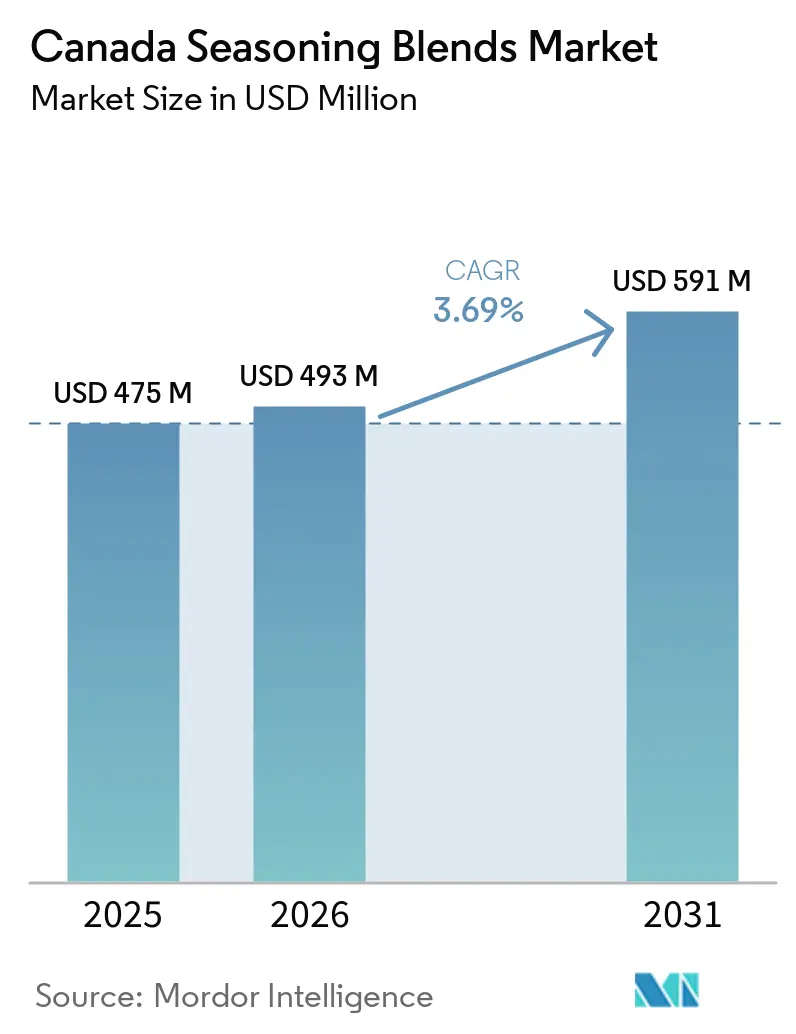
| Base Year Market Size (2025) | USD 475 Million |
| Market Size (2026) | USD 493 Million |
| Market Size (2031) | USD 591 Million |
| Growth Rate (2026 - 2031) | 3.69 % |
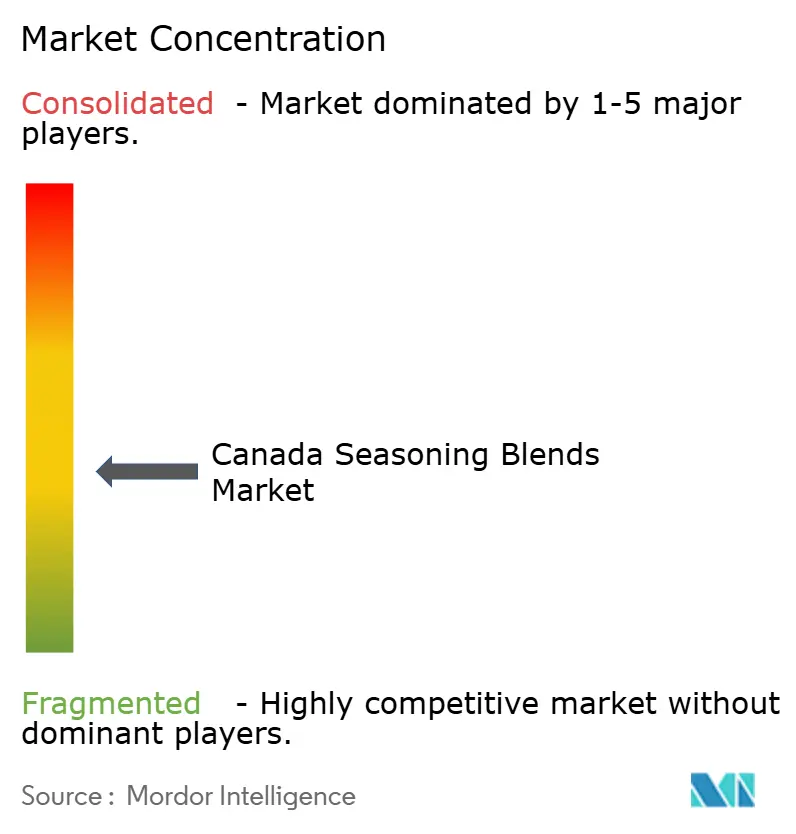
| Market Concentration | Medium |
Major Players *Disclaimer: Major Players sorted in no particular order Image © Mordor Intelligence. Reuse requires attribution under CC BY 4.0. | |
Canada Seasoning Blends Market Analysis by Mordor Intelligence
The seasoning blends market size was valued at USD 475 million in 2025 and is estimated to grow from USD 493 million in 2026 to reach USD 591 million by 2031, at a CAGR of 3.69% during the forecast period 2026-2031. The Canadian seasoning blends market is being shaped by growing demand for recognizable ingredients, clean-label formulations, and continued expansion of processed food production. Regulatory changes are also influencing formulation strategies, particularly around sodium and specific flavoring ingredients. Effective January 1, 2026, Canada’s front-of-package nutrition symbol requirements have increased the visibility of high sodium content in qualifying prepackaged foods, creating greater pressure on manufacturers to optimize seasoning formulations for sodium reduction without compromising taste, functionality, or processing performance[1]. In parallel, leading seasoning companies are strengthening their foodservice capabilities and regional manufacturing footprints, while specialty blenders continue to compete through customized flavor solutions, differentiated formulations, and ingredient traceability.
Key Report Takeaways
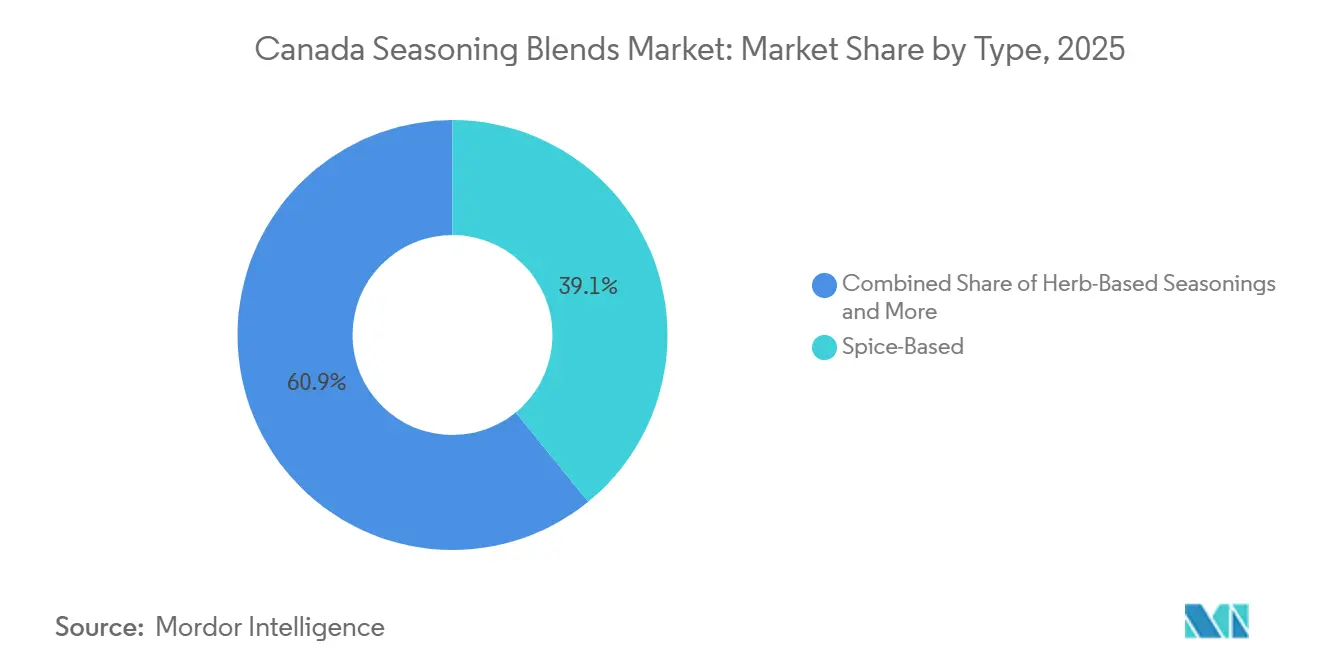
- By type, spice-based blends held 39.12% of the seasoning blends market share in 2025, while herb-based blends are forecast to grow at a 13.2% CAGR through 2031.
- By form, powder blends held 56.05% of value in 2025, while liquid blends are forecast to grow at a 13.01% CAGR through 2031.
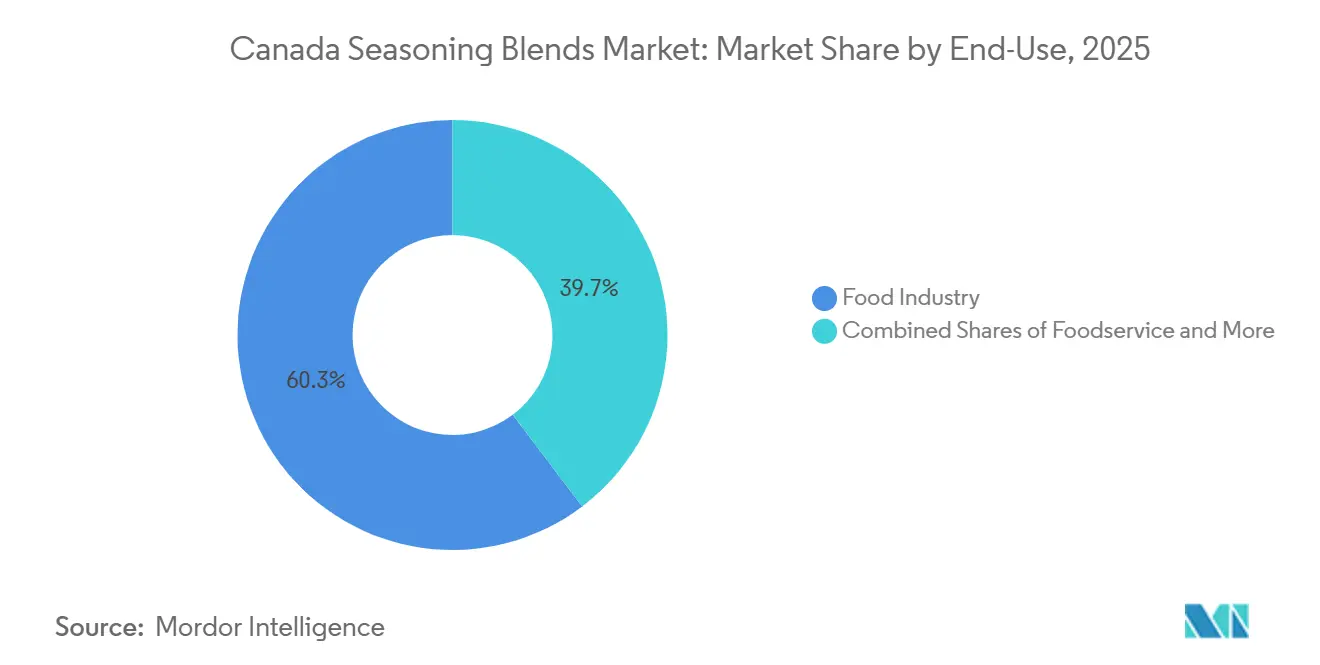
- By end-use, the food industry held 60.31% of the 2025 seasoning blends market size, while foodservice and HoReCa are forecast to grow at a 12.20% CAGR through 2031.
Note: Market size and forecast figures in this report are generated using Mordor Intelligence’s proprietary estimation framework, updated with the latest available data and insights as of January 2026.
Canada Seasoning Blends Market Trends and Insights
Drivers Impact Analysis*
| Driver | (~) % Impact on CAGR Forecast | Geographic Relevance | Impact Timeline |
|---|---|---|---|
| Growing Demand for Natural Flavoring Ingredients | +0.7% | Canada, particularly major urban markets and health-conscious consumer segments | Medium term (2-4 years) |
| Clean-Label Product Development | +0.6% | Canada, with strong relevance across packaged foods, sauces, snacks, and prepared meals | Medium term (2-4 years) |
| Expansion of Premium and Gourmet Prepared Foods | +0.5% | Canada, particularly Ontario, British Columbia, Quebec, and other high-income urban markets | Long term (≥ 4 years) |
| Consumer Preference for Recognizable Botanical Ingredients | +0.5% | Nationwide, driven by nutrition-conscious consumers and evolving food formulation requirements | Medium term (2-4 years) |
| Multicultural Consumption and Ethnic Flavor Profiles | +0.4% | Canada, particularly Ontario, British Columbia, Alberta, and Quebec | Medium term (2-4 years) |
| Growth in Processed Food Manufacturing | +0.5% | Nationwide, with strong relevance across meat, bakery, snacks, sauces, and ready-to-eat food manufacturing | Long term (≥4 years) |
| Source: Mordor Intelligence | |||
Growing Demand for Natural Flavoring Ingredients
Natural flavoring is becoming an increasingly important formulation consideration within the seasoning blends market, driven by growing consumer interest in recognizable, plant-based, and function-oriented ingredients. The Institute of Food Technologists identifies botanicals, adaptogens, and fermented ingredients as key ingredients gaining broader adoption across food and beverage applications in 2026. Its consumer insights further indicate that approximately one in four snack consumers actively seek ingredients such as ginger, rosemary, and hibiscus, supporting demand for herb-based and botanical seasoning blends across packaged foods, snacks, and prepared food applications[2]. Regulatory developments are further strengthening the shift toward natural flavor systems in export-oriented food manufacturing. The European Union has phased out eight approved smoke flavorings following safety concerns related to genotoxic constituents, reducing the availability of certain conventional smoke-flavoring options for food processors. This regulatory tightening is encouraging manufacturers serving European markets to evaluate natural smoke, botanical, herb, and spice-based alternatives, creating additional opportunities for suppliers offering clean-label and traceable seasoning solutions
Clean-Label Product Development Accelerates Natural Seasoning Adoption
Clean-label development in Canada’s seasoning blends market is increasingly extending beyond shorter ingredient lists to encompass ingredient transparency, sourcing, formulation compliance, and nutritional positioning. Canada’s front-of-package nutrition labelling requirements mandate a standardized symbol for prepackaged foods that meet the threshold for high sodium, increasing the visibility of sodium content at the point of purchase and creating greater commercial pressure to optimize high-sodium formulations. The potential public-health impact of sodium reduction further reinforces this formulation shift. A 2025 study estimated that achieving Canada’s voluntary sodium targets could prevent approximately 219,490 cases of ischemic heart disease and 164,435 strokes among the adult population modeled, supporting continued policy and industry focus on reducing sodium exposure from processed foods. Consequently, seasoning suppliers are increasingly prioritizing lower-sodium, transparent, and regulatory-compliant formulations, with compliance capabilities becoming an important component of customer qualification and product positioning across Canadian retail and food manufacturing channels.
Expansion of Premium and Gourmet Prepared Foods
The expansion of premium and specialty prepared foods is increasing demand for differentiated seasoning blends that can deliver distinctive flavor profiles and support product positioning. McCormick’s 2026 outlook highlights continued consumer demand for differentiated flavor experiences alongside its focus on sustainable volume growth and profitability, indicating ongoing commercial opportunities for value-added seasoning solutions. In Canada, consumer interest in global flavors combined with premium and locally relevant ingredients is creating opportunities for more specialized seasoning formulations. Kerry’s 2026 Canadian taste analysis highlights demand for global flavor profiles incorporating local cues such as maple, supporting the development of differentiated regional and fusion flavor concepts. Consequently, seasoning suppliers with capabilities in origin-specific spices, customized flavor profiles, and small-batch formulation can capture higher-value opportunities among prepared-food manufacturers seeking product differentiation. The trend also supports premium pricing where ingredient provenance, culinary specificity, and formulation uniqueness contribute directly to the finished product’s value proposition.
Multicultural Consumption Increases Demand for Ethnic Flavor Profiles
Canada’s multicultural consumer base is supporting sustained demand for diverse ethnic and globally inspired seasoning profiles across retail and foodservice channels. Kerry’s 2026 Canadian consumer analysis identifies Korean BBQ, shawarma, korma curry, and miso among the flavor profiles gaining consumer interest, highlighting increasing demand for internationally influenced taste experiences. The growing preference for global flavors adapted to familiar Canadian food formats is creating opportunities for seasoning suppliers to develop localized ethnic and fusion blends for prepared foods, restaurant menus, and at-home cooking. This trend enables retailers and food manufacturers to broaden flavor variety without significant changes to existing product formats or production processes. Suppliers with capabilities in authentic ingredient sourcing, recipe customization, and regional flavor adaptation are therefore well positioned to serve the expanding demand across both foodservice and retail applications.
Restraints Impact Analysis*
| Restraint | (~) % Impact on CAGR Forecast | Geographic Relevance | Impact Timeline |
|---|---|---|---|
| Volatility in Imported Spice and Herb Prices | -0.5% | Canada, given its reliance on imported spices and herbs from global producing regions | Short term (≤2 years) |
| Supply-Chain Disruptions and Rising Procurement Costs | -0.4% | Canada, particularly manufacturers dependent on imported raw materials and international logistics | Short term (≤2 years) |
| Sodium Reduction Constraints and Flavor Performance Challenges | -0.3% | Nationwide, particularly processed food and prepared-meal manufacturers | Medium term (2–4 years) |
| Stringent Food Safety, Labeling, and Ingredient Compliance Requirements | -0.3% | Nationwide, with implications across retail, foodservice, and food manufacturing | Long term (≥4 years) |
| Source: Mordor Intelligence | |||
Volatile Imported Spice Prices Pressure Blend Manufacturers
Volatility in imported spice and herb prices remains a key cost constraint for Canada’s seasoning blends market, given the industry’s exposure to global agricultural supply conditions and commodity price fluctuations. A 2025 agricultural economics study identified persistent price volatility across garbled and ungarbled black pepper grades in the Kochi market, with ungarbled grades demonstrating particularly slow adjustment following price shocks. Weather-related production disruptions across major spice-producing regions have further contributed to cost uncertainty for commodities such as black pepper, cumin, and cardamom. For Canadian seasoning manufacturers and blenders, these fluctuations can increase raw-material procurement costs and compress gross margins, particularly where customer contracts are fixed-price and do not allow rapid pass-through of input-cost increases. Limited purchasing flexibility and insufficient hedging or forward-contracting capabilities can therefore increase margin exposure during periods of sustained commodity price volatility.
Sodium Reduction Creates Formulation and Taste Challenges
Sodium reduction is creating a significant formulation challenge for Canada’s seasoning blends market, as manufacturers must reduce sodium content while maintaining flavor intensity, texture, functionality, and consumer acceptance. The continued high level of sodium consumption reinforces the pressure for reformulation. Health Canada’s interim assessment of 1,283 food labels collected between October 2023 and July 2024 found that sodium levels in certain food categories remained elevated, with pizza crust recording a 57.6% reversal relative to its targeted reduction [3]. A 2025 BMC Public Health study estimated that 63.9% of Canadian adults consume more than the recommended 2,300 mg of sodium per day, with average intake reaching 2,758 mg per day. However, salt contributes directly to flavor perception and product functionality in savory formulations, making substantial reductions technically challenging. Manufacturers may therefore require alternative flavor-enhancing ingredients, multiple formulation trials, and extended product-validation cycles. The need to reformulate multiple SKUs simultaneously can increase R&D and compliance costs, creating a disproportionate burden for smaller seasoning suppliers with limited technical and formulation resources.
*Our forecasts treat driver/restraint impacts as directional, not additive. The impact forecasts reflect baseline growth, mix effects, and variable interactions.
Segment Analysis
By Type: Herb-Based Variants Challenge Spice-Blend Leadership
Spice-based seasoning blends accounted for approximately 39.12% of the market in 2025, supported by their extensive application across processed meats, snacks, sauces, and quick-service food manufacturing. Their established use is driven by consistent flavor delivery, formulation scalability, and cost efficiency. Salt-based blends remain important in savory applications. However, sodium-reduction requirements are increasing formulation complexity, particularly where salt performs both flavor and functional roles. Manufacturers are therefore investing in flavor-enhancement technologies and alternative ingredients to reduce sodium while maintaining product performance and consumer acceptance.
Herb-based seasoning blends are expected to be the fastest-growing product type, with a projected CAGR of 13.20% during 2026–2031. Growth is being supported by increasing demand for clean-label formulations, recognizable botanical ingredients, and globally inspired flavor profiles. The Institute of Food Technologists highlights ingredients and flavor directions such as tulsi, nettles, rosemary, za’atar, baharat, and berbere as emerging culinary opportunities, while Kerry identifies growing Canadian consumer interest in herb-forward profiles incorporating ingredients such as ginger and turmeric. Beyond conventional herb and spice blends, innovation is expanding toward umami, smoked, fermented, and functional seasoning systems for noodles, grains, proteins, snacks, and prepared foods. These developments are creating opportunities for suppliers capable of delivering customized blends that combine flavor differentiation, nutritional positioning, and application-specific functionality.
By Form: Liquid Formats Gain Ground on Powder Dominance
Powder seasoning blends accounted for approximately 56.1% of the market in 2025, supported by cost efficiency, extended shelf stability, ease of storage, and compatibility with high-throughput food manufacturing operations. In Canada, powders are widely suited to industrial applications across snacks, processed meats, bakery products, sauces, and prepared foods, where standardized dosing, bulk procurement, and consistent formulation are critical to production efficiency. Their low-moisture characteristics also support longer storage and simplified handling across manufacturing and distribution networks. Flake blends occupy a more specialized position, primarily serving premium retail products and selected foodservice applications where visible ingredients and textural differentiation support product positioning.
Liquid seasoning blends are projected to be the fastest-growing format, with a CAGR of approximately 13.0% during 2026–2031. Precise dosing, uniform ingredient distribution, and batch-to-batch flavor consistency support this growth, making them particularly relevant to marinating, tumbling, injection, and coating applications in meat and poultry processing. The format also enables foodservice operators to standardize flavor delivery across multiple outlets and production batches. In retail, shelf-stable liquid formulations are gaining relevance as manufacturers seek to combine convenience with fresh ingredient character. Overall, the shift toward liquid formats is creating opportunities for suppliers with capabilities in application-specific formulation, dosing systems, and scalable liquid processing.
By End-Use: Foodservice Expansion Reshapes Market Architecture
The food manufacturing sector accounted for approximately 60.31% of the seasoning blends market in 2025, supported by broad application across meat, poultry, seafood, snacks, sauces, dressings, bakery products, and prepared foods. Meat, poultry, and seafood represent major consumption areas, where seasoning blends contribute to flavor consistency, curing performance, yield management, and process standardization. Snack manufacturers also represent a significant demand base, as frequent flavor innovation and product rotation require flexible seasoning systems. Meanwhile, sauces, dressings, and bakery manufacturers are increasingly adopting herb- and botanical-based formulations to support clean-label and differentiated product positioning. These applications position seasoning blends as an integral production input rather than a discretionary ingredient.
Foodservice and HoReCa is projected to expand at a CAGR of approximately 12.2% during 2026–2031, driven by the need for standardized flavor execution alongside menu differentiation. Canada’s food manufacturing sector comprises more than 11,000 businesses and employs approximately 318,000 people, providing a substantial downstream customer base for seasoning suppliers. Within foodservice, demand is increasingly influenced by multicultural and globally inspired menu development. Kerry identifies Korean BBQ, shawarma, and miso among flavor profiles gaining traction with Canadian consumers, creating opportunities for customized seasoning solutions across restaurant and prepared-food applications. Retail demand is also supported by e-commerce and growing consumer interest in restaurant-style and professional-grade flavor solutions, particularly among Canada’s diverse consumer base.
Geography Analysis
Canada represents an attractive market for seasoning blends, supported by its multicultural consumer base, established food manufacturing sector, and growing demand for differentiated and health-oriented flavor solutions. The country’s front-of-package nutrition labelling requirements have increased the visibility of high sodium content on qualifying prepackaged foods, strengthening the incentive for food manufacturers and seasoning suppliers to develop lower-sodium formulations while maintaining flavor performance and product functionality.
Multicultural consumption patterns are another important demand driver. Canadian consumers are showing increasing interest in globally inspired flavor profiles, including Korean BBQ, shawarma, korma curry, and miso, while also seeking these flavors in familiar food formats. This creates opportunities for seasoning manufacturers to supply ethnic, fusion, and customized blends across processed foods, restaurant menus, prepared meals, and retail products.
The Canadian market remains exposed to global spice procurement conditions because many key herbs and spices are sourced internationally. Persistent price volatility in commodities such as black pepper can increase input-cost uncertainty and place pressure on manufacturer margins, particularly under fixed-price customer contracts. As a result, supplier capabilities in sourcing diversification, inventory planning, cost management, and formulation flexibility are becoming increasingly important.
Competitive Landscape
Canada’s seasoning blends market remains moderately fragmented, with competition spread across multinational ingredient suppliers, regional blenders, specialty seasoning companies, and foodservice-focused suppliers. Large players compete through broad product portfolios, manufacturing scale, established customer relationships, and extensive distribution networks, while regional and specialty blenders differentiate through ethnic flavor profiles, premium positioning, clean-label formulations, and customized solutions.
Competitive dynamics are evolving as large food ingredient companies strengthen their portfolios and market reach. The proposed combination of McCormick and Unilever Foods would bring together major brands including McCormick, French’s, Frank’s RedHot, OLD BAY, Lawry’s, Knorr, and Hellmann’s, creating a broader platform across consumer, foodservice, and industrial food applications. Such consolidation could increase competitive pressure on smaller Canadian suppliers through greater purchasing power, broader portfolios, and stronger foodservice capabilities.
Regional and mid-sized suppliers continue to have opportunities by focusing on customized formulations, ethnic and culturally relevant flavor profiles, shorter product-development cycles, and localized manufacturing or sourcing. Suppliers offering technical application support, ingredient traceability, food-safety compliance, and clean-label formulation capabilities can strengthen their position in customer qualification and long-term supply relationships.
Canada Seasoning Blends Industry Leaders
-
McCormick & Company
-
Ajinomoto Co., Inc.
-
Olam Food Ingredients (OFI)
-
Donmar Foods Inc.
-
Hela Spice Canada
- *Disclaimer: Major Players sorted in no particular order
Recent Industry Developments
- August 2026: McCormick launched three new Grill Mates seasoning blends, Jalapeño Lime, Sesame Chili Fusion, and Salt, Pepper, Garlic & Truffle, targeting bold, convenient flavor solutions for grilling and everyday meals.
- March 2026: McCormick & Company and Unilever PLC agreed to combine McCormick with Unilever Foods, creating a global flavor business with USD 20 billion in FY2025 revenue and a portfolio spanning seasonings, sauces, condiments, and cooking aids across 90+ countries.
- September 2025: Club House launched six limited-edition seasonal products in Canada, including new Sticky Glazed Root Vegetable and Garlic & Herb Butter Holiday Roast seasoning mixes. The launch highlights demand for convenient, seasonal seasoning solutions that simplify meal preparation while introducing distinctive flavor profiles to everyday and holiday dishes.
Canada Seasoning Blends Market Report Scope
Seasoning blends are formulated mixtures of two or more ingredients, primarily spices, herbs, salt, and other flavoring components, combined in defined proportions to enhance, standardize, or modify the taste, aroma, and overall sensory profile of food and beverage products. The Canada seasoning blends market is segmented by type, form, and end-use. By type, the market is segmented into spice-based, herb-based, salt-based, and other. Based on form, the market includes powder, liquid, and flakes. By end-use, the market is divided into food industry, foodservice, and retail. The market size and forecasts have been provided in value terms (USD) and volume (tons) for all the above-mentioned segments.
| Spice-Based Seasoning Blends |
| Herb-Based Seasoning Blends |
| Salt-Based Seasoning Blends |
| Others |
| Powder |
| Liquid |
| Flakes |
| Food Industry | Meat, Poultry and Seafood |
| Snacks | |
| Sauces and Dressings | |
| Bakery | |
| Others | |
| Foodservice/HoReCa | |
| Retail |
| By Type | Spice-Based Seasoning Blends | |
| Herb-Based Seasoning Blends | ||
| Salt-Based Seasoning Blends | ||
| Others | ||
| By Form | Powder | |
| Liquid | ||
| Flakes | ||
| By End-Use | Food Industry | Meat, Poultry and Seafood |
| Snacks | ||
| Sauces and Dressings | ||
| Bakery | ||
| Others | ||
| Foodservice/HoReCa | ||
| Retail | ||
Key Questions Answered in the Report
Which type of seasoning blend is growing fastest?
Herb-based blends are forecast to grow at a 13.2% CAGR through 2031. Their outlook is tied to clean-label product development, recognizable botanicals, and demand for more specific global flavor profiles.
Why are liquid seasoning products gaining demand?
Liquid blends are forecast to grow at a 13.0% CAGR because they allow precise dosing and consistent flavor in marinating, tumbling, and injection applications. These features are relevant to meat processors and foodservice kitchens seeking repeatable results.
Which end-use category has the largest demand for seasoning blends?
The food industry held 60.31% of value in 2025, supported by meat, poultry, seafood, snack, sauce, dressing, and bakery applications. These producers use blends for flavor consistency, curing performance, yield management, and product differentiation.
How do sodium rules affect seasoning blend suppliers?
Canadian front-of-package rules make qualifying high-sodium products more visible, increasing the need for recipes that reduce sodium without weakening flavor. Reformulation can affect several product lines and requires careful sensory and operational testing.