
Canada Pet Treats Market Size and Share
Market Overview
| Study Period | 2021 - 2031 |
|---|---|
| Forecast Data Period | 2026 - 2031 |
| Base Year Market Size (2025) | USD 0.87 Billion |
| Market Size (2026) | USD 0.93 Billion |
| Market Size (2031) | USD 1.23 Billion |
| Growth Rate (2026 - 2031) | 5.75 % |
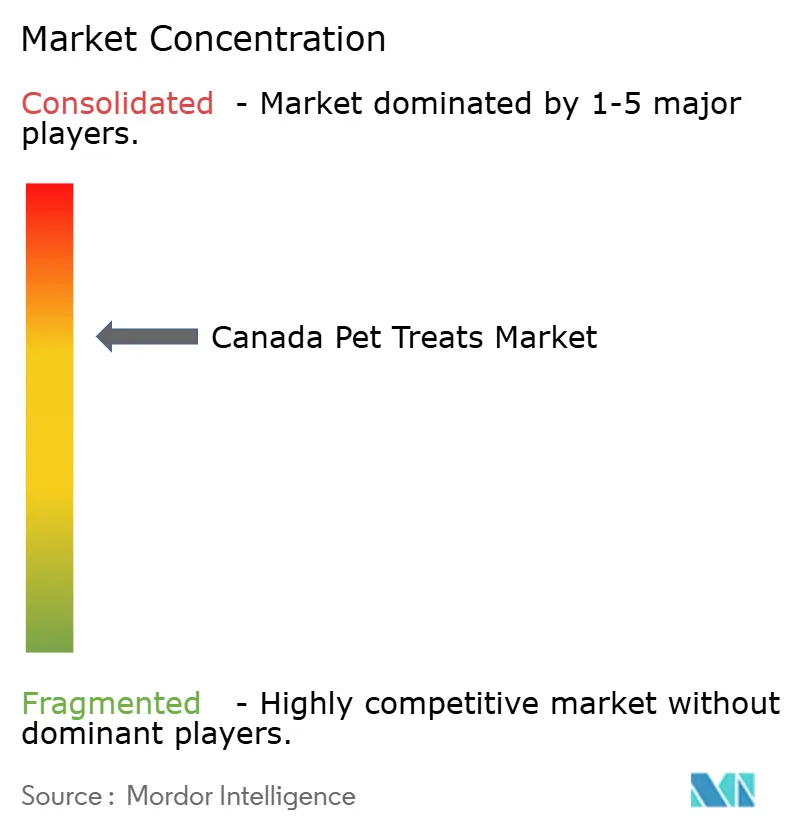
| Market Concentration | Medium |
Major Players *Disclaimer: Major Players sorted in no particular order Image © Mordor Intelligence. Reuse requires attribution under CC BY 4.0. | |
Canada Pet Treats Market Analysis by Mordor Intelligence
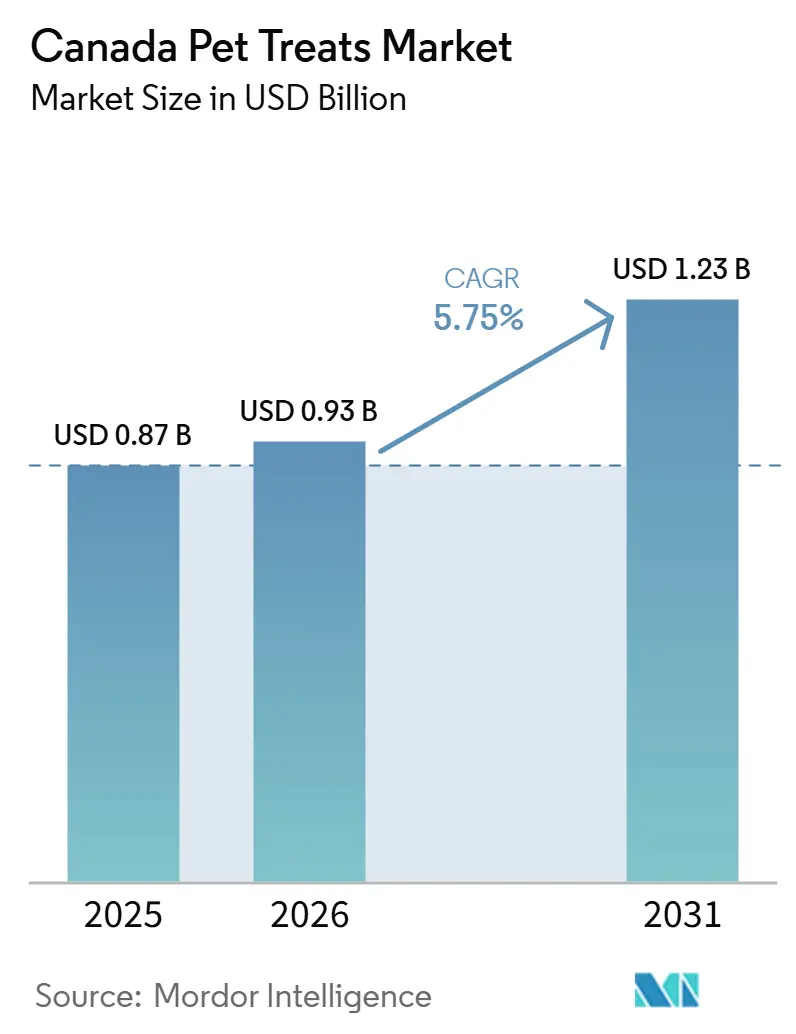
The Canada pet treats market size is projected to increase from USD 0.87 billion in 2025 to USD 0.93 billion in 2026, and reach USD 1.23 billion by 2031, growing at a CAGR of 5.75% from 2026 to 2031. Canada's broader pet food retail market provides a strong foundation for sustained demand for pet treats across food, chews, and reward products. The increasing share of premium pet food within overall pet food sales reflects a growing willingness among pet owners to trade up to higher-value nutrition, a trend that is also supporting premiumization in the Canada pet treats market. Treats and chews have become a regular part of pet care spending rather than occasional discretionary purchases, reinforcing stable consumer demand. At the same time, the continued expansion of e-commerce is improving the accessibility of premium and niche treat brands beyond traditional retail channels. Additionally, nearly 80% of Canadian households own at least one pet, representing approximately 29.8 million companion animals nationwide as of 2024, according to Statistics Canada. This large and established pet-owning population provides a durable consumer base, supporting the continued growth of the Canada pet treats market.
Key Report Takeaways
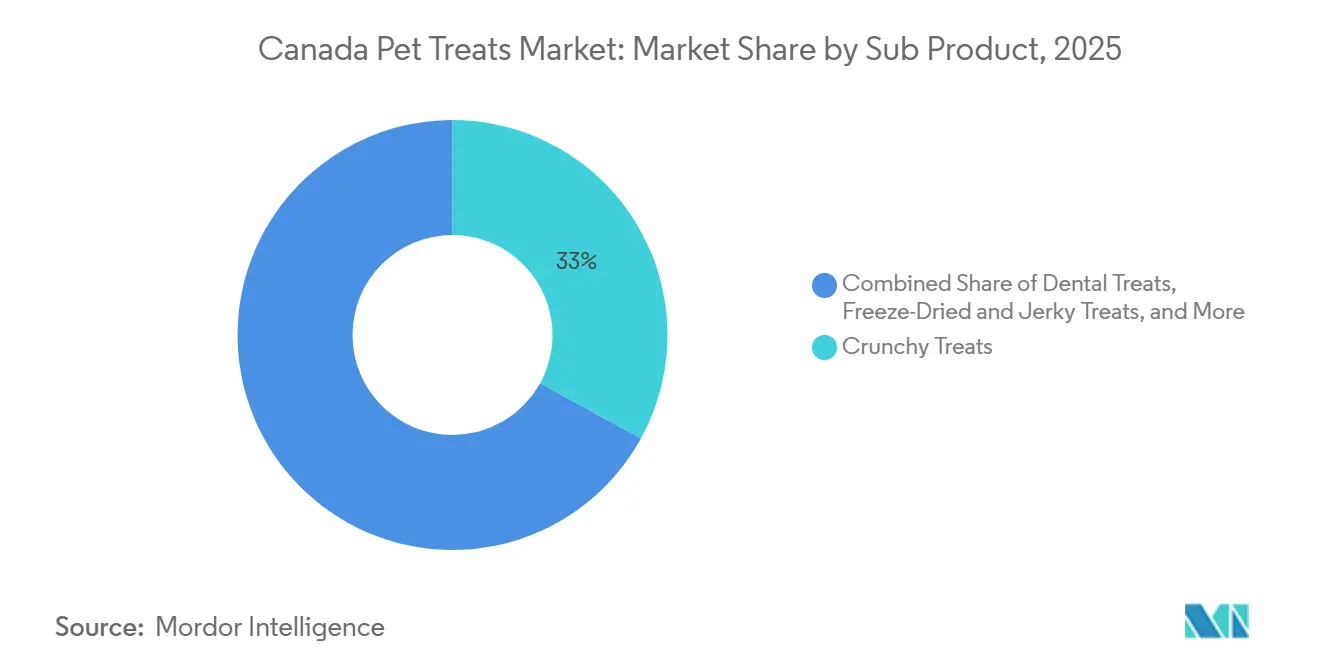
- By sub product, crunchy treats were the largest segment and accounted for 33.0% of the Canada pet treats market share in 2025, while freeze-dried and jerky treats are projected to be the fastest-growing segment, registering a 10.8% CAGR through 2026 to 2031.
- By pets, dogs were the largest segment and held a 71.0% share of the Canada pet treats market in 2025, while cats are projected to be the fastest-growing segment, expanding at a 7.2% CAGR through 2026 to 2031.
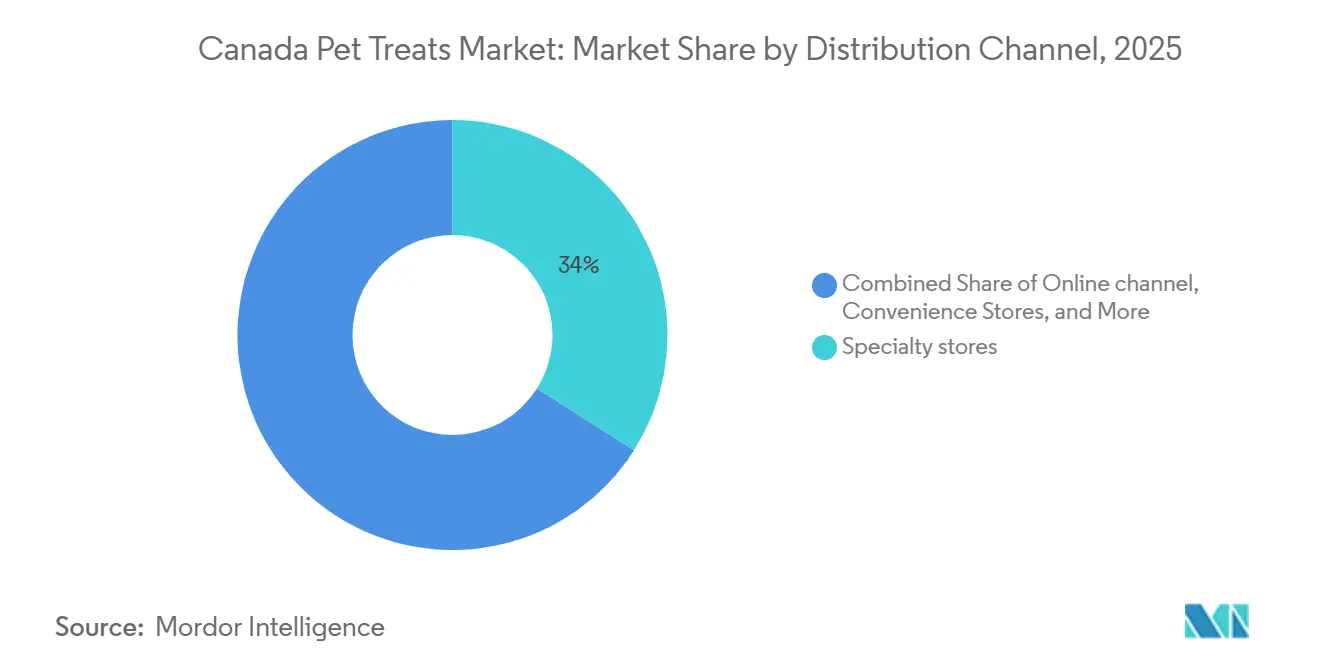
- By distribution channel, specialty stores were the largest segment and accounted for 34.0% of the Canada pet treats market size in 2025, while the online channel is projected to be the fastest-growing segment, advancing at a 9.4% CAGR through 2026 to 2031.
Note: Market size and forecast figures in this report are generated using Mordor Intelligence’s proprietary estimation framework, updated with the latest available data and insights as of January 2026.
Canada Pet Treats Market Trends and Insights
Drivers Impact Analysis*
| Driver | (~) % Impact on CAGR Forecast | Geographic Relevance | Impact Timeline |
|---|---|---|---|
| Rising pet humanization and premium treat spend | +1.2% | National, strongest in Ontario, British Columbia, and Quebec urban clusters | Long term (≥ 4 years) |
| Expansion of modern retail and specialty pet channels | +1.0% | National, with early gains in Ontario, British Columbia, and Quebec | Medium term (2-4 years) |
| E-commerce and direct-to-consumer growth in urban premium segments | +0.9% | National, strongest in dense urban corridors | Medium term (2-4 years) |
| Functional treats for digestive, dental, and skin support | +0.9% | National, with strong pull through specialty and veterinary-led channels | Long term (≥ 4 years) |
| Adoption of clean-label, single-ingredient, and protein-rich formulations | +0.8% | National, strongest in British Columbia and Quebec premium segments | Long term (≥ 4 years) |
| Local manufacturing and import substitution in key provinces | +0.6% | Ontario, British Columbia, and Quebec | Medium term (2-4 years) |
| Source: Mordor Intelligence | |||
Rising Pet Humanization and Premium Treat Spend
Pet humanization in the Canada pet treats market is visible in actual spending behavior rather than in branding language alone. In 2024, dog-owning households spent USD 330 annually on treats and chews, indicating that treats are already included in regular pet care budgets[1]Source: Agriculture and Agri-Food Canada, “Sector Trend Analysis Pet Food Trends in Canada,” Government of Canada, agriculture.canada.ca. The strong adoption of premium pet food in Canada supports premium positioning for adjacent treat categories as well. This trend matters because consumers who are willing to pay for premium complete nutrition are also more likely to purchase high-quality treats. As a result, the Canada pet treats market benefits from consumer preferences that prioritize quality, perceived health benefits, and ingredient transparency over price alone.
E-Commerce and Direct-to-Consumer Growth in Urban Premium Segments
The Canada pet treats market is gaining from the steady rise of digital purchasing in pet care. Pet food and supplies have established a strong online retail presence in Canada, demonstrating that e-commerce has become an important channel for product access and discovery. This growing digital adoption continues to support the expansion of online sales for pet treats. This channel favors premium treats because digital shelves can carry more niche, functional, and limited-ingredient products than physical stores. Pet Valu operated 863 stores as of January 2026 and reported system-wide sales of USD 1,533.5 million in fiscal 2025, indicating that specialty retail and digital-led assortment strategies are moving in tandem rather than replacing one another. The Canada pet treats market should continue to see stronger online traction in premium segments where repeat purchase behavior, subscription ordering, and broader product choice matter more than impulse shelf visibility.
Functional Treats for Digestive, Dental, and Skin Support
Functional positioning is pushing the Canada pet treats market further away from simple reward products and closer to daily wellness use. Petcurean Pet Nutrition announced Go! Solutions Dental and Immune Health recipes in February 2026 for both dogs and cats, showing how established brands are expanding treat use to meet condition-specific needs[2]Source: Petcurean Pet Nutrition, “Petcurean to Debut Go! Solutions Dental and Immune Health Chicken and Salmon Recipes with Grains at Global Pet Expo 2026,” National Post Business Wire, nationalpost.com. Purina PetCare (Nestlé S.A.) launched Pro Plan AdvantEDGE in April 2026 with prebiotics, probiotics, and postbiotics across digestive-support and senior formulas, confirming that larger players are also tying treats and adjacent formats to functional claims. Health Canada’s veterinary health product framework provides a formal route for substantiated health claims, which raises the standard for participation in premium functional segments[3]Source: Health Canada, “Veterinary Health Products,” Government of Canada, canada.ca. As a result, the Canada pet treats market is increasingly rewarding companies that can support efficacy, compliance, and specialized formulations simultaneously.
Adoption of Clean-Label, Single-Ingredient, and Protein-Rich Formulations
Ingredient simplicity remains an important growth theme in the Canada pet treats market. Yappetizers highlighted its single-ingredient positioning in 2025, showing that small Canadian producers are using transparency and clean labeling as central selling points rather than as secondary claims. Protein Industries Canada described pet food as a commercial opportunity for new protein development in 2024, including work that integrated animal collagen into Canadian-made formulas. NRGene Canada launched MaxBites in March 2026 using 100% dried Black Soldier Fly larvae, which brought a novel protein concept into the retail treat space. These moves show that the Canada pet treats market is opening space for brands that combine simple labels, differentiated proteins, and premium positioning without depending only on legacy brand scale.
Restraints Impact Analysis*
| Restraint | (~) % Impact on CAGR Forecast | Geographic Relevance | Impact Timeline |
|---|---|---|---|
| High price sensitivity outside premium urban clusters | -0.8% | National, strongest in Atlantic Canada, Prairie secondary cities, and rural Ontario | Long term (≥ 4 years) |
| Rising cost pressure from protein inputs and cold-chain logistics | -0.7% | National, strongest in freeze-dried and fresh formats | Medium term (2-4 years) |
| Fragmented compliance requirements for claims and labeling across channels | -0.5% | National, especially for brands serving grocery, specialty, and veterinary channels | Medium term (2-4 years) |
| Limited cold-chain and logistics coverage for moist and fresh treat formats | -0.5% | Strongest outside Ontario, British Columbia, and Quebec metro corridors | Long term (≥ 4 years) |
| Source: Mordor Intelligence | |||
High Price Sensitivity Outside Premium Urban Clusters
The Canada pet treats market does not move at the same pace across all regions and channels. Store-based non-specialty retail accounted for CAD 5.8 billion (USD 4.2 billion), or 86.6% of pet food retail value in 2024, which shows how much category volume still depends on mainstream retail environments. Supermarkets and hypermarkets remain the dominant store-based retail channel, where established price points and high-volume products are generally prioritized over premium experimentation. This creates a two-speed demand profile in which premium treats perform well in specialty-led urban markets but experience slower adoption in more value-conscious regions. As a result, the Canada pet treats market remains exposed to regional pricing constraints even as premium product innovation continues to expand.
Rising Cost Pressure from Protein Inputs and Cold-Chain Logistics
Cost pressure remains one of the main operating constraints in the Canada pet treats market. High-protein and single-ingredient treats rely heavily on animal proteins and on manufacturing processes that are more expensive than conventional ambient formats. Protein Industries Canada’s 2024 work on collagen and alternative proteins shows that the supply side is already looking for ways to reduce dependence on traditional protein inputs and improve formulation flexibility. Fresh, moist, and cold-chain-dependent products also face higher distribution complexity outside major metro corridors, which limits how widely these formats can scale at mainstream price points. For smaller brands in the Canada pet treats market, these cost layers can narrow margins even when demand for premium products stays healthy.
*Our forecasts treat driver/restraint impacts as directional, not additive. The impact forecasts reflect baseline growth, mix effects, and variable interactions.
Segment Analysis
By Sub Product: Freeze-Dried Innovation Reshapes the Treats Shelf
Crunchy treats held 33.0% of the Canada pet treats market size in 2025, maintaining their leadership due to their shelf stability, broad retail presence, and suitability for everyday training and rewarding. Dental treats continue to witness steady demand as pet owners increasingly seek products that support oral health and overall wellness. The Canada pet treats industry is also seeing stronger alignment between treat formulations and functional health benefits, particularly in dental care and immunity. Petcurean Pet Nutrition's 2026 product launch and Purina's 2026 functional portfolio expansion demonstrate that both leading and mid-sized manufacturers are investing in treats that offer nutritional benefits beyond taste and texture.
Freeze-dried and jerky treats are projected to be the fastest-growing sub-product, registering a 10.8% CAGR through 2031. Their growing popularity is driven by premium positioning, high-protein formulations, and strong consumer preference for clean-label products. Protein Industries Canada's protein innovation initiatives and NRGene Canada's 2026 MaxBites launch further indicate that differentiated protein ingredients will remain a key area of product development. Meanwhile, soft and chewy treats and other treat formats continue to support overall market demand, highlighting that while traditional products provide market stability, future growth is increasingly driven by premium and value-added offerings.



By Pets: Dog Dominance Persists as Cat Economics Accelerate
Dogs held 71.0% of the Canada pet treats market share in 2025, maintaining their position as the primary demand base for product innovation, brand investment, and retail expansion. Their dominance supports strong visibility across grocery, specialty, and omnichannel distribution, while premium dog treats continue to evolve through health-focused formulations, higher protein content, and functional benefits rather than basic category expansion.
Cats are projected to be the fastest-growing pet segment, registering a 7.2% CAGR through 2031. Growing consumer interest in feline health and wellness is driving demand for premium and functional treats, particularly in dental care and specialized nutrition. Product launches such as Wellness Pet Company, Inc. (Clearlake Capital Group, L.P.), WHIMZEES Natural Dental Treats for Cats highlight the increasing focus on innovation within the feline treats category. Meanwhile, treats for other pets continue to contribute to the market, although they remain a comparatively smaller segment within manufacturers' product portfolios.
By Distribution Channel: Specialty Stores Lead but Online Rewrites the Growth Hierarchy
Specialty stores accounted for 34.0% of the Canada pet treats market size in 2025, maintaining their position as the leading channel for premium product assortments, new product launches, and functional treat positioning. Their ability to offer exclusive brands, knowledgeable customer support, and wider shelf space for differentiated products continues to make them the preferred retail channel for premium pet treats. Supermarkets and hypermarkets remain important for broad market reach, routine purchases, and high-volume sales of mainstream brands.
The online channel is projected to be the fastest-growing distribution channel, registering a 9.4% CAGR through 2031. Rising consumer preference for convenience, subscription-based purchasing, and broader access to premium and niche products is accelerating online sales. Meanwhile, convenience stores and other retail channels continue to support overall market accessibility, although specialty retail and e-commerce remain the primary growth drivers. As a result, the Canada pet treats industry is evolving toward a channel landscape where specialty stores lead current sales while online platforms drive future market expansion.
Geography Analysis
The Canada pet treats market remains most concentrated in Ontario, British Columbia, and Quebec, which together form the largest base for premium demand and organized retail reach. Ontario remains the largest provincial demand center because it combines dense urban pet ownership with strong access to grocery, specialty, and e-commerce channels. The province also benefits from the broad operating footprint of national retailers, supporting category visibility and product availability across major population centers. Ontario’s role in the Canada pet treats market is reinforced by its large household base and the ability of premium products to reach both physical and online shoppers at scale. This combination keeps the province central to new product launches and premium assortment rollouts.
British Columbia demonstrates one of the strongest premium product profiles in the Canada pet treats market, particularly for single-ingredient and freeze-dried treats, reflecting growing consumer preference for clean-label and locally manufactured products. Quebec has a distinct market profile because bilingual packaging and labeling requirements have a greater influence on market access than in many other provinces. This gives well-prepared national brands and local manufacturers a practical advantage in retail shelf readiness and distribution. As a result, the Canada pet treats market develops differently in Quebec than in English-dominant provinces, even though broader premiumization trends remain similar.
The Prairie provinces and Atlantic Canada remain comparatively smaller and more price-sensitive markets. Value-oriented and shelf-stable products continue to perform well as they align with mainstream price expectations and are easier to distribute across geographically dispersed markets. Although expanding e-commerce is projected to improve access to premium products over time, regional growth is likely to remain uneven due to differences in pricing power, retail density, and distribution infrastructure.
Competitive Landscape
The Canada pet treats market is moderately consolidated, led by large multinational companies that benefit from broad brand recognition, extensive distribution networks, and strong shelf presence across grocery, specialty, veterinary, and online channels. Mars, Incorporated, Purina PetCare (Nestlé S.A.), Hill's Pet Nutrition, Inc. (Colgate-Palmolive Company), The J.M. Smucker Company, and General Mills Inc. remain the leading participants due to their diverse product portfolios, established retail partnerships, and strong marketing capabilities. Their presence is particularly strong in core dog and dental treat categories, where brand trust and repeat purchases are significant. However, the market remains open to smaller players, as premium and functional segments increasingly reward product differentiation over scale, creating opportunities in clean-label, cat-specific, novel protein, and health-focused treats.
Competition is increasingly shifting toward product innovation and premium positioning rather than relying solely on distribution. Hill's Pet Nutrition, Inc. (Colgate-Palmolive Company), Purina PetCare (Nestlé S.A.), and Petcurean Pet Nutrition continue to expand their portfolios with products targeting digestive health, immunity, dental care, and specialized nutrition for both dogs and cats. These developments reflect the growing importance of functional formulations and premium nutrition in strengthening competitive positioning. As a result, the market increasingly favors companies that combine scientific formulation, regulatory compliance, and strong brand credibility.
A second layer of competition is driven by regional and emerging manufacturers focusing on differentiated product offerings. Companies such as BrightPet Nutrition Group (Stewart), Farmina Pet Foods, Virbac, Wellness Pet Company, Inc. (Clearlake Capital Group, L.P.), Nulo, Redbarn Pet Products, and The Crump Group compete through premium ingredients, functional formulations, natural positioning, and specialized nutrition. The increasing focus on novel proteins, clean-label products, and locally manufactured treats is further intensifying competition, while Canada's regulatory framework continues to encourage high product quality and compliance standards, reinforcing consumer confidence across the market.
Canada Pet Treats Industry Leaders
Mars, Incorporated
Hill's Pet Nutrition, Inc. (Colgate-Palmolive Company)
The J.M. Smucker Company
General Mills Inc.
Purina PetCare (Nestlé S.A.)
- *Disclaimer: Major Players sorted in no particular order

Recent Industry Developments
- June 2026: Mellow Premium expanded its long-lasting dog treats into Independent Grocers Alliance (IGA) stores across Canada, strengthening the availability of premium pet treats through the grocery channel and supporting wider consumer access to premium treat products.
- March 2026: NRGene Canada launched MaxBites, an all-natural premium pet treat made from 100% Black Soldier Fly (BSF) larvae, entering the Canada pet treats market. The single-ingredient, clean-label treat supports gut health and immune function while addressing growing demand for sustainable, high-protein, and novel protein pet treats. Its launch reflects the increasing focus on premium and functional products in the Canada pet treats market.
- January 2025: Wellness Pet Company, Inc. (Clearlake Capital Group, L.P.) launched WHIMZEES Freshzees in Canada, expanding its premium dental treat portfolio with softer dog treats formulated with zinc, apple cider vinegar, and parsley.


Canada Pet Treats Market Report Scope
Pet Treats are complementary pet food products offered as rewards, snacks, or training aids. They are formulated to enhance palatability while supporting specific nutritional, functional, or dental health benefits and are intended to supplement, not replace, a complete and balanced diet.
The Canada Pet Treats Market Report is Segmented by Product (Dental Treats, Crunchy Treats, Soft and Chewy Treats, Freeze-Dried and Jerky Treats, and Other Treats), by Pet Type (Dogs, Cats, and Other Pets), and Distribution Channel (Supermarkets/Hypermarkets, Specialty Stores, Convenience Stores, Online Channel, and Other Channels). The Market Forecasts are Provided in Terms of Value (USD) and Volume (Metric Tons).
| Dental Treats |
| Crunchy Treats |
| Soft and Chewy Treats |
| Freeze-Dried and Jerky Treats |
| Other Treats |
| Dogs |
| Cats |
| Other Pets |
| Convenience Stores |
| Online Channel |
| Specialty Stores |
| Supermarkets and Hypermarkets |
| Other Channels |
| By Sub Product | Dental Treats |
| Crunchy Treats | |
| Soft and Chewy Treats | |
| Freeze-Dried and Jerky Treats | |
| Other Treats | |
| By Pets | Dogs |
| Cats | |
| Other Pets | |
| By Distribution Channel | Convenience Stores |
| Online Channel | |
| Specialty Stores | |
| Supermarkets and Hypermarkets | |
| Other Channels |


Key Questions Answered in the Report
What is the projected value of Canada pet treats by 2031?
The category is forecast to reach USD 1.23 billion by 2031, up from USD 0.93 million in 2026, at a 5.9% CAGR.
Which sub product is growing the fastest in Canada?
Freeze-dried and jerky treats are the fastest-growing sub product, with a projected 10.8% CAGR through 2031.
Which pets generate the most treat demand in Canada?
Dogs remain the largest demand base with 71.0% share in 2025, while cats are growing faster at a 7.2% CAGR through 2031.
Why are specialty stores still important for pet treats in Canada?
Specialty stores held the largest channel share at 34.0% in 2025 because they support premium assortments, education, and broader functional product selection.
Page last updated on:





