
Canada Kitchen Sink Market Size and Share
Market Overview
| Study Period | 2020 - 2031 |
|---|---|
| Forecast Data Period | 2026 - 2031 |
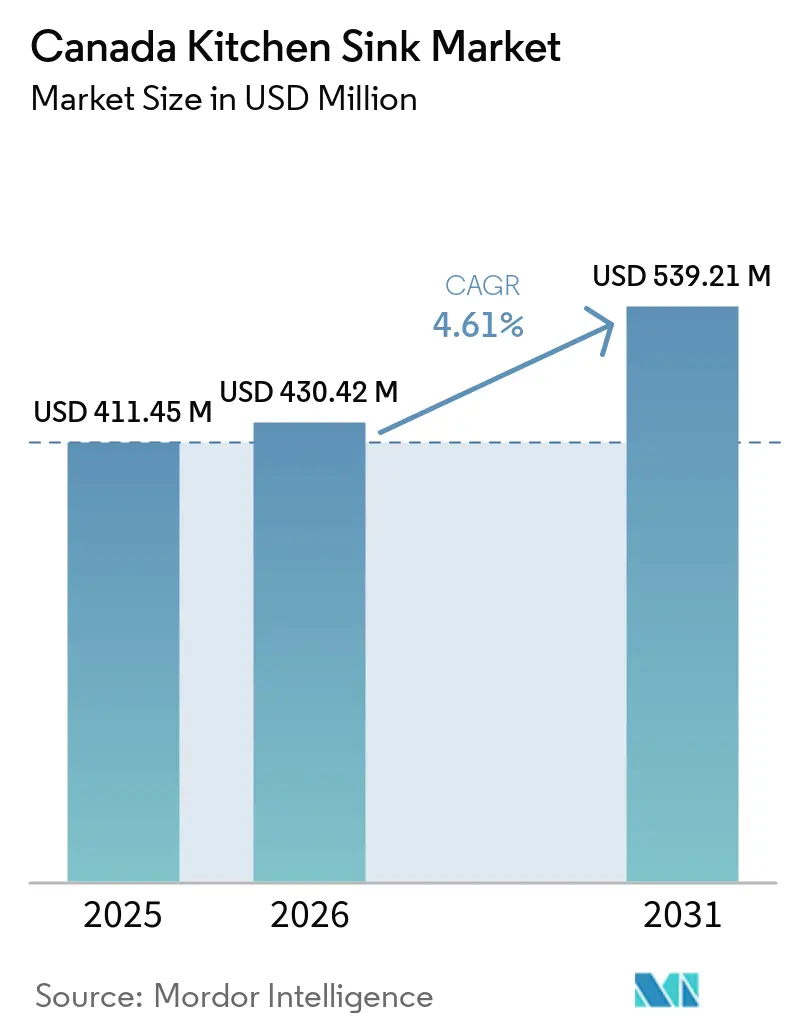
| Base Year Market Size (2025) | USD 411.45 Million |
| Market Size (2026) | USD 430.42 Million |
| Market Size (2031) | USD 539.21 Million |
| Growth Rate (2026 - 2031) | 4.61 % |
| Market Concentration | Medium |
Major Players *Disclaimer: Major Players sorted in no particular order Image © Mordor Intelligence. Reuse requires attribution under CC BY 4.0. | |
Canada Kitchen Sink Market Analysis by Mordor Intelligence
The Canada kitchen sink market size was valued at USD 430.4 million in 2025 and is estimated to grow from USD 430.4 million in 2026 to reach USD 539.2 million by 2031, at a CAGR of 4.6% during the forecast period (2026-2031). The Canada kitchen sink market is supported by replacement demand from older homes and continued kitchen renovation activity. Housing starts also create a steady flow of new kitchen installations, although the mix of new supply affects product selection. Higher demand for workstations, undermount, and composite products is raising the value of purchases even when unit volumes are more restrained. Online sales are changing how buyers compare materials, installation requirements, and product features before they choose a sink. Cost pressure and weaker renovation confidence in Ontario may delay some projects, but replacement needs and aging condominium stock continue to support demand across the Canada kitchen sink market.
Key Report Takeaways
- By material, stainless steel held 45.1% of the Canadian kitchen sink market share in 2025, while quartz is projected to grow at the fastest CAGR of 7.2% through 2031.
- By installation type, undermount sinks accounted for 34% of the Canadian kitchen sink market share in 2025 and are advancing at a 6.8% CAGR through 2031.
- By bowl configuration, single bowl sinks held 52% of the market value in 2025 and are projected to grow at the fastest CAGR of 5.7% through 2031.
- By end-user, residential users accounted for 78% of market value in 2025, while commercial users are projected to grow at a 6% CAGR through 2031.
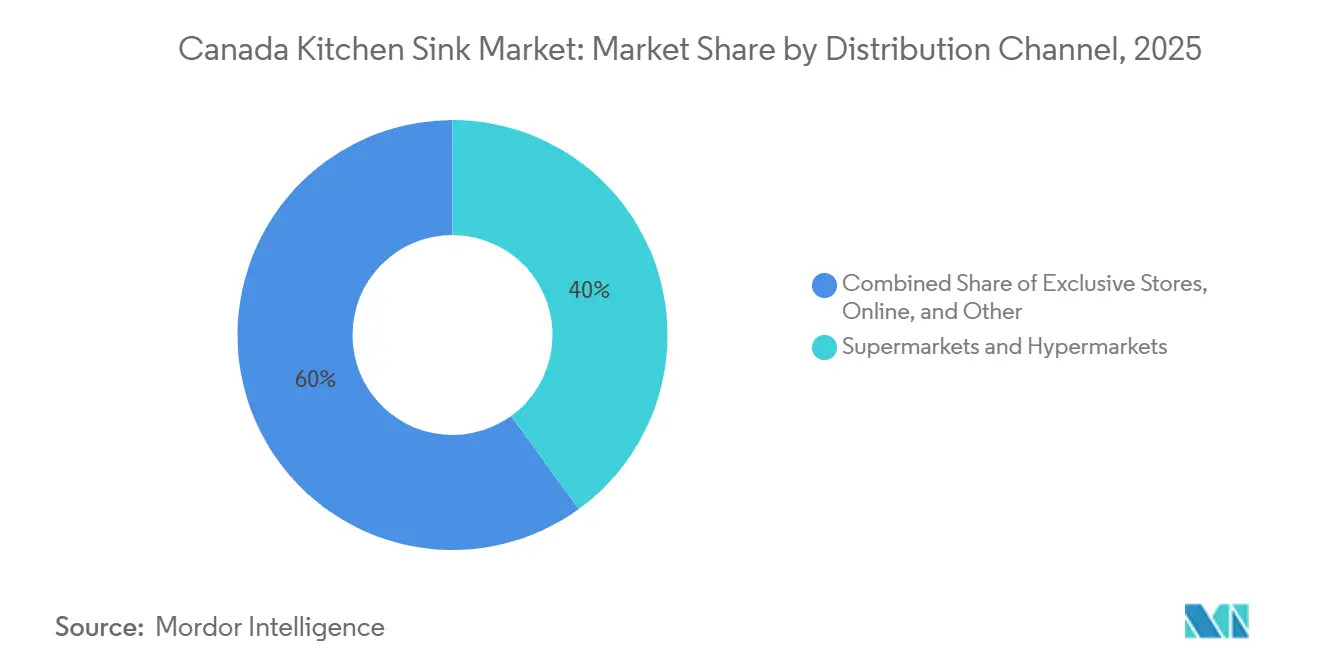
- By distribution channel, supermarkets and hypermarkets held 40% of distribution value in 2025, while online sales are projected to expand at a 9.2% CAGR through 2031.
- By geography, Ontario held 38% of the market value in 2025, while Alberta is projected to grow at a 5.3% CAGR through 2031.
Note: Market size and forecast figures in this report are generated using Mordor Intelligence’s proprietary estimation framework, updated with the latest available data and insights as of January 2026.
Canada Kitchen Sink Market Trends and Insights
Drivers Impact Analysis*
| Driver | (~) % Impact on CAGR Forecast | Geographic Relevance | Impact Timeline |
|---|---|---|---|
| Kitchen Renovation and Replacement Demand | +1.2% | National, with elevated intensity in Ontario, Québec, and British Columbia | Medium term (2-4 years) |
| Residential Construction and Household Formation | +0.9% | Ontario, British Columbia, Alberta, Québec | Short term (≤ 2 years) |
| Premiumization Of Workstation and Undermount Sinks | +0.8% | National, with stronger activity in Toronto, Vancouver, Calgary, and Montréal | Medium term (2-4 years) |
| Sustainability and Recycled-Content Product Demand | +0.5% | British Columbia, Ontario, Québec | Long term (≥ 4 years) |
| E-Commerce Expansion for Kitchen Fixtures | +0.6% | National, with stronger penetration in Ontario and British Columbia | Short term (≤ 2 years) |
| Aging Housing Stock and Accessibility Upgrades | +0.3% | National, with legacy stock concentrated in Ontario and Québec | Long term (≥ 4 years) |
| Source: Mordor Intelligence | |||
Kitchen Renovation and Replacement Demand
Kitchen projects appeared in 27% of residential renovations in the Canadian Home Builders’ Association’s recent renovation survey. Major remodels reached CAD 100,000 (USD 71,000) at the 90th percentile in the survey data, illustrating the scale of spending involved when owners replace cabinetry, counters, appliances, and fixtures together. A significant share of Canada’s housing stock predates 1980, which supports replacement activity as kitchens enter repair and modernization cycles[1]. In these homes, a sink replacement can be prompted by worn finishes, changing household needs, water-related damage, or a broader effort to improve the kitchen’s function. The Residential Renovation Price Index increased 0.3% in the first quarter of 2025, the smallest quarterly increase since the second quarter of 2020. The Canada kitchen sink market, therefore, retains a base of demand tied to fixture replacement, which is less discretionary than a complete kitchen redesign.
Residential Construction and Household Formation
Canada recorded 259,028 housing starts in 2025, which was the fifth-highest annual total on record and 5.6% above 2024[2]. Every completed dwelling requires a kitchen installation, providing a direct demand source for the Canada kitchen sink market and a predictable point at which builders choose materials, bowl layouts, and installation formats. Major urban centers recorded a 6% increase in starts during 2025, with rental apartments and missing-middle homes contributing to the supply. Rental construction supports sink volumes, but it often uses mid-range stainless steel drop-in products rather than premium formats, which limits the immediate value contribution from each new unit. Starts totaled 131,851 units through July 2026, 4% below the same period in 2025. This softer 2026 construction setting increases the importance of renovation and replacement demand for the Canada kitchen sink market.
Premiumization of Workstation and Undermount Sinks
Workstation sinks use integrated ledges that hold cutting boards, colanders, and racks above the bowl, turning the sink area into an active preparation and cleanup space. This format suits households that combine food preparation, composting, washing, and cleanup in one kitchen area, especially when counter space is limited. BLANCO introduced the INTEOS workstation sink in February 2025 in stainless steel and SILGRANIT options across 30-inch to 45-inch sizes[3]. Julien renewed its SmartStation collection in November 2025 with modular accessories and 2 installation modes. The Canada kitchen sink industry benefits when buyers move from basic bowls to products with integrated accessories and higher-value materials. Premium formats also place greater importance on compatibility with quartz and stone countertops, which supports undermount installations.
E-Commerce Expansion for Kitchen Fixtures
Online distribution in the Canada kitchen sink market is forecast to grow at a 9.2% CAGR from 2026 to 2031. Digital channels let buyers compare specifications, material options, images, installation instructions, available inventory, and product dimensions before making a purchase. This access is especially useful for buyers evaluating undermount and composite products that need countertop compatibility checks before installation can be planned. Online product information can reduce hesitation around configurations that were previously more likely to be selected in a showroom, particularly when buyers can review installation requirements before contacting a contractor. Mass retailers provide broad online access, while direct brand channels can serve buyers who have already selected a premium product. Brands with clear imagery, material explanations, installation guidance, and consistent product details are better positioned as online purchasing expands.
Restraints Impact Analysis*
| Restraint | (~) % Impact on CAGR Forecast | Geographic Relevance | Impact Timeline |
|---|---|---|---|
| Volatility In Stainless Steel, Quartz, and Freight Costs | -0.9% | National, with stronger exposure in provinces importing from non-FTA partners | Short term (≤ 2 years) |
| Installation Complexity and Countertop Compatibility | -0.4% | National, particularly in urban retrofit markets | Medium term (2-4 years) |
| Renovation Financing Pressure and High Project Costs | -0.8% | Ontario and British Columbia | Medium term (2-4 years) |
| Limited Domestic Manufacturing and Import Dependence | -0.4% | National | Long term (≥ 4 years) |
| Source: Mordor Intelligence | |||
Volatility In Stainless Steel, Quartz, And Freight Costs
Cost pressure can limit margin expansion in the Canada kitchen sink market, particularly for stainless steel products that depend on steady material availability and predictable input prices. Canada’s 2025 steel measures applied tariff rate quotas to certain non-FTA steel imports, with surtaxes on volumes above the specified thresholds. The resulting uncertainty affects material purchasing, supplier negotiations, inventory decisions, and pricing decisions across the supply chain. Stainless steel remains the largest material category, so changes in its cost base can affect a substantial part of the category mix and can be particularly difficult to absorb in price-sensitive replacement projects. Higher costs may also encourage specifiers to consider composite alternatives when performance, supply conditions, and countertop requirements are suitable. Quartz and granite composite inputs can face similar pressure when mineral sourcing and freight conditions become less predictable.
Renovation Financing Pressure and High Project Costs
Higher costs for cabinetry, countertops, labor, and materials can reduce the remaining budget for kitchen fixtures within a complete kitchen renovation. The Canadian Home Builders’ Association expected renovation investment to grow by less than 1% in 2026[4]. The association cited tariff-driven material costs, an unsettled economic environment, and slow building permit approvals, all of which can affect the timing and scope of planned work. Ontario’s renovation confidence score was 40.1 in the Spring 2026 Renovation Market Index, indicating that some projects may be deferred. The Canada kitchen sink market can face slower discretionary upgrades when households postpone full kitchen renovations or select simpler products to stay within the available project budget. Aging housing stock still creates a later replacement need, which can support activity after deferred projects resume.
*Our forecasts treat driver/restraint impacts as directional, not additive. The impact forecasts reflect baseline growth, mix effects, and variable interactions.
Segment Analysis
By Material: Quartz Expand While Stainless Steel Retains Its Base
Quartz is projected to record the highest growth among materials, with the Canadian kitchen sink market size for the category advancing at a 7.2% CAGR through 2031. The category includes granite composite, quartz composite, and newer material formulations that broaden the available choices beyond conventional metal finishes. Buyers value composite surfaces for finish variety, heat resistance, and scratch resistance, particularly in renovations where the sink is selected as part of a coordinated countertop and cabinet design. Matte, textured, and multitone finishes give these products options that conventional stainless steel does not provide. BLANCO launched its OOVALON sink in March 2026 using the company’s VELGRANIT granite composite material. The product received a 2026 iF Design Award and is available in undermount and flush-mount versions. These releases show continued product development in the premium composite category. The Canada kitchen sink market also gains value when consumers choose material upgrades during renovation projects.
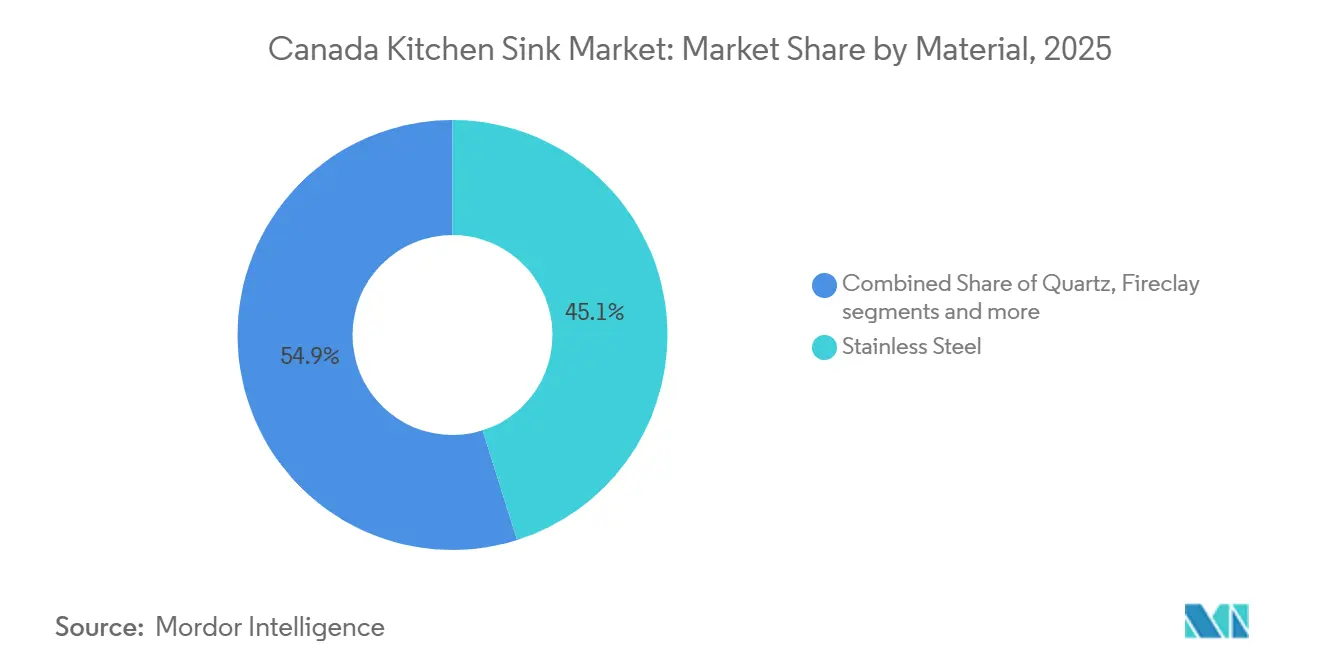
Stainless steel held 45.1% of the Canada kitchen sink market share in 2025. Its established position reflects broad use in commercial foodservice and lower-cost residential replacement, where familiar installation methods and wide product availability remain important. Stainless steel remains practical for rental properties and projects where durability, availability, and price are decisive, rather than finish coordination or accessory features. Quartz products align with premium countertop installations, while fireclay serves apron-front and heritage renovation projects. Kohler’s Audrine collection introduced fireclay options for apron-front, undermount, and bar applications in January 2026. Granite and marble-composite products serve buyers seeking stone-like finishes with less maintenance than solid stone. Acrylic continues to serve entry-level and property-management uses. Emerging composites are likely to receive attention where buyers seek newer finishes and performance characteristics.

By Installation Type: Undermount Sinks Lead Current Value and Future Growth
Undermount sinks held 34% of the Canada kitchen sink market by installation type in 2025. They are also forecast to grow at a 6.8% CAGR through 2031, making the format important to both current value and future product selection. An undermount installation creates a continuous transition from countertop to sink, which can simplify cleanup along the counter edge and create a more integrated visual result. This layout avoids the rim edge found in drop-in products, where debris can collect. Quartz and stone countertops are well-suited to undermount integration because the product is installed beneath the surface. The Canada kitchen sink industry, therefore, benefits from the parallel demand for premium counters and coordinated sink installations. Established suppliers also benefit from shared Canadian and U.S. product standards for kitchen sinks. These standards are especially relevant when contractors select products for regulated projects.
Top-mount and drop-in sinks retain meaningful demand in rental units, managed properties, and do-it-yourself renovations, where completing the installation with limited disruption can take priority. Their lower installation complexity and lower labor requirements remain important for price-sensitive projects and for the direct replacement of an existing sink opening. Farmhouse and apron-front formats occupy a premium position in heritage-inspired renovations. Kohler and Julien both address this style through expanding product collections. Flush-mount and dual-mount products provide flexibility where countertop conditions or future replacement needs are uncertain. The growth of undermount products is expected to increase their position within the Canada kitchen sink market by 2031. This shift may reduce the relative position of standard drop-in products. Installation choice will continue to depend on countertop material, labor cost, and the level of renovation planned.
By Bowl Configuration: Single Bowl Products Combine Space Efficiency and Workstation Use
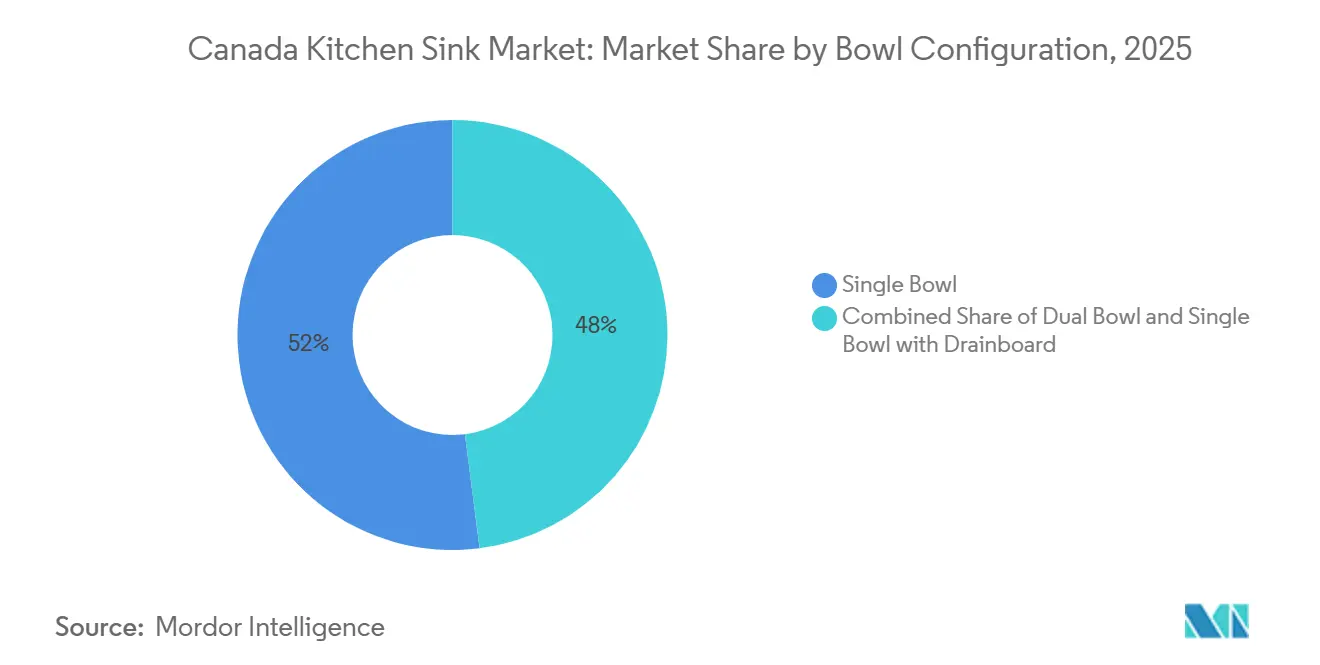
Single bowl sinks accounted for 52% of the Canada kitchen sink market size in 2025. They are also the fastest-growing bowl configuration, with a projected 5.7% CAGR through 2031. The format fits condominium kitchens where cabinet space is limited and where a wide, uninterrupted work area can be more useful than divided basins. It also supports workstation accessories that use one uninterrupted bowl area. A larger continuous bowl can accommodate food preparation, cleaning, and accessory storage in a compact layout. Julien’s SmartStation line combines a single bowl with modular accessories placed on an integrated ledge. This approach responds to kitchens in Toronto, Montréal, and Vancouver, where cabinet width can limit dual-bowl choices. The Canada kitchen sink market benefits when compact housing design favors products with several functions in one footprint.
Dual-bowl sinks retain an established user base in suburban and rural detached homes. Wider cabinets can accommodate 2 basins and support separate washing and rinsing tasks, which remains useful for larger households and kitchens with more generous preparation space. Single bowl products with drainboards provide another functional option for galley kitchens and utility-adjacent renovations. These formats serve buyers who want a practical workspace without using a separate second bowl. Workstation accessories can provide some task separation within a single-bowl design. That capability reduces the need to choose a larger dual-bowl layout in smaller kitchens. The Canada kitchen sink market will continue to include both formats because household size, cabinet dimensions, and kitchen routines differ. Single-bowl products nevertheless have a stronger growth outlook as urban housing becomes denser.
By End-User: Residential Demand Dominates While Commercial Renovation Grows Faster
Residential users accounted for 78% of the Canada kitchen sink market size in 2025. This segment is supported by homeowner renovation activity and fixture replacement in existing homes, which together cover both planned upgrades and necessary replacement work. Kitchen renovation can support resale value, which helps sustain spending on functional and visible kitchen upgrades. Residential buyers often select undermount, composite, or workstation products during full remodels, when countertop choice and sink choice are made together. These products can lift revenue even when the number of units sold does not rise at the same rate. Record rental construction in 2025 also supported demand for mid-range stainless steel and basic top-mount products. The Canada kitchen sink market has therefore served both premium owner-occupied renovations and volume-oriented rental installations. The mix between these uses affects the average value of products sold.
Commercial users are projected to grow at a 6% CAGR through 2031. Hospitality businesses, institutional foodservice sites, and multi-location restaurants can replace equipment during deferred renovation programs, particularly where older kitchen areas no longer match operating needs. Commercial installations often require heavier-gauge stainless steel and documented compliance with food-contact and plumbing requirements. These requirements favor established suppliers with product documentation, proven product ranges, and contractor relationships. Plumbing wholesalers also influence commercial specifications because they manage bulk orders and project lead times. The Canada kitchen sink industry has a smaller commercial base than residential demand, but commercial upgrades can provide higher specification requirements. Continued renovation of foodservice locations supports this segment. Product durability, standards compliance, and availability remain central to commercial purchasing decisions.
By Distribution Channel: Mass Retail Leads Current Value While Online Sales Grow Fastest
Supermarkets and hypermarkets accounted for 40% of distribution value in 2025. This channel includes broad retail outlets such as Home Depot Canada, RONA, and Canadian Tire, which provide a familiar local route for household purchasers and contractors. Same-day store availability is important for replacement projects that cannot wait for delivery or a specialized order. Contractors also use these outlets because familiar products and pricing can be compared quickly. Stainless steel top-mount and drop-in products are well suited to this channel because buyers often need immediate replacement options. The Canada kitchen sink market gains broad geographic coverage through this format. Exclusive kitchen-and-bath stores serve buyers who want to examine composite, fireclay, and premium stainless steel products in person. These locations remain important when choices are design-led or contractor-guided.
Online sales are projected to grow at a 9.2% CAGR through 2031. Digital retail gives buyers access to reviews, product details, inventory information, dimensions, material descriptions, and installation guidance before they make a final choice. This channel can win customers from mass retail and showroom formats as confidence in remote purchasing increases. It is particularly relevant for undermount and composite products after buyers confirm countertop compatibility. The other distribution category includes plumbing supply wholesalers that support commercial contractors. Their role is important where standards documentation, order quantities, and delivery schedules determine the purchase. The Canada kitchen sink market will continue to use several channels because urgent replacement, professional specification, and researched online purchases have different needs. Online growth does not remove the role of stores and wholesalers in those other purchase situations.
Geography Analysis
Ontario held 38% of the Canada kitchen sink market share in 2025. The province has the country’s largest concentration of residential renovation spending and a large base of older housing, including many homes and condominium units that require periodic kitchen repairs or full fixture replacement. Housing starts in Ontario reached 35,941 units from January through July 2026, 7% above the same 2025 period. London recorded 125% year-over-year growth in starts through July 2026. Toronto’s older condominium stock also creates replacement demand that does not depend on new construction, as kitchen fixtures are renewed during building repairs and unit renovations. Ontario’s Spring 2026 renovation confidence score of 40.1 indicates that some renovation projects may be delayed.
Québec is the second-largest provincial area in the Canada kitchen sink market. The province has an active contractor-led renovation base and demand for professionally installed kitchen products, which supports established installation channels as well as product suppliers. APCHQ reported in April 2026 that 64% of Québec homeowners planned renovations within the next 3 years. Quartz composite countertops are a common choice in renovation projects, which supports demand for undermount and composite sinks that are selected to match the countertop’s installation requirements and finish. Product installation is shaped by regulatory and skilled-trade requirements in Québec, making professional contractor involvement relevant for many projects. Montréal also completed a high volume of rental housing in 2025, with rental units accounting for more than 80% of new starts. That housing mix supports volume demand for mid-range stainless steel top-mount products.
Alberta is projected to record the highest provincial growth rate, at a 5.3% CAGR through 2031. Larger suburban homes support full kitchen remodels and create space for wider sink configurations, including dual-bowl and workstation products where the cabinet layout permits them. British Columbia has a premium renovation profile that supports composite and undermount products, despite housing starts falling 10% below 2025 levels through July 2026. Higher construction costs and softer condominium presales restrained new supply in British Columbia, increasing the relative importance of renovation purchases within the province. Manitoba, Saskatchewan, and the Atlantic provinces contribute demand through replacement activity in older single-detached homes. Winnipeg recorded a 40% year-over-year increase in starts through July 2026, identifying a developing volume opportunity in the Prairie region.
Competitive Landscape
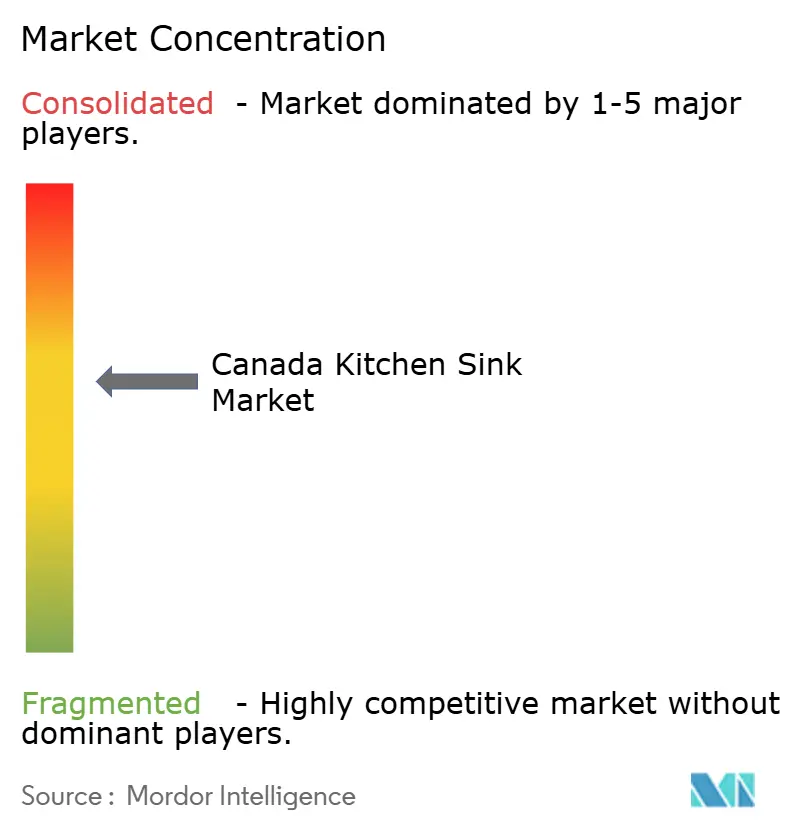
The Canadian kitchen sink market has a moderate structure, with established global and Canadian brands competing across retail, showroom, and commercial channels. Elkay, Franke, Kohler, BLANCO, and Kindred have broad positions in major distribution routes, allowing them to address both replacement buyers and customers undertaking full kitchen renovations. Regional and value-oriented brands also serve the mid-range and entry-level categories through online and mass-retail sales, where price, stock availability, and basic installation needs shape decisions. Competition centers on material choice, workstation functions, product design, and contractor access. Suppliers with recognized food-contact and plumbing compliance have an advantage in commercial and institutional specifications because buyers in these channels require products that can meet documented installation and operating requirements.
BLANCO introduced the OOVALON sink and LUNEOO electronic faucet as a coordinated system in March 2026. The launch used VELGRANIT composite material and included undermount and flush-mount options, giving the brand a product positioned around both material development and integrated kitchen design. Kohler launched the Audrine fireclay kitchen sink collection with Studio McGee in January 2026. The collection includes apron-front, undermount, and bar configurations with integrated accessories, extending the company’s offer in the premium renovation category. Julien renewed its SmartStation line with modular components and 2 installation modes in November 2025. These moves show how leading brands are using differentiated materials, design partnerships, and accessory systems to compete in the Canada kitchen sink market.
Workstation products are a key area of competition, with offerings from Elkay, BLANCO, Kohler, and Julien. The products combine sink bowls with accessories that add preparation and cleanup functions, responding to buyers who want more than a standard basin in the same cabinet footprint. Compact accessibility-focused sinks also address an opportunity in aging condominium buildings and renovation projects where kitchen use needs may change over time. Recycled-content composite products may be relevant for institutional buyers who consider environmental documentation as part of a procurement decision. Julien’s Canadian-made stainless steel positioning combines recycled and recyclable material claims with local manufacturing. The Canada kitchen sink industry will remain shaped by the ability to meet installation requirements, product preferences, and specialized project needs.
Canada Kitchen Sink Industry Leaders
-
Elkay Manufacturing
-
Franke Group
-
Kohler Co.
-
BLANCO GmbH and Co. KG
-
Julien Inc.
- *Disclaimer: Major Players sorted in no particular order
Recent Industry Developments
- March 2026: BLANCO launched the OOVALON sink crafted from its patented VELGRANIT granite composite material, paired with the LUNEOO electronic faucet as the OOVALON/LUNEOO UNIT system. The launch, which coincided with BLANCO’s centennial year, received the 2026 iF Design Award in the kitchen appliances category. It is available in undermount and flush-mount configurations and requires a minimum 33-inch base cabinet. The release placed a new composite material and an electronic faucet within one coordinated system for premium kitchen projects.
- January 2026: Kohler launched the Audrine kitchen sink collection in collaboration with Studio McGee. The fireclay collection offers apron-front, undermount, and bar configurations with a cutting board, basin rack, and wire basket. The launch marked the first kitchen-sink partnership between Kohler and Studio McGee. It broadened Kohler’s fireclay offer for homeowners who want an accessory-led product in premium residential renovations.
- January 2026: Zurn Elkay Water Solutions announced that its Elkay Liv EZ Built-In Filtered Water Dispenser won a 2025 Kitchen & Bath Business Product Award for water-quality innovation. The product links the company’s sink-related offer with the growing use of integrated filtered water systems in premium kitchen configurations. The recognition highlighted a product area adjacent to conventional sink selection.
Canada Kitchen Sink Market Report Scope
| Stainless Steel |
| Quartz |
| Fireclay |
| Granite/Marble |
| Acrylic |
| Others |
| Top-Mount / Drop-In |
| Undermount |
| Farmhouse / Apron-Front |
| Flush Mount |
| Dual Mount |
| Others |
| Single Bowl |
| Dual Bowl |
| Single Bowl with Drainboard |
| Residential |
| Commercial |
| Supermarkets/Hypermarkets |
| Exclusive Stores |
| Online |
| Other |
| Ontario |
| Québec |
| British Columbia |
| Alberta |
| Rest of Canada |
| By Material | Stainless Steel |
| Quartz | |
| Fireclay | |
| Granite/Marble | |
| Acrylic | |
| Others | |
| By Installation Type | Top-Mount / Drop-In |
| Undermount | |
| Farmhouse / Apron-Front | |
| Flush Mount | |
| Dual Mount | |
| Others | |
| By Bowl Configuration | Single Bowl |
| Dual Bowl | |
| Single Bowl with Drainboard | |
| By End-User | Residential |
| Commercial | |
| By Distribution Channel | Supermarkets/Hypermarkets |
| Exclusive Stores | |
| Online | |
| Other | |
| By Geography | Ontario |
| Québec | |
| British Columbia | |
| Alberta | |
| Rest of Canada |
Key Questions Answered in the Report
What is driving demand for kitchen sinks in Canada?
Replacement needs in aging homes, renovation activity, and new housing installations support demand. The category is forecast to grow at a 4.6% CAGR from 2026 to 2031.
Which material is most widely used in Canada?
Stainless steel held 45.1% of value in 2025, while quartz is projected to grow fastest at a 7.2% CAGR through 2031.
Which installation type is growing fastest?
Undermount sinks led installation types with 34% share in 2025 and are projected to grow at a 6.8% CAGR through 2031.
Why are single-bowl sinks gaining traction?
Single-bowl products held 52% of value in 2025 and fit compact kitchens while supporting workstation accessories.