
Canada Hydroponics Market Size and Share
Market Overview
| Study Period | 2021 - 2031 |
|---|---|
| Forecast Data Period | 2026 - 2031 |
| Base Year Market Size (2025) | USD 0.54 Billion |
| Market Size (2026) | USD 0.61 Billion |
| Market Size (2031) | USD 1.12 Billion |
| Growth Rate (2026 - 2031) | 12.80 % |
| Market Concentration | Medium |
Major Players *Disclaimer: Major Players sorted in no particular order Image © Mordor Intelligence. Reuse requires attribution under CC BY 4.0. | |
Canada Hydroponics Market Analysis by Mordor Intelligence
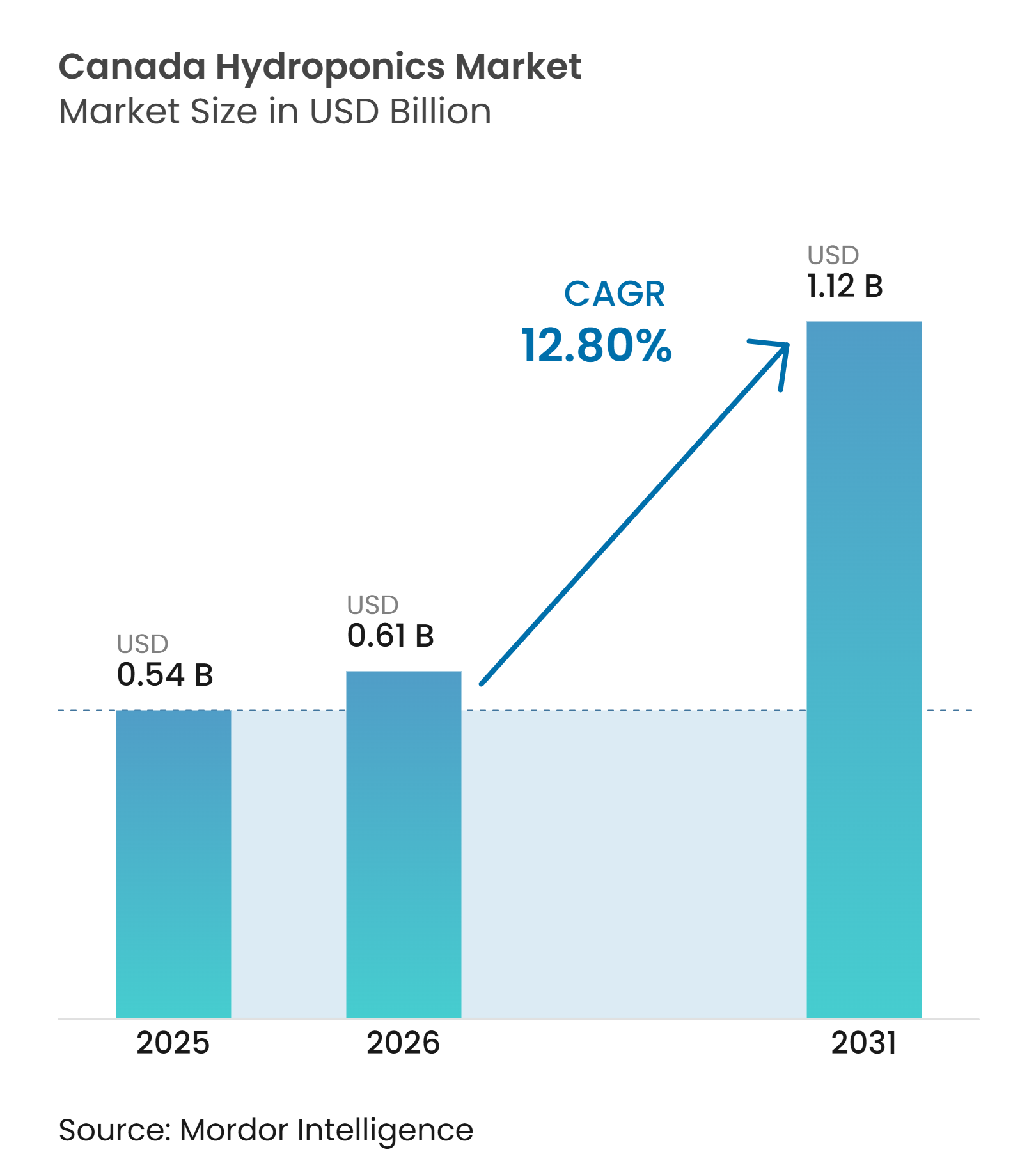
The Canada Hydroponics Market was valued at USD 0.54 billion in 2025, is estimated to increase to USD 0.61 billion in 2026, and is projected to grow to USD 1.12 billion by 2031, at a CAGR of 12.80% over 2026-2031. The Canada hydroponics market is supported by demand for dependable local produce during periods when outdoor supply is limited. Canada launched its National Food Security Strategy in June 2026, committing more than USD 3 billion over 10 years, including USD 750 million for the Controlled Environment Agriculture Growth Pathway[1]. The strategy targets the growth of controlled-environment agricultural production by 2032. This policy environment strengthens the position of project-ready operators while making automation, energy efficiency, and retail reach central competitive priorities. Trade tensions with the United States during 2025 also increased interest in domestic produce, and GoodLeaf Farms reported nearly double the demand for its products during April 2025.
Key Report Takeaways
- By production system, greenhouses held 62% share of Canada hydroponic market size in 2025, while container hydroponic farms are forecast to grow fastest at a 16.2% CAGR through 2031.
- By crop type, leafy greens accounted for 31% revenue share in 2025, while herbs and microgreens are forecast to be the fastest growing at a 15.4% CAGR through 2031.
- By equipment, lighting systems represented 49% of Canada hydroponics market share in 2025, while automation and control systems are forecast to grow at a 14.8% CAGR through 2031.
- By production scale, large-scale operations held 58% revenue share in 2025, while medium-scale farms are forecast to grow at a 14.1% CAGR through 2031.
Note: Market size and forecast figures in this report are generated using Mordor Intelligence’s proprietary estimation framework, updated with the latest available data and insights as of January 2026.
Market Trends and Insights
Drivers Impact Analysis of Canada Hydroponics Market*
| Driver | (~) %Impact on CAGR Forecast | Geographic Relevance | Impact Timeline |
|---|---|---|---|
| Year-round demand for local produce | 3.20% | National, with peak intensity in Ontario, Quebec, and British Columbia | Short term (≤ 2 years) |
| Federal and provincial controlled-environment agriculture support | 2.80% | National, with early gains in Ontario, Quebec, Alberta, and northern territories | Medium term (2–4 years) |
| Retail demand for leafy greens and specialty vegetables | 2.50% | National, concentrated in major urban retail corridors | Short term (≤ 2 years) |
| Technology transfer from cannabis production | 1.80% | British Columbia, Ontario, and Quebec, with spillover into Atlantic Canada | Medium term (2–4 years) |
| Food security in northern and remote communities | 1.50% | Nunavut, Northwest Territories, Yukon, and northern Manitoba | Long term (≥ 4 years) |
| Commercial use of automation, sensors, and data analytics | 2.00% | National, with early adoption in Ontario and Quebec greenhouse belts | Medium term (2–4 years) |
| Source: Mordor Intelligence | |||
Year-Round Demand for Locally Grown Produce
Canada imported the second-largest global volume of lettuce in 2024, much of it from the United States. This reliance became more visible when trade tensions increased in 2025. Domestic lettuce production exceeded 54 million pounds in 2025, rising by 9 million pounds from the prior year. Canada has a short frost-free period, leaving retailers dependent on imports for 5 to 8 months each year. Hydroponic output can fill supply gaps that field agriculture cannot serve reliably. Lufa Farms reduced its Lebanese cucumber cost to CAD 1.00 per 100 grams in 2026. At the 2026 average conversion used in the source, the latter value was USD 0.72 per 100 grams. Lower unit costs can help the Canada hydroponics market compete with imported produce rather than depend on premium pricing.
Federal and Provincial Support for Controlled Environment Agriculture
The National Food Security Strategy allocates USD 750 million over seven years through the Controlled Environment Agriculture Growth Pathway. Its USD 650 million Technology Adoption Stream supports robotics, advanced lighting, automation, and digital farm management tools. A further USD 100 million stream supports small indoor farms in rural and northern communities, an allocation suited to container hydroponic models serving smaller populations. Farm Credit Canada administers a USD 1 billion financing vehicle for capital-intensive agri-food projects. Immediate expensing for new or expanded greenhouses provides tax relief for qualifying construction. In December 2025, Alberta announced its three-year Growing Greenhouses program, providing CAD 10 million (USD 7.2 million) to support the construction or expansion of commercial greenhouses and vertical farms. The Strategic Response Fund opened a competitive round in June 2026, offering contributions of up to USD 50 million per project, creating an advantage for operators with ready designs.
Retail Demand for Fresh Leafy Greens and Specialty Vegetables
The local retail model is expanding beyond food cooperatives and specialty outlets. In May 2025, Lufa Farms and Walmart Canada launched a partnership in Montreal, through which produce from Lufa's 127,000-square-foot rooftop greenhouse can reach the store within one hour of harvest. The collaboration marked the first Canadian retail sale from an in-store rooftop greenhouse. GoodLeaf Farms supplies baby greens and microgreens to major national grocery chains and reported that demand nearly doubled in April 2025 as shoppers sought Canadian-grown alternatives. Increasing volumes and improved operating efficiency are reducing the reliance on premium pricing. Operators that build scale are better positioned in an environment where price parity with imported field-grown produce becomes a key requirement.
Hydroponic Technology Transfer from Canada’s Cannabis Industry
Canada's legal cannabis industry developed commercial controlled-environment production capabilities over the past decade. Operators built expertise in LED optimization, closed-loop fertigation, climate zoning, and production data systems capabilities that can be applied directly to food-crop hydroponics. Village Farms International is upgrading lighting and automated growing systems at its Delta 2 expansion in British Columbia. The company's Delta campus includes the world's largest EU-GMP certified cannabis facility by floor area. Cannabis production teams also gained experience with precise nutrient management and environmental control, and these skills are transferring into food-crop roles, broadening the available talent base. This existing infrastructure gives the Canada hydroponics market a practical foundation that newer food-hydroponics programs in other regions may not have.
Restraints Impact Analysis of Canada Hydroponics Market*
| Restraint | (~) % Impact on CAGR Forecast | Geographic Relevance | Impact Timeline |
|---|---|---|---|
| High capital and operating costs | -2.50% | National, with greater exposure in Alberta and Atlantic Canada | Short term (≤ 2 years) |
| Electricity costs for lighting and climate control | -1.80% | Alberta and Ontario face greater exposure, while Quebec and British Columbia have lower-cost hydroelectric supply | Medium term (2–4 years) |
| Shortage of skilled controlled-environment agriculture labor | -1.50% | National, with acute shortages in Ontario’s greenhouse belt and British Columbia | Medium term (2–4 years) |
| Limited crop portfolio and produce price volatility | -0.90% | National, with stronger exposure among leafy-green operators competing with United States imports | Long term (≥ 4 years) |
| Source: Mordor Intelligence | |||
High Capital and Operating Costs
Commercial hydroponic greenhouses and vertical farms require substantial initial investment. Vegpro International's 5.2-hectare glass greenhouse in Sherrington required CAD 135 million (USD 97.2 in 2024). GoodLeaf Farms invested CAD 200 million (USD 146 million) across three facilities in Guelph, Calgary, and Montreal, averaging USD 49 million per site. According to Statistics Canada, Specialized greenhouse vegetable producers reported operating expenses of CAD 2.08 billion (USD 1.5 billion) in 2025, with electricity, payroll, and plant materials contributing to these costs[2]. Mid-sized operators must often choose between extensive automation and a small, specialized model. As a result, the Canada hydroponics market has limited room for projects that lack either scale or a distinct niche.
Electricity Price Exposure from Lighting and Climate Control
Lighting accounts for 11% to 30% of operating costs for Canadian greenhouse producers. Provincial energy costs influence facility location and operating results. Electricity system costs were USD 76 per megawatt-hour in Quebec during 2023, compared to USD 225 per megawatt-hour in Alberta and USD 142 per megawatt-hour in Ontario. Alberta's pool prices were volatile until 2025, then averaged USD 44 in 2025. Such volatility complicates fixed-cost project planning. A 2026 academic study found that heat recovery, demand shifting, and dynamic LED light recipes could reduce energy cost per kilogram of produce. Clean Fuel Regulations and carbon pricing also influence energy-source and site-selection decisions.
*Our forecasts treat driver/restraint impacts as directional, not additive. The impact forecasts reflect baseline growth, mix effects, and variable interactions.
Canada Hydroponics Market Segment Analysis
By Production System:
Greenhouse Infrastructure Anchors the Market While Container Models AccelerateGreenhouses held 62% of Canada's hydroponics market share in 2025. Their dominance reflects established commercial infrastructure in Ontario, British Columbia, and Quebec. Large greenhouse operations combine natural light with LED toplighting, reducing reliance on artificial lighting compared with enclosed vertical farms. These systems also deliver yields above field agriculture. Canadian retailers depend on domestically grown greenhouse tomatoes, cucumbers, and peppers throughout the year. In April 2025, Vegpro inaugurated its Sherrington greenhouse, a CAD 135 million (USD 97.2 million) facility that uses a hydroponic mobile gutter system and closed-loop rainwater recirculation. The facility is projected to reduce greenhouse gas emissions by up to 2,000 metric tons annually[3].
Container hydroponic farms are forecast to grow at a 16.2% CAGR through 2031. Growcer has deployed more than 125 modular farms across Canada, serving First Nations communities, schools, food banks, and urban cooperatives. These farms enable year-round production in communities far from major distribution systems. In July 2025, Growcer acquired Freight Farms assets for USD 2.6 million, adding more than 600 international customers across 30 countries. Vertical farms are also transitioning from demonstration projects to commercial facilities. GoodLeaf operates three facilities in Quebec, Ontario, and Alberta. In January 2026, Elevate Farms acquired Fieldless Farms, combining complementary technology and production capacity. These models are expanding Canada's hydroponics market beyond conventional greenhouse production.
By Crop Type:
Leafy Greens Dominate, but Specialty Crops are Reshaping the EconomicsLeafy greens accounted for 31% of the Canada hydroponics market in 2025. Fast crop cycles, nutritional positioning, and established retail distribution support this position. The segment includes automated greenhouse operations and conventional commercial facilities. Haven Greens in King City operates a fully automated hydroponic greenhouse. The facility harvests 5,352 kilograms of pesticide-free lettuce daily using mobile gully systems, robotic arms, and RFID tracking. Tomatoes and cucumbers remain established greenhouse crops, while peppers hold a smaller share of the crop mix. British Columbia trials have demonstrated hydroponic pepper production under winter LED toplighting. This breadth of crops helps suppliers meet retail demand throughout the year.
Herbs and microgreens are forecast to grow at a 15.4% CAGR through 2031. Their 14- to 21-day harvest cycles suit dense, multi-tier growing systems. Foodservice buyers value specialty items that support a consistent menu supply. Lufa Farms grows cucumbers, tomatoes, and specialty herbs across 164,000 square feet of indoor space in Montreal, producing 10,000 pounds of cucumbers each day. Large-scale microgreen production can also supply hospitals, institutional foodservice, and premium grocery retailers, all of which require reliable volumes and traceability. The Safe Food for Canadians Regulations provide the compliance framework used for supplier qualification, favoring operators that can meet food safety and volume requirements.
By Equipment:
Lighting Systems Lead as Automation Gains GroundLighting systems accounted for 49% of equipment value in 2025, underscoring the essential role of grow lights in Canadian indoor farming. Growers are replacing legacy high-pressure sodium installations with dynamic, multi-channel LED systems. Heliospectra identified Canada as one of the world's largest greenhouse markets in its March 2026 report, citing a replacement cycle in 2026 and 2027 before its July 2026 bankruptcy. Sollum Technologies completed a 12-acre dynamic LED installation at Roelands Plant Farms in Ontario in February 2026. Energy efficiency guides purchasing decisions, as lighting contributes 11% to 30% of operating costs. Dynamic spectrum systems can also shift electricity demand to lower-cost periods.
Automation and control systems are forecast to grow at a 14.8% CAGR through 2031. Argus introduced the Axia control platform in October 2025 to manage climate, irrigation, fertigation, lighting, and heating. The platform was designed for commercial greenhouses and vertical farms. Priva added IUNU's LUNA artificial intelligence system to Priva One in January 2026, providing yield forecasts ranging from 1 to 8 weeks. Irrigation components, pumps, climate systems, and other equipment account for the remaining 51% of equipment value. Netafim launched its Dosing 5G automated fertigation range in February 2026, supporting more precise nutrient management and reducing routine manual work.
By Production Scale:
Large Operations Set Standards, Medium Scale Shapes the Next Growth WaveLarge held 58% of Canada's hydroponics market share in 2025. Their size supports lower unit costs across lighting, labor, and distribution. Village Farms, GoodLeaf, Lufa Farms, and Vegpro operate facilities ranging from 127,000 square feet to more than 1 million square feet. These operators can access retail channels, institutional contracts, and export markets. Village Farms is expanding its Delta 2 greenhouse to 1.1 million square feet. Once fully ramped in 2027, the expansion is projected to add 40 metric tonnes of annualized production, representing a 33% increase from the company's 2025 base. Canada recorded greenhouse sales of CAD 6.5 billion (USD 4.7 billion) in 2025.
Medium is forecast to grow at a 14.1% CAGR through 2031. Purpose-built facilities of 10,000 to 50,000 square feet can improve capital and operating efficiency and may benefit from the Technology Adoption Stream for equipment upgrades. The Growcer Fund, launched in 2025, offers a fully supported hydroponic farm for less than CAD 1,000 (USD 720) per week, including maintenance and technical support, lowering the capital barrier for smaller commercial operators. Small-scale farms continue to serve local and community needs, with Indigenous community farms, hospitals, schools, and urban micro-farms representing key users. In these settings, social return often takes priority over commercial margin.
Geography Analysis
Ontario is the dominant production province in the Canada hydroponics market. The Leamington-Windsor corridor is recognized as North America's greenhouse capital, and the Greater Toronto Area is home to Haven Greens in King City. Quebec holds the second-largest share, supported by Lufa Farms, GoodLeaf, and Vegpro. Lufa Farms operates six rooftop farms with more than 500,000 square feet of hydroponic growing space. Vegpro's Sherrington greenhouse required an investment of CAD 135 million (USD 97.2 million). Quebec's electricity cost of USD 76 per megawatt-hour compares favorably with USD 142 per megawatt-hour in Ontario, supporting greenhouse investment in the province. Quebec's Cap-and-Trade System and Pesticides Act further encourage closed-loop, pesticide-free production systems.
British Columbia hosts Village Farms International's 1.1 million-square-foot Delta campus. The province's mild coastal climate reduces winter heating needs compared with Prairie and northern areas, and Pacific port access supports exports to Asian medical cannabis markets. Revenue from this segment has supported greenhouse upgrades transferable to food hydroponics. Alberta has high electricity costs of USD 225 per megawatt-hour but benefits from urban demand and a CAD 10 million (USD 7.2 million) greenhouse support program. GoodLeaf's Calgary facility and Vertical Roots locations demonstrate that viable operations can exist where distribution density and pricing are sufficient.
Northern and remote communities represent the highest-growth geographic area. Food insecurity affects more than half of Nunavut households, and produce prices are elevated due to air freight dependence. In July 2026, the Canadian Space Agency awarded USD 745,000 to Growcer and Arctic Fresh Group to develop a deployable controlled-environment unit for Nunavut communities. The national strategy's USD 100 million northern stream can support further deployments through 2032. Atlantic Canada remains a smaller but developing market. GoodLeaf extends retail distribution to Nova Scotia, New Brunswick, and Prince Edward Island from its three-farm network.
Competitive Landscape
Market Concentration
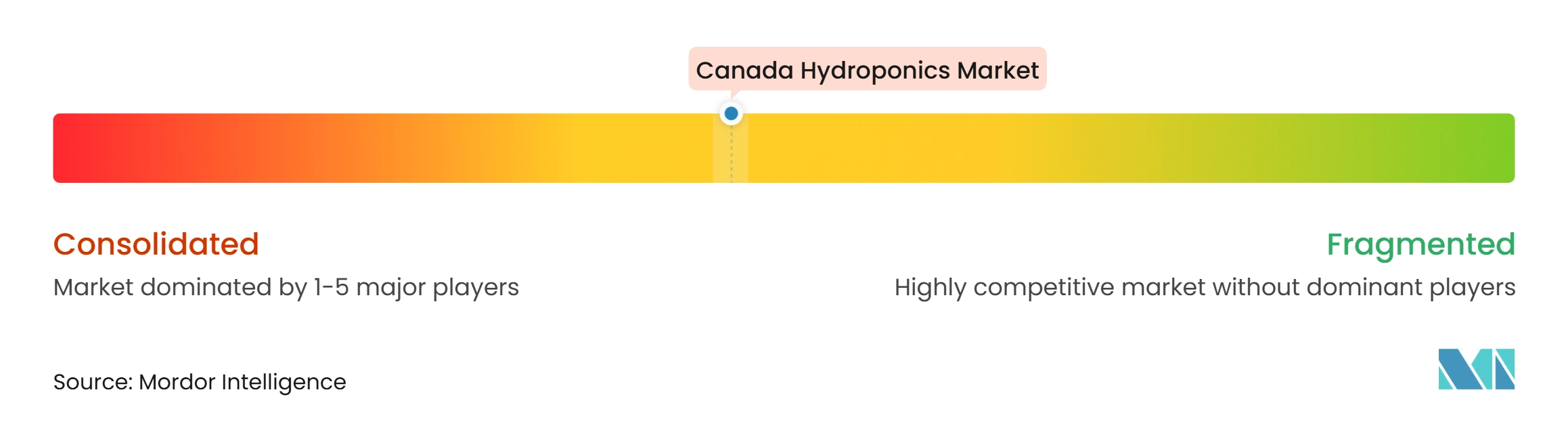
The Canada hydroponics market is moderately consolidated in 2025. Village Farms International, GoodLeaf Farms, Growcer Inc., Argus Control Systems Limited, and Les Fermes Lufa Farms are among the larger operators. The Canada hydroponics industry is moving away from venture-funded expansion toward more disciplined unit economics. GoodLeaf reported profitability across all 3 Canadian vertical farms in August 2026. The company stated that this was the first such result for a North American vertical-farming operator. Its performance shows the importance of scale, distribution, and operational control.
Competition in the equipment layer increasingly centers on integrated operating platforms. Priva partnered with IUNU, Grodan, Nelson Irrigation, and Skye Energy in 2026. These partnerships bring several cultivation data streams into one operating system. This can reduce complexity for growers and create switching costs. Argus repositioned its offering with the Axia platform in October 2025. The system integrates climate, irrigation, fertigation, lighting, and heating controls. This raises the barrier for narrow point-solution suppliers. Compliance with the Safe Food for Canadians Act also favors operators with strong traceability and food-safety systems.
Opportunities are strongest in automation services for mid-sized growers, crop genetics for Canadian indoor light conditions, and rooftop greenhouse models linked to retailers. Elevate Farms acquired Fieldless Farms in January 2026 to combine growing technology with commercial production capacity. Growcer’s Freight Farms asset purchase expanded its international customer base and modular-farm reach. Hydrofarm announced an alliance with Quality Horticulture in March 2026. The agreement transferred Canadian distribution for parts of Hydrofarm’s equipment portfolio to a family-owned Canadian business. Machine vision, automated harvesting, and energy-flexibility services remain relevant competitive areas. These approaches help operators address labor needs and manage electricity as more than a fixed cost.
Canada Hydroponics Industry Leaders
-
Village Farms International
-
GoodLeaf Farms
-
Growcer Inc.
-
Argus Control Systems Limited
-
Lufa Farms
- *Disclaimer: Major Players sorted in no particular order
Canada Hydroponics Market Companies Covered in this Report
- Argus Control Systems Limited
- Biofloral Inc.
- GoodLeaf Community Farms Ltd.
- Growcer Inc.
- Lufa Farms Inc.
- Village Farms International Inc.
- Elevate Farms Inc.
- Urban Cultivator Inc.
- Hydrofarm Canada
- Holland Industry, Inc.
- Hydro-Lite Hydroponics
- Netafim Ltd.
- Priva Holding B.V.
- Richel Group
- Heliospectra AB
- AmHydro
Recent Industry Developments in Canada Hydroponics Market
- August 2026: Netafim launched GrowSphere FLEX, an irrigation and fertigation controller for smallholders and mid-sized farms. The system extends professional digital farming tools to farms of all sizes.
- August 2026: Hydrofarm Holdings Group completed the sale of Aurora Peat Products ULC to Raven Holdings LLC for USD 16 million. Hydrofarm also launched Project Agility to expand its logistics services platform.
- July 2026: The Canadian Space Agency awarded USD 745,000 to Growcer and Inuit-owned Arctic Fresh Group. The partners will develop a deployable controlled-environment agriculture unit for Nunavut communities. The project includes consultations in 4 high-Arctic communities
Canada Hydroponics Market Report Scope
Hydroponics is the technique of growing plants using a water-based nutrient solution rather than soil. These production systems are used by small farmers, hobbyists, and commercial enterprises.
The Canada hydroponics market is segmented by production system (greenhouse, vertical farms, and container hydroponic farms), by crop type (leafy greens, tomatoes, cucumbers, peppers, and herbs and microgreens), by equipment (lighting, irrigation, climate systems, automation and control systems, and others, and by production scale (small, medium, and large). The market forecasts are in terms of value in USD.
Segmentation Overview
| Greenhouse |
| Vertical Farms |
| Container Hydroponic Farms |
| Leafy Greens |
| Tomatoes |
| Cucumbers |
| Peppers |
| Herbs and Microgreens |
| Lighting Systems |
| Irrigation Components and Pumps |
| Climate Systems |
| Automation and Control Systems |
| Other Equipment |
| Large |
| Medium |
| Small |
| Market Forecast by Production System | Greenhouse |
| Vertical Farms | |
| Container Hydroponic Farms | |
| Market Forecast by Crop Type | Leafy Greens |
| Tomatoes | |
| Cucumbers | |
| Peppers | |
| Herbs and Microgreens | |
| Market Forecast by Equipment | Lighting Systems |
| Irrigation Components and Pumps | |
| Climate Systems | |
| Automation and Control Systems | |
| Other Equipment | |
| Market Forecast by Production Scale | Large |
| Medium | |
| Small |
Key Questions Answered in the Report
What is the projected value of hydroponics in Canada by 2031?
The Canada hydroponics market is forecast to reach USD 1,121.3 million by 2031, expanding at a 12.8% CAGR from 2026 to 2031..
Which production system leads hydroponics in Canada?
Greenhouses led with 62% revenue share in 2025, supported by established infrastructure in Ontario, British Columbia, and Quebec.
Which crop category is growing fastest in Canadian hydroponics?
Herbs and microgreens are forecast to grow at a 15.4% CAGR through 2031, supported by foodservice and multi-tier production systems.
Why are container farms important in Canada?
Container farms support year-round local production in northern and remote communities that face high transport costs and limited fresh-produce access.