
Canada Fixed Wireless Access Market Size and Share
Market Overview
| Study Period | 2020 - 2031 |
|---|---|
| Forecast Data Period | 2026 - 2031 |
| Base Year Market Size (2025) | USD 1.51 Billion |
| Market Size (2026) | USD 1.79 Billion |
| Market Size (2031) | USD 3.51 Billion |
| Growth Rate (2026 - 2031) | 14.42 % |
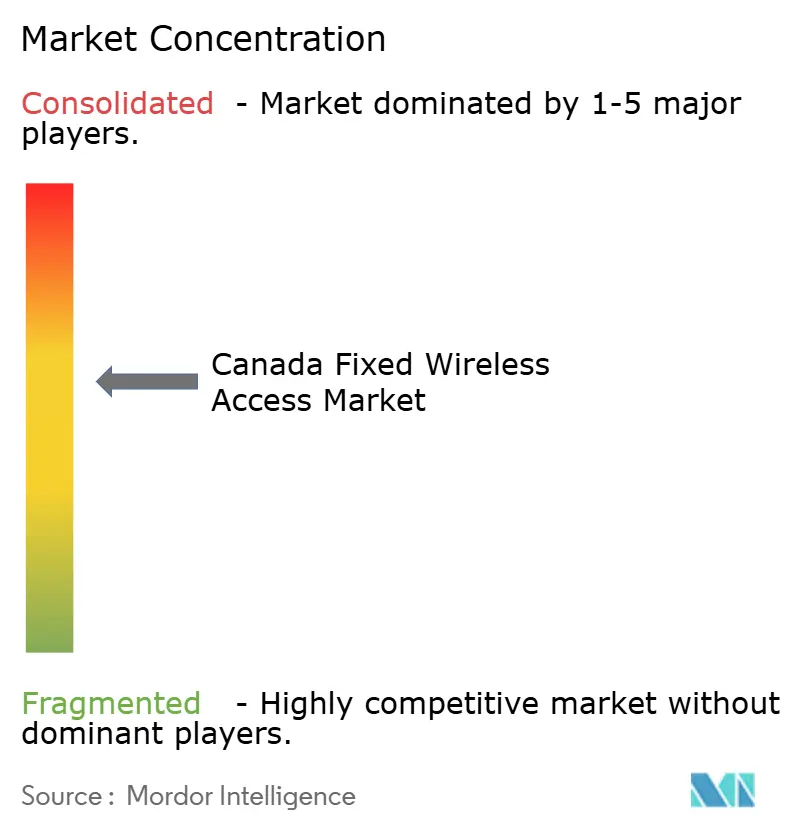
| Market Concentration | Medium |
Major Players *Disclaimer: Major Players sorted in no particular order Image © Mordor Intelligence. Reuse requires attribution under CC BY 4.0. | |
Canada Fixed Wireless Access Market Analysis by Mordor Intelligence
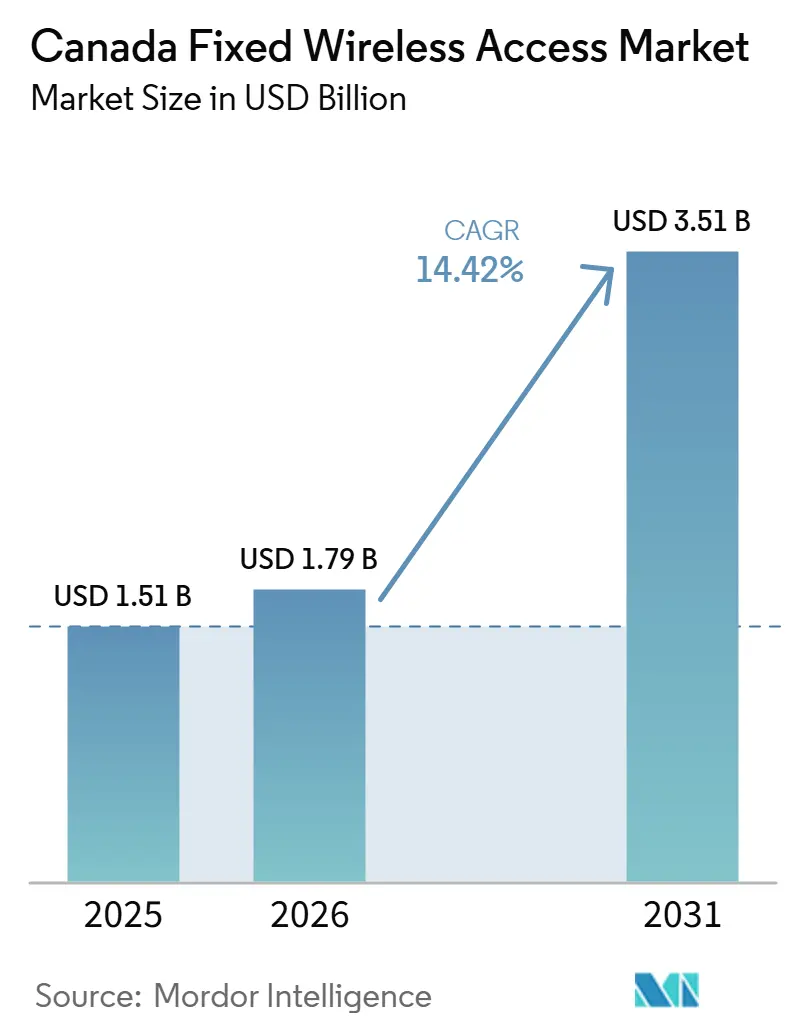
The Canada fixed wireless access market size is projected to expand from USD 1.51 billion in 2025 and USD 1.79 billion in 2026 to USD 3.51 billion by 2031, registering a CAGR of 14.42% between 2026 to 2031. The market is benefiting from a clear shift in access strategy as carriers and independent providers use wireless last-mile networks to reach homes and businesses outside dense fiber corridors. Demand is still supported by the part of the country that lacked gigabit-speed access in 2024, keeping fixed wireless relevant even as fiber networks continue to expand. The business case has improved because 5G mid-band coverage now reaches most of the population, and national operators have kept investing at scale in network modernization. Public broadband funding is also reducing the risk of rural rollout, giving fixed wireless a stronger position in subsidy-backed coverage programs. Competition will remain active because fiber sharing, delayed mmWave availability, and weather-related performance limits will keep providers focused on service quality, bundling, and targeted deployment in the Canada fixed wireless access market.
Key Report Takeaways
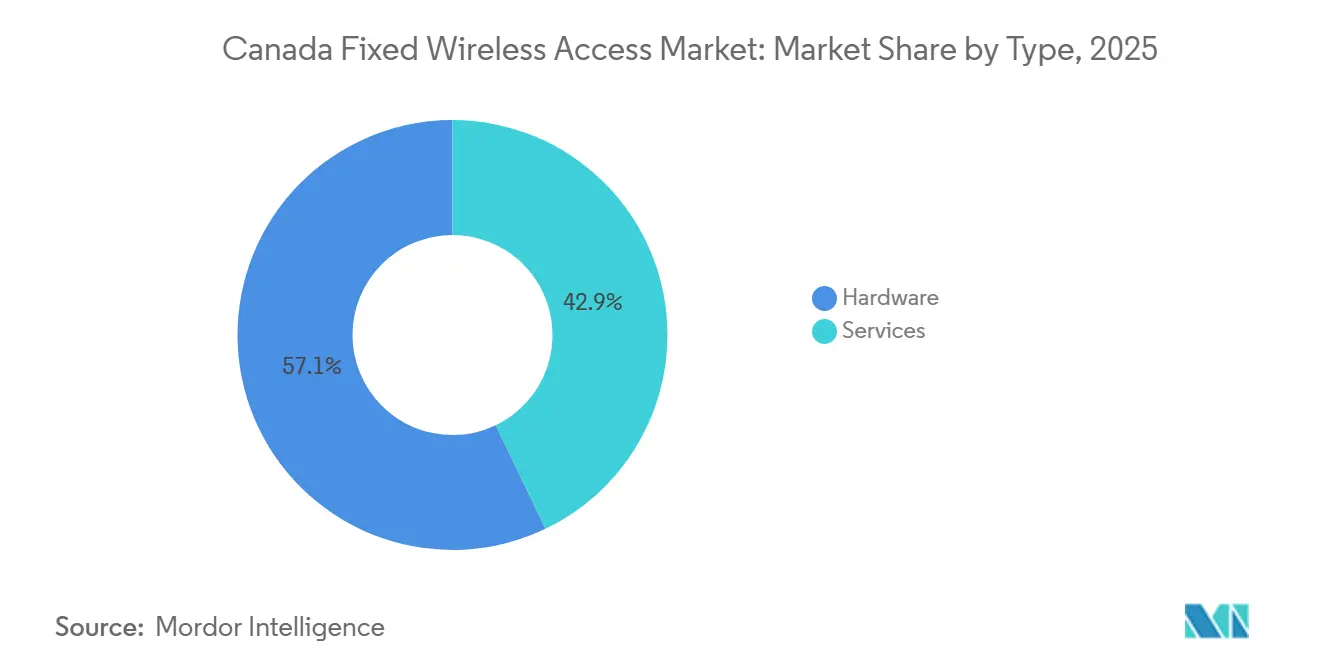
- By type, hardware held 57.12% of the Canada fixed wireless access market in 2025, while services are projected to expand at a 15.01% CAGR through 2031.
- By application, residential connections accounted for 66.12% revenue share in 2025, while government and public safety are expected to record the highest CAGR at 14.87% through 2031.
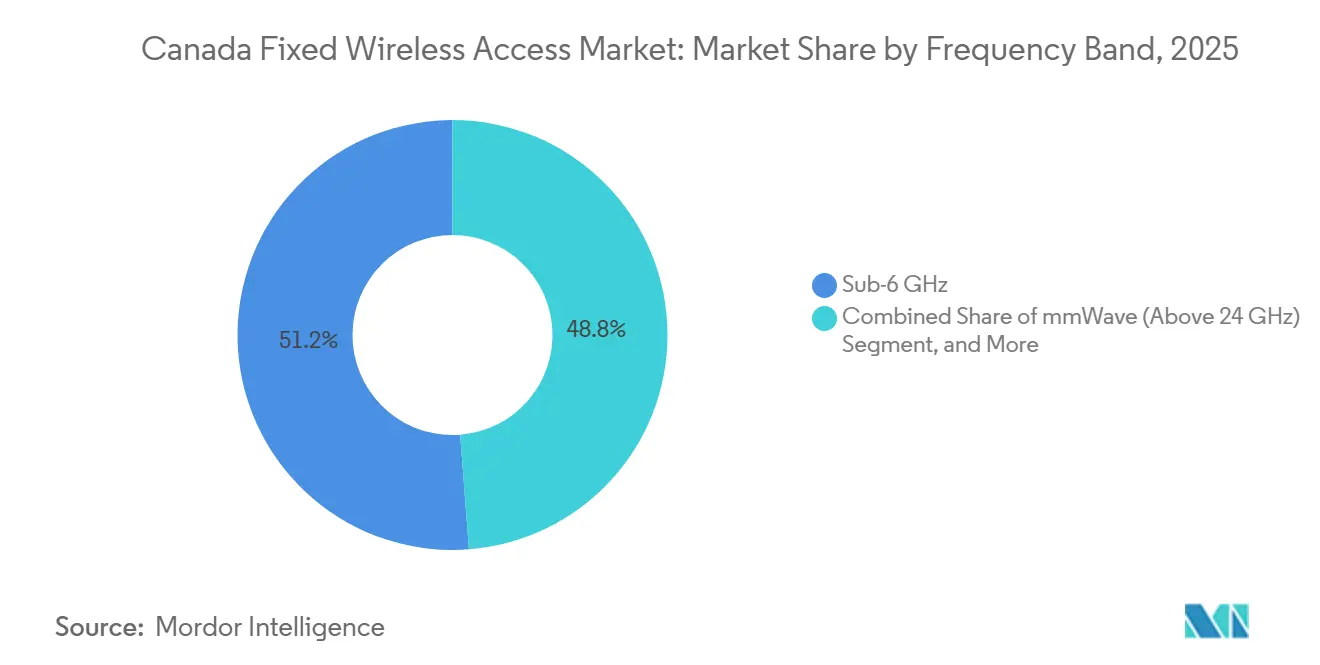
- By frequency band, sub-6 GHz captured 51.22% of the market in 2025, while mmWave is projected to grow fastest at a 15.21% CAGR through 2031.
- By deployment mode, indoor CPE accounted for 59.99% of the market in 2025, while self-install window-mount CPE is expected to grow at a 14.98% CAGR through 2031.
Note: Market size and forecast figures in this report are generated using Mordor Intelligence’s proprietary estimation framework, updated with the latest available data and insights as of January 2026.
Canada Fixed Wireless Access Market Trends and Insights
Drivers Impact Analysis*
| DRIVER | (~) % IMPACT ON CAGR FORECAST | GEOGRAPHIC RELEVANCE | IMPACT TIMELINE |
|---|---|---|---|
| 5G Rollout Expanding Rural and Semi-Urban Coverage | +2.8% | National, with early gains in British Columbia, Alberta, Ontario, and Quebec | Medium term (2-4 years) |
| Fixed Wireless Access Lowering Last-Mile Delivery Cost Versus Fiber Buildouts | +2.3% | National, with higher relevance in rural and remote areas across all provinces | Long term (≥ 4 years) |
| Public Broadband Funding Accelerating Rural Service Availability | +2.0% | National, concentrated impact in Nunavut, Saskatchewan, British Columbia, and Ontario | Short term (≤ 2 years) |
| Enterprise Demand for Rapid Backup Connectivity And SD-WAN Resilience | +1.8% | Urban and suburban, with primary gains in Ontario, Quebec, and British Columbia | Medium term (2-4 years) |
| Self-Install CPE And AI-Assisted Provisioning Reducing Truck Rolls | +1.4% | National, with a broader rural impact in areas without dense technical support infrastructure | Medium term (2-4 years) |
| Winter-Resilient Sub-6 GHz Designs Improving Canadian Network Reliability | +1.1% | Northern Canada, Prairie provinces, and Atlantic regions with harsh winter conditions | Long term (≥ 4 years) |
| Source: Mordor Intelligence | |||
5G Rollout Expanding Rural and Semi-Urban Coverage
The 5G buildout has made the Canada fixed wireless access market more viable at scale because mid-band wireless coverage already reaches 94% of the population.[1]Canadian Radio-television and Telecommunications Commission, “Canadian Telecommunications Market Report 2026,” CRTC That footprint allows operators to launch service in communities that previously depended on LTE or DSL, without waiting for a fresh round of greenfield access programs. Rogers said its 5G network had expanded to more than 2,800 communities by the end of 2025, and the company spent CAD 3.7 billion (USD 2.66 billion) in capital expenditure during that year. TELUS said in 2026 that it plans to invest CAD 66 billion (USD 47.5 billion) in Canada through 2030, and that program includes more than 160 new rural cell sites built with Terrion in 2026.[2]TELUS Corporation, “TELUS Investing $66 Billion in Canada Through 2030 to Enhance Connectivity, Support Canadian AI Leadership and Drive Economic Growth,” TELUS As this coverage gap narrows, the competitive focus in the Canada fixed wireless access market moves from simple footprint expansion toward consistent quality of service. That shift matters most in semi-urban areas where fixed wireless and fiber overlap, because users there can compare installation speed, reliability, and bundle value much more closely.
Fixed Wireless Access Lowering Last-Mile Delivery Cost Versus Fiber Buildouts
Cost remains one of the strongest structural supports for the Canada fixed wireless access market, especially in a country where distance and terrain can sharply raise the economics of fiber deployment. The input notes that remote fiber build costs can exceed CAD 10,000 (USD 7,200) per passing, while a fixed wireless connection can be delivered at a much lower cost with shared radio infrastructure. Xplore reinforced that proposition in March 2025 when it launched 5G Ultra with download speeds of up to 500 Mbps for rural and small-town communities across several provinces.[3]Xplore Inc., “Xplore Launches New Ultra-Fast Wireless Home Internet for Rural Canada,” Xplore The gap between wireless and fiber performance is also narrowing globally, supporting wider acceptance of fixed wireless as a long-term access platform rather than a temporary substitute. Ericsson expects global fixed wireless access connections to rise from 185 million at the end of 2025 to 350 million by the end of 2031, indicating sustained vendor and operator investment in the technology base supporting the Canada fixed wireless access market. As hardware and spectral efficiency improve, providers can achieve better unit economics in areas where fiber still has a long payback period.
Public Broadband Funding Accelerating Rural Service Availability
Public funding is making rural deployment more practical in the Canada fixed wireless access market by reducing the risk of serving thinly populated areas. The Universal Broadband Fund totals USD 2.32 billion and aims to achieve 98% high-speed internet coverage by the end of 2026 and 100% by 2030. The CRTC also said that more than USD 783.7 million had been awarded through the Broadband Fund across provinces and territories, which widens the pool of projects where fixed wireless can serve the last mile.[4]Canadian Radio-television and Telecommunications Commission, “Canadian Telecommunications Market Report 2026,” CRTC In July 2025, the federal government committed CAD 105 million (USD 75.6 million) for SaskTel to connect 6,522 households in rural and remote Saskatchewan communities, and it also announced a joint CAD 77 million (USD 55.4 million) investment with British Columbia for 15 projects serving 7,700 households.[5]Government of Canada, “Government of Canada Advances Wireless Connectivity With Additional Spectrum to Support 5G Innovation and Streamlined Tower Siting,” Government of Canada These programs favor practical delivery models, often involving fiber backhaul combined with fixed wireless distribution in areas where full end-to-end fiber remains expensive. That policy design gives Canada a fixed wireless access market a durable role in publicly backed coverage expansion.
Enterprise Demand for Rapid Backup Connectivity And SD-WAN Resilience
Enterprise demand is widening the addressable base for the Canada fixed wireless access market beyond household broadband replacement. Rogers said it launched Canada’s first commercial home internet backup solution and also extended bundled 5G Home Internet offers, which shows how wireless access can be packaged as resilient secondary connectivity. This matters because backup connectivity tends to be less price sensitive than consumer replacement demand, especially when operators bundle it with managed Wi-Fi or broader network services. TERAGO is already positioned in this part of the value chain through managed fixed wireless, SD-WAN, and private 5G activities, which support the commercial case for enterprise convergence at the network edge. The result is a revenue model in which providers can attach recurring service layers to access subscriptions rather than relying only on connectivity fees. That shift helps the Canada fixed wireless access market by improving monetization in urban and suburban areas, where simple price competition is often harder to sustain.
Restraints Impact Analysis*
| RESTRAINT | (~) % IMPACT ON CAGR FORECAST | GEOGRAPHIC RELEVANCE | IMPACT TIMELINE |
|---|---|---|---|
| Fiber Price Competition Limiting FWA Pricing Power | -1.8% | National, concentrated in Ontario, Quebec, and British Columbia, where fiber penetration is highest | Short term (≤ 2 years) |
| Spectrum Availability Constraints in Dense and High-Demand Markets | -1.3% | Urban centers, including Toronto, Vancouver, Montreal, and Calgary | Medium term (2-4 years) |
| Higher mmWave Sensitivity to Weather and Seasonal Propagation Loss | -0.9% | Northern Canada, Prairie provinces, and Atlantic regions with snow and ice conditions | Long term (≥ 4 years) |
| Subsidy And Permitting Dependence Slowing Some Rural Deployments | -0.6% | Rural and remote areas, particularly in northern Ontario, Saskatchewan, and the Territories | Short term (≤ 2 years) |
| Source: Mordor Intelligence | |||
Fiber Price Competition Limiting FWA Pricing Power
Fiber competition is limiting pricing flexibility in the Canada fixed wireless access market because users in hybrid service areas can compare wireless offers with increasingly accessible fiber plans. The CRTC’s fiber-sharing framework has increased the likelihood of overlapping offers in regions where large incumbents have already built extensive wireline infrastructure. When households and small businesses can choose between fiber and fixed wireless at similar speed tiers, wireless operators need stronger differentiation on installation speed, bundling, or service continuity. That pressure is most visible in Ontario, Quebec, and British Columbia, where fiber presence is deeper and wholesale access rules can intensify price competition. The issue does not remove demand from the Canada fixed wireless access market, but it does narrow the room for providers that position the product only as a lower-cost substitute. Operators that attach backup connectivity, managed Wi-Fi, or enterprise service commitments are therefore better placed to protect revenue quality.
Spectrum Availability Constraints in Dense and High-Demand Markets
Spectrum limits are a clear operating constraint for the Canada fixed wireless access market in large urban centers, where mobile broadband already consumes a large share of available mid-band spectrum. ISED said the commercial auction for spectrum in the 26 GHz and 38 GHz bands is planned for October 2027, which means dense-market operators must work within today’s high-demand capacity envelope until that process advances. ISED also established a non-competitive local licensing framework in the 27.5-28.35 GHz band, but that mechanism is more relevant for localized enterprise and fixed uses than for wide-area consumer scaling. This creates a near-term split, with rural rollout remaining more straightforward while dense urban expansion faces tighter spectrum constraints. That constraint is especially relevant for the Canada fixed wireless access market in Toronto, Vancouver, Montreal, and Calgary, where demand is not the main issue. Capacity planning, therefore, becomes a bigger competitive variable than simple market access.
*Our forecasts treat driver/restraint impacts as directional, not additive. The impact forecasts reflect baseline growth, mix effects, and variable interactions.
Segment Analysis
By Type: Managed Services Narrowing Hardware’s Lead
Hardware is expected to account for 57.12% of the Canada fixed wireless access market in 2025, reflecting the high volume of CPE purchases driven by ongoing 5G home internet expansion. Customer premise equipment continues to anchor hardware demand, as indoor gateways, outdoor radios, and window-mount units remain the primary access devices for new connections. The hardware mix also benefits from self-installation trends, as providers aim to reduce installation costs without delaying activation. This operating model increases the importance of device design, as placement flexibility and easier setup can improve early service performance. In the Canada fixed wireless access market, these factors keep hardware revenue substantial, even as carriers work to contain average device costs.
The balance is still shifting, as services are projected to grow at a CAGR of 15.01% from 2026 to 2031, faster than the hardware layer. Managed Wi-Fi, backup connectivity, and SD-WAN packaging are shifting the economics from one-time equipment sales toward recurring access and service fees. The GSA reported that the average marketed maximum peak download speed for 5G-based fixed wireless offerings globally reached 774.7 Mbps in June 2026, supporting stronger enterprise and premium household use cases. As performance expectations rise, the service layer in the Canada fixed wireless access market gives providers a more practical way to protect margins and improve retention. Hardware still leads today, but service monetization is steadily taking a larger role in long-term value capture.


By Application: Residential Volume Leads While Public Connectivity Programs Support Faster Growth
Residential connections are expected to account for 66.12% of the Canadian fixed wireless access market in 2025, indicating that household broadband replacement remains the primary near-term demand base. The product fits suburban and rural homes where legacy DSL still needs to be replaced, and full-fiber construction remains less economical. Price, installation speed, and basic service availability still matter more in this segment than advanced service layering. These factors keep residential demand broad, especially in communities where households need an immediate alternative to slower wireline options. In the Canada fixed wireless access market, this large installed household base gives operators a stable volume foundation, even as competitive conditions vary by province.
Government and public safety are expected to expand at a CAGR of 14.87% through 2031, making it the fastest-growing application area in the current input set. The funding target of 98% national high-speed coverage by end-2026 and 100% by 2030 keeps pressure on operators to connect remote, Indigenous, and northern communities through workable access models. The Canada fixed wireless access industry also benefits from procurement logic that favors practical deployment in locations where full fiber remains difficult or uneconomic. CRTC Broadband Fund criteria reinforce this pattern, as underserved and remote areas continue to receive priority in subsidy allocation. As a result, the Canada fixed wireless access market is gaining a policy-backed application stream that is less dependent on pure consumer replacement behavior.
By Frequency Band: Sub-6 GHz Holds the Base While mmWave Builds a Targeted Pipeline
Sub-6 GHz is expected to account for 51.22% of the Canada fixed wireless access market share in 2025, reflecting its strong fit for wide-area rural and suburban coverage. These bands provide the range and penetration needed for service in low-density geographies, and they perform more reliably in difficult weather than higher frequencies. This advantage matters in a country where snowfall, ice accretion, and temperature swings can materially affect signal performance. As a result, sub-6 GHz continues to support the broadest commercial deployment model. For the Canada fixed wireless access market, sub-6 GHz remains the practical base layer for scale.
mmWave is projected to grow the fastest, at a 15.21% CAGR through 2031, though broader commercial scaling depends on future spectrum availability. ISED’s policy framework in 2026 opened a clearer path toward the 26 GHz and 38 GHz bands, and the planned October 2027 auction sets the next major milestone for wider commercial supply. The non-competitive local licensing framework in the 27.5-28.35 GHz range is also creating a route for localized enterprise and fixed applications outside the large-carrier spectrum model. Therefore, mmWave growth in the Canada fixed wireless access market is likely to appear first in campuses, industrial parks, and dense business corridors rather than in mass residential rollout. The near-term pattern is a broad sub-6 GHz scale with selective mmWave expansion.

By Deployment Mode: Indoor CPE Leads While Self-Install Formats Gain Ground
Indoor CPE is expected to account for 59.99% of the Canada fixed wireless access market by deployment mode in 2025, showing that plug-and-play gateways remain the preferred option for most residential users. Indoor placement works best in coverage conditions where signal penetration is strong enough to support consistent performance without exterior mounting. This model appeals to carriers because it reduces truck-roll requirements and shortens the time from order to activation. The approach is especially useful in suburban settings where operators can support self-installation at scale. In the Canada fixed wireless access market, indoor CPE remains the leading deployment mode because convenience and cost discipline align well.
Self-install window-mount CPE is projected to grow at a 14.98% CAGR through 2031, making it the fastest-growing deployment format in the current segmentation set. This design sits between simple indoor gateways and full outdoor equipment because it improves signal reception without requiring rooftop work or permitting. Rogers expanded Wi-Fi 7-capable 5G Home Internet gateways to Quebec in August 2025, following an initial Calgary rollout, demonstrating how carriers are pairing fixed wireless backhaul with more advanced in-home equipment. Growth in self-install formats also reflects the need to scale subscriber additions without proportional increases in field service headcount. This gives the Canada fixed wireless access market a deployment path that can support faster activation while preserving operating efficiency.
Geography Analysis
Ontario and Quebec represent the largest regional revenue base in the Canada fixed wireless access market, supported by dense populations, extensive 5G coverage, and high carrier investment intensity. These provinces also have the strongest overlap between fiber and wireless infrastructure, which influences how providers position fixed wireless within the commercial mix. In many cases, enterprise backup connectivity and SD-WAN use cases carry more weight than household substitution, as wired access is already widely available. This mix supports higher revenue per connection, even though the addressable replacement pool remains smaller than in remote regions. Vidéotron is expected to raise the competitive benchmark in Quebec with the launch of its 2 GIGA internet service in select parts of Montreal, Laval, and Quebec City in April 2026.
Western Canada remains one of the most commercially important regions for the Canada fixed wireless access market, as rural DSL replacement is more advanced there. British Columbia, Alberta, Saskatchewan, and Manitoba include low-density pockets where fiber payback is harder to justify, and wireless economics are stronger. The relatively open terrain in the Prairie provinces also supports favorable signal propagation for sub-6 GHz deployment. TELUS continues to support this regional structure through long-term national network investment, including rural site expansion that strengthens service reach in less dense communities. At the same time, the Canada fixed wireless access market in Western Canada continues to benefit from the need for fast installation in areas where households seek better broadband without waiting for full wireline construction.
Atlantic Canada and the Northern Territories remain the least substitutable geographies in the Canada fixed wireless access market, as many communities still have limited alternative access options. This makes fixed wireless a necessity rather than a tactical product in these areas. In April 2026, the federal government is expected to announce Universal Broadband Fund support for Northwestel to extend high-speed internet to all 25 communities in Nunavut through Telesat Lightspeed backhaul with local fixed wireless distribution. Xplore is also expected to strengthen its rural position in June 2025 by finalizing CAD 375 million (USD 270 million) in financing commitments for broadband expansion across Ontario, New Brunswick, and Prince Edward Island. These regions, therefore, remain central to the long-term role of the Canada fixed wireless access market in national coverage policy.
Competitive Landscape
The Canada fixed wireless access market has a dual-tier structure, with a concentrated upper group and a more fragmented specialist base beneath it. Rogers, Bell, and TELUS operate at a national scale and can extend fixed wireless from existing mobile networks at a lower incremental deployment cost than smaller competitors. Rogers is expected to end 2025 with around 4.5 million internet subscribers, while TELUS is expected to report 2.8 million fixed internet subscribers by year-end 2025. This scale gives the largest players a structural edge in marketing, bundling, and spectrum utilization across the Canada fixed wireless access market. Smaller providers remain relevant where geography, specialization, or local licensing creates room for focused operating models.
Strategic differentiation in the Canada fixed wireless access market increasingly depends on how providers package resilience, spectrum access, and targeted enterprise capabilities. Rogers applied this approach by pairing 5G Home Internet with Canada’s first commercial home internet backup offer and later extending WiFi 7-capable gateways into Quebec. TELUS is pursuing scale through long-cycle national investment, with CAD 66 billion (USD 47.5 billion) committed through 2030 to support connectivity and broader network expansion. TERAGO is taking a different approach by combining fixed wireless, SD-WAN, private 5G, and a large mmWave license position to focus on enterprise-grade deployments. These moves show that the Canada fixed wireless access market competes not only on raw connectivity but also on how providers package access for different customer needs.
White-space opportunities in the Canadian fixed wireless access market remain strongest in enterprise-managed bundles, public connectivity contracts, and cost-saving deployment formats. Xplore’s expected March 2025 5G Ultra launch and June 2025 financing package demonstrate how rural specialists continue to build in areas where national carriers do not fully address local access gaps. Tarana’s expected G2 platform announcement in September 2025 adds another competitive angle by supporting up to 2,000 subscribers per tower with gigabit-capable throughput, extending the relevance of fixed wireless into denser suburban settings. The result is a market where national scale matters, but specialized execution still creates room for selective gains.
Canada Fixed Wireless Access Industry Leaders
TELUS Corporation
Rogers Communications Inc.
BCE Inc.
ZTE Corporation
Ericsson AB
- *Disclaimer: Major Players sorted in no particular order

Recent Industry Developments
- May 2026: TERAGO Inc. and Ericsson Enterprise Wireless Solutions successfully deployed Canada’s first live private 5G network at the McMaster Manufacturing Research Institute, a milestone combining TERAGO’s mmWave spectrum holdings with Ericsson’s enterprise 5G infrastructure. The deployment enables dedicated, low-latency connectivity for manufacturing and research, advancing the case for mmWave FWA in industrial environments.
- May 2026: ISED published a Policy and Licensing Framework for Spectrum in the 26 GHz and 38 GHz bands, making 4.8 GHz of mmWave spectrum available through an auction planned for October 2027. The rules include competitive safeguards to preserve access for smaller operators and open a structured pathway for broader commercial mmWave FWA deployment from 2028 onward.
- April 2026: The Government of Canada announced Universal Broadband Fund support for Northwestel to extend high-speed internet to all 25 communities in Nunavut through a partnership with Telesat Lightspeed’s LEO satellite constellation. The project is expected to use FWA distribution at the local access layer.
- April 2026: Vidéotron launched its 2 GIGA internet service in select areas of Montreal, Laval, and Quebec City, offering download speeds up to 2,000 Mbps through its hybrid fiber-coaxial network. The launch raises the competitive benchmark for FWA in Quebec, reinforcing the need for FWA operators to differentiate on service quality and bundling rather than raw speed.


Canada Fixed Wireless Access Market Report Scope
The Canada Fixed Wireless Access Market Report is Segmented by Solution Type (Hardware [Consumer Premise Equipment and Access Units] and Services), Application (Residential, Commercial, Industrial, and Government and Public Safety), Frequency Band (Sub-6 GHz, mmWave (Above 24 GHz), and Unlicensed/Shared CBRS), and Deployment Mode (Indoor CPE, Outdoor CPE, and Self-Install Window-Mount CPE). The Market Forecasts are Provided in Terms of Value (USD).
| Hardware | Consumer Premise Equipment (CPE) |
| Access Units (Femto and Picocells) | |
| Services |
| Residential |
| Commercial |
| Industrial |
| Government and Public Safety |
| Sub-6 GHz |
| mmWave (Above 24 GHz) |
| Unlicensed / Shared CBRS |
| Indoor CPE |
| Outdoor CPE |
| Self-Install Window-Mount CPE |
| By Solution Type | Hardware | Consumer Premise Equipment (CPE) |
| Access Units (Femto and Picocells) | ||
| Services | ||
| By Application | Residential | |
| Commercial | ||
| Industrial | ||
| Government and Public Safety | ||
| By Frequency Band | Sub-6 GHz | |
| mmWave (Above 24 GHz) | ||
| Unlicensed / Shared CBRS | ||
| By Deployment Mode | Indoor CPE | |
| Outdoor CPE | ||
| Self-Install Window-Mount CPE |


Key Questions Answered in the Report
How large is the Canada fixed wireless access market and what is its growth outlook?
The Canada fixed wireless access market size is projected to expand from USD 1.51 billion in 2025 and USD 1.79 billion in 2026 to USD 3.51 billion by 2031, registering a CAGR of 14.42% between 2026 to 2031.
Which application generates the most revenue in Canada fixed wireless access?
Residential connections led the revenue mix with a 66.12% share in 2025, showing that household broadband replacement remains the main volume driver.
Which frequency band is growing fastest in Canada fixed wireless access deployments?
MmWave is projected to post the highest CAGR at 15.21% through 2031, while sub-6 GHz remained the largest frequency band segment in 2025.
Why is fixed wireless still important when fiber keeps expanding in Canada?
It remains important because rural and remote build costs still favor wireless in many areas, and subsidy-backed access programs continue to support last-mile coverage.
What is driving faster growth in the services layer?
Services are projected to grow at a 15.01% CAGR as operators add managed Wi-Fi, backup connectivity, and SD-WAN to basic access subscriptions.
Which deployment format is gaining momentum fastest?
Self-install window-mount CPE is expected to expand at a 14.98% CAGR through 2031 because it improves reception without the cost and delay of full outdoor installation.
Page last updated on:





