
Canada Enterprise Content Management (ECM) Market Size and Share
Market Overview
| Study Period | 2020 - 2031 |
|---|---|
| Forecast Data Period | 2026 - 2031 |
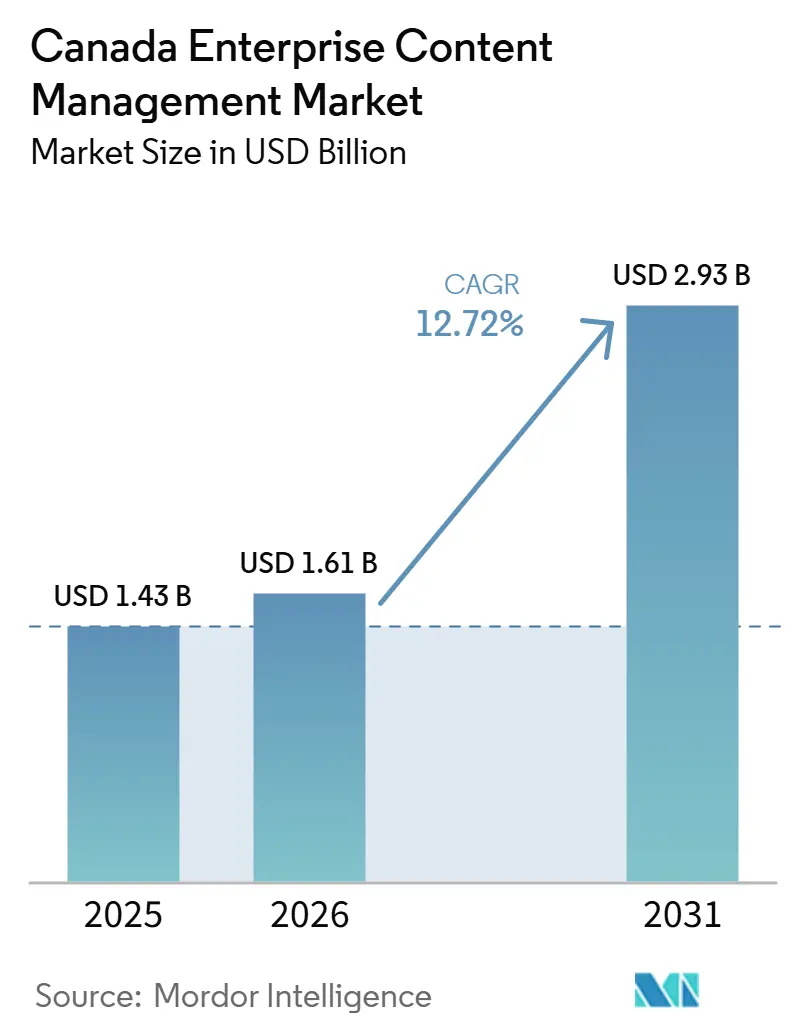
| Base Year Market Size (2025) | USD 1.43 Billion |
| Market Size (2026) | USD 1.61 Billion |
| Market Size (2031) | USD 2.93 Billion |
| Growth Rate (2026 - 2031) | 12.72% CAGR |
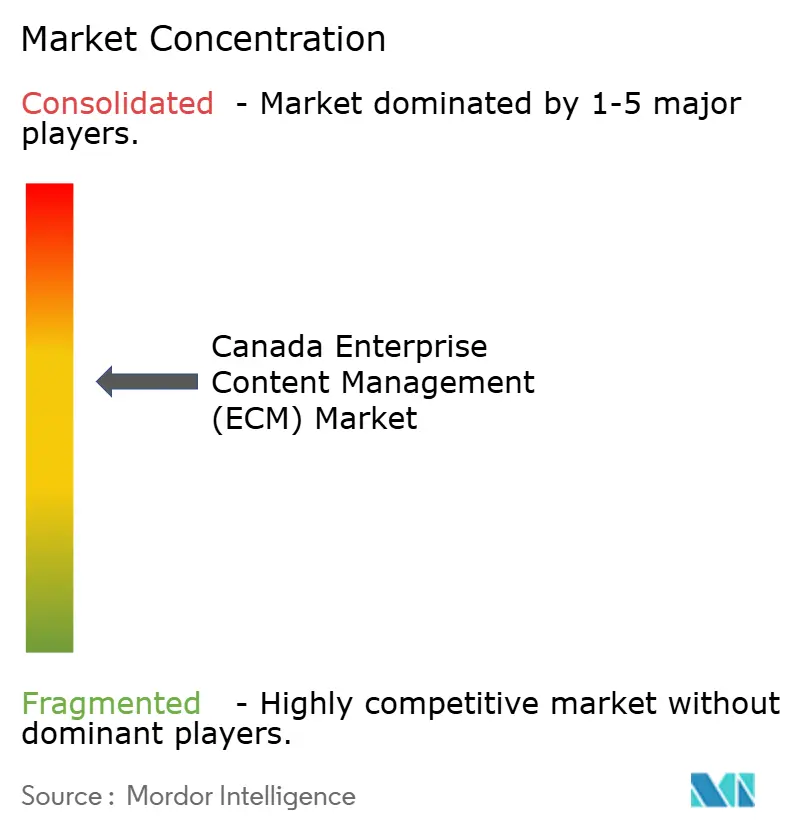
| Market Concentration | Medium |
Major Players *Disclaimer: Major Players sorted in no particular order Image © Mordor Intelligence. Reuse requires attribution under CC BY 4.0. | |
Canada Enterprise Content Management (ECM) Market Analysis by Mordor Intelligence
The Canada Enterprise Content Management (ECM) Market size is projected to be USD 1.43 billion in 2025, USD 1.61 billion in 2026, and reach USD 2.93 billion by 2031, growing at a CAGR of 12.72% from 2026 to 2031. The Canada Enterprise Content Management (ECM) Market is being pushed forward by the federal move to standardize Microsoft 365 E5 across government departments, which has brought SharePoint governance, records control, and information architecture work into active budgets. Demand is also rising because banks, insurers, hospitals, and public bodies are dealing with larger volumes of unstructured content that older repositories cannot govern well enough for current workflow and compliance needs. Privacy and retention obligations are becoming more demanding, which is pushing organizations to review content estates that were left loosely managed for years and to fund broader modernization work than initially planned. These conditions are shortening the upgrade cycle across the Canada Enterprise Content Management (ECM) Market and are drawing mid-sized organizations into purchase decisions that had been delayed. Sovereign hosting preferences are also encouraging platform consolidation, because regulated buyers increasingly find it harder to manage several disconnected repositories inside a single domestic data perimeter.
Key Report Takeaways
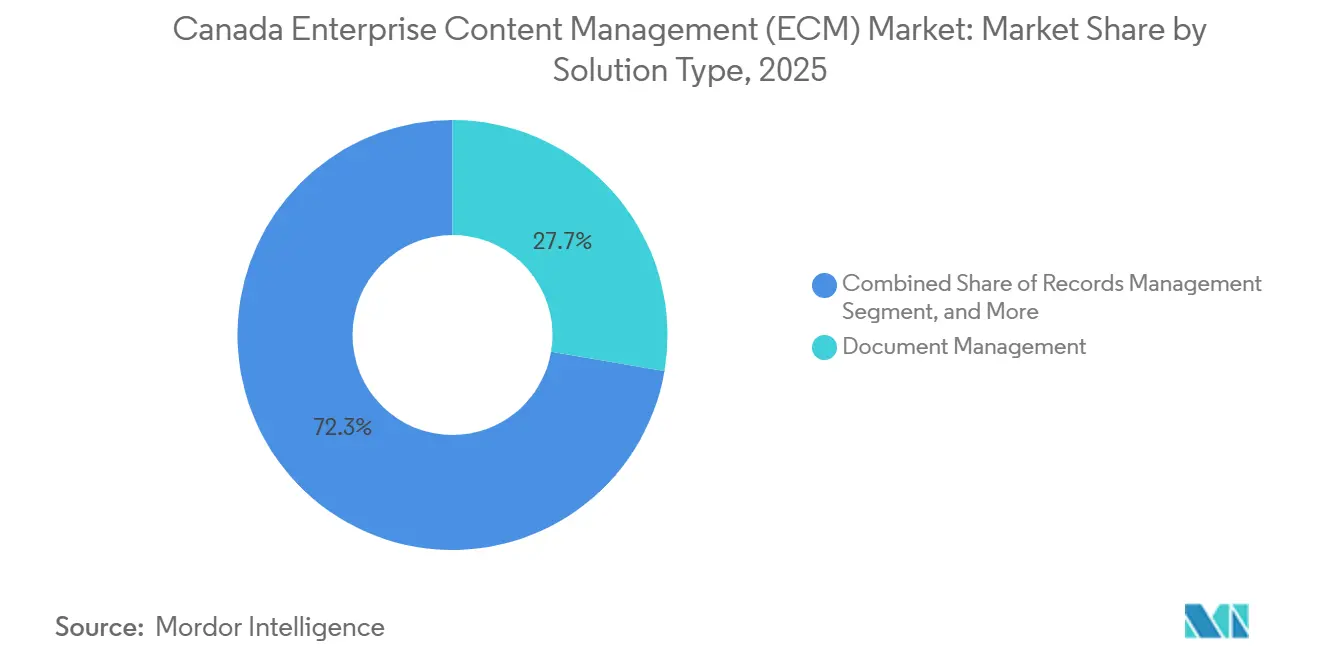
- By solution type, document management held 27.68% of the Canada enterprise content management (ECM) market in 2025, while workflow and business process management is projected to expand at a 15.91% CAGR through 2031.
- By deployment mode, cloud accounted for 69.73% of the market in 2025, while hybrid is projected to record the highest CAGR of 16.83% through 2031.
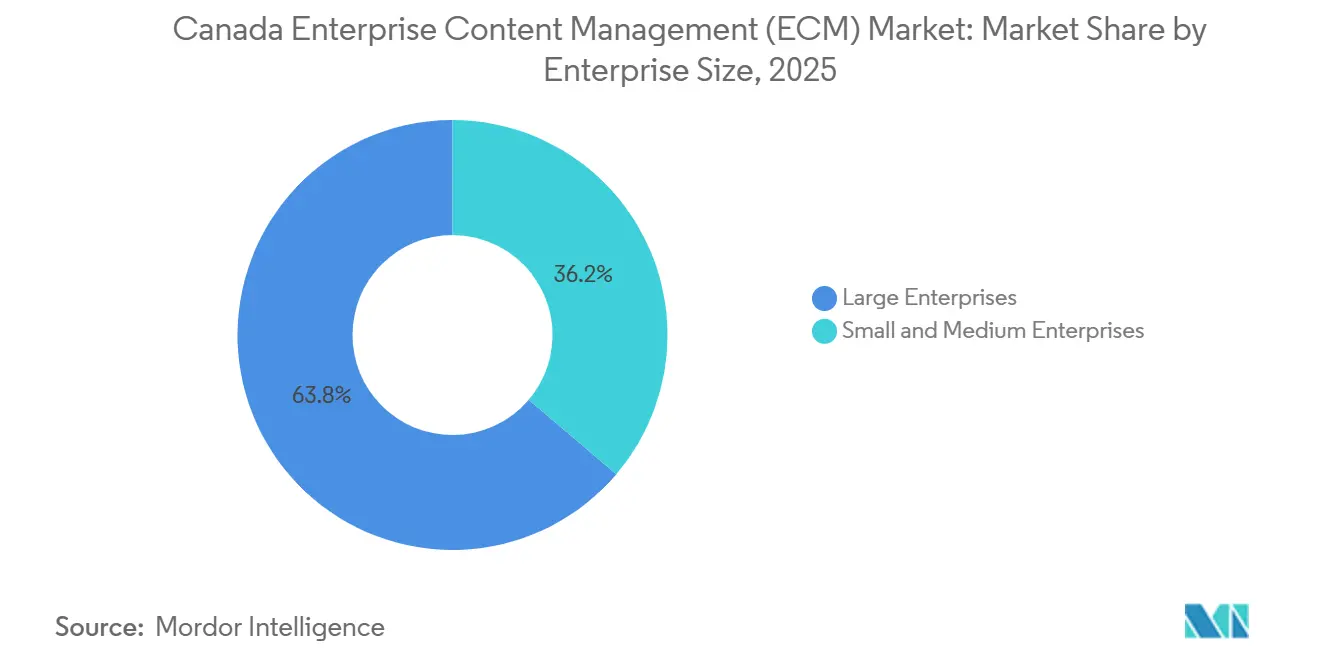
- By enterprise size, large enterprises held 63.78% of the Canada enterprise content management (ECM) market in 2025, while small and medium enterprises are projected to grow at a 16.28% CAGR through 2031.
- By end-user industry, BFSI held 26.73% of the market in 2025, while healthcare is projected to expand at a 17.23% CAGR through 2031.
Note: Market size and forecast figures in this report are generated using Mordor Intelligence’s proprietary estimation framework, updated with the latest available data and insights as of January 2026.
Canada Enterprise Content Management (ECM) Market Trends and Insights
Drivers Impact Analysis*
| DRIVER | (~) % IMPACT ON CAGR FORECAST | GEOGRAPHIC RELEVANCE | IMPACT TIMELINE |
|---|---|---|---|
| Rising Need for AI-Ready Content Governance | +3.2% | National, concentrated in Toronto, Vancouver, and Ottawa federal agencies | Long term (≥ 4 years) |
| Accelerated Microsoft 365 and SharePoint Modernization | +2.5% | National, with early adoption in Ontario and British Columbia | Medium term (2-4 years) |
| Compliance Pressure From Privacy, Records, and Audit Requirements | +2.0% | National, Quebec most acutely affected by Loi 25 | Medium term (2-4 years) |
| Workflow Automation Demand in Back-Office Operations | +1.6% | National, with leading uptake in BFSI hubs of Toronto and Calgary | Medium term (2-4 years) |
| Growth of Hybrid Work and External Collaboration Use Cases | +1.1% | National, strongest uplift in Greater Toronto Area and Greater Vancouver Area | Short term (≤ 2 years) |
| Sovereign Data and Canadian Hosting Preferences | +0.7% | National, with immediate impact on federal government and regulated financial institutions | Long term (≥ 4 years) |
| Source: Mordor Intelligence | |||
Rising Need for AI-Ready Content Governance
The Canada enterprise content management (ECM) market is gaining support from enterprise AI programs that need governed, well-structured, and permission-aware content to produce reliable outputs. Many organizations are finding that AI tools perform poorly when content is spread across disconnected repositories and tagged inconsistently, which shifts ECM spending from storage projects toward governance-led modernization. OpenText reinforced this direction in June 2026 when it added agentic capabilities to Content Management 26.2, including natural-language actions for document handling and records governance through Content Aviator. Hyland made the same competitive move with its Enterprise Agent Mesh and Control Tower, which shows that vendors now position ECM as an operating layer for AI rather than only as a repository. This shift is expanding the scope of the Canada enterprise content management (ECM) market because buyers now connect content quality directly to AI accuracy, compliance, and workflow execution.
Accelerated Microsoft 365 and SharePoint Modernization
The Canada enterprise content management (ECM) market is also being supported by a large modernization wave around Microsoft 365 and SharePoint environments. The Government of Canada required departments to standardize on Microsoft 365 E5 from April 1, 2025, and the policy required implementation within 180 days of license receipt, which created direct pull for governance, records, and architecture work around Microsoft content estates.[1]Government of Canada, “Standardized Use Of Microsoft Tools - Policy Implementation Notice,” Government of Canada, canada.ca Alberta Innovates added to that pattern with a 35-month SharePoint Online modernization effort focused on lifecycle control and compliance consistency across more than 1,000 sites. M-Files deepened the strategic tie between ECM and Microsoft in March 2026 by becoming the first document management system to store content natively within Microsoft 365 through SharePoint Embedded. As a result, the Canada enterprise content management (ECM) market is benefiting from Microsoft’s installed base, because M365 modernization budgets increasingly double as ECM buying decisions.
Compliance Pressure from Privacy, Records, and Audit Requirements
Compliance requirements remain a major reason organizations are expanding content governance programs across the Canada enterprise content management (ECM) market. Quebec’s Loi 25 has been fully in force since September 2024 and requires destruction schedules, privacy impact assessments before new projects, and published privacy governance policies for organizations that handle personal information. The Office of the Privacy Commissioner of Canada has also signaled stronger attention to privacy in the age of AI, which increases the value of auditable records, retention controls, and traceable content workflows.[2]Office of the Privacy Commissioner of Canada, “Championing Privacy In The Age Of AI - 2025-2026 Annual Report To Parliament On The Privacy Act And PIPEDA,” Office of the Privacy Commissioner of Canada, priv.gc.ca At the federal level, Bill C-36, introduced on June 15, 2026, added another layer of urgency by outlining a more demanding private-sector privacy framework with stricter accountability and penalty exposure. These rules are widening the ECM project scope across the Canada enterprise content management (ECM) market because buyers are not only adding software, they are also auditing years of poorly governed content before new compliance models can work.
Workflow Automation Demand in Back-Office Operations
The Canada enterprise content management (ECM) market is further supported by demand for workflow automation that connects documents directly to operational decisions. CIBC Mellon expanded its Appian relationship in April 2026 through a Universal Enterprise Master License aimed at AI-powered onboarding, rules-based decisions, and operational workflows for institutional investor services. Hyland’s deployment for Rexel Canada in May 2026 reached near-100% invoice indexing accuracy within 48 hours and removed manual validation for non-trade accounts payable processing. Process Fusion also joined the CAN Health Network in February 2026 to automate clinical documentation, referrals, patient intake, records processing, and back-office work in healthcare settings. These examples show why workflow-centric deployments are moving faster inside the Canada enterprise content management (ECM) market than basic repository refresh programs.
Restraints Impact Analysis*
| RESTRAINT | (~) % IMPACT ON CAGR FORECAST | GEOGRAPHIC RELEVANCE | IMPACT TIMELINE |
|---|---|---|---|
| Legacy Repository Migration Complexity | -1.4% | National, most acute in large public-sector institutions in Ottawa, Toronto, and Quebec City | Long term (≥ 4 years) |
| Skills Shortage in Information Governance and ECM Administration | -1.1% | National, most pronounced in rural and mid-size markets outside major urban centers | Medium term (2-4 years) |
| Fragmented Buying Across IT, Compliance, and Business Teams | -0.8% | National | Medium term (2-4 years) |
| High Cost of Full-Scale Platform Replacement | -0.6% | National, most impactful for mid-market organizations | Long term (≥ 4 years) |
| Source: Mordor Intelligence | |||
Legacy Repository Migration Complexity
Migration complexity continues to slow the Canada enterprise content management (ECM) market, especially where organizations have decades of content in older on-premises systems and loosely managed SharePoint estates. Many large buyers cannot move directly into a modern platform because they first need to sort content ownership, retention status, metadata quality, and duplicate records across repositories. The issue becomes more serious in public-sector and regulated environments, where defensible disposition and audit readiness must be addressed before migration work can progress at scale. This often stretches project timelines, raises service costs, and delays follow-on investments that would otherwise expand platform scope inside the Canada enterprise content management (ECM) market. The restraint is structural rather than temporary, because the content debt accumulated in legacy systems is large and difficult to unwind quickly.
Skills Shortage in Information Governance and ECM Administration
The Canada enterprise content management (ECM) market also faces a persistent shortage of people who understand privacy, taxonomy, retention, and platform administration at the same time. The Future Skills Center has highlighted how hybrid work has weakened informal knowledge transfer, which makes governance capability harder to build and sustain across organizations. Many buyers respond by outsourcing administration to managed service providers, which keeps projects moving but also raises recurring operating costs for smaller organizations. This shortfall is particularly visible outside major metropolitan areas, where access to specialized implementation partners is thinner, and governance resources are harder to recruit. The result is that some organizations in the Canada enterprise content management (ECM) market delay full deployment or accept partial governance coverage until internal skills or external support become available.
*Our forecasts treat driver/restraint impacts as directional, not additive. The impact forecasts reflect baseline growth, mix effects, and variable interactions.
Segment Analysis
By Solution Type: Document Management Anchors Revenue While Process Automation Accelerates
Document management held 27.68% of the Canada enterprise content management (ECM) market in 2025, which kept it as the largest solution type across the period. Its lead reflects the fact that nearly every end-user group still depends on a controlled system for document capture, storage, retrieval, version control, and retention. Regulatory retention duties and daily workflow dependence keep this segment central even when buyers invest in newer automation tools. Records Management stays closely tied to public bodies, legal services, and regulated enterprises that need strong audit trails and defensible disposition. Case Management also retains steady value where files move through structured review paths, especially in government and insurance settings that rely on documented process history.
Workflow and business process management is projected to grow at a 15.91% CAGR through 2031, making it the fastest-growing solution area in the Canada enterprise content management (ECM) market. That growth shows that buyers increasingly want content systems to trigger actions, route approvals, and connect documents to decisions instead of only storing files. M-Files supported that direction in April 2026 when it launched 3 industry applications for tax advisory, quality management, and contract lifecycle management, all of which embedded workflow logic inside the content platform.[3]M-Files, “M-Files Launches Industry Solutions,” M-Files, m-files.com The move highlights a widening split between basic storage functions and higher-value workflow automation, where vendors can differentiate more clearly on outcomes and operational speed. Digital asset management and web content management remain relevant in the Canada enterprise content management (ECM) market as organizations manage brand assets, external content, and distributed digital experiences more systematically.



By Deployment Mode: Cloud Leads While Hybrid Supports Compliance and Agility
Cloud accounted for 69.73% share of the Canada enterprise content management (ECM) market size in 2025, which confirms that subscription delivery, elastic capacity, and lower infrastructure burden remain the preferred model for most buyers. The segment stays strong because cloud platforms reduce upgrade friction and give organizations faster access to collaboration, AI, and disaster recovery features. This matters in the Canada enterprise content management (ECM) market because many organizations want easier scaling without carrying the full operational weight of legacy server environments. At the same time, cloud leadership does not mean every buyer is comfortable with a full relocation of sensitive information. Regulated institutions and government users still assess hosting, residency, and control requirements carefully before shifting core repositories.
Hybrid deployment is projected to expand at a 16.83% CAGR through 2031, which makes it the fastest-growing architecture across the Canada enterprise content management (ECM) market. Buyers are using Hybrid as a deliberate long-term design, keeping highly governed content in controlled environments while moving active collaboration and AI-enabled work into cloud layers. OpenText and TELUS responded directly to that need in September 2025 by launching a Canadian Sovereign Cloud hosted in Rimouski, Quebec, and Kamloops, British Columbia.[4]OpenText, “OpenText And TELUS Partner To Deliver Canadian Sovereign AI-Powered Solutions For Government And Business,” OpenText, opentext.com The same pattern is visible in procurement behavior, where domestic hosting now matters more in regulated accounts than it did a few years ago. Laserfiche’s June 2026 launch on AWS Marketplace also supports cloud adoption in the Canada enterprise content management (ECM) market because it lets customers buy content management capabilities through existing cloud spending commitments.
By Enterprise Size: Large Enterprises Lead Spending While SMEs Expand Faster
Large enterprises held 63.78% of the Canada enterprise content management (ECM) market share in 2025, which reflects the capital intensity and governance depth required for broad ECM programs. Large institutions usually operate across business units, regulatory regimes, and language environments, which increases the value of centralized control and integrated records policy. In the Canada enterprise content management (ECM) market, these buyers also account for a heavier share of professional services and managed services because their environments are harder to govern after initial software deployment. Platform choices for this group are often shaped by integration needs around SAP, Salesforce, Microsoft 365, and sector-specific systems rather than by document management features alone. Federal departments, large financial institutions, and major healthcare networks remain the most visible examples of this buying profile.
Small and medium enterprises are projected to grow at a 16.28% CAGR through 2031, which makes them the most dynamic customer group in the Canada enterprise content management (ECM) market. Growth is being supported by subscription pricing, lower infrastructure needs, and cloud-native tools that make governed content handling more accessible to firms without large internal IT teams. This matters because smaller professional services firms, clinics, and regional public bodies increasingly face the same privacy and workflow requirements as larger organizations. M-Files has aimed at that opening with a context-first design that reduces reliance on complex folder hierarchies, a model that is easier for lean teams to manage. Adoption in the Canada enterprise content management (ECM) market is likely to remain strongest first in legal, accounting, consulting, and other document-heavy settings where governance has direct revenue and liability consequences.
By End-User Industry: BFSI Holds the Largest Share While Healthcare Advances Fastest
BFSI held 26.73% of the Canada enterprise content management (ECM) market share in 2025, which kept it as the largest end-user group. The segment’s lead comes from the weight of documentation in lending, claims, onboarding, regulatory reporting, and anti-money laundering work. Buyers in this group increasingly want systems that do more than archive files, because turnaround time and auditability now affect client service and compliance at the same time. CIBC Mellon’s April 2026 expansion with Appian fits that pattern, as the company targeted complex onboarding, rules-based decision work, and operating services for institutional investor clients. The BFSI role in the Canada enterprise content management (ECM) market should remain strong because documentation intensity is high and process latency has direct operating cost.
Healthcare is projected to expand at a 17.23% CAGR through 2031, which makes it the fastest-growing vertical in the Canada enterprise content management (ECM) market. Growth is being driven by expanding clinical documentation volumes, stronger patient information controls, and the need to move records through operational workflows instead of only archiving them. Process Fusion’s February 2026 work with the CAN Health Network illustrates that shift, with automation spanning clinical documentation, referrals, patient intake, records processing, and back-office operations. Tali added another healthcare example in March 2026 when it launched an AI real-time billing agent approved by the Ontario Ministry of Health as a certified billing agent, which shows how content processing is moving into revenue cycle tasks as well. Government and public sector, IT and telecommunications, manufacturing, retail, media and entertainment, education, and energy and utilities continue to form a broad demand base across the Canada enterprise content management (ECM) market, each with its own compliance and workflow priorities.
Geography Analysis
Ontario remains the largest regional center of demand in the Canada enterprise content management (ECM) market because it combines Toronto’s financial services base with major federal operations in the National Capital Region and a dense concentration of professional services and technology firms. The federal Microsoft 365 E5 standardization policy accelerated procurement around SharePoint governance, records management, and information architecture work across departments headquartered in Ottawa. British Columbia forms the second major pillar of the Canada enterprise content management (ECM) market, supported by Vancouver’s technology cluster and ongoing interest in cloud-native content modernization. Alberta also contributes meaningful demand, especially where energy-sector buyers need strong document control for engineering records, compliance submissions, and regulated asset documentation.
Quebec stands out because compliance requirements there are shaping buying behavior more directly than in most other provinces. Loi 25 requires organizations that handle personal information to maintain destruction schedules, carry out privacy impact assessments before new projects, and publish privacy governance policies, which makes informal content management much harder to sustain. That pressure is extending evaluation cycles, but it is also increasing budgets because buyers often need to remediate governance gaps before new systems can be rolled out effectively. French-language support adds another selection factor in the province, which gives an advantage to vendors that can localize metadata structures and interfaces well. OpenText’s March 2026 release of multilingual support for categories and attributes in Smart View responded directly to that requirement and aligns well with deployment needs in Quebec.
Atlantic Canada and the Prairie provinces remain smaller but important parts of the Canada enterprise content management (ECM) market, with demand coming from provincial governments, healthcare organizations, agricultural documentation flows, and land-related records. These regions often face a thinner local supply of specialized implementation partners, which can slow deployment even where the content governance need is clear. Saskatchewan and Manitoba continue to support steady interest in workflow-led use cases tied to public administration and document-intensive sector operations. Hybrid work remains an enabling condition for regional growth because organizations need governed collaboration and records access that works across distributed teams and locations.[5]Future Skills Centre, “Skills And Strategies For Quality Hybrid Work In Canada,” Future Skills Centre, fsc-ccf.ca
Competitive Landscape
The Canada enterprise content management (ECM) market is moderately concentrated, with a clear group of established platform vendors and a wider field of specialists competing on governance depth, AI integration, and deployment flexibility. OpenText holds a structural advantage because it is headquartered in Canada, has a strong sovereign cloud position with TELUS, and serves 1,600 Canadian institutions, with nearly 1,000 actively using AI-powered cloud applications on that platform. Microsoft, IBM, SAP, and Oracle remain important competitors, but they often approach the Canada enterprise content management (ECM) market through broader enterprise software ecosystems rather than pure-play ECM positioning. That leaves room for specialists such as Hyland, M-Files, Laserfiche, Newgen, and NetDocuments to compete where content governance capability and workflow outcomes matter more than suite breadth.
Strategic moves in 2025 and 2026 show that vendors are competing less on storage alone and more on the quality of AI-enabled content reasoning. Hyland pushed that shift through its Enterprise Agent Mesh and through the Rexel Canada deployment, where agentic document processing reached near-100% invoice indexing accuracy within 48 hours. M-Files strengthened its position with native Microsoft 365 storage through SharePoint Embedded and later added Custom Agents built on its Enterprise Knowledge Graph, which supports governed automation without heavy custom coding. Laserfiche expanded reach through AWS Marketplace and added AI Agents for its cloud base, which improves access to mid-market and cloud-first buyers. These moves show that the Canada enterprise content management (ECM) market now rewards vendors that can connect governance, automation, and AI inside the same platform environment.
There is still white space in regulated vertical applications, bilingual platform support, and managed services for buyers that lack internal governance staff. Doxis signaled a sharper AI-first stance with its January 2026 rebrand, while NetDocuments moved deeper into legal specialization with its Context Graph for legal work in May 2026. The Canada enterprise content management (ECM) market is therefore moving toward a competition model where domain fit, content intelligence, and governance quality carry more weight than repository scale alone. That should keep competitive pressure active across the Canada enterprise content management (ECM) market even as larger vendors retain an advantage in public-sector credibility and integration breadth.
Canada Enterprise Content Management (ECM) Industry Leaders
OpenText Corporation
Hyland Software, Inc.
Box, Inc.
M‑Files Corporation
Laserfiche
- *Disclaimer: Major Players sorted in no particular order

Recent Industry Developments
- June 2026: M-Files launched M-Files for Consulting, a purpose-built application for consulting firms that organizes the full proposal-to-delivery lifecycle based on client, proposal, and engagement context on its AI-native platform. The solution extends M-Files' industry applications portfolio and directly targets knowledge-intensive professional services firms, a high-value segment in Canada's ECM market.
- June 2026: M-Files released M-Files Custom Agents in Beta, enabling administrators to configure AI-powered workflow steps that read, reason, and act on content in natural language, with no custom development required. Built natively on M-Files' Enterprise Knowledge Graph, the agents enable governed agentic automation across metadata enrichment, intelligent search, and workflow routing.
- June 2026: Laserfiche launched on AWS Marketplace, enabling AWS customers to procure its intelligent content management and agentic AI capabilities through existing cloud spending commitments. The move significantly expands Laserfiche's distribution reach in Canada, where AWS cloud spending is prevalent across enterprise and public-sector buyers.
- May 2026: NetDocuments unveiled the first Context Graph for legal document management, a system that continuously maps relationships across every matter, document, and communication within a firm while respecting existing permissions and ethical walls. Private preview opened immediately, targeting Canadian and global law firms managing complex, high-stakes document environments.


Canada Enterprise Content Management (ECM) Market Report Scope
The Canada Enterprise Content Management (ECM) Market refers to the market for platforms and solutions that enable enterprises in Canada to manage, store, organize, and secure digital content in a centralized and scalable environment. ECM systems help organizations manage documents, records, customer communications, compliance data, and marketing assets while improving workflow efficiency, regulatory compliance, and collaboration across industries such as government, banking, healthcare, telecom, and retail. The market supports enterprises in their digital transformation initiatives by enabling data governance, AI-powered automation, and omnichannel customer engagement.
The Canada Enterprise Content Management Market Report is Segmented by Solution Type (Document Management, Records Management, Workflow and Business Process Management, Case Management, Digital Asset Management, Web Content Management, and Other Solutions), Deployment Mode (On-Premises, Cloud, and Hybrid), Enterprise Size (Small and Medium Enterprises (SME), and Large Enterprises). and End-User Industry (BFSI, Government and Public Sector, Healthcare, IT and Telecommunications, Manufacturing, Retail, Media and Entertainment, Education, Energy and Utilities, and Other End-User Industries). The Market Forecasts are Provided in Terms of Value (USD).
| Document Management |
| Records Management |
| Workflow and Business Process Management |
| Case Management |
| Digital Asset Management |
| Web Content Management |
| Other Solutions |
| On-Premises |
| Cloud |
| Hybrid |
| Small and Medium Enterprises (SME) |
| Large Enterprises |
| BFSI |
| Government and Public Sector |
| Healthcare |
| IT and Telecommunications |
| Manufacturing |
| Retail |
| Media and Entertainment |
| Education |
| Energy and Utilities |
| Other End-User Industries |
| By Solution Type | Document Management |
| Records Management | |
| Workflow and Business Process Management | |
| Case Management | |
| Digital Asset Management | |
| Web Content Management | |
| Other Solutions | |
| By Deployment Mode | On-Premises |
| Cloud | |
| Hybrid | |
| By Enterprise Size | Small and Medium Enterprises (SME) |
| Large Enterprises | |
| By End-User Industry | BFSI |
| Government and Public Sector | |
| Healthcare | |
| IT and Telecommunications | |
| Manufacturing | |
| Retail | |
| Media and Entertainment | |
| Education | |
| Energy and Utilities | |
| Other End-User Industries |


Key Questions Answered in the Report
What is the 2026 size of the Canada enterprise content management (ECM) sector?
The Canada enterprise content management (ECM) market stands at USD 1.61 billion in 2026 and is projected to reach USD 2.93 billion by 2031 at a 12.72% CAGR.
Which solution area leads revenue in Canada?
Document Management led with 27.68% share in 2025 because it remains the core layer for capture, retrieval, version control, and retention across industries.
Which solution area is growing the fastest through 2031?
Workflow and Business Process Management is projected to expand at a 15.91% CAGR as buyers connect documents to approvals, routing, and AI-enabled operational decisions.
Why is healthcare expanding faster than other end-user groups?
Healthcare is projected to grow at a 17.23% CAGR because providers are automating clinical documentation, intake, billing, referrals, and patient record governance.
Why are hybrid deployments gaining momentum in Canada?
Hybrid is projected to grow at a 16.83% CAGR because buyers want cloud agility and AI features while keeping selected records in controlled environments for residency and compliance reasons.
What is shaping vendor competition in Canada right now?
Competition is shifting toward AI-ready governance, Microsoft 365 integration, sovereign hosting, and workflow automation, with OpenText, Hyland, M-Files, Laserfiche, and others investing in these areas.
Page last updated on:






