
Campaign Management Services Market Size and Share
Market Overview
| Study Period | 2020 - 2031 |
|---|---|
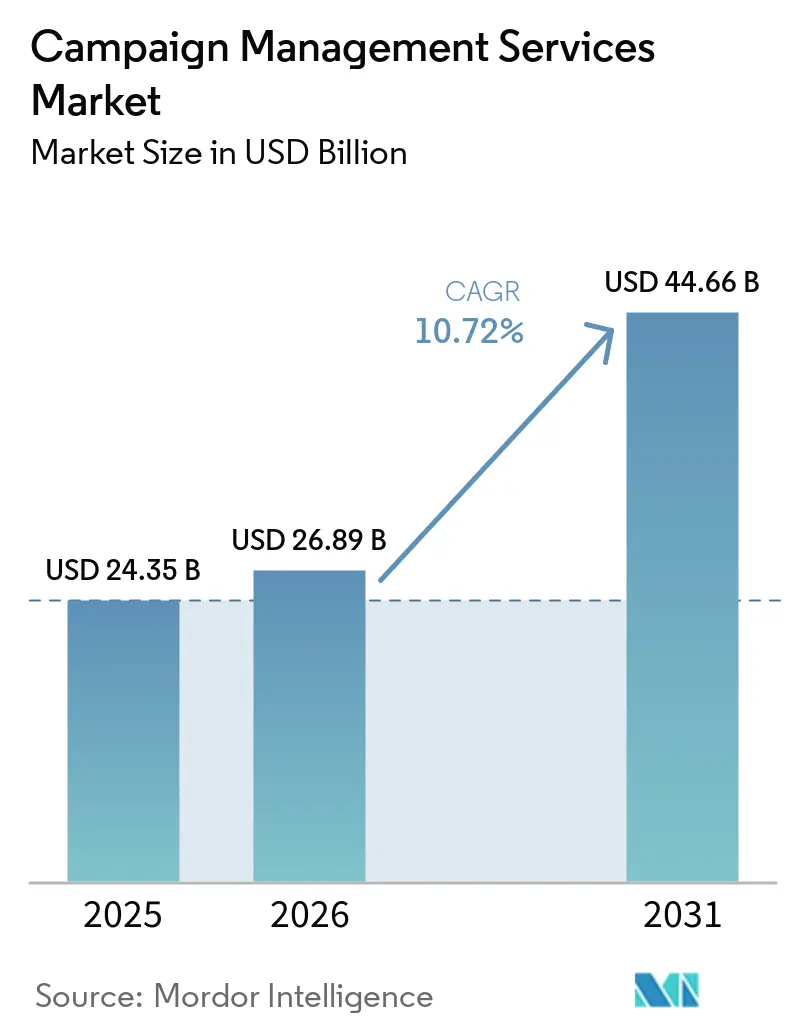
| Market Size (2026) | USD 26.89 Billion |
| Market Size (2031) | USD 44.66 Billion |
| Growth Rate (2026 - 2031) | 10.72 % |
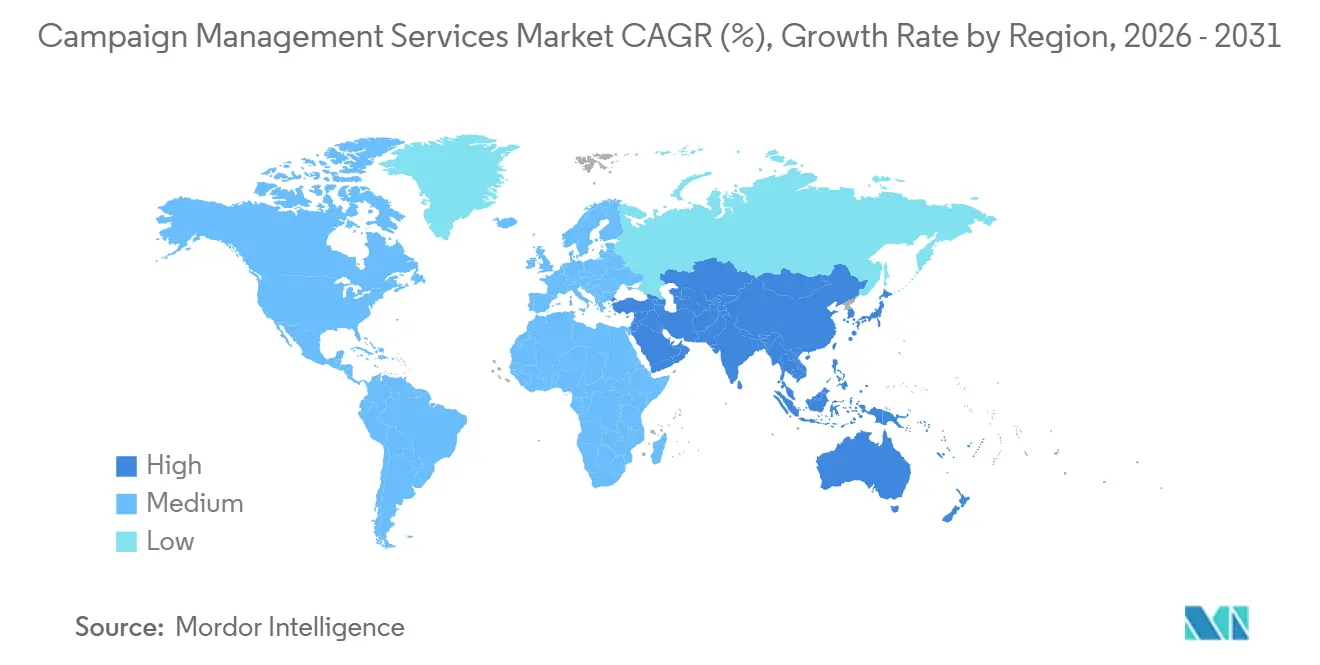
| Fastest Growing Market | Asia-Pacific |
| Largest Market | North America |
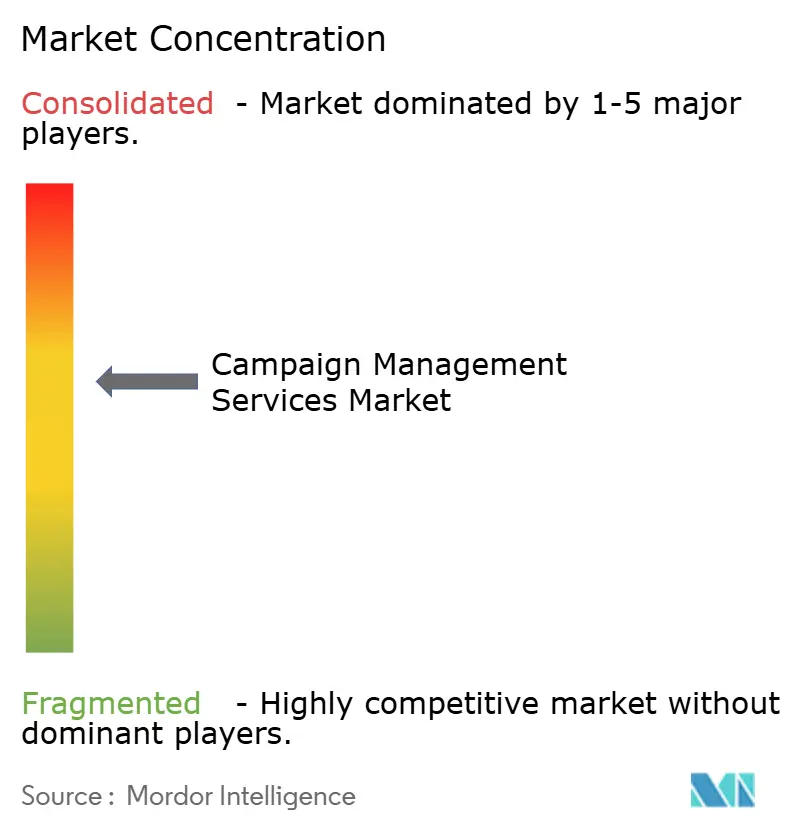
| Market Concentration | Medium |
Major Players *Disclaimer: Major Players sorted in no particular order Image © Mordor Intelligence. Reuse requires attribution under CC BY 4.0. | |
Campaign Management Services Market Analysis by Mordor Intelligence
The campaign management services market size is projected to be USD 24.35 billion in 2025, USD 26.89 billion in 2026, and reach USD 44.66 billion by 2031, growing at a CAGR of 10.72% from 2026 to 2031. The campaign management services market is expanding because enterprises are moving more of their marketing workflow, from planning and activation to analytics and optimization, to specialist providers that can deploy AI-native tools faster than internal teams. The campaign management services market is also being reshaped by the merging of programmatic media, real-time audience intelligence, and agentic AI into a single managed service layer, narrowing the line between campaign execution and marketing technology. This is creating a larger pool of outsourcing demand as providers draw spending from both legacy agency budgets and martech software budgets simultaneously. Competitive positioning in the campaign management services market now depends more on identity infrastructure, cloud integration, governance, and workflow depth than on creative execution alone. Growth still faces pressure from privacy compliance complexity, fragmented retail media measurement, legacy martech integration debt, and the need to keep human oversight in AI-led campaign operations.
Key Report Takeaways
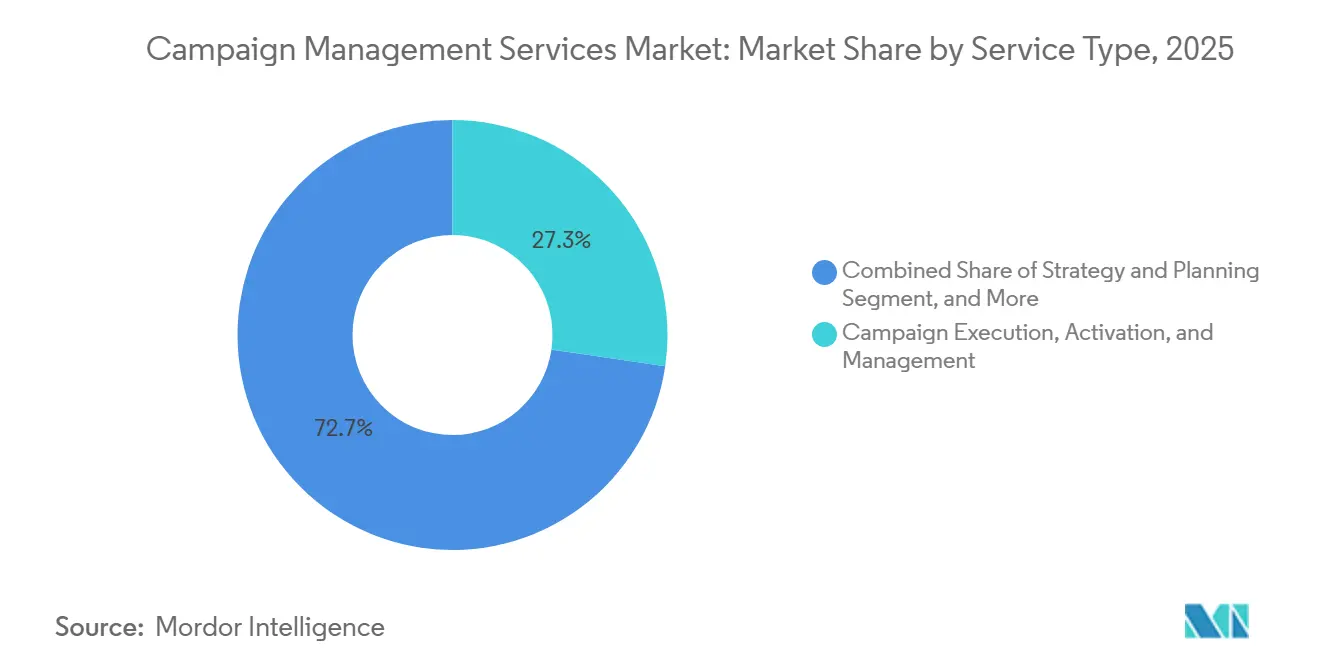
- By service type, campaign execution and activation held 27.32% share in 2025, while campaign optimization and personalization are projected to expand at a 14.78% CAGR through 2031.
- By client organization size, large enterprises accounted for 61.84% of the market share in 2025, and small and medium enterprises accounted for 11.74% CAGR through 2031.
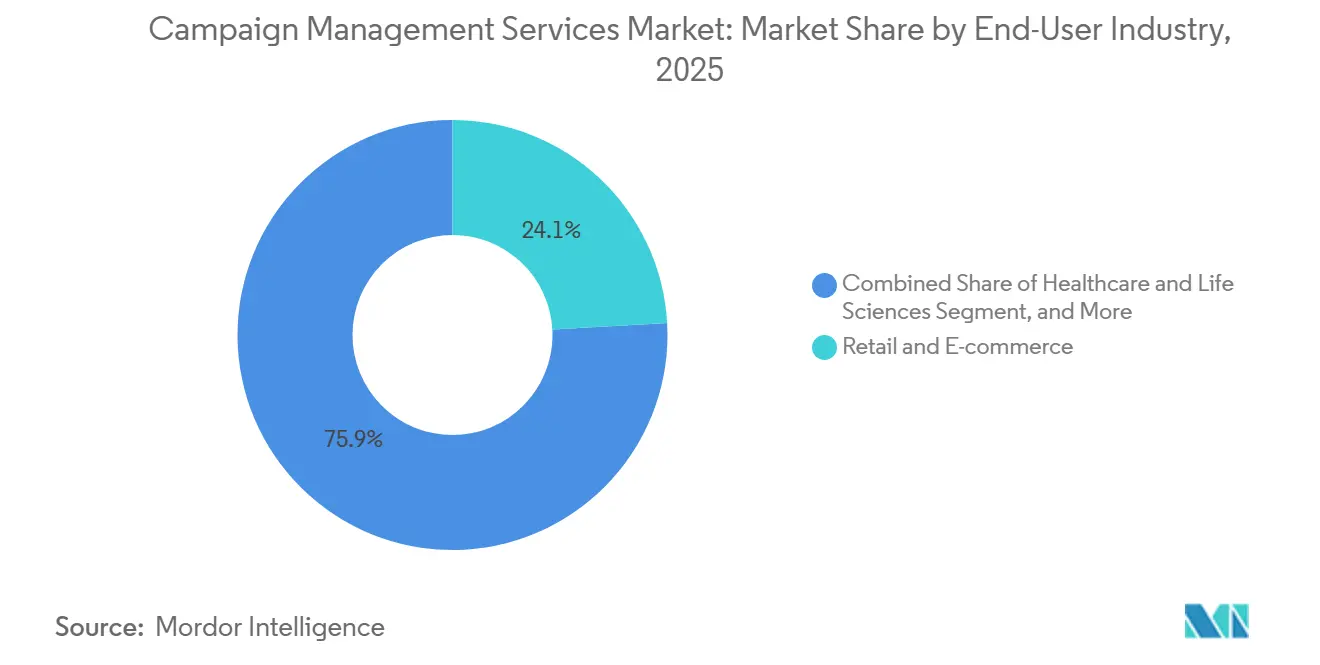
- By end-user industry, retail and e-commerce captured 24.11% of the campaign management services market in 2025, while healthcare and life sciences are projected to record the fastest 14.19% CAGR through 2031.
- By geography, North America held 38.53% share in 2025, while Asia-Pacific is expected to expand at the fastest 12.81% CAGR through 2031.
Note: Market size and forecast figures in this report are generated using Mordor Intelligence’s proprietary estimation framework, updated with the latest available data and insights as of January 2026.
Market Trends and Insights
Drivers Impact Analysis of Campaign Management Services Market*
| Driver | (~) % Impact on CAGR Forecast | Geographic Relevance | Impact Timeline |
|---|---|---|---|
| Omnichannel Personalization Spend Expansion | +2.0% | Global, concentrated in North America and Europe | Medium term (2-4 years) |
| AI-Enabled Campaign Optimization and Automation | +2.8% | Global, early gains in North America, Asia-Pacific, and Europe | Short term (≤ 2 years) to Medium term (2-4 years) |
| First-Party Data Activation and Clean-Room Adoption | +1.4% | North America and Europe primarily, Asia-Pacific emerging | Medium term (2-4 years) |
| Retail Media and Creator Commerce Workflow Convergence | +1.8% | Global, highest impact in North America and Asia-Pacific | Short term (≤ 2 years) to Medium term (2-4 years) |
| Cloud-Native Managed Marketing Operations Adoption | +0.8% | Global, mid-market in North America and Asia-Pacific core | Medium term (2-4 years) to Long term (≥ 4 years) |
| Asia-Pacific Mobile Commerce and Social Engagement Expansion | +1.5% | Asia-Pacific core, spillover to Middle East and Africa | Short term (≤ 2 years) |
| Source: Mordor Intelligence | |||
Omnichannel Personalization Spend Expansion
Personalization is now treated as a core operating requirement rather than an optional marketing layer. That shift increases demand for providers that can coordinate messaging, timing, and audience logic across email, paid media, web, mobile, and in-store activation without breaking campaign continuity. The main issue for many brands is not strategy alone; it is the day-to-day workload of keeping these programs active across multiple channels simultaneously. That execution gap supports the campaign management services market because specialist providers can always run on personalization programs while internal teams stay focused on planning cycles, product launches, and approval workflows. Providers with stronger data orchestration and AI-led decisioning capabilities are better positioned to win this work because they can connect personalization to live activation rather than treating it as a separate advisory task.
AI-Enabled Campaign Optimization and Automation
AI is changing campaign operations by raising the performance standard that enterprise buyers expect from external providers. Google reported that AI Max for Search Campaigns delivered a 14% average uplift in conversions or conversion value, and that uplift rose to 27% for campaigns that had been overly dependent on exact and phrase match keywords, making AI-enabled optimization harder for clients to ignore.[1] As a result, buyers increasingly want managed service partners that can deploy, monitor, retrain, and govern AI agents across search, social, and commerce media within one operating model. This is also changing provider economics because automation pushes human teams toward higher-value work in planning, creative direction, and audience interpretation rather than repetitive trafficking tasks. The campaign management services market gains from this shift because providers that combine AI performance gains with human review controls are becoming more relevant in enterprise procurement.
First-Party Data Activation and Clean-Room Adoption
Signal loss and privacy pressure are making first-party data activation a practical requirement for campaign delivery. That change is increasing the value of providers that can connect audience planning, activation, and reporting through privacy-safe operating models rather than older cookie-based workflows. Publicis Groupe's agreement to acquire LiveRamp shows how identity resolution and data collaboration capabilities are being pulled directly into campaign service delivery rather than being treated as separate infrastructure decisions. Merkle's partnership with Shopify points in the same direction, as it combines identity, loyalty, CRM, promotions, and commerce analytics into a more unified service model for enterprise clients. As these identity-heavy workflows become more embedded, the campaign management services market benefits because clients are less willing to maintain fragmented data activation models across internal teams and disconnected vendors.
Retail Media and Creator Commerce Workflow Convergence
Retail media and creator commerce are moving closer together, changing what managed campaign execution now requires. IAB and Advertiser Perceptions reported creator advertising at USD 37 billion in 2025 and USD 44 billion in 2026, which shows that creator-led media is becoming a larger, more formal part of paid marketing plans. WPP Media also stated that global retail media spend reached USD 169.6 billion in 2025 and is projected to reach USD 252.1 billion by 2030, which confirms that retail platforms are absorbing a larger share of total ad budgets. When those two channels converge, providers need to manage creator selection, content governance, retail media trafficking, attribution logic, and co-op funding workflows in one service chain. This expands the campaign management services market because brands often lack a single internal team that can handle both creator-led demand generation and retail media conversion operations together.
Restraints Impact Analysis of Campaign Management Services Market*
| Restraint | (~) % Impact on CAGR Forecast | Geographic Relevance | Impact Timeline |
|---|---|---|---|
| Data Privacy and Consent Compliance Complexity | -0.8% | Europe, North America, Asia-Pacific expanding | Short term (≤ 2 years) to Long term (≥ 4 years) |
| Legacy MarTech Integration and Data Silos | -1.2% | Global, most acute in Europe and large North American enterprises | Medium term (2-4 years) to Long term (≥ 4 years) |
| Measurement Fragmentation Across Retail Media and Creator Ecosystems | -0.6% | Global, most acute in North America and Asia-Pacific | Short term (≤ 2 years) to Medium term (2-4 years) |
| Agentic AI Governance and Brand Safety Controls | -0.5% | Global, regulatory dimension strongest in Europe | Medium term (2-4 years) |
| Source: Mordor Intelligence | |||
Data Privacy and Consent Compliance Complexity
Privacy obligations now vary across jurisdictions, making cross-border campaign execution harder to standardize. The European Data Protection Board's Opinion 08/2024 tightened the interpretation of what may constitute freely given consent in consent or pay models, adding legal and operational pressure to behavioral advertising workflows.[2] For managed providers, this increases the review work needed for audience use, activation rules, suppression logic, and documentation across markets. The burden tends to slow smaller operators first, while larger providers can incorporate consent management, geofenced activation rules, and review controls into their service offer. Even so, this restraint limits the speed of the campaign management services market because compliance work can delay launches, narrow targeting choices, and increase delivery costs.
Legacy MarTech Integration and Data Silos
Legacy stack problems still slow execution more than the channel strategy does. Many managed service engagements begin with disconnected CRM, CDP, email, analytics, and ad tech environments that cannot easily share audiences, events, or reporting outputs within a single workflow. That forces providers to spend time fixing data architecture and workflow sequencing before live campaign activation can scale. The issue is especially important in large enterprise accounts where years of tool additions have created overlapping systems and unclear ownership across marketing, data, and technology teams. This remains a drag on the campaign management services market because clients may want advanced AI-enabled delivery, but those benefits are harder to realize until the underlying stack is connected and usable.
*Our forecasts treat driver/restraint impacts as directional, not additive. The impact forecasts reflect baseline growth, mix effects, and variable interactions.
Campaign Management Services Market Segment Analysis
By Service Type:
Execution Scale Meets Personalization IntelligenceCampaign Execution and Activation commanded 27.32% of the campaign management services market share in 2025, underscoring how much enterprise outsourcing still centers on the operational layer, where plans become live campaigns. This segment remains the anchor of managed demand because providers are responsible for keeping search, social, email, and retail media programs running with the speed and consistency that internal teams often struggle to maintain. The work is becoming more complex because activation now involves more channels, more data dependencies, and tighter turnaround expectations within the same campaign cycle. Strategy and Planning still supports premium billing, but it usually serves as the front door into broader execution work rather than the largest pool of recurring spend. Campaign Analytics and Reporting is also changing because clients increasingly want performance views that feed directly into live optimization rather than sit in separate reporting cycles.
Campaign Optimization and Personalization is projected to expand at a 14.78% CAGR through 2031, making it the fastest-growing service type in the campaign management services industry. That growth reflects the spread of AI-led personalization tools that require ongoing deployment, model supervision, and audience refreshes to deliver stable results over time. Deloitte Digital's May 2026 collaboration with Optimizely shows how leading providers are competing not only on execution capacity but also on marketing operating model redesign for AI-powered delivery. WPP's February 2026 expansion with Adobe follows the same pattern by integrating Adobe Firefly Foundry into WPP Open, so creative and media teams can work inside a more unified AI-enabled content and activation workflow

By Client Organization Size:
Enterprise Scale Spending Leads While SME Adoption Accelerates Through AI-Enabled Marketing AccessLarge Enterprises accounted for 61.84% of the campaign management services market share in 2025, reflecting their extensive reliance on external partners to manage increasingly complex, multi-channel marketing ecosystems. Large organizations operate across multiple brands, regions, customer segments, and digital platforms, creating a sustained need for specialized service providers capable of coordinating campaign planning, activation, optimization, analytics, and compliance requirements at scale. The segment continues to dominate spending because enterprise marketing teams are under pressure to deliver personalized customer engagement across hundreds of campaigns simultaneously while integrating data from CRM systems, customer data platforms, retail media networks, and emerging AI-driven marketing tools. Campaign management service providers are increasingly functioning as strategic operating partners rather than execution vendors, helping enterprises unify marketing operations, improve campaign velocity, and maintain governance across fragmented digital ecosystems.
Small and Medium Enterprises are projected to expand at an 11.74% CAGR between 2026 and 2031, making them the fastest-growing client organization segment in the campaign management services market. Growth is being driven by the democratization of advanced marketing technologies that were previously accessible primarily to large enterprises. Cloud-based campaign management platforms, AI-powered audience targeting tools, automated content generation, and performance optimization solutions are reducing operational barriers and enabling smaller organizations to execute sophisticated marketing programs without building large in-house teams. As competition intensifies across digital channels, SMEs are increasingly outsourcing campaign management functions to gain access to specialized expertise, improve return on advertising spend, and accelerate customer acquisition efforts. Service providers are responding by introducing modular engagement models, subscription-based service packages, and industry-specific campaign solutions tailored to the budget and resource constraints of smaller businesses.
By End-User Industry:
Healthcare Accelerates While Retail Sustains ScaleRetail and E-commerce held a 24.11% share of the campaign management services market in 2025, reflecting the sector's constant need for loyalty campaigns, seasonal promotions, product launches, and always-on performance marketing. This vertical produces steady outsourcing demand because campaign volumes are high, timing windows are short, and execution now spans commerce platforms, marketplaces, retail media networks, and social storefronts simultaneously. The convergence of retail media, social commerce, and creator-led activation makes these mandates more operationally complex than traditional media-buying models. BFSI remains another large user group because consent handling, auditability, and documented data practices matter more in financial outreach than in many other sectors. In practice, that gives providers with stronger workflow controls and compliance-ready data handling an advantage across high-value accounts in the campaign management services industry.
Healthcare and Life Sciences are projected to grow at the fastest 14.19% CAGR through 2031, reflecting heavier digital outreach to healthcare professionals and consumers, along with stricter campaign governance needs. Outsourcing demand is supported by the fact that campaign delivery in this segment must align with promotional review processes, audit trails, and channel-specific controls that many brands do not want to manage internally at scale. Cognizant's April 2026 launch of an agentic retail CX solution with Google Cloud shows how large providers are building vertical-ready AI accelerators that combine personalization with governance rather than treating those goals separately. Technology and Telecom, Media and Entertainment, Consumer Goods and Manufacturing, Travel and Hospitality, and Government and Non-Profit also support demand through subscription campaigns, seasonal promotions, public outreach programs, and other recurring activation needs.
Geography Analysis
The Americas Campaign Management Services Market
North America held 38.53% of the campaign management services market share in 2025, which made it the largest regional center for outsourced campaign operations. The region benefits from large enterprise marketing budgets, dense retail media activity, and faster investment in first-party data and identity infrastructure than most other markets. Publicis Groupe's agreement to acquire LiveRamp and Omnicom's completed acquisition of Interpublic both show that campaign leadership in the region is increasingly tied to ownership of identity, data collaboration, and decisioning assets rather than creative capability alone. Canada and Mexico add support through nearshore delivery expansion and a broader base of digital transformation demand across mid-market and enterprise accounts. South America remains smaller, but demand is improving as brands in the region expand digital commerce, platform advertising, and performance-led customer acquisition programs.
Europe Campaign Management Services Market
Europe remained the second-largest geography, with Germany, the United Kingdom, and France forming the core demand base for the campaign management services market. Ongoing GDPR interpretation has made privacy-safe campaign architecture a real competitive issue for providers managing cross-border work, not just a legal review step. Merkle's March 2026 appointment by Samsung Electronics Europe for a three-year CRM transformation program across 16 markets shows the scale of AI-enabled, compliance-aware campaign transformation now moving through the region.[3] The United Kingdom is also seeing competitive realignment as identity-led operating models gain ground, while continental Europe continues to support cloud-native managed marketing operations tied to broader enterprise transformation programs.
APAC and MEA Campaign Management Services Market
Asia-Pacific is projected to expand at a 12.81% CAGR through 2031, making it the fastest-growing geography in the campaign management services market. Growth comes from mobile commerce, social commerce fragmentation, and the rising need to manage campaigns across multiple platform ecosystems with different algorithms, formats, and measurement rules. Alibaba Mama's March 2026 launch of AI Wanxiang, which uses 4 specialized AI agents across brand intelligence, content creation, media planning, and optimization, shows how platform-led AI infrastructure is changing campaign execution in China. YRGLM's January 2026 survey in Japan, along with Concentrix's September 2025 acquisition of SAI Digital, which positions Vietnam as a strategic hub, points to both a modernization gap and a delivery build-out opportunity across the region. Middle East markets, especially the UAE and Saudi Arabia, are growing through large-scale digital transformation programs, while Africa remains early-stage, with South Africa, Nigeria, and Kenya as the main demand nodes.
Competitive Landscape
The campaign management services market is moderately concentrated, with technology-led consulting firms and integrated marketing services groups holding the largest share of major enterprise accounts. The main shift behind this structure is that data, identity, cloud integration, and AI governance now matter more than traditional agency strengths when buyers choose a managed partner. Publicis Groupe's May 2026 agreement to acquire LiveRamp makes that clear, as the deal was framed around data collaboration, identity resolution, and smarter, agent-based workflows within campaign delivery. Omnicom's completed acquisition of Interpublic sends the same message by bringing Acxiom's identity capabilities into a larger decisioning and services platform.[4] These moves are raising barriers for competitors that do not control comparable identity and data infrastructure.
Another important pattern is the growing role of hyperscaler and platform partnerships in enterprise campaign delivery. The April 2026 expansion of the Microsoft and Publicis Groupe partnership shows how a large provider can integrate Microsoft 365 Copilot, Azure, Fabric, and Epsilon's identity layer into a single operating environment for managed marketing operations. WPP's February 2026 expansion with Adobe and Structured's February 2026 launch of its AI-native Partner Marketing Execution Platform with Microsoft deployment show similar efforts to build deeper workflow control around content, brand governance, and scalable execution. These examples matter because smaller firms can often match channel execution in narrow cases, but they usually cannot replicate the same platform depth across large global mandates.
The market still leaves room for specialist competition, especially in healthcare, government, BFSI, analytics-heavy operations, and regional delivery models. BPO-origin providers and specialist operators remain active because many clients still need disciplined execution, reporting, and process control even when they do not want a full consulting-led transformation program. At the same time, the campaign management services market is becoming harder for generalist players to navigate, as clients are increasingly asking for privacy-ready data handling, AI oversight, and workflow accountability in a single contract. That combination supports a competitive field where the leaders are getting stronger, but the wider base of agencies, BPM firms, and niche operators still matters in mid-market, regional, and vertical-specific mandates.
Campaign Management Services Industry Leaders
-
Accenture Plc
-
WPP Plc
-
Publicis Groupe S.A.
-
Deloitte Touche Tohamtsu Limited
-
IBM Corporation
- *Disclaimer: Major Players sorted in no particular order
Campaign Management Services Market Companies Covered in this Report
- Accenture plc
- Capgemini SE
- Cognizant Technology Solutions Corporation
- Concentrix Corporation
- DEPT Holding B.V.
- Dentsu Group Inc.
- Deloitte Touche Tohmatsu Limited
- eClerx Services Limited
- EXLService Holdings, Inc.
- Genpact Limited
- HCL Technologies Limited
- Infosys Limited
- International Business Machines Corporation
- Merkle Inc.
- PricewaterhouseCoopers International Limited
- Publicis Groupe S.A.
- R.R. Donnelley & Sons Company
- Stagwell Inc.
- Tata Consultancy Services Limited
- Tech Mahindra Limited
- Wipro Limited
- WPP plc
Recent Industry Developments in Campaign Management Services Market
- May 2026: Publicis Groupe entered a definitive agreement to acquire LiveRamp, the global data collaboration platform, in an all-cash transaction with a total enterprise value of USD 2.167 billion and an equity value of USD 2.546 billion. The acquisition is positioned to extend Publicis's Epsilon identity layer with LiveRamp's data collaboration infrastructure, accelerating agentic AI capabilities and data co-creation services for enterprise clients. The transaction is expected to close before year-end 2026, subject to regulatory approvals.
- May 2026: Deloitte Digital and Optimizely announced a strategic technology collaboration to accelerate AI-powered marketing transformation, combining Optimizely's digital experience platform with Deloitte Digital's marketing operating model redesign capabilities, offering clients a phased transformation journey from strategy through content supply chain and AI-native execution.
- April 2026: Microsoft and Publicis Groupe announced an expansion of their strategic partnership, with Publicis designated as Microsoft's global media agency of record and committing to deploy Microsoft 365 Copilot across all 114,000+ employees globally. The collaboration integrates Epsilon's identity data with Microsoft Azure, Fabric, and Copilot Studio to deploy enterprise-grade agentic marketing solutions. Publicis Sapient's Slingshot framework will migrate legacy client systems to Azure as part of cloud-native marketing operations adoption.
- April 2026: Publicis Groupe announced a definitive agreement to acquire 160over90, a global sports- and culture-first marketing agency, reinforcing its campaign management capabilities across sports, entertainment, and fan-engagement marketing. The acquisition builds on prior 2025 acquisitions in the sports and culture domain, Adopt and Bespoke, and a partnership with Magic Johnson Enterprises.
Global Campaign Management Services Market Report Scope
The Campaign Management Services Market comprises specialized services that enable organizations to plan, execute, monitor, optimize, and measure marketing, advertising, customer engagement, and promotional campaigns across multiple channels. These services help businesses coordinate campaign activities, improve audience targeting, enhance customer engagement, and maximize return on marketing investments through data-driven decision-making and performance analysis.
The Campaign Management Services Report is Segmented by Service Type (Strategy and Planning, Campaign Execution, Activation, and Management, Campaign Analytics and Reporting, and Creative and Content Operations), By Client Organization Size (Large Enterprises, and Small and Medium Enterprises), End-User (Retail and E-commerce, BFSI, Healthcare and Life Sciences, Technology and Telecom, Media and Entertainment, Consumer Goods and Manufacturing, Travel and Hospitality, Government and Non-Profit), and Geography (North America, South America, Europe, Asia-Pacific, Middle East, and Africa). The Market Forecasts are Provided in Terms of Value (USD).
Segmentation Overview
| Strategy and Planning |
| Campaign Execution, Activation, and Management |
| Campaign Analytics and Reporting |
| Creative and Content Operations |
| Large Enterprises |
| Small and Medium Enterprises |
| Retail and E-commerce |
| BFSI |
| Healthcare and Life Sciences |
| Technology and Telecom |
| Media and Entertainment |
| Consumer Goods and Manufacturing |
| Travel and Hospitality |
| Government and Non-Profit |
| North America | United States |
| Canada | |
| Mexico | |
| South America | Brazil |
| Argentina | |
| Chile | |
| Rest of South America | |
| Europe | Germany |
| United Kingdom | |
| France | |
| Italy | |
| Spain | |
| Russia | |
| Rest of Europe | |
| Asia-Pacific | China |
| India | |
| Japan | |
| South Korea | |
| Australia | |
| Singapore | |
| Rest of Asia-Pacific | |
| Middle East | United Arab Emirates |
| Saudi Arabia | |
| Turkey | |
| Rest of Middle East | |
| Africa | South Africa |
| Nigeria | |
| Kenya | |
| Rest of Africa |
| By Service Type | Strategy and Planning | |
| Campaign Execution, Activation, and Management | ||
| Campaign Analytics and Reporting | ||
| Creative and Content Operations | ||
| By Client Organization Size | Large Enterprises | |
| Small and Medium Enterprises | ||
| By End-user Industry | Retail and E-commerce | |
| BFSI | ||
| Healthcare and Life Sciences | ||
| Technology and Telecom | ||
| Media and Entertainment | ||
| Consumer Goods and Manufacturing | ||
| Travel and Hospitality | ||
| Government and Non-Profit | ||
| By Geography | North America | United States |
| Canada | ||
| Mexico | ||
| South America | Brazil | |
| Argentina | ||
| Chile | ||
| Rest of South America | ||
| Europe | Germany | |
| United Kingdom | ||
| France | ||
| Italy | ||
| Spain | ||
| Russia | ||
| Rest of Europe | ||
| Asia-Pacific | China | |
| India | ||
| Japan | ||
| South Korea | ||
| Australia | ||
| Singapore | ||
| Rest of Asia-Pacific | ||
| Middle East | United Arab Emirates | |
| Saudi Arabia | ||
| Turkey | ||
| Rest of Middle East | ||
| Africa | South Africa | |
| Nigeria | ||
| Kenya | ||
| Rest of Africa | ||
Key Questions Answered in the Report
What is the current and forecast value of the campaign management services market?
The campaign management services market was valued at USD 24.35 billion in 2025, is expected to reach USD 26.89 billion in 2026, and is forecast to rise to USD 44.66 billion by 2031 at a 10.72% CAGR.
Which service type leads campaign management spending today?
Campaign Execution and Activation led with 27.32% share in 2025 because enterprises still outsource the operational core of omnichannel campaign delivery more than any other service layer.
Which end-user group is creating the most outsourcing demand?
Retail and E-commerce held the largest share at 24.11% in 2025 because the sector runs constant launch, promotion, loyalty, and performance campaigns across multiple commerce channels.
Why is Asia-Pacific growing faster than other regions?
Asia-Pacific is forecast to grow at a 12.81% CAGR through 2031 because mobile commerce, social commerce, and platform fragmentation create more execution complexity that specialist providers are hired to manage.
What are the main risks slowing adoption of managed campaign services?
The main pressure points are privacy and consent compliance, legacy martech integration issues, fragmented retail media measurement, and the need for human oversight in agentic AI workflows.