
Butyl Acetate Market Size and Share
Market Overview
| Study Period | 2022 - 2032 |
|---|---|
| Market Size (2027) | USD 2.55 Billion |
| Market Size (2032) | USD 3.18 Billion |
| Growth Rate (2027 - 2032) | 4.57 % |
| Fastest Growing Market | Asia-Pacific |
| Largest Market | Asia-Pacific |
| Market Concentration | Medium |
Major Players *Disclaimer: Major Players sorted in no particular order Image © Mordor Intelligence. Reuse requires attribution under CC BY 4.0. | |
Butyl Acetate Market Analysis by Mordor Intelligence
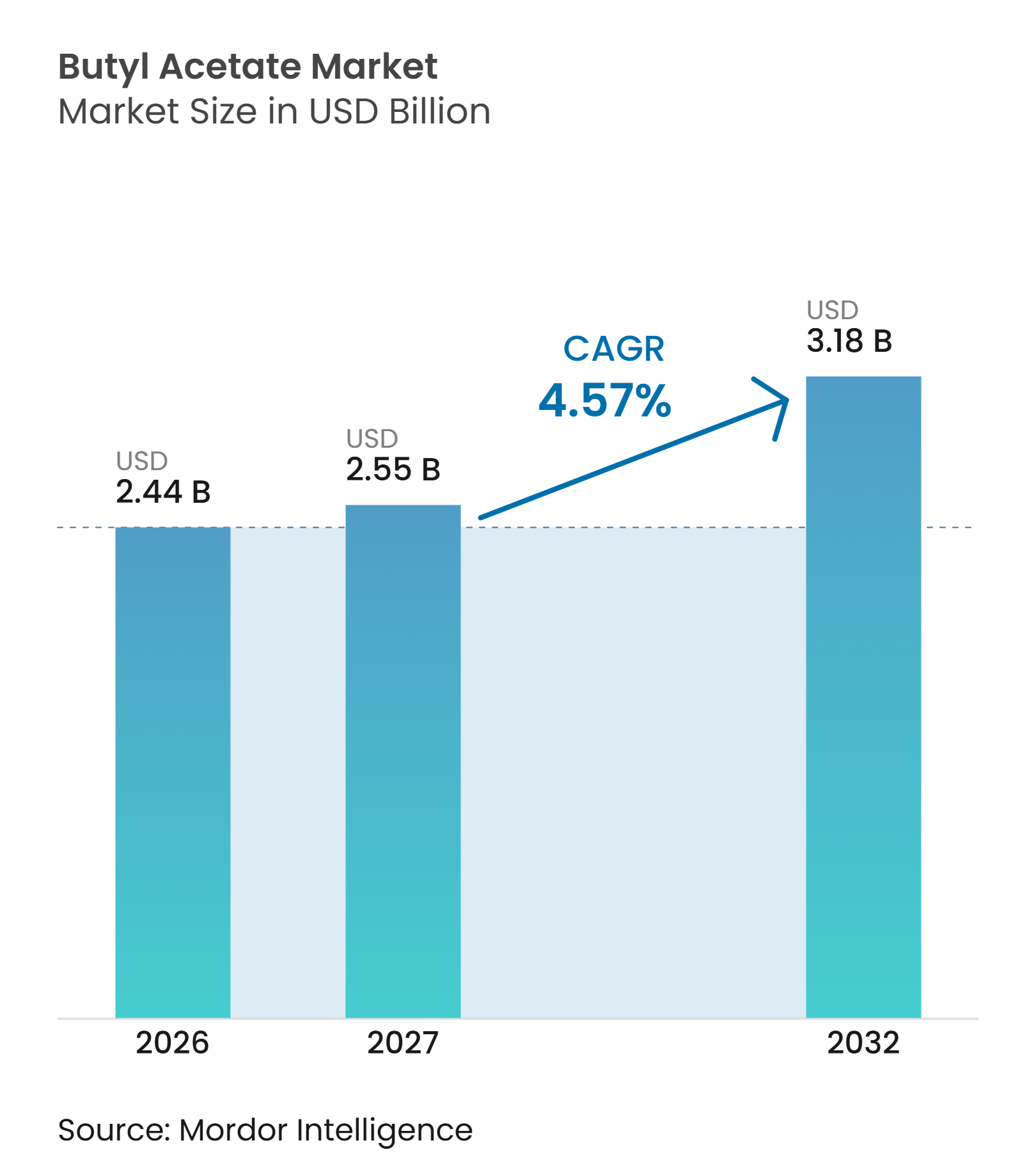
The butyl acetate market size was valued at USD 2.44 billion in 2026 and is estimated to grow from USD 2.55 billion in 2027 to reach USD 3.18 billion by 2032, at a CAGR of 4.57% during the forecast period (2027-2032). Industrial demand remains centered on coatings, inks, and adhesives, while higher-purity material supports pharmaceutical and semiconductor uses. The shift in the butyl acetate market toward higher-purity products creates a value opportunity for producers that can meet qualification requirements. Integrated producers also have a cost advantage because they can manage the supply of n-butanol and acetic acid within their own operations. Environmental rules are changing solvent selection in coatings, which can reduce demand in some uses while supporting reformulation in others. Chinese capacity and export availability continue to influence pricing and utilization across the butyl acetate market.
Key Report Takeaways
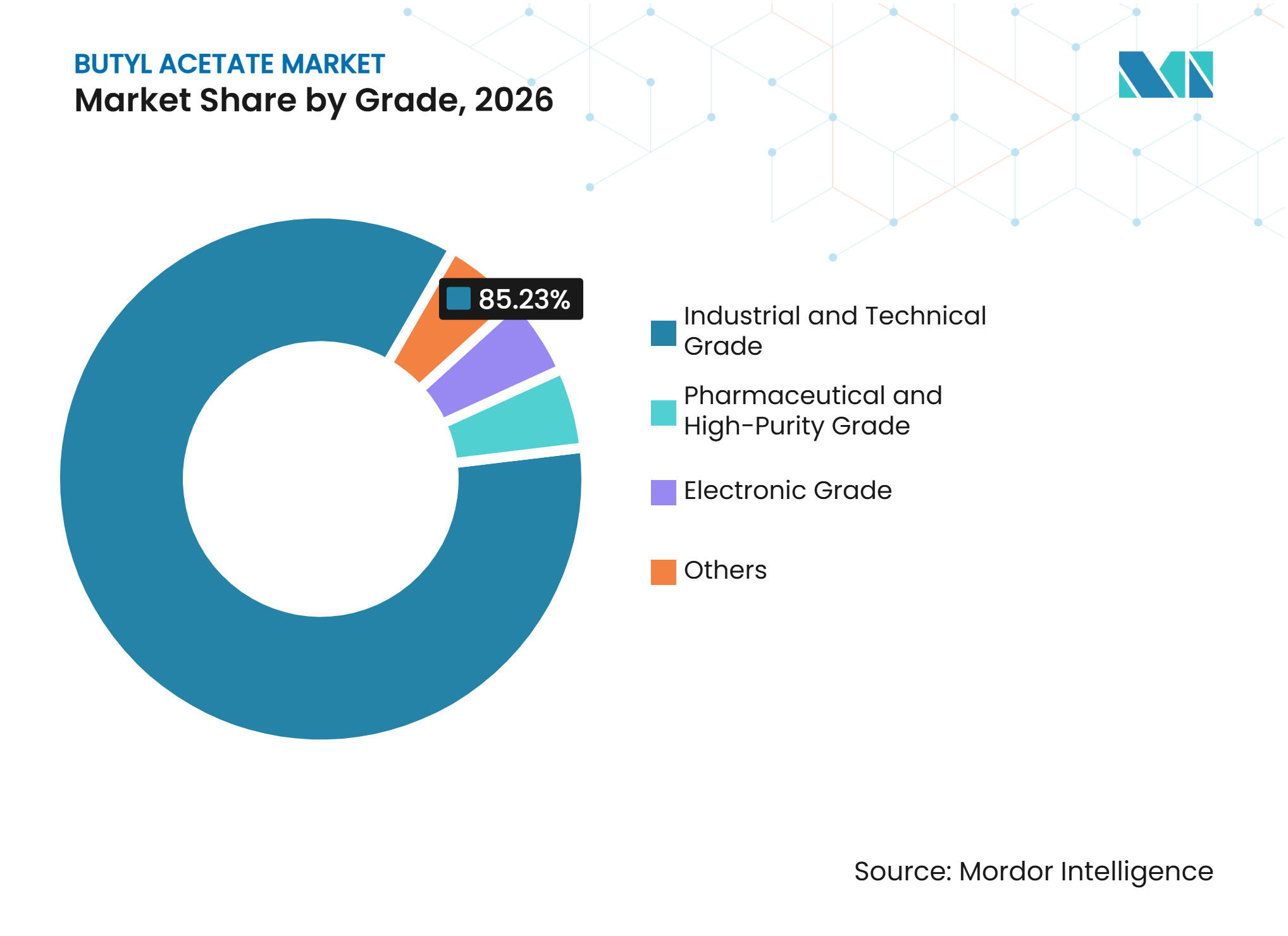
- By grade, industrial and technical grade held 85.23% of the butyl acetate market share in 2026, while electronic grade is projected to advance at a 4.91% CAGR through 2032.
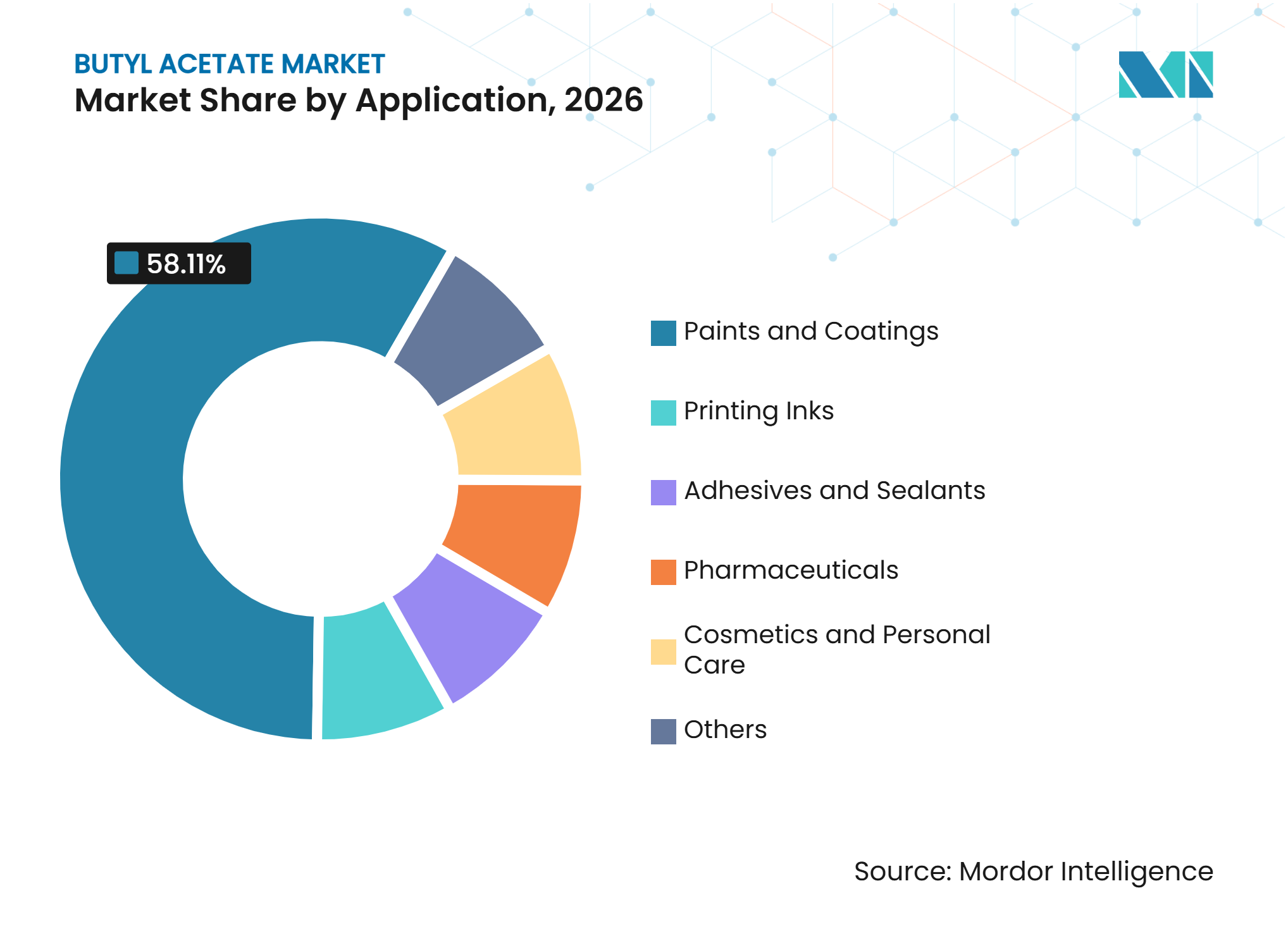
- By application, paints and coatings held 58.11% of the butyl acetate market share in 2026, while pharmaceuticals are projected to advance at a 5.25% CAGR through 2032.
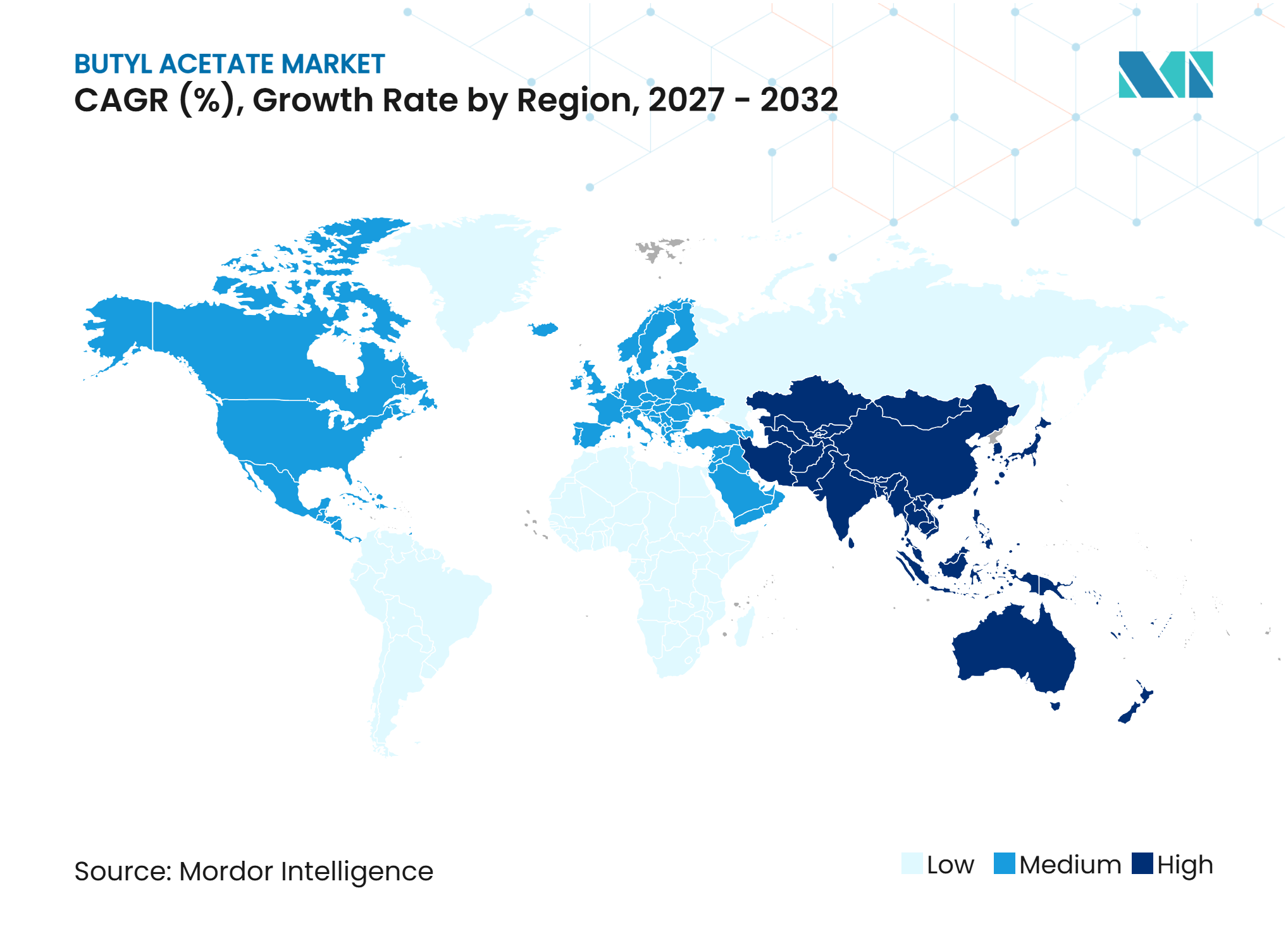
- By geography, Asia-Pacific held 47.98% of the butyl acetate market share in 2026 and is projected to advance at a 5.17% CAGR through 2032.
Note: Market numbers in this report are based on Mordor Intelligence's proprietary estimation framework, which combines nine months of actuals with Q4 projections for base year 2026.
Market Trends and Insights
Drivers Impact Analysis of Butyl Acetate Market*
| Driver | (~) % Impact on CAGR Forecast | Geographic Relevance | Impact Timeline |
|---|---|---|---|
| Asia-Pacific Coatings and Export Manufacturing Expansion | +1.7% | APAC core (China, India, ASEAN), spillover to MEA | Medium term (2-4 years) |
| Generic Pharmaceutical and High-Purity Solvent Manufacturing Growth | +1.2% | South Asia (India), Southeast Asia, Global export markets | Long term (≥ 4 years) |
| Electronic-Grade and Specialty-Purity Demand | +0.8% | APAC core (South Korea, Japan, China), North America | Long term (≥ 4 years) |
| VOC-Compliant Solvent and Resin-System Performance | +0.5% | North America & EU, spillover to APAC | Short term (≤ 2 years) |
| Integrated Oxo and Acetyl Chain Advantages | +0.3% | Global, strongest in North America and EU | Medium term (2-4 years) |
| Source: Mordor Intelligence | |||
Asia-Pacific Coatings and Export Manufacturing Expansion
India’s automotive original equipment manufacturers, industrial maintenance, and construction coatings use support steady solvent demand. Manufacturing investment in Vietnam, Thailand, and Indonesia is also adding coatings and adhesives production that requires solvent capacity. Export activity is reshaping trade flows, as Yip’s Chemical Holdings Limited reported that its associate Handsome Chemical recorded 1.8 million metric tons of acetate solvent sales in 2025. The same release reported exports of 760,000 metric tons, which increase the relevance of Asian supply to overseas buyers.
Generic Pharmaceutical and High-Purity Solvent Manufacturing Growth
India’s generic drug manufacturing base supports demand for high-purity butyl acetate that is less dependent on construction activity. The International Council for Harmonisation (ICH) classifies butyl acetate as a Class 3 residual solvent under its Q3C guideline. This classification supports its use in tablet coatings and active pharmaceutical ingredient synthesis when manufacturers meet applicable quality requirements. Export-oriented facilities must also manage Current Good Manufacturing Practice requirements under the relevant national regulatory systems. High-purity supply can therefore command a premium over industrial material, supporting a change in the product mix for qualified suppliers. This demand stream gives the butyl acetate market a more stable outlet than applications tied mainly to building activity.
Electronic-Grade and Specialty-Purity Demand
Electronic-grade demand is supported by the need for tightly controlled impurities in semiconductor process chemicals. SEMI C12 provides the relevant framework for photoresist process chemicals, including requirements that support ultra-pure solvent use in semiconductor fabrication. Eastman Chemical Company describes its EastaPure range as a portfolio of ultrapure solvents supported by clean-room monitoring and purity certification. Korea Alcohol Industrial is expanding its semiconductor materials position through investment at the Yesan 2 General Industrial Complex with affiliated companies. These investments reflect the need for reliable, qualified supply near semiconductor manufacturing clusters. The higher technical threshold makes this part of the butyl acetate market more difficult for commodity suppliers to enter.
VOC-Compliant Solvent and Resin-System Performance
Volatile Organic Compound (VOC) rules are changing how formulators assess the role of butyl acetate in coatings. The U.S. Environmental Protection Agency finalized amendments to the National Volatile Organic Compound Emission Standards for Aerosol Coatings in January 2025[1]. The amendments require manufacturers to consider compliance when selecting solvents and resin systems. In California, the South Coast Air Quality Management District amended Rule 1171 in 2025, affecting the use of certain solvents in cleaning operations. Formulators can respond by changing solvent blends, improving transfer efficiency, or moving some applications toward lower-solvent systems. The resulting demand effect is uneven because some applications require the evaporation rate and resin compatibility that butyl acetate provides.
Restraints Impact Analysis of Butyl Acetate Market*
| Restraint | (~) % Impact on CAGR Forecast | Geographic Relevance | Impact Timeline |
|---|---|---|---|
| Waterborne and High-Solids Coating Conversion | -0.9% | North America & EU, early adoption in APAC | Medium term (2-4 years) |
| N-Butanol and Acetic Acid Cost Volatility | -0.6% | Global, most acute in Europe and APAC | Short term (≤ 2 years) |
| Chinese Export Price Competition and Oversupply Risk | -0.5% | Global, most acute in APAC and MEA | Short term (≤ 2 years) |
| Source: Mordor Intelligence | |||
Waterborne and High-Solids Coating Conversion
The move toward waterborne and high-solids systems limits solvent demand in architectural and some industrial coatings. A 2025 scientific study examined the substitution of fossil-based solvents in organic coatings and showed pathways to reduce life-cycle emissions while maintaining coating performance. Waterborne systems are moving beyond decorative coatings into some industrial wood, automotive original equipment manufacturer, and refinish uses. This conversion is gradual in demanding applications because polyurethane and epoxy systems can still require controlled open time, flow, and film formation. The European Union’s Industrial Emissions Directive and Registration, Evaluation, Authorisation and Restriction of Chemicals framework reinforce pressure to manage emissions from surface-treatment operations[2]. This restraint limits growth in the butyl acetate market without eliminating use in applications that require solvent-borne performance.
N-Butanol and Acetic Acid Cost Volatility
N-butanol and acetic acid remain the two critical feedstocks for butyl acetate production. Cost changes can temporarily improve producer margins when selling prices respond more slowly than input prices. The reverse can occur when supply disruption or operating changes raise feedstock costs faster than producers can pass them through. Producers without integration are more exposed because they depend on regional merchant supply. This volatility complicates planning for coatings, ink, and adhesive customers that require stable delivered prices. It also makes supply-chain flexibility a competitive requirement in the butyl acetate market.
*Our forecasts treat driver/restraint impacts as directional, not additive. The impact forecasts reflect baseline growth, mix effects, and variable interactions.
Butyl Acetate Market Segment Analysis
By Grade:
Industrial and Technical Grade Anchors Revenue, Electronics Grade ExpandsIndustrial and technical grade held an 85.23% share in 2026, reflecting its use in coatings, adhesives, printing inks, and general industrial formulations. Its position reflects the established evaporation rate and solvency profile of n-butyl acetate in resin systems. Formulators often design products around those characteristics, which makes direct substitution difficult in existing solvent-borne products. Pharmaceutical and high-purity grades serve a different customer base that needs controlled purity, water content, acidity, and trace contaminants. The ICH Q3C guideline gives pharmaceutical producers a recognized basis for residual-solvent assessment.
Electronic grade is projected to advance at a 4.91% CAGR through 2032, making it the fastest-growing grade in the butyl acetate market. Semiconductor manufacturing requires high-quality chemicals with tight impurity control, which raises the qualification threshold for suppliers. Eastman Chemical Company identified ultrapure solvents as part of its EastaPure portfolio in its 2025 Form 10-K. Korea Alcohol Industrial’s investment in a semiconductor materials campus in South Chungcheong Province aligns with the expansion of regional electronics supply chains. This grade can improve producer value realization because customers place greater importance on certification, consistency, and local technical support.



By Application:
Paints and Coatings Lead Demand, Pharmaceuticals Drive GrowthPaints and coatings held 58.11% of the butyl acetate market in 2026 because the solvent works with acrylic, alkyd, and polyurethane resin systems. Its balanced evaporation behavior supports film appearance and application control in solvent-borne topcoats. Automotive refinish, wood finishes, and industrial maintenance coatings remain important demand outlets. At the same time, waterborne conversion reduces solvent loading in selected applications. The segment therefore remains large, but its expansion is affected by environmental compliance and construction-related cycles.
Pharmaceuticals are projected to advance at a 5.25% CAGR through 2032. Their growth is linked to high-purity use in generic drug production rather than to building or infrastructure demand. Butyl acetate’s Class 3 designation under ICH Q3C supports continued evaluation for appropriate pharmaceutical uses. Printing inks, adhesives and sealants, and cosmetics and personal care provide additional outlets for industrial-grade material. Flexible packaging printing benefits from fast flash-off behavior, while nail-care products continue to use butyl acetate in conventional lacquer systems.

Geography Analysis
Asia-Pacific: Manufacturing Scale Supports Regional Leadership
Asia-Pacific held 47.98% of the butyl acetate market size in 2026 and is projected to advance at a 5.17% CAGR through 2032. China remains the region’s major supply center, while India’s coatings and active pharmaceutical ingredient production provide demand across industrial and higher-purity grades. South Korea adds specialty demand through its semiconductor materials chain. Korea Alcohol Industrial’s investment in the Yesan 2 General Industrial Complex reflects the region’s focus on semiconductor materials. Export availability from the region can also influence prices in nearby import markets.
North America: Premium Grades and Regulatory Change Shape Demand
North America has a steady demand base in pharmaceutical and coatings applications, while construction conditions and trade policy can affect demand. Eastman Chemical Company has positioned EastaPure ultrapure solvents for electronic-chemical customers that require controlled quality in semiconductor supply chains. The U.S. Environmental Protection Agency’s 2025 aerosol-coatings amendments influence formulation decisions. Mexico provides an additional outlet through automotive coatings and electronics assembly, while integrated assets and qualified electronic-grade material support less price-sensitive applications.
Europe, South America, and Middle East and Africa: Different Cost and Demand Conditions
Europe faces high energy costs, weak construction-linked coatings demand, and tighter environmental compliance factors. INEOS completed an investment at its Hull site in July 2025 to convert production from natural gas to hydrogen fuel. The company stated that the project reduces carbon dioxide emissions by 75%. South America remains concentrated in Brazil, where import competition can affect local producers and customers. Sahara International Petrochemical Company (Sipchem) reported challenging 2025 market conditions, while Middle East and Africa demand depends on local acetyls production, import availability, and infrastructure-related coatings demand.
Competitive Landscape
Market Concentration
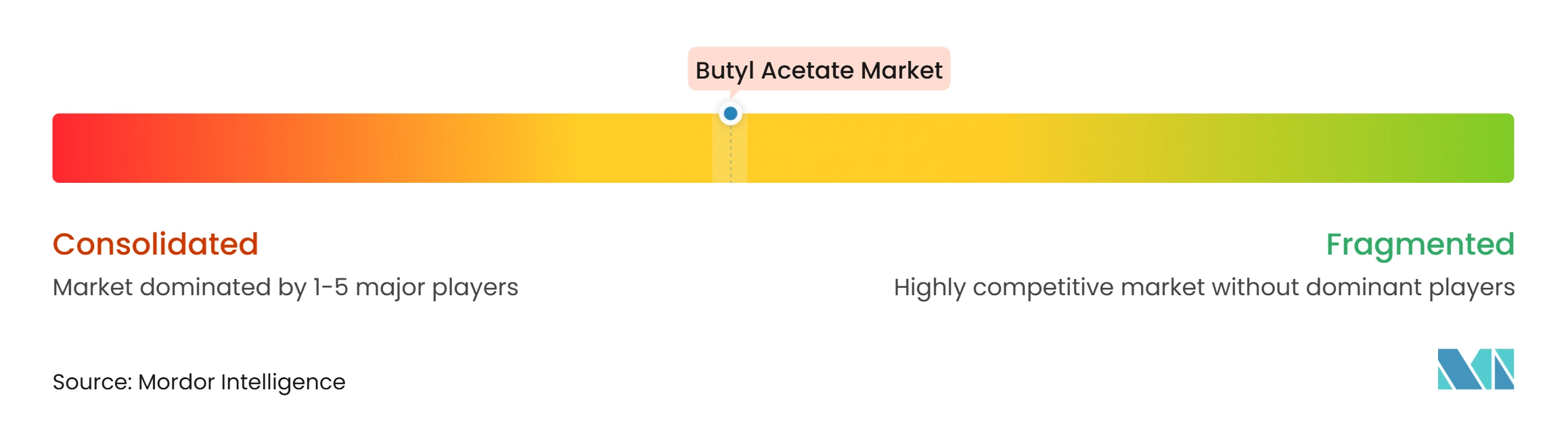
The butyl acetate market is moderately concentrated, with top players including BASF, Eastman Chemical Company, Celanese Corporation, Dow, and OQEMA Ltd. BASF’s Zhanjiang Verbund development expands its integrated chemical production position in China. Celanese Corporation reported a focus on its lowest-cost production assets as it managed its 2025 portfolio. Eastman Chemical Company differentiates its EastaPure portfolio through ultrapure-solvent capabilities.
Chinese producers compete with production scale and export availability, while other regional suppliers focus on local demand. Yip’s Chemical Holdings Limited reported that Handsome Chemical, its associate, achieved 1.8 million metric tons of acetate solvent sales in 2025. The company also reported that the associate’s new acetic acid and acetate solvents plant in Hubei entered full-scale production in the second half of 2025. Korea Alcohol Industrial is building capabilities linked to electronic-grade materials. Qualified semiconductor and pharmaceutical supply can therefore compete on certification as well as price.
The competitive focus is shifting from commodity volume toward purity, supply reliability, and lower-carbon production. INEOS completed its hydrogen conversion project at Hull in 2025, strengthening its lower-emissions acetyls position in Europe. Celanese Corporation’s asset actions in 2025 also reflected a focus on cost-efficient assets and downstream opportunities. BASF’s integrated investment in China strengthens its access to a major manufacturing region.
Butyl Acetate Industry Leaders
-
BASF
-
Eastman Chemical Company
-
Celanese Corporation
-
Dow
-
OQEMA Ltd
- *Disclaimer: Major Players sorted in no particular order
Butyl Acetate Market Companies Covered in this Report
- BASF
- Celanese Corporation
- Dow
- Eastman Chemical Company
- INEOS
- Jiangsu Baichuan High-Tech New Materials Co., Ltd.
- Korea Alcohol Industrial
- Mitsubishi Chemical Corporation
- OQEMA Ltd
- Sasol
- Saudi International Petrochemical Company (Sipchem)
- Shandong Jinyimeng Group Co., Ltd.
- Solvay
- Yankuang Lunan Chemicals Co Ltd
- Yip's Chemical Holdings Limited
Recent Industry Developments in Butyl Acetate Market
- January 2026: Laxmi Organic Industries Limited confirmed that Phase I of its new n-butyl acetate facility at Dahej, Gujarat, had started operations. The project added to India's domestic production capacity for n-butyl acetate, with the planned facility designed for 70,000 metric tons per year and intended to substitute imports.
- July 2025: INEOS announced an investment at its Hull, UK site to convert production from natural gas to hydrogen fuel, targeting a 75% reduction in carbon dioxide emissions. This decarbonization initiative at Europe's only industrial-scale manufacturing site for acetic acid and acetic anhydride is expected to support a reliable, lower-carbon supply to UK and European markets, positively influencing the butyl acetate market, which relies on acetic acid as a key feedstock.
Global Butyl Acetate Market Report Scope
Butyl acetate is an organic solvent and ester produced through the reaction of butanol and acetic acid. It is characterized by its moderate evaporation rate, low water solubility, and ability to dissolve a wide range of resins and polymers. These properties make it suitable for use in paints and coatings, printing inks, adhesives, pharmaceutical formulations, and personal care products.
The Butyl Acetate Market is segmented by grade, application, and geography. By grade, the market is segmented into industrial and technical grade, pharmaceutical and high-purity grade, electronic grade, and others. By application, the market is segmented into paints and coatings, printing inks, adhesives and sealants, pharmaceuticals, cosmetics and personal care, and others. The report also covers the market size and forecasts for butyl acetate in 15 countries across major regions. For each segment, the market sizing and forecasts have been done on the basis of value (USD).
Segmentation Overview
| Industrial and Technical Grade |
| Pharmaceutical and High-Purity Grade |
| Electronic Grade |
| Others |
| Paints and Coatings |
| Printing Inks |
| Adhesives and Sealants |
| Pharmaceuticals |
| Cosmetics and Personal Care |
| Others |
| Asia-Pacific | China |
| India | |
| Japan | |
| South Korea | |
| ASEAN Countries | |
| Rest of Asia-Pacific | |
| North America | United States |
| Canada | |
| Mexico | |
| Europe | Germany |
| United Kingdom | |
| France | |
| Italy | |
| NORDIC Countries | |
| Rest of Europe | |
| South America | Brazil |
| Argentina | |
| Rest of South America | |
| Middle East and Africa | Saudi Arabia |
| South Africa | |
| Rest of Middle East and Africa |
| By Grade | Industrial and Technical Grade | |
| Pharmaceutical and High-Purity Grade | ||
| Electronic Grade | ||
| Others | ||
| By Application | Paints and Coatings | |
| Printing Inks | ||
| Adhesives and Sealants | ||
| Pharmaceuticals | ||
| Cosmetics and Personal Care | ||
| Others | ||
| By Geography | Asia-Pacific | China |
| India | ||
| Japan | ||
| South Korea | ||
| ASEAN Countries | ||
| Rest of Asia-Pacific | ||
| North America | United States | |
| Canada | ||
| Mexico | ||
| Europe | Germany | |
| United Kingdom | ||
| France | ||
| Italy | ||
| NORDIC Countries | ||
| Rest of Europe | ||
| South America | Brazil | |
| Argentina | ||
| Rest of South America | ||
| Middle East and Africa | Saudi Arabia | |
| South Africa | ||
| Rest of Middle East and Africa | ||
Key Questions Answered in the Report
What is the size of the butyl acetate market?
The butyl acetate market size was valued at USD 2.44 billion in 2026 and is estimated to grow from USD 2.55 billion in 2027 to reach USD 3.18 billion by 2032, at a CAGR of 4.57% during the forecast period (2027-2032).
What is driving demand for butyl acetate?
Demand is supported by coatings, adhesives, printing inks, generic drug manufacturing, and semiconductor-grade solvent requirements.
Which grade held the largest share in 2026?
Industrial and technical grade held an 85.23% share in 2026 because it is widely used in coatings, adhesives, inks, and industrial formulations.
Which application is projected to advance fastest through 2032?
Pharmaceuticals are projected to advance at a 5.25% CAGR through 2032, supported by demand for qualified high-purity solvents.