
Building-Based Vertical Farming Market Size and Share
Market Overview
| Study Period | 2022 - 2032 |
|---|---|
| Market Size (2027) | USD 6.41 Billion |
| Market Size (2032) | USD 11.26 Billion |
| Growth Rate (2027 - 2032) | 11.93 % |
| Fastest Growing Market | Middle East |
| Largest Market | North America |
| Market Concentration | Low |
Major Players *Disclaimer: Major Players sorted in no particular order Image © Mordor Intelligence. Reuse requires attribution under CC BY 4.0. | |
Building-Based Vertical Farming Market Analysis by Mordor Intelligence
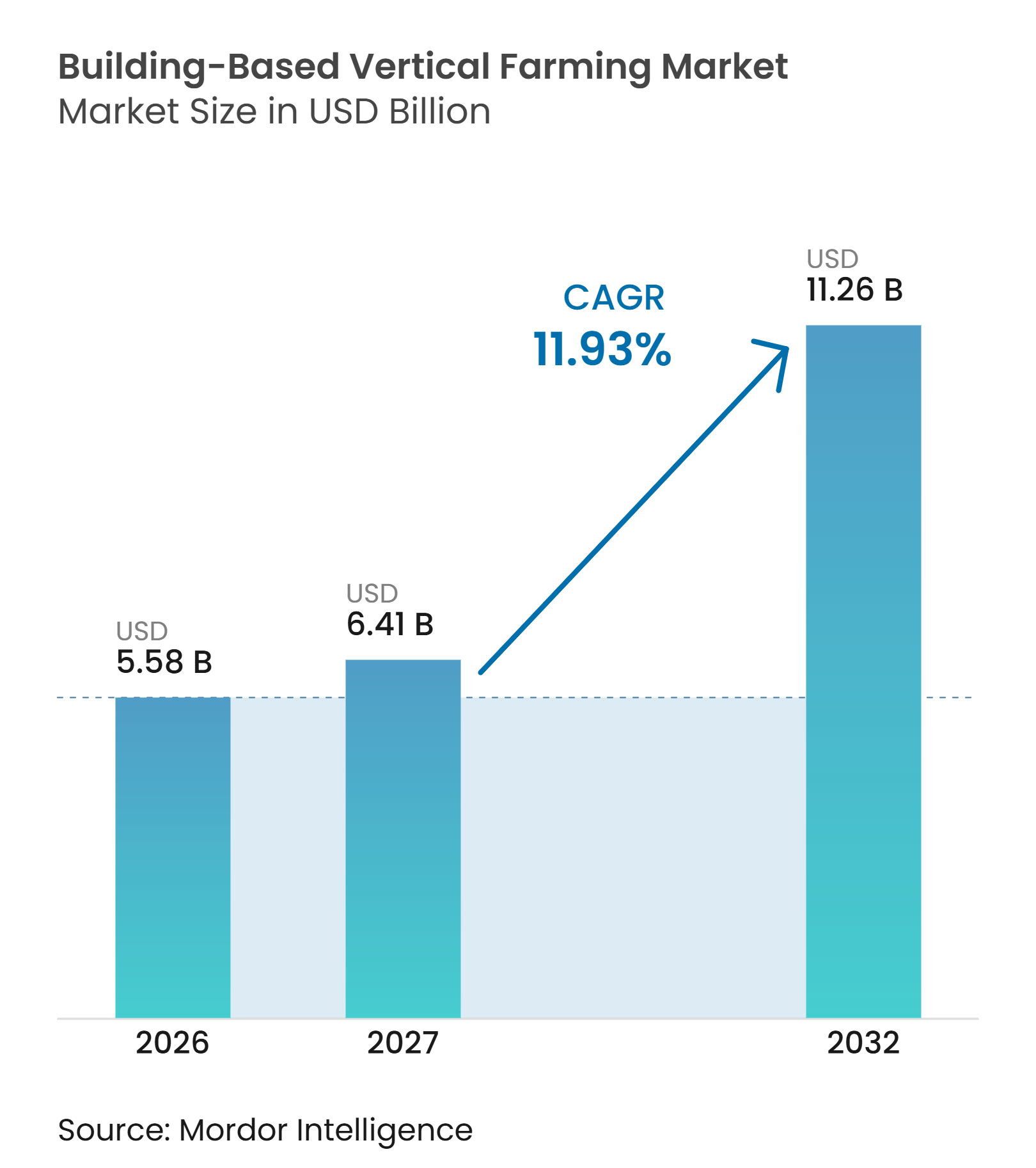
The building-based vertical farming market size was valued at USD 5.58 billion in 2026 and is forecast to grow from USD 6.41 billion in 2027 to USD 11.26 billion by 2032, at a CAGR of 11.93% from 2027 to 2032. Urban growth is concentrating demand near retail and food-service outlets, where shorter distribution routes improve product freshness and reduce inventory pressure. Climate disruption is making consistent, local production more valuable in regions where heat, water stress, or transport disruptions affect conventional supply. Public food-security programs and falling equipment costs support investment, although capital requirements remain high. Building-based vertical farms can also offer traceability and controlled production conditions that align with certain retail and food-service procurement requirements. Commercial performance depends on factors such as energy costs, crop selection, facility utilization, and achievable selling prices.
Key Report Takeaways
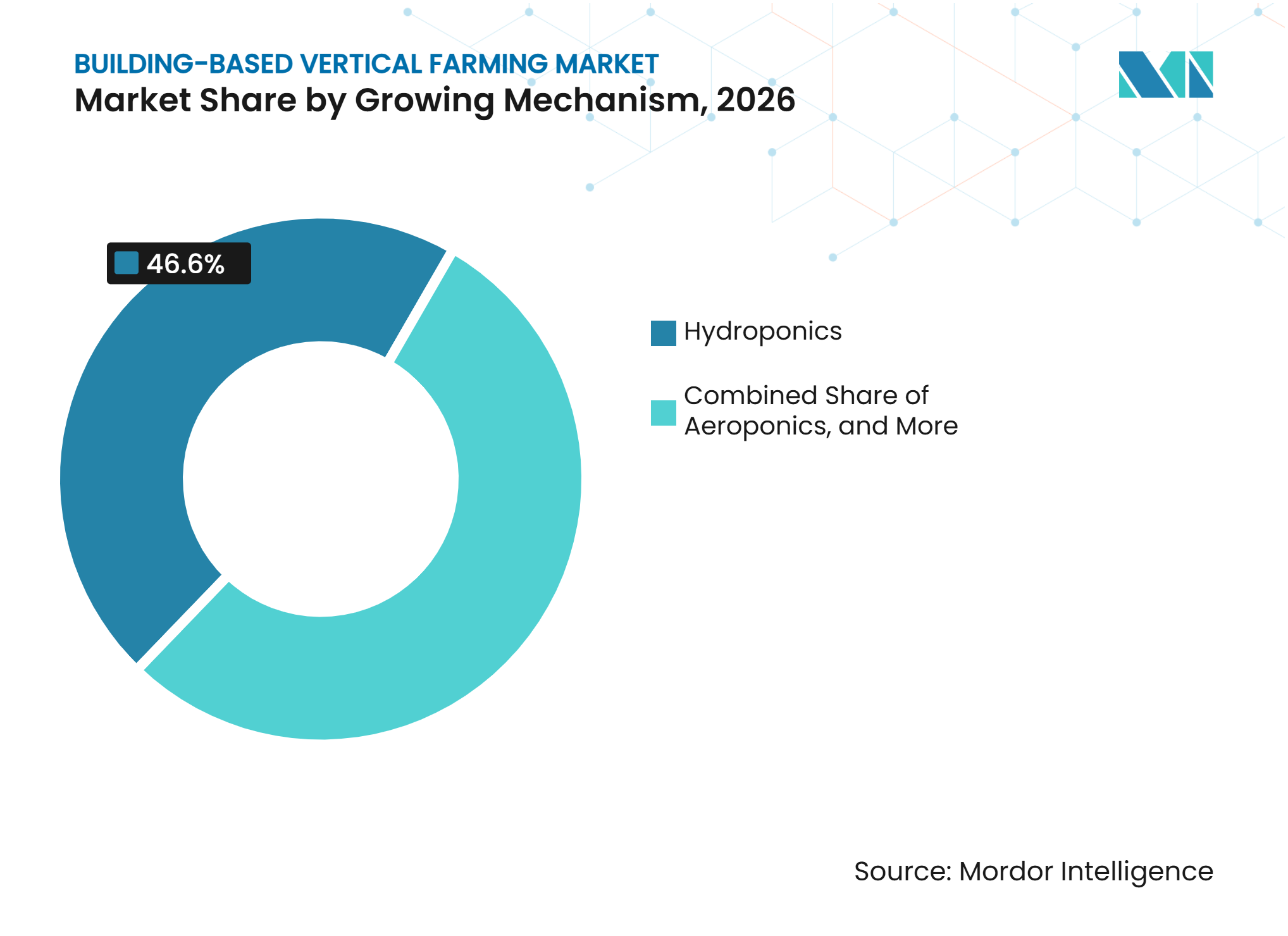
- By growing mechanism, hydroponics accounted for 46.6% of the building-based vertical farming market share in 2026, while aeroponics is forecast to grow at a CAGR of 14.8% from 2027 to 2032.
- By farm structure, purpose-built buildings accounted for 65.0% of the building-based vertical farming market size in 2026 and are forecast to grow at a CAGR of 15.2% from 2027 to 2032.
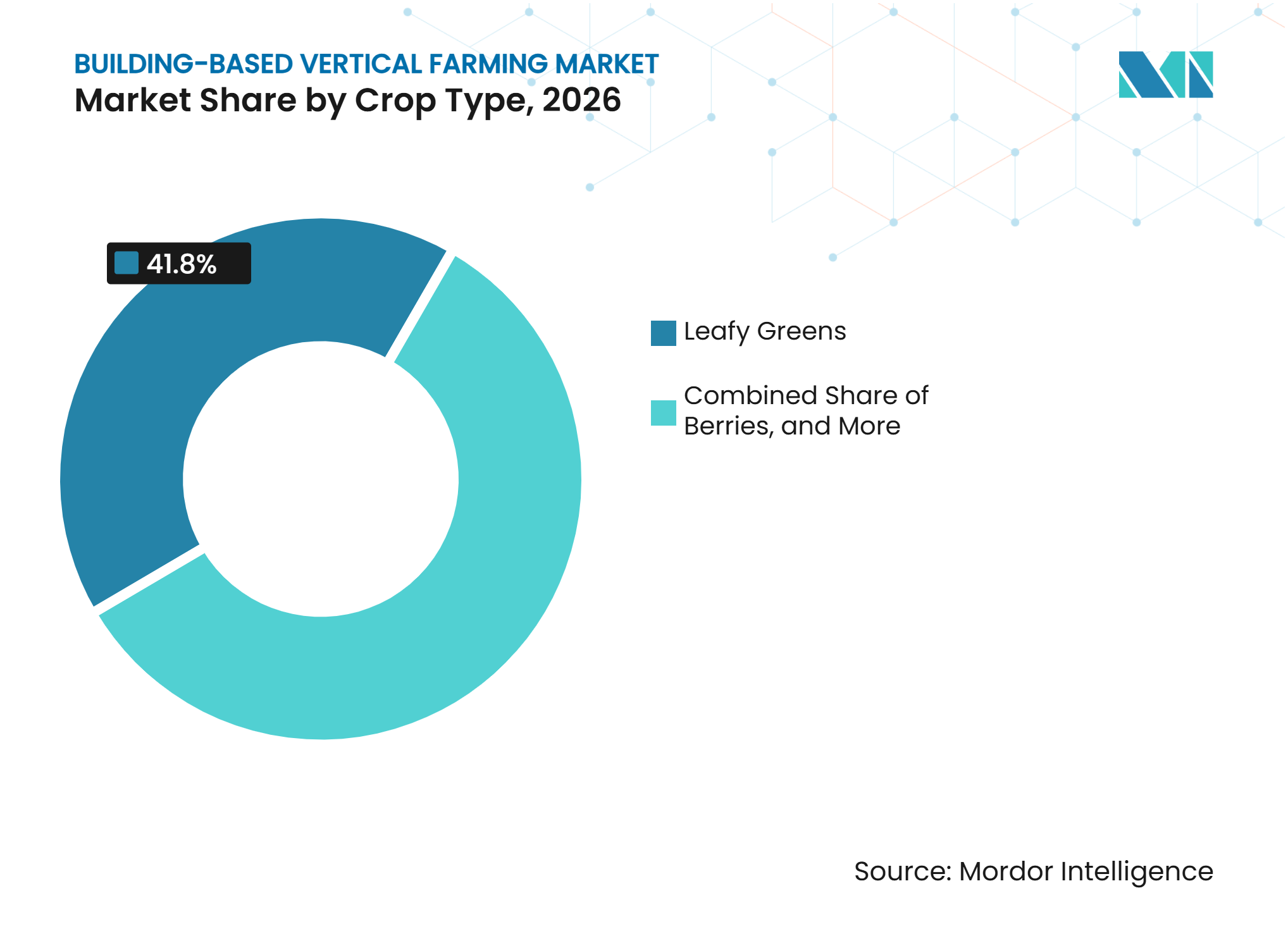
- By crop type, leafy greens accounted for 41.8% of the market share in 2026, while berries are forecast to grow at a CAGR of 15.1% from 2027 to 2032.
- By geography, North America accounted for 38.0% of market share in 2026, while the Middle East is forecast to be the fastest-growing region, at a CAGR of 13.1% from 2027 to 2032.
Note: Market numbers in this report are based on Mordor Intelligence's proprietary estimation framework, which combines nine months of actuals with Q4 projections for base year 2026.
Market Trends and Insights
Drivers Impact Analysis of Building-Based Vertical Farming Market*
| Driver | (~) % Impact on CAGR Forecast | Geographic Relevance | Impact Timeline |
|---|---|---|---|
| Rising Urban Demand for Locally Grown Produce | +3.2% | Global, with highest intensity in North America, Europe, and Asia | Short term (≤ 2 years) |
| Improving LED Efficiency and Lighting Optimization | +2.8% | Global | Medium term (2-4 years) |
| Demand for Climate-Resilient, Year-Round Production | +2.5% | Global, highest in Western Asia, Africa, and Asia | Short term (≤ 2 years) |
| Government Food-Security Initiatives and AgTech Funding | +2% | Asia, Western Asia, North America, and South America | Medium term (2-4 years) |
| Carbon-Credit and ESG Premium Revenue Stacking | +1.5% | Europe and North America | Long term (≥ 4 years) |
| Integration of Waste Heat and Low-Cost Energy Sources | +1.2% | North America, Europe, and Asia | Long term (≥ 4 years) |
| Source: Mordor Intelligence | |||
Rising Urban Demand for Locally Grown Produce
Urban proximity gives the building-based vertical farming market a quality and logistics advantage by enabling fresh produce to reach retailers and consumers more quickly. Shorter transport distances can help extend shelf life, reduce product markdowns, and lower retailers' safety-stock requirements. A report by the Food and Agriculture Organization of the United Nations and the European Bank for Reconstruction and Development also highlighted the role of fully controlled building-based environments in high-tech commercial urban farming[1]. As retailers increasingly seek reliable supplies of fresh, locally grown produce, building-based vertical farms can benefit from proximity to urban consumption centers, consistent product quality, and shorter distribution chains.
Improving LED Efficiency and Lighting Optimization
Advances in LED lighting technology are improving the operating economics of the building-based vertical farming market by reducing energy consumption and enabling more precise control over crop growth conditions. A review published in Sustainability in 2025 found that high-efficiency LED systems can reduce energy consumption by 30% to 50% compared with traditional high-pressure sodium lamps, with payback periods of two to three years under standard operating conditions[2]. Dynamic LED systems also allow growers to adjust light intensity and spectral composition to meet crop-specific requirements. Research published in Scientific Reports in 2025 demonstrated that optimizing LED light spectra can support crop growth in controlled-environment vertical farms [3]. In the United States, the Department of Energy estimates that wider adoption of LEDs could reduce annual energy use for indoor horticultural lighting by 34% and generate USD 350 million in industry-wide savings. These efficiency gains can help vertical farm operators manage electricity expenses and improve facility economics, particularly in energy-intensive indoor production environments.
Demand for Climate-Resilient, Year-Round Production
The building-based vertical farming market benefits from the ability to maintain production under controlled conditions, reducing dependence on outdoor weather patterns and seasonal growing cycles. Indoor facilities can limit exposure to extreme temperatures, certain pests, and external environmental contaminants while supporting more consistent year-round supplies of fresh produce. Research published in Philosophical Transactions of the Royal Society B: Biological Sciences examined urban vertical farming as a potential approach to addressing food production challenges under changing environmental conditions. These efforts support interest in production systems that can improve supply consistency, particularly in regions facing heat stress, water scarcity, or limited agricultural land. As climate-related disruptions increase uncertainty in conventional fresh-produce supply chains, building-based vertical farming offers an alternative for producing selected crops year-round.
Government Food-Security Initiatives and AgTech Funding
Government initiatives can support the building-based vertical farming market by providing grants, technical assistance, and funding for controlled-environment agriculture and smart-farming technologies. In the United States, the Department of Agriculture supports urban agriculture through its Urban Agriculture and Innovative Production Grant Program, while other programs may aid with eligible energy-efficiency improvements. South Korea allocated KRW 11.7 billion (USD 8.4 million) to its K-Vertical Farm Globalization Project for modular farm models and smart-farming exports. The United Nations Development Programme identified food-security strategies and land-use planning as key tools for unlocking private co-investment. Such initiatives can help reduce barriers to technology adoption and encourage private investment, particularly in regions seeking to strengthen domestic fresh-produce supplies and reduce reliance on imports.
Restraints Impact Analysis of Building-Based Vertical Farming Market*
| Restraint | (~) % Impact on CAGR Forecast | Geographic Relevance | Impact Timeline |
|---|---|---|---|
| High Electricity Consumption and Capital Intensity | -2.5% | Global | Short term (≤ 2 years) |
| Limited Range of Economically Viable Crops at Commercial Scale | -1.8% | Global | Medium term (2-4 years) |
| Tighter Lending and Investment Conditions Following Sector Failures | -1.2% | North America and Europe | Short term (≤ 2 years) |
| Rising Insurance Costs and Food-Safety Risks | -0.9% | North America and Europe, with spillover to Asia | Medium term (2-4 years) |
| Source: Mordor Intelligence | |||
High Electricity Consumption and Capital Intensity
Electricity consumption and upfront investment requirements remain significant restraints on the building-based vertical farming market. Artificial lighting accounts for a substantial share of energy use in fully controlled indoor farms, while heating, ventilation, and air conditioning (HVAC) systems add to operating expenses. A review published in Agronomy for Sustainable Development in 2025 found that indoor production remains more energy-intensive than greenhouse production, even with the adoption of high-efficiency LED lighting. Purpose-built sites also require specialized electrical systems, HVAC equipment, structural reinforcement, and automation before production begins. The building-based vertical farming market, therefore, requires careful power procurement and crop pricing to protect margins. High upfront capital requirements can also limit access to financing, particularly for operators that have yet to demonstrate consistent commercial performance.
Limited Range of Economically Viable Crops at Commercial Scale
The building-based vertical farming market remains concentrated in leafy greens, herbs, microgreens, and selected high-value fruiting crops, as these crops are generally better suited to controlled indoor production systems. Longer growth cycles, taller canopies, and greater space requirements can increase production costs and complicate the cultivation of crops beyond these established categories. Research published in Frontiers in Sustainable Food Systems in 2026 found that longer-cycle and taller-canopy crops pose biophysical challenges that increase per-kilogram production costs. Although expansion into berries, tomatoes, peppers, and flowers can diversify product offerings, these crops may require additional investment, crop-specific infrastructure, and specialized production expertise. The limited range of crops that can be produced competitively at a commercial scale, therefore, constrains market expansion and reduces the suitability of standard vertical farming systems for a broader range of agricultural products.
*Our forecasts treat driver/restraint impacts as directional, not additive. The impact forecasts reflect baseline growth, mix effects, and variable interactions.
Building-Based Vertical Farming Market Segment Analysis
By Growing Mechanism:
Hydroponics Leads While Aeroponics Gains MomentumHydroponics accounted for 46.6% of the building-based vertical farming market share in 2026, making it the leading growing method. Its position reflects commercial experience with nutrient film technique and deep-water culture systems. These systems work well for lettuce, basil, and spinach, which have short cycles and shallow roots. The established installed base supports a broad ecosystem of equipment suppliers and operating knowledge. Aquaponics remains a smaller contributor because managing fish and plant production together adds operational complexity.
Aeroponics is forecast to grow at a CAGR of 14.8% from 2027 to 2032. A review published in Agriculture in 2026 reported that closed-loop aeroponic systems can reduce water use by more than 90% compared with conventional cultivation. The review also reported yield improvements of 45% to 75% compared with soil-based methods, attributing these gains in part to improved root-zone oxygenation through ultrasonic mist delivery. The building-based vertical farming market size for aeroponic systems benefits from the ability to support root crops and medicinal plants at commercial yields. Digital control of misting frequency and nutrient concentration can improve crop-cycle management and resource use.



By Farm Structure:
Purpose-Built Facilities Support Scale and EfficiencyPurpose-built buildings accounted for 65.0% of the building-based vertical farming market share in 2026 and are forecast to grow at a CAGR of 15.2% from 2027 to 2032. They can be designed around crop mix, racking geometry, airflow, energy distribution, and automation-compatible aisle widths. These features can improve yields per square meter compared with structures first designed for logistics or manufacturing. The configuration allows developers to address stacking loads and HVAC requirements before construction is complete. Purpose-built projects require larger initial investments but can create better long-term operating conditions.
Planet Farms Holding S.p.A.’s Cirimido facility was built for EUR 62.5 million (USD 67.5 million) and reached positive EBITDA in 2026 while producing 90,000 packs per day. Its performance provides a commercial example of the purpose-built model. Repurposed warehouses offer lower initial construction costs and faster deployment for operators testing local demand. They have been common near urban freight corridors in the United States and the United Kingdom. The building-based vertical farming market still faces lower ceiling clearance and more extensive HVAC retrofit needs in warehouse structures.
By Crop Type:
Leafy Greens Lead While Berries Offer Faster GrowthLeafy greens accounted for 41.8% of the building-based vertical farming market share in 2026. Their 20- to 30-day cultivation cycles support high turnover per square meter and meet established retail demand. Herbs were the second-largest revenue contributor because food-service buyers value their high price per gram relative to the space required. Tomatoes, peppers, and other fruiting crops can be produced in advanced facilities but need a longer period to reach profitability. This crop mix positions the building-based vertical farming market around fast-cycle products with predictable demand.
Berries are forecast to grow at a CAGR of 15.1% from 2027 to 2032, the fastest rate among crop types. Oishii expanded to 18 U.S. states and introduced berry lines priced from USD 4.99 to USD 15. The example indicates that premium berries can reach mainstream retail distribution when quality and pricing support consumer demand. Microgreens are high-value additions with fast production cycles, while flowers and ornamentals attract interest in Japan and the Netherlands. The building-based vertical farming market benefits when these categories reduce dependence on commodity leafy greens.

Geography Analysis
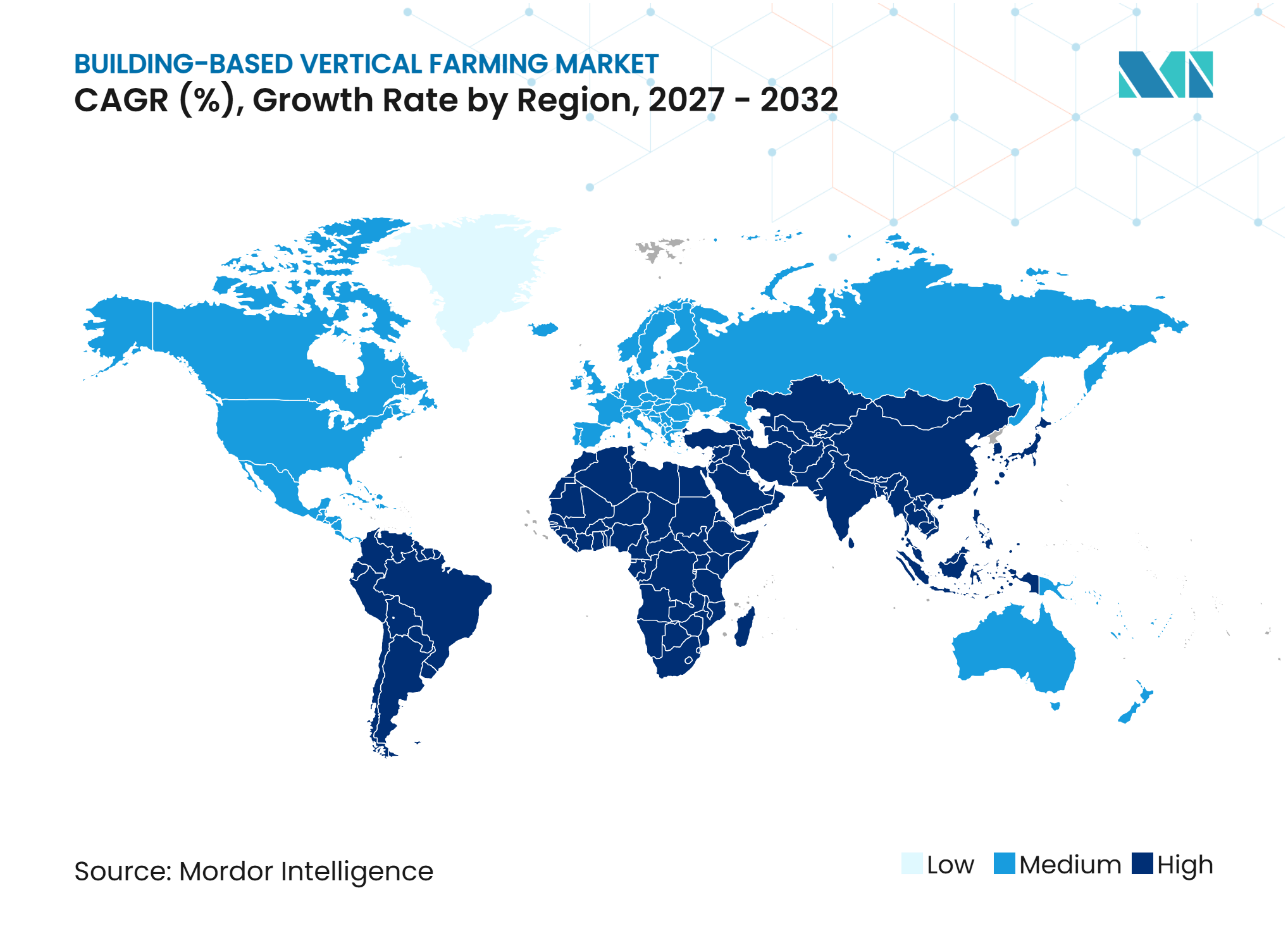
North America accounted for 38.0% of the building-based vertical farming market share in 2026, supported by an established commercial ecosystem and investment in purpose-built indoor farming facilities. Government initiatives supporting urban agriculture and innovative production may further encourage market development. Europe is also advancing through investments in commercial vertical farming projects, including a joint venture between Planet Farms and Swiss Life Asset Managers that plans to support regional expansion. Meanwhile, Russia and Oceania present additional opportunities as operators target urban consumers and food-service customers seeking consistent supplies of fresh produce.
The Middle East is forecast to be the fastest-growing region in the building-based vertical farming market, at a CAGR of 13.1% from 2027 to 2032. High summer temperatures, water scarcity, and dependence on food imports are driving interest in controlled-environment food production. Food-security strategies across Gulf Cooperation Council countries are also creating opportunities for investment in building-based vertical farming facilities. Africa is another emerging market, supported by urban population growth and rising demand for fresh produce, although energy infrastructure constraints continue to affect project economics in several sub-Saharan countries.
Asia-Pacific's building-based vertical farming market is supported by government initiatives and investments in indoor farming technologies. South Korea has eased regulations for vertical farms in certain agricultural and industrial settings and funded its K-Vertical Farm Globalization Project, supporting domestic technology development and export capacity. South America is also gaining traction as urban agriculture initiatives and demand for locally produced fresh food create opportunities for controlled-environment farming. However, market development will depend on investment in infrastructure and the commercial viability of building-based facilities.
Competitive Landscape
Market Concentration
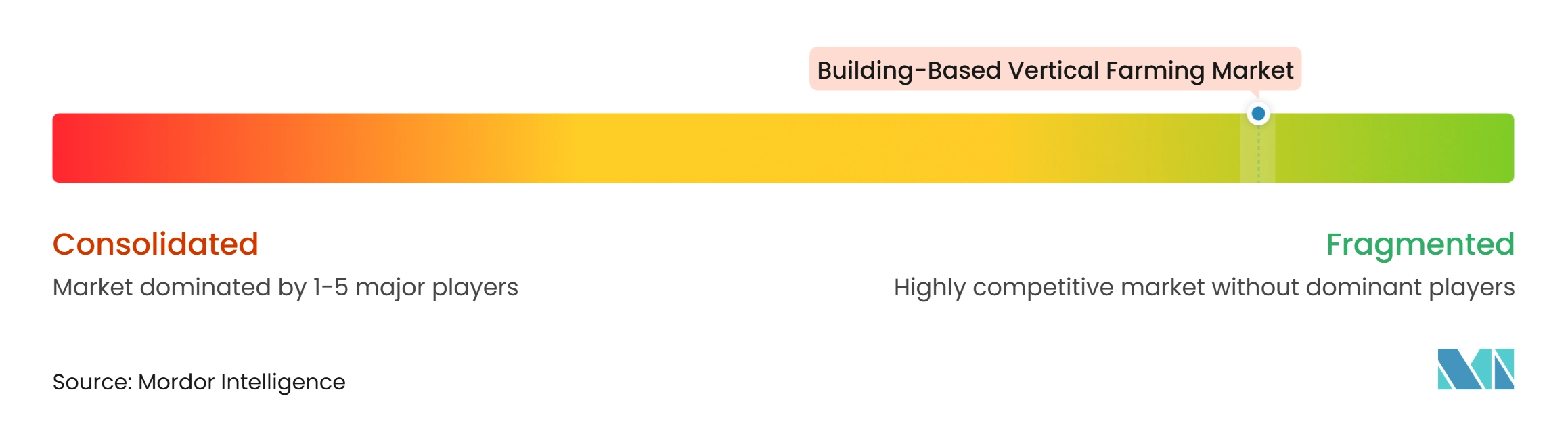
The building-based vertical farming market is highly fragmented in 2026, with competition spread across farm operators and technology providers specializing in horticultural lighting, climate control, fertigation, automation, and farm management systems. Major players include Signify N.V., Planet Farms Holding S.p.A., GrowUp Farms Limited, Oishii Farm Corporation, and AeroFarms LLC. Companies are focusing on automation, proprietary technologies, and operational efficiency to reduce labor costs and improve crop yields. Technology providers differentiate themselves through lighting systems, integrated control platforms, and solutions that support consistent crop production.
Oishii Farm Corporation acquired Tortuga AgTech's intellectual property, assets, and engineering team in March 2025 to expand its robotics-assisted harvesting capabilities. The company targeted a 50% reduction in strawberry-harvesting costs by integrating AI-driven robotics. This move highlights the role of automation in addressing labor costs in commercial vertical farming. In March 2025, 80 Acres Farms acquired three indoor farms from Kalera, expanding its footprint across Georgia, Texas, and Colorado and integrating the facilities into its GroLoop platform. These acquisitions demonstrate how operators are using technology and facility expansion to strengthen their operations.
Opportunities remain in crop-neutral farm operating systems and energy co-location models that improve facility economics. The Legendary Harvest Project in North Dakota is evaluating the use of data-center waste heat for controlled-environment food production. Such approaches could help reduce energy costs, which remain a key operating challenge for building-based vertical farms. Competition is likely to focus on operational reliability, energy efficiency, crop selection, automation, and customer relationships rather than market-share concentration.
Building-Based Vertical Farming Industry Leaders
-
Signify N.V.
-
Planet Farms Holding S.p.A.
-
GrowUp Farms Limited
-
Oishii Farm Corporation
-
AeroFarms LLC
- *Disclaimer: Major Players sorted in no particular order
Building-Based Vertical Farming Market Companies Covered in this Report
- Oishii Farm Corporation
- GrowUp Farms Limited
- Planet Farms Holding S.p.A.
- Intelligent Growth Solutions Limited
- Urban Crop Solutions BV
- Signify N.V.
- Heliospectra AB
- AeroFarms LLC
- LettUs Grow Ltd.
- Intravision Group AS
- AGEYE Technologies Inc.
- UrbanKisaan
- Alta-CEA Innovations Inc.
- SPREAD Co., Ltd.
Recent Industry Developments in Building-Based Vertical Farming Market
- April 2025: Planet Farms Holding S.p.A. and Swiss Life Asset Managers established a joint venture to develop indoor vertical farming facilities in Europe, with Swiss Life Asset Managers committing up to EUR 125 million in growth capital.
- March 2025: LettUs Grow Ltd. and KG Systems established a global distribution partnership to integrate LettUs Grow’s Advanced Aeroponics technology into KG Systems’ greenhouse and vertical farming projects. The agreement added LettUs Grow’s Aeroponic Rolling Bench systems to KG Systems’ product portfolio, with deployment across multiple hectares targeted for 2026.
- March 2025: Oishii Farm Corporation acquired key intellectual property, assets, and members of the engineering team from Tortuga AgTech to strengthen its robotic harvesting capabilities. The integration of AI models, robotics software, and custom hardware aims to improve harvesting efficiency and reduce strawberry harvesting costs by 50%.
Global Building-Based Vertical Farming Market Report Scope
The building-based vertical farming market refers to the commercial cultivation of crops in vertically stacked layers within enclosed buildings using controlled-environment technologies to regulate lighting, temperature, humidity, and nutrient delivery.
The Building-Based Vertical Farming Market Report is Segmented by Growing Mechanism (Hydroponics, Aeroponics, and Aquaponics), by Farm Structure (Purpose-Built Buildings and Repurposed Buildings), by Crop Type (Leafy Greens, Herbs, Tomatoes, Berries, Peppers, Microgreens, Flowers and Ornamentals, and Others), and by Geography (North America, South America, Europe, Asia-Pacific, Middle East, and Africa). The Market Forecasts are Provided in Terms of Value (USD).
Segmentation Overview
| Hydroponics |
| Aeroponics |
| Aquaponics |
| Purpose-Built Buildings |
| Repurposed Buildings |
| Leafy Greens |
| Herbs |
| Tomatoes |
| Berries |
| Peppers |
| Microgreens |
| Flowers and Ornamentals |
| Others |
| By Growing Mechanism | Hydroponics |
| Aeroponics | |
| Aquaponics | |
| By Farm Structure | Purpose-Built Buildings |
| Repurposed Buildings | |
| By Crop Type | Leafy Greens |
| Herbs | |
| Tomatoes | |
| Berries | |
| Peppers | |
| Microgreens | |
| Flowers and Ornamentals | |
| Others |
Key Questions Answered in the Report
What is the forecasted value of the building-based vertical farming market?
The market is forecast to reach USD 11.26 billion by 2032, growing at a CAGR of 11.93% from 2027 to 2032.
Which growing mechanism accounts for the largest market share?
Hydroponics accounted for 46.6% of the market share in 2026, supported by its established use in controlled-environment production.
Which crop type is forecast to grow the fastest?
Berries are forecast to grow at a 15.1% CAGR from 2027 to 2032, supported by premium retail positioning and investment in automation.
Which region has the fastest forecast growth?
The Middle East is forecast to be the fastest-growing region, at a CAGR of 13.1% from 2027 to 2032