
Brine Concentration Minerals Market Size and Share
Market Overview
| Study Period | 2022 - 2032 |
|---|---|
| Market Size (2027) | USD 1.48 Billion |
| Market Size (2032) | USD 2.20 Billion |
| Growth Rate (2027 - 2032) | 8.37 % |
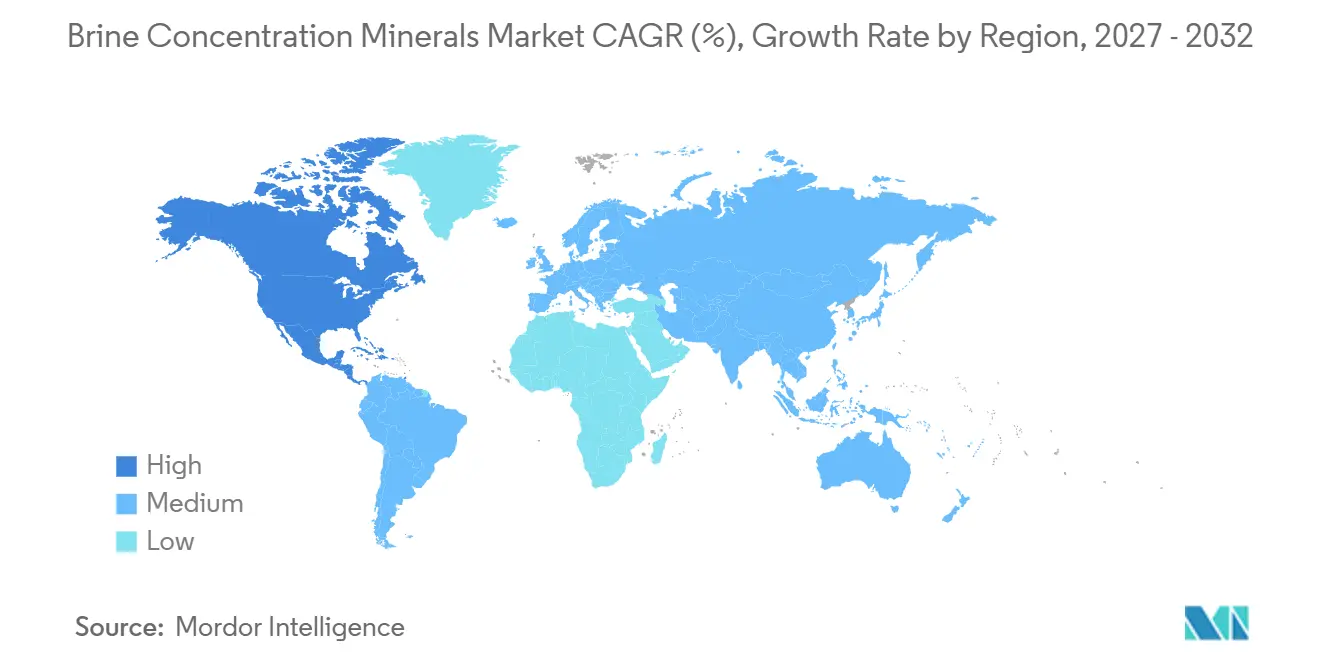
| Fastest Growing Market | North America |
| Largest Market | Asia-Pacific |
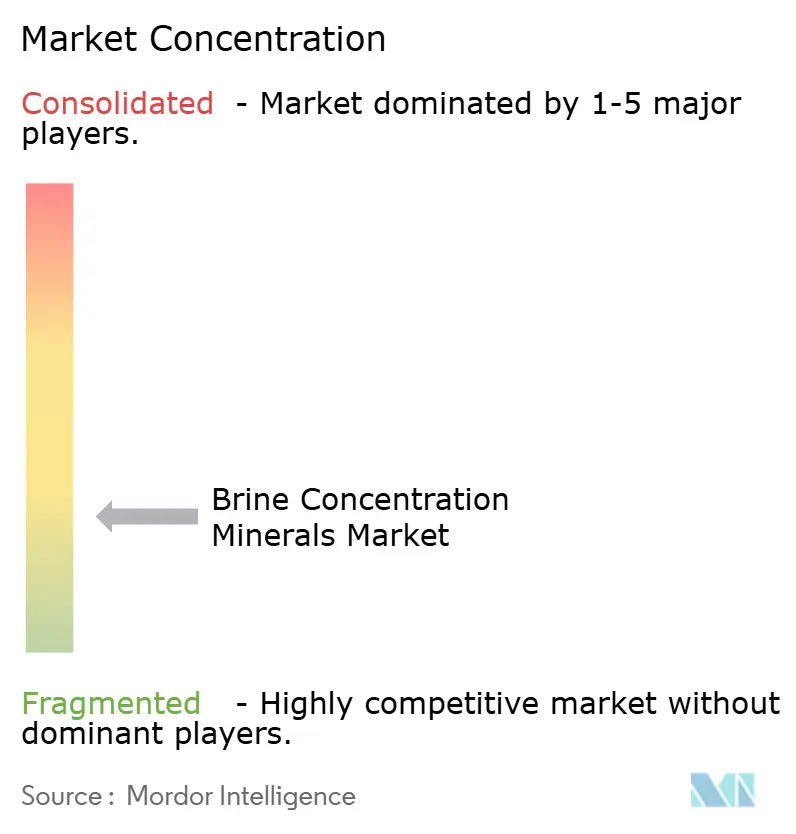
| Market Concentration | Low |
Major Players *Disclaimer: Major Players sorted in no particular order Image © Mordor Intelligence. Reuse requires attribution under CC BY 4.0. | |
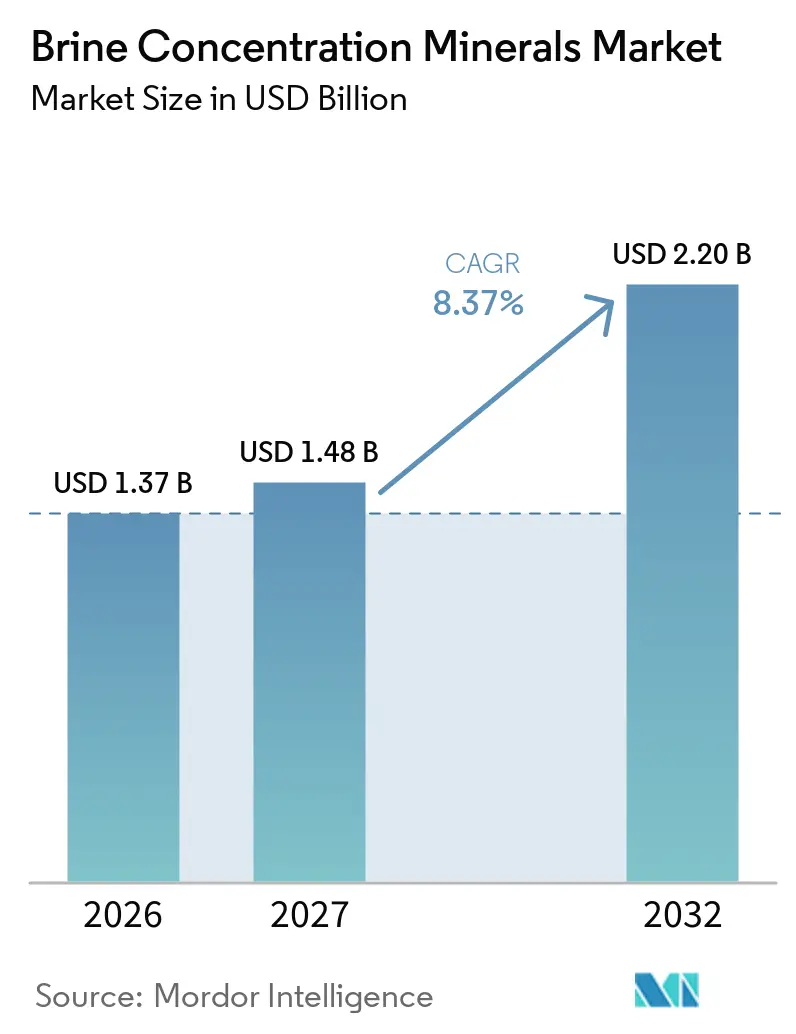
Brine Concentration Minerals Market Analysis by Mordor Intelligence
The Brine concentration minerals market size was valued at USD 1.37 billion in 2026 and is estimated to grow from USD 1.48 billion in 2027 to USD 2.20 billion by 2032, at a CAGR of 8.37% during the forecast period (2027-2032). The brine concentration minerals market is supported by rising demand for battery-grade lithium, expanding desalination capacity, and policies that favor domestic critical mineral supply chains. The market is moving beyond conventional potash and sodium chloride recovery toward a model that produces derivatives of lithium, magnesium, potassium, and calcium from the same resource base. This broader product mix links brine resources with battery materials, agriculture, water treatment, and metallurgical applications. Regulatory support in the United States, Europe, and Chile improves the commercial case for qualifying projects, while low lithium prices delay final investment decisions for capital-intensive developments. The market, therefore, favors operators that combine resource quality, processing flexibility, and existing infrastructure.
Key Report Takeaways
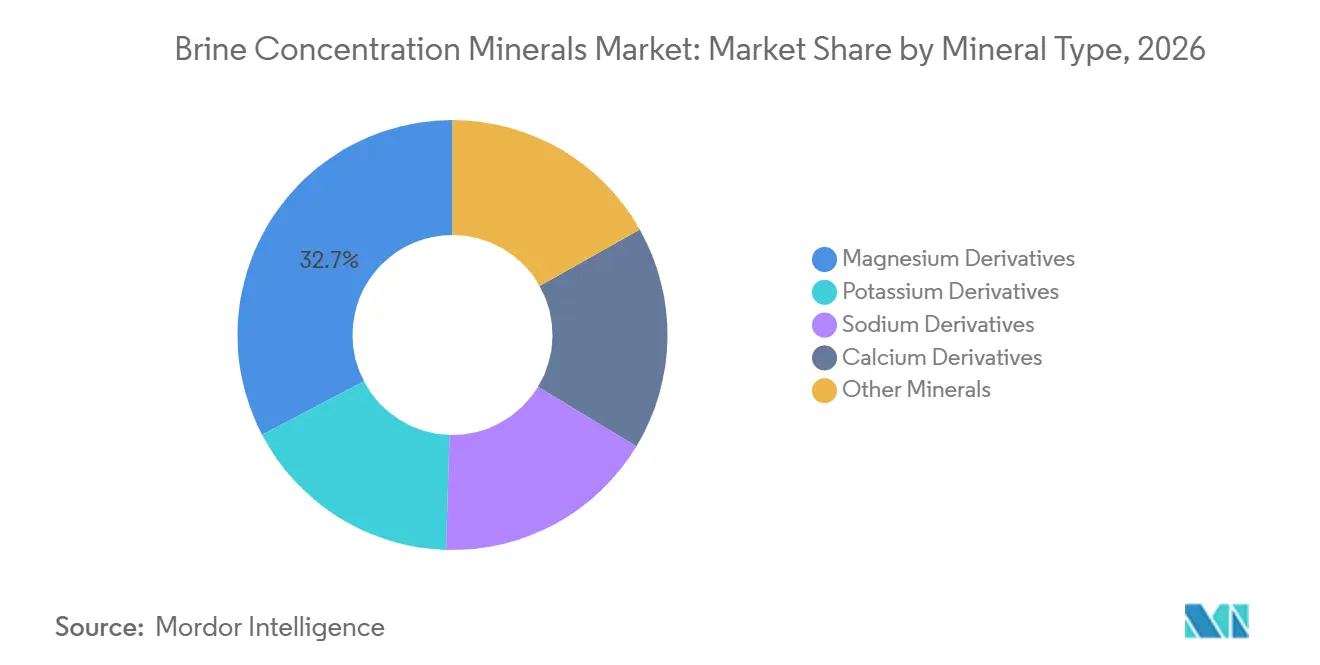
- By mineral type, magnesium derivatives held 32.67% market share in 2026 and are forecast to grow at an 8.91% CAGR through 2032.
- By technology, solar evaporation accounted for 38.58% of the market share in 2026, while nanofiltration, reverse osmosis, and microfiltration are forecast to grow at an 8.95% CAGR through 2032.
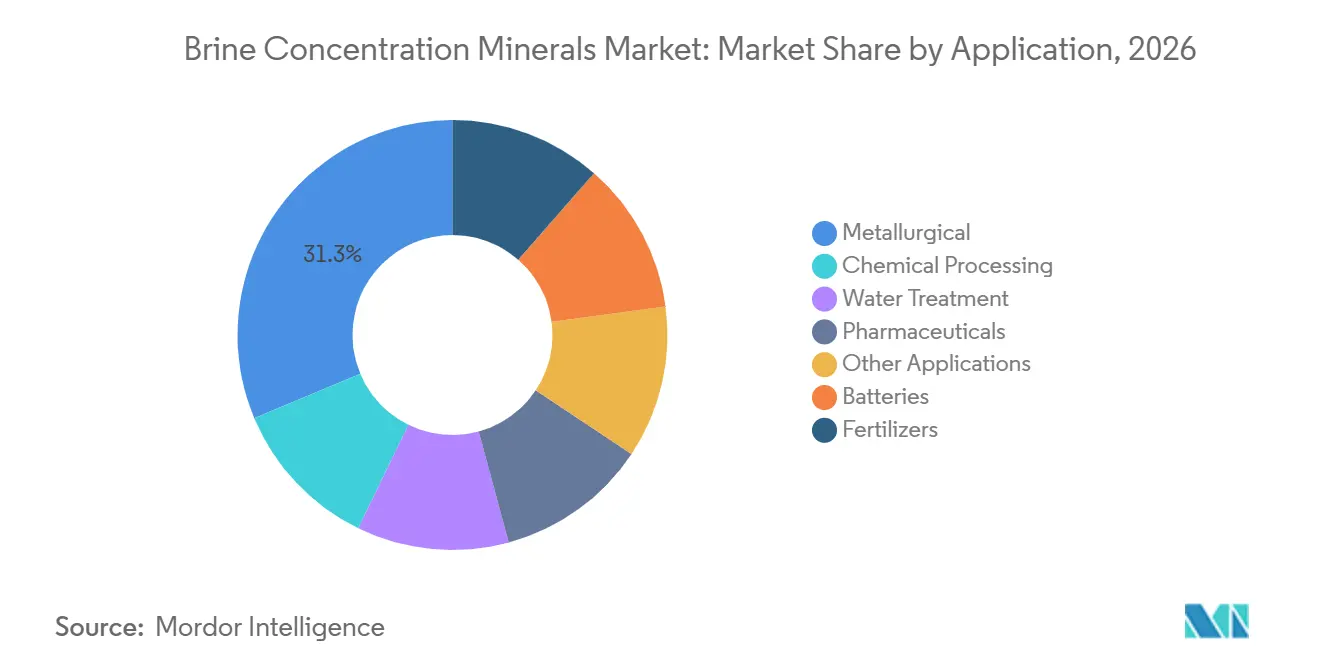
- By application, metallurgical accounted for 31.32% of the market share in 2026, while water treatment is forecast to grow at a 9.34% CAGR through 2032.
- By geography, Asia-Pacific held 36.91% market share in 2026, while North America is forecast to grow at a 9.12% CAGR through 2032.
Note: Market numbers in this report are based on Mordor Intelligence's proprietary estimation framework, which combines nine months of actuals with Q4 projections for base year 2026.
Market Trends and Insights
Drivers Impact Analysis of Brine Concentration Minerals Market*
| Drivers | (~) % Impact on CAGR Forecast | Geographic Relevance | Impact Timeline |
|---|---|---|---|
| Battery-Grade Lithium Supply Requirements | +2.80% | Global, led by North America, Asia-Pacific, and South America | Short term (≤ 2 years) |
| Desalination and Industrial Brine Resource Recovery | +1.90% | Middle East and Africa, Asia-Pacific, and Europe | Medium term (2-4 years) |
| Critical-Mineral Supply-Chain Localization | +1.50% | North America, Europe, and Australia | Medium term (2-4 years) |
| Agricultural Demand for Potassium and Magnesium Derivatives | +1.20% | Global, with concentrated demand in Asia-Pacific and South America | Long term (≥ 4 years) |
| Brine-to-Product Integration With Existing Energy and Mining Assets | +0.70% | North America, Europe, and South America | Medium term (2-4 years) |
| Source: Mordor Intelligence | |||
Battery-Grade Lithium Supply Requirements Drive Brine Asset Valuations
Long-term battery supply requirements continue to shape investment in brine resources. The International Energy Agency (IEA) projects that primary lithium supply requirements will reach 440 kt by 2030 and 846 kt by 2040. The brine concentration minerals market benefits from this outlook, as large brine deposits can support lithium recovery alongside other mineral products. China announced export controls affecting parts of the lithium-ion battery supply chain in 2025, reinforcing concerns about concentrated supply and supporting project activity in North America and Europe. The United States Geological Survey (USGS) identified the Smackover Formation as potentially containing 5 million to 19 million tons of lithium, while the 2025 U.S. critical minerals list includes lithium, magnesium, and potash. Large resources alone do not guarantee supply, as projects must also secure processing systems, permits, customers, and financing. This creates opportunities for brine projects that pair direct lithium extraction with recoverable co-products.
Desalination and Industrial Brine Resource Recovery as a Circular Economy Lever
Desalination plants generate concentrated brine streams that can be treated as mineral feedstocks rather than disposal streams. A 2025 study found that recovering major ions from a 100,000 m³-per-day seawater reverse osmosis plant could produce 3.8 million tons of salts each year under favorable recovery conditions. The Sea4Value initiative published CWA 18153 in January 2025, establishing a framework for recovering minerals from seawater desalination brines via evaporation, membrane separation, and electrochemical processes. The brine concentration minerals market can draw on this feedstock base in water-scarce regions where desalination capacity and mineral-rich brines overlap. DuPont stated that its FilmTec membranes can concentrate brines to 220 g/L, enabling pre-concentration prior to thermal crystallization. This approach can reduce land requirements compared with large evaporation ponds and may improve the economics of downstream recovery in the brine concentration minerals market.
Critical-Mineral Supply-Chain Localization Reshapes Investment Flows
The March 2025 U.S. executive action on mineral production directed agencies to support domestic mineral development. U.S. Section 232 actions issued in April 2025 also focused attention on processed critical minerals and derivative products. Chilean authorities authorized additional lithium production quotas for SQM and Codelco-related operations during 2025. The European Commission designated 47 Strategic Projects under the Critical Raw Materials Act in 2025, including 22 projects targeting lithium[1]. The brine concentration minerals market can benefit from shorter permitting timelines, access to financing, and preferred customer relationships when a project qualifies for domestic or strategic status.
Agricultural Demand for Potassium and Magnesium Derivatives Provides a Stable Base
The USGS 2025 outlook points to continued potash demand, supporting brine-derived potassium and magnesium products even as lithium prices weaken. Specialty fertilizers containing magnesium sulfate are relevant in high-value crop production, where soil nutrient management supports demand for multi-nutrient products. Producers in the brine concentration minerals market can use product quality, reliability, and organic-channel eligibility to differentiate sulfate of potash offerings. Solar evaporation can link brine recovery with crop nutrition and create recurring sales channels for integrated producers. The brine concentration minerals market has a more stable base when producers can sell agricultural products alongside battery and industrial materials, which can also reduce dependence on a single mineral price in investment decisions.
Restraints Impact Analysis of Brine Concentration Minerals Market*
| Restraints | (~) % Impact on CAGR Forecast | Geographic Relevance | Impact Timeline |
|---|---|---|---|
| Low Mineral Concentration and Complex Impurity Profiles | -1.30% | South America, Asia-Pacific, and North America | Medium term (2-4 years) |
| High Capital, Energy, and Reagent Requirements | -1.10% | Global, most acute in North America and Europe, for direct lithium extraction projects | Long term (≥ 4 years) |
| Brine Reinjection and Aquifer-Impact Uncertainty | -0.60% | South America and North America | Long term (≥ 4 years) |
| Source: Mordor Intelligence | |||
Low Mineral Concentration and Complex Impurity Profiles Challenge Unit Economics
The composition of a brine can limit its commercial value because recoverable minerals, impurities, and water chemistry vary across formations. A 2025 study found that calcium chloride and magnesium chloride can reduce the performance of three-dimensional solar evaporators by blocking internal water transport channels. High magnesium-to-lithium ratios in many South American salars require additional selective separation before lithium can reach battery-grade purity. A 2025 review concluded that no single extraction technology is economical for every brine type at a commercial scale. Resource characterization, process flexibility, reinjection planning, and aquifer monitoring therefore remain central to project development in the brine concentration minerals market. These requirements can increase early development costs and extend the timeline from exploration to production.
Capital, Energy, and Reagent Intensity Constraints on Project Financing at Scale
The Southwest Arkansas feasibility study, published in September 2025, estimated USD 1.45 billion in capital expenditure for an initial phase producing 22,500 tons per year of battery-quality lithium carbonate, equivalent to USD 64,000 per ton of annual production capacity. A U.S. Department of Energy technical report found that bipolar membrane electrodialysis can lose efficiency over time due to membrane wear. Thermal crystallization and forced evaporation can add further energy costs in the brine concentration minerals market, particularly in colder or high-altitude locations. Eramet reported that its Centenario direct lithium extraction process achieved 90% lithium recovery in one week, compared with 12 to 18 months for conventional solar evaporation. The brine concentration minerals market faces financing constraints, as advanced systems require a large upfront investment during periods of lower lithium prices.
*Our forecasts treat driver/restraint impacts as directional, not additive. The impact forecasts reflect baseline growth, mix effects, and variable interactions.
Brine Concentration Minerals Market Segment Analysis
By Mineral Type:
Magnesium Derivatives Lead Both Share and GrowthMagnesium derivatives held 32.67% of the brine concentration minerals market share in 2026 and are forecast to expand at an 8.91% CAGR from 2027 to 2032. Their position reflects use across pharmaceutical-grade magnesium oxide, construction-grade magnesium chloride, agricultural magnesium sulfate, and cast magnesium production. The projected growth rate also reflects demand for lighter vehicle components and the broader use of magnesium compounds in water treatment. Magnesium derivatives give the brine concentration minerals market exposure to several end uses rather than dependence on a single commodity cycle.
Potassium derivatives remain important because fertilizer consumption creates recurring demand. The USGS expects continued potash demand in 2026, and brine remains a low-cost source for sulfate of potash in suitable deposits. Sodium derivatives provide the market with industrial salt, a soda ash precursor, and de-icing applications, which generate large output but slower growth. Calcium derivatives are used in road maintenance, oil and gas well servicing, and food processing. Other minerals include bromine and lithium, which can improve the economics of mature brine resources when recovered as co-products. The brine concentration minerals industry benefits when operators use these multiple product pathways to balance price cycles.

By Technology:
Solar Evaporation Holds Scale and Membranes Lead GrowthSolar evaporation accounted for 38.58% of revenue in 2026, as large installations have operated for decades at the Dead Sea and in the Atacama. Israel Chemicals Limited (ICL) stated that Dead Sea Works produces 3.7 million tons of potash annually through solar evaporation. In the brine-concentration minerals market, this method retains a cost advantage when solar conditions, land availability, and brine chemistry are favorable. Research published in 2025 found that interfacial solar evaporation increased evaporation rates by 40% to 122% compared to open ponds in Chilean field pilots. These incremental efficiency gains can sustain the relevance of solar evaporation rather than prompt the immediate replacement of installed assets.
Nanofiltration, reverse osmosis, and microfiltration are forecast to advance at an 8.95% CAGR through 2032. Their growth is linked to zero-liquid-discharge and minimal-liquid-discharge systems that target both water reuse and mineral recovery. DuPont agreed in September 2025 to acquire Sinochem Ningbo RO Memtech, expanding FilmTec manufacturing into China. Osmotically assisted reverse osmosis (OARO) can concentrate brines beyond the pressure limits of standard reverse osmosis. Danfoss reported that Hyrec deployed a large-scale OARO brine-mining plant in Indonesia, increasing the sodium chloride concentration from 8% to 16% by weight. Adsorption-based direct lithium extraction systems provide another route for high magnesium-to-lithium brines.
By Application:
Metallurgical Uses, Anchor Revenue, and Water Treatment Grow FastestThe metallurgical segment accounted for 31.32% of the brine concentration minerals market size in 2026. Magnesium metal and sodium compounds support steel desulfurization, aluminum alloying, and foundry operations. Magnesium remains attractive to vehicle manufacturers because its lower density can reduce component weight, although this end use remains sensitive to commodity pricing. Metallurgical demand provides the market with exposure to established industrial consumption, which is important for sustaining output demand while newer battery-related projects are developed.
Water treatment is forecast to grow at a 9.34% CAGR through 2032, driven by the wider adoption of zero liquid discharge and minimal liquid discharge systems. These systems support the brine concentration minerals market in textiles, chemicals, and power generation, where they recover water while reducing waste brine. DuPont reported that the Foshan Jialida minimal liquid discharge project reclaims 142,000 m³ of water per day and recovers 200 metric tons of Glauber's salt per day. Battery applications are drawing investment as direct lithium extraction projects target battery-grade lithium carbonate and hydroxide. Fertilizers, chemical processing, and pharmaceuticals remain mature outlets for potassium, magnesium, sodium, chlorine, and high-purity magnesium products.
Geography Analysis
Asia-Pacific accounted for 36.91% of revenue in 2026. China's revised Mineral Resources Law, which took effect in July 2025, placed lithium within an independent strategic mineral category and centralized licensing approval within the Ministry of Natural Resources, raising compliance requirements for smaller operators. China's salt lake resources remain an important source of regional mineral supply, while Japan and South Korea contribute strong downstream demand through battery cell and cathode supply chains. The brine-concentration minerals market in Asia-Pacific combines large-scale resource activity with close links to downstream processing.
North America is forecast to grow at a 9.12% CAGR through 2032. Arkansas established a 2.50% gross royalty framework for lithium brine units in 2025, covering projects involving ExxonMobil, Smackover Lithium, and TETRA Technologies. In January 2025, the U.S. Department of Energy announced a conditional commitment of USD 1.36 billion for the ATLiS lithium hydroxide project in California. Intrepid Potash also signed a joint development agreement in 2025 to develop a 5,000-ton lithium extraction facility at Wendover, Utah. Adding lithium recovery to established infrastructure at existing brine operations can reduce development risk in the brine-concentration minerals market.
Europe is developing geothermal brine resources under the Critical Raw Materials Act, which sets 2030 benchmarks for domestic extraction and processing. South America retains large salar resources, while Rio Tinto's Rincon project obtained approval under Argentina's Régimen de Incentivo para las Grandes Inversiones (RIGI) investment regime in May 2025 and targets 50,000 tons per year by 2028[2]. In the Middle East and Africa, Dead Sea operations and desalination streams present opportunities to recover magnesium, potassium, and sodium.
Competitive Landscape
The brine concentration minerals market is fragmented, with two broad groups of competitors. ICL, Albemarle, Compass Minerals, and SQM operate long-established brine infrastructure and hold advantages in resource quality, evaporation capacity, and operational experience. Their positions are supported by control over resources such as the Dead Sea, the Atacama, and the Great Salt Lake. Albemarle commissioned a direct lithium extraction pilot at La Negra, Chile, in 2025 and reported more than 3,000 operating hours with lithium recovery above 94%. This demonstrates that established producers can integrate direct lithium extraction with existing evaporation assets.
Technology-focused companies include EnergyX, Sunresin New Materials, Lilac Solutions, and Vulcan Energy. EnergyX completed a pre-feasibility study for its Black Giant project in Chile in September 2025 and reported USD 690 million of investor interest from the U.S. Export-Import Bank. Lilac Solutions announced successful pilot operations on the Great Salt Lake in 2025, adding another reference point for direct lithium extraction in North America. These companies compete on process performance, licensing, and the ability to treat difficult brines. Their projects can attract customers who require lower land use, shorter processing times, or more effective treatment of complex feedstocks.
Oil and gas companies are also reshaping the competitive landscape. ExxonMobil and Equinor bring subsurface expertise, existing brine infrastructure, and greater funding capacity to Arkansas lithium projects. Their entry increases pressure on smaller developers that depend on access to acreage and early project advancement. Co-product recovery from industrial and oilfield produced-water brines remains an opportunity for specialized technology providers, while geothermal brines offer an integrated energy-and-minerals model. The brine concentration minerals market remains open to new entrants, but infrastructure, permits, and customer contracts will continue to favor well-capitalized operators.
Brine Concentration Minerals Industry Leaders
-
Albemarle Corporation
-
Sociedad Química y Minera de Chile S.A.
-
ICL
-
Ganfeng Lithium Group Co., Ltd
-
Rio Tinto
- *Disclaimer: Major Players sorted in no particular order
Brine Concentration Minerals Market Companies Covered in this Report
- Albemarle Corporation
- Compass Minerals
- DuPont
- Energy Exploration Technologies, Inc.
- Eramet
- Exxon Mobil Corporation
- Ganfeng Lithium Group Co., Ltd
- ICL
- Intrepid Potash
- Lilac Solutions, Inc.
- Rio Tinto
- Sociedad Química y Minera de Chile S.A.
- Standard Lithium Ltd.
- Sunresin New Materials Co. Ltd.
- Vulcan Energy
Recent Industry Developments in Brine Concentration Minerals Market
- September 2025: DuPont signed an agreement to acquire Sinochem (Ningbo) RO Memtech Co., Ltd., expanding FilmTec reverse osmosis and nanofiltration manufacturing into China. The acquisition increased DuPont's membrane supply capacity for lithium, potassium, and magnesium brine concentration applications across the Asia-Pacific market.
- September 2025: EnergyX (Energy Exploration Technologies) completed the Pre-Feasibility Study for Project Black Giant in Chile, which targets 52,500 tons per annum of battery-grade lithium carbonate production. The company engaged Goldman Sachs for financing advisory and secured USD 690 million in investor interest from the US Export-Import Bank. EnergyX also completed its acquisition of 35,000 acres of Smackover lithium brine acreage in Arkansas from Pantera Lithium.
Global Brine Concentration Minerals Market Report Scope
Brine concentration minerals are chemical elements and salts extracted from hypersaline water solutions (brines) through processes such as solar evaporation, membrane separation, and crystallization. These minerals include lithium, potassium, magnesium, sodium, and bromine, among others, which are recovered in solid or liquid form depending on the extraction method used. Brines are naturally occurring in salt lakes, underground aquifers, and seawater, and serve as a significant source of these minerals due to their high mineral content.
The brine concentration minerals market is segmented by mineral type, technology, application, and geography. By mineral type, the market is segmented into potassium derivatives, magnesium derivatives, sodium derivatives, calcium derivatives, and other minerals. By technology, the market is segmented into solar evaporation, nanofiltration, reverse osmosis and microfiltration, osmotically assisted reverse osmosis, and other technologies. By application, the market is segmented into batteries, fertilizers, chemical processing, metallurgical, water treatment, pharmaceuticals, and other applications. The report also covers market sizes and forecasts for the brine concentration minerals across 15 countries in major regions. The market sizes and forecasts are provided in terms of value (USD).
Segmentation Overview
| Potassium Derivatives |
| Magnesium Derivatives |
| Sodium Derivatives |
| Calcium Derivatives |
| Other Minerals |
| Solar Evaporation |
| Nanofiltration, Reverse Osmosis and Microfiltration |
| Osmotically Assisted Reverse Osmosis |
| Other Technologies |
| Batteries |
| Fertilizers |
| Chemical Processing |
| Metallurgical |
| Water Treatment |
| Pharmaceuticals |
| Other Applications |
| Asia-Pacific | China |
| India | |
| Japan | |
| South Korea | |
| ASEAN Countries | |
| Rest of Asia-Pacific | |
| North America | United States |
| Canada | |
| Mexico | |
| Europe | Germany |
| United Kingdom | |
| France | |
| Italy | |
| NORDIC Countries | |
| Rest of Europe | |
| South America | Brazil |
| Argentina | |
| Rest of South America | |
| Middle East and Africa | Saudi Arabia |
| South Africa | |
| Rest of Middle East and Africa |
| By Mineral Type | Potassium Derivatives | |
| Magnesium Derivatives | ||
| Sodium Derivatives | ||
| Calcium Derivatives | ||
| Other Minerals | ||
| By Technology | Solar Evaporation | |
| Nanofiltration, Reverse Osmosis and Microfiltration | ||
| Osmotically Assisted Reverse Osmosis | ||
| Other Technologies | ||
| By Application | Batteries | |
| Fertilizers | ||
| Chemical Processing | ||
| Metallurgical | ||
| Water Treatment | ||
| Pharmaceuticals | ||
| Other Applications | ||
| By Geography | Asia-Pacific | China |
| India | ||
| Japan | ||
| South Korea | ||
| ASEAN Countries | ||
| Rest of Asia-Pacific | ||
| North America | United States | |
| Canada | ||
| Mexico | ||
| Europe | Germany | |
| United Kingdom | ||
| France | ||
| Italy | ||
| NORDIC Countries | ||
| Rest of Europe | ||
| South America | Brazil | |
| Argentina | ||
| Rest of South America | ||
| Middle East and Africa | Saudi Arabia | |
| South Africa | ||
| Rest of Middle East and Africa | ||
Key Questions Answered in the Report
What is current market size of Brine Concentration Minerals Market?
The Brine concentration minerals market size was valued at USD 1.37 billion in 2026 and is estimated to grow from USD 1.48 billion in 2027 to USD 2.20 billion by 2032, at a CAGR of 8.37% during the forecast period (2027-2032).
Which mineral type leads to brine concentration minerals revenue?
Magnesium derivatives lead with 32.67% revenue share in 2026 and are forecast to grow at an 8.91% CAGR through 2032.
Which extraction technology is growing fastest?
Nanofiltration, reverse osmosis, and microfiltration are forecast to grow at an 8.95% CAGR through 2032.
Which region is expected to grow fastest?
North America is forecast to grow at a 9.12% CAGR through 2032, supported by project activity in Arkansas, California, and Utah.