
Brazil Wire and Cable Market Size and Share
Market Overview
| Study Period | 2020 - 2031 |
|---|---|
| Forecast Data Period | 2026 - 2031 |
| Base Year Market Size (2025) | USD 4.42 Billion |
| Market Size (2026) | USD 4.70 Billion |
| Market Size (2031) | USD 6.34 Billion |
| Growth Rate (2026 - 2031) | 6.17% CAGR |
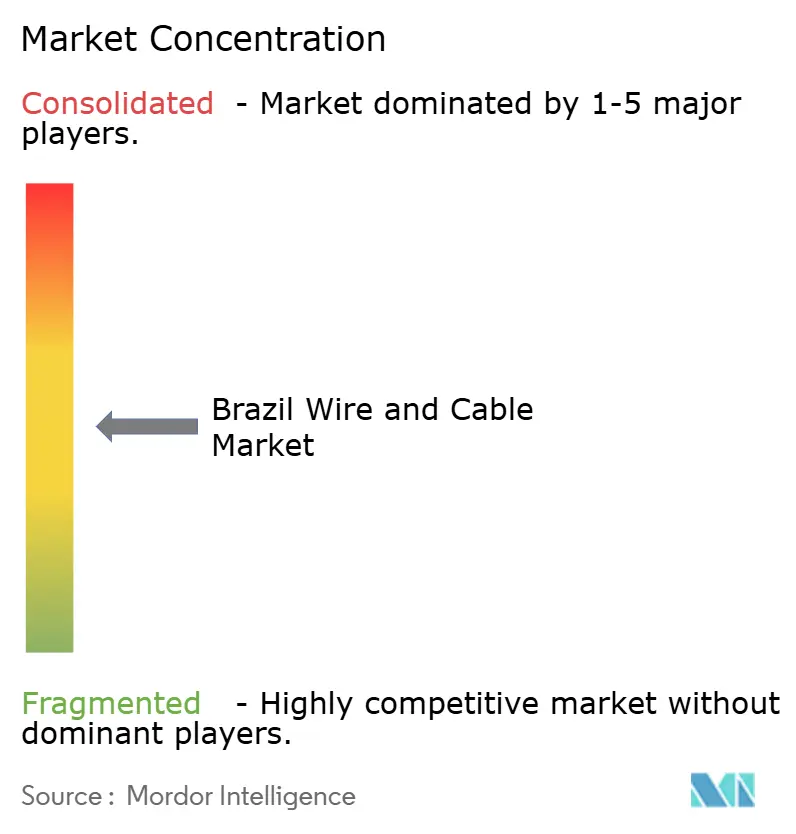
| Market Concentration | Medium |
Major Players *Disclaimer: Major Players sorted in no particular order Image © Mordor Intelligence. Reuse requires attribution under CC BY 4.0. | |
Brazil Wire and Cable Market Analysis by Mordor Intelligence
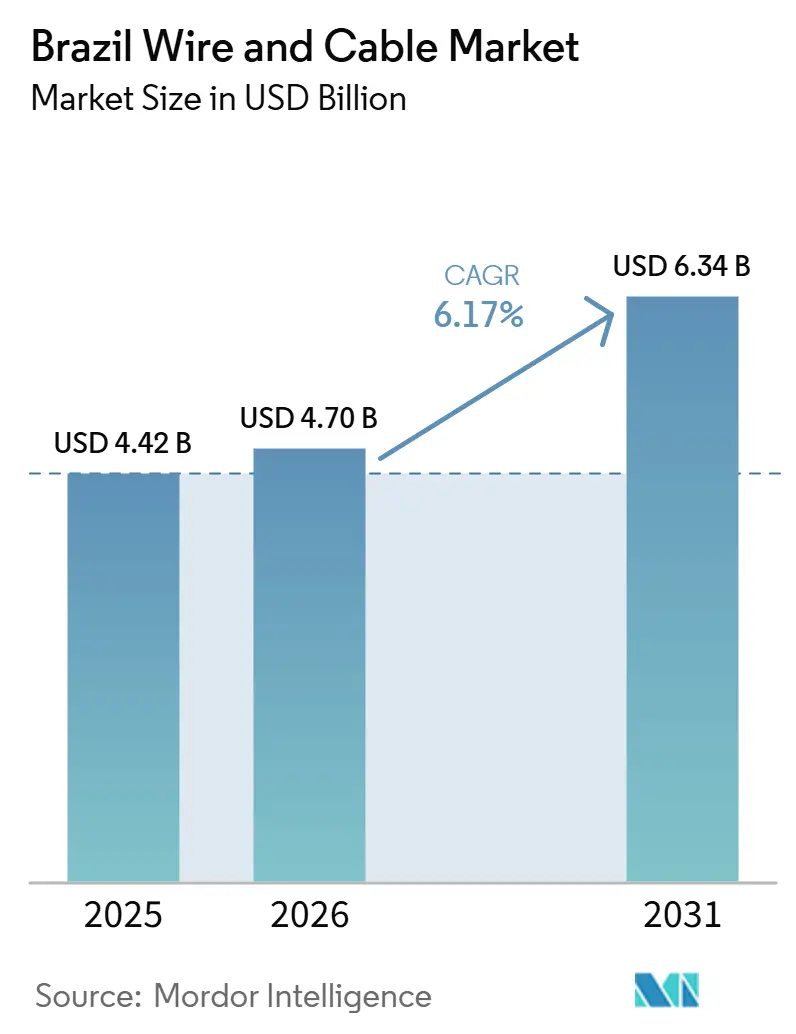
The Brazil Wire and Cable Market size is projected to expand from USD 4.42 billion in 2025 and USD 4.70 billion in 2026 to USD 6.34 billion by 2031, registering a CAGR of 6.17% from 2026 to 2031. Growth is supported by renewable generation, transmission expansion, fixed-network upgrades, 5G backhaul deployment, and data center construction. Brazil's wire and cable market demand is increasingly linked to projects that need both power delivery and digital connectivity. Transmission concessions and distribution investments can give suppliers clearer order visibility than short-cycle construction work. This favors producers that can meet strict technical requirements, manage material costs, and serve several voltage classes. The Brazilian wire and cable market also faces pressure from fluctuations in copper and aluminum prices, licensing delays, counterfeit products, and shortages of specialized installation labor.
Key Report Takeaways
- By voltage, low-voltage (below 1 kV) cables accounted for 54.18% of revenue share in the Brazil wire and cable market in 2025, while extra- and high-voltage (above 35 kV) cables are projected to expand at a 7.36% CAGR through 2031.
- By cable type, power cables accounted for 63.27% of revenue share in the Brazil wire and cable market in 2025, while fiber-optic cable is expected to record a 7.12% CAGR through 2031.
- By conductor material, copper conductors held 61.42% of revenue share in the Brazil wire and cable market in 2025, while optical glass/polymer conductors are projected to grow at a 7.18% CAGR through 2031.
- By installation, overhead cables accounted for 56.73% of revenue share in the Brazil wire and cable market in 2025, while underground cables are expected to advance at a 6.94% CAGR through 2031.
- By end-user vertical, construction held 30.86% of revenue share in the Brazil wire and cable market in 2025, while power infrastructure is projected to grow at a 7.29% CAGR through 2031.
- By insulation, insulated cables accounted for 88.64% of revenue share in the Brazil wire and cable market in 2025 and are projected to grow at a 6.26% CAGR through 2031.
Note: Market size and forecast figures in this report are generated using Mordor Intelligence’s proprietary estimation framework, updated with the latest available data and insights as of January 2026.
Brazil Wire and Cable Market Trends and Insights
Drivers Impact Analysis*
| Driver | (~) % Impact on CAGR Forecast | Geographic Relevance | Impact Timeline |
|---|---|---|---|
| Utility-Scale Renewable Generation and Transmission Expansion | +1.8% | Northeast and Center-West Brazil, with delivery to Southeast load centers | Long term (≥ 4 years) |
| Fiber-to-the-Home and 5G Backhaul Densification | +1.4% | National, with early gains in Sao Paulo, Rio de Janeiro, and Fortaleza metropolitan areas | Short term (≤ 2 years) |
| Grid Modernization and Climate-Resilience Investment | +1.0% | National, concentrated in SIN substation corridors across South and Southeast | Medium term (2-4 years) |
| Data Center, Cloud, and Artificial Intelligence Infrastructure Build-Out | +0.8% | Sao Paulo state and greater Rio de Janeiro axis, with secondary gains in Ceara and Para | Short term (≤ 2 years) |
| Distributed Generation Curtailment and Grid Reinforcement | +0.5% | Northeast and Center-West Brazil, with national spillover through ONS protocols | Medium term (2-4 years) |
| Localized Cable Manufacturing and Lower Logistics Exposure | +0.3% | National, with production clusters in Sao Paulo, Parana, and Para | Long term (≥ 4 years) |
| Source: Mordor Intelligence | |||
Utility-Scale Renewable Generation and Transmission Expansion
Renewable generation is changing where and how cable demand emerges across Brazil. The country needs long transmission links to move wind and solar output from the Northeast to major demand centers in the Southeast. The energy expansion plan referenced in the draft projected installed generation capacity to rise from 249 GW to 359 GW by 2035. It also identified 41,460 km of new transmission lines, with nearly 70% rated at 500 kV or above. The plan assigned BRL 158 billion (USD 22.4 billion) to transmission infrastructure through 2035. Long-term concessions can help manufacturers of high-voltage products achieve more predictable procurement schedules.
Fiber-to-the-Home and 5G Backhaul Densification
Telecommunications investment is supporting demand for fiber-optic cable in the Brazil wire and cable market. The sector invested BRL 36.3 billion (USD 6.3 billion) in 2025, with spending directed toward 5G coverage and fiber-to-the-home networks. Brazil had 66.1 million 5G lines in the second quarter of 2026, equal to 23.9% of the mobile base. The number of municipalities with 5G coverage rose from 812 to 1,420 during 2025. Fiber connections accounted for more than 80% of fixed broadband subscriptions in mid-2026. This leaves further deployment needs in less-connected municipalities and increases demand for backhaul capacity as mobile networks become denser.[1]Agência Nacional de Telecomunicações, “Anatel Divulga Relatório de Monitoramento da Competição do Segundo Trimestre de 2026,” Agência Nacional de Telecomunicações, gov.br
Grid Modernization and Climate-Resilience Investment
Grid modernization is moving from planning to project execution across the National Interconnected System. In March 2026, ANEEL approved USD 108 million to USD 180 million for nearly 100 priority upgrades under the POTEE 2025 cycle. These projects covered transformer replacements, switchgear modernization, and monitoring systems. The work can increase demand for cable products used in substations and distribution corridors. Hitachi Energy announced BRL 1.4 billion (USD 280 million) for a Brazil investment program that included a new Greater São Paulo Service Center expected to begin operations by the end of 2026. Clearer curtailment protocols and reinforcement needs in generation-rich areas can further support transmission investment.[2]U.S. International Trade Administration, “Brazil Electricity Regulator Approves Major Transmission Modernization,” International Trade Administration, trade.gov
Data Center, Cloud, and Artificial Intelligence Infrastructure Build-Out
Data center development is adding a second major source of demand for power and fiber cable. Facilities require fiber links within their campuses and high-capacity feeder cables connecting dedicated substations. The draft identified a USD 720 million investment for the Ascenty Sumaré facility, described as South America’s first hyperscale artificial intelligence data center. It also identified ByteDance’s planned Ceará project at BRL 200 billion (USD 37 billion). These facilities raise the need for larger conductor cross-sections and stronger insulation specifications. The combination of data center construction and renewable energy development is particularly relevant in northeastern states.
Restraints Impact Analysis*
| Restraint | (~) % Impact on CAGR Forecast | Geographic Relevance | Impact Timeline |
|---|---|---|---|
| Copper and Aluminum Price Volatility | -0.8% | National, with acute exposure in São Paulo and Rio Grande do Sul manufacturing clusters | Short term (≤ 2 years) |
| Regulatory and Environmental Licensing Delays for Submarine and Underground Routes | -0.5% | Northeast coastal zones and major metropolitan corridors in São Paulo and Rio de Janeiro | Medium term (2-4 years) |
| Counterfeit and Under-Specified Products in Informal Distribution Channels | -0.3% | National, with higher concentration in North, Northeast, and peripheral urban markets | Short term (≤ 2 years) |
| Skilled-Labor Shortage for High-Density Fiber and Extra-High-Voltage Installation | -0.2% | National, with acute shortages in fast-growing Northeast and North regions | Medium term (2-4 years) |
| Source: Mordor Intelligence | |||
Copper and Aluminum Price Volatility
Copper and aluminum prices directly affect cable manufacturing costs and margins. The draft reported that copper exceeded USD 14,500 per tonne in January 2026, before falling to near USD 12,780 per tonne in March 2026. These prices increase the cost of copper-intensive low-voltage and power cable lines. Higher copper prices can also lead contractors to consider aluminum conductors in applications where copper was previously specified. That shift complicates inventory planning for producers focused on one metal. Companies with hedging programs, flexible sourcing, and broad conductor portfolios are better placed to manage this pressure.
Regulatory and Environmental Licensing Delays for Submarine and Underground Routes
Licensing requirements can delay submarine and underground cable projects, even where demand and financing are established. Urban underground routes may require approvals from the federal, state, and municipal governments. This can increase delivery times and raise infrastructure costs in dense metropolitan areas. The V.tal Synapse project was announced in January 2026 as a 9,700 km, 320 Tbps link between Brazil and the United States. Construction was scheduled to begin in the second half of 2026, with operations targeted for 2029-2030. Longer project cycles can increase working capital requirements and disadvantage smaller suppliers.
*Our forecasts treat driver/restraint impacts as directional, not additive. The impact forecasts reflect baseline growth, mix effects, and variable interactions.
Segment Analysis
By Voltage: High-Voltage Demand Adds Growth to a Low-Voltage Base
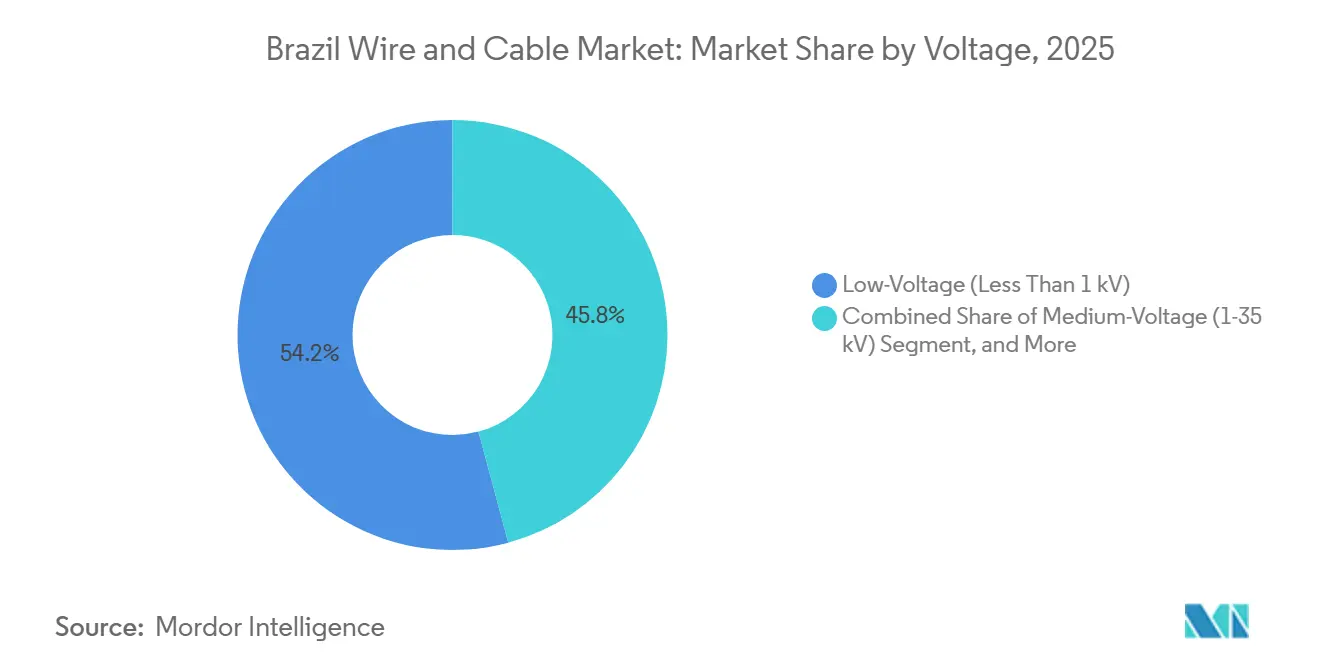
Low-voltage cables held 54.18% of Brazil wire and cable market share in 2025. Residential electrification, commercial wiring, and light industrial connections support this large installed demand base. Medium-voltage cables link substations with industrial parks, commercial developments, and urban distribution networks. Their demand is supported by efforts to improve network reliability. Extra- and high-voltage cables are projected to record a 7.36% CAGR from 2026 to 2031. Their faster growth reflects transmission projects that connect renewable generation areas with distant demand centers.
The Brazil wire and cable market size for high-voltage products is supported by planned transmission expansion, even though the draft did not provide a separate revenue value for this segment. Long-distance lines need high ratings to carry renewable electricity across Brazil’s large geography. Distribution investment also supports medium-voltage demand alongside the transmission buildout. Suppliers able to offer low-, medium-, and high-voltage products can compete for a greater share of a project’s cable requirements. This capability may simplify procurement for utilities and contractors. It can also reduce dependence on a single demand category within the wire and cable industry.



By Cable Type: Fiber Optics Grow Faster Than Power Cables
Power cables held 63.27% of revenue in 2025, making them the largest cable type. Renewable facilities, transmission projects, and data center campuses all require substantial volumes of power cabling. Fiber-optic cable is projected to expand at a 7.12% CAGR through 2031. Fiber-to-the-home adoption and data center interconnection are the main drivers of demand. Signal and control cables support industrial automation and process control. Demand for coaxial and data cables faces pressure as operators replace copper-based last-mile networks with fiber.
The Brazilian wire and cable market continues to need power cables, as energy projects require large cable volumes by weight and length. Fiber products, however, benefit from stronger requirements for capacity, reliability, and connection density. Prysmian deployed 432-fiber SiroccoHD microcables in a 30 km underground network for hyperscale data center interconnection in Alphaville and Barueri, São Paulo. The project used cable with a density of 8.6 F/mm² and a 50-year service life. It shows how data center requirements are moving beyond older fiber specifications.[3]Prysmian Brazil, “Prysmian e Ufinet Unem Expertise para Interconexão de Datacenters com Nova Geração de Cabos Ópticos,” Prysmian Brazil, br.prysmian.com
By Conductor Material: Copper Leads Volume While Optical Materials Lead Growth
Copper conductors held 61.42% of revenue in 2025, the largest share among conductor materials. They are used across residential wiring, power cables, and other applications that require dependable conductivity. Optical glass/polymer conductors are projected to grow at a 7.18% CAGR through 2031. Their growth is linked to the expansion of fixed broadband and the deployment of dense fiber in data centers. Aluminum conductors remain important for overhead transmission applications. Material selection increasingly depends on project costs, engineering requirements, and supply availability.
Copper plays a broad role in the Brazilian wire and cable market, serving applications from low-voltage wiring to high-voltage systems. Its position can come under pressure when the copper-to-aluminum price ratio strengthens the case for substitution. Alubar produces more than 100,000 tonnes of cable annually and has a leading regional position in aluminum conductors. This capacity supports the overhead transmission supply chain. The wire and cable industry, therefore, has to balance copper’s established use with aluminum’s relevance in large transmission projects.
By Installation: Underground Networks Gain Importance in Cities
Overhead cables held 56.73% of revenue in 2025. Aerial lines remain cost-effective for long-distance transmission corridors, especially those serving renewable generation projects. Underground cables are projected to advance at a 6.94% CAGR from 2026 to 2031. Urban utility programs, data center links, and dense power distribution upgrades support this growth. Submarine cables represent a smaller volume of demand. They remain strategically important because international connectivity projects need complex, high-specification products.
The Brazil wire and cable market for underground installations benefits from product requirements that differ from those for overhead lines. Duct-based routes need durable insulation, mechanical protection, and longer service lives. These requirements can support higher selling prices for compliant cable products. INMETRO inspected more than 452,000 electrical products between May 4 and May 29, 2026. The operation found 2,043 non-compliant items across 48 establishments, including wires and cables with insufficient copper content. The results show why quality assurance remains important as underground deployment expands.
By End-User Vertical: Power Infrastructure Gains Faster Than Construction
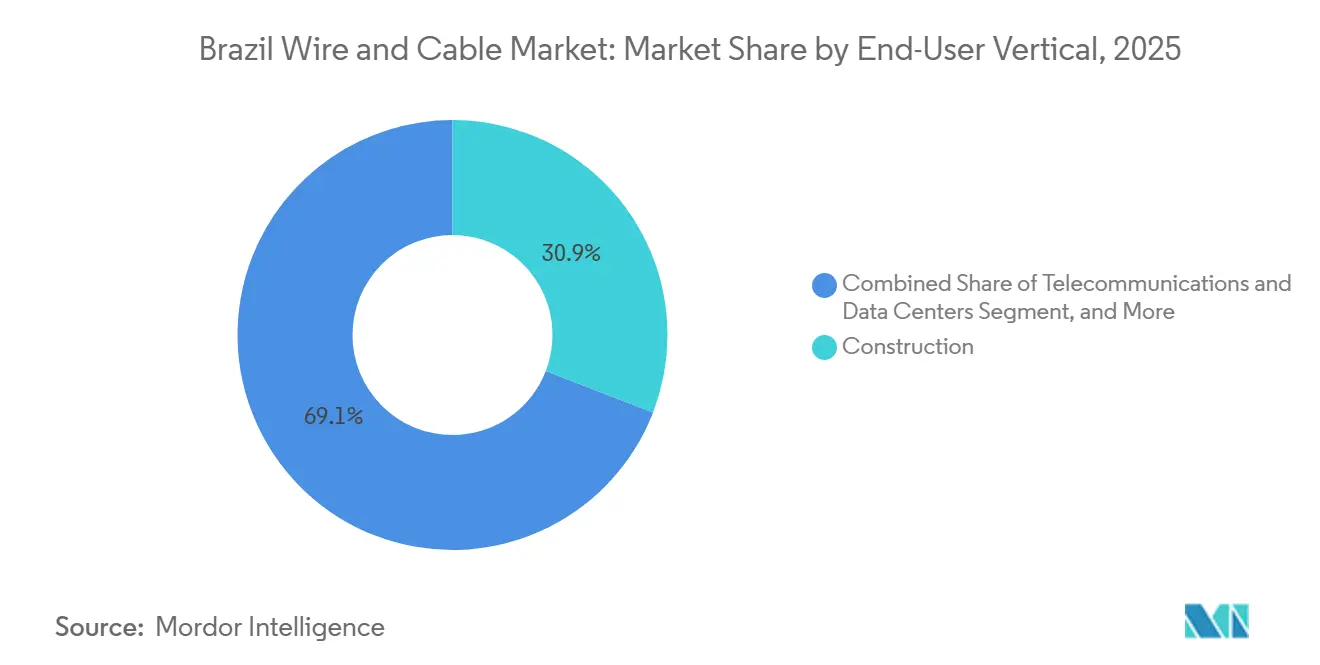
Construction held 30.86% of revenue in 2025, making it the largest end-user vertical. Residential projects account for a large share of low-voltage cable use. Commercial buildings add demand from offices, retail facilities, and hospitality projects. Power infrastructure is projected to expand at a 7.29% CAGR through 2031. Transmission auctions, concession renewals, and substation modernization programs support this faster growth. Telecommunications and data centers are becoming more connected end-use areas because they use similar fiber products, contractors, and installation methods.
The Brazil wire and cable market share held by construction reflects the scale of cable consumption in the building sector. Power infrastructure growth is shifting attention toward utility and renewable applications with multi-year delivery schedules. Oil and gas and petrochemical projects continue to have a specialized demand for subsea-grade cables. Automotive and mobility applications remain at an early stage. As electric vehicle adoption grows, demand can shift from factory wiring to charging infrastructure. This would broaden the end-user base beyond the current forecast period.
By Insulation: Insulated Cables Remain the Standard Choice
Insulated cables accounted for 88.64% of revenue in 2025. Safety requirements support their use across construction, industrial, and utility applications. Underground and data infrastructure projects also require reliable insulation because cable failures can disrupt critical services. Non-insulated cables are mainly used in overhead aluminum transmission configurations. Insulated cables are projected to grow at a 6.26% CAGR through 2031. Product differentiation is increasingly based on flame resistance, cross-linking grade, and halogen-free formulations.
Insulation performance is more important than the basic distinction between insulated and non-insulated in many applications. Cross-linked polyethylene, PVC, and halogen-free products serve different safety and installation requirements. Data centers and industrial automation facilities can require low-smoke, halogen-free products for enclosed areas. This supports demand for higher-specification insulated cables.
Geography Analysis
The Southeast is the main value consumption hub in the Brazil wire and cable market. São Paulo, Rio de Janeiro, and Minas Gerais have the country’s largest concentration of industrial facilities and commercial construction activity. The region also hosts a growing data center corridor across Barueri, Alphaville, Sumaré, Vinhedo, and Santana de Parnaíba. The draft identified USD 92 billion in cumulative data center investment between 2025 and 2031, with heavy weighting toward São Paulo state. Equinix opened its SP6 facility in April 2026 after a BRL 569 million (USD 114 million) investment. These projects require high-density fiber links and high-capacity power feeder cables.
The Northeast has the fastest-growing cable demand by volume. Bahia, Ceará, Rio Grande do Norte, and Piauí host major wind and solar generation clusters. The planned transmission system requires extra-high-voltage equipment to deliver this output to the Southeast. The draft identified BRL 26.5 billion (USD 4.9 billion) for regional renewable energy outflow interconnections by 2035. Fortaleza is also an important landing point for international submarine cable systems. The region combines demand for submarine, underground, and power cables as digital and energy infrastructure expand.
The South, North, and Center-West have distinct demand profiles in the Brazilian wire and cable market. Rio Grande do Sul, Santa Catarina, and Paraná support demand from industrial manufacturing, food processing, and automotive supply chains. Pará, Amazonas, and Mato Grosso are gaining importance through fiber deployment and power infrastructure projects. The Norte Conectado program involved BRL 1.3 billion (USD 226 million) in subfluvial fiber deployment and expanded access to locations previously outside formal networks. Alubar completed the conversion of 5 aluminum rod production furnaces to natural gas at its Barcarena, Pará, facility in January 2026. This shows that the North is developing as both a production location and a demand center.
Competitive Landscape
The Brazil wire and cable market has a two-tier competitive structure. Prysmian and Nexans bring global technology, broad product portfolios, and experience in complex projects. Furukawa Electric has specialized positions in telecommunications and industrial cable categories. Domestic producers, including Alubar Metais e Cabos, SIL Fios e Cabos Elétricos, and Cobrecom, compete strongly in low-voltage and overhead conductor segments. Their local distribution links and responsiveness to pricing needs are important advantages.
Prysmian’s May 2026 partnership with Ufinet is a specific example of a strategy focused on high-density fiber infrastructure. The 30 km underground network in Alphaville and Barueri used 432-fiber SiroccoHD microcable technology. The deployment responded to data center interconnection needs in São Paulo. Hitachi Energy’s BRL 50 million (USD 11 million) investment in a Greater São Paulo Service Center was another move linked to grid modernization. The center was expected to begin operations by the end of 2026 as part of a BRL 1.4 billion (USD 280 million) investment program in Brazil.
Material cost volatility favors companies with sourcing flexibility, hedging capacity, and internal processing capabilities. Growth in data infrastructure rewards manufacturers that can produce dense, reliable fiber products. Distribution quality matters because informal channels can carry products that do not meet specifications. Extra-high-voltage transmission cable and halogen-free insulated cable remain technically demanding opportunities. These segments can favor established suppliers with certified manufacturing capacity.
Brazil Wire and Cable Industry Leaders
Prysmian S.p.A
Nexans S.A.
Alubar Metais e Cabos S.A.
Cobrecom S.A.
SIL Fios e Cabos Elétricos Ltda.
- *Disclaimer: Major Players sorted in no particular order

Recent Industry Developments
- May 2026: Hitachi Energy announced a BRL 50 million (USD 11 million) investment to establish a new Service Center in Greater São Paulo, with operations expected to begin by end-2026, as part of its broader BRL 1.4 billion (USD 280 million) Brazil investment program targeting grid modernization services across the SIN.
- May 2026: Prysmian and Ufinet announced a strategic partnership to deploy a 30 km underground fiber optic network for hyperscale data center interconnection in Alphaville/Barueri, São Paulo, using 432-fiber SiroccoHD microcable technology at 8.6 F/mm² density, 3 times the capacity of conventional Brazilian-market microcables and rated for a 50-year service life.


Brazil Wire and Cable Market Report Scope
The Brazil wire and cable market revenue is generated through the sale of low-, medium-, and high-voltage wires and cables, including power, fiber-optic, signal and control, and coaxial/data cables with copper, aluminum, or optical glass/polymer conductors, along with associated value-added products and installation-specific solutions for overhead, underground, and submarine network deployments.
The Brazil wire and cable market report is segmented by voltage (extra- and high-voltage (greater than 35 kV), medium-voltage (1-35 kV), and low-voltage (less than 1 kV)), cable type (power cable, fiber-optic cable, signal and control cable, and coaxial and data cable), conductor (copper, aluminum, and optical glass/polymer), installation (overhead, underground, and submarine), end-user vertical (construction (residential and commercial), power infrastructure (utilities and renewables), telecommunications and data centers, oil and gas and petrochemicals, automotive and mobility, and industrial manufacturing), and insulation (insulated and non-insulated). The market forecasts are provided in terms of value (USD).
| Extra- and High-Voltage (Greater Than 35 kV) |
| Medium-Voltage (1-35 kV) |
| Low-Voltage (Less Than 1 kV) |
| Power Cable |
| Fiber-Optic Cable |
| Signal and Control Cable |
| Coaxial and Data Cable |
| Copper |
| Aluminum |
| Optical Glass/Polymer |
| Overhead |
| Underground |
| Submarine |
| Construction | Residential |
| Commercial | |
| Power Infrastructure (Utilities and Renewables) | |
| Telecommunications and Data Centers | |
| Oil and Gas and Petrochemicals | |
| Automotive and Mobility | |
| Industrial Manufacturing |
| Insulated |
| Non-Insulated |
| By Voltage | Extra- and High-Voltage (Greater Than 35 kV) | |
| Medium-Voltage (1-35 kV) | ||
| Low-Voltage (Less Than 1 kV) | ||
| By Cable Type | Power Cable | |
| Fiber-Optic Cable | ||
| Signal and Control Cable | ||
| Coaxial and Data Cable | ||
| By Conductor Material | Copper | |
| Aluminum | ||
| Optical Glass/Polymer | ||
| By Installation | Overhead | |
| Underground | ||
| Submarine | ||
| By End-User Vertical | Construction | Residential |
| Commercial | ||
| Power Infrastructure (Utilities and Renewables) | ||
| Telecommunications and Data Centers | ||
| Oil and Gas and Petrochemicals | ||
| Automotive and Mobility | ||
| Industrial Manufacturing | ||
| By Insulation | Insulated | |
| Non-Insulated | ||


Key Questions Answered in the Report
What is the Brazil wire and cable market size?
The Brazil wire and cable market was valued at USD 4.42 billion in 2025, stands at USD 4.7 billion in 2026, and is forecast to reach USD 6.34 billion by 2031.
What is driving cable demand in Brazil?
Renewable power transmission, fiber-to-the-home expansion, 5G backhaul, grid modernization, and data center construction are supporting demand.
Which voltage category is growing fastest in Brazil?
Extra- and high-voltage cables are projected to expand at a 7.36% CAGR from 2026 to 2031 as transmission links connect renewable generation with demand centers.
Which cable type has the largest share in Brazil?
Power cables held 63.27% of revenue in 2025, supported by utility, renewable energy, construction, and data center requirements.
Why are underground cables gaining use in Brazil?
Underground cables are projected to grow at a 6.94% CAGR because urban power upgrades and data center networks need protected, durable cable routes.
What are the main challenges for cable suppliers in Brazil?
Copper and aluminum price changes, licensing delays, counterfeit products, and specialized labor shortages can affect costs, project schedules, and product quality.
Page last updated on:






