
Brazil Urban Logistics Market Size and Share
Market Overview
| Study Period | 2020 - 2031 |
|---|---|
| Forecast Data Period | 2026 - 2031 |
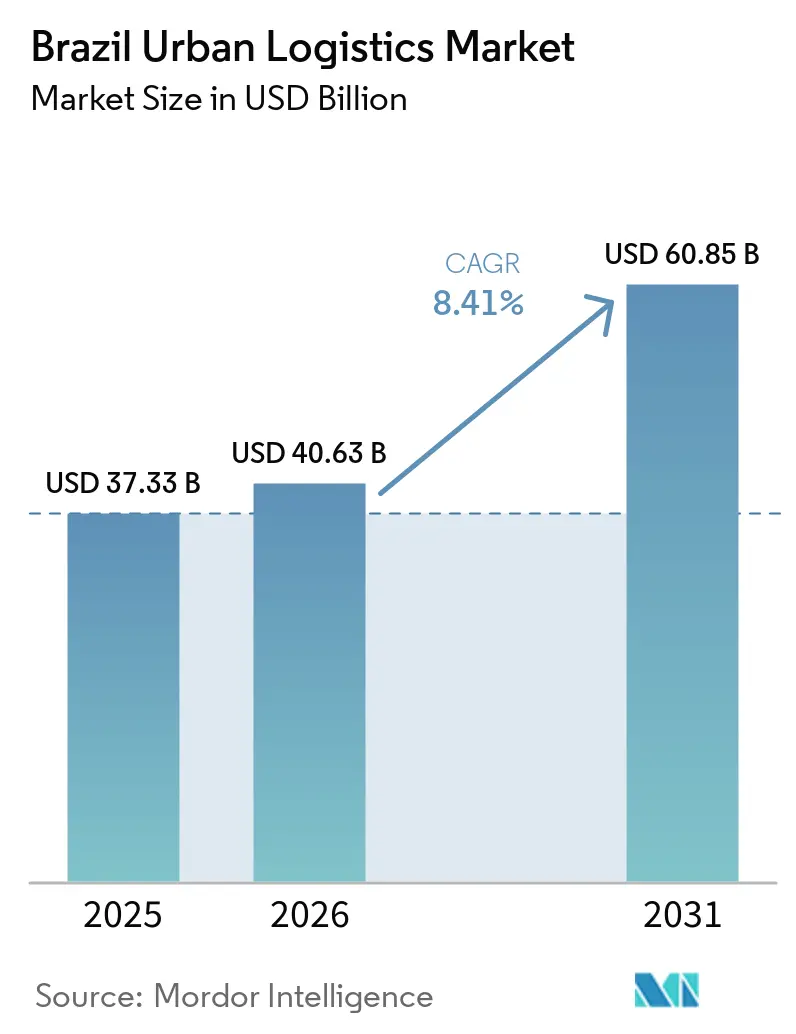
| Base Year Market Size (2025) | USD 37.33 Billion |
| Market Size (2026) | USD 40.63 Billion |
| Market Size (2031) | USD 60.85 Billion |
| Growth Rate (2026 - 2031) | 8.41 % |
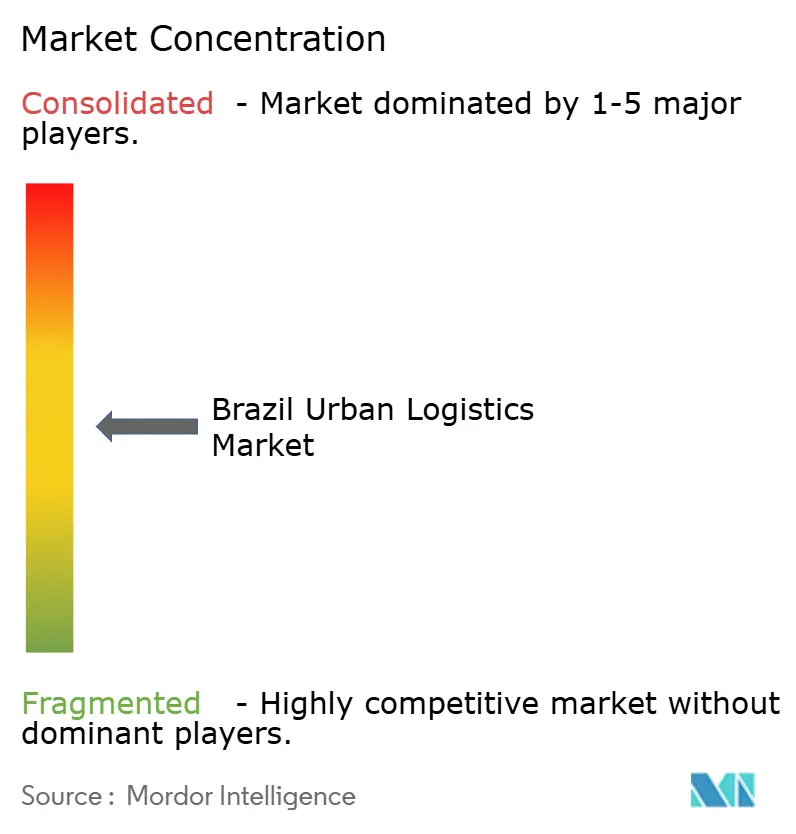
| Market Concentration | Medium |
Major Players *Disclaimer: Major Players sorted in no particular order Image © Mordor Intelligence. Reuse requires attribution under CC BY 4.0. | |
Brazil Urban Logistics Market Analysis by Mordor Intelligence
The Brazil urban logistics market size was valued at USD 37.33 billion in 2025 and is estimated to grow from USD 40.63 billion in 2026 to reach USD 60.85 billion by 2031, at a CAGR of 8.41% during the forecast period (2026-2031).
The Brazilian urban logistics market is being shaped by the expansion of digital retail, faster payment settlement, and the need to position inventory closer to customers. Platform operators are putting more control over fulfillment, sorting, and last-mile delivery inside their own networks, which changes the opportunity set for independent carriers. The Brazilian urban logistics market also benefits from more activity in secondary cities, where logistics real estate and local delivery networks are becoming commercially viable. At the same time, congestion, freight-cost pressure, cargo security risks, and inconsistent municipal access rules limit operational efficiency. Companies that can combine dense urban coverage, flexible fulfillment capacity, and specialized service capabilities are better placed to compete as delivery expectations continue to change.
Key Report Takeaways
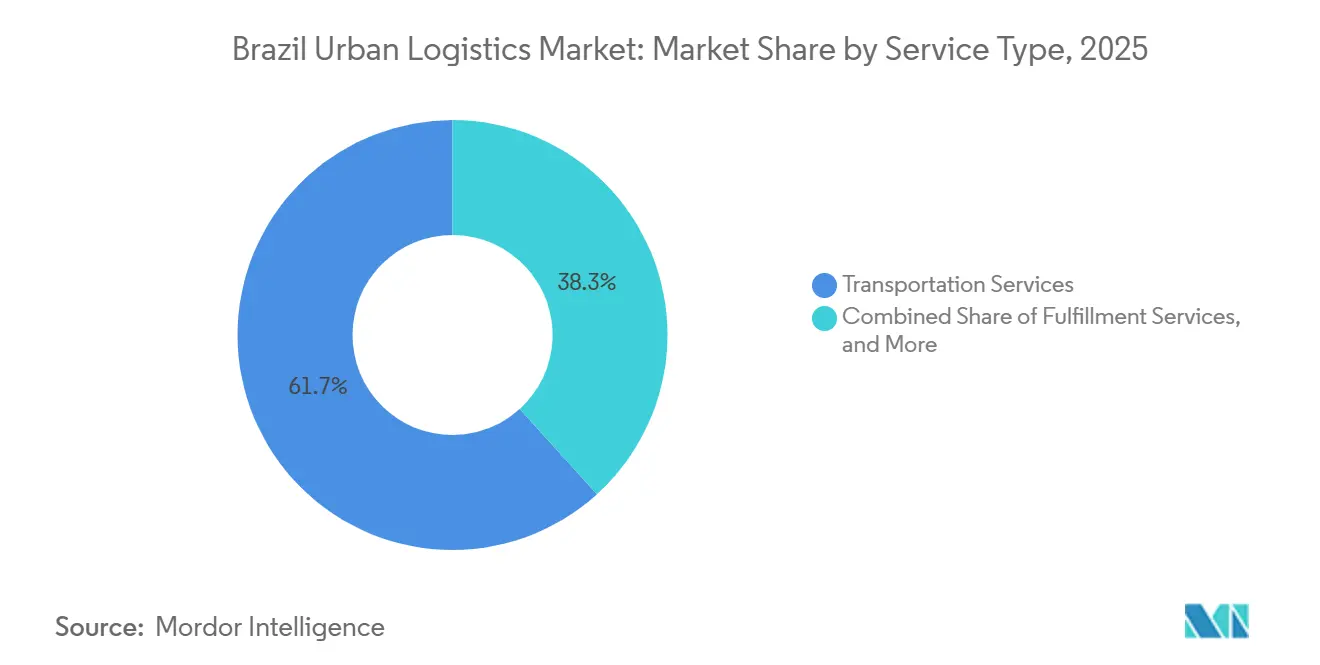
- By service type, transportation services held 61.72% of the Brazil urban logistics market share in 2025, while fulfillment services are forecast to grow at a 10.33% CAGR through 2031.
- By delivery speed, standard delivery accounted for 56.71% of the Brazil urban logistics market size in 2025, while instant and same-day delivery are forecast to grow at a 9.50% CAGR through 2031.
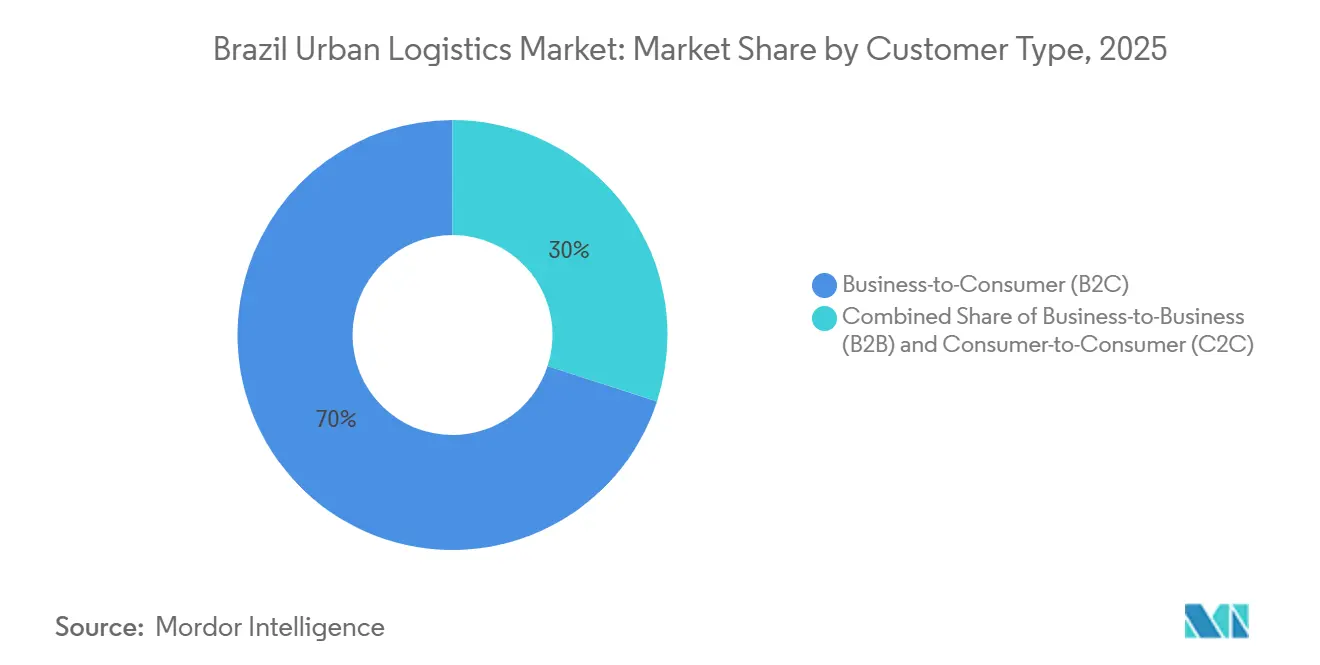
- By customer type, B2C logistics held 70.00% of the Brazil urban logistics market share in 2025, while C2C logistics are forecast to grow at an 11.28% CAGR through 2031.
- By end-use industry, e-commerce and retail accounted for 46.07% of the Brazil urban logistics market size in 2025, while healthcare and pharmaceuticals are forecast to grow at an 11.05% CAGR through 2031.
- By city, Sao Paulo held 12.99% of the revenue in 2025, while Manaus is forecast to grow at a 9.88% CAGR through 2031.
Note: Market size and forecast figures in this report are generated using Mordor Intelligence’s proprietary estimation framework, updated with the latest available data and insights as of January 2026.
Brazil Urban Logistics Market Trends and Insights
Drivers Impact Analysis*
| Driver | (~) % Impact on CAGR Forecast | Geographic Relevance | Impact Timeline |
|---|---|---|---|
| E-Commerce and Omnichannel Fulfillment Expansion | +2.8% | National, with concentration in Sao Paulo, Rio de Janeiro, Belo Horizonte, and Manaus | Short term (≤ 2 years) |
| Demand for Same-Day and Instant Delivery | +2.1% | Dense metropolitan corridors in Sao Paulo, Rio de Janeiro, Curitiba, and Fortaleza | Short term (≤ 2 years) |
| Urban Delivery-Density Gains | +1.4% | Sao Paulo and Rio de Janeiro metro clusters, with expansion to Recife and Fortaleza | Medium term (2-4 years) |
| Expansion of Micro-Fulfillment and Dark Stores | +0.9% | Sao Paulo, Rio de Janeiro, Belo Horizonte, and emerging locations in Manaus and Fortaleza | Medium term (2-4 years) |
| Instant-Payment-Enabled Order Compression | +0.6% | National, strongest in banked urban segments of Sao Paulo and Rio de Janeiro | Short term (≤ 2 years) |
| Secondary-City Delivery-Network Densification | +0.4% | Northeast capitals, Manaus, Curitiba, Brasília, and interior cities | Long term (≥ 4 years) |
| Source: Mordor Intelligence | |||
E-Commerce and Omnichannel Fulfillment Expansion
Mercado Livre invested BRL 34 billion (USD 6.14 billion) in Brazilian logistics operations in 2025. The company expanded its fulfillment center network from 17 to 27 units and processed 95 orders per second in the fourth quarter of 2025. Amazon Brazil operated 250 logistics centers in 2025, including 100 facilities opened during that year. Magazine Luiza’s Magalog operated 21 distribution centers, 177 last-mile bases, and 350 partner micro-hubs, allowing two-hour delivery in 139 cities. This shift turns retail space and local inventory into delivery assets, which can reduce linehaul requirements for local orders. The Brazil urban logistics market, therefore, favors providers that can manage B2B replenishment and B2C last-mile activity through one coordinated network.
Demand for Same-Day and Instant Delivery
Amazon launched Amazon Now in 8 Brazilian cities in March 2026, using micro-distribution centers to provide grocery and daily essentials delivery in under 15 minutes. The service uses 38 micro-distribution facilities designed for delivery radii of less than 2 kilometers. iFood expanded rapid delivery to 200 municipalities during 2025, supporting the broader use of short delivery windows beyond conventional food orders. Faster delivery is extending into consumer electronics, pharmaceuticals, fashion, and personal-care purchases, where higher basket values can support premium delivery costs. Dark-store networks close to residential areas give operators a meaningful advantage over networks that depend on distant hubs. The Brazilian urban logistics market is consequently placing greater value on local inventory placement and responsive route planning.
Urban Delivery-Density Gains
Loggi recorded a 77% rise in parcel volumes from small and medium-sized enterprises during 2025. Its pickup-point network expanded from 1,000 to 1,700 locations, while city coverage rose from 90 to 194 locations. Greater parcel density can reduce the cost of each delivery when routes carry more shipments within a smaller service area. Loggi replaced static postal-code routing with daily algorithmic rezoning across active packages, showing how routing systems can improve the use of available fleet capacity. Sao Paulo and Rio de Janeiro retain the most concentrated delivery demand, but Fortaleza, Recife, and Curitiba are attracting more dedicated logistics infrastructure. These changes support a wider geographic base for the Brazilian urban logistics market as e-commerce origination expands beyond the largest metropolitan areas.
Expansion of Micro-Fulfillment and Dark Stores
Micro-fulfillment facilities allow operators to store fast-moving goods closer to high-density residential districts. A 300-square-meter dark store can support short delivery trips and permit the use of motorcycles, e-bikes, and cargo bicycles for suitable orders. BNDES approved BRL 340 million (USD 61.42 million) to finance up to 85,000 electric bicycles for delivery workers through Tembici and iFood. The initiative is planned to scale from 5,000 available units to 42,500 units by the end of 2027. Local facilities also produce faster sales and inventory data, which can improve replenishment decisions for retailers and suppliers. The Brazil urban logistics market gains from this model because it links inventory management, delivery performance, and lower-emission urban fleet options.
Restraints Impact Analysis*
| Restraint | (~) % Impact on CAGR Forecast | Geographic Relevance | Impact Timeline |
|---|---|---|---|
| Metropolitan Traffic Congestion | -1.8% | Sao Paulo, Rio de Janeiro, Belo Horizonte, and Fortaleza | Short term (≤ 2 years) |
| Fuel, Labor, and Vehicle-Maintenance Cost Pressure | -1.3% | National, with higher exposure on freight-intensive Sao Paulo and Rio de Janeiro corridors | Medium term (2-4 years) |
| Security-Adjusted Routing in High-Theft Corridors | -0.8% | Southeast, especially the Sao Paulo and Rio de Janeiro corridor, with spillover to the Northeast | Medium term (2-4 years) |
| Fragmented Curb-Access and Municipal Delivery Rules | -0.5% | Sao Paulo, Manaus, Joao Pessoa, Londrina, and other municipalities | Long term (≥ 4 years) |
| Source: Mordor Intelligence | |||
Metropolitan Traffic Congestion
Traffic congestion raises last-mile costs and makes delivery times less predictable across Brazil’s largest cities. Brazil’s Ministry of Transport identified saturated logistics corridors, heavy reliance on roads, and urban-access bottlenecks among the national freight system’s systemic constraints in its December 2025 PNL 2050 assessment. The assessment stated that cargo volumes increased 25% from 2014 to 2025, with little expansion in underlying infrastructure. Sao Paulo’s North Rodoanel opened in late 2025 under a BRL 3.4 billion (USD 0.61 billion) concession and redirected 15,000 vehicles each day, including trucks, from the Tietê and Pinheiros expressways.[1] The project shows that targeted capacity additions can ease individual choke points, even though they do not resolve broader urban access limits. The Brazilian urban logistics market remains exposed, where route density cannot offset delays caused by congested roads.
Fuel, Labor, and Vehicle-Maintenance Cost Pressure
Diesel, driver wages, and fleet maintenance costs are tightening carrier margins and restricting capacity investment. ANTT adjusted minimum freight rates by 4.8% to 7% in early 2026 under Law 13.703/2018 after a diesel-price movement triggered the statutory mechanism. The INCTF increased 8.1% over the 12 months through July 2026, while driver and helper salaries were adjusted by 7% under the 2025 road-freight collective bargaining agreement.[2] The discussion over changes to the 6×1 work schedule adds uncertainty for operators with continuous delivery operations. Fuel accounts for 35% to 50% of road freight operating costs, leaving limited room to absorb increases in tires, insurance, labor, and administrative expenses. The Brazil urban logistics market may continue to require contract repricing and tighter fleet utilization when these cost pressures persist.
*Our forecasts treat driver/restraint impacts as directional, not additive. The impact forecasts reflect baseline growth, mix effects, and variable interactions.
Segment Analysis
By Service Type: Transportation Leads While Fulfillment Changes Network Economics
Transportation services held the leading position in the Brazilian urban logistics market in 2025, accounting for 61.72% of the market. Road carriers, express operators, and marketplace-owned fleets move most intercity and urban freight volumes. The Brazil urban logistics market share held by transportation reflects its role as the physical backbone for parcel and freight movement. Marketplace logistics arms have taken over volumes that previously moved through neutral third-party carriers. Warehousing and urban storage are benefiting from inventory being located closer to the end customers. Reverse logistics is becoming more important for fashion, electronics, and social-commerce orders that require collection, inspection, and return handling. Value-added logistics is also relevant in healthcare, automotive, and fashion supply chains that require labeling, kitting, or temperature control.
Fulfillment services are the fastest-growing service category in the Brazil urban logistics market, growing at a 10.33% CAGR through 2031. Marketplace programs now cover storage, pick-and-pack, sorting, and first-mile injection for more sellers. Mercado Livre Envios Full, Amazon FBA, and Shopee’s fulfillment network illustrate this broader control of logistics activity. Dense and predictable routes support automation and reduce the spot freight available to independent carriers. JSL reported BRL 9.6 billion (USD 1.73 billion) in 2025 revenue and separated its intralogistics division into Intralog from April 2026. This response shows why managed warehousing and industrial logistics are becoming important revenue areas for established carriers. The Brazil urban logistics industry is therefore shifting toward service models that extend beyond transport alone.

By Delivery Speed: Standard Delivery Leads While Faster Formats Attract Investment
Standard delivery retained the largest volume position in the Brazilian urban logistics market in 2025, accounting for 56.71% of the market. Many buyers remain price sensitive and choose base shipping for routine e-commerce purchases. Scheduled delivery remains important for B2B users who need predictable arrival times for healthcare distribution and automotive replenishment. Next-day delivery is expanding as wider facility networks allow inventory to be positioned closer to customers. Jadlog opened its Perus hub in May 2026 with investment exceeding BRL 100 million (USD 18.06 million). The facility has a 310-meter automated sorter that can process up to 18,000 packages each hour. Such investments improve cut-off times and help make morning delivery more reliable for orders placed late in the day.
Instant and same-day formats are the fastest-growing delivery-speed category in the Brazilian urban logistics market, growing at a 9.50% CAGR through 2031. Amazon Now’s March 2026 launch across 8 cities shows that sub-hour delivery has moved beyond food and pharmacy orders. High-order density around dark stores can improve delivery economics and support further local expansion. Electronics, personal care, and convenience goods are becoming more suitable for these shorter delivery windows. Providers that lack local micro-hubs face a disadvantage because peripheral distribution centers cannot reliably serve a 15-minute window. Partnership or ownership of dark-store capacity is becoming a practical access requirement in this part of the Brazil urban logistics market. The service is likely to remain focused on dense locations where short routes can support the higher operating intensity.
By Customer Type: B2C Leads, While C2C Requires Different Collection Models
B2C represented the largest customer category in the Brazilian urban logistics market in 2025, accounting for 70.00% of the market. Marketplace and direct-to-consumer channels serve household spending on fashion, electronics, food, and home goods. These networks are built around smaller parcels, frequent deliveries, and short service windows. B2B volumes remain significant in healthcare procurement, automotive parts, and industrial inputs. Larger consignment sizes, fixed schedules, and contracted service levels make B2B freight operationally different from household delivery. Long-term supply contracts also provide dependable volume when consumer demand changes by season. The Brazil urban logistics market needs both operating models because neither B2C nor B2B networks fully replace the other.
C2C is the fastest-growing customer type in the Brazil urban logistics market, growing at an 11.28% CAGR through 2031. Resale activity through social commerce, second-hand platforms, and peer-to-peer marketplaces is increasing demand for simple parcel collection and delivery. Loggi stated that pickup and drop-off points handled 33% of SME shipments on its platform in 2025, a volume 7 times higher than in 2024.[3] C2C parcels tend to be lighter and originate from dispersed senders, many of whom do not have carrier accounts. Uber and Loggi launched Flash Nacional in July 2025, connecting users to cross-city parcel delivery through the Uber application and Loggi’s network of more than 5,500 municipalities. The service reduces the steps required for an individual to send a parcel. These features make accessible pickup points and low-friction digital onboarding central to this part of the Brazilian urban logistics industry.
End-Use Industry: E-Commerce Leads While Healthcare Requires Specialized Capability
E-commerce and retail formed the largest end-use category in the Brazilian urban logistics market in 2025, accounting for 46.07% of the market. Large marketplace platforms concentrate a significant share of online sales and give preferred delivery partners access to greater volumes. Food and beverage demand is supported by grocery, prepared meal, and instant retail delivery requirements. Fashion and apparel generate returns and dispersed seller volumes that increase the need for flexible reverse logistics. Consumer electronics delivery needs are shaped by higher-order values and demand for careful handling. Automotive parts logistics depend on predictable replenishment for service networks and commercial fleets. These demand patterns broaden the Brazilian urban logistics market beyond a single parcel type or operating model.
Healthcare and pharmaceuticals are the fastest-growing end-use categories in the Brazilian urban logistics market, growing at an 11.05% CAGR through 2031. Omnichannel pharmacies and prescription fulfillment are increasing demand for controlled, reliable last-mile delivery. ANVISA requirements for temperature records and validated pharmaceutical transport create a high barrier for providers without appropriate processes. Compliance capability can therefore be a competitive strength rather than only an added cost. Sao Paulo and Rio de Janeiro have older urban populations that generate recurring medication-delivery requirements. This demand can offer more stable volume than discretionary retail categories. The Brazil urban logistics market size for specialized healthcare delivery is supported by cold-chain needs, pharmacy networks, and recurring medicine orders.
Geography Analysis
Sao Paulo held the largest city-level position in the Brazil urban logistics market in 2025, accounting for 12.99% of the market. The metropolitan area connects major highways with the Port of Santos, supporting both urban delivery and regional linehaul. Amazon operated 38 micro-distribution centers in the Sao Paulo metropolitan area during 2025. Magalog’s 177 last-mile bases supported two-hour delivery in 139 cities from its wider network. The state’s PLI-SP 2050 framework identifies more decentralized logistics investment as a long-term priority.[4] Rio de Janeiro remains a major hub, but cargo-security costs create routing premiums for frequent urban delivery cycles. Belo Horizonte and Curitiba also serve as break-bulk points connecting the southern and central regions with the Southeast’s logistics networks.
Manaus is the fastest-growing urban node in the Brazilian urban logistics market, growing at a 9.88% CAGR through 2031. The Zona Franca fiscal perimeter, import activity, and air-cargo connectivity give the city a logistics profile that differs from the Southeast. Total Express’s Sao Paulo to Manaus air-cargo service reduced transit time from 14 days to 3 days and increased the volume of e-commerce parcels served fivefold. Fortaleza is becoming a regional distribution hub as its airport and road links support Northeast coverage. Recife also supports a large Northeast consumer catchment through the Port of Suape and airport infrastructure. The Brazil urban logistics market share of these cities is rising as private networks extend beyond their traditional Southeast focus. Their development reduces reliance on long-distance delivery from Sao Paulo for some regional orders.
Brasilia, Salvador, and smaller cities create different demand pools for the Brazil urban logistics market. Brasilia is supported by government procurement, public-health supply, and institutional B2B activity. Salvador serves Bahia’s consumer base and provides an Atlantic port option for industrial and bulk cargo. Smaller urban centers are gaining local delivery infrastructure as networks extend to interior cities. The national logistics assessment still identifies secondary-road quality and weak multimodal integration as constraints. Private logistics real-estate investment outside the Southeast is increasing despite these infrastructure gaps. This expansion gives the Brazilian urban logistics market a broader base for future demand and network investment.
Competitive Landscape
The Brazilian urban logistics market is moderately consolidated at the national carrier and platform level, while regional operators, specialized providers, and micro-logistics businesses remain numerous. Mercado Livre, Amazon, Shopee, and Magazine Luiza together control 50% of domestic parcel flows through proprietary logistics networks. These platforms have integrated fulfillment, sorting, and last-mile delivery into their broader commercial operations. Independent carriers compete for residual volumes and often operate with less route density than platform-owned networks. Automation, coverage expansion, and specialized services are the principal responses among leading logistics companies. Jadlog’s Perus facility doubles its processing capacity and uses automated sorting to improve delivery speed. The Brazilian urban logistics market, therefore, has a clear divide between high-density proprietary networks and more open carrier networks.
C2C and SME delivery in secondary cities remains an area where fixed logistics infrastructure is still developing. Pharmaceutical cold-chain delivery is another area where providers with ANVISA-compliant urban processes can differentiate their services. JSL created Intralog as a separately managed business from April 2026, extending its focus on managed warehousing and industrial logistics. Intralog is expected to have 65 distribution centers and more than 2 million square meters under management. This move reflects the value of broader contract logistics services when open-market transportation volumes face pressure.
Fleet electrification is also becoming more visible in the Brazilian urban logistics market. Mercado Livre reported in August 2026 that electric vehicles have become economically competitive with combustion vehicles in selected urban delivery operations. BNDES’s electric-bicycle financing program provides a public-finance mechanism for lower-emission urban delivery fleets. DSV completed its EUR 14.3 billion (USD 16.82 billion) acquisition of DB Schenker in April 2025. Its Brazilian operations are being integrated into a broader global network. This may strengthen freight-forwarding and cross-border B2B options for multinational shippers. The competitive landscape remains consistent with a moderately concentrated Brazil urban logistics market, where major platforms have material volume advantages, but specialized and regional opportunities remain.
Brazil Urban Logistics Industry Leaders
-
JSL S.A.
-
Correios
-
DHL
-
Loggi
-
Jadlog
- *Disclaimer: Major Players sorted in no particular order
Recent Industry Developments
- May 2026: Jadlog inaugurated a logistics hub in Perus, Sao Paulo, with investment above BRL 100 million (USD 18.06 million). The 20,000-square-meter facility has a 310-meter automated sorter that processes up to 18,000 parcels an hour and doubles Jadlog’s processing capacity.
- March 2026: Amazon launched Amazon Now in 8 Brazilian cities, offering grocery and daily-essentials delivery in under 15 minutes through urban micro-distribution centers.
- September 2025: Correios launched Transfer LOG, a pallet transport service with return-freight capability, and Log Supri In House, a supply-management service for client facilities.
- July 2025: Uber and Loggi launched Flash Nacional, a cross-city parcel-delivery service in the Uber application that uses Loggi’s network of more than 5,500 municipalities.
Brazil Urban Logistics Market Report Scope
| Transportation Services |
| Warehousing and Urban Storage Services |
| Fulfillment Services |
| Reverse Logistics Services |
| Value-Added Logistics (VAL) Services |
| Instant and Same-Day Delivery |
| Next-Day Delivery |
| Scheduled Delivery |
| Standard Delivery |
| Business-to-Business (B2B) |
| Business-to-Consumer (B2C) |
| Consumer-to-Consumer (C2C) |
| E-commerce and Retail |
| Food and Beverage |
| Healthcare and Pharmaceuticals |
| Consumer Electronics |
| Fashion and Apparel |
| Automotive Parts |
| Industrial and Manufacturing |
| Others |
| Sao Paulo |
| Rio de Janeiro |
| Brasilia |
| Fortaleza |
| Salvador |
| Belo Horizonte |
| Manaus |
| Curitiba |
| Recife |
| Rest of Cities |
| By Service Type | Transportation Services |
| Warehousing and Urban Storage Services | |
| Fulfillment Services | |
| Reverse Logistics Services | |
| Value-Added Logistics (VAL) Services | |
| By Delivery Speed | Instant and Same-Day Delivery |
| Next-Day Delivery | |
| Scheduled Delivery | |
| Standard Delivery | |
| By Customer Type | Business-to-Business (B2B) |
| Business-to-Consumer (B2C) | |
| Consumer-to-Consumer (C2C) | |
| By End-Use Industry | E-commerce and Retail |
| Food and Beverage | |
| Healthcare and Pharmaceuticals | |
| Consumer Electronics | |
| Fashion and Apparel | |
| Automotive Parts | |
| Industrial and Manufacturing | |
| Others | |
| By City | Sao Paulo |
| Rio de Janeiro | |
| Brasilia | |
| Fortaleza | |
| Salvador | |
| Belo Horizonte | |
| Manaus | |
| Curitiba | |
| Recife | |
| Rest of Cities |
Key Questions Answered in the Report
What is driving Brazil's urban logistics demand?
Digital retail, omnichannel fulfillment, faster delivery formats, and wider secondary-city coverage are supporting demand. Marketplace operators are also bringing more fulfillment and last-mile activity into proprietary networks, which supports more consistent inventory positioning and faster local order processing.
How large is Brazil’s urban logistics sector?
It is expected to increase from USD 40.63 billion in 2026 to USD 60.85 billion by 2031 at an 8.41% CAGR. This expansion reflects higher demand for urban fulfillment and more responsive delivery capacity.
Which service category is expanding most quickly?
Fulfillment services are the fastest-growing category because platforms are taking on storage, sorting, and first-mile operations. This approach gives sellers access to denser and more predictable logistics flows.
Why are dark stores important for urban delivery?
They position inventory near customers, support short delivery routes, and enable same-day or instant service in dense neighborhoods. They can also support lower-intensity vehicle types for suitable urban orders.
What constraints affect last-mile delivery in Brazil?
Congestion, freight-cost adjustments, cargo security risks, and inconsistent municipal access rules reduce operating efficiency. These factors can increase route variability and require tighter contract and fleet management.
Which cities offer the strongest growth opportunities?
Manaus, Fortaleza, Recife, Brasília, Salvador, and smaller cities are gaining importance as networks expand beyond Sao Paulo and Rio de Janeiro. Their growth is linked to rising local demand and broader delivery-network coverage.