
Brazil Soil Monitoring Market Size and Share
Market Overview
| Study Period | 2021 - 2031 |
|---|---|
| Forecast Data Period | 2026 - 2031 |
| Base Year Market Size (2025) | USD 67.20 Million |
| Market Size (2026) | USD 77.80 Million |
| Market Size (2031) | USD 139.90 Million |
| Growth Rate (2026 - 2031) | 15.80 % |
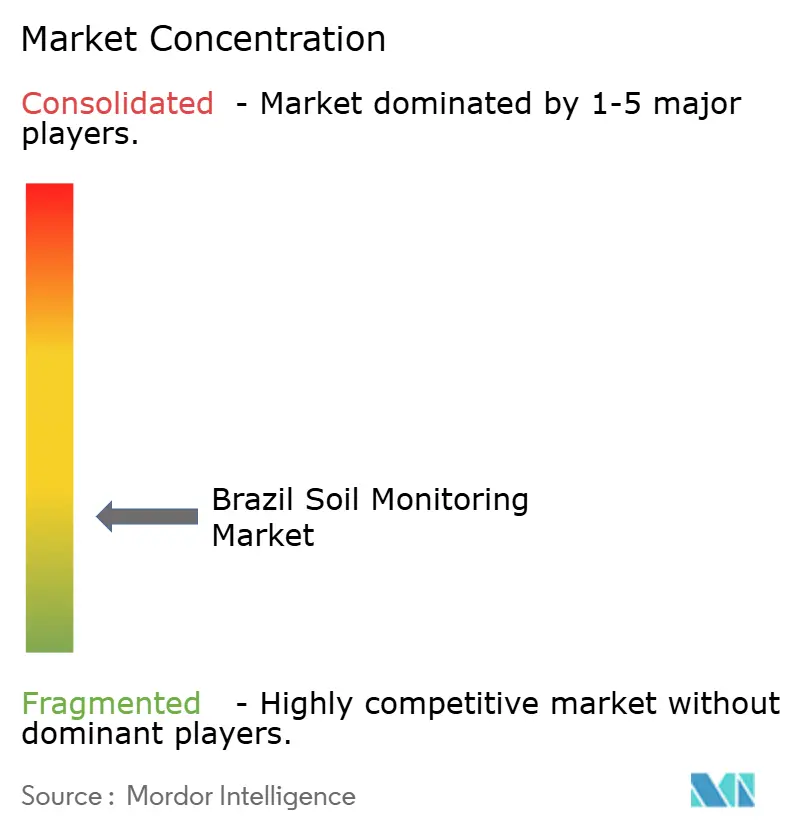
| Market Concentration | Low |
Major Players *Disclaimer: Major Players sorted in no particular order Image © Mordor Intelligence. Reuse requires attribution under CC BY 4.0. | |
Brazil Soil Monitoring Market Analysis by Mordor Intelligence
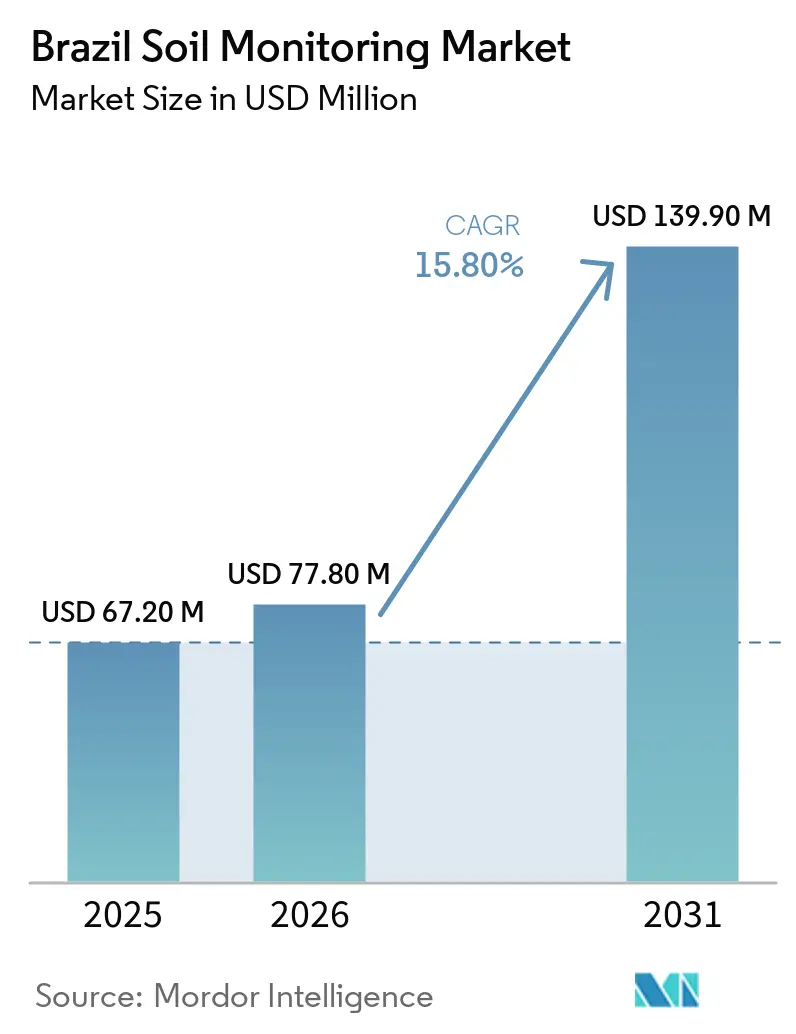
The Brazil soil monitoring market was valued at USD 67.20 million in 2025 and is estimated to grow from USD 77.80 million in 2026 to reach USD 139.90 million by 2031, at a CAGR of 15.80% during the forecast period 2026–2031. Large export-oriented farms are incorporating soil data into routine decisions on irrigation, fertilizer application, and field operations. According to the National Water and Basic Sanitation Agency (ANA), irrigation accounted for 50.3% of total water consumption in Brazil in 2024, making water constraints a key driver for soil monitoring adoption[1]. Carbon measurement requirements are also increasing the value of reliable soil records for farms participating in sustainability programs. Brazil's varied soil conditions favor suppliers that can offer devices paired with local calibration and agronomic support. As a result, the Brazil soil monitoring market favors solutions that integrate with existing farm workflows over stand-alone measurement equipment.
Key Report Takeaways
- By component, hardware was the largest segment and held 58.0% of the Brazil soil monitoring market share in 2025, while services is the fastest-growing segment and is forecast to expand at a 16.3% CAGR between 2026 and 2031.
- By product type, in-situ sensors were the largest segment and held 46.0% of the Brazil soil monitoring market size in 2025, while remote-sensing platforms are the fastest-growing segment and are forecast to expand at an 18.1% CAGR between 2026 and 2031.
- By connectivity technology, wireless was the largest segment and held 70.0% of the market share in 2025, while also being the fastest-growing segment, forecast to grow at a 19.8% CAGR between 2026 and 2031.
- By application, open field was the largest segment and held 63.0% of the market share in 2025, while protected cultivation is the fastest-growing segment and is forecast to expand at a 16.8% CAGR between 2026 and 2031.
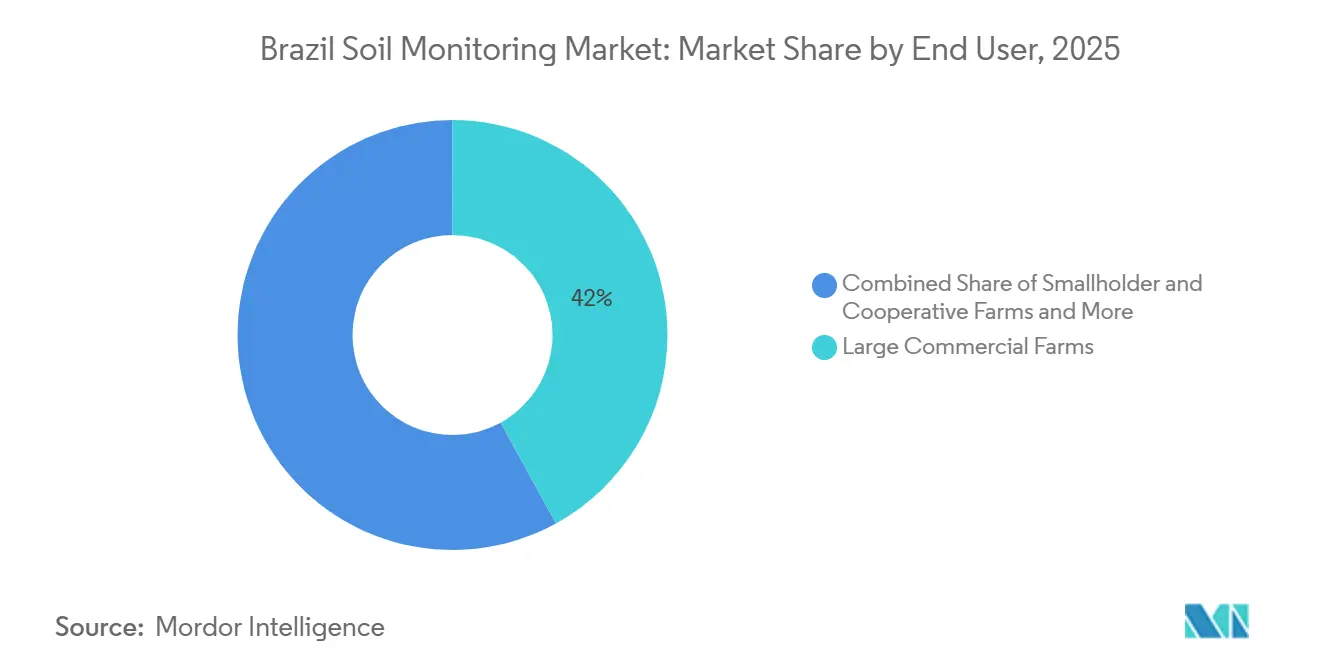
- By end user, large commercial farms were the largest segment and held 42.0% of the market share in 2025, while research institutes and universities are the fastest-growing segment and are forecast to expand at a 16.4% CAGR between 2026 and 2031.
Note: Market size and forecast figures in this report are generated using Mordor Intelligence’s proprietary estimation framework, updated with the latest available data and insights as of January 2026.
Market Trends and Insights
Drivers Impact Analysis of Brazil Soil Monitoring Market*
| Driver | (~) % Impact on CAGR Forecast | Geographic Relevance | Impact Timeline |
|---|---|---|---|
| Precision Agriculture Adoption in Large-Scale Brazilian Farming | +4.0% | Cerrado, Center-West, Mato Grosso, São Paulo, and MATOPIBA | Medium term (2-4 years) |
| Water-Efficient Irrigation and Climate-Resilient Requirements | +3.0% | MATOPIBA, Cerrado, South, and Southeast Brazil | Short term (≤ 2 years) |
| Integration with Farm Management Software and Machinery Platforms | +2.5% | National, with early concentration in Mato Grosso and Goiás | Medium term (2-4 years) |
| Expansion of Cooperative and Shared-Sensor Models | +2.0% | São Paulo, Minas Gerais, and Rio Grande do Sul | Long term (≥ 4 years) |
| Localized Soil Intelligence for Acidic Soils and Multi-Crop Cycles | +1.8% | Cerrado, MATOPIBA, and new frontier areas | Medium term (2-4 years) |
| Embrapa-Aligned Real-Time Nutrient Recommendations | +1.5% | National, with early gains in Mato Grosso, Goiás, and Paraná | Short term (≤ 2 years) |
| Source: Mordor Intelligence | |||
Precision Agriculture Adoption in Large-Scale Brazilian Farming
The increasing adoption of precision agriculture across large-scale farming operations is driving demand for soil monitoring technologies in Brazil. A 2025 study by the Brazilian Agricultural Research Corporation (Embrapa) and the Federal University of São Carlos, based on 148 soybean farmers in São Paulo, identified grid soil sampling, variable-rate application, yield monitoring, and GNSS auto-steering among the precision agriculture technologies used by producers. The study also found that farm size, farming experience, access to consultancy and information, and education positively influenced technology adoption. Large commercial farms can distribute equipment and service costs across extensive cultivated areas, improving the economic viability of soil monitoring and precision-input management. Brazilian precision-agriculture companies such as Falker offer soil electrical-conductivity meters, digital soil-moisture meters, soil-compaction meters, and field GPS solutions, supporting the integration of soil data into farm management. Integrating soil data with variable-rate application technologies and precision machinery enables producers to optimize fertilizer and irrigation applications while improving operational efficiency. The growing use of precision technologies among commercial farms is supporting demand for soil monitoring solutions in Brazil.
Water-Efficient Irrigation and Climate-Resilience Requirements
Water management is becoming a key driver for the adoption of soil moisture measurement systems. Irrigation accounts for the largest share of water consumption in Brazil, increasing the focus on efficient irrigation scheduling and water management practices across agricultural operations. Soil data helps operators avoid irrigation decisions based solely on fixed schedules. Researchers supported by the São Paulo Research Foundation (FAPESP) are developing PalmaFlex Total in 2026, combining soil sensors, long-range radio, and artificial intelligence (AI) to forecast water availability. The system is designed to forecast water availability for up to 16 days across areas of up to 3,000 hectares[2]. Such systems illustrate why irrigation monitoring is increasingly linked to local water planning. This demand is less dependent on short-term commodity price fluctuations than on equipment purchases tied solely to production expansion.
Integration With Farm Management Software and Machinery Platforms
The increasing integration of soil monitoring systems with farm management software and precision machinery is enhancing the value of digital agriculture solutions in Brazil. By enabling the seamless transfer of soil data into irrigation, nutrient management, and field operation workflows, integrated platforms support more informed and timely farm management decisions. This trend is encouraging producers to adopt interoperable solutions that combine data collection, analytics, and decision support within a single platform. As a result, technology providers are increasingly focusing on compatibility with digital farm management ecosystems and connected agricultural equipment, strengthening demand for comprehensive soil monitoring solutions that improve operational efficiency and optimize resource use.
Expansion of Cooperative and Shared-Sensor Models
The expansion of agricultural cooperatives and shared-service models is improving access to soil monitoring technologies among small and medium-sized farms in Brazil. In 2025, initiatives such as the Brazilian Agricultural Research Corporation (Embrapa) Digital Agriculture program supported the development and dissemination of digital and precision-agriculture technologies, including tools for soil and crop monitoring. Agricultural cooperatives are also increasingly incorporating digital technologies into farm-support services, allowing costs for sensors, data platforms, and technical assistance to be distributed across multiple producers. Shared access to soil monitoring systems enables producers to obtain data-driven recommendations for irrigation, fertilization, and soil health management without requiring significant individual investments. As cooperatives expand technology-sharing and technical-support services among their members, these models can broaden access to soil monitoring solutions and support the adoption of precision agriculture practices among smaller and medium-sized farms.
Restraints Impact Analysis of Brazil Soil Monitoring Market*
| Restraint | (~) % Impact on CAGR Forecast | Geographic Relevance | Impact Timeline |
|---|---|---|---|
| High Initial Investment and Limited Smallholder Financing | -3.2% | National, especially Northeast and Northern smallholder areas | Long term (≥ 4 years) |
| Rural Connectivity and Technical-Service Gaps | -2.6% | Northern Brazil, MATOPIBA, and remote Center-West areas | Medium term (2-4 years) |
| Calibration Drift Across Brazil's Diverse Soil Profiles | -1.8% | Cerrado frontier, MATOPIBA, and new Oxisol areas | Medium term (2-4 years) |
| Low Willingness to Pay for Low-Value and Low-Margin Crops | -1.4% | Northeast subsistence areas and cassava and bean farming zones | Medium term (2-4 years) |
| Source: Mordor Intelligence | |||
High Initial Investment and Limited Smallholder Financing
The high upfront cost of soil monitoring technologies and limited access to institutional financing continue to restrain their adoption, particularly among small and medium-sized farms in Brazil. In 2025, Brazil’s Plano Safra 2025/26 allocated BRL 516.2 billion (USD 94.0 billion) in rural credit for family and commercial agriculture, including financing lines supporting machinery, equipment, and technological modernization. However, access to these resources varies by farm size, credit eligibility, and producer profile, limiting the ability of some smaller farms to finance precision-agriculture technologies. Programs such as the Moderfrota credit line provide financing for the acquisition of agricultural machinery and equipment, while cooperative-based financing can facilitate technology investment among affiliated producers. Investments in sensors, software platforms, maintenance, and technical advisory services can still require significant capital, particularly where technology adoption does not generate immediate returns. Lower-value crops may also provide limited scope to recover technology costs within a single production cycle, reducing the economic incentive for adoption. As a result, differences in farm income and access to agricultural credit remain important constraints on the broader deployment of soil monitoring solutions across Brazil.
Low Willingness to Pay for Low-Value and Low-Margin Crops
The economic benefits of soil monitoring technologies vary significantly across crop types, limiting their adoption in low-value and low-margin agricultural segments. Producers cultivating crops such as cassava, dry beans, and subsistence maize often face difficulty justifying investments in soil monitoring systems, as the anticipated productivity gains may not generate sufficient returns to offset technology costs. This challenge is further intensified by limited access to institutional credit and precision agriculture support services, particularly among independent producers. To improve adoption in these segments, technology providers are increasingly exploring cost-effective solutions, including simplified sensor packages and shared-service models. While emerging sustainability and carbon farming initiatives may create additional incentives by encouraging the use of soil data for program participation and environmental reporting, their adoption remains concentrated in export-oriented and high-value commodity supply chains. Consequently, limited economic returns continue to restrain the widespread adoption of soil monitoring technologies across lower-value crop segments in Brazil.
*Our forecasts treat driver/restraint impacts as directional, not additive. The impact forecasts reflect baseline growth, mix effects, and variable interactions.
Brazil Soil Monitoring Market Segment Analysis
By Component:
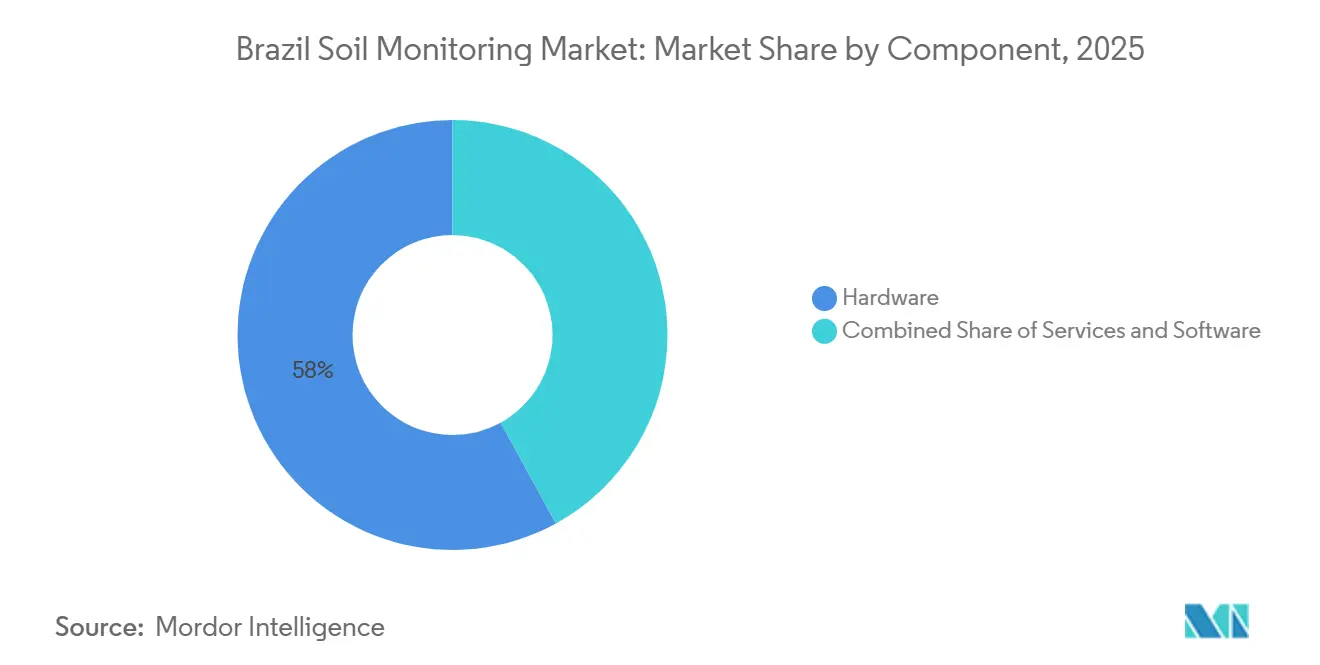
Hardware Anchors Revenue While Services AcceleratesHardware accounted for 58.0% of the Brazil soil monitoring market in 2025, reflecting the purchasing preferences of large farm operators. Soil moisture probes, electrical conductivity sensors, and data loggers are the core physical products in this market. Many farm operators prefer to own the installed equipment that generates their field records, particularly on broad-acre farms with recurring measurement needs. Hardware also establishes the initial installed base for software and advisory services. Multi-parameter devices allow users to collect several readings from the same location, though their value depends on calibration quality and how easily the data integrates into daily farm operations. Hardware therefore remains a significant component of the market even as service-led models grow.
The services segment is forecast to expand at a 16.3% CAGR between 2026 and 2031. Managed offerings can include installation, calibration, data interpretation, and agronomic recommendations, addressing the operational gap between collecting a reading and making a field decision. In 2026, METER Group introduced the SOLYX 14 sensor, which enables simultaneous dielectric permittivity and pore-water conductivity measurement. This product direction supports differentiation based on measurement quality rather than basic equipment specifications. Software can generate recurring revenue by converting hardware readings into farm recommendations. The Brazil soil monitoring market is therefore moving toward a model in which device performance and ongoing support are closely connected.

By Product Type:
In-Situ Sensors Lead, Remote Sensing Reframes CompetitionIn-situ sensors accounted for 46.0% of the Brazil soil monitoring market in 2025. Their installed base is supported by irrigated soy and corn farms that require continuous field moisture readings. Tensiometers, capacitance probes, and time-domain reflectometry (TDR) sensors are used for this purpose. These products offer direct measurement at the point where irrigation and nutrient decisions are made. Their value increases when readings are maintained consistently over time, which creates a need for field maintenance and appropriate soil calibration. Suppliers serving these deployments compete on reliability, installation support, and practical data usability. In-situ products remain the primary physical link between a soil profile and a farm's operating plan.
Remote-sensing platforms are forecast to expand at an 18.1% CAGR between 2026 and 2031. These platforms use satellite or drone imagery to extend field observation beyond fixed sensor points. Artificial intelligence can convert imagery into prescription files, reducing the need for separate specialist analysis. This capability can make remote sensing more accessible to mid-sized farms. However, it does not eliminate the need for local soil measurements where detailed root-zone conditions are relevant. The two approaches provide different views of the same field and can be used together. Portable probes and test kits also serve input retailers that provide diagnostics during farm visits. The Brazil soil monitoring market supports a broader set of use cases when remote sensing, portable testing, and installed sensors are used in combination.
By Connectivity Technology:
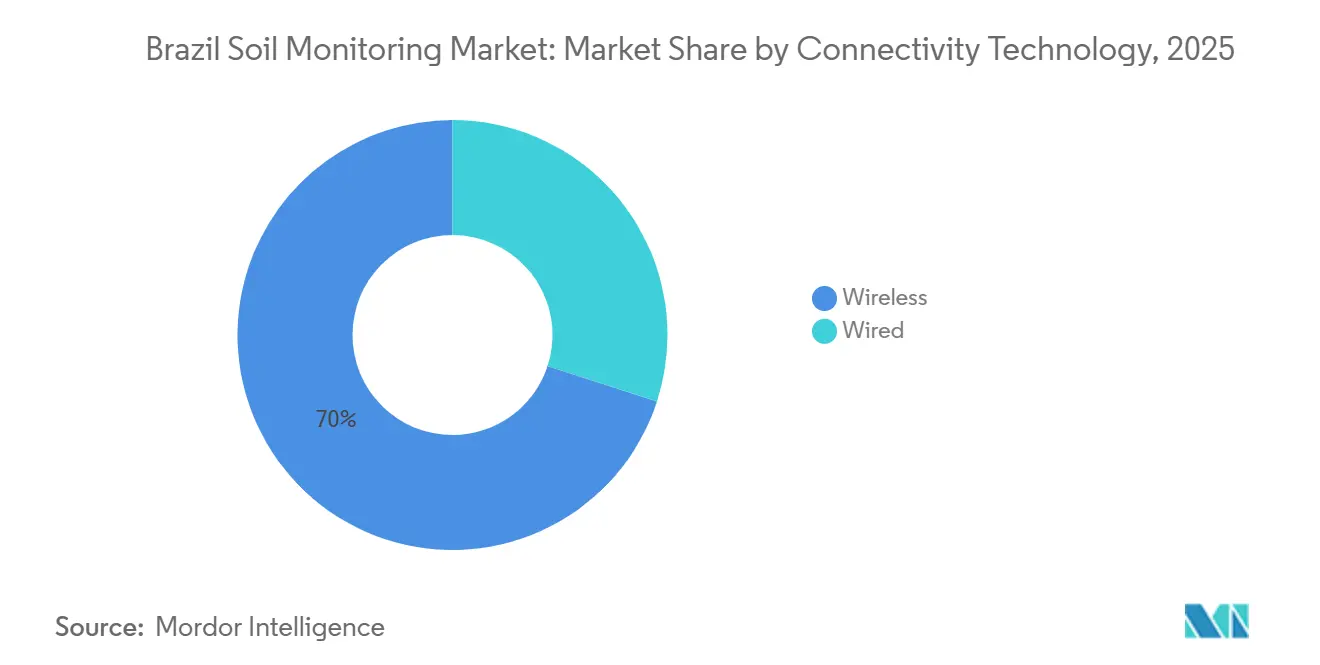
Wireless Dominates, Satellite Closes the Coverage GapWireless connectivity accounted for 70.0% of the Brazil soil monitoring market share in 2026. This category includes LPWAN, cellular, and satellite links, a mix suited to farms that cover large areas and cannot rely on a single wired network. TIM Brasil reported that its narrowband Internet of Things (NB-IoT) network covered 54 million agricultural hectares and 348,000 rural properties in 2026[3]. The network provides a terrestrial option for connected farm devices and illustrates the scale required to support wide-area agricultural monitoring. Wireless designs can match connection type to local geography and power availability, and this flexibility supports their role as the operating standard for broad-acre farms.
Wireless connectivity is forecast to expand at a 19.8% CAGR between 2026 and 2031. Satellite IoT services can extend data transmission to areas where terrestrial coverage is unavailable. In March 2026, São Martinho and Vivo announced a project involving 44 telecommunications towers across 3 million hectares, using 4G, NB-IoT, and long-term evolution for machines (LTE-M) signals in agricultural areas. Wired systems retain a role in protected cultivation and research settings where consistent local transmission can justify installation costs, though their relevance is lower in dispersed open-field locations. The future connectivity model is likely to remain hybrid, as coverage and service conditions vary widely between regions.
By Application:
Open Field Anchors Volume, Protected Cultivation AcceleratesOpen-field applications accounted for 63.0% of the Brazil soil monitoring market in 2025. Soy, corn, sugarcane, and cotton represent the majority of monitored land in this application. These crops are cultivated across large areas where small errors in water or input decisions can result in significant costs. The Brazilian Agricultural Research Corporation (Embrapa)'s AFERE (Soil Fertility Assessment and Fertilization Recommendation) platform supports soil fertility evaluation and fertilizer recommendations for field production systems, giving producers a reference point for applying soil information to agronomic decisions. Open-field deployments typically require durable equipment and connectivity capable of operating across large distances. This application therefore favors solutions that combine direct measurement, field mapping, and operational integration, making it the core volume base for the Brazil soil monitoring market.
Protected cultivation is forecast to expand at a 16.8% CAGR between 2026 and 2031. Greenhouse and high-value horticulture operations require close monitoring of substrates and local root-zone conditions. Their requirements differ from large open fields, as readings may need to guide more frequent irrigation decisions. The higher value of crops in these operations can support more intensive sensor use. Forestry applications are smaller in scale but may require soil water tension monitoring across large eucalyptus and pine plantations, creating sizable procurement opportunities for suppliers that meet plantation operating requirements. Each application has a different balance between sensor density, connectivity, service, and data interpretation. This diversity limits the effectiveness of a single product design for all Brazilian farming conditions.
By End User:
Large Farms Drive Volume, Research Institutes Accelerate the EcosystemLarge commercial farms accounted for 42.0% of the Brazil soil monitoring market in 2025. This share reflects their extensive irrigated land and greater access to commercial lending and cooperative finance. These farms can deploy integrated hardware, software, and advisory arrangements across multiple fields. Their procurement decisions often serve as a reference point for smaller operations and cooperative members. Large farms also have the staff required to act on frequent data flows, making them central customers for suppliers seeking to demonstrate equipment performance at scale. Their requirements favor systems that connect with machinery and farm management platforms, and the large fleets of devices they operate create consistent demand for support services.
Research institutes and universities are forecast to expand at a 16.4% CAGR between 2026 and 2031. The Brazilian Agricultural Research Corporation (Embrapa) launched the BR Soil Health Platform in November 2025 at COP30 in Belém, Brazil, providing open access to soil-health data from more than 52,000 samples across all Brazilian states through interactive maps and indicators covering biological, physical, and chemical soil characteristics. Research deployments can help validate local sensor performance, improve soil interpretation, and create a shared evidence base for producers, suppliers, and public programs. Smallholder and cooperative farms remain important segments where services help reduce upfront costs. Government and non-governmental organization (NGO) procurement can support environmental monitoring and reforestation programs that require soil records. These user groups broaden the Brazil soil monitoring market beyond private large-farm purchases.
Geography Analysis
The Cerrado is the largest geographic demand area in the Brazil soil monitoring market due to its concentration of large commercial farms and complex soil management requirements. Its Oxisol and Latosol profiles are characterized by high acidity, aluminum toxicity, and phosphorus fixation, which increase the importance of accurate lime, gypsum, irrigation, and fertilizer decisions. A 2024 study published in MDPI Agriculture found that lime applications above 10 metric tons per hectare in newly converted Cerrado soy areas reduced phosphorus and micronutrient uptake. This finding supports greater use of localized soil data prior to large-scale correction decisions. Mato Grosso is a significant contributor to this demand, as large farm units in the state can finance full sensor and data deployments. Goiás and Mato Grosso do Sul share similar demand factors driven by broad-acre production and soil variability.
The South and Southeast form a denser demand area per hectare, as coffee, citrus, horticulture, and other higher-value crops support intensive monitoring. Paraná benefits from the Brazilian Agricultural Research Corporation (Embrapa) Soja's technical base in Londrina and its role in soil fertility guidance. Cooperative networks also enable farms to share technical knowledge and reduce individual capital requirements. In 2025, Lacuna Space and Wyld Networks collaborated with Embrapa on real-time connectivity for soil and irrigation monitoring in São Sebastião do Paraíso, demonstrating how satellite services can be validated with Brazilian research partners. Local crop diversity generates demand for solutions that support varied irrigation and nutrient management practices, making these regions important markets where service quality and calibration can justify more intensive deployments.
MATOPIBA (Maranhão, Tocantins, Piauí, and Bahia) is the fastest-growing geographic area in the Brazil soil monitoring market, supported by expanding agricultural activity and increasing pressure on water resources. Rising irrigation demand is strengthening the need for soil moisture monitoring to improve water-use efficiency and guide irrigation decisions. The region’s remote agricultural areas also increase the importance of reliable connectivity and field support, with satellite and hybrid network solutions helping address these requirements. Basin-level water allocation requirements are further encouraging farms to integrate water management with soil moisture monitoring. Together, water stress, expanding agricultural infrastructure, and production growth are creating opportunities for soil monitoring solutions across MATOPIBA.
Competitive Landscape
The Brazil soil monitoring market had a fragmented structure in 2025, with the top five players, METER Group, Inc., Solinftec Tecnologia Agrícola Ltda., Stevens Water Monitoring Systems, Inc., SENTEK PTY. LTD, and CropX Technologies, Inc. Hardware patents and proprietary data platforms are important competitive tools. Sensors can be differentiated by measurement depth, parameter range, durability, and calibration performance. Data platforms can also make supplier changes harder when farm records and workflows are already integrated. Local installation and agronomic support remain important because Brazilian soils require regional interpretation. The market does not support a simple global hardware-only strategy. Players need to demonstrate that their systems can deliver reliable readings under local field conditions.
CropX Technologies, Inc. launched its Apex multi-depth soil sensor in April 2026. The product supports configurable 12-inch, 24-inch, and 36-inch configurations and measures root-zone salinity and temperature. This targets irrigated grain and sugarcane applications where root-zone detail is important. Pessl Instruments GmbH and IMKO Mikromodultechnik GmbH are extending their reach through local distributors and technical service networks. Their competitive position relies on more than device specifications, as installation and calibration can affect customer outcomes. Players that offer responsive post-sale service can retain customers even where product specifications are similar. The Brazil soil monitoring market therefore places value on local delivery capability alongside device innovation.
Brazilian platforms Solinftec Tecnologia Agricola Ltda. and Agrosmart Tecnologia Ltda. compete by combining field data with broader farm and supply chain information. Solinftec Tecnologia Agricola Ltda. uses soil and field data in machine-level operational decisions, raising the standard for platform integration. Agrosmart Tecnologia Ltda.'s Nexus platform uses climate and soil data for environmental, social, and governance (ESG) and measurement, reporting, and verification (MRV) services. CropX Technologies, Inc. integrated with the Cool Farm Platform in May 2026 for Scope 3 reporting, soil organic carbon (SOC) MRV, and greenhouse gas reporting. Low-cost cooperative bundles and offline-first services remain areas where no single supplier dominates. Integrated services that combine irrigation, fertilizers, and carbon programs may be more compelling than standalone device sales.
Brazil Soil Monitoring Industry Leaders
-
METER Group, Inc.
-
Stevens Water Monitoring Systems, Inc.
-
SENTEK PTY. LTD
-
CropX Technologies, Inc.
-
Solinftec Tecnologia Agrícola Ltda.
- *Disclaimer: Major Players sorted in no particular order
Brazil Soil Monitoring Market Companies Covered in this Report
- METER Group, Inc. (Campbell Group, Inc.)
- Stevens Water Monitoring Systems, Inc.
- SENTEK PTY. LTD
- CropX Technologies, Inc.
- Pessl Instruments GmbH
- IMKO Mikromodultechnik GmbH (Endress+Hauser Group)
- Irrometer Company, Inc.
- Delta-T Devices Ltd
- PTx Trimble LLC (AGCO Corporation)
- Deere and Company
- Topcon Positioning Systems, Inc. (Topcon Corporation)
- Yara International ASA
- Solinftec Tecnologia Agricola Ltda.
- Agrosmart Tecnologia Ltda.
Recent Industry Developments in Brazil Soil Monitoring Market
- December 2025: MapBiomas launched its third national soil collection alongside the SoilData open-access platform, providing soil-property data from more than 45,000 samples collected at 15,000 locations, including information on soil texture, organic carbon, bulk density, and coarse fragments across Brazil.
- November 2025: The Brazilian Agricultural Research Corporation (Embrapa) launched the Soil Health BR Platform at COP30 in Belém, an open-access digital system aggregating over 56,000 soil samples from 1,502 municipalities across all Brazilian states, built on its BioAS bioanalysis technology to support regenerative agriculture, low-carbon farming, and national soil health monitoring.
- June 2025: Regrow Ag announced a strategic partnership with Embrapa to calibrate its DNDC biogeochemical model for Brazilian tropical soils, establishing a technical framework for monitoring, reporting, and verification (MRV) of greenhouse gas emissions and carbon sequestration across agricultural soils, unveiled at the LAC Soil Carbon 2025 symposium in Rio de Janeiro, Brazil.
- January 2025: Marfrig, in partnership with Agrorobótica, adopted a NASA-calibrated laser-AI soil analysis system that reduces soil carbon assessment time from 20 days to approximately 20 seconds, with plans to extend the technology to its beef-supplier network for carbon baseline measurement and credit generation under regenerative agriculture programs.
Brazil Soil Monitoring Market Report Scope
The Soil Monitoring Market refers to the market that focuses on the use of technology to monitor soil conditions, which is crucial for agriculture and environmental management. It encompasses various components and is driven by the need for real-time data on soil parameters such as moisture, temperature, and nutrient content.
The Brazil Soil Monitoring Market Report is Segmented by Component (Hardware, Software and Services), by Product Type (In-Situ Sensors, Remote-Sensing Platforms and Portable Probes and Test Kits), by Connectivity Technology (Wired and Wireless), by Application (Open Field, Protected Cultivation and Forestry), and by End-User (Large Commercial Farms, Smallholder and Cooperative Farms Research Institutes and Universities and Government and NGOs). The Market Forecasts are Provided in Terms of Value (USD).
Segmentation Overview
| Hardware |
| Software |
| Services |
| In-Situ Sensors |
| Remote-Sensing Platforms |
| Portable Probes and Test Kits |
| Wired |
| Wireless (LPWAN, Cellular, Satellite) |
| Open Field |
| Protected Cultivation |
| Forestry |
| Large Commercial Farms |
| Smallholder and Cooperative Farms |
| Research Institutes and Universities |
| Government and NGOs |
| By Component | Hardware |
| Software | |
| Services | |
| By Product Type | In-Situ Sensors |
| Remote-Sensing Platforms | |
| Portable Probes and Test Kits | |
| By Connectivity Technology | Wired |
| Wireless (LPWAN, Cellular, Satellite) | |
| By Application | Open Field |
| Protected Cultivation | |
| Forestry | |
| By End User | Large Commercial Farms |
| Smallholder and Cooperative Farms | |
| Research Institutes and Universities | |
| Government and NGOs |
Key Questions Answered in the Report
What is the Brazil soil monitoring market size?
The Brazil soil monitoring market is valued at USD 77.8 million in 2026 and is forecast to reach USD 139.9 million by 2031, at a 15.80% CAGR between 2026 and 2031.
Why are farms adopting soil monitoring in Brazil?
Large farms use soil data for irrigation, fertilizer decisions, and machine operations, while water pressure is increasing demand for moisture monitoring.
What limits adoption among small Brazilian farms?
High initial costs, limited institutional credit, rural connectivity gaps, and technical service needs limit deployment among many smallholders.
Which is the fastest growing segment under connectivity technology?
Wireless connectivity is forecast to expand at a 19.8% CAGR between 2026 and 2031, making it the fastest-growing in the segment.