
Brazil Social Commerce Market Size and Share
Market Overview
| Study Period | 2019 - 2030 |
|---|---|
| Forecast Data Period | 2025 - 2030 |
| Historical Data Period | 2019 - 2023 |
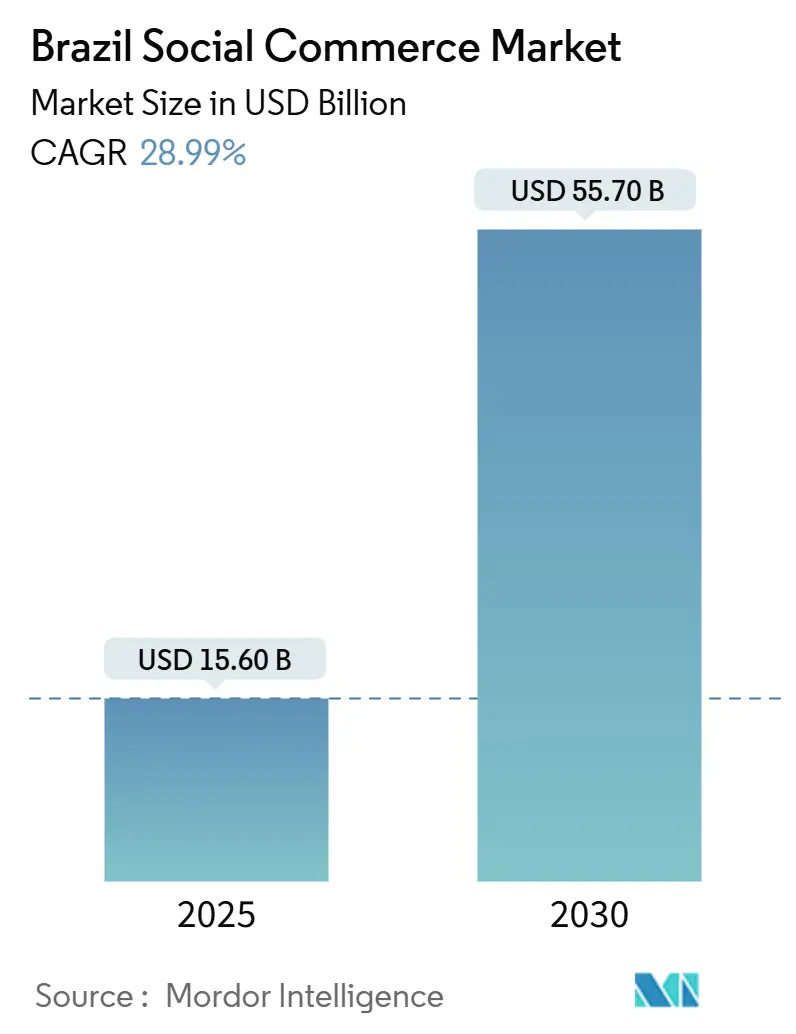
| Market Size (2025) | USD 15.60 Billion |
| Market Size (2030) | USD 55.70 Billion |
| Growth Rate (2025 - 2030) | 28.99 % |
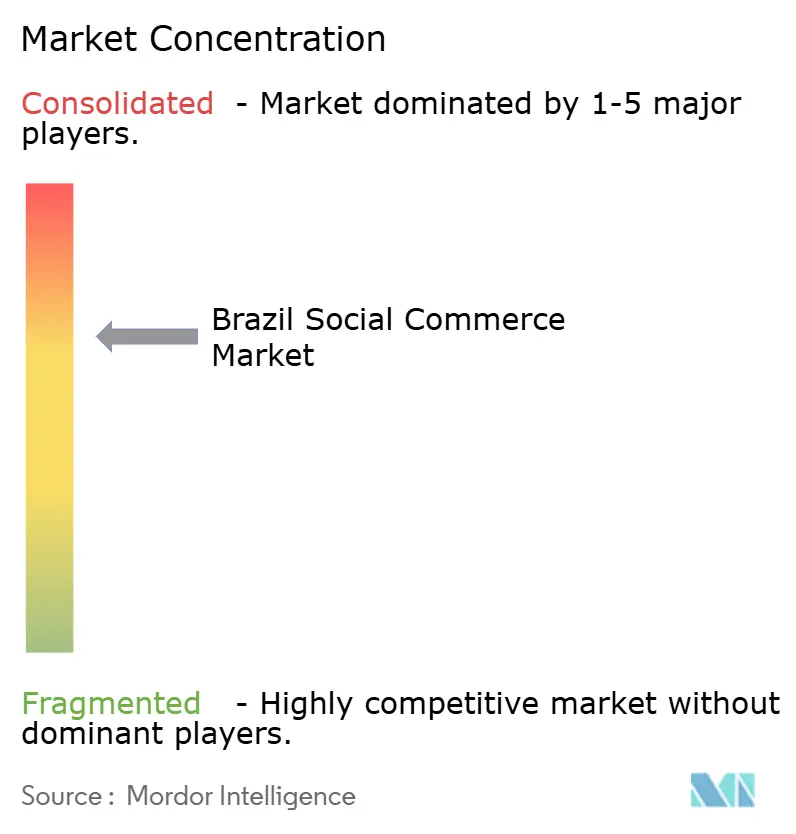
| Market Concentration | Medium |
Major Players *Disclaimer: Major Players sorted in no particular order Image © Mordor Intelligence. Reuse requires attribution under CC BY 4.0. | |
Brazil Social Commerce Market Analysis by Mordor Intelligence
The Brazil social commerce market size stands at USD 15.60 billion in 2025 and is forecast to reach USD 55.70 billion by 2030, registering a 28.99% CAGR. Robust instant-payment rails, near-universal social-media penetration, and purchasing habits that favor in-feed discovery all combine to keep the Brazil social commerce market in sustained hyper-growth. Ubiquitous PIX checkouts shorten the customer journey from inspiration to conversion, while smartphone-led browsing encourages quick, impulse-driven transactions. Intensifying platform competition is prompting feature rollouts such as live-stream shopping, AI-powered product tagging, and direct-message storefronts that deepen consumer engagement. Regulatory shifts—ranging from PIX Parcelado installments to new import duties—reshape operating economics yet also expand the addressable base of lower-income buyers. These factors collectively position the Brazil social commerce market as one of the world’s fastest-growing digital-retail arenas.
Key Report Takeaways
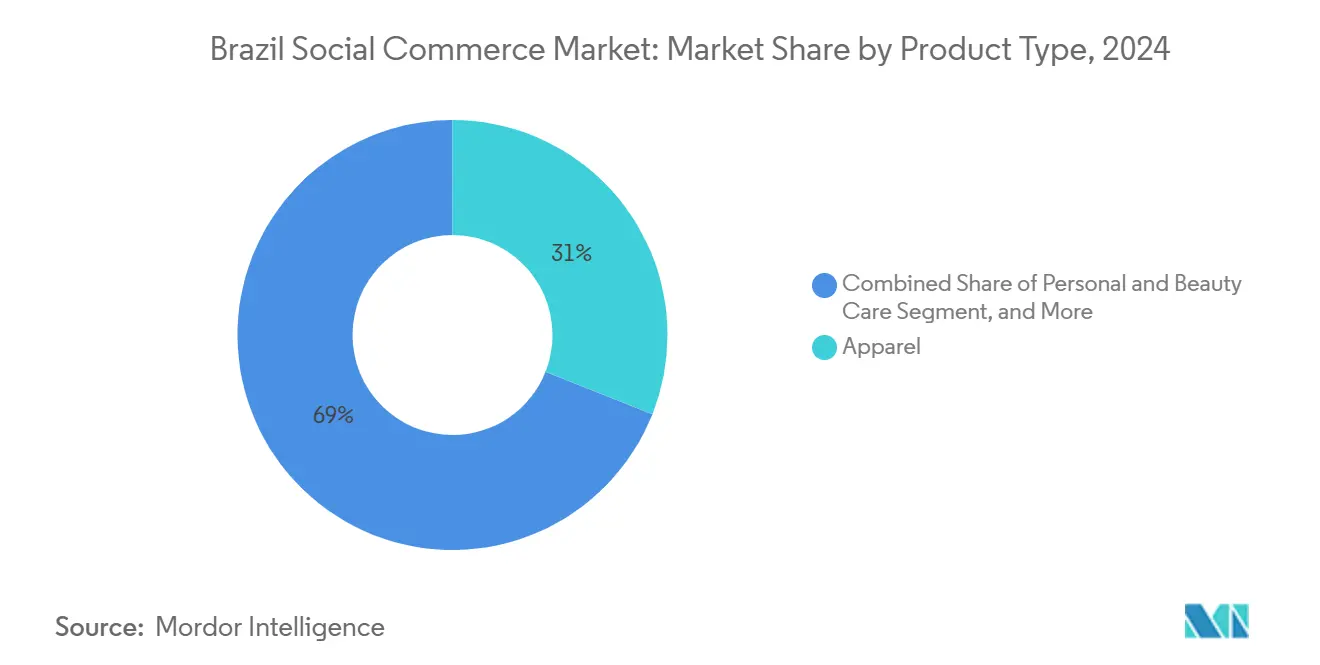
- By product type, Apparel led with 30.77% of Brazil social commerce market share in 2024, while Personal and Beauty Care is advancing at a 29.23% CAGR through 2030.
- By device, smartphones accounted for 90.11% of the Brazil social commerce market size in 2024 and are projected to expand at a 30.13% CAGR between 2025 and 2030.
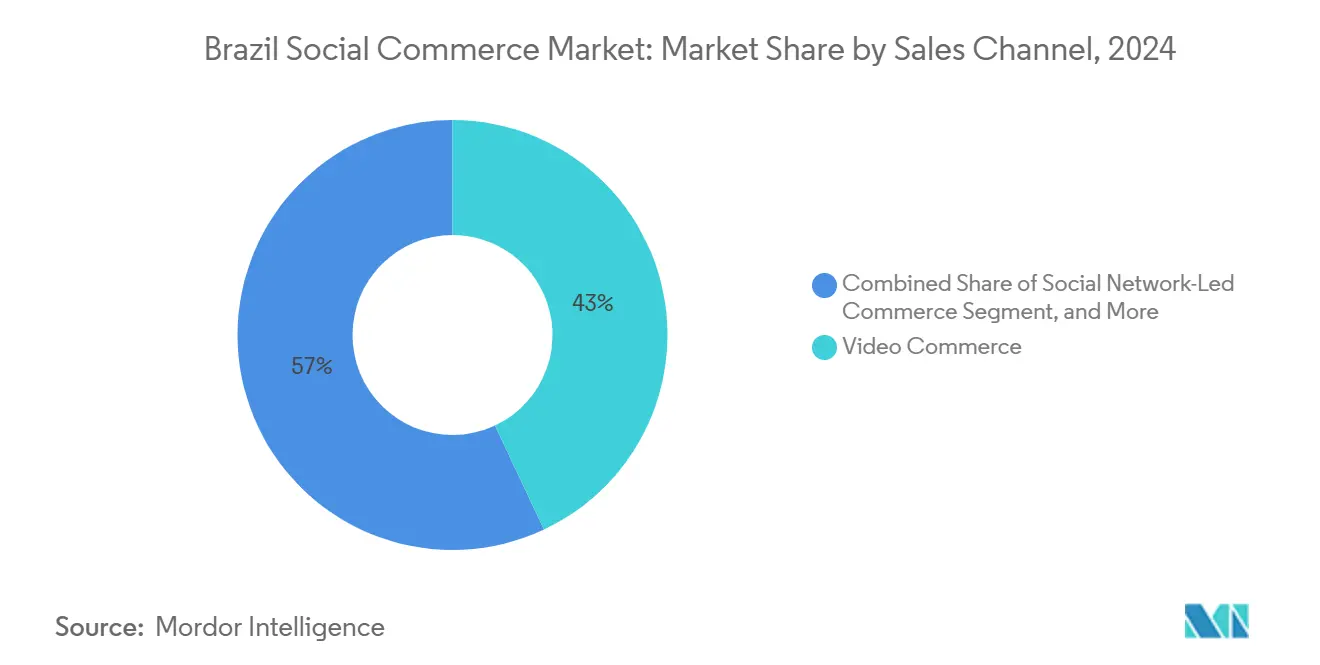
- By sales channel, video commerce captured 43.42% of the Brazil social commerce market share in 2024; social reselling is forecast to record the highest CAGR at 29.72% through 2030.
Brazil contributes to a system defined not by any single country or region but by the interaction of many. The global social commerce market data by Mordor Intelligence represents that combined structure.
Brazil Social Commerce Market Trends and Insights
Drivers Impact Analysis*
| Driver | (~) % Impact on CAGR Forecast | Geographic Relevance | Impact Timeline |
|---|---|---|---|
| WhatsApp-PIX checkout ubiquity | +8.2% | National; early gains in São Paulo, Rio de Janeiro, Minas Gerais | Medium term (2-4 years) |
| Creator-economy ad-spend surge | +6.5% | National; concentrated in Southeast and Northeast | Short term (≤2 years) |
| Embedded Meta Shops and Instagram Checkout | +5.8% | National; higher uptake in urban centers | Medium term (2-4 years) |
| Mobile 5G rollout and falling data prices | +4.7% | National; major metropolitan areas prioritized | Long term (≥4 years) |
| TikTok Shop low-fee seller onboarding | +3.9% | National; fashion and beauty focus | Short term (≤2 years) |
| PIX Parcelado enabling installments | +3.2% | National; benefits lower-income segments | Medium term (2-4 years) |
| Source: Mordor Intelligence | |||
WhatsApp-PIX Checkout Integration Transforms Conversational Commerce
Seamless payment inside WhatsApp chats eliminates the hand-off from social discovery to external checkout, a friction point that once suppressed conversion on the Brazil social commerce market. PIX settlement times measured in seconds improve micro-seller cash flow, encouraging more informal merchants to participate. Early adoption has clustered in São Paulo’s fashion districts, yet penetration is rapidly moving into Minas Gerais and Bahia as small businesses publicize positive results. Merchants note lower cart-abandonment rates because consumers never leave the chat thread, which preserves trust and immediacy. Together, messaging-first sales and instant payments are redefining the “storefront” as a conversational interface.
Creator-Economy Investment Surge Drives Platform Monetization
Global platforms upgraded native tools such as Meta’s Creator Marketplace and AI Studio in 2024, enabling data-driven brand-influencer matchmaking and chatbot-based customer care.[1]Meta Platforms, “Introducing AI Studio,” meta.com Brands now structure contracts around sales delivered rather than impressions, directly aligning incentives with revenue. This evolution draws a wider range of midsize creators into the Brazil social commerce market, widening product reach beyond Tier-A influencers. Sharper attribution also steers media budgets toward social commerce because return on ad spend is now more transparent. As measurement improves, even regulated categories such as OTC health products are testing shoppable live streams, further diversifying assortment.
Meta Shops Integration Accelerates Social Shopping Adoption
Instagram Shopping and Facebook Shops allow merchants to tag inventory in reels, carousels, and stories; visual AI then suggests similar items to undecided viewers. Domestic fashion labels report double-digit lift in click-throughs when using native checkouts relative to external redirects. Seamless transitions keep buyers inside the feed, sustaining dopamine-driven scrolling while removing page-load delays. Meta’s ad engine leverages the rising volume of in-app purchases to refine audience look-alikes, reducing acquisition costs for high-frequency advertisers. As a result, the Brazil social commerce market witnesses a feedback loop where better performance data spurs higher ad investment, which in turn amplifies marketplace liquidity.
5G Infrastructure Expansion Enables Rich-Media Commerce
By late 2024, Anatel reported significant 5G coverage across Brazil, enabling faster download speeds and reduced latency.[2]Agência Nacional de Telecomunicações, “5G Coverage Brazil 2024,” anatel.gov.br These advancements support high-definition live shows, multi-angle product demonstrations, and AR try-ons, which previously faced limitations on 4G networks. Video-centric platforms like TikTok Shop benefit from improved viewer retention, offering a seamless experience on mobile devices. In Mato Grosso, rural cooperatives now stream real-time produce auctions to urban grocery buyers, demonstrating enhanced accessibility for sellers. Additionally, these capabilities improve post-purchase services, such as video-based customer support, contributing to better customer satisfaction and loyalty.
Restraints Impact Analysis*
| Restraint | (~) % Impact on CAGR Forecast | Geographic Relevance | Impact Timeline |
|---|---|---|---|
| Fraud and scam growth on social channels | −4.3% | National; higher in less digitally literate regions | Short term (≤2 years) |
| LGPD data-privacy compliance costs | −3.7% | National; heavier burden on small platforms | Medium term (2-4 years) |
| Import-duty hike on ≤USD 50 parcels (Law 14.902) | −2.8% | National; cross-border commerce affected | Long term (≥4 years) |
| Declining organic reach → rising CAC on Meta | −2.1% | National; impacts SMEs most | Medium term (2-4 years) |
| Source: Mordor Intelligence | |||
Social-Channel Fraud Undermines Consumer Trust
In 2024, scams associated with the PIX payment system led to significant financial losses, as reported by central-bank data. Fraudsters create fake profiles, misuse branded images, and attract shoppers with substantial discounts, requiring payments through instant transfers. Since these transactions are irreversible, victims rarely recover their funds, increasing the perceived risk. Platforms have implemented seller ID verification and machine-learning-based anomaly detection; however, fraud networks continue to adapt their methods. This rise in fraudulent activities diminishes trust among new buyers and pressures legitimate sellers to implement measures such as free returns and escrow-like payment holds to maintain credibility.
LGPD Compliance Creates Operational Overhead
Since October 2024, Brazil's national data-protection authority has enforced penalties for LGPD violations.[3]Autoridade Nacional de Proteção de Dados, “Multa LGPD,” gov.br Start-ups face challenges due to requirements such as mapping data flows, managing consent revocation, and ensuring localized data storage. Cross-border platforms must either establish data centers within Brazil or implement costly edge-processing solutions. Consequently, engineering teams are reallocating resources from growth-oriented features to privacy compliance measures, which slows product development. However, compliance helps mitigate reputational risks, an essential factor for achieving scalability in Brazil's social commerce market.
*Our forecasts treat driver/restraint impacts as directional, not additive. The impact forecasts reflect baseline growth, mix effects, and variable interactions.
Segment Analysis
By Product Type: Apparel Dominance Faces Beauty Disruption
Apparel held 30.77% of Brazil social commerce market share in 2024, validating the category’s historic strength in digital retail. Personal and Beauty Care, however, is projected to grow at a 29.23% CAGR, the fastest of any segment. Apparel’s resilience stems from well-established local supply chains and buyers’ familiarity with size exchanges, returns, and influencer styling videos that lower fit anxiety. Live-stream haul sessions, flash discount drops, and peer styling reels sustain shopper enthusiasm and repeat purchase frequency.
The Brazil social commerce market size for beauty products is forecast to widen sharply as creators pivot from affiliate links to in-app checkout, capturing impulse buys generated by tutorial videos. Skincare brands employ AR try-ons to demonstrate shade matching, turning subjective evaluation into real-time proof. Smaller categories such as home products and health supplements also benefit from storytelling but still lag due to logistical complexity or regulatory hurdles. Food and beverage transactions, buoyed by meal-delivery tie-ins, reveal future upside as instant-consumption verticals converge with social discovery.



By Device: Smartphone Supremacy Reinforced by 5G
Smartphones represented 90.11% of Brazil social commerce market share in 2024 and are tracking a 30.13% CAGR to 2030. The dominance is entrenched by cheaper data bundles, OLED screens that enhance product visualization, and system-level PIX shortcuts that speed checkout. Desktop usage remains relevant for intensive research purchases such as high-value electronics but continues to lose share as mobile UI improvements close functionality gaps.
The Brazil social commerce market size captured via mobile is expanding fastest in lower-income regions where smartphones leapfrog PCs altogether. Retailers optimize vertical video, one-hand navigation, and voice search to match on-the-go browsing habits. 5G unlocks additional features like HD live streams and multi-cam shopping events without buffering. As a result, merchants allocate creative budgets overwhelmingly to portrait-orientation content, and payment providers optimize biometric authentication for quick thumbprint confirmation.
By Sales Channel: Video Commerce Leadership Challenged by Social Reselling
Video commerce claimed 43.42% of Brazil social commerce market size in 2024, showcasing the persuasive power of motion and narrative. Hosts blend entertainment with urgency through limited-time coupon codes, driving on-air conversion rates as high as 30%. Algorithms prioritize watch-time, ensuring high-potential shows surface on personalized feeds, which broadens reach beyond incumbent followers.
Social reselling, forecast to rise to a 29.72% CAGR, turns everyday users into micro-franchises. Informal sellers curate catalogs via group chats, earn margins on collective orders, and leverage social trust innate to friends-and-family networks. Group buying and team purchase formats entice price-sensitive consumers, while product-review platforms supply objective validation that feeds both video commerce and reselling loops. Channel diversification signals a maturing Brazil social commerce market in which formats coexist and reinforce—rather than cannibalize—one another.
Geography Analysis
Southeast Brazil anchors the Brazil social commerce market, driven by São Paulo and Rio de Janeiro’s dense urban clusters, affluent consumers, and advanced fintech adoption. Early pilots of WhatsApp-PIX checkout launched here, providing proof points later replicated nationwide. Brands base social-commerce content studios in these cities, leveraging local creative talent and fulfillment hubs to shorten delivery windows.
The Northeast region is the fastest growing, benefiting from rising smartphone penetration and cultural emphasis on community. Informal artisans in Salvador leverage Instagram Shops to formalize cottage industries, selling regional crafts nationwide. Local governments run digital-literacy programs that teach PIX safety, mitigating fraud perceptions among first-time buyers.
Southern states such as Santa Catarina and Paraná demonstrate strong B2B social-commerce usage. Manufacturers promote spare parts via WhatsApp catalogs, linking directly to distributor payment portals. Higher average incomes also lift premium-category demand, especially for imported cosmetics that grew despite the new import duty.
Across the Central-West, agribusiness entrepreneurs stream live cattle auctions to urban investors, fusing traditional commodities with conversational bidding. Meanwhile, the North’s Amazon basin faces connectivity challenges, yet 5G rollout on key highways is opening niche sales of rainforest superfoods to national health-and-wellness audiences. Together, these patterns confirm that the Brazil social commerce market is national in scope yet regionally nuanced in growth triggers.
The social commerce market is analyzed by Mordor Intelligence across multiple other geographies. This is complemented by country-specific insights for Canada, India, China, and France, reflecting various localized market behavior and policy environments' coverage.
Competitive Landscape
The Brazil social commerce market is moderately concentrated yet highly contested. Meta’s Instagram and Facebook combine vast audiences with embedded shops, positioning the company as the de facto storefront for many SMBs. Mercado Libre supplements marketplace heft with advertising solutions that monetize seller traffic at scale. Magazine Luiza differentiates via omnichannel logistics and a super-app that merges content with same-day delivery.
TikTok Shop entered in April 2025 and immediately began courting creators through zero-commission promotions, tilting competitive dynamics toward video-first commerce. Amazon maintains a formidable presence in traditional e-commerce but trails in social integrations; its API partnerships are accelerating, evidenced by experiments embedding Amazon carts within influencer livestreams. VTEX’s acquisition of conversational-commerce specialist Weni underscores the strategic importance of automated WhatsApp storefronts.
Strategic partnerships continue to shape the battlefield. Magazine Luiza’s tie-up with AliExpress expanded cross-border assortment while leveraging domestic fulfillment for last-mile speed.[4]Reuters, “Magalu se associa com AliExpress,” reuters.com Payment innovation acts as a second axis of differentiation: PagSeguro and StoneCo race to roll out PIX Parcelado features for merchants ahead of competitors. As LGPD compliance costs climb, scale players wield legal infrastructure as a barrier to entry, while start-ups pivot to niche verticals where smaller user bases limit compliance overhead.
Brazil Social Commerce Industry Leaders
Meta Platforms, Inc.
Mercado Libre, Inc.
ByteDance Ltd.
Sea Ltd.
Amazon.com, Inc.
- *Disclaimer: Major Players sorted in no particular order

Recent Industry Developments
- September 2025: Pix Parcelado, a payment rail integrated into Brazil's Pix instant payment network, introduces installment payments and credit offerings. This development is expected to increase competition with credit cards, influence retail and banking operations, and drive fintech advancements as digital payments continue to evolve. By enabling installment payments within the Pix system, Pix Parcelado challenges traditional credit card models and promotes financial inclusion. Merchants benefit from receiving immediate full payments, reducing exposure to credit risk, while consumers gain access to flexible, digital installment payment options. This initiative aligns with Brazil's mobile-driven shopping patterns and supports the growth of fintech solutions, enhancing the efficiency of social commerce.
- September 2025: Temu, a rapidly expanding eCommerce platform, has introduced its Local Seller Program in Brazil. This development represents a key step in Temu's global expansion strategy, creating new opportunities for Brazilian businesses and consumers. The program enables Brazilian businesses to sell directly to local consumers through Temu’s platform, improving delivery efficiency and customer experience. This localized approach supports economic activity, enhances brand visibility, and aligns with Brazil’s increasing adoption of social and mobile-driven shopping behaviors, reflecting its relevance in the evolving eCommerce market.
- May 2025: Outlandish, a global company specializing in live shopping and social commerce, has expanded into the Brazilian market through a strategic partnership with MindgruveMacarta, a firm focused on performance marketing, retail media, and data technology. This collaboration enables brands to establish a presence on TikTok Shop Brazil, addressing the growing demand for live, shoppable content in Latin America’s largest market. Outlandish and MindgruveMacarta will provide brands with a range of services, including content production, local influencer collaborations, logistics and fulfillment, compliance, and advertising, all tailored to Brazil’s evolving social commerce environment.
- March 2025: TikTok Shop had initiated its operations in Brazil by introducing integrated shopping tools and onboarding local sellers. Utilizing TikTok's extensive user base and short-video format, the platform enables streamlined product discovery and transactions within the app. By engaging local merchants and aligning with Brazil's mobile-first consumer behavior, TikTok Shop strengthens digital retail engagement, increases competition with platforms such as Mercado Libre and Shopee, and advances the integration of entertainment and e-commerce in the Brazilian market.


Brazil Social Commerce Market Report Scope
The Brazil Social Commerce Market Report is Segmented by Product Type (Apparel, Personal and Beauty Care, Accessories, Home Products, Health Supplements, Food and Beverages, Other Product Types), Device (Laptops and Desktops, Smartphone), Sales Channel (Video Commerce, Social Network-Led Commerce, Social Reselling, and Other Sales Channel Types), and Geography (Brazil). The Market Forecasts are Provided in Terms of Value (USD).
| Apparel |
| Personal and Beauty Care |
| Accessories |
| Home Products |
| Health Supplements |
| Food and Beverages |
| Other Product Types |
| Laptops and Desktops |
| Smartphone |
| Video Commerce |
| Social Network-Led Commerce |
| Social Reselling |
| Group Buying / Team Purchase |
| Product Review and Discovery Platforms |
| By Product Type | Apparel |
| Personal and Beauty Care | |
| Accessories | |
| Home Products | |
| Health Supplements | |
| Food and Beverages | |
| Other Product Types | |
| By Device | Laptops and Desktops |
| Smartphone | |
| By Sales Channel | Video Commerce |
| Social Network-Led Commerce | |
| Social Reselling | |
| Group Buying / Team Purchase | |
| Product Review and Discovery Platforms |


Key Questions Answered in the Report
What is the current size of Brazil's social commerce market?
The Brazil social commerce market is valued at USD 15.60 billion in 2025 and is projected to reach USD 55.70 billion by 2030, growing at a robust CAGR of 28.99% during the forecast period.
Which product category dominates Brazil's social commerce market?
Apparel leads the market with a 30.77% share in 2024, driven by fashion influencers, live shopping events, and the visual nature of clothing products that perform well on social platforms.
Which product segment is growing fastest?
Personal and Beauty Care is the fastest-growing segment with a 29.23% CAGR (2025-2030), fueled by beauty influencer marketing, skincare tutorials, and the rise of Brazilian beauty brands leveraging social selling.
What devices do Brazilian consumers primarily use for social commerce?
Smartphones dominate with a 90.11% market share in 2024, reflecting Brazil's mobile-first digital economy and the optimization of social commerce platforms for mobile experiences.
Which sales channel leads Brazil's social commerce market?
Video Commerce holds the largest share at 43.42% in 2024, leveraging Brazil's strong video content consumption culture and live shopping trends popularized by influencers and brands.
Page last updated on:


 Your data is secure and never sold or shared.


