
Brazil Secure Logistics Market Size and Share
Market Overview
| Study Period | 2020 - 2031 |
|---|---|
| Forecast Data Period | 2026 - 2031 |
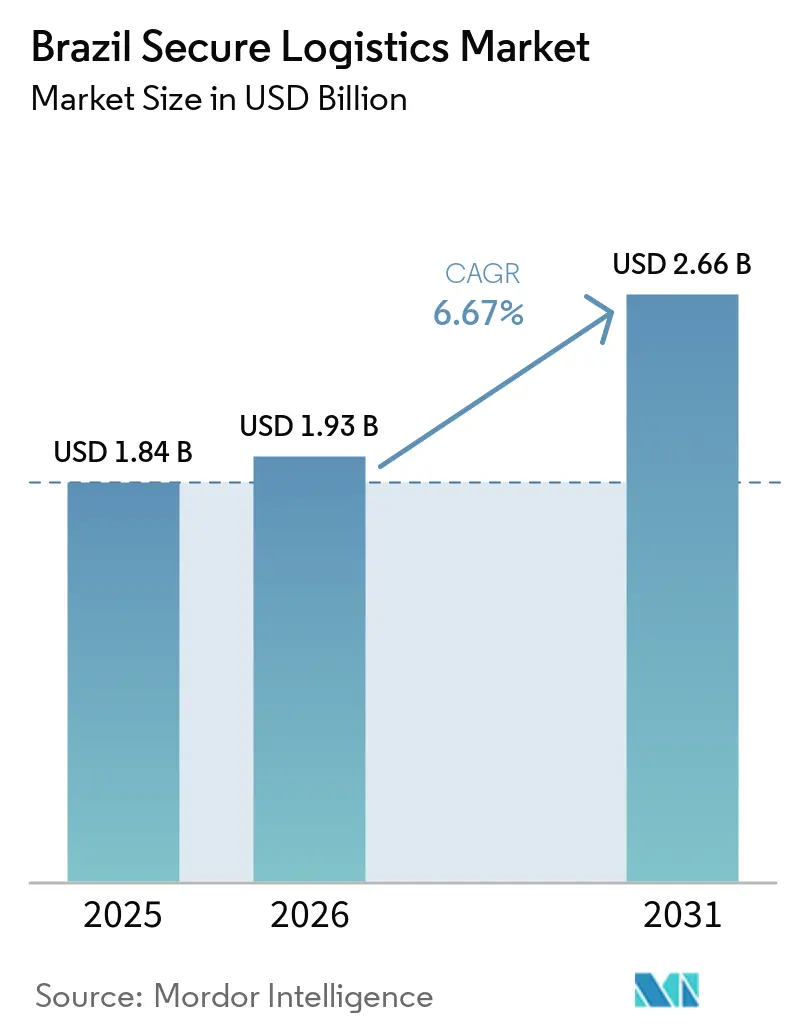
| Base Year Market Size (2025) | USD 1.84 Billion |
| Market Size (2026) | USD 1.93 Billion |
| Market Size (2031) | USD 2.66 Billion |
| Growth Rate (2026 - 2031) | 6.67 % |
| Market Concentration | Medium |
Major Players *Disclaimer: Major Players sorted in no particular order Image © Mordor Intelligence. Reuse requires attribution under CC BY 4.0. | |
Brazil Secure Logistics Market Analysis by Mordor Intelligence
The Brazil secure logistics market size was valued at USD 1.84 billion in 2025, and is estimated to grow from USD 1.93 billion in 2026 to reach USD 2.66 billion by 2031, at a CAGR of 6.67% during the forecast period (2026-2031).
The Brazil secure logistics market continues to serve cash flows that remain necessary across informal trade, rural commerce, public transfers, and ATM networks. Pix processed 79.8 billion transactions worth BRL 35.36 trillion (USD 638.79 billion) in 2025, growing 33.6% year over year, but this expansion did not remove the need for cash replenishment and secure vault services. Digital payments reduced cash use in parts of formal urban commerce, while the remaining physical flows required more specialized handling and distribution. Lei 14.967/2024 and Decreto 13.012/2026 raised operating and compliance requirements for fleets and services, favoring operators with established security capabilities. The Brazil secure logistics market also gained support from demand for the protected movement of high-value goods, including pharmaceuticals, electronics, jewelry, and precious metals.
Key Report Takeaways
- By service type, transportation held 63.15% of the Brazil secure logistics market share in 2025, while value-added services recorded the highest projected CAGR at 8.40% through 2031.
- By application, cash management held 60.25% of the Brazil secure logistics market size in 2025, while jewelry and precious metals recorded the highest projected CAGR at 9.20% through 2031.
- By type, mobile operations held 56.50% of the Brazil secure logistics market share in 2025 and recorded a CAGR of 7.02% through 2031.
- By end user, financial institutions held 47.55% of the Brazil secure logistics market size in 2025, while retailers recorded the highest projected CAGR at 7.50% through 2031.
Note: Market size and forecast figures in this report are generated using Mordor Intelligence’s proprietary estimation framework, updated with the latest available data and insights as of January 2026.
Brazil Secure Logistics Market Trends and Insights
Drivers Impact Analysis*
| Driver | (~) % Impact on CAGR Forecast | Geographic Relevance | Impact Timeline |
|---|---|---|---|
| Continued Cash Use in Informal and Underserved Trade | +1.5% | National, with concentration in Northeast and North Brazil | Medium term (2-4 years) |
| Expansion of ATM, Retail and Financial Inclusion Networks | +1.2% | National, with early gains in Northeast, North, and Center-West | Short term (≤ 2 years) |
| Escalating Organized Cargo Theft and Hijacking Exposure | +0.9% | Southeast, with 86% of 2025 incidents, and spillover to Northeast and North | Short term (≤ 2 years) |
| E-Commerce Concentration of High Value Inventory | +1.1% | São Paulo, Rio de Janeiro, and major distribution corridors | Medium term (2-4 years) |
| Mandatory Compliance Investment Under the Private Security Statute | +1.3% | National, with adoption pressure in large urban centers | Short term (≤ 2 years) |
| Secure Movement of Pharmaceuticals, Electronics, and Other High Liquidity Cargo | +0.8% | National, with concentration around São Paulo, Campinas, and Recife | Long term (≥ 4 years) |
| Source: Mordor Intelligence | |||
Continued Cash Use in Informal and Underserved Trade
Brazil’s informal economy supported cash-in-transit activity beyond what broad digital payment data showed. Pix transaction growth was concentrated among urban consumers with formal banking access, while informal traders, rural vendors, and social program beneficiaries continued to depend on cash distribution. Tecban’s mini Banco24Horas fleet reached 1,775 devices by the end of 2025, representing 177% growth from 2024. Tecban projected 1,000 additional installations by the end of 2026, and the Northeast led the existing rollout with 477 devices.[1]“Quase 70 trilhões de reais em transações de pagamento foram movimentados no segundo semestre de 2025,” Banco Central do Brasil, bcb.gov.br Each added terminal extended the routes that secure logistics providers had to serve. The Brazil secure logistics market, therefore, retained a role in areas where physical access to currency remained part of local commerce and public financial access.
Expansion of ATM, Retail, and Financial Inclusion Networks
Brazil’s bank branch network stood at 14,990 by the end of 2025, shifting cash handling toward ATM replenishment and off-branch custody. Tecban expanded its bank ATM substitution model in early 2026 to include Crefisa, Agibank, and Banco do Nordeste alongside its Banrisul agreement. The company managed nearly 25,000 Banco24Horas-branded ATMs and over 5,000 partner network ATMs as of August 2026. Outsourced terminals shifted replenishment, maintenance, and cash processing obligations to specialist providers. This model created recurring service work that was tied to network density rather than to the value of each payment.[2]“Lei nº 14.967, de 9 de setembro de 2024 — Estatuto da Segurança Privada e da Segurança das Instituições Financeiras,” Governo Federal do Brasil, planalto.gov.br For the Brazil secure logistics market, managed ATM networks supported continuing demand for scheduled replenishment and secure processing.
Escalating Organized Cargo Theft and Hijacking Exposure
Brazil accounted for 32% of global cargo hijacking incidents in 2025, despite a 5% decline from 2024. Organized networks increasingly targeted oncology drugs, electronics, and precious metals rather than bulk commodities. This change increased the value at risk per shipment even when incident totals fell. In Q2 2026, 97% of thefts remained concentrated in 10 states, and Rio de Janeiro represented 36.6% of national financial losses in H1 2026. Prosegur identified specialty loads valued at up to USD 350,000 per trip in this operating environment. The Brazil secure logistics market benefited, where shippers selected armored and GPS-monitored transport for these higher value loads.
E-Commerce Concentration of High Value Inventory
E-commerce growth concentrated on electronics, luxury goods, and specialty chemicals at distribution centers in major metropolitan corridors. This inventory profile raised demand for physical access barriers, video monitoring, and armored last-mile services. Portaria Coana 200/2026 will require real-time GPS tracking for customs transit road shipments from October 2026. The rule will also require automated alerts for route deviations and stops longer than 30 minutes. Operators with established satellite monitoring infrastructure entered this requirement with a practical advantage. Grupo Protege’s OEA-S certification showed its documented supply chain security capability for customs-related high-value cargo. The Brazil secure logistics market gained opportunities where distribution and customs processes required auditable security controls.
Restraints Impact Analysis*
| Restraint | (~) % Impact on CAGR Forecast | Geographic Relevance | Impact Timeline |
|---|---|---|---|
| Pix and Digital Payment Substitution of Physical Cash | -1.8% | National, most acute in formally banked urban São Paulo and Rio de Janeiro centers | Medium term (2-4 years) |
| High Cost of Armored Fleets, Qualified Personnel, and Insurance | -0.9% | National, with greater severity for mid market regional operators | Medium term (2-4 years) |
| Fragmented Road Infrastructure and Route Volatility | -0.6% | North, Center-West, and remote Northeast areas | Long term (≥ 4 years) |
| Tightening Entry Requirements and Operating Restrictions | -0.4% | National, affecting new entrants and operators seeking license renewals | Medium term (2-4 years) |
| Source: Mordor Intelligence | |||
Pix and Digital Payment Substitution of Physical Cash
Pix became Brazil’s dominant payment system and created a persistent constraint on traditional cash-in-transit activity. It represented 54.7% of retail payment transactions in H2 2025, up from 47% in Q3 2024. Account-to-account payments reached 42% of e-commerce value and 34% of point-of-sale transaction value during H2 2025. Pix processed 7.4 billion transactions in March 2026. This use reduced physical cash volumes in formal urban commerce and affected traditional revenue per route.[3]Banco Central do Brasil, “Pix consolida liderança nos pagamentos digitais e projeta novas evoluções até 2030,” Banco Central do Brasil, bcb.gov.br The Brazil secure logistics market still served cash that became concentrated in informal channels and ATM replenishment cycles, where security needs remained substantial.
High Cost of Armored Fleets, Qualified Personnel, and Insurance
Armored fleet procurement, specialized personnel, and insurance created a high fixed cost base for secure logistics providers. Analysis placed individual armored truck procurement costs between USD 150,000 and USD 350,000, depending on ballistic resistance specifications. Insurance costs increased as exposure to attacks remained elevated. Statutory capital, vehicle certification, and staffing obligations were added to these financial requirements. These costs limited margin expansion for regional operators with lower route density.[4]“PRF adequa convênios para operações conjuntas,” Governo Federal do Brasil, gov.br/prfThe Brazil secure logistics market retained barriers that reduced the number of providers able to finance compliant operations.
*Our forecasts treat driver/restraint impacts as directional, not additive. The impact forecasts reflect baseline growth, mix effects, and variable interactions.
Segment Analysis
By Service Type: Cash Cycle Integration Reshapes Transport Economics
Transportation held 63.15% of the Brazil secure logistics market share by service type in 2025. Armored road fleets connected Brazil’s 5,570 municipalities with cash-dependent commerce and financial access points. Road transport remained the core mode for regular route coverage. Air transport served ultra-high-value pharmaceutical shipments on specialized corridors. Sea and inland waterway transport supported remote Amazon communities. The Brazil secure logistics market size for transportation reflected the broad geographic requirement for protected physical movement. Warehousing and storage provided recurring revenue through vault services and contracted secure storage. Financial institutions used these services when they outsourced custody through multiyear managed service arrangements.
Value-added services recorded the fastest projected growth at 8.40% CAGR through 2031. These services included cash counting, banknote authentication, ATM replenishment management, and digital reconciliation. Prosegur launched a physical currency payment terminal for retail acceptance in May 2026, extending its offer beyond vehicle operations. The Brazil secure logistics market moved toward combined transport, processing, custody, and payment support services.
By Application: Precious Metals Logistics Emerges as a High Margin Growth Vertical
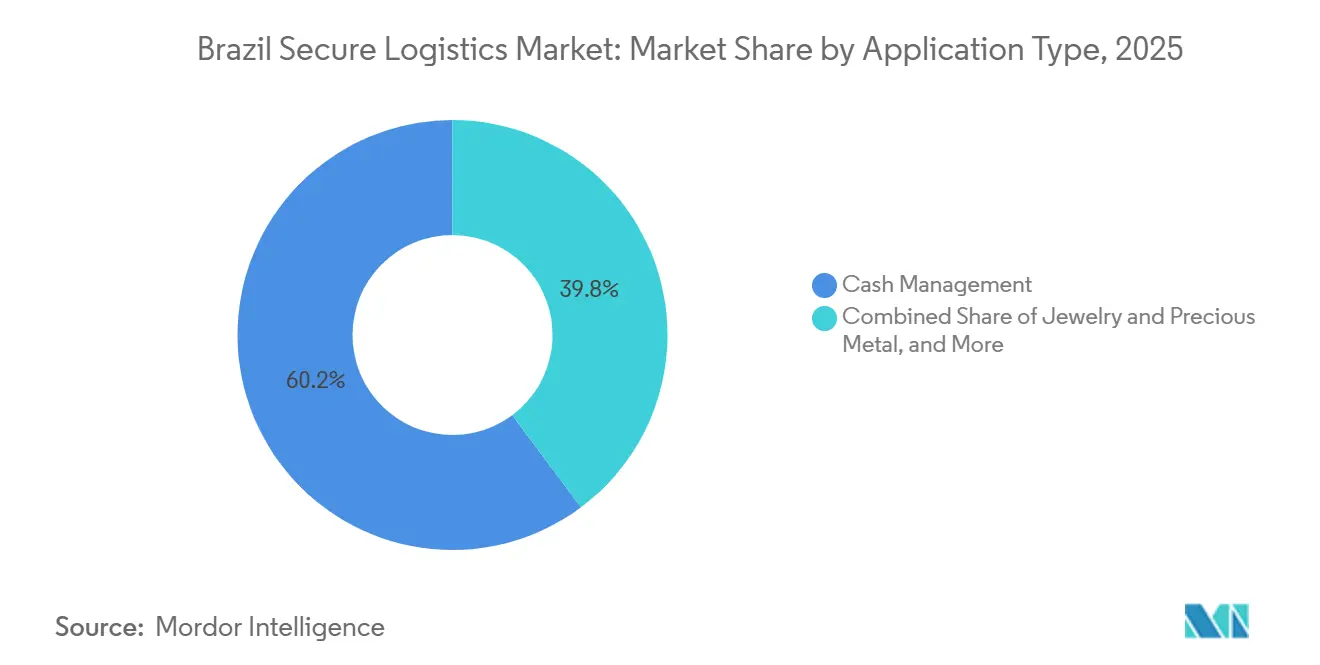
Cash management accounted for 60.25% of the Brazil secure logistics market share revenues by application in 2025. Banks, ATM networks, and retail chains required contracts for processing, counting, custody, and physical currency redistribution. Caixa Economica Federal contracted Prosegur for cash transport and custody in Goias in September 2026. The contract covered Itumbiara units and lottery outlets and was valued at USD 510,000 under Contract 08070/2026. This public banking agreement showed the contractual base supporting Brazil's secure logistics market size for cash management. Diamonds and Manufacturing remained smaller applications in Sao Paulo and Rio de Janeiro commercial hubs.
Jewelry and precious metals recorded the fastest projected growth at 9.20% CAGR through 2031. Elevated commodity valuations and planned gold traceability rules supported demand for documented, protected movement. PL 3025/2023 advanced under an urgency regime in Congress in 2026 and covered electronic invoicing and digital transport documentation across the gold supply chain. Brink’s partnered with IBGM for the 80th Feninjer jewelry fair in 2025 and provided logistics for nearly 30 exhibitors. The service covered armored vans and end to end custody. The Brazil secure logistics industry therefore addressed a specialized application with higher security and documentation needs.



By Type: Mobile Operations Defend Both Share and Growth Rate
Mobile operations held 56.50% of the Brazil secure logistics market size by type in 2025. Armored fleet coverage remained the principal service differentiator across diverse routes and municipalities. Mobile operations also recorded a projected CAGR of 7.02% through 2031. Tecban’s mini ATM rollout in Northeast and North secondary cities added cash withdrawal locations beyond established armored networks. The Brazil secure logistics market size for Mobile operations remained linked to the need to actively replenish and collect cash across this expanding footprint. Geographic coverage kept vehicle deployment central to the service model.
Static solutions included fixed vault facilities and on-premises cash management services. These services grew more slowly as financial institutions used asset-light arrangements and outsourced vault infrastructure. Brink’s Brasil replaced light vehicles with electric models in early 2026 while its AMS division managed 175,000 ATM terminals globally. Brink’s launched the B-POD modular banking hub at Febraban Tech 2026 in August. The B-POD placed intelligent safe infrastructure within bank and retailer locations. This approach reduced vehicle visit frequency while adding on-site processing revenue under unified contracts.
By End User: Retailers Redefine Security Requirements Beyond Cash
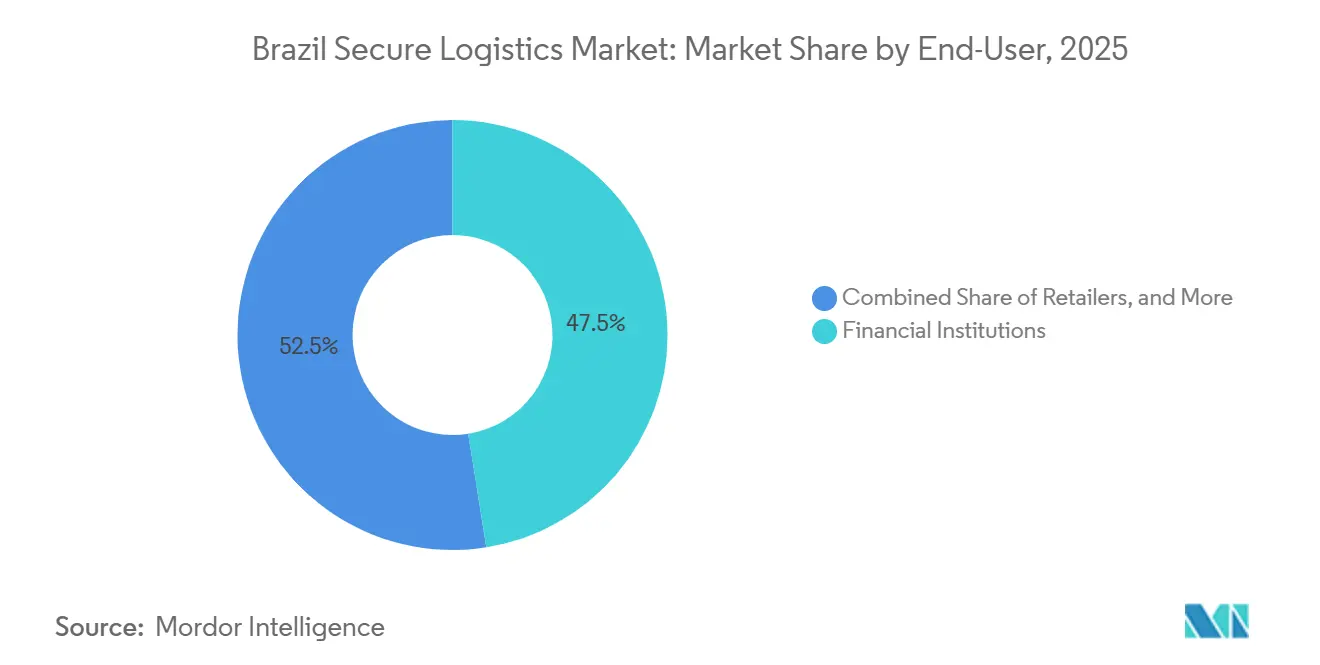
Financial institutions accounted for 47.55% of the Brazil secure logistics market share by end-user demand in 2025. Bank branches, ATM networks, and banking correspondents each required cash replenishment and vault servicing under formal agreements. Government demand included currency distribution, treasury disbursements, and custody of seized assets. These functions provided a stable base for the Brazil secure logistics market. Contractual requirements remained important even as payment preferences changed. Financial institutions, therefore, continued to anchor regular service volumes.
Retailers recorded the highest projected CAGR at 7.50% through 2031. Omnichannel retail concentrated high-value inventory at fulfillment nodes and increased the protection required for stock movement. Pharmaceutical distributors, electronics manufacturers, and luxury importers also needed armored vehicle services rather than standard freight for certain loads. The Others category included mining, healthcare, and luxury goods. Brink’s BrinksLog served electronics, jewelry, luxury goods, mining, and pharmaceutical clients, while Prosegur targeted consumer electronics and specialty medicines starting from 2026. These client groups often selected full-service providers with Federal Police authorization and IATA cargo agent certification.
Geography Analysis
The Southeast anchored the Brazil secure logistics market by revenue concentration and operating complexity. Sao Paulo accounted for 35.7% of cargo theft incidents in Q3 2025, while Rio de Janeiro accounted for 30.5%. Rio de Janeiro also accounted for 36.6% of national financial losses from cargo theft in H1 2026. Urban last-mile operations represented 39.6% of Southeast loss exposure in H1 2026, compared with 20.4% a year earlier. This pattern increased investment in route randomization, GPS-triggered anti-robbery measures, and real-time command platforms. Decreto 13.012/2026 compliance requirements were most extensively enforced in Southeast operations. These conditions supported premium pricing for certified armored logistics services.
The Northeast represented the highest growth corridor in the Brazil secure logistics market. Financial inclusion and ATM network expansion supported demand in underbanked municipalities. Tecban installed 477 mini Banco24Horas devices in the Northeast by the end of 2025, compared with 348 in the Southeast. Bahia had 126 devices, and Maranhao had 89 devices. Federal social transfer programs created recurring contracted demand through Caixa Economica Federal’s network. Bahia, Maranhao, and Pernambuco accounted for 28.4%, 24.7%, and 23.8% of Northeast cargo theft losses in 2025. These conditions encouraged shippers to use armored transport on major highway corridors.
South Brazil attracted strategic infrastructure investment tied to cross-border and airport cargo flows. Florianopolis International Airport’s cargo terminal was the third fastest growing in Latin America in 2025. It moved 18% more cargo year over year in Q1 2026. Brink’s and Zurich Airport Brasil announced a direct high value cargo partnership in May 2026 with 15 weekly international landings. The North and Center West represented longer horizon opportunities for the Brazil secure logistics market. Amazon basin communities required multimodal operations, including fluvial transport. Lower route density was balanced in part by higher per route tariffs.
Competitive Landscape
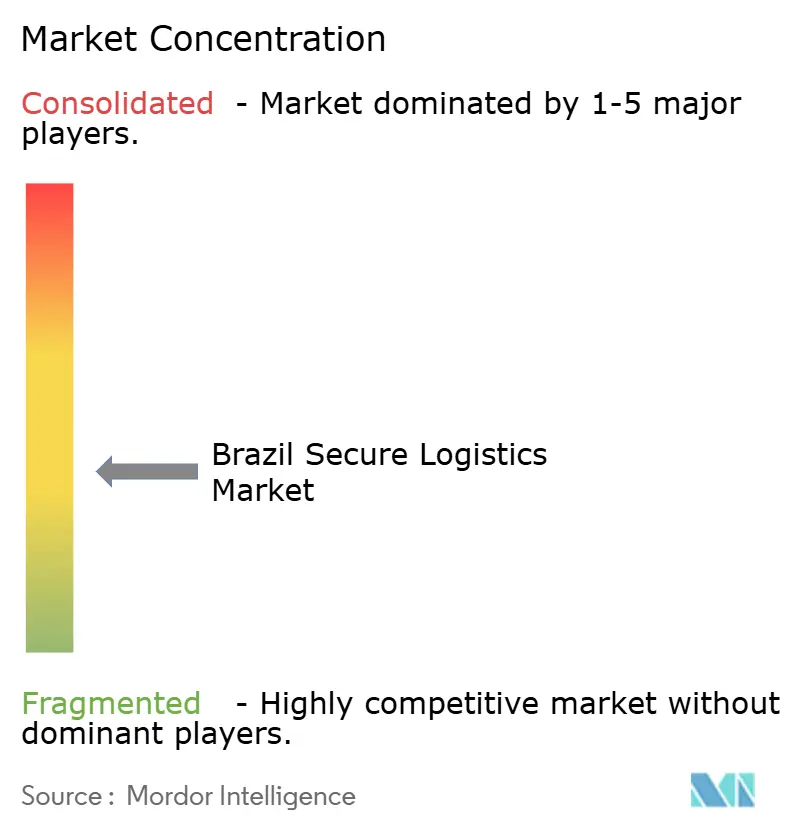
The Brazil secure logistics market is moderately fragmented with a two-tier competitive structure. Prosegur and Brink’s led the upper tier through nationwide armored fleets, digital solutions, and managed ATM service relationships. More than 15 regional carriers competed below this group on price and local corridor knowledge. Grupo Preserve Liserve, FXX Participacoes, Corpvs Seguranca, and Seguranca built density in areas where multinational operators had less coverage. This structure made national technology and compliance capacity important for large contracts. It also preserved room for regional providers with local operating knowledge.
Prosegur’s 2026 to 2029 Strategic Plan focuses on sustainable growth through technological innovation. Its POPS platform and iSOC operations centers included the largest private security iSOC in Latin America, located in Sao Paulo. Prosegur reported EUR 2.59 billion (USD 3.05 billion) in group revenue for H1 2026, representing 5.2% growth. Brink’s recorded USD 5.26 billion in global revenue in 2025. Its acquisition of NCR Atleos received Brazilian and United States regulatory clearance in 2026 and is scheduled to close in Q1 2027. The transaction targeted USD 200 million in annualized groups. These actions increased the capability pressure on mid-tier providers.
Grupo Protege held an Authorized Economic Operator Security certification from Brazil’s Receita Federal. This certification supported its position in customs bonded high value cargo that required documented supply chain controls. Pharmaceutical cold chain armored transport, gold and precious metal movement in Para and Mato Grosso, and Amazon basin multimodal operations remained areas of opportunity. Prosegur’s Bitruck provided an early example of pharmaceutical cold chain armored transport. Smart safes, route optimization, and IoT cash recyclers allowed larger operators to improve client economics and reduce vehicle visits. Decreto 13.012/2026 raised the operational technology floor through communication and vehicle certification requirements.
Brazil Secure Logistics Industry Leaders
Prosegur Group
The Brink’s Company
Tecban
Grupo Protege
Grupo Preserve Liserve
- *Disclaimer: Major Players sorted in no particular order

Recent Industry Developments
- September 2026: Caixa Economica Federal contracted Prosegur Brasil S/A for cash transport, processing, and custody across Goias state, covering Itumbiara units and lottery outlets. The contract, valued at USD 510,000 under Contract 08070/2026, reflected sustained demand for armored cash logistics within Brazil’s public banking network.
- August 2026: Brink’s Brasil launched the B-POD modular banking hub at Febraban Tech 2026, held in August in Sao Paulo. The system integrates intelligent safes, real-time banknote validation, and instant account credits in formats from self-service kiosks to full-service branch models.
- August 2026: Tecban expanded bank ATM substitution agreements with Crefisa, Agibank, and Banco do Nordeste, extending beyond the 2024 Banrisul contract. Tecban operated nearly 25,000 Banco24Horas-branded and over 5,000 partner network ATMs as of August 2026.
- May 2026: Brink’s Brasil and Zurich Airport Brasil announced a direct high-value cargo partnership in Santa Catarina, enabling Federal Police authorized cross-border clearance with 15 weekly international landings.


Brazil Secure Logistics Market Report Scope
| Transportation | Road |
| Rail | |
| Air | |
| Sea and Inland Waterways | |
| Warehousing and Storage (including Secure Storage and Vault Services) | |
| Value-added Services |
| Cash Management |
| Diamonds |
| Jewelry and Precious Metal |
| Manufacturing |
| Others |
| Static |
| Mobile |
| Financial Institutions |
| Retailers |
| Government |
| Others |
| By Service Type | Transportation | Road |
| Rail | ||
| Air | ||
| Sea and Inland Waterways | ||
| Warehousing and Storage (including Secure Storage and Vault Services) | ||
| Value-added Services | ||
| By Application | Cash Management | |
| Diamonds | ||
| Jewelry and Precious Metal | ||
| Manufacturing | ||
| Others | ||
| By Type | Static | |
| Mobile | ||
| By End User | Financial Institutions | |
| Retailers | ||
| Government | ||
| Others |


Key Questions Answered in the Report
What was the size of Brazil secure logistics in 2026?
The sector stood at USD 1.93 billion in 2026 and is forecast to reach USD 2.66 billion by 2031 at a 6.67% CAGR.
What services held the largest position in Brazil secure logistics?
Transportation held 63.15% share by service type in 2025, supported by armored road fleet coverage.
Which application grew fastest through 2031?
Jewelry and precious metal recorded the highest projected CAGR at 9.20% through 2031.
How did Pix affect secure logistics demand in Brazil?
Pix held 54.7% of retail payment transactions in H2 2025, reducing cash use in formal urban commerce while cash replenishment needs remained.
Which end users supported demand for secure logistics services?
Financial institutions held 47.55% of demand in 2025, while Retailers recorded the highest projected CAGR at 7.50% through 2031.
Why did high value cargo create demand for protected transport?
Electronics, pharmaceuticals, jewelry, and precious metals required armored movement and monitoring because organized theft increasingly focused on high liquidity goods.
Page last updated on:





