
Brazil Premium Bottled Water Market Size and Share
Market Overview
| Study Period | 2021 - 2031 |
|---|---|
| Forecast Data Period | 2026 - 2031 |
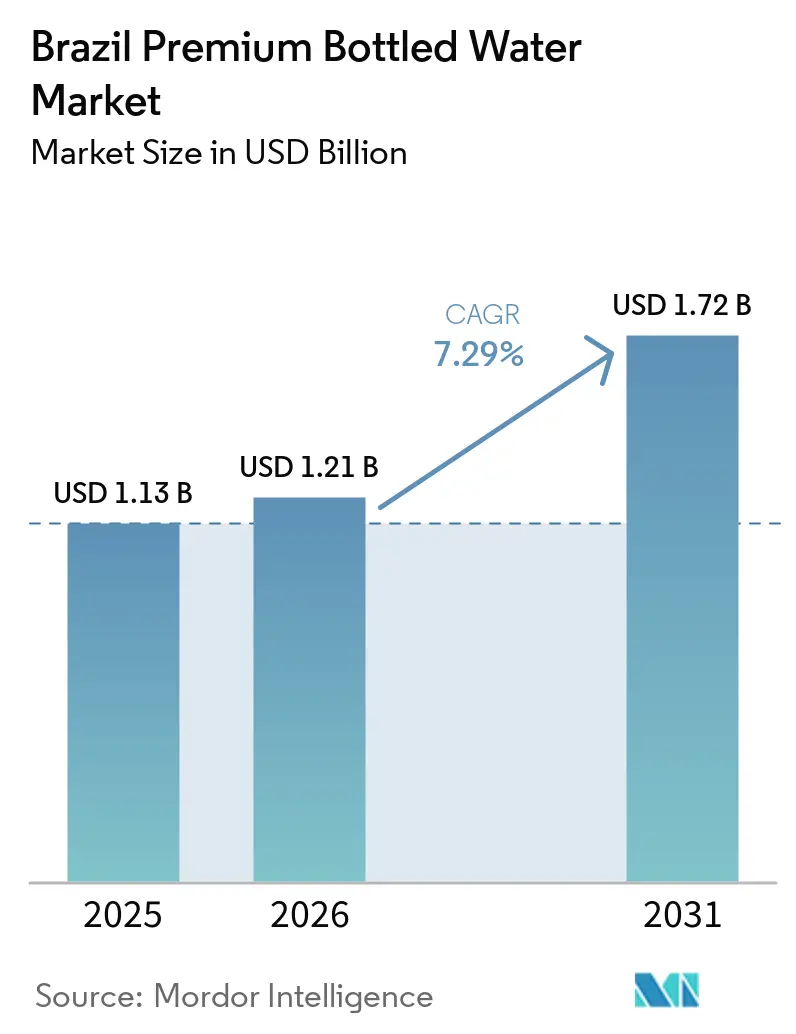
| Base Year Market Size (2025) | USD 1.13 Billion |
| Market Size (2026) | USD 1.21 Billion |
| Market Size (2031) | USD 1.72 Billion |
| Growth Rate (2026 - 2031) | 7.29 % |
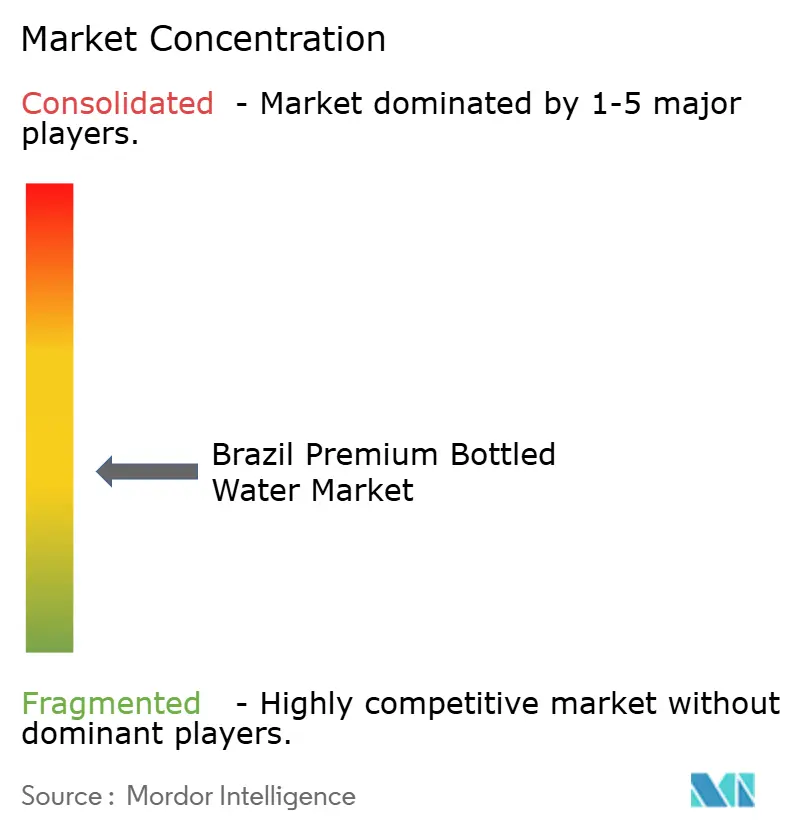
| Market Concentration | Medium |
Major Players *Disclaimer: Major Players sorted in no particular order Image © Mordor Intelligence. Reuse requires attribution under CC BY 4.0. | |
Brazil Premium Bottled Water Market Analysis by Mordor Intelligence
The Brazil premium bottled water market size is expected to grow from USD 1.13 billion in 2025 to USD 1.21 billion in 2026, and is forecast to reach USD 1.72 billion by 2031, at a 7.29% CAGR over 2026-2031. The growing premium hospitality industry is raising consumers' awareness of water choices, especially in restaurants, hotels, airport lounges, and event venues. Consumers increasingly view bottled water as part of the overall dining and hospitality experience, supporting demand for premium brands and packaging formats. Glass and aluminum bottles provide alternative packaging options for producers, although these formats involve higher production, transportation, and operating costs. By packaging type, glass bottles drive premium value growth because of their upscale image and strong fit with hospitality venues, while PET bottles face ongoing structural challenges. By product type, still water remains the main revenue contributor, while flavored, mineral-infused, and other functional water products attract growing consumer interest and reshape category trends. The market is moderately fragmented, with players such as Minalba Brasil, Água Pedra Azul, and others competing through product quality, packaging, and distribution.
Key Report Takeaways
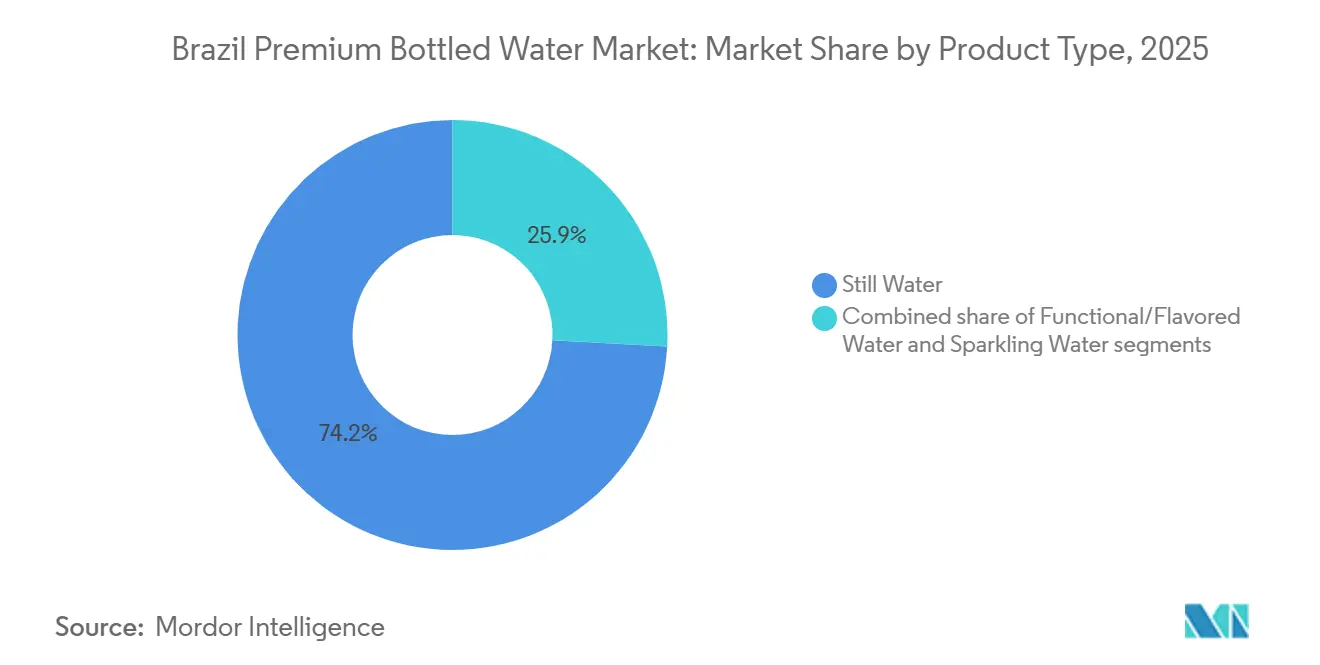
- By product type, still water held 74.15% of the Brazil premium bottled water market share in 2025, while functional and flavored water is forecast to be the fastest-growing category through 2031, expanding at a CAGR of 8.21%.
- By packaging type, PET and plastic bottles accounted for 63.07% of the Brazilian premium bottled water market in 2025, while glass bottles is forecast to grow at an 8.65% CAGR through 2031.
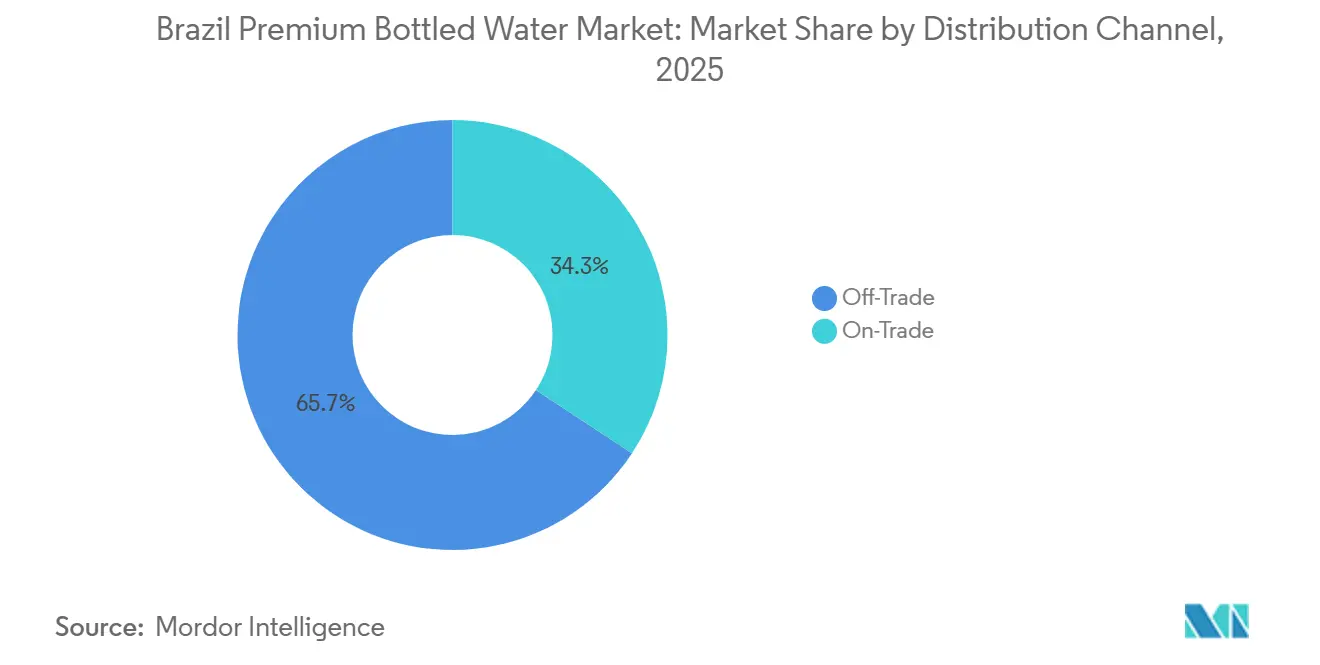
- By distribution channel, off-trade held 65.73% of 2025 revenue, while on-trade is forecast to grow at a CAGR of 8.14% through 2031.
Note: Market size and forecast figures in this report are generated using Mordor Intelligence’s proprietary estimation framework, updated with the latest available data and insights as of January 2026.
Brazil Premium Bottled Water Market Trends and Insights
Drivers Impact Analysis*
| Driver | (~) % Impact on CAGR Forecast | Geographic Relevance | Impact Timeline |
|---|---|---|---|
| Health-led substitution from sugary beverages | +1.8% | Concentrated in São Paulo, Rio de Janeiro, and Belo Horizonte | Short term (≤ 2 years) |
| Expansion of premium foodservice and tourism consumption | +1.5% | National, with early gains in São Paulo, Rio de Janeiro, Gramado, and resort corridors | Medium term (2-4 years) |
| Growing importance of water provenance and quality | +1.2% | National, skewing toward major urban centers and high-income consumers | Medium term (2-4 years) |
| Premiumization of mineral and sparkling water | +1.1% | National, led by Southeast and South Brazil | Medium term (2-4 years) |
| Sustainability as a premium differentiator | +0.9% | National, early adopters concentrated in São Paulo and Curitiba | Long term (≥ 4 years) |
| Preference for differentiated bottle formats | +0.6% | National, with premium retail and foodservice as primary adoption channels | Medium term (2-4 years) |
| Source: Mordor Intelligence | |||
Health-Led Substitution From Sugary Beverages
Brazil’s increasing focus on health and wellbeing is driving demand for healthier beverage choices, including premium bottled water. According to the World Health Organization, an additional 20.5 million people in Brazil were projected to benefit from improved health and well-being by 2025[1]Source: World Health Organization, “Population, Brazil”, data.who.int. This shift is encouraging consumers to reduce their intake of sugary carbonated beverages and opt for hydration-focused alternatives, including sparkling, flavored, and functional water. Consumers are also placing greater importance on product quality, convenience, taste, and perceived health benefits, prompting premium bottled water brands to broaden their portfolios with differentiated offerings. In Brazil, Minalba’s premium sparkling water and Indaiá’s flavored beverage offerings highlight the growing diversification of premium hydration options and the industry’s response to evolving consumer preferences nationwide.
Growing Importance of Water Provenance and Quality
In Brazil, persistent gaps in access to safe drinking water are increasing consumer awareness of water safety, quality, and supply reliability, creating opportunities for premium bottled water brands to differentiate their offerings. According to the Water Organization, as of August 2026, approximately 24 million people out of Brazil’s population of 211 million, equivalent to 11%, lack access to safe water[2]Source: Water Organization, “Brazil's Water and Sanitation Crisis”, water.org. This situation reinforces the importance of trusted drinking-water sources and supports demand for bottled water products that clearly communicate quality, safety, and provenance. Premium spring water brands, such as Cambuquira from Minas Gerais, can leverage distinctive geological characteristics, natural mineral composition, and source heritage to strengthen quality-focused positioning. In addition, regulatory requirements under Resolução ANM 157/2024 emphasize accurate labeling and transparent origin communication, enabling producers to substantiate source-specific claims, improve product traceability, and strengthen consumer trust in premium bottled water offerings.
Premiumization of Mineral and Sparkling Water
Rising demand for premium mineral and sparkling water is driving value growth in Brazil’s premium bottled water market, particularly among fine-dining restaurants, luxury hotels, and other upscale hospitality venues. Consumers and water connoisseurs increasingly value naturally carbonated water, distinctive mineral compositions, and authentic source credentials. Brazilian sparkling water brands from the Serra da Mantiqueira region compete with Italian and French imports by emphasizing local provenance and premium quality. Minalba Brasil’s São Lourenço water, drawn from a naturally carbonated spring in Minas Gerais, reflects this trend. The product was recognized as Brazil’s best sparkling water in an Estadão Paladar blind tasting. Such recognition can enhance brand credibility and support uptake among restaurant purchasers and water sommeliers, while dependable distribution and careful handling remain essential to preserve product quality.
Expansion of Premium Foodservice and Tourism Consumption
The continued growth of international tourism and the hospitality industry in Brazil is expected to support demand for premium bottled water across luxury hotels, fine-dining restaurants, airport lounges, and high-end event venues. According to the Organization for Economic Co-operation and Development, Brazil welcomed a record 9.3 million international arrivals in 2025, representing a 37.1% increase from nearly 6.8 million arrivals in 2024[3]Source: Organization for Economic Co-operation and Development, “OECD Tourism Trends and Policies 2026”, oecd.org. The rising influx of international visitors is increasing demand for elevated hospitality experiences, particularly in premium accommodation, dining, and travel settings. In response, hospitality establishments are enhancing their food and beverage offerings by introducing premium bottled water brands distinguished by natural source credentials, refined packaging, mineral composition, and sophisticated table presentation.
Restraints Impact Analysis*
| Restraint | (~) % Impact on CAGR Forecast | Geographic Relevance | Impact Timeline |
|---|---|---|---|
| Premium price sensitivity | -0.9% | National, more acute in the Northeast and North Brazil | Short term (≤ 2 years) |
| Availability of low-cost bottled water alternatives | -0.8% | National, with the highest competitive intensity in Northeast Brazil | Short term (≤ 2 years) |
| Environmental concerns over single-use packaging | -0.6% | National, compliance burden concentrated in São Paulo and the Southeast | Long term (≥ 4 years) |
| High packaging and logistics costs | -0.5% | National, most acute in geographically remote production and distribution zones | Medium term (2-4 years) |
| Source: Mordor Intelligence | |||
Premium Price Sensitivity
Price sensitivity remains a key challenge for premium bottled water in Brazil, as consumer preferences differ by region, income group, and consumption occasion. Consumers in luxury tourism destinations such as Gramado may be willing to purchase high-priced imported or premium bottled water. In contrast, consumers in cities such as Fortaleza and Recife often compare premium offerings with more affordable alternatives, including water with added mineral salts. In the Northeast, returnable 20-liter containers and smaller 500-milliliter packs continue to serve routine consumption needs, restricting premium product adoption beyond hospitality settings and special occasions. This cost-conscious market environment may limit premiumization, prompting producers to target higher-value products toward modern retail outlets, hotels, restaurants, cafés, and specialty health channels.
Availability of Low-Cost Bottled Water Alternatives
Low-cost alternatives, particularly added-salt bottled water, constrain Brazil’s premium bottled water market. Added-salts water is purified drinking water to which minerals or salts are added during processing and falls under Brazil’s sanitary regulatory framework through RDC 717/2022. In July 2025, Ceará reportedly had 141 registered producers of added-salt water, compared with 18 natural mineral water companies, underscoring the widespread availability of lower-cost options in the region. Taxation and regulatory differences can further intensify price competition, reducing the accessibility of premium natural mineral water in price-sensitive retail channels. However, hotels, restaurants, and other hospitality establishments that prioritize provenance and authenticity are relatively less affected, as these attributes often influence procurement decisions.
*Our forecasts treat driver/restraint impacts as directional, not additive. The impact forecasts reflect baseline growth, mix effects, and variable interactions.
Segment Analysis
By Product Type: Still Water Holds the Broadest Demand Base
Still water was the largest product category in the Brazilian premium bottled water market, accounting for 74.15% of total revenue in 2025. Consumers choose still water because it is simple, familiar, and suitable for everyday hydration. It is widely available in supermarkets, convenience stores, restaurants, hotels, and other hospitality locations. Its steady demand across retail and foodservice channels continues to support its strong market position. For premium bottled water brands, still water remains an important category for generating consistent sales and revenue.
Functional and flavored water is expected to be the fastest-growing category through 2031, with a CAGR of 8.21%. Consumers are showing greater interest in water products with different flavors or added functional benefits. These products offer greater variety than regular still water and meet the needs of consumers seeking new hydration options. Growing demand is encouraging brands to introduce new products and expand their portfolios in this category. This trend is expected to support the continued growth of functional and flavored water in the Brazil premium bottled water market.



By Packaging Type: PET Retains Scale While Glass Gains in Premium Settings
PET and plastic bottles dominated the premium bottled water market in Brazil by packaging type, accounting for 63.07% of the total market size in 2025. Their leadership reflects their affordability, lightweight design, and ease of transportation across the country. These formats provide convenience for consumers purchasing premium water through supermarkets, convenience stores, and foodservice outlets. Their durability also supports on-the-go consumption in travel, the workplace, and outdoor settings. Consequently, PET and plastic bottles remain important for expanding the availability and distribution reach of premium bottled water brands.
Glass bottles are expected to be the fastest-growing packaging category in Brazil's premium bottled water market through 2031, registering a CAGR of 8.65%. Their growth is driven by their premium visual appeal and strong alignment with upscale hospitality and dining environments. Restaurants, hotels, and event venues increasingly use glass bottles to enhance product presentation and the consumer experience. Glass packaging also supports brand differentiation among consumers seeking higher-quality, more sustainable packaging alternatives. However, producers must manage the higher transportation, handling, and operating requirements associated with glass bottle formats.
By Distribution Channel: Off-Trade Provides the Largest Revenue Base While On-Trade Strengthens Brand Validation
Off-trade distribution channels dominated the Brazilian premium bottled water market, accounting for 65.73% of total revenue in 2025. Supermarkets and hypermarkets remained key sales outlets, offering broad product assortments and enabling consumers to compare premium brands, formats, and price points. Convenience stores also supported demand by providing immediate access to premium bottled water for on-the-go consumption. Online retail platforms further strengthened the channel by offering home delivery, product visibility, and access to specialized premium water brands. This extensive retail presence continues to support household purchases and recurring individual consumption across Brazil.
On-trade distribution is projected to be the fastest-growing channel in the Brazilian premium bottled water market, expanding at a CAGR of 8.14% through 2031. Restaurants, hotels, cafés, airport lounges, and event venues increasingly use premium bottled water to enhance beverage menus and guest experiences. Premium dining and hospitality establishments are also creating greater visibility for glass-bottled and other high-value water offerings. Rising consumer preference for premium service experiences supports the adoption of branded bottled water in foodservice settings. Consequently, on-trade operators provide premium water brands with opportunities to build brand recognition and increase sales volumes.
Geography Analysis
Brazil’s premium bottled water market has a nationwide footprint, with demand concentrated in major metropolitan areas, upscale hospitality venues, and key tourism destinations. São Paulo, Rio de Janeiro, Belo Horizonte, and Gramado serve as major consumption centers for premium still and sparkling water products. The Southeast and South regions offer significant growth potential, supported by well-developed retail infrastructure and a strong network of hotels, restaurants, and cafés. Consumers in these regions increasingly associate premium water with dining experiences, wellness preferences, and high-quality service. This environment also supports the adoption of differentiated packaging formats, particularly glass and aluminum bottles.
Northeast Brazil has an established mineral water production base, supported by local bottlers, natural water sources, and regional distribution networks. The region presents opportunities for premium brands, although price sensitivity remains a key factor shaping consumer purchasing decisions. Returnable containers remain relevant, particularly among consumers seeking lower-cost and more sustainable purchasing options. Premium bottled water producers must therefore balance distinctive product attributes, source credentials, and packaging quality with accessible price points. The region’s diverse consumer base allows companies to target both value-focused buyers and consumers seeking premium water experiences.
Minas Gerais remains an important source region for premium spring water brands, including those associated with Cambuquira and São Lourenço. Gramado also offers a prominent hospitality setting where hotels, restaurants, and tourism operators can develop curated premium water programs. Tourism activity across major cities, resort areas, and leisure destinations continues to support premium bottled water consumption in on-trade channels. Producers located near natural water sources can strengthen brand authenticity while improving supply efficiency and regional distribution capabilities. As demand expands, companies with reliable supply networks and strong source positioning can serve regional consumers and selective national hotel, restaurant, and café accounts.
Competitive Landscape
The Brazilian premium bottled water market remains moderately fragmented, with established national brands competing alongside regional producers and specialized spring water companies. Minalba Brasil, Água Pedra Azul, Empresa de Águas Ouro Fino Ltda., Águas Prata, and Mineração Canaã are among the notable companies operating in the market. Access to regional water sources and the distinctive mineral composition of these sources create important opportunities for product differentiation. Independent producers can compete with larger companies by leveraging localized distribution networks, source authenticity, and targeted premium positioning. This competitive structure supports a broad range of products designed for consumers seeking quality, exclusivity, and differentiated consumption experiences.
Minalba Brasil, part of Grupo Edson Queiroz, maintains operations across multiple Brazilian states and offers a diversified bottled water portfolio. Its broad product range allows the company to address varying consumer preferences, price points, and consumption occasions. Águas Prata focuses on premium packaging and hospitality-oriented solutions, including reusable glass bottles and customized aluminum-can programs. These packaging formats strengthen brand visibility in restaurants, hotels, events, and other premium consumption settings. Such initiatives demonstrate that packaging design, product presentation, and channel-specific offerings play a central role in premium market differentiation.
Other market participants differentiate their offerings by emphasizing geographic rarity, water-source authenticity, and specialized packaging formats. Premium hospitality, restaurant, airport lounge, and event channels create opportunities for suppliers that can provide distinctive water origins and consistent product quality. Producers that invest in glass-bottle filling, quality inspection, and advanced packaging capabilities can strengthen their access to upscale hospitality accounts. However, these investments also require companies to manage higher operational costs and more complex logistics requirements. As a result, competition in the Brazil premium bottled water market extends beyond price to include source identity, packaging innovation, operational reliability, and distribution capabilities.
Brazil Premium Bottled Water Industry Leaders
Minalba Brasil
Água Pedra Azul
Empresa de Águas Ouro Fino Ltda.
Águas Prata
Mineração Canaã
- *Disclaimer: Major Players sorted in no particular order

Recent Industry Developments
- October 2025: The federal government published Federal Decree 12,688/2025, establishing a mandatory nationwide reverse-logistics system for plastic packaging. The decree covers primary, secondary, and tertiary plastic packaging across the supply chain.
- August 2025: Lindoya Verão launched sustainable thermoshrinkable secondary packaging in a milky-white format for its 1.5L natural and 1.25L sparkling bottles. The packaging features Serra da Mantiqueira origin branding.
- May 2025: São Paulo State issued Portarias SRE 26 and 27/2025, extending the Electronic Fiscal Seal requirement to disposable mineral water packages below 4 liters.


Brazil Premium Bottled Water Market Report Scope
Premium bottled water refers to bottled water positioned in the higher-value segment through attributes such as superior source quality, distinctive mineral composition, upscale packaging, and premium brand positioning. The Brazil premium bottled water market report provides comprehensive coverage of product type into still water, sparkling water, and functional or flavored water; packaging type into PET or plastic bottles, glass bottles, and aluminum cans; and distribution channel into on-trade and off-trade, including supermarkets and hypermarkets, convenience and grocery stores, online retail stores, and other off-trade channels. Market forecasts are provided in terms of value in USD and volume in liters.
| Still Water |
| Sparkling Water |
| Functional/Flavored Water |
| PET/Plastic Bottles |
| Glass Bottles |
| Aluminium Cans |
| On-Trade | |
| Off-Trade | Supermarkets/Hypermarkets |
| Convenience/Grocery Stores | |
| Online Retail Stores | |
| Other Off-Trade Channels |
| By Product Type | Still Water | |
| Sparkling Water | ||
| Functional/Flavored Water | ||
| By Packaging Type | PET/Plastic Bottles | |
| Glass Bottles | ||
| Aluminium Cans | ||
| By Distribution Channel | On-Trade | |
| Off-Trade | Supermarkets/Hypermarkets | |
| Convenience/Grocery Stores | ||
| Online Retail Stores | ||
| Other Off-Trade Channels | ||


Key Questions Answered in the Report
What is the forecast growth rate for premium bottled water in Brazil?
The Brazil premium bottled water market is forecast to grow at a 7.29% CAGR from 2026 through 2031.
Which product category leads premium bottled water sales in Brazil?
Still water led 2025 revenue with a 74.15% share because it serves retail, workplace, hotel, and restaurant occasions.
Which packaging format is growing fastest for premium water in Brazil?
Glass bottles are projected to grow at an 8.65% CAGR through 2031, supported by demand from hospitality and fine-dining venues.
How concentrated is Brazil’s premium bottled water sector?
The Brazil premium bottled water market is moderately fragmented because more than 800 brands and 700 licensed extraction operations create a fragmented competitive field.
Page last updated on:


 Your data is secure and never sold or shared.


