
Brazil ITSM Market Size and Share
Market Overview
| Study Period | 2024 - 2031 |
|---|---|
| Forecast Data Period | 2025 - 2031 |
| Base Year Market Size (2025) | USD 255.95 Million |
| Market Size (2026) | USD 295.84 Million |
| Market Size (2031) | USD 633.75 Million |
| Growth Rate (2025 - 2031) | 16.46% CAGR |
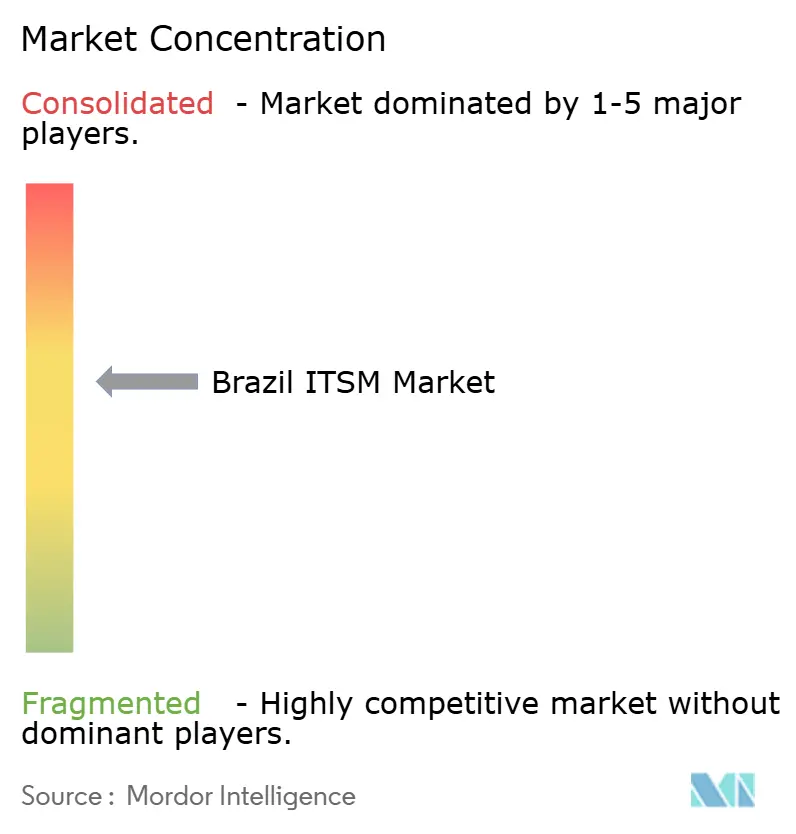
| Market Concentration | Medium |
Major Players *Disclaimer: Major Players sorted in no particular order Image © Mordor Intelligence. Reuse requires attribution under CC BY 4.0. | |
Brazil ITSM Market Analysis by Mordor Intelligence
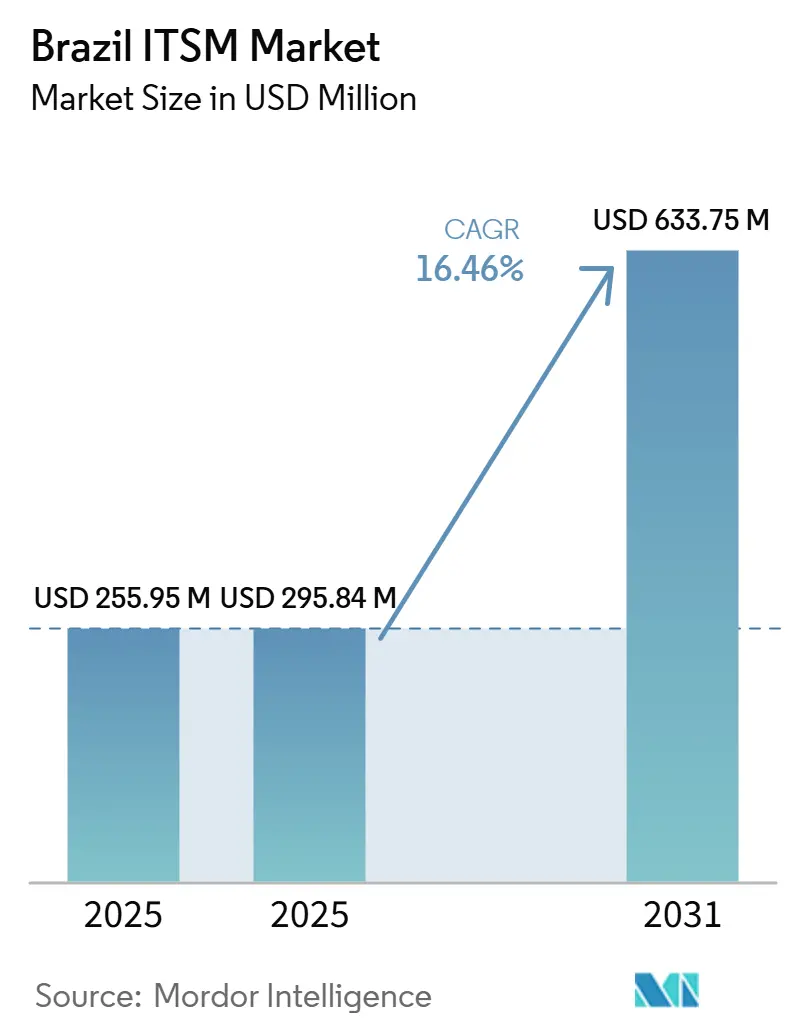
The Brazil ITSM Market size was valued at USD 255.95 million in 2025 and is estimated to grow from USD 295.84 million in 2026 to reach USD 633.75 million by 2031, at a CAGR of 16.46% during the forecast period (2026-2031).
Brazil remains South America's primary hub for IT spending, consistently attracting more substantial digital investments than its neighboring economies. As enterprises in Brazil shift toward cloud migration and hybrid environments, they are also tightening controls in compliance with the LGPD. This transition has prompted many organizations to move from fragmented support tools to cohesive service workflows. Companies are increasingly prioritizing platforms that provide auditability, automation, and uninterrupted service. The competitive landscape is intensifying, with global platforms, local providers, and managed service specialists competing for prominence. These providers are focusing on Brazil-centric delivery, offering support in Portuguese, and integrating AI-driven workflows. Although public sector procurement progresses at a slower pace compared to private enterprise purchases, the overall demand environment remains robust, supporting strong growth through 2031.
Key Report Takeaways
- By component, solutions held 64% of revenue in 2025, while services is projected to expand at a 19.80% CAGR through 2031.
- By deployment, cloud accounted for 67% of the Brazil ITSM market size in 2025 and is expected to remain the fastest-growing model at an 18.20% CAGR through 2031.
- By application, Service Desk and Incident Management led with a 29% share in 2025, while Knowledge Management is projected to grow at a 17.90% CAGR through 2031.
- By end-user industry, BFSI held 20% of revenue in 2025, while healthcare is expected to record the highest CAGR at 17.40% through 2031.
- By enterprise size, large enterprises captured 61% of revenue in 2025, while SMEs are projected to expand at an 18.10% CAGR through 2031.
Note: Market size and forecast figures in this report are generated using Mordor Intelligence’s proprietary estimation framework, updated with the latest available data and insights as of January 2026.
Brazil ITSM Market Trends and Insights
Drivers Impact Analysis*
| Driver | (~) % Impact on CAGR Forecast | Geographic Relevance | Impact Timeline |
|---|---|---|---|
| Accelerating Cloud-First ITSM Modernization | +3.5% | National, with concentration in São Paulo's enterprise corridor and Rio de Janeiro | Short term (≤ 2 years) |
| Expansion of AI-Assisted Service Desk Automation | +3.2% | National, with early adopters in BFSI and telecommunications clusters | Short term (≤ 2 years) |
| Rising ITSM Demand from Hybrid and Multicloud Operations | +2.8% | National, with emphasis on the Southeast region and regulated-industry hubs | Medium term (2-4 years) |
| Increasing Regulated-Industry Demand for Audit-Ready Workflow Control | +2.5% | National, strong in BFSI and healthcare verticals in São Paulo and Brasília | Medium term (2-4 years) |
| Growing SME Adoption of Packaged ITSM Suites | +2.0% | National, with spillover to the South and Northeast regions | Medium term (2-4 years) |
| Rising Demand for Portuguese-Language, Brazil-Hosted Support Models | +1.5% | National, with higher impact in public sector and SME segments | Long term (≥ 4 years) |
| Source: Mordor Intelligence | |||
Accelerating Cloud-First ITSM Modernization in Brazilian Enterprises
Brazil began 2026 with a robust foundation for IT investments, setting the stage for stable demand in the country's IT Service Management (ITSM) market. Enterprises transitioning applications and workloads to the cloud often find their older ticketing tools inadequate. This is because cloud migration tends to highlight deficiencies in areas such as access control, incident routing, and service ownership. Consequently, many enterprises view migration as an opportunity to unify their service desk, asset management, request handling, and change processes into a singular operating model. This trend is significant: Brazil's ITSM market is not only benefiting from initial software adoptions but also witnessing growth from platform expansions. These expansions occur as migration projects lead to increased ticket volumes and heightened workflow complexities. The most pronounced activity is in the Southeast, home to a concentration of major financial institutions, telecom operators, and intricate enterprise groups, all pushing for standardization. This dynamic positions vendors with a robust local presence to capitalize on the cloud-driven demand, fostering longer, multi-module partnerships.
Expansion Of AI-Assisted Service Desk Automation
In Brazil's ITSM market, enterprises are increasingly turning to AI-assisted support, seeking quicker incident resolutions without proportionately increasing service desk labor. This demand is particularly pronounced among companies formalizing their digital operations, aiming to transition repetitive tasks into guided automation instead of keeping them entirely manual. However, this transition does not eliminate the need for human oversight; AI-driven workflows necessitate governance, escalation design, knowledge curation, and defined approval paths for high-risk actions. Brazil's federal initiative, emphasizing responsible and supervised AI usage, underscores the importance of traceable service processes, especially concerning public data, regulated transactions, and critical operations. Consequently, software vendors, service providers, and internal IT teams in Brazil's ITSM market must adopt a more disciplined approach to workflows before scaling automation safely. In this context, Brazil's ITSM market thrives when AI is leveraged as an enhancement to service management, rather than merely a standalone automation tool.
Rising ITSM Demand From Hybrid And Multicloud Operations
Brazil's ITSM market is witnessing growth as enterprises shift away from a simplistic single-cloud approach. Instead, they are embracing a blend of cloud services, private environments, and on-premises systems. This hybrid structure amplifies the demand for a unified service layer capable of managing incidents, changes, approvals, and service levels across diverse environments, all while maintaining control visibility. In Brazil, hybrid operations hold particular significance. Concerns such as data protection, a preference for local hosting, and the need for operational continuity often necessitate keeping critical workloads close to domestic infrastructure. Bolstering this trend is the Brazilian government's expansive digital transformation agenda, which underscores the importance of secure, auditable, and sovereign digital development in public systems and the wider economy. For buyers, the focus shifts from merely seeking the cheapest standalone help desk to prioritizing platforms adept at coordinating diverse environments within a singular operational framework.[1]Ministério da Gestão e da Inovação em Serviços Públicos, “MGI Institui Política de Governança de Inteligência Artificial no Âmbito do Ministério,” Governo do Brasil, gov.br This evolving landscape fuels a robust demand for platforms and managed services proficient in orchestrating workflows across both cloud and localized infrastructures.
Increasing Regulated-Industry Demand For Audit-Ready Workflow Control
In Brazil, the IT Service Management (ITSM) market is experiencing robust growth, largely driven by the heightened influence of compliance teams on software decisions, especially in regulated industries. Sectors such as banking, insurance, healthcare, and public services are now prioritizing the ability to clearly and retrievably track requests, approvals, changes, and access actions. Bolstered by Brazil's enhanced digital government initiatives and broader efforts in AI governance and data protection, there is a pronounced shift towards emphasizing documented process control over informal task management. This evolution is reshaping vendor competition; it is no longer sufficient for vendors to offer just a strong interface. Regulated buyers now demand features like auditability, controlled handoffs, and policy-driven workflows. Furthermore, the emphasis on compliance tends to elongate evaluation cycles, as legal, risk, and governance teams collaborate closely with core IT staff during platform reviews. However, once a platform meets these stringent criteria and is chosen, the challenges of switching platforms increase, solidifying long-term revenue prospects for the winning suppliers.
Restraints Impact Analysis*
| Restraint | (~) % Impact on CAGR Forecast | Geographic Relevance | Impact Timeline |
|---|---|---|---|
| Integration Complexity Across Legacy IT And Enterprise Apps | -2.8% | National, with acute impact in manufacturing hubs and state-owned enterprises | Medium term (2-4 years) |
| Shortage Of Skilled ITSM Administrators And Process Owners | -2.1% | National, more acute in secondary cities outside São Paulo and Rio de Janeiro | Long term (≥ 4 years) |
| Data Residency And Procurement Constraints In Public Sector Buying | -1.8% | National, concentrated in federal and state government agencies in Brasília | Medium term (2-4 years) |
| Limited Process Maturity In Smaller Brazilian Organizations | -1.5% | National, more acute in the North and Northeast regions | Long term (≥ 4 years) |
| Source: Mordor Intelligence | |||
Integration Complexity Across Legacy IT And Enterprise Apps
In Brazil's ITSM market, legacy integration poses a significant challenge. Many large organizations continue to rely on customized ERP systems, older middleware, and long-standing operational tools, all of which struggle to integrate seamlessly with modern workflows. This issue extends beyond mere technicalities; prolonged deployment times inflate budgets, hinder user adoption, and diminish confidence in the anticipated returns from platform investments. Incomplete integrations often force teams to juggle parallel processes: one workflow within the ITSM platform and another in the legacy operational system. This duality undermines the audit trail that regulated entities aim to bolster through ITSM adoption. The challenge is particularly pronounced in large enterprises, state-affiliated organizations, and sectors with deep operational legacies. Consequently, integration capability has emerged as a pivotal buying criterion in Brazil's ITSM market. Vendors and service partners adept at efficiently linking local enterprise software will maintain a distinct edge over those offering generic implementations.
Shortage Of Skilled ITSM Administrators And Process Owners
In Brazil, the ITSM market faces a talent shortage, as the growth of platforms outpaces the availability of certified administrators, process owners, and workflow specialists. This talent gap is particularly pronounced outside the primary Southeast corridor, where numerous organizations seek structured ITSM solutions but struggle to find seasoned professionals for implementation and governance. The shortage of skills not only delays deployments and stretches the availability of partners but also escalates the costs associated with operating advanced modules post-launch. Consequently, many buyers are leaning towards managed services, as internal teams often find it challenging to consistently uphold configuration quality, maintain knowledge bases, and oversee automation rules. While Brazil's broader strides in digital transformation highlight this talent issue, they also amplify its visibility as more entities transition to digitized service environments. Suppliers that prioritize local training, partner empowerment, and enhancing customer capabilities stand to gain a competitive edge as the Brazilian ITSM market expands beyond its urban hubs.
*Our forecasts treat driver/restraint impacts as directional, not additive. The impact forecasts reflect baseline growth, mix effects, and variable interactions.
Segment Analysis
By Component: Services Gain Speed As The Installed Base Matures
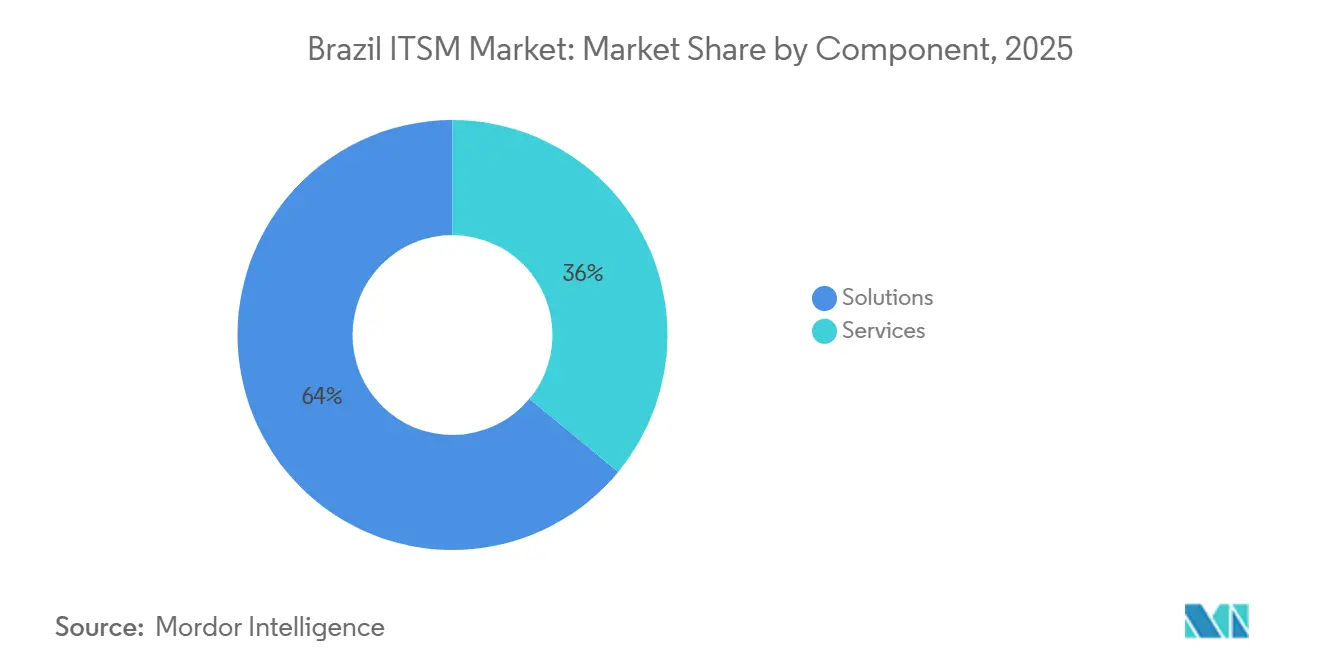
Solutions held 64% of revenue in 2025, which kept software as the largest component in the Brazil ITSM market while most large enterprises continued to standardize core service workflows across wider IT estates. That lead reflected earlier buying behavior, since enterprises usually start with platform licenses before they deepen spending on optimization, support, and governance services. The Brazil ITSM market therefore still rests on a sizeable software base that supports incident management, asset control, and change governance across complex organizations. This pattern also explains why large accounts remained central to vendor strategy, because they were more likely to commit to broader suites instead of isolated tools. For many buyers, the first phase of adoption was less about automation depth and more about building one operating structure that could replace fragmented departmental practices.
Services is projected to grow at a 19.80% CAGR from 2026 to 2031, which shows that the value pool is moving from initial deployment toward continuous operation, configuration refinement, and managed support. As that transition continues, the Brazil ITSM industry is becoming less dependent on one-time implementation work and more dependent on recurring service relationships that help customers keep workflows aligned with changing policies and internal process needs. This shift often appears after organizations realize that owning licenses does not guarantee strong outcomes unless service catalogs, knowledge articles, approvals, and automation logic are kept current. It also improves the position of partners that can combine platform skills with local delivery and regulatory familiarity. In effect, services growth signals a maturing installed base in the Brazil ITSM market, where customers now spend more on extracting value from existing platforms instead of only adding new seats.


By Deployment: Cloud Leads, While Hybrid Needs Keep Structure Complex
Cloud accounted for 67% of the Brazil ITSM market share in 2025, and it is expected to remain the fastest-growing deployment model with an 18.20% CAGR through 2031. That combination of leadership and momentum shows that the Brazil ITSM market has already moved beyond an early cloud adoption phase and is now deepening cloud-based operational dependence. SaaS delivery fits the needs of many enterprises because it shortens rollout cycles, reduces infrastructure burden, and supports easier access for distributed teams. It also matches the broader digital investment climate in Brazil, where enterprise technology spending remained strong and continued to support platform modernization ABES.ORG.BR. For vendors, this means cloud leadership is not just a product preference, it is a core route into multi-module adoption and recurring account expansion.
At the same time, on-premises and hybrid demand remain important because not every buyer can move fully into externally hosted environments without control concerns. Some public bodies, regulated enterprises, and state-linked organizations still need stronger visibility over where data resides and how workflow records are governed. That is why hybrid models are gaining attention, especially where front-end services can run in cloud settings but critical data or operational layers stay closer to domestic infrastructure. The Brazil ITSM market size for cloud deployment is rising, yet the surrounding opportunity still depends on vendors that can coordinate mixed environments without creating breaks in approvals, change tracking, or compliance reporting. This keeps architecture complexity high even as cloud adoption broadens. It also gives locally attuned providers room to compete on deployment flexibility rather than only on feature depth.
By Application: Core Ticketing Stays Central, While Knowledge Use Broadens
In 2025, Service Desk and Incident Management commanded a dominant 29% share of the application market, underscoring the primary focus of Brazil's ITSM market on daily support operations. Organizations typically initiate their ITSM journey with incident handling due to its visibility, measurability, and ease of standardization compared to broader service governance. Once formalized, the service desk enables buyers to implement refined routing logic, enhance response tracking, and ensure consistent user support across various sites and teams. This positions the service desk as the foundational operational hub, often leading to the expansion into other modules. It is also a testament to why vendors prioritize rapid deployment, intuitive case management, and robust reporting as fundamental necessities rather than mere add-ons.
Knowledge Management is projected to surge at a 17.90% CAGR through 2031, indicating a shift in Brazil's ITSM landscape toward proactive service operations post-platform rollout. With ticket intake now stabilized, organizations are honing in on reducing recurring issues, promoting self-service, and leveraging internal resolution histories. Knowledge tools play a pivotal role, enabling service teams to avoid redundant problem-solving, a crucial advantage in a market grappling with uneven labor availability. As companies strive to balance support costs with service quality, especially in midmarket environments, knowledge-led workflows in Brazil's ITSM market stand to gain significantly. Every enhancement in first-contact resolution or guided self-service not only alleviates the burden on lean IT teams but also elevates knowledge capture from a secondary module to a primary efficiency driver.
By End-User Industry: BFSI Anchors Demand, While Healthcare Expands Faster
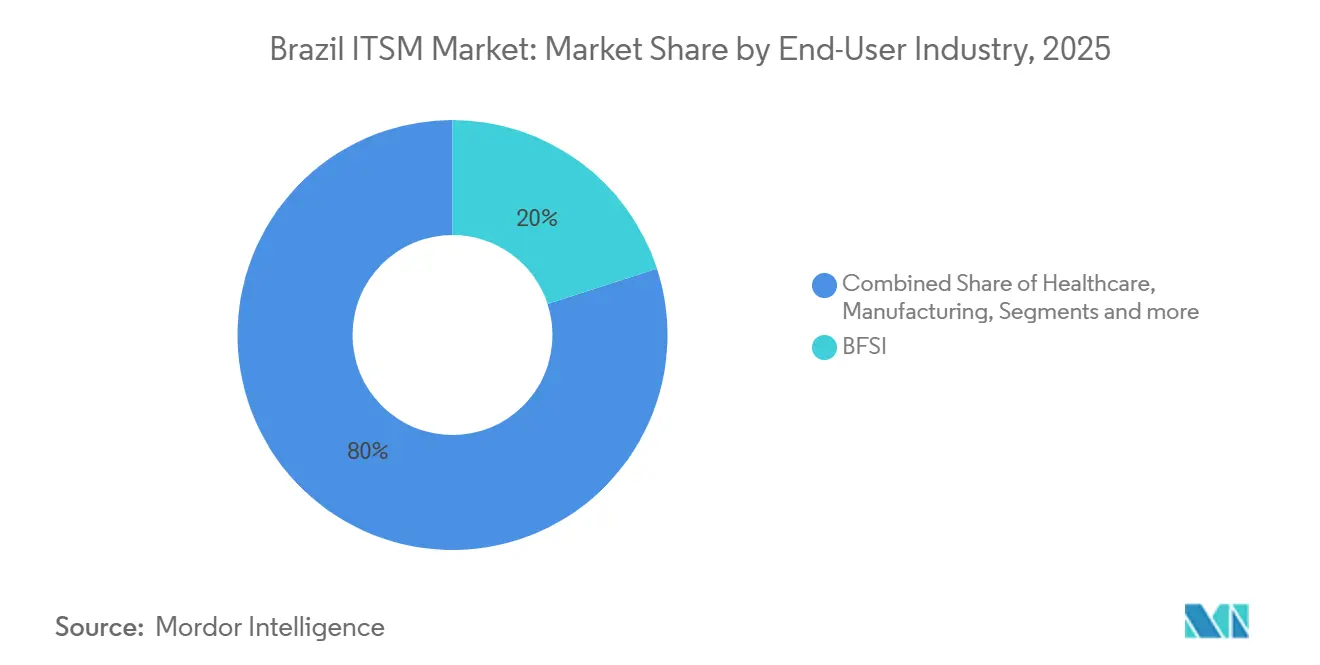
In 2025, the BFSI sector commanded a dominant 20% share, solidifying its position as the primary demand hub in Brazil's ITSM landscape. Banks and insurers, grappling with expansive service scales and stringent process oversight, operate extensive digital channels and handle high transaction volumes. Their governance of changes is more formal than in many other sectors, amplifying the need for meticulous incident management, access approvals, and workflow traceability among dispersed teams. Furthermore, the leadership dynamics within BFSI underscore Brazil's progressive banking landscape, where digital innovations and regulatory demands evolve hand in hand. Simply put, the operational advantages of structured ITSM are most evident and least postponable in the BFSI realm.
Healthcare is set to surge at a robust 17.40% CAGR through 2031, emerging as the fastest-growing sector. As hospitals, health platforms, and associated service networks adopt formal digital models, the sector's momentum intensifies. This is largely due to the increasing interconnectedness and data-sharing needs, underscoring a heightened reliance on controlled service processes, a challenge many providers previously overlooked. The burgeoning healthcare segment indicates a diversification in the Brazil ITSM market, extending beyond its traditional strongholds of finance and telecom. Notably, Bradesco's health consolidation underscores the escalating significance of digital coordination in major health operations. Meanwhile, sectors like manufacturing, government, retail, and travel, each at varying maturity stages, present substantial adoption opportunities. This diversification diminishes reliance on any single sector, fostering a more balanced demand landscape for Brazil's ITSM market in the coming years.

By Enterprise Size: Large Enterprises Lead Today, While SMEs Build The Next Layer
In 2025, large enterprises commanded 61% of the revenue in Brazil's ITSM market, underscoring their dominance. These organizations, equipped with expansive IT estates and robust budgets, leaned towards comprehensive IT service management (ITSM) solutions. Their intricate needs often bridge ITSM with ERP, security operations, and cloud management, paving the way for broader deployments. Given their scale, consistency in service becomes paramount; as the number of sites, users, and systems grows, managing fragmented support processes becomes increasingly challenging. Thus, large enterprises not only formed the backbone of Brazil's ITSM landscape but also shaped the competitive dynamics, emphasizing the importance of enterprise-grade compliance, localization, and integration.
From 2026 to 2031, SMEs are projected to grow at an impressive 18.10% CAGR, signaling a shift in Brazil's ITSM market. While these smaller firms are awakening to the necessity of structured IT support, many are still in the nascent stages of adopting formal frameworks. This lag presents an opportunity for tailored offerings: subscription-based, Portuguese-language solutions that simplify the complexities and costs typically associated with larger deployments. The significance of this midmarket potential was evident at an event in São Paulo in 2025, which drew over 400 industry leaders. As more SMEs embrace ITSM, the focus in Brazil's ITSM landscape is likely to pivot. Vendors will increasingly compete on aspects like streamlined rollouts and user-friendly templates, rather than solely on expansive enterprise solutions. This shift underscores the growing importance of SMEs as a vital market segment for vendors eyeing expansion beyond their established top-tier clientele.
Competitive Landscape
In 2025, Brazil commanded a dominant 38.5% share of the South American IT market, positioning its IT service management (ITSM) sector as the region's frontrunner. With total IT expenditures hitting USD 67.8 billion in 2025[2]Atlassian Corporation, “Q4 FY25 Letter to Shareholders,” Atlassian, atlassian.com, Brazil solidified its status as the primary hub for technology investments, particularly for service management vendors and their partners. The Southeast corridor, spearheaded by São Paulo and Rio de Janeiro, remained the focal point, housing the largest concentration of enterprise buyers, major financial institutions, telecom operators, and complex corporate accounts. This concentration elucidates the rapid development of Brazil's ITSM market, especially in areas where there is a heightened demand for compliance, cloud operations, and multi-site governance. Furthermore, it underscores the significance of a vendor's presence in the Southeast, especially when dealing with large, regulated accounts, overshadowing the importance of a broader national branding.
Brazil's strides in public digital initiatives further bolster its narrative. In 2025, Brazil achieved a score of 0.79 on the OECD Digital Government Index, a notable jump from 0.62 in 2023, positioning it alongside Chile as the top performer in the Americas. With over 173 million users, the digital platform seamlessly connected citizens to more than 4,600 federal digital services and 8,300 state and municipal offerings, underscoring the extensive reach of digital services nationwide. This expansive digital service landscape is pivotal for Brazil's ITSM market; as government digitization scales, the emphasis on service quality, uptime, workflow control, and reliability in citizen-facing processes intensifies. Brasília emerges as a prime opportunity hub, given that federal agencies and public entities are influenced by governance mandates that prioritize traceable service workflows. However, it is worth noting that while public procurement processes are more deliberate and structured than their private counterparts, leading to regional growth disparities, the demand for digital services remains evident.
According to the 2026-2031 E-Digital consultation, Brazil is advancing a national digital transformation agenda centered on access, participation, secure development, and transparent digital actions. In April 2026, the MGI AI governance policy introduced a pragmatic framework for responsible AI practices within public administration, emphasizing the need for controlled workflows over casual automation. Beyond the Southeast and Brasília, cities like Belo Horizonte, Porto Alegre, Curitiba, and Recife are emerging as the next wave of adopters. Yet, they lag behind the primary corridor in terms of implementation pace and access to niche talent. This gradual geographic diversification could lead to a more balanced Brazil ITSM market, even as the Southeast retains its lead in enterprise spending.
Brazil ITSM Industry Leaders
ServiceNow, Inc.
BMC Software, Inc.
Atlassian Corporation Plc
OpenText Corporation
Ivanti, Inc.
- *Disclaimer: Major Players sorted in no particular order

Recent Industry Developments
- April 2026: Brazil's Ministry of Management and Innovation issued Portaria nº 3.485 on April 24, 2026, launching a nationwide AI Governance Policy. This initiative aligns with the PBIA 2024-2028 plan, which allocates BRL 23 billion for strengthening the nation's AI capabilities. The mandate, applicable to 58 federal bodies, emphasizes the requirement for traceable and auditable workflows in AI applications, indicating a growing demand for IT service management in the public sector.
- October 2025: Atlassian hosted the System of Work Brazil 2025 event in São Paulo, which attracted over 400 executives, experts, and ecosystem partners. The event agenda included discussions on high-velocity IT service management, AI integration through Rovo, and enterprise planning at scale, highlighting Atlassian's commitment to Brazil's enterprise market.


Brazil ITSM Market Report Scope
The Brazil IT Service Management (ITSM) Market Report is Segmented by Component (Solutions, Services), Deployment (Cloud, On-Premises, Hybrid), Application (Service Desk and Incident Management, Asset and Configuration Management, and More), End-User Industry (BFSI, Manufacturing, and More), and Enterprise Size (Large Enterprises, Small and Medium Enterprises). The Market Forecasts are Provided in Terms of Value (USD).
| Solutions |
| Services |
| Cloud |
| On-Premise |
| Hybrid |
| Service Desk and Incident Management |
| Asset and Configuration Management |
| Change and Release Management |
| Service Request Management |
| Knowledge Management |
| Other Applications |
| BFSI |
| Manufacturing |
| Government and Public Sector |
| IT and Telecommunications |
| Retail and E-commerce |
| Healthcare |
| Travel and Hospitality |
| Other End-User Industries |
| Large Enterprises |
| Small and Mid-size Enterprises (SMEs) |
| By Component | Solutions |
| Services | |
| By Deployment | Cloud |
| On-Premise | |
| Hybrid | |
| By Application | Service Desk and Incident Management |
| Asset and Configuration Management | |
| Change and Release Management | |
| Service Request Management | |
| Knowledge Management | |
| Other Applications | |
| By End-User Industry | BFSI |
| Manufacturing | |
| Government and Public Sector | |
| IT and Telecommunications | |
| Retail and E-commerce | |
| Healthcare | |
| Travel and Hospitality | |
| Other End-User Industries | |
| By Enterprise Size | Large Enterprises |
| Small and Mid-size Enterprises (SMEs) |


Key Questions Answered in the Report
What is the current and projected size of Brazil's ITSM space?
The Brazil ITSM market was valued at USD 255.95 million in 2025, stood at USD 295.84 million in 2026, and is forecast to reach USD 633.75 million by 2031 at a 16.46% CAGR.
Which deployment model leads in Brazil?
Cloud led with a 67% share in 2025 and is also projected to be the fastest-growing deployment model at an 18.20% CAGR through 2031.
Which end-user sector generates the most demand?
BFSI held the largest end-user share at 20% in 2025 because financial institutions combine large digital operations with heavy process control and compliance needs.
Why are services growing faster than software licenses?
Services are projected to grow at a 19.80% CAGR as customers move from initial platform rollout toward ongoing configuration, optimization, managed support, and governance work.
What is pushing SME adoption in Brazil?
SMEs are projected to grow at an 18.10% CAGR as vendors bring simpler subscription pricing, Portuguese-language interfaces, and preconfigured workflows that lower adoption barriers.
How is AI changing service management demand in Brazil?
AI is increasing interest in automation, but it is also raising the need for governed workflows, better knowledge management, clearer approvals, and stronger auditability across service processes.
Page last updated on:






