
Brazil Fresh Herbs Market Size and Share
Market Overview
| Study Period | 2021 - 2031 |
|---|---|
| Forecast Data Period | 2026 - 2031 |
| Base Year Market Size (2025) | USD 215.22 Million |
| Market Size (2026) | USD 237.17 Million |
| Market Size (2031) | USD 385.45 Million |
| Growth Rate (2026 - 2031) | 10.20 % |
| Market Concentration | Low |
Major Players *Disclaimer: Major Players sorted in no particular order Image © Mordor Intelligence. Reuse requires attribution under CC BY 4.0. | |
Brazil Fresh Herbs Market Analysis by Mordor Intelligence
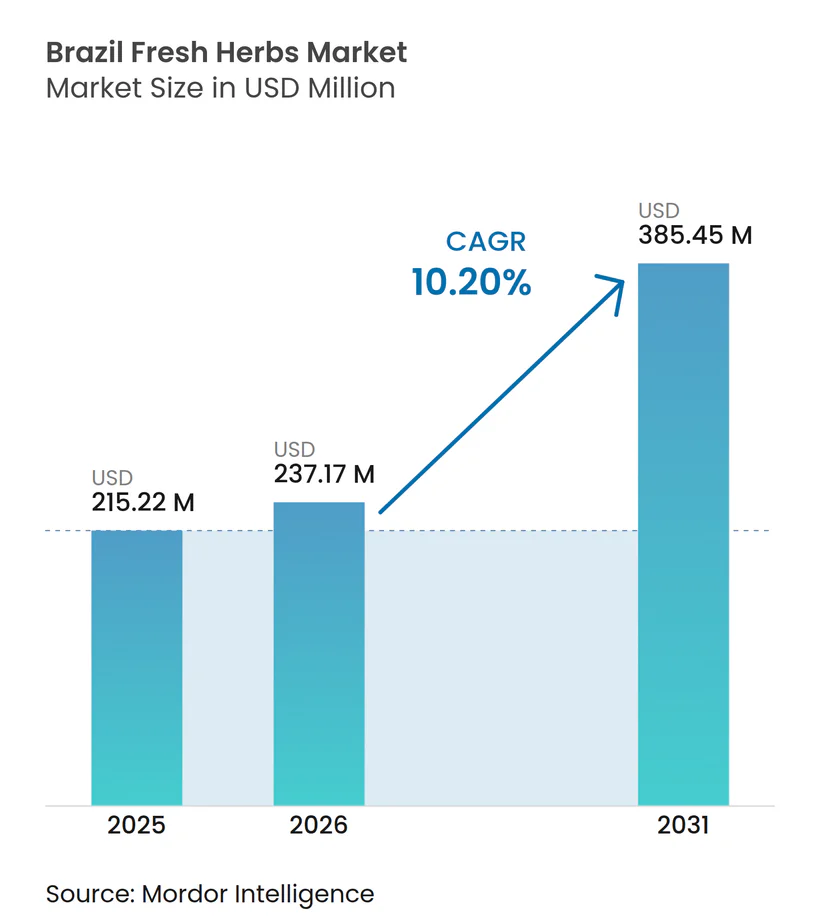
The Brazil fresh herbs market was valued at USD 215.22 million in 2025 and is estimated to grow from USD 237.17 million in 2026 to reach USD 385.45 million by 2031, at a CAGR of 10.20% during the forecast period 2026-2031. Urban demand is concentrated in the Southeast and South, where dense retail and restaurant networks support shorter supply routes. Formal retailers and foodservice buyers increasingly prioritize reliable freshness, documented handling, and year-round availability. These requirements support controlled-environment production, even as open-field farms remain important to overall supply and account for much of the volume used by traditional wholesale and retail channels. The market also includes a premium tier covering organic, living, and specialty products, where certification and reduced in-store waste influence purchasing decisions and product quality carries more weight than initial purchase cost. Competition remains fragmented, giving growers that combine dependable supply with traceability a clearer path to larger formal accounts, particularly where buyers require consistent product condition across repeated deliveries.
Key Report Takeaways
- By product, basil was the largest segment and held 38.3% of the Brazil fresh herbs market share in 2025, while it is also the fastest-growing segment and forecast to expand at a 10.1% CAGR between 2026 and 2031.
- By category, conventional was the largest segment and held 78.0% of the Brazil fresh herbs market size in 2025, while organic is the fastest-growing segment and is forecast to expand at a 13.5% CAGR between 2026 and 2031.
- By cultivation method, open-field cultivation was the largest segment and held 68.0% of the market share in 2025, while vertical indoor cultivation is the fastest-growing segment and is forecast to expand at a 19% CAGR between 2026 and 2031.
- By end user, food retail was the largest segment and held 43.7% of the market share in 2025, while foodservice is the fastest-growing segment and is forecast to expand at a 12.5% CAGR between 2026 and 2031.
Note: Market size and forecast figures in this report are generated using Mordor Intelligence’s proprietary estimation framework, updated with the latest available data and insights as of January 2026.
Market Trends and Insights
Drivers Impact Analysis of Brazil Fresh Herbs Market*
| Driver | (~) % Impact on CAGR Forecast | Geographic Relevance | Impact Timeline |
|---|---|---|---|
| Clean-Label Flavor Substitution in Brazilian Foodservice and Retail | +1.4% | National, with highest intensity in the São Paulo, Rio de Janeiro, and Curitiba metropolitan areas | Short term (≤ 2 years) |
| Expansion of Controlled-Environment Herb Production in Brazilian Cities | +1.7% | São Paulo, Minas Gerais, Paraná, and Goiás, with spillover to major metropolitan areas | Medium term (2-4 years) |
| Premiumization of Organic, Living, and Specialty Herbs | +1.3% | São Paulo and South Brazil, with early momentum in Minas Gerais | Medium term (2-4 years) |
| Growth of Restaurant, Meal-Kit, and Ready-to-Eat Demand | +1.2% | National, with highest relevance in São Paulo, Curitiba, and Belo Horizonte | Short term (≤ 2 years) |
| Same-Day Local Delivery and Micro-Fulfillment for Perishable Herbs | +1.1% | São Paulo, Santos, and Curitiba urban corridors | Short term (≤ 2 years) |
| Retailer Demand for Consistent Year-Round Hydroponic Supply | +1.2% | National modern retail, concentrated in Southeast and South Brazil | Medium term (2-4 years) |
| Source: Mordor Intelligence | |||
Clean-Label Flavor Substitution in Brazilian Foodservice and Retail
Demand for fresh herbs in Brazil is supported by food manufacturers, retailers, and foodservice operators seeking recognizable ingredients and greater control over the nutritional profile of prepared foods. The Brazilian Health Regulatory Agency (ANVISA) introduced front-of-pack nutrition labeling under RDC 429/2020 and IN 75/2020, requiring a prominent warning symbol when packaged foods reach specified levels of added sugars, saturated fat, or sodium. The regulation identifies sodium, added sugars, and saturated fat as the nutrients covered by the front-of-pack system, increasing the importance of reformulation and clearer ingredient positioning in packaged-food categories. Fresh herbs can support flavor development in sauces, prepared foods, salads, and foodservice dishes while providing an alternative to relying solely on salt-heavy seasoning blends. For the Brazil fresh herbs market, the regulatory environment therefore supports a broader clean-label and formulation trend, while suppliers with consistent quality, traceability, and reliable delivery can better serve retailers, food processors, and foodservice operators seeking recognizable ingredients.
Expansion of Controlled-Environment Herb Production in Brazilian Cities
Controlled-environment agriculture is expanding the capacity to provide consistent fresh-herb supply closer to Brazil’s major urban consumption centers. According to the Brazilian Agricultural Research Corporation (Embrapa) in 2025, vertical aromatic gardens are being developed to overcome space constraints in large cities, demonstrating the suitability of compact controlled systems for urban herb production. Commercial operators are also demonstrating the scalability of this model. BG Fazendas Urbanas S.A. (BeGreen) reported that its urban-farm network had 10,200 m² of built area and production capacity exceeding 24 metric tons per month, with production using hydroponic systems and controlled environments[1]. The company also reports 90% lower water consumption and 28 times higher production than conventional agriculture. For the Brazil fresh herbs market, the expansion of urban controlled-environment production can improve supply consistency for retail and foodservice customers while shortening the distance between harvest and consumption, helping address the perishability and logistics challenges associated with fresh herbs.
Premiumization of Organic, Living, and Specialty Herbs
Organic, living, and specialty herbs are gaining opportunities as Brazil's formal organic production base expands and certification provides greater product differentiation. According to the Brazilian Agricultural Research Corporation (Embrapa), in 2025, the number of registered organic producers in Brazil increased by 45% between 2019 and 2024, reaching 25,536 producers in 2024, with organic vegetables among the most common products. The Ministry of Agriculture and Livestock (MAPA) requires organic products marketed as organic to comply with established conformity mechanisms, including audit certification, participatory certification, or social-control arrangements, while the SisOrg seal provides formal identification for certified products. This expanding formal production base and certification framework can support differentiation of organic herbs from conventional products, while living herbs and specialty formats provide additional opportunities through product presentation and freshness. For the Brazil fresh herbs market, premium segments therefore depend on certification, traceability, consistent quality, and differentiated packaging and presentation rather than competing solely on volume.
Growth of Restaurant, Meal-Kit, and Ready-to-Eat Demand
Restaurants, meal-kit providers, and ready-to-eat food suppliers require fresh herbs that meet specific quality, freshness, and delivery requirements, supporting demand for reliable commercial supply. The expansion of foodservice activity is creating a broader demand base for fresh herbs. According to ABIA, ANR, and Galunion, 55% of foodservice operators reported higher revenue in the first half of 2024, based on a survey covering 453 brands and more than 7,400 foodservice outlets. The increase in revenue indicates stronger activity across a substantial portion of Brazil's foodservice sector, which can support recurring procurement of fresh ingredients, including basil, coriander, parsley, mint, and other culinary herbs.[2]. The Brazilian Health Regulatory Agency (ANVISA) requires foodservice establishments to follow Good Practices for food handling, preparation, storage, transportation, and delivery under Resolution RDC No. 216/2004. This environment increases the importance of consistent quality, food-safety procedures, and reliable deliveries for suppliers serving formal foodservice accounts. For the Brazil fresh herbs market, growing foodservice activity can support recurring procurement of basil, coriander, parsley, mint, and other herbs, while scheduled supply relationships allow growers to plan harvesting, packing, and local distribution around customer requirements.
Restraints Impact Analysis of Brazil Fresh Herbs Market*
| Restraint | (~) % Impact on CAGR Forecast | Geographic Relevance | Impact Timeline |
|---|---|---|---|
| Short Shelf Life and Post-Harvest Waste | -1% | National, with the highest impact outside Southeast Brazil where cold-chain infrastructure is limited | Short term (≤ 2 years) |
| Weather, Water, and Disease Exposure in Open-Field Supply | -0.9% | South Brazil, São Paulo state, and Northeast Brazil, where climate variability is high | Short term (≤ 2 years) |
| High Cost of Controlled-Environment Production and Energy | -0.8% | National, with the strongest impact on smaller operators moving beyond initial hydroponic pilots | Medium term (2-4 years) |
| Fragmented Smallholder Quality and Traceability Compliance | -0.7% | National, with a higher impact where formal buyers apply strict sanitation and traceability requirements | Long term (≥ 4 years) |
| Source: Mordor Intelligence | |||
Short Shelf Life and Post-Harvest Waste
Short shelf life remains a significant constraint for fresh herbs because quality can deteriorate rapidly during harvesting, transport, retail handling, and storage. According to the International Fresh Produce Association (IFPA) in 2025, citing the Brazilian Supermarkets Association (ABRAS) 2024 operational-efficiency survey, losses in the fruit, vegetable, and greens (FFLV) retail category declined from 5.83% in 2023 to 4.73% in 2024, while the category still accounted for 30% of total retail losses[3]. Although this measure covers the broader FFLV category rather than fresh herbs specifically, it highlights the continuing loss burden associated with highly perishable produce. Herb-specific evidence from a study published in Horticultura Brasileira found discard rates ranging from 8.7% to 97.0% of purchased units across four Brazilian supermarkets, with outcomes varying by species, supplier, store, and management practices. The study identified technological constraints and inadequate retail practices as major contributors to discard. For the Brazil fresh herbs market, these losses can reduce saleable volumes and returns across the supply chain, increasing the importance of rapid distribution, appropriate temperature management, careful handling, and suitable packaging. Smaller growers may face greater difficulty investing in these post-harvest systems, particularly when supplying formal retailers with stringent freshness requirements.
Weather, Water, and Disease Exposure in Open-Field Supply
Open-field fresh-herb production remains exposed to weather variability, water availability, and phytosanitary pressure, which can affect yields, quality, and supply consistency. According to the Brazilian Agricultural Research Corporation (Embrapa) in 2025, a review of 304 plant disease systems across 32 economically important crops in Brazil found that fungal diseases accounted for 79% of the disease systems evaluated, while changes in temperature and rainfall patterns can alter the risk and severity of plant diseases. Water availability is also an important production consideration, with Embrapa highlighting water shortages in important agricultural regions of Brazil and the need for more efficient water management. For fresh herbs such as basil, mint, and coriander, weather and moisture fluctuations can increase the need for irrigation, disease monitoring, and crop-protection measures, complicating efforts to maintain consistent quality and supply. Protected cultivation can reduce exposure to adverse environmental conditions and improve production control, but requires additional infrastructure and operating investment. Embrapa's 2024 research on protected vegetable cultivation identifies greenhouses and substrate systems as tools for reducing the effects of adverse weather and improving production consistency.
*Our forecasts treat driver/restraint impacts as directional, not additive. The impact forecasts reflect baseline growth, mix effects, and variable interactions.
Brazil Fresh Herbs Market Segment Analysis
By Product Type:
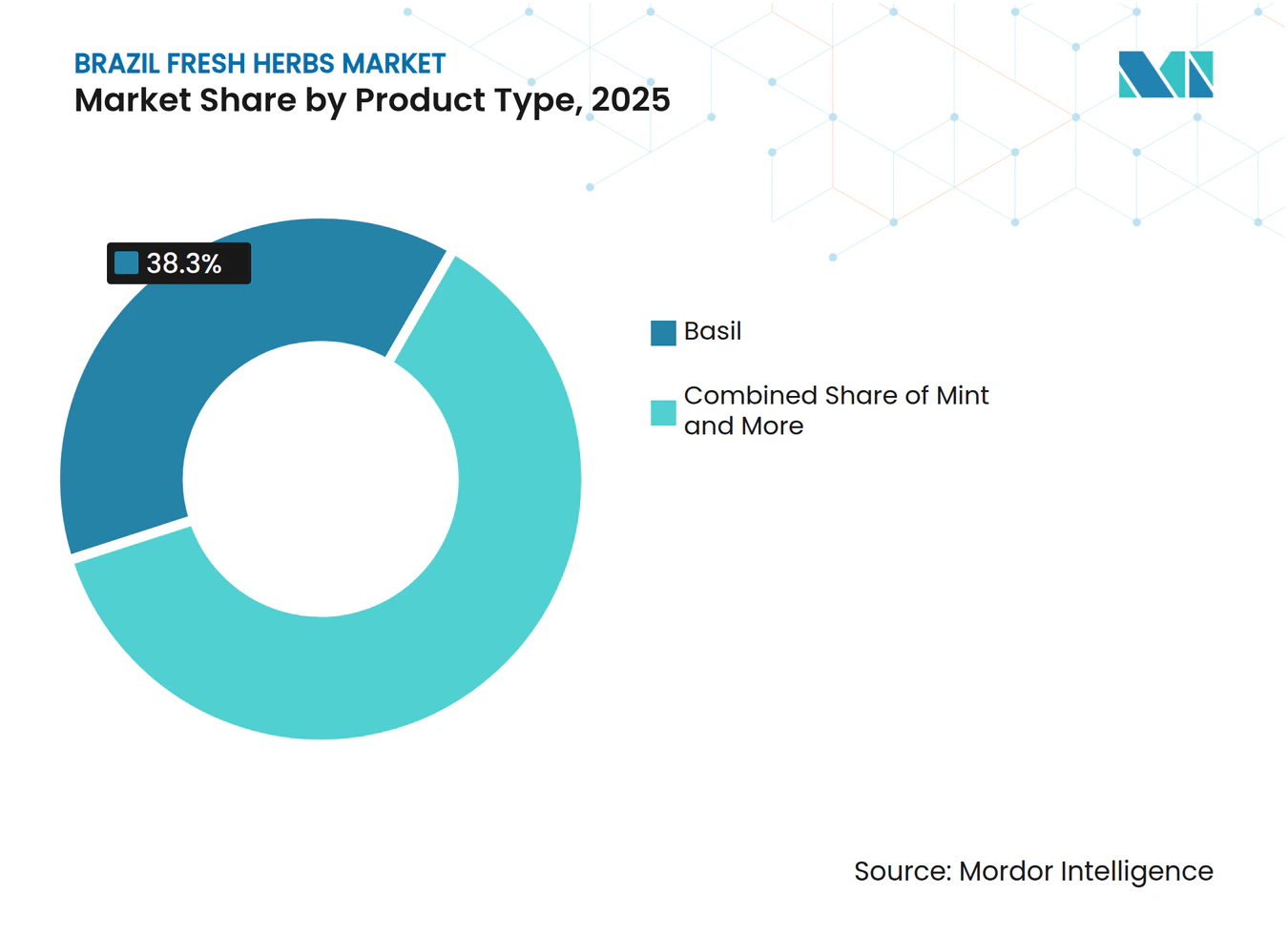
Basil Anchors Revenue While Specialty Varieties Build PremiumsBasil accounted for 38.3% of the Brazil fresh herbs market share in 2025, making it the largest product type, and is forecast to expand at a 10.1% CAGR between 2026 and 2031. Its leading position is supported by widespread use in Brazilian, Italian, and fusion cuisine, as well as availability across retail and foodservice channels. Cilantro and parsley remain important staples for household cooking, restaurants, and institutional food preparation, supporting recurring demand across mainstream channels. Basil's high perishability also increases the importance of efficient post-harvest handling and rapid distribution. A Brazilian supermarket study found that fresh herbs are particularly susceptible to wilting, yellowing, bruising, and decay, with discard varying substantially by species, supplier, and store practices.
Specialty herbs such as mint, thyme, rosemary, sage, and dill serve more differentiated culinary and foodservice applications, including premium restaurant menus, beverages, sauces, and prepared foods. Mint also has applications beyond conventional culinary use, although its positioning in nutraceutical and craft-beverage applications should be considered an additional demand channel rather than a direct indicator of fresh-herb market growth. Organic certification provides another differentiation route, with Brazil's National System of Organic Production (SisOrg) enabling compliant products to be identified as organic in formal retail channels. For the Brazil fresh herbs market, specialty and organic formats can therefore command differentiation through product variety, certification, traceability, freshness, and packaging, while basil remains the principal volume and revenue anchor.



By Category:
Conventional Leads While Organic Accelerates ValueConventional accounted for 78.0% of the Brazil fresh herbs market size in 2025, making them the largest category. Their leading position is supported by the established scale of conventional cultivation, broader availability, competitive pricing, and well-developed distribution through traditional wholesale markets and retail channels. Conventional remains important across household, foodservice, and institutional applications, where buyers generally prioritize consistent availability, product quality, and price. Organic accounts for the remaining share and is gaining relevance in premium retail and foodservice channels, where buyers place greater emphasis on certified production, traceability, and environmental practices. Brazil's Ministry of Agriculture and Livestock (MAPA) provides formal mechanisms for organic production through audit certification, participatory guarantee systems, and social-control arrangements for direct sales, supporting differentiation between certified organic and conventional herbs.
Organic is the fastest-growing category, forecast to expand at a 13.5% CAGR between 2026 and 2031. Growth is supported by increasing demand for certified and traceable produce, particularly in formal retail and foodservice channels where organic claims require compliance with Brazil's organic-production framework. The SisOrg seal provides a recognized identification for products covered by the country's organic conformity system, while certified producers can supply supermarkets, restaurants, hotels, industries, and online channels. These requirements increase the importance of certification, documentation, consistent production, and reliable supply for organic herb suppliers. The higher growth rate therefore reflects increasing opportunities for differentiated organic supply, even as conventional continue to account for the majority of the Brazil fresh herbs market.
By Cultivation Method:
Open Field Remains Dominant as Indoor Cultivation Reshapes ValueOpen-field cultivation accounted for 68.0% of the Brazil fresh herbs market in 2025, making it the largest cultivation method. Its leading position is supported by established farm infrastructure, comparatively lower investment requirements, and the widespread availability of land-based production systems supplying traditional wholesale, retail, and foodservice channels. Open-field cultivation also remains suitable for growers serving regional markets where proximity to established production areas and competitive procurement costs are important. Greenhouse and hydroponic systems complement field production by providing greater control over environmental conditions and production schedules. Brazilian Agricultural Research Corporation (Embrapa) notes that hydroponic vegetables experience less environmental stress from wind, rainfall, solar exposure, pests, and diseases when the system is properly managed, supporting more consistent product quality.
Vertical indoor cultivation is the fastest-growing method, forecast to expand at a 19.0% CAGR between 2026 and 2031. Growth is supported by the ability to produce herbs in controlled environments close to urban consumption centers, reducing dependence on external weather conditions and enabling year-round production. Embrapa's research on vertical farming specifically includes basil, coriander, and parsley, identifying herbs as suitable crops because of their high value and short production cycles. In 2025, Embrapa also highlighted vertical aromatic gardens as a solution for producing herbs in space-constrained urban areas. These characteristics support adoption among suppliers targeting premium retail and foodservice customers that value consistent volumes, predictable quality, and shorter harvest-to-delivery periods, although higher infrastructure and energy requirements remain barriers to wider adoption.
By End User:
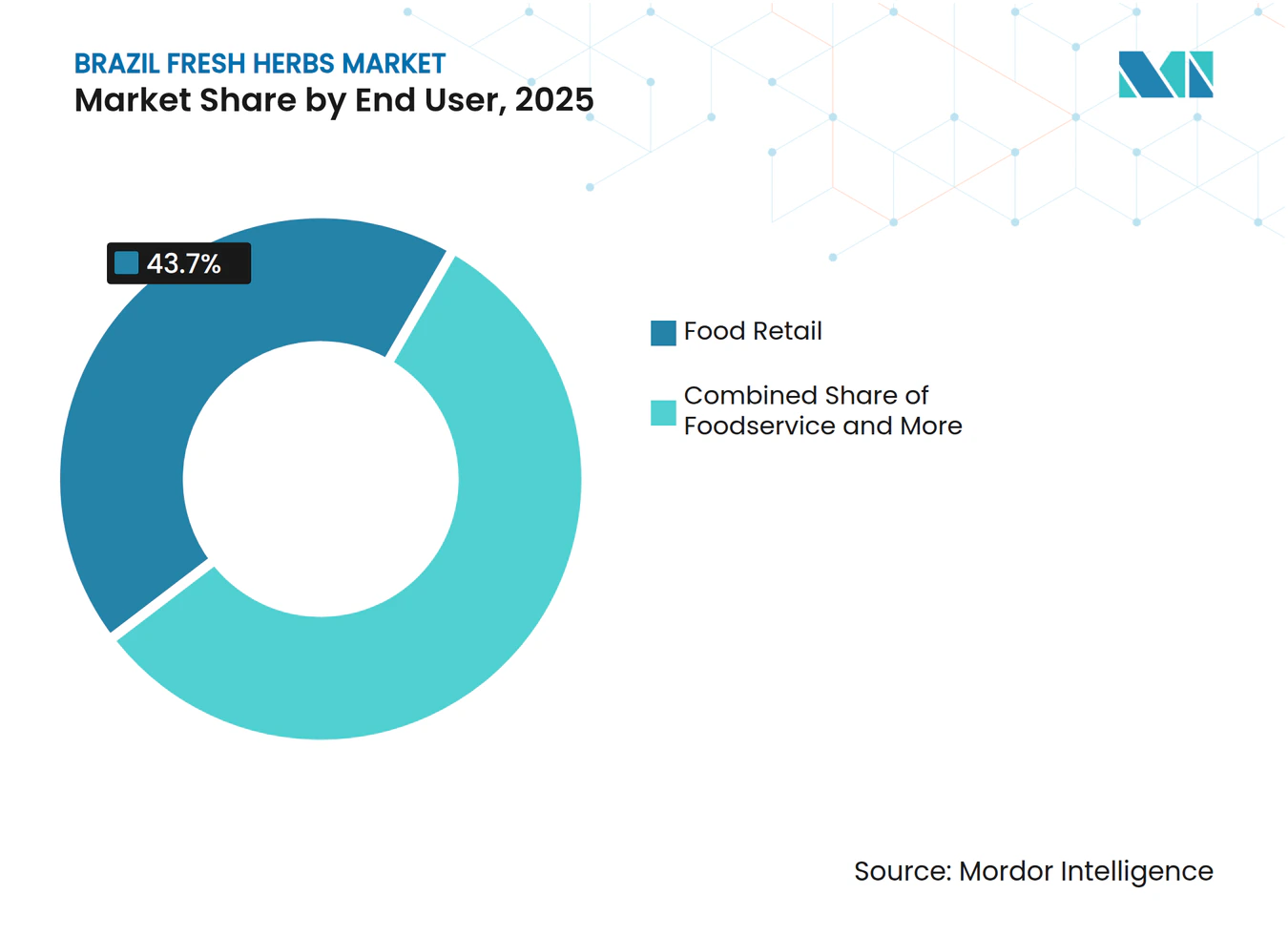
Food Retail Leads Share While Foodservice Drives Incremental GrowthFood retail accounted for 43.7% of the Brazil fresh herbs market share in 2025, making it the largest end-user segment. Its leading position is supported by regular household purchases, broad supermarket and grocery distribution, and the increasing availability of fresh and premium herb assortments. Retail buyers prioritize consistent appearance, freshness, shelf life, pack formats, and reliable replenishment because visible wilting or deterioration can increase product losses and affect consumer purchase decisions. Supermarkets and other organized retailers also provide opportunities for differentiated organic, living, and specialty herb formats, while conventional herbs continue to serve mainstream household demand. Suppliers that can maintain consistent quality and coordinate harvest, packing, and delivery schedules are therefore better positioned to meet the requirements of formal retail channels.
Foodservice is the fastest-growing end-user segment, forecast to expand at a 12.5% CAGR between 2026 and 2031. Growth is supported by demand from restaurants, hotels, institutional kitchens, cloud kitchens, and other prepared-food operators that require regular supplies of fresh herbs for menu preparation. Foodservice buyers typically place greater emphasis on variety, pack size, delivery frequency, freshness, and traceability because procurement needs are linked to menu requirements and recurring service schedules. According to a 2024 survey by the Brazilian Association of Food Industries (ABIA), the National Restaurant Association (ANR), and Galunion, foodservice operators reported improved revenue performance during the first half of 2024. This expansion in foodservice activity supports recurring procurement opportunities for basil, coriander, parsley, mint, and other herbs, while controlled-environment growers can differentiate through standardized quality and scheduled deliveries.

Geography Analysis
São Paulo remains a key regional market for Brazil's fresh herbs industry, supported by the state's large urban consumer base, organized retail and foodservice channels, and extensive horticultural distribution infrastructure. According to the National Supply Company (CONAB) in 2026, the São Paulo unit of the Company of Warehouses and General Storage of São Paulo (CEAGESP) handled 2.99 million metric tons of fruits and vegetables in 2025, the highest volume among the wholesale centers included in the survey. The Southeast region accounted for 52% of total horticultural sales volume across the covered wholesale markets. São Paulo also has an expanding urban-production ecosystem. The municipal Sampa+Rural program mapped more than 2,600 agricultural locations in 2025, including urban and rural production sites growing vegetables and other food crops. These characteristics support São Paulo's role as an important consumption, distribution, and production center for fresh herbs, particularly for suppliers targeting organized retail, foodservice, and shorter harvest-to-market cycles.
Other states in the Southeast and South provide complementary production and consumption bases, with Minas Gerais, Rio de Janeiro, Paraná, and Rio Grande do Sul supported by large urban markets, established horticultural activity, and wholesale distribution networks. CONAB reported that CeasaMinas in Contagem and Ceasa/RJ each handled approximately 1.5 million metric tons of fruits and vegetables in 2025, further demonstrating the importance of the Southeast's wholesale infrastructure. São Paulo's urban-agriculture initiatives also demonstrate the potential for localized production. A municipal model farm established in the city produced more than 3.7 metric tons of food during its first year, with regular deliveries to social organizations. For the Brazil fresh herbs market, these regional networks provide different combinations of production capacity, metropolitan demand, wholesale access, and controlled-environment opportunities.
Across the regions, supply-chain efficiency remains important because fresh herbs require rapid movement from production to retail and foodservice outlets. Suppliers serving organized buyers need consistent grades, standardized packaging, traceability, reliable replenishment, and appropriate temperature and handling practices. The concentration of wholesale infrastructure and large consumer markets in the Southeast creates opportunities for growers located close to major distribution centers, while other regions can develop through localized production and shorter supply chains. Geographic expansion of the Brazil fresh herbs market will therefore depend not only on cultivation capacity but also on the ability of regional suppliers to connect production efficiently with urban retail, foodservice, and other commercial buyers.
Competitive Landscape
Market Concentration
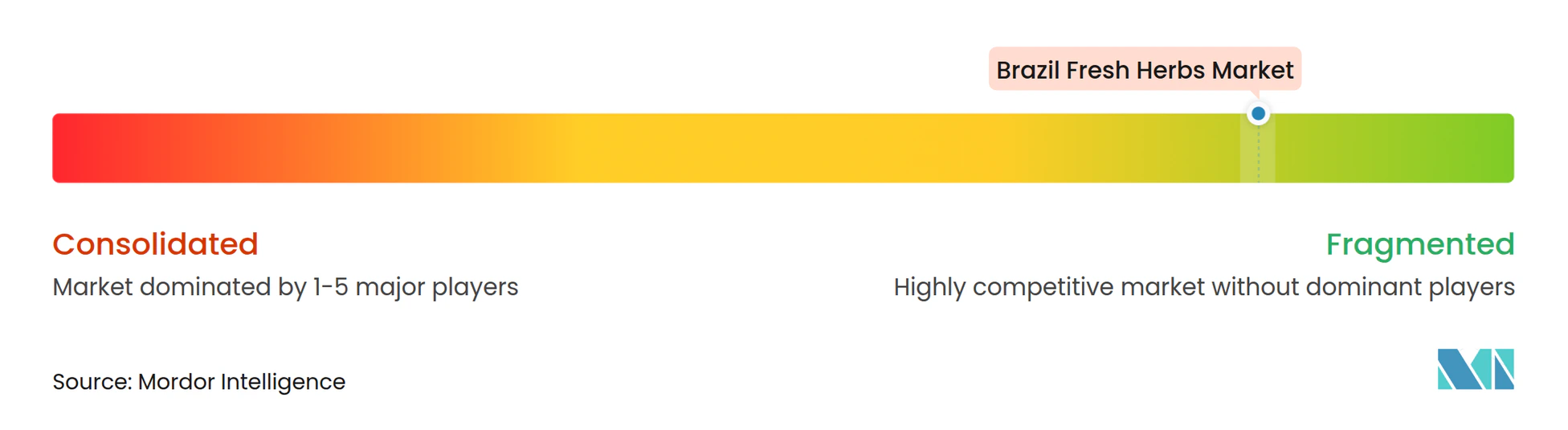
The Brazil fresh herbs market is fragmented, with BG Fazendas Urbanas S.A., Zaya Farms Ltda., H2Orti Hidroponia Fazenda Macaúbas Ltda., Global Hortaliças Hidropônicas, and Fazenda Bella Orgânicos do Brasil Ltda. representing major players in the market. Competition is centered on freshness, consistent quality, reliable delivery, cultivation technology, and access to formal retail and foodservice customers. Controlled-environment producers increasingly differentiate through year-round production, proximity to consumption centers, and standardized supply. Zaya Farms Ltda. operates an urban vertical hydroponic farm in Santos using nutrient-film technique and sensor-based automation, while Global Hortaliças Hidropônicas supplies supermarkets, restaurants, and distributors with hydroponically grown herbs and other leafy vegetables.
Competitive differentiation is also increasingly linked to expansion of controlled-environment production and customer-specific supply arrangements. In August 2025, Vale and BG Fazendas Urbanas S.A. entered into a partnership to establish a 6,000 m² horticultural production hub in Nova Lima, Minas Gerais, with planned production of approximately 20 metric tons of vegetables per month. The project demonstrates how controlled-environment producers can develop dedicated production capacity around institutional customers and underutilized urban or industrial sites. Zaya Farms Ltda. similarly positions its Santos facility close to restaurants, hotels, and markets, enabling delivery on the same day as harvest. H2Orti Hidroponia Fazenda Macaúbas Ltda., established in 2014, supplies supermarket chains in Minas Gerais and positions its hydroponic production around year-round availability and product quality.
Smaller and regional suppliers, including H2Orti Hidroponia Fazenda Macaúbas Ltda., Global Hortaliças Hidropônicas, Isabela Hortaliças, and Folha D'Água Cultivo Hidropônico Ltda., can compete through proximity to local customers, specialized production, and flexible delivery. Folha D'Água, for example, supplies supermarkets, hortifrutis, and restaurants with hydroponic herbs including coriander, mint, basil, rosemary, parsley, and packaged herb products. The competitive environment therefore provides opportunities for suppliers that combine cultivation control with efficient packing, traceability, and distribution. As formal retail and foodservice buyers increase requirements for freshness and supply consistency, the ability to maintain standardized quality and reliable delivery across multiple customer locations will remain an important differentiator in the Brazil fresh herbs market.
Brazil Fresh Herbs Industry Leaders
-
BG Fazendas Urbanas S.A.
-
Zaya Farms Ltda.
-
H2Orti Hidroponia Fazenda Macaúbas Ltda.
-
Global Hortaliças Hidropônicas
-
Fazenda Bella Orgânicos do Brasil Ltda.
- *Disclaimer: Major Players sorted in no particular order
Brazil Fresh Herbs Market Companies Covered in this Report
- BG Fazendas Urbanas S.A.
- Zaya Farms Ltda.
- H2Orti Hidroponia Fazenda Macaúbas Ltda.
- Global Hortaliças Hidropônicas
- Fazenda Bella Orgânicos do Brasil Ltda.
- Isabela Hortaliças
- Sprout Holdings S.A.
- Folha D'Água Cultivo Hidropônico Ltda.
- Tamcar Hortifruti / Chácara Tamcar
- Sítio Boa Safra
Recent Industry Developments in Brazil Fresh Herbs Market
- August 2025: Vale S.A. and BG Fazendas Urbanas S.A. (BeGreen) signed a contract to establish a horticultural production hub in Nova Lima, Minas Gerais. The facility covers approximately 6,000 m² and was designed for around 20 metric tons of vegetables per month, including fresh herbs.
- July 2025: The Brazilian Institute of Horticulture (IBRAHORT) and Plataforma Hidroponia established a technological cooperation agreement to promote innovative hydroponic technologies across Brazil's horticulture sector. The partnership focuses on connecting producers, disseminating technical knowledge, and encouraging the adoption of hydroponic production technologies.
- April 2025: Grano Alimentos expanded its foodservice portfolio with frozen parsley, chives and basil, alongside chopped onion. The products were positioned for foodservice applications requiring convenience, standardization and operational efficiency.
Brazil Fresh Herbs Market Report Scope
Fresh herbs refer to edible leafy or tender plant parts that are harvested and sold in their fresh, unprocessed state for culinary, foodservice, and food-processing applications. They are primarily used to add flavor, aroma, color, and garnish to foods rather than as a primary source of calories.
The Japan Fresh Herbs Market Report is Segmented by Product Type (Basil, Cilantro/Coriander, Mint, and More), by Category (Conventional and Organic), by Cultivation Method (Open-Field Cultivation, Greenhouse Cultivation, and More), and by End User (Foodservice, Food Retail, and More). The Market Forecasts are Provided in Terms of Value (USD).
Segmentation Overview
| Basil |
| Cilantro/Coriander |
| Mint |
| Parsley |
| Chives |
| Oregano |
| Rosemary |
| Thyme |
| Sage |
| Dill |
| Other Fresh Herbs |
| Conventional |
| Organic |
| Open-Field Cultivation |
| Greenhouse Cultivation |
| Hydroponic Cultivation |
| Aeroponic Cultivation |
| Vertical Indoor Cultivation |
| Foodservice |
| Food Retail |
| Food Processing |
| Pharmaceutical and Nutraceutical |
| Other |
| By Product Type | Basil |
| Cilantro/Coriander | |
| Mint | |
| Parsley | |
| Chives | |
| Oregano | |
| Rosemary | |
| Thyme | |
| Sage | |
| Dill | |
| Other Fresh Herbs | |
| By Category | Conventional |
| Organic | |
| By Cultivation Method | Open-Field Cultivation |
| Greenhouse Cultivation | |
| Hydroponic Cultivation | |
| Aeroponic Cultivation | |
| Vertical Indoor Cultivation | |
| By End User | Foodservice |
| Food Retail | |
| Food Processing | |
| Pharmaceutical and Nutraceutical | |
| Other |
Key Questions Answered in the Report
What is the size of the Brazil fresh herbs market?
The Brazil fresh herbs market size is USD 237.17 million in 2026 and is forecast to reach USD 385.45 million by 2031, at a 10.20% CAGR between 2026 and 2031.
Which product leads fresh herb sales in Brazil?
Basil led sales with 38.3% of 2025 revenue and is forecast to expand at a 10.1% CAGR between 2026 and 2031.
Which end user buys the most fresh herbs in Brazil?
Food retail held 43.7% of 2025 market share, while foodservice is forecast to expand at a 12.5% CAGR between 2026 and 2031.
What limits fresh herb supply in Brazil?
Short shelf life, post-harvest waste, weather exposure in open-field farming, high controlled-environment costs, and fragmented traceability practices limit supply efficiency.