
Brazil Freight Forwarding Market Size and Share
Market Overview
| Study Period | 2021 - 2032 |
|---|---|
| Forecast Data Period | 2027 - 2032 |
| Base Year Market Size (2026) | USD 13.99 Billion |
| Market Size (2027) | USD 14.72 Billion |
| Market Size (2032) | USD 18.88 Billion |
| Growth Rate (2027 - 2032) | 5.10 % |
| Market Concentration | Low |
Major Players *Disclaimer: Major Players sorted in no particular order Image © Mordor Intelligence. Reuse requires attribution under CC BY 4.0. | |
Brazil Freight Forwarding Market Analysis by Mordor Intelligence
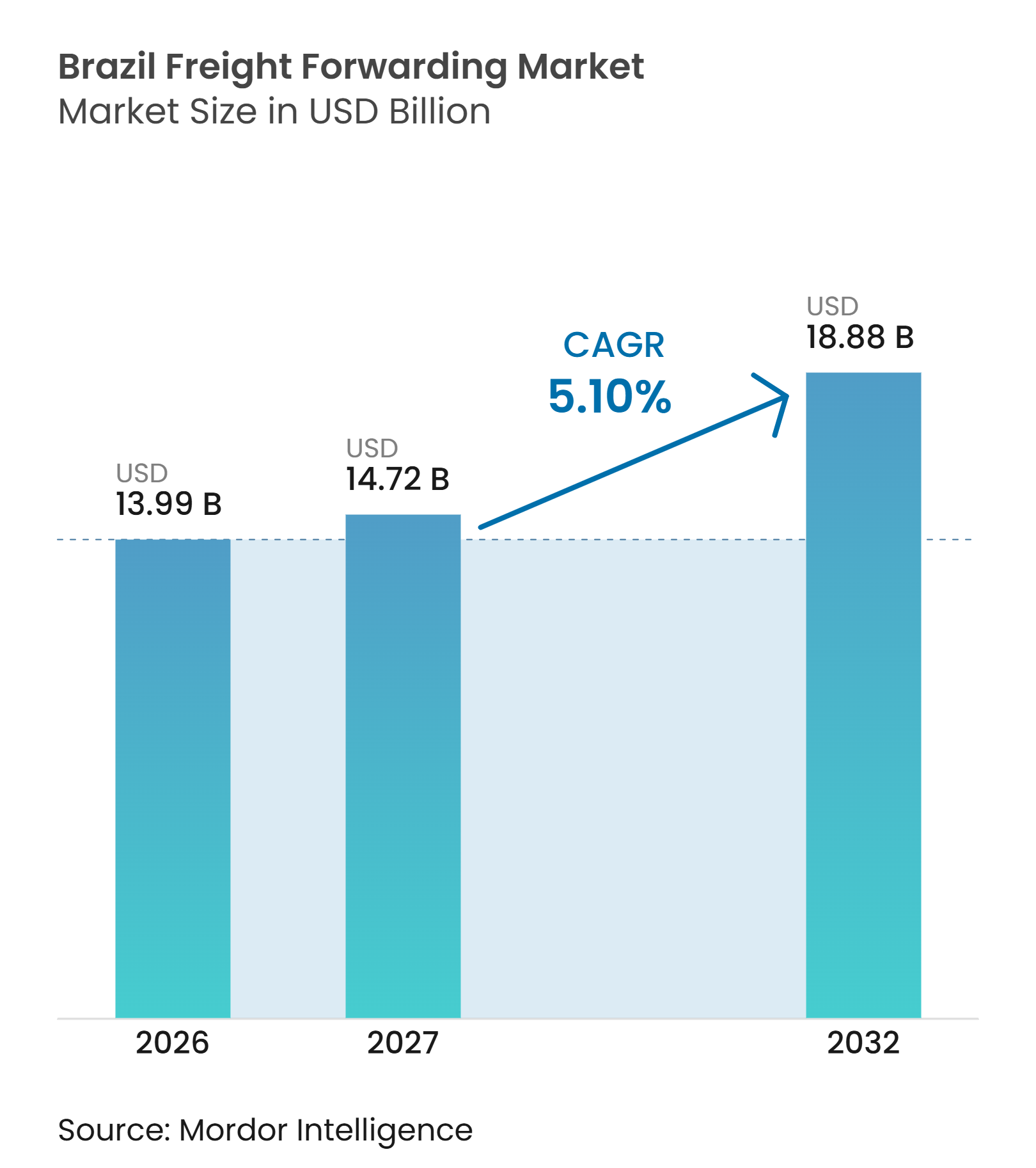
The Brazil freight forwarding market size is valued at USD 13.99 billion in 2026 and is estimated to grow from USD 14.72 billion in 2027 to reach USD 18.88 billion by 2032, at a CAGR of 5.10% during the forecast period from 2027 to 2032.
Trade flows, nearshoring activity, and expanding e-commerce are widening the range of shipments that require customs, consolidation, and inland coordination. The Brazil freight forwarding market is also being reshaped by electronic documentation, which raises the value of reliable compliance systems. Northern port corridors are gaining importance as agricultural production moves toward Mato Grosso and adjacent states. Congestion, fuel costs, cargo security, and rail gaps remain material operating constraints, but they also reward forwarders that can offer multimodal alternatives and dependable shipment visibility.
Key Report Takeaways
- By mode of transport, ocean freight forwarding accounts for 73.28% of the Brazil freight forwarding market share in 2026, while air freight forwarding is projected to register a 6.98% CAGR through 2032.
- By enterprise size, large enterprises account for 68.47% of the Brazil freight forwarding market size in 2026, while small and medium enterprises are projected to register a 7.14% CAGR through 2032.
- By forwarder model, traditional asset-light forwarders account for 76.72% of the Brazil freight forwarding market share in 2026, while digital-first and online platforms are projected to register a 6.23% CAGR through 2032.
- By end-user industry, industrial and manufacturing accounts for 37.56% of the Brazil freight forwarding market share in 2026, while wholesale and retail trade is projected to register a 7.69% CAGR through 2032.
- By geography, Southeast Brazil accounts for 53.38% of the Brazil freight forwarding market share in 2026, while Central-West Brazil is projected to register a 7.36% CAGR through 2032.
Note: Market numbers in this report are based on Mordor Intelligence's proprietary estimation framework, which combines nine months of actuals with Q4 projections for base year 2026.
Market Trends and Insights
Drivers Impact Analysis of Brazil Freight Forwarding Market*
| Driver | (~) % Impact on CAGR Forecast | Geographic Relevance | Impact Timeline |
|---|---|---|---|
| Manufacturing Nearshoring Expanding Freight Forwarding Demand | +0.7% | National, with early gains in São Paulo, Minas Gerais, and Santa Catarina | Medium term (2-4 years) |
| CT-e Digitalization Improving Compliance and Shipment Processing | +0.5% | National, with strongest uptake in São Paulo, Paraná, and Rio Grande do Sul. | Short term (≤ 2 years) |
| Agribulk Exports Strengthening Northern Corridor Freight Flows | +0.4% | Mato Grosso, Pará, Maranhão, and Tocantins, with spillover to Mato Grosso do Sul. | Long term (≥ 4 years) |
| Digital Freight Platforms Improving Capacity Matching Efficiency | +0.5% | National, concentrated in the Southeast and South | Short term (≤ 2 years) |
| E-Commerce Growth Increasing Fragmented Shipment Forwarding Demand | +0.8% | Southeast, with growing activity in the Central-West and Northeast | Short term (≤ 2 years) |
| Carbon Tracking Increasing Multimodal Forwarding Service Requirements | +0.3% | National, influenced by ANTT sustainable-corridor initiatives and COP30 preparations in Belém. | Long term (≥ 4 years) |
| Source: Mordor Intelligence | |||
Manufacturing Nearshoring Expanding Freight Forwarding Demand
Brazil is becoming a more important location for regional manufacturing and distribution, increasing demand for freight services that can manage varied and time-sensitive cargo. The Inter-American Development Bank stated that nearshoring could add USD 7.8 billion in annual Brazilian goods exports, with transport and cross-border logistics among the main beneficiaries. Components used in manufacturing often need customs coordination, consolidation, and scheduled delivery rather than the standardized handling used for bulk commodity exports. DHL Global Forwarding has positioned Guarulhos and Viracopos as Americas redistribution hubs, using in-transit cargo arrangements to support regional distribution from Brazil. This pattern creates opportunities for operators that can combine airport handling, bonded storage, and customs support. It also increases the importance of capacity planning around industrial clusters in São Paulo, Minas Gerais, and Santa Catarina.
CT-e Digitalization Improving Compliance and Shipment Processing
The CT-e electronic transport document is central to shipment documentation in the Brazil freight forwarding market. Brazil’s federal technology company SERPRO reported that the SPED infrastructure processed 17 billion digital documents and 690 million electronic fiscal documents each month in 2025[1]. CONFAZ established a 132-month minimum retention period for CT-e XML files through Adjustment SINIEF No. 2 of April 2025. The record supports auditability and gives forwarders a common digital basis for transport and customs workflows. Operators with systems connected to electronic fiscal processes can reduce manual re-entry and improve shipment status reporting. The requirement also makes basic digital capability a practical condition for serving larger shippers across several modes.
Agribulk Exports Strengthening Northern Corridor Freight Flows
Agricultural exports are changing the physical footprint of freight forwarding across Brazil. CONAB reported soybean exports of 108.2 million tons in 2025, while northern routes accounted for 39.5% of combined soybean and corn exports. The Ministry of Ports and Airports reported that Arco Norte ports handled 163.3 million tons in 2025. Freight forwarders need stronger operating coverage in Itaqui, Barcarena, Vila do Conde, and related inland collection points. The United States Department of Agriculture noted that northern export options can reduce the distance between Mato Grosso production and ports, changing the economics of origin-to-port planning. Seasonal navigation conditions on the Tapajós and Madeira rivers still require contingency routing and close coordination with carriers.
E-Commerce Growth Increasing Fragmented Shipment Forwarding Demand
E-commerce is increasing the number of smaller, more frequent shipments that enter and move through the Brazil freight forwarding market. The Southeast remains the main center of delivery activity, but fulfillment investment is extending into the Central-West. DHL Supply Chain opened fulfillment centers in Cajamar and Brasília in March 2026, increasing the number of Brazil locations in its fulfillment network to 5. The LGPD data-protection framework also makes secure management of shipment and customer information an important operating requirement for logistics platforms.
Restraints Impact Analysis of Brazil Freight Forwarding Market*
| Restraint | (~) % Impact on CAGR Forecast | Geographic Relevance | Impact Timeline |
|---|---|---|---|
| Toll and Diesel Costs Increasing Forwarding Expenses | -0.7% | National, especially BR-116, BR-101, BR-163, and BR-364 | Short term (≤ 2 years) |
| Port Congestion Increasing Demurrage and Transit Delays | -0.6% | Santos, Paranaguá, Itapoá, Itajaí, Navegantes, and Northern Arc terminals | Medium term (2-4 years) |
| Rail Fragmentation Increasing Intermodal Handoff Complexity | -0.3% | National, with major gaps between the Central-West and South | Long term (≥ 4 years) |
| Cargo Crime Increasing Insurance and Cybersecurity Costs | -0.4% | Southeast, with nationwide cyber risks | Medium term (2-4 years) |
| Source: Mordor Intelligence | |||
Toll and Diesel Costs Increasing Forwarding Expenses
Road transport remains essential to domestic collection and delivery, making diesel and toll costs a persistent challenge for forwarders. ANTT updated freight-rate references in March 2026 following regulatory changes and diesel-price movements. There was a 13.1% increase in road freight rates in the third quarter of 2026 compared with the same period in 2025[2]. Higher toll-road coverage may improve reliability and vehicle conditions, but it also raises direct access costs for road-linked cargo. These expenses are difficult to absorb when contracts have fixed pricing or when shipments make several inland handoffs. Multimodal offerings that use rail or cabotage for feasible long-haul sections can provide clients with an alternative when road costs rise.
Port Congestion Increasing Demurrage and Transit Delays
Capacity pressure at ports makes schedule reliability a core service issue in the Brazil freight forwarding market. Higher utilization can lengthen gate, berth, and container-release times, which adds risk to customers with narrow production schedules. DP World is expanding its Santos terminal to 1.7 million TEU of annual capacity, and its agreement with Maersk is intended to support additional services. The investment should add capacity, but it does not eliminate the need for forwarders to use alternative ports and maintain timely customer communication. Operators that can shift cargo among Santos, Paranaguá, Suape, and northern gateways are better placed to limit disruption.
*Our forecasts treat driver/restraint impacts as directional, not additive. The impact forecasts reflect baseline growth, mix effects, and variable interactions.
Brazil Freight Forwarding Market Segment Analysis
By Mode of Transport:
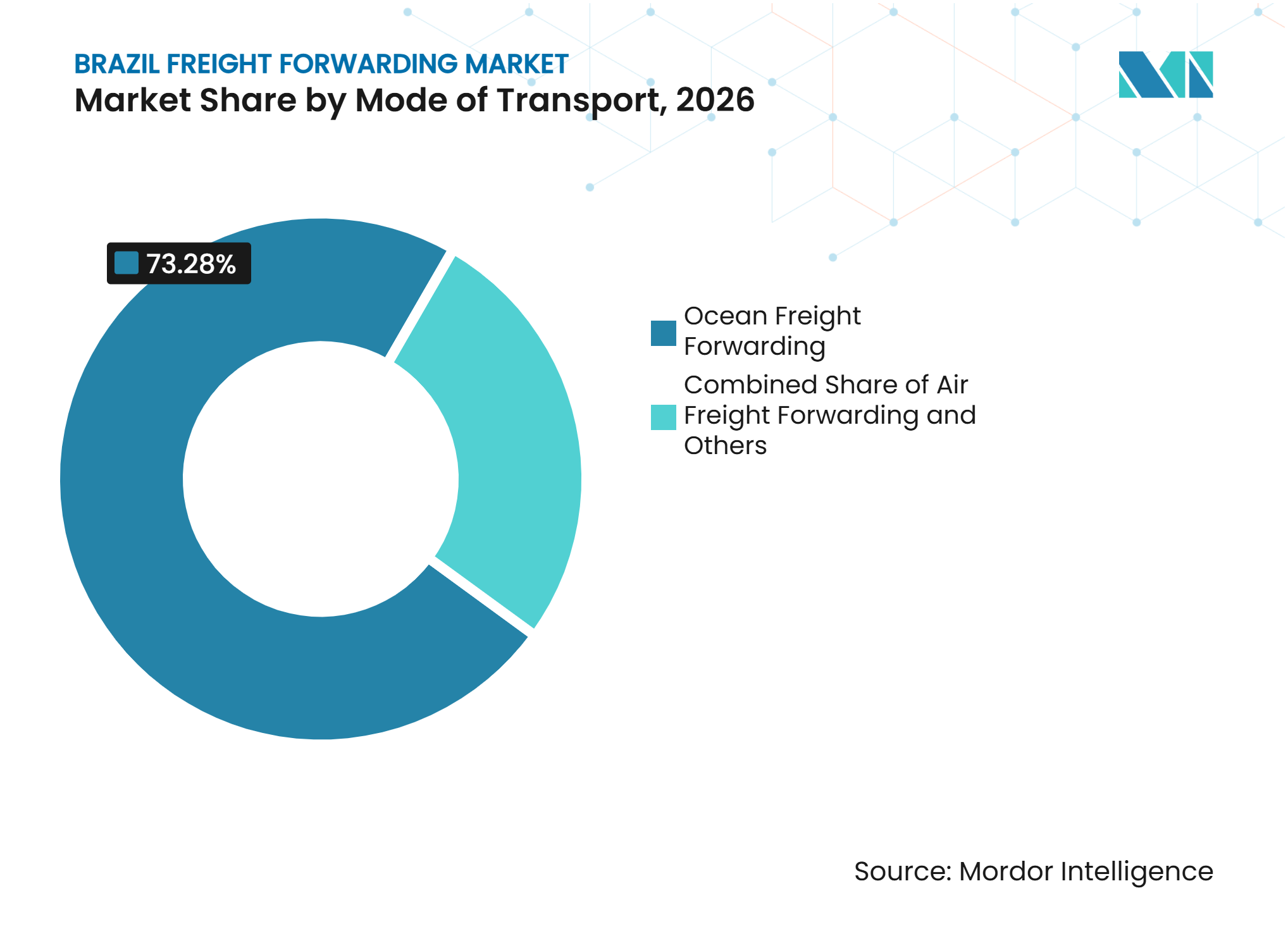
Ocean Leads While Air Freight ExpandsOcean freight forwarding accounts for 73.28% of the Brazil freight forwarding market share in 2026. Its position reflects the role of Santos, Paranaguá, Itapoá, and northern ports in handling containerized imports and commodity-linked exports. Full-container and less-than-container services remain the principal products for importers of equipment, electronics, and consumer goods. Ocean services also support exporters that need reliable reefer capacity for food and beverage cargo. Road forwarding connects ports with inland customers and remains necessary for domestic distribution and agricultural collection. Yet road margins face pressure from diesel, tolls, and mandated freight-rate changes.
The Brazil freight forwarding market size for air freight forwarding is projected to expand at a 6.98% CAGR through 2032, supported by high-value electronics, pharmaceuticals, and cross-border e-commerce. Air freight offers speed and temperature control for shipments that cannot tolerate extended ocean transit. Guarulhos and Viracopos are becoming more relevant as redistribution points for cargo arriving from Asia and Europe. This makes airport-to-regional distribution a more important capability for freight forwarders. Multimodal services are also gaining attention because they link inland production with rail and port capacity.



By Enterprise Size:
Large Operators Retain Scale While SMEs Grow FasterLarge enterprises account for 68.47% of the Brazil freight forwarding market share in 2026. Their scale supports carrier purchasing, customs credit, established agent networks, and investment in bonded warehouses. They are well positioned to serve project cargo, regulated healthcare shipments, and complex cross-border movements. Large providers also have stronger capacity to support national shipper contracts and extended payment terms. The segment benefits from a wide base of industrial, energy, automotive, and consumer-goods customers. Its position is reinforced by physical assets and customs expertise that are difficult to reproduce quickly.
The Brazil freight forwarding market size for small and medium enterprises is projected to register a 7.14% CAGR through 2032. Smaller forwarders are gaining access to digital booking, documentation, and carrier-management tools that reduce manual work. Digital platforms can help smaller operators issue CT-e documentation, confirm container space, and manage credit checks through more integrated workflows. This can reduce the staffing required to manage routine movements. Smaller firms can also compete through local knowledge and specialized customer support in particular corridors. The move toward destination-based taxation may increase the importance of well-located warehousing and bonded-storage assets. As a result, large operators retain an advantage in asset-intensive services even while smaller firms grow in standard freight services.
By Forwarder Model:
Traditional Networks Maintain Control While Digital Platforms ScaleTraditional asset-light forwarders account for 76.72% of the Brazil freight forwarding market share in 2026. Their scale rests on longstanding carrier relationships, customs-agent networks, and familiarity with Brazil’s fiscal documentation requirements. These operators can purchase capacity across shipping alliances without owning large transport fleets. They also provide cargo insurance arrangements and customer support for high-value or hazardous cargo. Their operating model remains well suited to manufacturers and importers that need predictable execution across several modes. Established networks are particularly valuable when port delays require a shift in carrier, sailing, or gateway. The ability to coordinate brokers, carriers, and warehouses remains a major advantage. Traditional providers therefore continue to hold the broadest customer base in the Brazil freight forwarding market.
Digital-first and online platforms are projected to register a 6.23% CAGR through 2032. Digital offerings can improve quote speed, capacity matching, shipment visibility, and document control. They are most useful where cargo moves are frequent and operational rules are repeatable. Hybrid providers combine these tools with fleets, warehouses, drayage equipment, or port-adjacent assets. This model can be useful in northern agricultural corridors where physical transshipment capacity protects service delivery during spot-rate changes. CT-e and electronic customs integration are becoming more important for every model. Providers without system connectivity may face delays that digitally integrated competitors can avoid.
By End-User Industry:
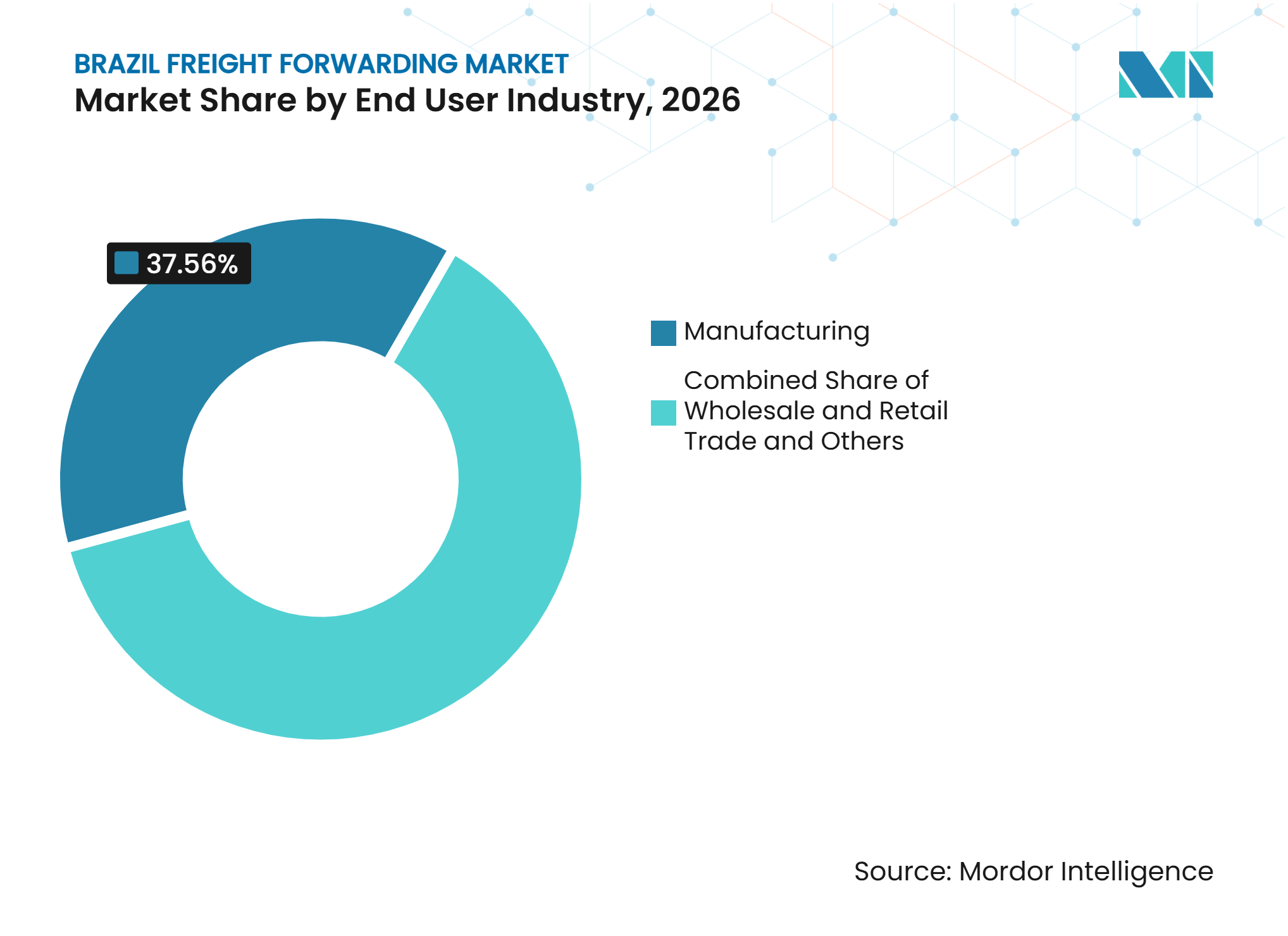
Manufacturing Provides Volume While Retail Raises Shipment FrequencyIndustrial and manufacturing accounts for 37.56% of the Brazil freight forwarding market share in 2026. The segment includes inbound components for automotive, aerospace, chemical, and capital-goods production. Manufacturing customers often need customs support, project-cargo expertise, and bonded storage near production sites. Brazil’s New Industry program focuses on strategic supply chains and supports demand for specialized logistics handling. These flows can include heavy equipment, oversized cargo, and goods that require controlled delivery schedules. Forwarders with customs-brokerage capacity are well placed to manage these movements. The concentration of factories in the Southeast also supports a dense base of freight activity near Santos and São Paulo. The segment remains a dependable source of volume for the Brazil freight forwarding industry.
Wholesale and retail trade is projected to register a 7.69% CAGR through 2032. E-commerce adds more shipments with smaller order values and a greater need for consolidation. This changes the mix of work toward parcel-linked imports, less-than-container loads, and air cargo. Healthcare and pharmaceuticals add demand for controlled-temperature handling, particularly for vaccines and injectable medicines. Oil, gas, and energy projects require specialized forwarding for offshore equipment and renewable-energy installations. Food and beverages continue to rely on reefer ocean services. Chemicals and automotive freight also sustain recurring container flows for global forwarders.

Geography Analysis
Southeast Brazil accounts for 53.38% of the Brazil freight forwarding market share in 2026. The region combines the Port of Santos with industrial production and consumer demand across São Paulo, Minas Gerais, Rio de Janeiro, and Espírito Santo. Santos set a single-month record of 538,200 TEUs in August 2026. This volume supports a broad base of ocean, road, air, and warehouse activity. It also puts pressure on terminal access and schedule reliability. Bonded warehouses and customs providers around the Rodoanel support consolidation and import clearance. The LGPD remains relevant because forwarders handling consumer and shipment data need sound data-governance practices. DHL Supply Chain’s expansion in Brasília also suggests that capacity limits in the Southeast are pushing some distribution investment toward other regions.
Central-West Brazil is projected to register a 7.36% CAGR through 2032. Agricultural production in Mato Grosso and neighboring states is broadening the region’s freight requirements beyond traditional road transport. The DP World and MRS Logística service adds an integrated road, rail, and port option between the Central-West and Santos. It provides a contractual flow across transport modes and can improve predictability for exporters. The Central-West is also receiving fulfillment investment for domestic consumer shipments. This mix of agricultural exports and consumer distribution requires forwarders to develop both bulk-corridor and parcel-linked capabilities.
The North is gaining importance as Arco Norte ports handle a larger share of agricultural exports. Northern Arc ports processed 163.3 million tons of cargo in 2025, and the Brazil freight forwarding market size associated with northern export corridors is supported by rising soybean and corn movements[3]. Freight providers need customs, consolidation, and corridor-switching capabilities in ports such as Itaqui and Barcarena. In the Northeast, Suape offers an alternative gateway for regional consumption and import cargo; in the South, Paranaguá, Itapoá, and Rio Grande support agricultural and automotive logistics. These regions provide alternatives when congestion affects Santos. The Brazil freight forwarding market share of these mixed regional corridors depends on their ability to add capacity while preserving reliable inland links.
Competitive Landscape
Market Concentration
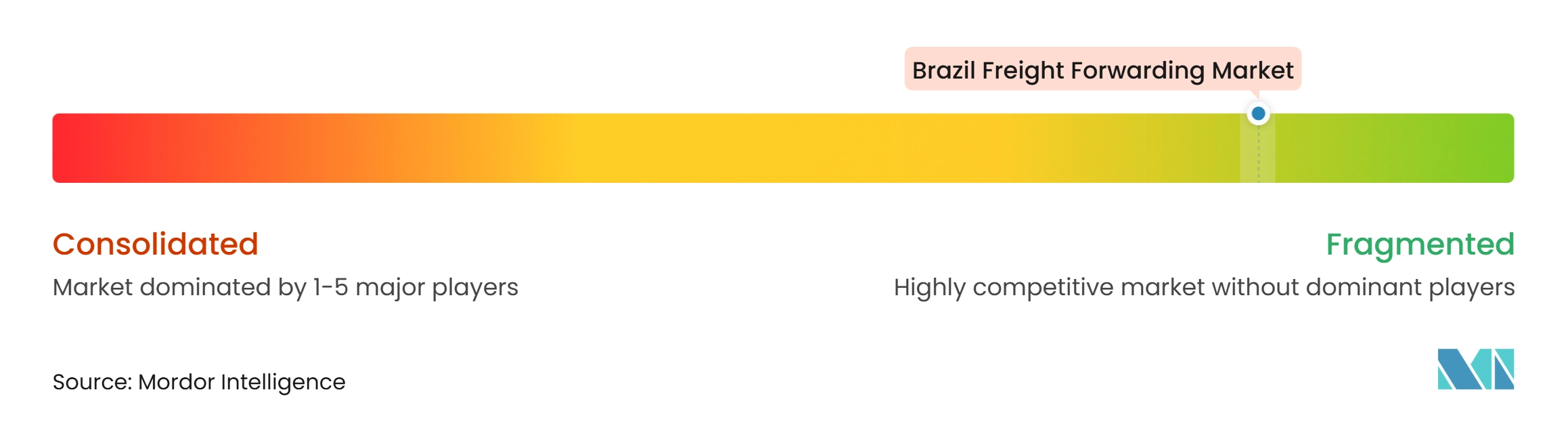
The Brazil freight forwarding market is fragmented, with global integrators competing alongside regional specialists. Asia Shipping, DSV, DHL, Maersk, CEVA, and other international operators compete across ocean, air, customs, and contract logistics. Regional providers such as ES Logistics, Allog, and AMTrans compete through local operating knowledge and service responsiveness. Competition is therefore based on network reach, compliance capability, shipment visibility, and access to capacity.
DSV completed the acquisition of DB Schenker in April 2025, increasing its global scale and bringing its Brazilian operations into a larger combined network. The transaction affects competitive conditions because larger networks can combine carrier purchasing, customs coverage, and customer contracts. Maersk continues to extend its door-to-door logistics offering through terminal access, inland services, and equipment positioning. Its March 2025 agreement with DP World supports expanded services at Santos. DP World and MRS Logística added a further competitive option through their integrated Central-West corridor in July 2026[4]. These moves favor providers that can connect port, rail, road, and customs services in a single customer offering.
Digital investment is becoming more important because customers expect status updates, documentation control, and alternatives when schedules change. CT-e integration provides a practical route to lower manual processing and stronger compliance. Large providers have capital for technology and specialized infrastructure, while regional firms can move faster in local adaptation. Pharmaceutical cold-chain forwarding has high entry requirements because operators must manage temperature control and regulatory requirements from ANVISA. Digital services for small and medium shippers are another area of competition, especially when platforms add customs-brokerage functions. CEVA’s Amazon fulfillment center in the Federal District shows that contract-logistics providers are also expanding their presence beyond traditional port centers. The competitive landscape is likely to remain diverse because Brazil’s regional logistics constraints favor both global scale and local operating knowledge.
Brazil Freight Forwarding Industry Leaders
-
Asia Shipping
-
Allog Group
-
DC Logistics Brasil
-
DSV AS
-
DHL Group
- *Disclaimer: Major Players sorted in no particular order
Brazil Freight Forwarding Market Companies Covered in this Report
- DSV AS
- DHL Group
- Kuehne+Nagel International AG
- A.P. Moller - Maersk
- CEVA Logistics
- GEODIS
- Expeditors International of Washington Inc.
- Nippon Express Holdings Inc.
- Asia Shipping
- C.H. Robinson Worldwide Inc.
- Rhenus Group
- Hellmann Worldwide Logistics
- JAS Worldwide Inc.
- DACHSER
- Savino Del Bene
- FedEx Logistics Inc.
- UPS Supply Chain Solutions
- Allog Group
- DC Logistics Brasil
- Rohlig Logistics
- ES Logistics
- AMTrans Logistics
Recent Industry Developments in Brazil Freight Forwarding Market
- July 2026: DP World and MRS Logística launched an integrated multimodal agri-export corridor between the Central-West and the Port of Santos. The service moves up to 84 TEUs per train and is designed to reduce road dependence.
- July 2026: Kuehne+Nagel expanded its Cool Corridor air freight network, adding temperature-controlled routes connecting Brussels and Chicago with São Paulo. The expansion strengthened pharmaceutical forwarding connectivity between Brazil, Europe, and North America.
- April 2026: DP World launched the Brazil–Africa Link, an integrated logistics corridor connecting the Port of Santos with Angola, Mozambique, and South Africa. The service combined ocean freight and inland logistics, expanding international forwarding options for Brazilian exporters.
- April 2026: Deugro opened its fifth Brazilian office in Porto Alegre, expanding project freight forwarding services for renewable energy, mining, oil and gas, and industrial customers. The investment strengthened specialized cargo coordination in Southern Brazil.
Brazil Freight Forwarding Market Report Scope
Segmentation Overview
| Ocean Freight Forwarding | Full Container Load (FCL) |
| Less-Than-Container Load (LCL) | |
| Road Freight Forwarding | Full Truck Load (FTL) |
| Less-Than-Truck Load (LTL) | |
| Air Freight Forwarding | |
| Rail Freight Forwarding | |
| Multimodal and Intermodal Forwarding |
| Small and Medium Enterprises |
| Large Enterprises |
| Traditional Asset-Light Forwarders |
| Digital-First / Online Platforms |
| Hybrid Asset-Enabled Forwarders |
| Industrial and Manufacturing |
| Retail and E-commerce |
| Healthcare and Pharmaceuticals |
| Oil, Gas and Energy |
| Food and Beverages |
| Automotive |
| Chemicals |
| Other End-Users |
| North |
| Northeast |
| Central-West |
| Southeast |
| South |
| By Mode of Transport | Ocean Freight Forwarding | Full Container Load (FCL) |
| Less-Than-Container Load (LCL) | ||
| Road Freight Forwarding | Full Truck Load (FTL) | |
| Less-Than-Truck Load (LTL) | ||
| Air Freight Forwarding | ||
| Rail Freight Forwarding | ||
| Multimodal and Intermodal Forwarding | ||
| By Enterprise Size | Small and Medium Enterprises | |
| Large Enterprises | ||
| By Forwarder Model | Traditional Asset-Light Forwarders | |
| Digital-First / Online Platforms | ||
| Hybrid Asset-Enabled Forwarders | ||
| By End-User Industry | Industrial and Manufacturing | |
| Retail and E-commerce | ||
| Healthcare and Pharmaceuticals | ||
| Oil, Gas and Energy | ||
| Food and Beverages | ||
| Automotive | ||
| Chemicals | ||
| Other End-Users | ||
| By Region | North | |
| Northeast | ||
| Central-West | ||
| Southeast | ||
| South | ||
Key Questions Answered in the Report
What is the forecast growth rate for freight forwarding in Brazil?
The Brazil freight forwarding market is forecast to register a 5.10% CAGR from 2027 to 2032, reaching USD 18.88 billion by 2032.
Which transport mode has the largest role in Brazilian freight forwarding?
Ocean freight forwarding held a 73.28% share in 2026 because Brazil relies heavily on containerized imports and deep-sea commodity exports.
Which freight forwarding segment is growing fastest in Brazil?
By mode, air freight forwarding is projected to register a 6.98% CAGR through 2032, supported by e-commerce, electronics, and healthcare cargo.
Why are the Northern Arc ports important for freight providers?
Northern Arc ports handled 163.3 million tons in 2025 and provide export routes for agricultural output from Mato Grosso and nearby states.
What are the main operating challenges for freight forwarders in Brazil?
Higher diesel and toll expenses, port congestion, uneven rail links, and cargo-security costs can affect transit times and contract margins.
How is electronic documentation affecting Brazilian freight services?
CT-e documentation supports more integrated compliance and shipment workflows, while CONFAZ requires CT-e XML files to be retained for at least 132 months.