
Market Overview
| Study Period | 2020 - 2030 |
|---|---|
| Forecast Data Period | 2025 - 2030 |
| Historical Data Period | 2020 - 2023 |
| Market Size (2025) | USD 490.94 Million |
| Market Size (2030) | USD 637.39 Million |
| Growth Rate (2025 - 2030) | 5.36 % |
| Market Concentration | Medium |
Major Players *Disclaimer: Major Players sorted in no particular order Image © Mordor Intelligence. Reuse requires attribution under CC BY 4.0. | |

Brazil Food Emulsifiers Market Analysis by Mordor Intelligence
The Brazil Food Emulsifiers market is expected to grow from USD 490.94 million in 2025 to USD 637.39 million by 2030, registering a compound annual growth rate (CAGR) of 5.36% during the forecast period. This growth is driven by increasing demand for convenience foods, particularly among dual-income households. Manufacturers are expanding their production of shelf-stable bakery, dairy, and meat products to cater to this demand. Emulsifiers play a crucial role in these products by enhancing texture, retaining moisture, and improving oxidative stability, which helps extend shelf life and maintain product quality. By product type, mono-, di-, and glycerides are the leading segments, while Lecithin is gaining traction. In terms of form, liquid emulsifiers dominate the market, although powdered emulsifiers are also witnessing growing adoption. When categorized by source, plant-based emulsifiers hold the largest market share, but animal-based emulsifiers are showing signs of recovery. Among applications, the bakery segment remains steady, while the dairy segment is experiencing the fastest growth. The market is moderately consolidated, with a few key players holding significant shares, while smaller companies continue to compete by offering innovative solutions.
Key Report Takeaways
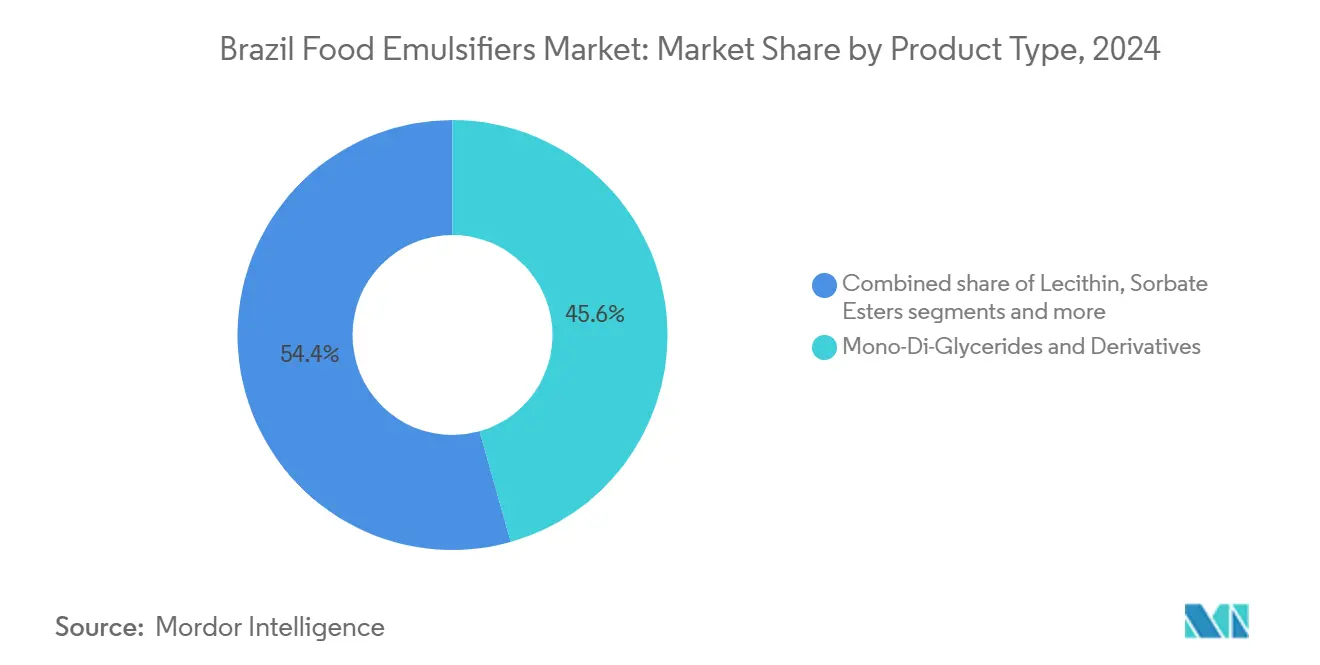
- By product type, mono-, di-, and glycerides, as well as their derivatives, held 45.63% of the Brazilian food emulsifiers market share in 2024, while lecithin is poised to expand at a 6.54% CAGR through 2030.
- By form, liquid variants commanded 57.82% revenue share in 2024, while powder formats are forecast to grow at a 6.38% CAGR to 2030.
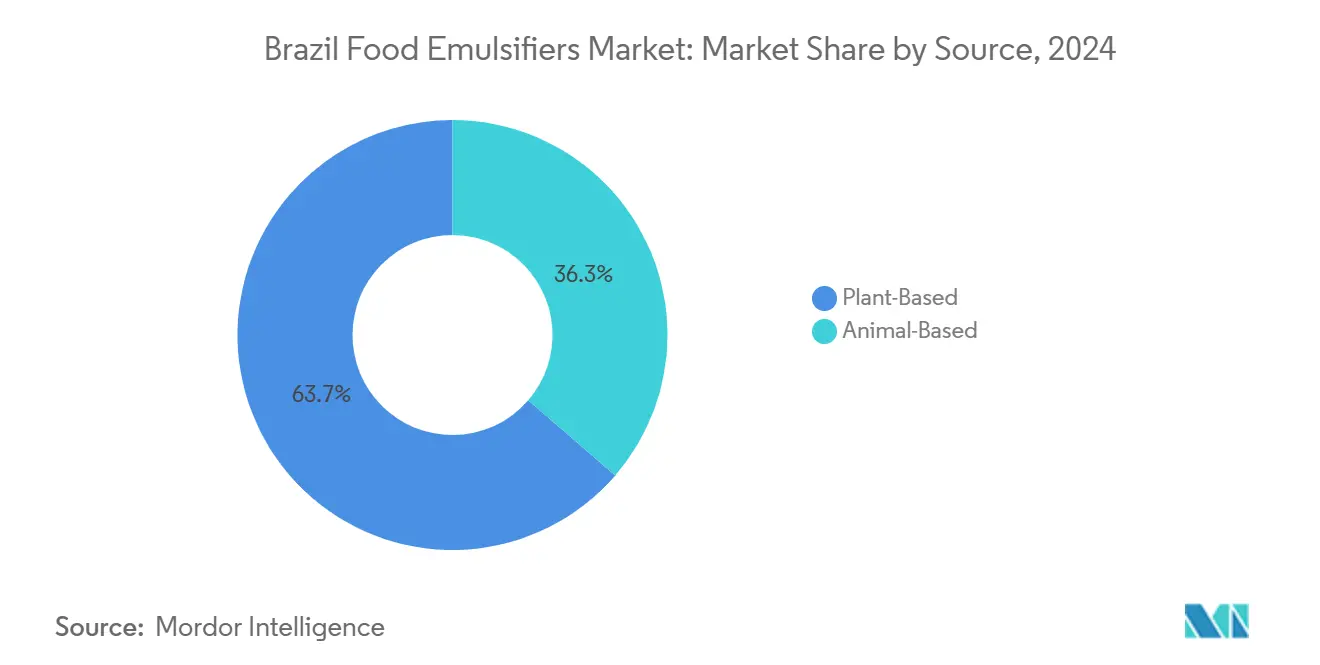
- By source, plant-based emulsifiers accounted for a 63.67% share in 2024, whereas animal-based counterparts registered the fastest 7.45% CAGR through 2030.
- By application, bakery and confectionery contributed 35.38% to the Brazil food emulsifiers market size in 2024, while dairy and desserts led growth at a 7.81% CAGR to 2030.
Brazil Food Emulsifiers Market Trends and Insights
Drivers Impact Analysis*
| Driver | (~) % Impact on CAGR Forecast | Geographic Relevance | Impact Timeline |
|---|---|---|---|
| Rising demand for processed and convenience food products | +1.2% | National, concentrated in São Paulo, Rio de Janeiro, Minas Gerais | Medium term (2-4 years) |
| Rising consumer awareness and demand for stable food formulations | +0.8% | National, urban centers leading | Medium term (2-4 years) |
| Increasing adoption of clean-label and natural emulsifier variants | +1.0% | National, export-oriented segments | Long term (≥ 4 years) |
| Investment in emulsification technology and processing infrastructure | +0.9% | National, South and Southeast regions | Medium term (2-4 years) |
| Growth in dairy product consumption, including ice cream, yogurt, and processed cheeses | +0.7% | National, higher in South and Southeast | Short term (≤ 2 years) |
| Greater use of emulsifiers in plant-based and alternative protein products | +0.6% | National, São Paulo and Rio de Janeiro early adopters | Long term (≥ 4 years) |
| Source: Mordor Intelligence | |||
Rising demand for processed and convenience food products
In Brazil, changing lifestyles, particularly in urban areas with a growing number of working and dual-income households, are driving increased demand for convenient food options, such as ready-to-eat meals, packaged snacks, and shelf-stable bakery and meat products. With the employment rate reaching 92.46% in 2024 as per Macrotrends, more consumers are looking for foods that require less time and effort to prepare[1]. To meet this growing demand, food manufacturers are expanding their production capabilities, including the establishment of specialized facilities for breaded and value-added meat products. These production processes heavily rely on food emulsifiers, such as mono- and diglycerides, as well as lecithin, which are crucial for maintaining product quality. Emulsifiers help ensure a consistent texture, retain moisture, and enhance product stability, especially during long storage and transportation periods. This increasing reliance on emulsifiers is playing a significant role in driving the growth of Brazil’s food emulsifiers market, as manufacturers continue to innovate to meet consumer preferences for convenience and quality.
Growth in dairy product consumption, including ice cream, yogurt, and processed cheeses
Brazil’s dairy market is shifting toward more premium and indulgent products, such as high-quality ice creams, yogurts, and fermented dairy beverages, which are growing at a faster rate compared to plain liquid milk. This change highlights the growing consumer demand for richer flavors, smoother textures, and an overall enhanced sensory experience in their dairy consumption. According to a May 2023 report by ScienceDirect, Brazilians consume an average of 5 liters of ice cream per person annually[2]. To cater to these evolving preferences, manufacturers are increasingly relying on emulsifiers to meet these needs. These ingredients play a crucial role in improving the texture, creaminess, and stability of dairy products. Emulsifiers help prevent the formation of large ice crystals, maintain a smooth and consistent texture, and ensure the product remains fresh throughout storage and transportation. This is particularly important for premium and low-fat dairy products, where delivering a high-quality experience is crucial to meeting consumer expectations and maintaining competitiveness in the market.
Greater use of emulsifiers in plant-based and alternative protein products
The rising trend of plant-based diets in Brazil is significantly boosting the demand for food emulsifiers. Manufacturers are increasing their production of plant-based meat and dairy alternatives, as these products require stable and appealing formulations to satisfy consumer preferences. According to the Good Food Institute as of May 2024, approximately 26% of Brazilians consume plant-based meat products at least once a month, while 48% regularly consume plant-based milk and dairy alternatives[3]. To replicate the texture, juiciness, and creamy consistency of traditional animal-based products, producers rely on emulsifiers to stabilize oil-in-water mixtures in products like plant-based burgers, sausages, beverages, and yogurt alternatives. This trend is particularly prominent among urban and flexitarian consumers, who are increasingly looking for allergen-free and plant-derived emulsifiers. Consequently, emulsifiers derived from sources such as sunflower are gaining popularity in the Brazilian food emulsifiers market, aligning with the growing demand for healthier, more sustainable, and innovative food options.
Investment in emulsification technology and processing infrastructure
Investments in emulsification and formulation technologies are playing a significant role in the steady growth of Brazil’s food emulsifiers market. In 2024, Kerry launched its São Paulo Taste and Nutrition Centre, which is equipped with advanced sensory laboratories and pilot-scale facilities. These facilities are specifically designed to expedite the formulation process and to tailor emulsifier solutions to meet local taste preferences and production requirements. This initiative enables food manufacturers to collaborate more closely with suppliers, reduce the time required to launch new products, and enhance the performance of emulsifiers in key applications, including bakery, dairy, processed foods, and plant-based products. By focusing on innovation and leveraging advanced technology, the market is better prepared to address the growing consumer demand for convenient, high-quality, and diverse food products, catering to changing lifestyles and preferences.
Restraints Impact Analysis*
| Restraint | (~) % Impact on CAGR Forecast | Geographic Relevance | Impact Timeline |
|---|---|---|---|
| Increasing scrutiny from regulatory authorities on food additives | -0.5% | National, Agência Nacional de Vigilância Sanitária (ANVISA) enforcement | Medium term (2-4 years) |
| Volatility in raw material prices such as vegetable oils and fats | -0.7% | National, import-dependent segments | Short term (≤ 2 years) |
| Negative perception of emulsifiers as artificial ingredients | -0.4% | National, urban consumers | Long term (≥ 4 years) |
| Growing demand for minimally processed foods | -0.3% | National, health-conscious segments | Long term (≥ 4 years) |
| Source: Mordor Intelligence | |||
Increasing scrutiny from regulatory authorities on food additives
Stricter regulations in Brazil are making it harder for companies to enter the food emulsifiers market and reformulate their products. The introduction of RDC 843/2024 has increased the time required for product approvals and imposed stricter demands for detailed toxicological and safety data[4]. This has slowed down the approval process for new or modified emulsifier systems. The expansion of front-of-pack warning labels has made consumers more cautious about processed foods, encouraging manufacturers to reduce the number of additives in their products. To adapt, companies are focusing on developing multifunctional emulsifiers that can serve multiple purposes, such as improving texture, retaining moisture, and enhancing shelf life, while complying with regulatory standards. However, these regulatory changes have also raised compliance costs and extended the time it takes for suppliers to bring their products to market under Agência Nacional de Vigilância Sanitária (ANVISA) regulations.
Negative perception of emulsifiers as artificial ingredients
Consumer concerns about food additives are slowing the growth of the food emulsifiers market in Brazil, particularly as clean-label and minimally processed food trends continue to gain momentum. Many consumers associate emulsifiers with artificial or synthetic additives, even when they are derived from plants or natural sources. This perception creates hesitation among health-conscious buyers who are paying closer attention to ingredient lists. Front-of-pack labeling regulations and growing awareness about food ingredients have increased scrutiny, pushing manufacturers to reformulate products or reduce the use of emulsifiers to avoid negative consumer reactions. To address these challenges, suppliers are being forced to invest in educating consumers, adopting transparent labeling practices, and developing emulsifiers from natural sources. However, these efforts often lead to more complex formulations and higher production costs, making it a significant challenge for the industry to balance consumer demands with operational efficiency.
*Our forecasts treat driver/restraint impacts as directional, not additive. The impact forecasts reflect baseline growth, mix effects, and variable interactions.
Segment Analysis
By Product Type: Mono-Di-Glycerides Anchor, Lecithin Ascends
Mono- and diglycerides, along with their derivatives, were the most widely used emulsifiers in the Brazilian food emulsifiers market in 2024, accounting for 45.63% of the total demand. These emulsifiers are highly versatile and are commonly used in bakery, dairy, processed meats, and confectionery products. Their popularity stems from their ability to effectively control moisture, stabilize textures, and extend the shelf life of food products. They are cost-efficient and easy to incorporate into large-scale food production, making them a preferred choice for manufacturers. This strong performance has allowed them to maintain a significant lead over other emulsifier types, such as lecithin and bio-based alternatives.
Lecithin is expected to grow at the fastest rate between 2025 and 2030, with a projected CAGR of 6.54%, as consumer demand for clean-label and plant-based ingredients continues to rise. Soy and sunflower lecithin are particularly favored for their natural origin and multifunctional benefits, making them ideal for bakery, chocolate, and dairy alternative applications. Meanwhile, biosurfactants and fermentation-based emulsifiers are slowly gaining traction due to their sustainability and innovative appeal. However, their adoption is still limited by higher costs and production challenges. These trends highlight the growing focus on natural and sustainable solutions in the food emulsifiers market.

By Form: Liquids Dominate, Powders Gather Steam
Liquid emulsifiers held a major 57.82% share of the Brazilian food emulsifiers market in 2024, primarily due to their ease of use in automated systems for dairy, sauce, and bakery production. These emulsifiers mix quickly, provide consistent results, and reduce dust during processing, making them highly efficient for large-scale manufacturing. Their ability to improve production efficiency and minimize material waste has made them a preferred choice for industrial food producers. Liquid emulsifiers help streamline operations, which is crucial for manufacturers aiming to meet growing consumer demand.
Powdered emulsifiers are expected to grow steadily through 2030, with a projected CAGR of 6.38%, as they cater to the rising need for convenient and long-lasting ingredients. Their lightweight and shelf-stable nature makes them ideal for products like baking kits sold online, instant drink mixes, and plant-based dry blends. These emulsifiers are also easier to store and transport, which benefits smaller manufacturers and businesses focused on retail products. As companies seek cost-effective and versatile options, powdered emulsifiers are likely to gain wider acceptance across various food applications, especially in emerging product categories.
By Source: Plant-Based Maintains Lead, Animal-Based Rebounds
In 2024, plant-based emulsifiers, such as those derived from soy, sunflower, palm, and citrus fibers, accounted for 63.67% of Brazil’s food emulsifiers market revenue. These emulsifiers are widely preferred because they align with growing consumer demand for clean-label, vegan, and allergen-free products. They are commonly used in bakery items, dairy alternatives, beverages, and processed foods due to their consistent performance and easy availability. Manufacturers also choose plant-based emulsifiers to simplify ingredient labels while ensuring that key product attributes, such as texture, stability, and shelf life, are maintained, which helps meet consumer expectations.
Animal-based emulsifiers are expected to grow at the fastest rate between 2025 and 2030, with a projected CAGR of 7.45%, despite currently holding a smaller market share. This growth is driven by the increasing demand for gelatin and collagen-based emulsifiers in products such as dairy desserts, confectionery, and sports nutrition items. These emulsifiers are appreciated for their ability to enhance protein content and improve the texture and mouthfeel of food products, which are important factors for consumers. Although their applications are more limited compared to plant-based options, animal-derived emulsifiers are gaining popularity in premium and performance-focused food segments, where quality and functionality are prioritized.
By Application: Bakery Steady, Dairy Fastest
In 2024, bakery and confectionery applications made up 35.38% of Brazil’s food emulsifiers market revenue, driven by the increasing demand for packaged breads, cakes, biscuits, and chocolate-based products. Emulsifiers are crucial in this segment as they help improve dough handling, enhance product volume, and ensure softness and even fat distribution in baked goods. These features make them essential for industrial bakeries and confectionery manufacturers. Emulsifiers play a significant role in extending the shelf life of products and maintaining consistent quality, which is vital for large-scale production and distribution.
Dairy and dessert applications are expected to grow the fastest through 2030, with a CAGR of 7.81%, as consumers increasingly prefer products like ice creams, yogurts, dairy desserts, and premium indulgent treats. Emulsifiers play a vital role in these products by stabilizing mixtures of fat and water, enhancing creaminess, and maintaining texture during storage and transportation. The growing demand for healthier options, such as reduced-fat and functional dairy products, is further driving the adoption of emulsifiers in this segment. This trend reflects the growing demand for innovative solutions to meet consumer expectations for high-quality and diverse dairy products.
Geography Analysis
The demand for emulsifiers in Brazil is heavily influenced by the food production and consumption patterns in different regions. The Southeast region, which includes São Paulo, Rio de Janeiro, and Minas Gerais, serves as a major hub for packaged food manufacturing and modern retail networks. This region relies significantly on liquid emulsifiers, which are well-suited for automated and continuous processing systems. In the South, the strong presence of dairy and pork processing industries drives demand for emulsifiers, such as gelatin and phosphate-based systems. Meanwhile, the Center-West region, traditionally focused on beef processing, is gradually shifting its focus toward producing value-added meat products. These products increasingly use starch and lecithin-based emulsifiers to improve moisture retention and enhance product yield.
The overall market environment in Brazil is favorable for the growing adoption of emulsifiers, supported by stable economic conditions that encourage household spending on processed and value-added foods. Food manufacturers are also facing pressure to manage costs, which has led to a stronger focus on improving formulation efficiency. Emulsifiers play a crucial role in enhancing the texture, stability, and cost-effectiveness of food products. Companies aiming to expand in export markets are driving demand for emulsifiers that comply with international food safety standards, religious certifications, and quality management requirements. This ensures that Brazilian manufacturers can meet global standards and remain competitive in international markets.
Despite these opportunities, infrastructure challenges in certain regions create obstacles for the emulsifiers market. The North and Northeast regions primarily depend on basic and shelf-stable food products, which currently limit the use of advanced emulsifiers. However, ongoing investments in cold-chain logistics, food processing facilities, and regulatory reforms are expected to gradually support the adoption of more advanced emulsifier formulations. Moreover, industry events and technical workshops held in major cities are helping to spread knowledge and innovation. These initiatives are bringing advanced emulsifier solutions closer to food and animal nutrition manufacturers across Brazil, creating long-term growth opportunities for the market.
Competitive Landscape
The Brazilian food emulsifiers market is moderately consolidated, led by a few major multinational companies, including Cargill Inc., International Flavors & Fragrances Inc., Archer Daniels Midland Company, Kerry Group plc, and Bunge Ltd. These companies benefit from their large-scale operations, advanced research capabilities, and access to essential raw materials, such as oilseeds. Their strong presence across key segments, including bakery, dairy, processed foods, and plant-based products, ensures a reliable supply chain and a wide customer base. Their long-standing partnerships with major food manufacturers give them a competitive edge and help maintain their market dominance.
Companies in this market stand out by offering diverse product portfolios, technical expertise, and customized solutions tailored to meet specific needs. Leading players develop emulsifier systems tailored to improve product texture, stability, and shelf life while addressing the growing demand for clean-label products. They are also investing in plant-based and multifunctional emulsifiers to meet the rising preference for simpler and more natural ingredient labels. By providing strong technical support through local teams and application labs, these companies build trust and loyalty among their customers, making it challenging for competitors to capture market share.
Looking ahead, regulatory compliance, sustainability, and supply chain reliability are becoming key factors for success in the market. As food producers face stricter regulations and increasing demand for certified and traceable ingredients, companies with robust quality systems and transparent sourcing practices are better positioned to thrive. The focus on reducing carbon footprints and adopting responsible sourcing practices is influencing purchasing decisions, particularly among large buyers. In this evolving market, the scale, innovation, and integrated capabilities of companies like Cargill Inc., International Flavors & Fragrances Inc., Archer Daniels Midland Company, Kerry Group plc, and Bunge Ltd. are expected to drive their continued growth and success.
Brazil Food Emulsifiers Industry Leaders
-
Cargill Inc.
-
International Flavors & Fragrances Inc.
-
Archer Daniels Midland Company
-
Kerry Group plc
-
Bunge Ltd.
- *Disclaimer: Major Players sorted in no particular order

Recent Industry Developments
- October 2025: Palsgaard Gods A/S increased the production of its Emulpals powdered cake emulsifiers in Brazil to address the rising demand for whipping agents both globally and regionally.
- November 2024: Bunge Ltd. achieved full monitoring of its indirect soy value chain in Brazil's priority regions. This milestone underscored the company's dedication to sustainable sourcing practices and its efforts to maintain transparency and traceability throughout its supply chain.
- December 2023: Archer Daniels Midland Company increased its crush capacity by 400,000 tonnes across its facilities in Campo Grande, Porto Franco, and Uberlândia. This expansion aimed to enhance lecithin production.
Brazil Food Emulsifiers Market Report Scope
The Brazil food emulsifiers market is segmented by product type, form, source, and application. On the basis of product type, the market is segmented into mono-, di-, and triglycerides and derivatives, lecithin, sorbate esters, stearoyl lactylates, and others. Based on form, the market is segmented into powder and liquid. On the basis of source, the market is segmented into plant-based, animal-based. Based on application, the market is segmented into bakery and confectionery, dairy and desserts, beverages, meat and meat products, soups, sauces, dressings, and other categories.
By Product Type
| Mono-Di-Glycerides and Derivatives |
| Lecithin |
| Sorbate Esters |
| Stearoyl Lacylates |
| Others |
By Form
| Powder |
| Liquid |
By Source
| Plant-Based |
| Animal-Based |
By Application
| Bakery and Confectionery |
| Dairy and Desserts |
| Beverages |
| Meat and Meat Products |
| Soups, Sauces, and Dressings |
| Others |
| By Product Type | Mono-Di-Glycerides and Derivatives |
| Lecithin | |
| Sorbate Esters | |
| Stearoyl Lacylates | |
| Others | |
| By Form | Powder |
| Liquid | |
| By Source | Plant-Based |
| Animal-Based | |
| By Application | Bakery and Confectionery |
| Dairy and Desserts | |
| Beverages | |
| Meat and Meat Products | |
| Soups, Sauces, and Dressings | |
| Others |
Key Questions Answered in the Report
What is the projected value of the Brazil Food Emulsifiers market in 2030?
It is forecast to reach USD 637.39 million by 2030, growing at a 5.36% CAGR from 2025.
Which product type leads current revenues?
Mono-Di-Glycerides and Derivatives, with 45.63% of 2024 revenue.
Why is lecithin growing faster than other emulsifiers?
Brazil’s large soybean crush provides abundant low-cost lecithin, supporting a 6.54% CAGR to 2030.
Which application is expanding at the quickest pace?
Dairy and desserts, advancing at a 7.81% CAGR as premium ice cream and yogurt demand rises.