
Brazil Enterprise Content Management (ECM) Market Size and Share
Market Overview
| Study Period | 2020 - 2031 |
|---|---|
| Forecast Data Period | 2026 - 2031 |
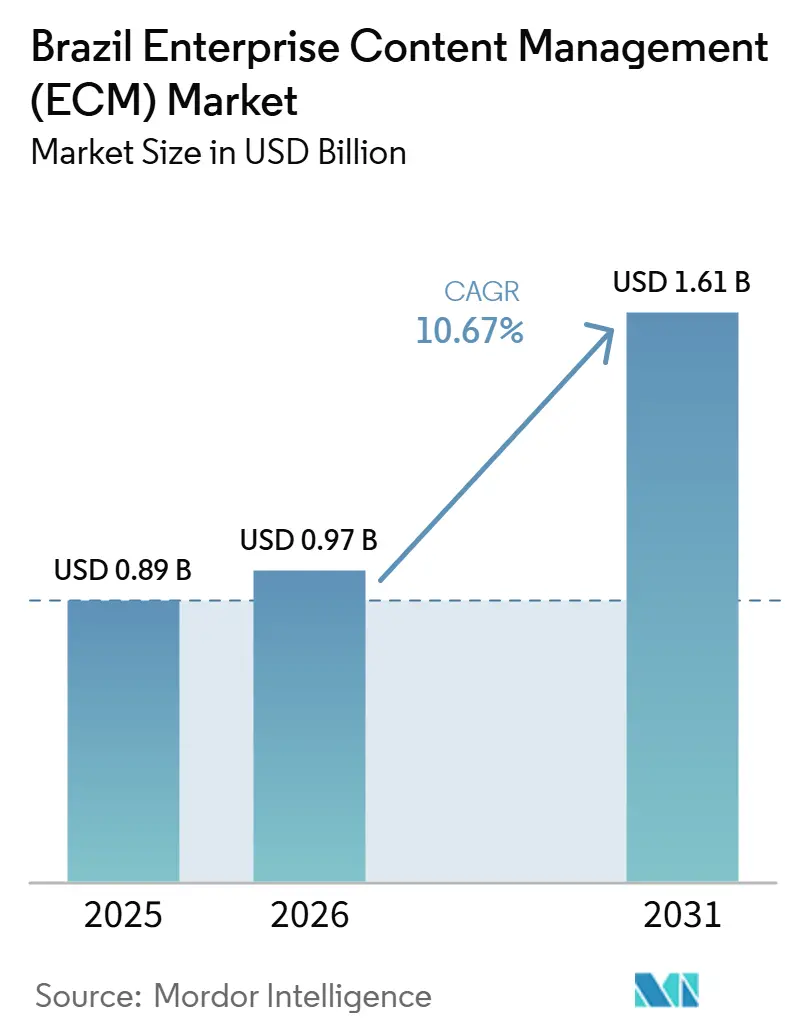
| Base Year Market Size (2025) | USD 0.89 Billion |
| Market Size (2026) | USD 0.97 Billion |
| Market Size (2031) | USD 1.61 Billion |
| Growth Rate (2026 - 2031) | 10.67% CAGR |
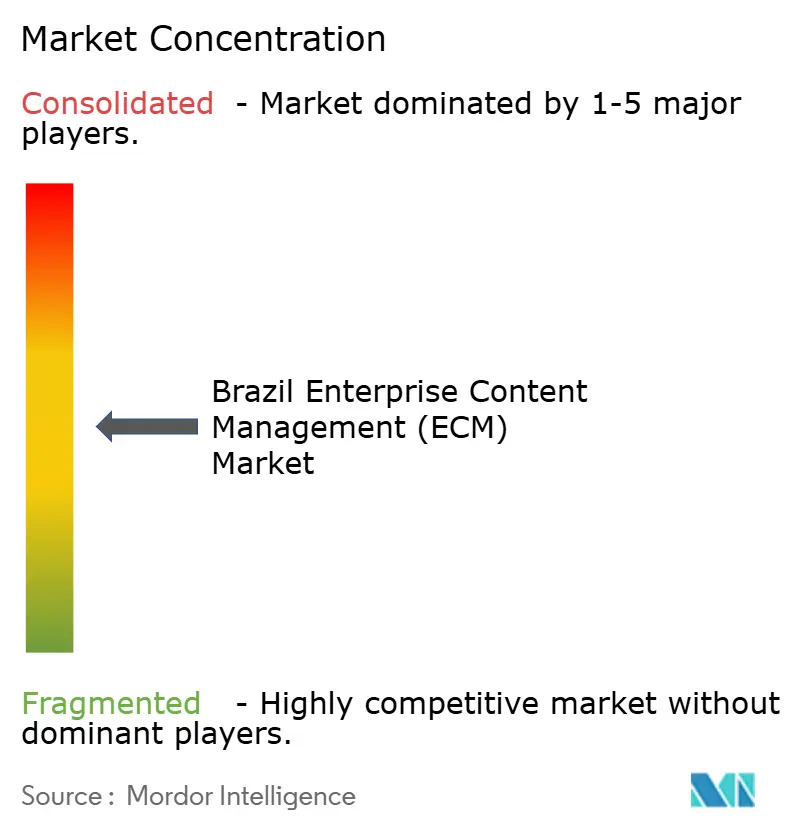
| Market Concentration | Medium |
Major Players *Disclaimer: Major Players sorted in no particular order Image © Mordor Intelligence. Reuse requires attribution under CC BY 4.0. | |
Brazil Enterprise Content Management (ECM) Market Analysis by Mordor Intelligence
The Brazil enterprise content management (ECM) market size was USD 0.89 billion in 2025 and is forecast to reach USD 1.61 billion by 2031 at a CAGR of 10.67% during 2026-2031. The Brazil enterprise content management (ECM) market is moving from basic document storage toward compliance- and workflow-led spending, as organizations now need systems that can demonstrate control over records and content. Regulatory pressure under LGPD, stronger enforcement powers for ANPD, and the broader federal push toward digital public services are keeping content governance high on management agendas. Cloud adoption is also shortening implementation cycles, especially when companies want faster rollouts, lower upfront costs, and easier access to automation features. Competition is shifting toward platforms that integrate well with broader enterprise software environments, as buyers increasingly prefer ECM tools that work within existing cloud, ERP, and productivity ecosystems. This creates room for growth in regulated sectors, public administration, and the digitalization of mid-sized organizations, even as integration challenges and skill gaps continue to slow some large deployments.
Key Report Takeaways
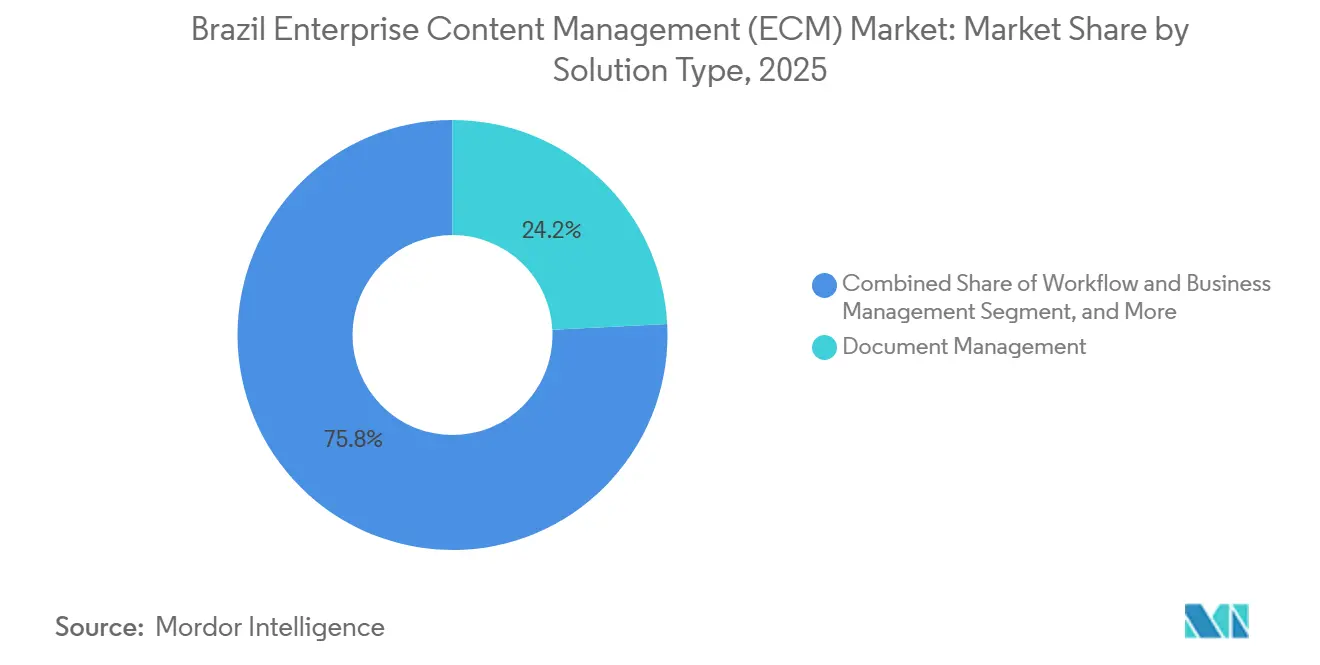
- By solution type, Document Management led the Brazil enterprise content management (ECM) market with a 24.18% revenue share in 2025, while Workflow and Business Process Management are projected to expand at a 13.42% CAGR through 2031.
- By deployment mode, cloud held 73.26% of the Brazilian enterprise content management (ECM) market share in 2025, and is also expected to record the highest growth at a 12.84% CAGR through 2031.
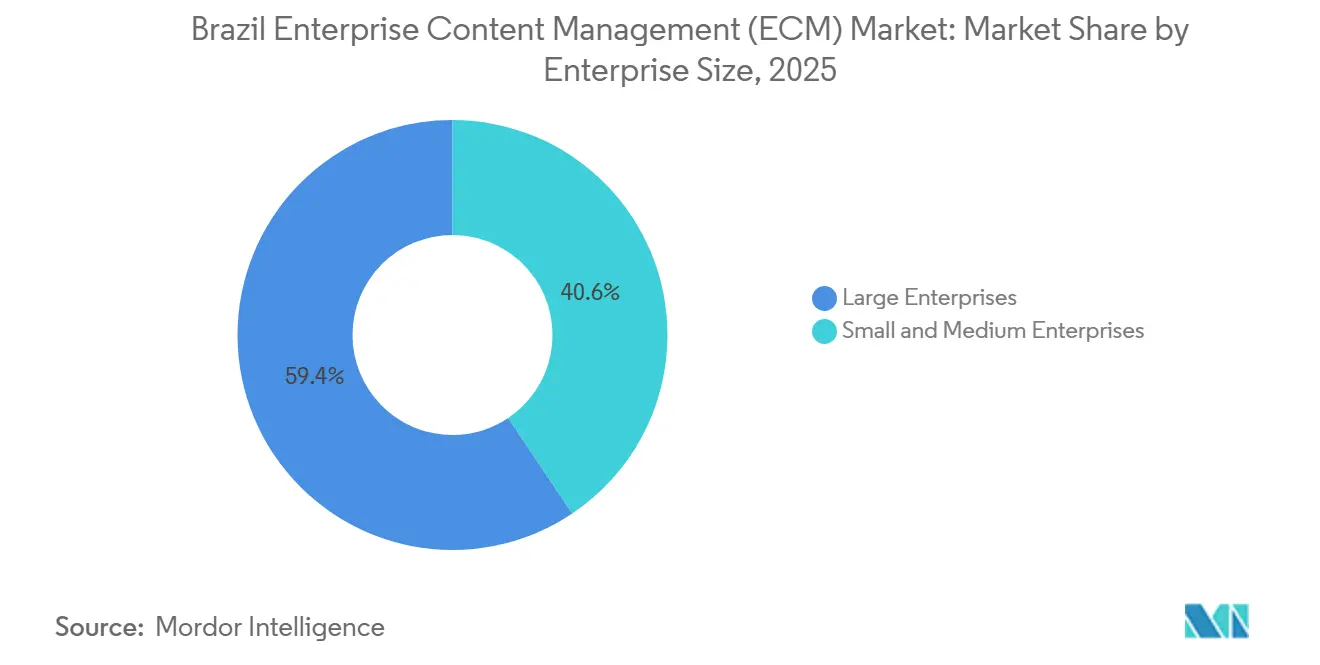
- By enterprise size, Large Enterprises accounted for 59.41% of revenue in 2025, while SMEs are projected to grow the fastest at a 13.69% CAGR through 2031.
- By end-user industry, BFSI accounted for 22.73% of revenue in the Brazil enterprise content management (ECM) market in 2025, while healthcare is expected to grow at a 12.91% CAGR through 2031.
Note: Market size and forecast figures in this report are generated using Mordor Intelligence’s proprietary estimation framework, updated with the latest available data and insights as of January 2026.
Brazil Enterprise Content Management (ECM) Market Trends and Insights
Drivers Impact Analysis*
| Driver | (~) % Impact on CAGR Forecast | Geographic Relevance | Impact Timeline |
|---|---|---|---|
| Accelerating Digital Document Standardization Across Regulated Industries | +2.8% | National, with concentration in São Paulo, Rio de Janeiro, and Brasília financial and government clusters | Short term (≤ 2 years) |
| Rapid Shift Toward Cloud-First Content Platforms | +2.5% | National, strongest in Southeast Brazil with spillover to the South and Northeast | Short term (≤ 2 years) |
| Growing Need for Audit-Ready Records And Traceability | +1.8% | National, intensified in ANPD-supervised sectors such as BFSI, healthcare, and federal public administration | Medium term (2-4 years) |
| Rising Demand For AI-Assisted Metadata Capture And Content Classification | +1.4% | National, with early concentration in São Paulo financial services and technology clusters | Medium term (2-4 years) |
| Expansion Of Citizen-Facing And Customer-Facing Digital Workflows | +1.2% | National, with early gains in federal and state capitals and large municipalities | Medium term (2-4 years) |
| Hybrid Work And Distributed Collaboration Requirements | +0.8% | National, with wider relevance across mid-sized cities as office footprints decentralize | Long term (≥ 4 years) |
| Source: Mordor Intelligence | |||
Accelerating Digital Document Standardization Across Regulated Industries
The Brazil enterprise content management (ECM) market is benefiting from a clear change in buyer priorities across regulated sectors. Document standardization is no longer treated as a back-office efficiency project, as it now affects legal exposure and operational continuity. ANPD gained greater institutional standing in 2025, raising the cost of weak document governance for banks, healthcare providers, and public agencies. The need to show how information is stored, accessed, transferred, and retained is pushing organizations toward structured content environments with stronger controls and audit logs. This is especially relevant where multiple departments still manage contracts, forms, and records in disconnected systems. The result is firmer demand for platforms that can turn content control into a repeatable operating process rather than a manual policy exercise.[1]Governo do Brasil, “Gestão Atualiza Iniciativas Da Estratégia Federal De Governo Digital,” Governo do Brasil, gov.br
Rapid Shift toward Cloud-First Content Platforms
Cloud adoption is one of the strongest immediate supports for the Brazil enterprise content management (ECM) market. A large share of Brazilian companies already uses cloud services, which means many buyers no longer debate whether cloud is acceptable and instead focus on vendor fit, security, and rollout speed. This has made cloud ECM easier to position in both replacement deals and first-time deployments. The preference is also practical, because subscription pricing, faster updates, and easier integration with collaboration tools make cloud platforms more usable for growing firms. In regulated verticals, this shift is happening alongside broader modernization efforts, so content management decisions are often tied to wider cloud transformation programs. That combination is helping cloud-based ECM move from a departmental purchase into a broader enterprise platform decision.[2]instituto Information Management, “77% Das Empresas Brasileiras Já Operam Na Nuvem, Mostra Novo Estudo Da TOTVS,” Instituto Information Management, iimainfo.com.br
Growing Need for Audit-Ready Records and Traceability
The Brazil enterprise content management (ECM) market is also being shaped by a stronger need for records that can withstand review at any time. Companies increasingly need systems that show when a file was created, who changed it, what version was approved, and how long it should be retained. This is becoming more important in healthcare and other sensitive environments where data exchange is expanding, but oversight remains strict. National health data initiatives are raising the value of structured records because digital exchange works better when content is searchable, standardized, and traceable. Audit-readiness, therefore, supports both compliance and day-to-day coordination across institutions. Buyers are moving toward tools that can support evidence trails without creating more manual work for operating teams.[3]Conselho Nacional de Secretários de Saúde, “Conass Informa N. 120/2025, Decreto N. 12.560,” CONASS, conass.org.br
Rising Demand for AI-Assisted Metadata Capture and Content Classification
The Brazil enterprise content management (ECM) market is gaining from the spread of AI features that reduce manual indexing and classification work. Metadata capture has long been a weak point in document-heavy environments because employees often skip tagging steps when systems are slow or rules are unclear. AI support can improve this by identifying document types, extracting fields, and suggesting classifications with less manual effort. That matters in Brazil, where many organizations handle a variety of local document formats across tax, labor, healthcare, and compliance workflows. Better classification improves search, retention control, and workflow automation, making it easier to prove ECM's value after deployment. Vendors that can apply these capabilities to Brazilian content formats are likely to gain an advantage in environments with high document diversity and lean teams.[4]Iron Mountain, “2025 AI Readiness Research Study, Brazil Profile,” Iron Mountain, theshift.info
Restraints Impact Analysis*
| Restraint | (~) % Impact on CAGR Forecast | Geographic Relevance | Impact Timeline |
|---|---|---|---|
| Legacy Integration Complexity in Large Brazilian Enterprises | -2.1% | National, most acute in São Paulo and Rio de Janeiro financial hubs where older SAP and mainframe systems remain in production | Medium term (2-4 years) |
| Data Residency And Compliance Concerns for Sensitive Content | -1.6% | National, elevated in BFSI and healthcare settings subject to sector-specific control requirements | Medium term (2-4 years) |
| Budget Pressure from Multi-Year Enterprise Software Modernization Cycles | -1.2% | National, with greater effect in mid-sized organizations handling concurrent ERP, CRM, and ECM upgrades | Long term (≥ 4 years) |
| Limited Internal ECM Skills in Mid-Market Organizations | -0.9% | National, strongest outside the São Paulo metropolitan area where technology talent pools are thinner | Long term (≥ 4 years) |
| Source: Mordor Intelligence | |||
Legacy Integration Complexity in Large Brazilian Enterprises
Legacy integration remains a meaningful drag on the Brazil enterprise content management (ECM) market. Large organizations often run a mix of older archiving tools, sector-specific applications, ERP modules, and newer cloud services, which makes ECM modernization harder to sequence. The issue is not only a technical connection, because historical content often sits inside inconsistent taxonomies and incomplete retention structures. This increases the time and cost required to clean, map, and govern information before new automation features can operate reliably. As a result, some buyers slow their deployments or choose phased rollouts rather than full platform replacement. Vendors with stronger implementation services and better connector libraries are better placed to win these larger and more complex accounts.
Data Residency and Compliance Concerns for Sensitive Content
Sensitive content handling is another restraint for the Brazil enterprise content management (ECM) market. Organizations that process personal, financial, or clinical data often need clear rules on hosting location, transfer methods, and access accountability before approving a platform. This creates longer procurement cycles when a vendor relies on offshore hosting or cannot clearly explain compliance controls. The issue is especially important in sectors where information sensitivity is high and external review risk is real. Even when buyers want the flexibility of cloud deployment, they may delay decisions until local hosting, sovereign options, or contractual safeguards are in place. This favors vendors that can pair cloud delivery with stronger residency assurances and clearer compliance governance.
*Our forecasts treat driver/restraint impacts as directional, not additive. The impact forecasts reflect baseline growth, mix effects, and variable interactions.
Segment Analysis
By Solution Type: Document Control Supports The Base, While Workflow Automation Drives The Next Phase
Document Management accounted for 24.18% of the Brazilian enterprise content management (ECM) market in 2025, making it the largest solution category. This leadership reflects the central role of repositories, version control, search, retention, and access discipline in regulated operating environments. Many organizations still begin their ECM journey by trying to reduce scattered content and improve control over records that support legal, tax, and operational activity. That keeps core document functions commercially important even as the broader platform conversation becomes more advanced. Workflow and Business Process Management is projected to grow at a 13.42% CAGR through 2031, which shows that the next spending wave is tied to process automation rather than storage alone. The Brazil enterprise content management (ECM) industry is therefore moving from static digitization toward systems that actively route work, trigger approvals, and connect content to business actions.
The balance of demand remains spread across Records Management, Case Management, Digital Asset Management, and Web Content Management. Records Management is gaining support where organizations need stronger proof of retention control and disposal discipline. Case Management has relevance in public administration and service environments where intake, review, and response workflows depend on structured content handling. Digital Asset Management is also becoming more useful in retail, media, and education settings that manage large volumes of branded content across channels. Web Content Management remains tied to organizations that want tighter control over digital publishing and service communication. Public-sector modernization targets under the federal digital government program are helping support these adjacent categories, because better digital service delivery depends on more organized content flows behind the interface.



By Deployment Mode: Cloud Leads Clearly, While Hybrid Remains A Practical Bridge
Document Management accounted for 24.18% of the Brazilian enterprise content management (ECM) market in 2025, making it the largest solution category. This leadership reflects the central role of repositories, version control, search, retention, and access discipline in regulated operating environments. Many organizations still begin their ECM journey by trying to reduce scattered content and improve control over records that support legal, tax, and operational activity. That keeps core document functions commercially important even as the broader platform conversation becomes more advanced. Workflow and Business Process Management is projected to grow at a 13.42% CAGR through 2031, which shows that the next spending wave is tied to process automation rather than storage alone. The Brazil enterprise content management (ECM) industry is therefore moving from static digitization toward systems that actively route work, trigger approvals, and connect content to business actions.
The balance of demand remains spread across Records Management, Case Management, Digital Asset Management, and Web Content Management. Records Management is gaining support where organizations need stronger proof of retention control and disposal discipline. Case Management has relevance in public administration and service environments where intake, review, and response workflows depend on structured content handling. Digital Asset Management is also becoming more useful in retail, media, and education settings that manage large volumes of branded content across channels. Web Content Management remains tied to organizations that want tighter control over digital publishing and service communication. Public-sector modernization targets under the federal digital government program are helping support these adjacent categories, because better digital service delivery depends on more organized content flows behind the interface.
By Enterprise Size: Large Accounts Hold The Revenue Base, While SMEs Expand More Quickly
Large Enterprises accounted for 59.41% of revenue in 2025, making them the primary revenue driver of the Brazil enterprise content management (ECM) market. These buyers run broader content estates, more demanding governance structures, and more complex approval environments than smaller organizations. They also tend to expand from one use case into several, which increases account value over time. A large bank, manufacturer, or public institution may start with document control and then add workflow automation, records rules, and AI-assisted classification under the same platform strategy. That upsell potential keeps large enterprises central to vendor revenue planning. The Brazil enterprise content management (ECM) industry still depends heavily on this group for complex implementations and long contract cycles.
SMEs are projected to grow at a 13.69% CAGR through 2031, making them the fastest-growing segment of the enterprise market. Lower entry costs, subscription pricing, and lighter deployment models are making ECM more accessible to firms that previously viewed it as too costly or too complex. Many smaller businesses already have the core digital infrastructure needed to adopt cloud-based content tools, even if their governance layers remain basic. This creates space for focused solutions that simplify invoice handling, contract management, approval routing, and record storage without requiring extensive customization. The opportunity is especially strong where new compliance demands make informal document handling harder to sustain. Vendors that keep implementation simple and localize workflows for Brazilian business practices should be well positioned to capture this growing part of the Brazilian enterprise content management (ECM) market.
By End-User Industry: BFSI Provides Scale, While Healthcare Adds Speed
BFSI captured 22.73% of the Brazil enterprise content management (ECM) market size in 2025, which made it the leading end-user category. The sector generates a large volume of sensitive records, internal approvals, compliance documentation, and customer-facing content flows. That naturally supports demand for controlled repositories, audit logs, and process discipline. Banks and insurers also tend to buy broader software stacks, which helps ECM attach to wider cloud, data, and workflow transformation programs. Government and public administration remain another important demand base because national and federal digital service programs continue to increase the need for organized content, secure records, and workflow accountability. This keeps the Brazil enterprise content management (ECM) market closely linked to both private compliance workloads and public modernization programs.
Healthcare is projected to grow at a 12.91% CAGR through 2031, which makes it the fastest-growing vertical in the forecast period. National health data initiatives and interoperability requirements are raising the need for structured clinical and administrative records. Hospitals, operators, and public health entities need platforms that can support secure exchange, retrieval, retention, and auditability across multiple stakeholders. This raises the value of ECM features that handle content integrity and traceability rather than simple storage alone. The integration of certified digital hospital systems into broader public health structures adds to this momentum, because it increases the volume of digital records that must be organized and governed. As this environment matures, healthcare should remain one of the clearest growth engines for the Brazil enterprise content management (ECM) market.
Geography Analysis
The Brazil enterprise content management (ECM) market is concentrated in the Southeast, where the country’s largest financial, commercial, and technology centers are located. São Paulo remains the core demand hub because it houses a dense base of banks, enterprise headquarters, technology buyers, and service firms. Rio de Janeiro also supports meaningful demand through large corporations, regulated operations, and public-sector activity. This concentration gives the Southeast a natural advantage in vendor presence, partner networks, and implementation capacity. It also means many high-value deals are still sourced from organizations that already run complex software environments.
Brasília is a distinct and important demand center within the Brazilian enterprise content management (ECM) market. Its role is tied less to private enterprise density and more to federal administration, digital public service programs, and government records modernization. National digital government initiatives are supporting more structured content flows across agencies, service desks, and citizen-facing platforms. This keeps public procurement relevant even when private-sector investment becomes more selective. Brazil’s recognition by the OECD in digital government adds credibility to the public modernization agenda and supports continued demand for systems that improve content organization and service execution.
The South is an important secondary zone for the Brazilian enterprise content management (ECM) market due to its manufacturing and agribusiness base. High volumes of fiscal records, quality documents, contracts, and supply-chain files create a practical need for organized content workflows. The Northeast is still more underpenetrated, which leaves room for first-time cloud adoption in both smaller businesses and public institutions. Lower legacy complexity in some of these areas may make cloud rollout easier than in older enterprise environments. Over time, these regional patterns should broaden demand beyond the main Southeast centers, even though the country’s leading technology and financial clusters will continue to shape the overall market direction.
Competitive Landscape
The Brazil enterprise content management (ECM) market shows a moderately fragmented top tier and a wider, fragmented layer beneath it. OpenText, Microsoft, IBM, Hyland Software, and Oracle remain the main enterprise platform names in the market. Their position is supported by broad installed bases, existing enterprise relationships, and the ability to package ECM within larger cloud or application environments. This makes competition less about standalone document storage and more about how content tools fit within wider digital operating models. Buyers often prefer vendors that can reduce integration effort by staying close to the software ecosystems they already use.
This dynamic gives platform integration an important role in competitive outcomes across the Brazil enterprise content management (ECM) market. M-Files strengthened its position in July 2025 by expanding its strategic partnership with Microsoft, using SharePoint Embedded as the underlying content store for its AI-powered document management system. That move allows M-Files to compete in a Microsoft-heavy environment rather than asking customers to shift away from it. OpenText also expanded its SAP alignment in November 2025 by becoming an SAP Solution Extensions partner for SAP S/4HANA Cloud Public Edition, strengthening its appeal to buyers who want ECM embedded in core ERP workflows. These moves show that leading vendors are trying to secure their relevance by strengthening ties with the enterprise systems that already shape user workflows.
Competition is also shifting toward AI functionality, sovereign controls, and channel reach in the Brazil enterprise content management (ECM) market. Box and AWS signed a multi-year strategic collaboration in November 2025 to develop agentic AI capabilities for enterprise content management, which supports Box’s profile in cloud-first and data-sensitive environments. OpenText’s April 2026 sovereign cloud partnership with S3NS also matters because it shows how vendors are responding to stricter residency and control expectations in regulated accounts. At the same time, regional and specialized suppliers still have room to improve in areas where buyers want Portuguese-language support, sector fit, and faster implementation. This keeps the market open enough for niche growth, even as the largest platform vendors maintain the strongest enterprise visibility.
Brazil Enterprise Content Management (ECM) Industry Leaders
OpenText Corporation
Microsoft Corporation
Hyland Software, Inc.
Oracle Corporation
IBM Corporation
- *Disclaimer: Major Players sorted in no particular order

Recent Industry Developments
- July 2026: Newgen Software Technologies strengthened its global leadership team to accelerate AI-driven ECM growth across international markets, with South America positioned as a priority expansion region given its growing demand for intelligent process automation in BFSI and government verticals.
- April 2026: OpenText partnered with S3NS, an alliance between Thales and Google Cloud, to deliver European sovereign cloud solutions supporting GDPR, SecNumCloud 3.2, and strict data-residency controls for Content Management and Documentum. While Europe-focused, the architecture directly informs OpenText’s sovereign-cloud response strategy for Brazilian ANPD compliance requirements.
- April 2026: OpenText appointed Ayman Antoun, former President of IBM Americas with over 30 years at IBM spanning cloud, infrastructure, cybersecurity, and digital modernization across the United States, Canada, and South America, as Chief Executive Officer, effective April 20, 2026. The appointment signals a strategic orientation toward enterprise AI and South American market engagement.
- February 2026: Brazil’s ITI published its Digital Transformation Plan 2025-2027, focusing on federal biometrics, electronic signatures, and data interoperability. The plan established mandatory milestones for AI governance and electronic document validation integration across government systems, creating a structured ECM procurement pipeline for the public sector.


Brazil Enterprise Content Management (ECM) Market Report Scope
The Brazil enterprise content management (ECM) market refers to the ecosystem of software solutions and services designed to systematically capture, manage, store, preserve, and deliver an organization's unstructured and structured content and documents within the country. This includes technologies such as document management, records management, workflow, business process management, case management, digital asset management, and web content management. Deployed on-premises, in the cloud, or in hybrid models, these solutions cater to organizations of all sizes across diverse industries in Brazil, including BFSI, government, healthcare, manufacturing, and retail. Driven by the country's rapid digital transformation initiatives, the growing need for operational efficiency, and stringent data protection and regulatory compliance requirements (such as the LGPD), ECM solutions enable Brazilian businesses to streamline administrative workflows, enhance cross-departmental collaboration, ensure information security, and reduce reliance on manual paper-based processes to improve overall productivity and decision-making.
The Brazil Enterprise Content Management (ECM) Market Report is Segmented by Solution Type (Document Management, Records Management, Workflow and Business Process Management, Case Management, Digital Asset Management, Web Content Management, and Other Solutions), Deployment Mode (On-Premises, Cloud, and Hybrid), Enterprise Size (Small and Medium Enterprises, and Large Enterprises), and End-User Industry (BFSI, Government and Public Sector, Healthcare, IT and Telecommunications, Manufacturing, Retail, Media and Entertainment, Education, Energy and Utilities, and Other End-User Industries). The Market Forecasts are Provided in Terms of Value (USD).
| Document Management |
| Records Management |
| Workflow and Business Process Management |
| Case Management |
| Digital Asset Management |
| Web Content Management |
| Other Solutions |
| On-Premises |
| Cloud |
| Hybrid |
| Small and Medium Enterprises |
| Large Enterprises |
| BFSI |
| Government and Public Sector |
| Healthcare |
| IT and Telecommunications |
| Manufacturing |
| Retail |
| Media and Entertainment |
| Education |
| Energy and Utilities |
| Other End-User Industries |
| By Solution Type | Document Management |
| Records Management | |
| Workflow and Business Process Management | |
| Case Management | |
| Digital Asset Management | |
| Web Content Management | |
| Other Solutions | |
| By Deployment Mode | On-Premises |
| Cloud | |
| Hybrid | |
| By Enterprise Size | Small and Medium Enterprises |
| Large Enterprises | |
| By End-User Industry | BFSI |
| Government and Public Sector | |
| Healthcare | |
| IT and Telecommunications | |
| Manufacturing | |
| Retail | |
| Media and Entertainment | |
| Education | |
| Energy and Utilities | |
| Other End-User Industries |


Key Questions Answered in the Report
What is the size outlook for Brazil enterprise content management through 2031?
The Brazil enterprise content management (ECM) market was valued at USD 0.89 billion in 2025 and is forecast to reach USD 1.61 billion by 2031, growing at a 10.67% CAGR during 2026-2031.
Which deployment model leads content management adoption in Brazil?
Cloud led the market with a 73.26% share in 2025 and is also the fastest-growing deployment mode, with a 12.84% CAGR projected through 2031.
Which solution category is most widely used in Brazil?
Document Management was the largest solution type in 2025, with a 24.18% revenue share, because buyers still prioritize content control, search, versioning, and retention discipline.
Which customer group is expanding the fastest in Brazil?
SMEs are the fastest-growing enterprise-size segment, with a 13.69% CAGR expected through 2031, supported by cloud pricing and simpler deployment models.
Which end-user vertical offers the strongest immediate demand base?
BFSI held the largest end-user share in 2025 at 22.73%, reflecting strong needs around sensitive records, compliance workflows, and operational control.
Why is healthcare becoming more important for content management vendors in Brazil?
Healthcare is expected to grow at a 12.91% CAGR through 2031, supported by interoperability requirements, digital health programs, and the need for secure and traceable records.
Page last updated on:






