
Brazil Dairy Market Size and Share
Market Overview
| Study Period | 2022 - 2032 |
|---|---|
| Forecast Data Period | 2027 - 2032 |
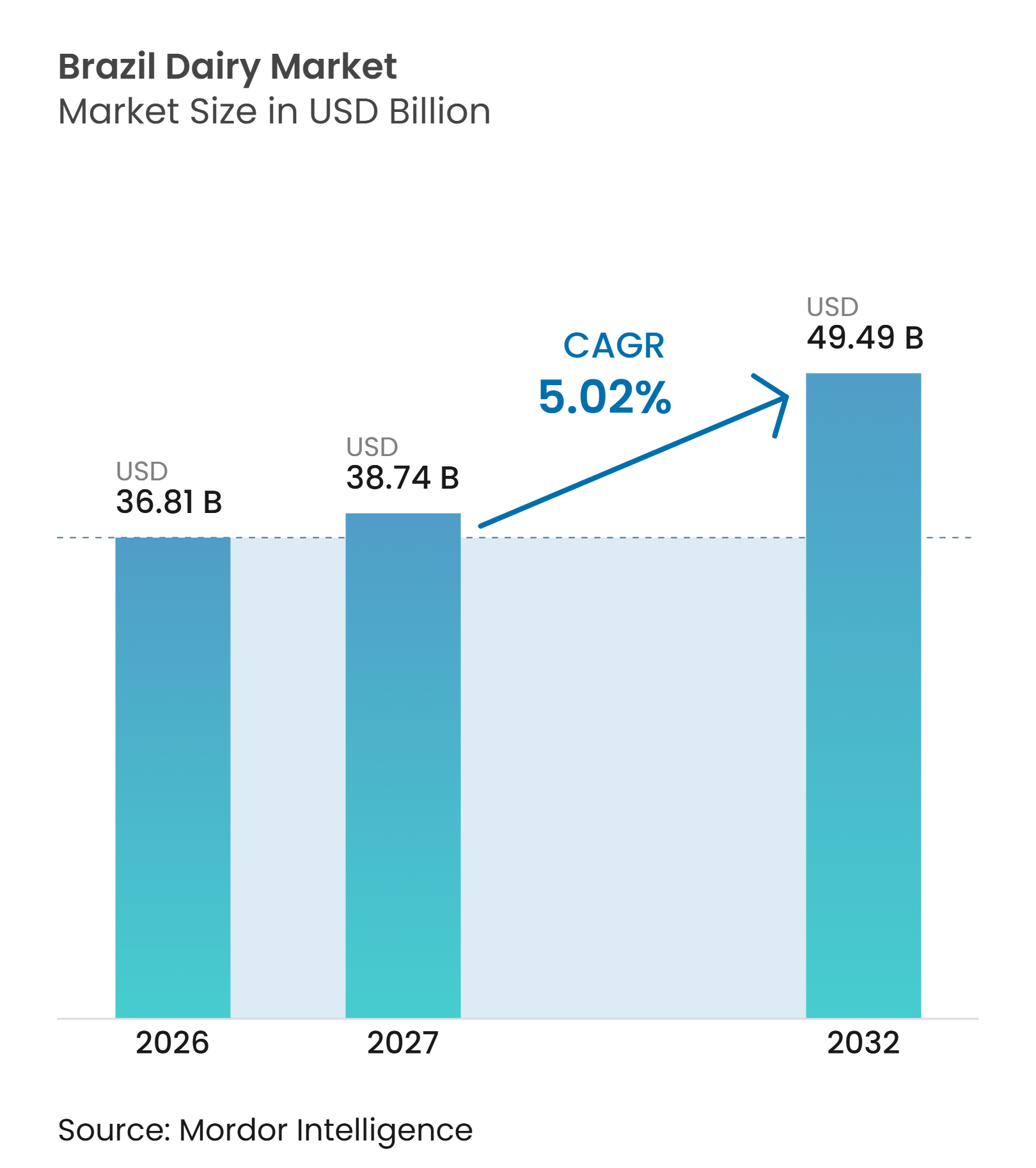
| Base Year Market Size (2026) | USD 36.81 Billion |
| Market Size (2027) | USD 38.74 Billion |
| Market Size (2032) | USD 49.49 Billion |
| Growth Rate (2027 - 2032) | 5.02 % |
| Market Concentration | Low |
Major Players *Disclaimer: Major Players sorted in no particular order Image © Mordor Intelligence. Reuse requires attribution under CC BY 4.0. | |
Brazil Dairy Market Analysis by Mordor Intelligence
The Brazil dairy market size is projected to expand from USD 36.81 million in 2026 and USD 38.66 million in 2027 to USD 49.49 million by 2032, registering a CAGR of 5.02% between 2027 and 2032. The Brazil dairy market is shifting from standard fluid milk toward higher-value dairy products as consumption patterns change. USDA FAS reports fluid milk consumption at 11.5 million MT in 2026, while yogurt, cheese, and functional products attract additional consumer spending[1]. Formally inspected milk acquisition reached 27.51 billion liters in 2025, an 8.5% increase from 2024, which gave processors a stronger raw-material base[2]. The additional supply favors processors that can convert milk into cheese, yogurt, and other differentiated products while maintaining dependable quality and distribution. It also increases pressure on businesses that remain focused on commodity products, where price competition is more intense, and consumer loyalty can be weaker.
Key Report Takeaways
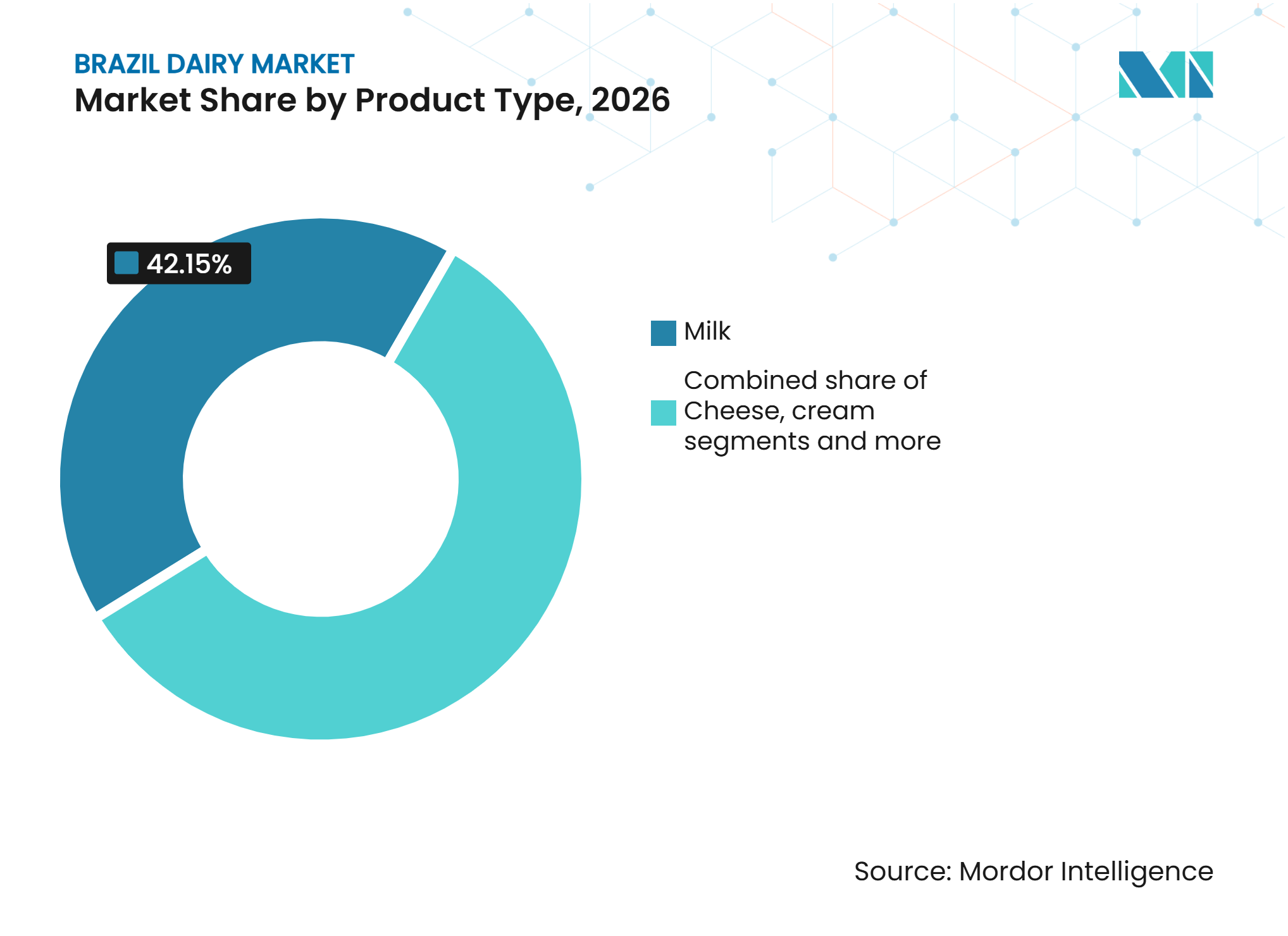
- By product type, milk accounted for the largest share of the Brazil dairy market, at 42.15% in 2026, while cheese is projected to grow at the fastest CAGR of 4.65% during 2027-2032.
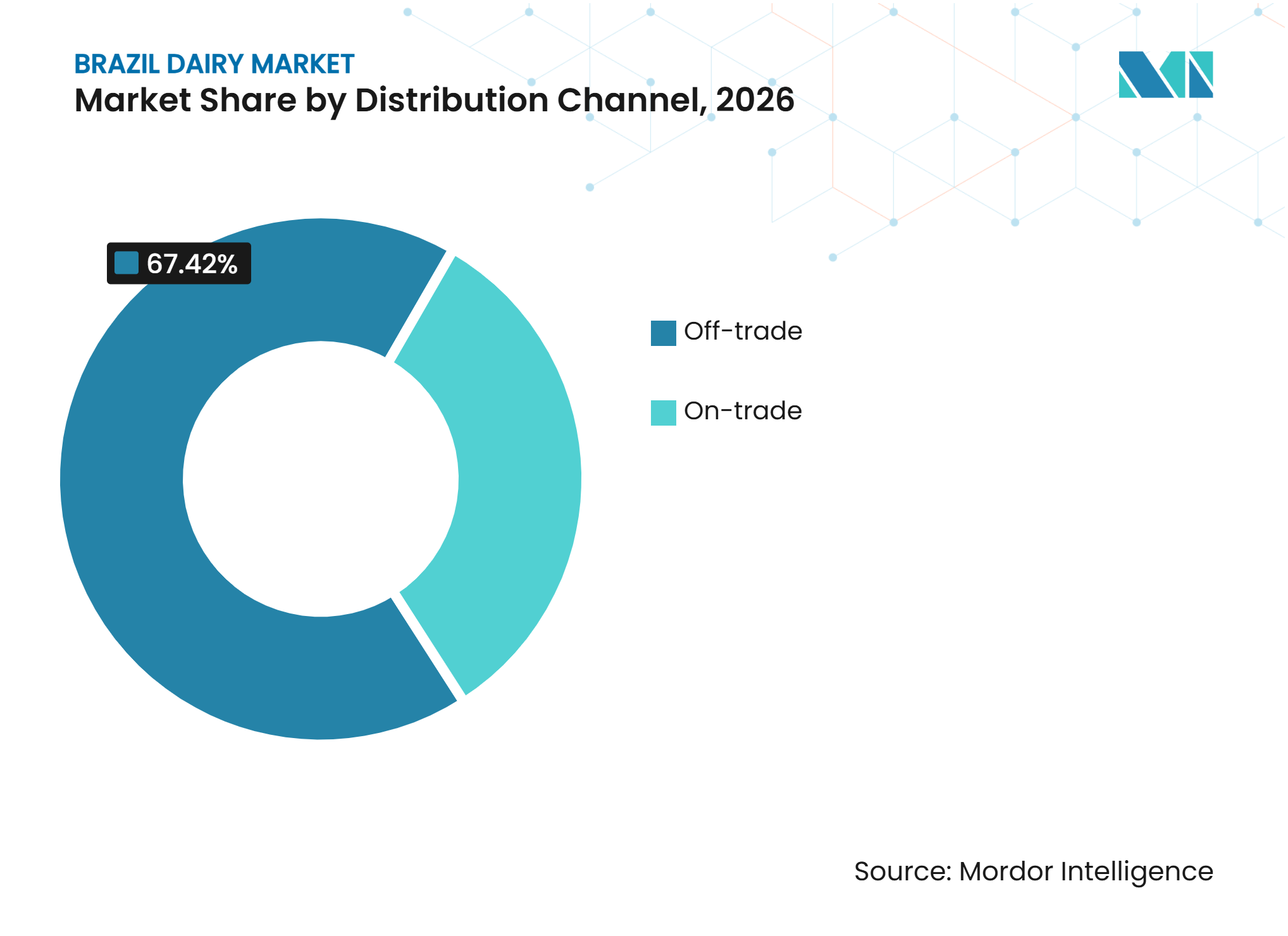
- By distribution channel, off-trade accounted for the largest share of the Brazil dairy market, at 67.42% in 2026, while on-trade is projected to grow at the fastest CAGR of 4.82% during 2027-2032.
Note: Market numbers in this report are based on Mordor Intelligence's proprietary estimation framework, which combines nine months of actuals with Q4 projections for base year 2026.
Market Trends and Insights
Drivers Impact Analysis of Brazil Dairy Market of Brazil Dairy Market*
| Driver | (~) % Impact on CAGR Forecast | Geographic Relevance | Impact Timeline |
|---|---|---|---|
| Rising Demand for Cheese, Yogurt, and Protein Beverages | +1.2% | National, with concentration in São Paulo, Rio de Janeiro, and Southern metros | Medium term (2-4 years) |
| Health, Wellness, and Functional Dairy Premiumization | +1.0% | National, strongest in A/B income brackets across São Paulo and Minas Gerais | Medium term (2-4 years) |
| Retail Modernization and E-Commerce Expansion | +0.8% | National, with early gains in São Paulo, Rio de Janeiro, and Curitiba metro corridors | Short term (≤ 2 years) |
| Dairy-Farm Productivity Gains and Producer Professionalization | +0.7% | South and Southeast, including Minas Gerais, Paraná, and Rio Grande do Sul | Long term (≥ 4 years) |
| Regional Cold-Chain Bypass Through UHT and Aseptic Formats | +0.6% | Northeast and Center-West, with spillover to the North | Medium term (2-4 years) |
| Expansion of Precision-Fermentation Dairy Ingredients | +0.3% | São Paulo-centered at present, with national potential over the forecast horizon | Long term (≥ 4 years) |
| Source: Mordor Intelligence | |||
Rising Demand for Cheese, Yogurt, and Protein Beverages
Cheese, yogurt, and protein beverages are driving an ongoing shift in the product mix within the Brazil dairy market. According to the USDA FAS, cheese, yogurt, and functional products are expected to attract incremental dairy spending as fluid milk consumption stabilizes. This trend encourages processors to develop products with more differentiated positioning than standard milk. Cheese serves household meals, snacking occasions, and foodservice preparation, providing suppliers with multiple routes to reach consumers. Yogurt and protein beverages also enable manufacturers to address health-focused purchasing behavior and demand for convenient consumption options. As this shift continues, product development, packaging, reliable cold-chain execution, and consistent product quality will become increasingly important competitive factors for brands.
Health, Wellness, and Functional Dairy Premiumization
Functional dairy products are gaining attention from consumers seeking protein, probiotics, and other product benefits. The Brazil dairy market therefore gives greater importance to clear product positioning, understandable labeling, dependable quality controls, and products that fit regular consumption habits. Larger processors can spread reformulation, labeling, marketing, quality assurance, and packaging costs over wider product portfolios. ANVISA’s dairy compound and dairy beverage labeling deadlines make accurate classifications and product information increasingly important for manufacturers, online sellers, distributors, and retailers. These compliance factors may favor companies that have established technical resources, distribution coverage, and regulatory capacity. The result is a stronger commercial case for differentiated dairy products than for undifferentiated fluid milk, especially where brands can clearly explain the product benefit.
Retail Modernization and E-Commerce Expansion
Modern retail remains critical to dairy product access, particularly for products that require frequent replenishment and consistent visibility. The Brazil dairy market also offers opportunities for digital ordering and direct delivery models, enabling brands to drive repeat purchases and engage more directly with consumers. Online channels provide suppliers with greater control over product information, customer relationships, pack selection, and the presentation of differentiated dairy products. These channels are particularly relevant for premium yogurt, cheese, lactose-free milk, high-protein products, and shelf-stable formats that can be distributed through wider delivery networks. However, digital operations require accurate product listings, reliable fulfillment, temperature management when necessary, and product information that complies with regulatory requirements. As a result, service capabilities, data accuracy, and delivery reliability are becoming as important as shelf availability in major urban areas.
Dairy-Farm Productivity Gains and Producer Professionalization
Milk productivity per cow reached 2,498.7 liters in 2025, increasing by 5.6% from the previous year, even as the number of milked cows declined[3]. This trend indicates that output growth increasingly relies on efficiency, farm management, and production systems rather than herd expansion alone. Improvements in genetics, animal management, feeding practices, and structured production systems can enhance supply reliability for processors. The South and Southeast maintain an advantage due to their dairy specialization, experienced producers, and established processing infrastructure. Higher-productivity farms can also strengthen quality, traceability, and planning practices throughout the supply chain. These conditions increase the value of long-term supply relationships for dairy manufacturers requiring consistent volumes for both everyday and value-added products.
Restraints Impact Analysis of Brazil Dairy Market of Brazil Dairy Market*
| Restraint | (~) % Impact on CAGR Forecast | Geographic Relevance | Impact Timeline |
|---|---|---|---|
| Volatile Farm-Gate Milk Prices and Feed Costs | -0.5% | National, with sharpest pressure in South and Southeast producing states | Short term (≤ 2 years) |
| Competition from Mercosur Milk Powder and Cheese Imports | -0.6% | National, with the heaviest impact in commodity powder and processed-cheese segments | Medium term (2-4 years) |
| Informal Milk Channels and Uneven Quality Compliance | -0.4% | Northeast and inland Brazil, with national public-health implications | Long term (≥ 4 years) |
| Shrinking Producer Base and Succession Constraints | -0.3% | South, including Rio Grande do Sul and Paraná, and Minas Gerais, with national implications | Long term (≥ 4 years) |
| Source: Mordor Intelligence | |||
Volatile Farm-Gate Milk Prices and Feed Costs
Price volatility can constrain farm investment in productivity, herd quality, feed management, and long-term improvements. An 8.5% increase in formally inspected milk acquisition in 2025 expanded available supply, while fluid milk demand was expected to stabilize. This imbalance may pressure raw milk prices, farm income, and producer margins. Processors require stable sourcing relationships, while suppliers need returns that sustain farm investment, strengthen herd management, and support compliance with quality requirements. Cost pressures are particularly significant in concentrated production areas, where local prices respond rapidly to supply changes. A stronger value-added product mix can help processors reduce exposure to commodity market conditions while supporting more stable demand for processed dairy products.
Competition from Mercosur Milk Powder and Cheese Imports
Imported milk powder and cheese can intensify price competition in commodity categories, limiting domestic suppliers’ ability to raise prices. Products that face direct import competition have less capacity to pass higher input costs through to consumers, even when local supply conditions change. This dynamic particularly affects processors that concentrate on standard milk powder and processed cheese rather than branded or specialized dairy products. The Brazil dairy market can address these pressures by improving farm productivity, strengthening product differentiation, enhancing processing efficiency, and developing products that meet clearly defined consumer needs. Trade conditions also influence the willingness of processors and farms to invest in local supply chains, processing capacity, and quality improvements. Companies offering more specialized products face lower exposure than those focused solely on standardized formats; however, they still require a reliable milk supply and disciplined cost management.
*Our forecasts treat driver/restraint impacts as directional, not additive. The impact forecasts reflect baseline growth, mix effects, and variable interactions.
Brazil Dairy Market Segment Analysis
By Product Type:
Milk Holds Scale While Cheese Leads GrowthMilk held 42.15% of Brazil's dairy market share in 2026, supported by the widespread use of UHT milk in Brazilian households. The product remains important because it is affordable, familiar, and suited to broad distribution. USDA FAS expects overall fluid milk consumption to plateau at 11.5 million MT in 2026, which limits the scope for volume-led expansion in standard milk USDA FAS. The largest segment is therefore likely to rely more on packaging, convenience, and premium sub-formats for value growth. Lactose-free, A2 beta-casein, and high-protein milk offer ways to differentiate an established category. These variants allow familiar milk products to meet more specific dietary preferences without changing the basic purchase occasion. Butter, cream, desserts, and sour milk drinks continue to serve specific culinary and regional preferences. These products broaden the range of occasions addressed by the Brazilian dairy market. Their performance depends on whether processors can maintain quality, distribution, and clear consumer positioning. Supply availability also matters because processors need stable input volumes for both everyday and differentiated products.
Cheese is projected to record the fastest product CAGR of 4.65% during 2027-2032. The Brazil dairy market size for cheese is supported by premiumization and greater demand through foodservice and household consumption. USDA FAS identifies cheese among the dairy categories expected to receive incremental consumer spending as standard fluid milk consumption stabilizes. Cheese also offers processors more opportunities for specialty formats and branded product lines. This makes investment in capacity, aging, quality control, and cold-chain management more relevant. Product variety can also help suppliers address household cooking, snacking, and foodservice needs through distinct pack sizes and formats. Yogurt can benefit from the same shift toward functional and convenient products. Product innovation will remain important where cheese producers seek to hold price premiums. Growth will also depend on keeping quality consistent as capacity and product ranges expand.



By Distribution Channel:
Off-Trade Leads While On-Trade Expands FasterOff-trade accounted for 67.42% of the Brazil dairy market share in 2026, making supermarkets, hypermarkets, cash-and-carry stores, and other retail outlets the primary route to consumers. The channel’s scale reflects its broad coverage of household dairy purchases and its ability to stock both shelf-stable and chilled products. UHT milk is particularly well suited to extensive off-trade distribution, as it can reach areas with limited refrigerated infrastructure. The channel also provides suppliers with an established platform for cheese, yogurt, butter, and dairy desserts. Retail formats support planned household purchases and routine replenishment, reinforcing the importance of broad product availability. However, intense off-trade competition can increase pressure on suppliers to manage promotions, shelf availability, and pack sizes. Retailers with strong logistics capabilities can influence the availability of dairy products in areas outside major cities. Digital retail may expand within the off-trade channel as consumers increasingly use delivery platforms for routine food purchases. The leading channel will remain important even as direct ordering models expand. Manufacturers must balance broad retail access against the commercial costs of promotions and distribution.
On-trade is forecasted to grow at the fastest CAGR among distribution channels, 4.82% during 2027-2032. Cafés, restaurants, quick-service outlets, and foodservice operators create opportunities for cheese, cream, butter, and premium dairy products. Denser foodservice activity in São Paulo, Belo Horizonte, and Curitiba supports the size of Brazil's dairy market for this channel. On-trade customers may place greater value on product consistency, portion-specific formats, and reliable delivery than retail customers. They also require ingredients that perform consistently across menus, recipes, and prepared beverages. This channel provides branded suppliers with an opportunity to build demand beyond supermarket shelves. Foodservice exposure can also encourage trials of specialty cheeses and premium dairy offerings. However, faster projected growth does not eliminate the need for price discipline, as operators remain sensitive to input costs. Suppliers that combine reliable distribution with product-specific applications may be best positioned to serve this channel. Consistent service quality can be as important as the product itself in securing repeat foodservice orders.

Geography Analysis
Southeast and South
The Southeast and South form the largest supported processing and consumption base in the Brazil dairy market. Minas Gerais accounted for 23.90% of national milk acquisition in 2025, followed by Paraná at 15.60% and Rio Grande do Sul at 12.80% as per IBGE. These states combine specialized farming, processing assets, major consumer centers, and more established supply networks. Lactalis operates 5 facilities in Rio Grande do Sul and plans to expand cheese output there, reinforcing regional investment in value-added products. Southern productivity and formal production systems support reliable supply and stronger quality management.
Northeast Brazil
The Northeast recorded the fastest-growing regional expansion, with milk acquisition growth of 14.4% in the fourth quarter of 2025. The region offers an important route for wider consumption of shelf-stable, functional, and regional dairy products. Decree No. 12,408 authorized temporary interstate trade in pasteurized and UHT milk made under eligible state and municipal inspection services registered with. This regulatory influence can improve formal market access for qualifying suppliers and help raise consistency in quality standards. UHT formats remain useful where distribution networks serve dispersed consumers.
Center-West, North, and Other States
The Center-West, North, and other smaller state markets offer long-term expansion opportunities through improved collection infrastructure, shelf-stable products, and formal quality systems. The Center-West has significant potential to enhance productivity and expand processing networks. In the North, a 2025 peer-reviewed study reported antibiotic residues in informal raw milk samples, underscoring the need for stronger monitoring and compliance. MAPA and ANVISA requirements can facilitate the transition from informal trade to inspected supply chains.
Competitive Landscape
Market Concentration
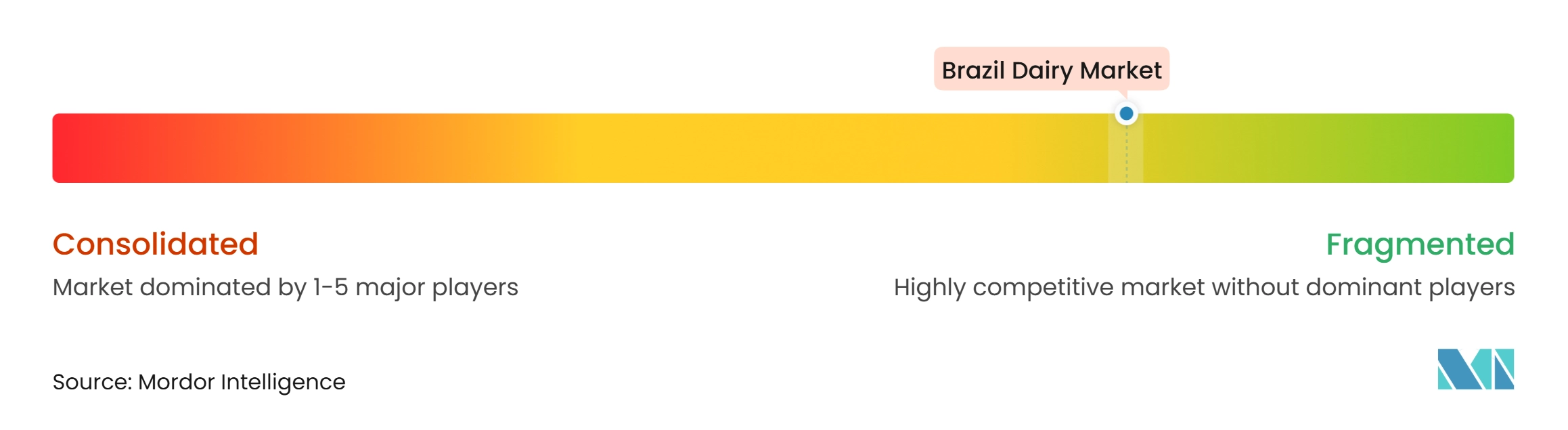
The Brazilian dairy market is moderately fragmented, although investment in specialized products is increasing the importance of scale. Lactalis led in milk intake, with 2.9 billion liters in 2025, according to USDA FAS. Its investment in 5 Rio Grande do Sul facilities covers prato cheese, mozzarella, whey protein, butter, and requeijão. The plan targets an annual cheese capacity of 100,000 MT by 2028, according to USDA FAS. This move shows the value of reliable milk supply, processing technology, and product quality.
Competitive strategies increasingly center on cheese, yogurt, functional dairy, and direct consumer relationships rather than standard fluid milk alone. USDA FAS expects fluid milk consumption to plateau while cheese, yogurt, and functional dairy receive more consumer spending. Lactalis has also stated that it is investing in yogurt production as part of its Brazil strategy. Smaller processors can remain relevant through local demand and specialized product niches. However, compliance, cold-chain capabilities, and access to productive farms can constrain their expansion.
Precision fermentation could reshape selected dairy ingredient applications. Future Cow has received support for technology producing casein, whey, and lactoferrin through fermentation. The technology could provide partnership or licensing options for high-protein and specialized products. Safety review, regulation, cost, and consumer acceptance will determine its commercial adoption.
Brazil Dairy Industry Leaders
-
Lactalis S.A.
-
Laticínios Bela Vista S.A.
-
Central Cooperativa Frimesa Ltda.
-
Nestlé S.A.
-
Cooperativa Central Gaúcha Ltda
- *Disclaimer: Major Players sorted in no particular order
Brazil Dairy Market Companies Covered in this Report
- Lactalis S.A.
- Laticínios Bela Vista S.A.
- Central Cooperativa Frimesa Ltda.
- Nestle S.A.
- Cooperativa Central Gaúcha Ltda.
- Aurora Coop Cooperativa Central Aurora Alimentos
- Laticínios Porto Alegre Indústria e Comércio S.A.
- Jussara S.A.
- Central de Cooperativas de Produtores Rurais de Minas Gerais Ltda.
- Laticínios Tirolez Ltda.
- Laticínios Scala Ltda.
- Cooperativa Castrolanda
- P & L Dairy Agroindustry LTDA.
- Danone S.A.
- Cooperativa Central Mineira de Laticínios Ltda.
- Alvoar Lácteos SA
- Itambé Alimentos S.A.
- Vigor Alimentos S.A.
- Lacticínios Tirol Ltda.
- Catupiry Ltda.
- Savencia Fromage & Dairy S.A.
- Verde Campo S.A.
Recent Industry Developments in Brazil Dairy Market
- May 2026: At Apas Show 2026, Tirolez launched a 250 g fresh cream pack designed to reduce waste, a 370 g lactose-free cream cheese (requeijão), and a PRO+ cream cheese containing 17 g of protein.
- May 2026: Laticínios Scala announced a winter cheese fondue and a new Gouda line produced in Serra da Canastra, Minas Gerais, at Apas Show 2026. The fondue combines Gruyère, prato, mozzarella, and six-month-aged Parmesan cheeses and can be prepared in up to five minutes.
- May 2025: Tirolez expanded its lactose-free range with Zero Lactose Butter, which it will first present at the Apas Show 2025. The range already includes cheeses, spreadable ricotta cream, and cream cheese.
- June 2025: Laticínio Bom Destino launched Brazil’s first 100% buffalo milk powder at MegaLeite 2025. The company expects the product to help balance raw material supply between the peak and off-seasons. It also markets the milk as A2A2 for consumers sensitive to beta-casein.
Brazil Dairy Market Report Scope
Brazil Dairy Market refers to the market for dairy products derived from milk and processed into a wide range of food and beverage categories, serving both nutritional and indulgence consumption needs across retail and foodservice channels.
The Brazil Dairy Market is segmented by product type and distribution channel. Based on product type, the market is segmented into butter (salted butter and unsalted butter), cheese (natural cheese including cheddar, cottage, feta, parmesan, and others, and processed cheese), cream (fresh cream, cooking cream, whipping cream, and other creams), dairy desserts (ice cream, cheesecakes, frozen desserts, and other dairy desserts), milk (condensed milk, flavored milk, fresh milk, UHT milk, powdered milk, and other milk products), yogurt (drinkable and spoonable), sour milk drinks, and other product types. Based on distribution channel, the market is segmented into on-trade and off-trade, with the latter further categorized into convenience stores, specialist retailers, supermarkets/hypermarkets, online retail stores, and other off-trade channels. For each segment, market sizing and forecasting have been conducted in value terms (USD million) and volume terms (metric tons).
Segmentation Overview
| Butter | Salted Butter | |
| Unsalted Butter | ||
| Cheese | Natural Cheese | Cheddar |
| Cottage | ||
| Feta | ||
| Parmesan | ||
| Others | ||
| Processed Cheese | ||
| Cream | Fresh Cream | |
| Cooking Cream | ||
| Whipping Cream | ||
| Other Creams | ||
| Dairy Desserts | Ice Cream | |
| Cheesecakes | ||
| Frozen Desserts | ||
| Other Dairy Desserts | ||
| Milk | Condensed Milk | |
| Flavored Milk | ||
| Fresh Milk | ||
| UHT Milk | ||
| Powdered Milk | ||
| Other Milk Products | ||
| Yogurt | Drinkable | |
| Spoonable | ||
| Sour Milk Drinks | ||
| Other Product Types | ||
| On-trade | |
| Off-trade | Convenience Stores |
| Specialist Retailers | |
| Supermarkets/Hypermarkets | |
| Online Retail Stores | |
| Other Off-trade Channels |
| By Product Type | Butter | Salted Butter | |
| Unsalted Butter | |||
| Cheese | Natural Cheese | Cheddar | |
| Cottage | |||
| Feta | |||
| Parmesan | |||
| Others | |||
| Processed Cheese | |||
| Cream | Fresh Cream | ||
| Cooking Cream | |||
| Whipping Cream | |||
| Other Creams | |||
| Dairy Desserts | Ice Cream | ||
| Cheesecakes | |||
| Frozen Desserts | |||
| Other Dairy Desserts | |||
| Milk | Condensed Milk | ||
| Flavored Milk | |||
| Fresh Milk | |||
| UHT Milk | |||
| Powdered Milk | |||
| Other Milk Products | |||
| Yogurt | Drinkable | ||
| Spoonable | |||
| Sour Milk Drinks | |||
| Other Product Types | |||
| By Distribution Channel | On-trade | ||
| Off-trade | Convenience Stores | ||
| Specialist Retailers | |||
| Supermarkets/Hypermarkets | |||
| Online Retail Stores | |||
| Other Off-trade Channels | |||
Key Questions Answered in the Report
What is the forecast growth rate for dairy in Brazil?
The Brazil dairy market is projected to grow at a CAGR of 5.02% from 2027 to 2032, reaching USD 49.49 million in 2032. Growth is supported by a shift in spending toward cheese, yogurt, and functional dairy products.
Which product category leads dairy sales in Brazil?
Milk leads with a 42.15% share in 2026, supported by broad household use, the reach of UHT formats, and established retail distribution. The Brazil dairy market continues to rely on this category even as more differentiated products gain attention.
Which dairy product is growing fastest in Brazil?
Cheese is projected to grow at a 4.65% CAGR during 2027-2032 as consumers shift spending toward differentiated dairy products and foodservice use. The Brazil dairy market gives processors ways to serve both retail and foodservice demand through cheese formats.
Which distribution channel has the largest share in Brazil?
Off-trade leads with a 67.42% share in 2026, reflecting the reach of supermarkets, hypermarkets, cash-and-carry stores, and other retail outlets. The Brazil dairy market depends on these formats for routine household dairy purchases.