
Brazil Customs Brokerage Market Size and Share
Market Overview
| Study Period | 2021 - 2032 |
|---|---|
| Forecast Data Period | 2027 - 2032 |
| Base Year Market Size (2026) | USD 0.98 Billion |
| Market Size (2027) | USD 1.03 Billion |
| Market Size (2032) | USD 1.31 Billion |
| Growth Rate (2027 - 2032) | 5.00 % |
| Market Concentration | Low |
Major Players *Disclaimer: Major Players sorted in no particular order Image © Mordor Intelligence. Reuse requires attribution under CC BY 4.0. | |
Brazil Customs Brokerage Market Analysis by Mordor Intelligence
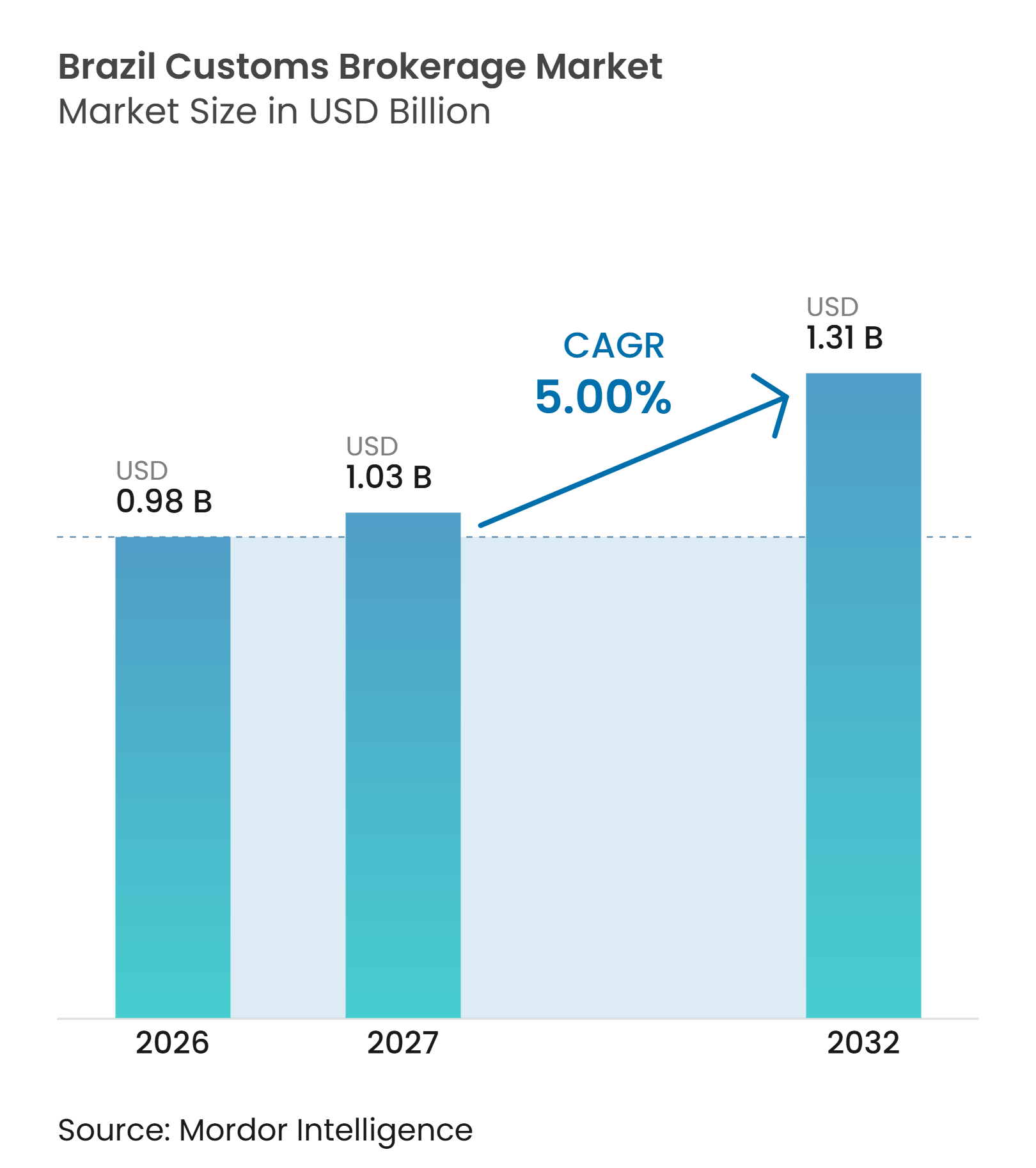
The Brazil customs brokerage market size is valued at USD 0.98 billion in 2026. It is estimated to grow from USD 1.03 billion in 2027 to USD 1.31 billion by 2032, at a CAGR of 5% during the forecast period from 2027 to 2032.
The Brazil customs brokerage market benefits from formal import requirements, a layered tariff system, and growing demand for compliance support across import channels. Cross-border e-commerce is increasing the number of lower-value declarations, while trade in complex goods continues to require classification, licensing, and document management. The transition to DUIMP under Portal Único is shifting competition toward firms that can connect directly with government systems. Integrated logistics providers are extending brokerage services alongside freight forwarding, warehousing, and bonded-zone operations. This combination creates room for specialist brokers in e-commerce, regulated goods, and regional customs regimes, even as larger providers expand their end-to-end offerings.
Key Report Takeaways
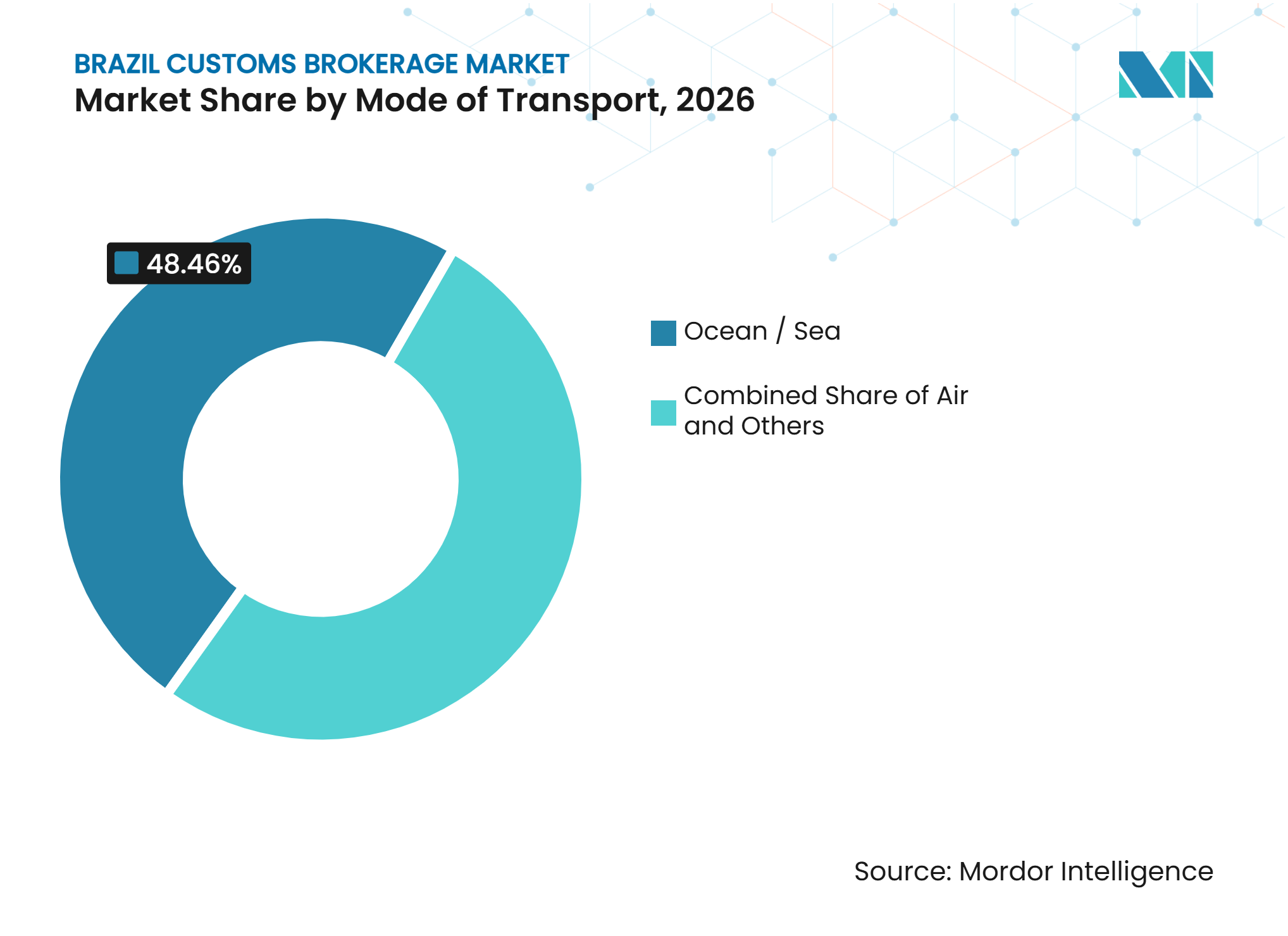
- By mode of transport, ocean/sea accounts for 48.46% of the Brazil customs brokerage market share in 2026, while air cargo is forecast to register a 7.76% CAGR through 2032.
- By broker type, freight forwarder/3PL-integrated brokers account for 65.34% of the Brazil customs brokerage market size in 2026, while pure customs brokers are forecast to register a 6.98% CAGR through 2032.
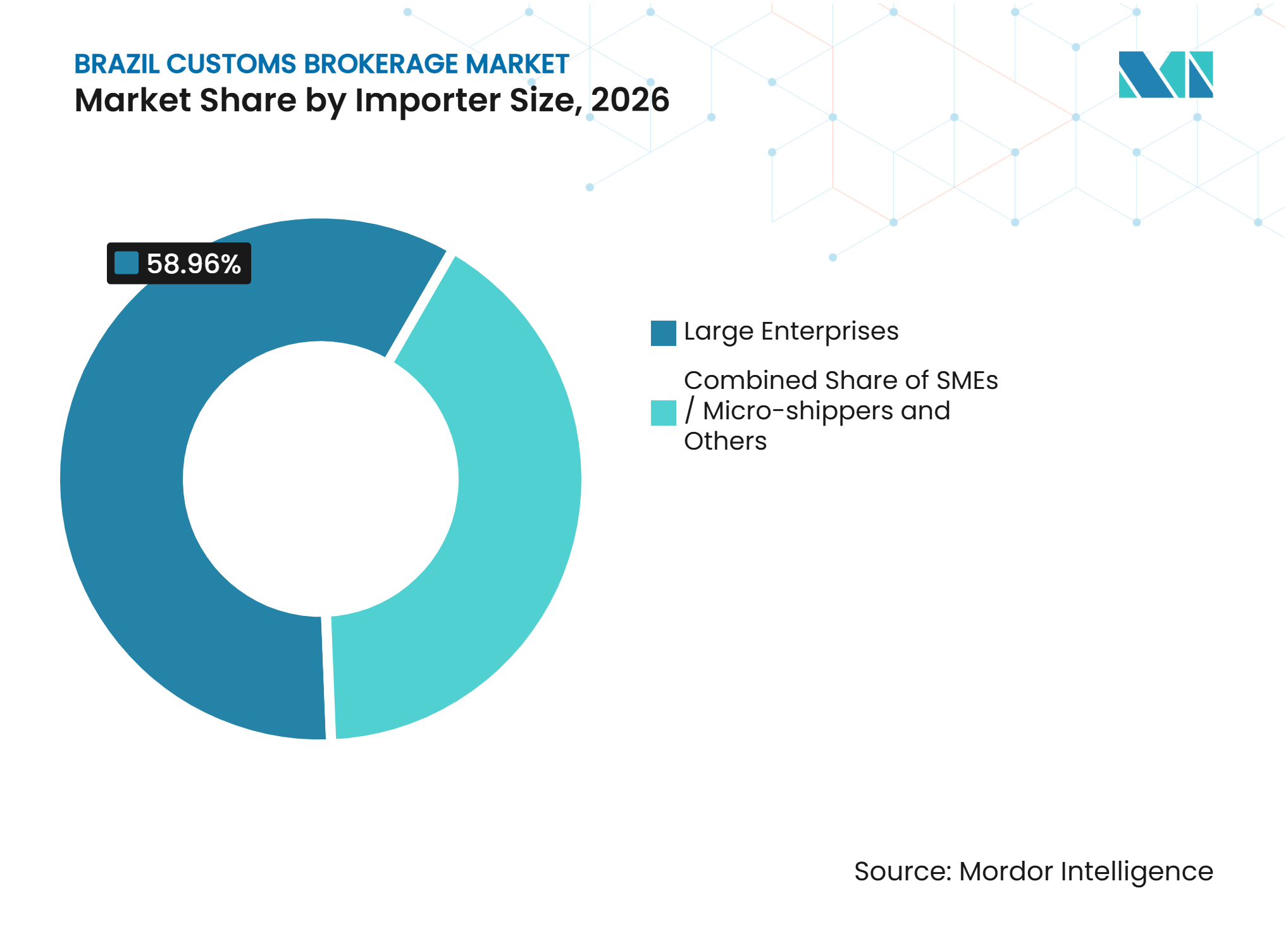
- By importer size, large enterprises account for 58.96% of the Brazil customs brokerage market share in 2026, while SMEs and micro-shippers are forecast to register a 6.61% CAGR through 2032.
- By digital adoption, traditional brokerages account for 77.57% of the Brazil customs brokerage market size in 2026, while digital-first/API-based brokerages are forecast to register a 7.92% CAGR through 2032.
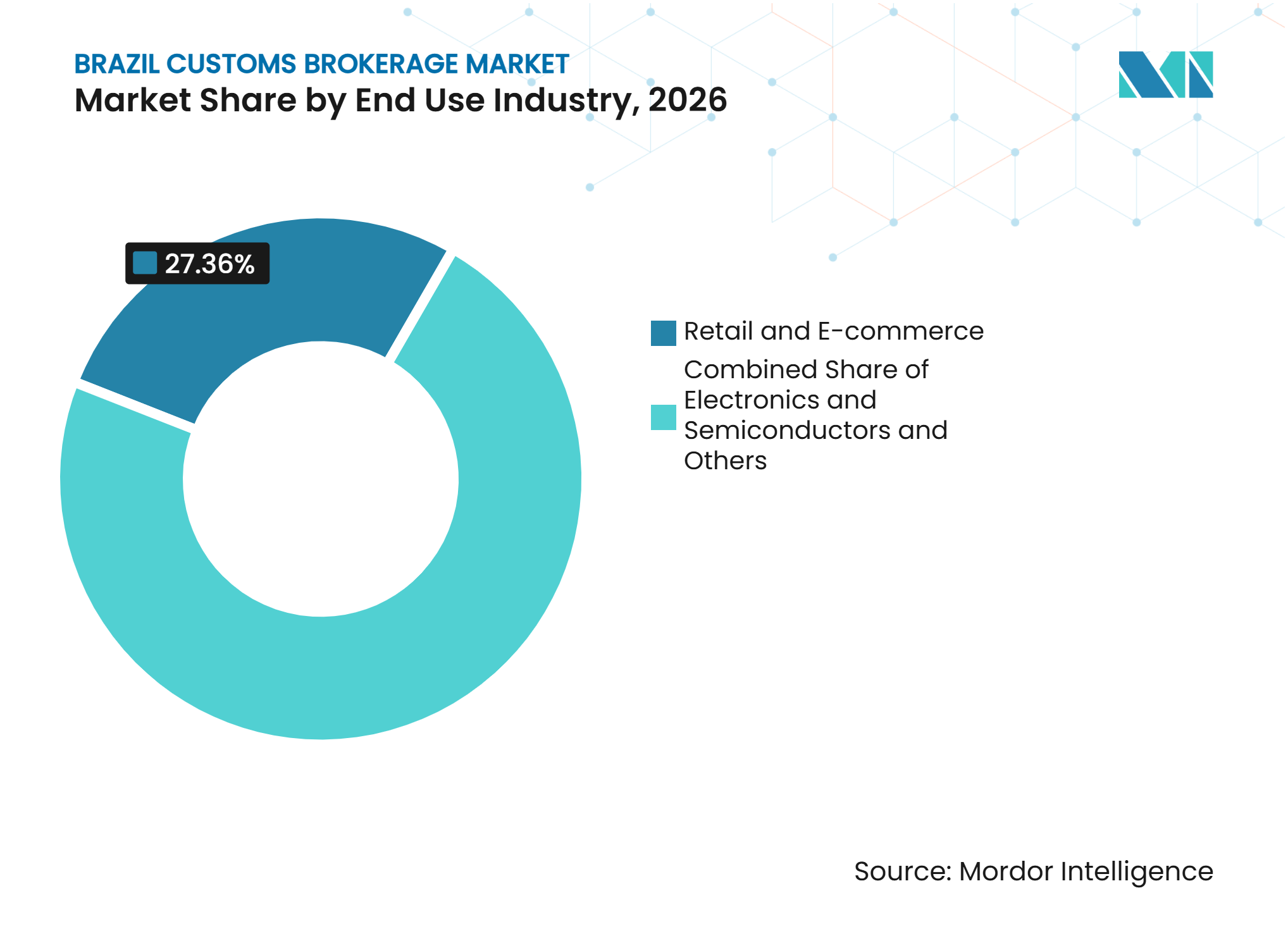
- By end-use industry, retail and e-commerce account for 27.36% of the Brazil customs brokerage market share in 2026, while electronics and semiconductors are forecast to register a 6.26% CAGR through 2032.
- By geography, Southeast accounts for 48.96% of the Brazil customs brokerage market size in 2026, while North is forecast to register a 7.49% CAGR through 2032.
Note: Market numbers in this report are based on Mordor Intelligence's proprietary estimation framework, which combines nine months of actuals with Q4 projections for base year 2026.
Market Trends and Insights
Drivers Impact Analysis of Brazil Customs Brokerage Market*
| Driver | (~) % Impact on CAGR Forecast | Geographic Relevance | Impact Timeline |
|---|---|---|---|
| Cross-Border E-Commerce Expanding Parcel Clearance Demand | +1.3% | National, concentrated in Southeast and North | Short term (≤ 2 years) |
| Portal Único Digitalization Improving Customs Processing Efficiency | +0.9% | National, with early gains in Santos, Guarulhos, and Viracopos | Medium term (2-4 years) |
| Integrated 3PL Networks Expanding Brokerage Service Demand | +0.7% | Southeast and South, with spillover to Northeast | Medium term (2-4 years) |
| Regulatory Compliance Increasing Specialized Brokerage Requirements | +0.5% | National | Long term (≥ 4 years) |
| Remessa Conforme Increasing Upstream Clearance Service Demand | +0.5% | National, especially North and Southeast | Short term (≤ 2 years) |
| Automated Classification Improving Documentation Accuracy | +0.4% | National, concentrated in multimodal hubs | Medium term (2-4 years) |
| Source: Mordor Intelligence | |||
Cross-Border E-Commerce Expanding Low-Value Parcel Clearance Demand
Cross-border e-commerce is moving a larger share of customs work from consolidated container shipments to frequent, lower-value parcel declarations. This shift increases demand for data validation, tariff calculation, classification, and release coordination before a parcel reaches the final consumer. Brokers linked to express carrier networks are well placed because they can connect platform data with declaration processes and delivery operations. The Programa Remessa Conforme has increased the importance of pre-shipment information quality, especially for tariff and product classification fields. The Brazil customs brokerage market therefore has a growing need for service models designed for high transaction volumes rather than a small number of complex entries.
Portal Único Digitalization Improving Customs Processing Efficiency
Portal Único is changing the operating requirements for brokers by moving customs processes toward structured, system-to-system information exchange. Its August 2025 release introduced 189 new functionalities across 17 systems and added support for land-mode DUIMP processes, while the platform connected 27 systems and exposed 220 APIs for private-sector use[1]. The migration from legacy import declaration processes makes technology capability a practical requirement rather than a secondary service feature. Brokers with direct connections can reduce manual re-entry and manage exceptions more consistently. Firms dependent on manual workflows may face greater compliance risk as maritime operations complete the shift to the new framework.
Integrated 3PL Networks Expanding Brokerage Service Demand
Large importers increasingly prefer a single provider that can coordinate international freight, bonded warehousing, customs clearance, and domestic delivery. This preference strengthens the position of providers that operate across ports, airports, storage sites, and inland transport corridors. DP World opened a freight forwarding office in Porto Alegre in October 2025, adding customs clearance to its ocean, air, and road freight offerings. Such expansions allow integrated providers to manage the handoffs that often cause delays or incomplete customs documentation. They are particularly relevant for regulated shipments where carriers, importers, brokers, and government bodies must exchange information quickly.
Regulatory Compliance Increasing Specialized Brokerage Requirements
Brazilian imports can require several layers of tariff classification, licensing, tax treatment, and technical certification review. These requirements create recurring demand for brokers that understand product-specific rules and the procedures of multiple authorities. Electronics, pharmaceuticals, chemicals, aerospace equipment, and telecommunications goods need closer coordination because clearance can involve additional permits or certifications. The regulatory environment also raises the value of early document review, which can prevent avoidable delays at a port or airport.
Restraints Impact Analysis of Brazil Customs Brokerage Market*
| Restraint | (~) % Impact on CAGR Forecast | Geographic Relevance | Impact Timeline |
|---|---|---|---|
| Tariff Complexity Increasing Customs Compliance Burden | -0.6% | National, with high impact in Southeast hubs | Long term (≥ 4 years) |
| Port Congestion Delaying Cargo Clearance Processes | -0.5% | Santos, Paranaguá, Rio Grande, and Suape | Short term (≤ 2 years) |
| Customs Talent Shortages Limiting Brokerage Service Capacity | -0.4% | National, especially emerging port regions | Medium term (2-4 years) |
| System Migration Risks Disrupting Digital Clearance Operations | -0.3% | National, concentrated in maritime hubs | Short term (≤ 2 years) |
| Source: Mordor Intelligence | |||
Tariff Complexity Increasing Customs Compliance Burden
Brazil’s tariff system combines Mercosur rules, national measures, ex-tarifário mechanisms, and product-specific requirements. This structure increases the cost of keeping tariff codes, landed-cost estimates, and licensing assessments current. In February 2026, GECEX maintained or adjusted import tariff treatment for 120 capital goods and information technology and telecommunications products, illustrating the need for regular product-level review. The United States also announced action related to Brazil’s digital trade and electronic payment practices in July 2026, adding trade-policy uncertainty for companies managing cross-border commercial relationships. Frequent rule changes can create work for brokers, but they can also delay importer decisions and complicate pricing. The Brazil customs brokerage market must therefore balance growing advisory demand with the operational burden of a changing rulebook.
Port Congestion Delaying Cargo Clearance Processes
Port congestion can delay cargo availability even when the customs declaration is complete. At Santos, bulk agricultural exports and containerized imports compete for rail access, yard space, truck scheduling, and berth availability. Delays can increase storage, detention, and demurrage exposure for importers, which often leads to more broker coordination and dispute management. DP World and Maersk agreed in March 2025 to expand maritime services at Santos, supported by a terminal capacity expansion to 1.7 million TEUs by the end of 2026 and 2.1 million TEUs by the end of 2027[2]. The investment improves the long-term capacity outlook, but it does not remove current scheduling pressure across the port system. Near-term congestion remains a restraint because it makes service quality dependent on factors outside a broker’s direct control.
*Our forecasts treat driver/restraint impacts as directional, not additive. The impact forecasts reflect baseline growth, mix effects, and variable interactions.
Brazil Customs Brokerage Market Segment Analysis
By Mode of Transport:
Air Cargo Gaining Ground Against Sea DominanceOcean/sea accounts for 48.46% of the Brazil customs brokerage market share in 2026. The segment is supported by Brazil’s commodity exports and containerized imports of manufactured goods through Santos, Paranaguá, Suape, and other coastal gateways. Ocean shipments commonly require coordination between shipping lines, port terminals, bonded warehouses, importers, and inspection agencies. This creates steady demand for document management and cargo-status monitoring. Brokers also manage changes to bills of lading, release conditions, and storage arrangements when cargo does not move on schedule. The depth of port-linked infrastructure makes sea freight central to the Brazil customs brokerage market size, even as other modes grow faster.
Air cargo is forecast to register a 7.76% CAGR through 2032. Growth reflects the need for faster clearance of e-commerce parcels, high-value electronics, and time-sensitive components. Guarulhos and Viracopos are becoming more important for regional freight consolidation and onward distribution. DHL Global Forwarding repositioned Brazil as a regional transshipment location and identified Guarulhos and Viracopos as consolidation points for cargo moving from Asia into Latin America. Air brokers must manage shorter operating windows, precise document timing, and certification requirements for sensitive goods. The mode gives specialized providers opportunities to build high-service offerings around fast exception resolution.



By Broker Type:
3PL Integration Dominant, While Pure Brokers Gain in the SME SegmentFreight forwarder/3PL-integrated brokers account for 65.34% of the Brazil customs brokerage market size in 2026. Their leadership reflects the preference of large importers for one provider that can organize freight, bonded storage, customs filing, and domestic movement. Integrated providers can reduce handoffs and provide a single operational contact for complex supply chains. They often have broader access to warehouses, transport capacity, and technology resources than independent brokerage firms. This model is well suited to automotive, pharmaceutical, aerospace, and high-volume retail customers. It also supports longer commercial contracts that combine several logistics services.
Pure customs brokers are forecast to register a 6.98% CAGR through 2032. The segment benefits from SMEs and micro-shippers that require formal declaration expertise but do not need a full logistics outsourcing contract. These customers often value direct access to a specialist who can explain an import process and resolve a narrow compliance issue. Pure brokers can compete through flexible service packages, faster client onboarding, and knowledge of e-commerce procedures. They can also develop strong positions in specific product categories, airports, ports, or special customs regimes. This creates a practical growth route even as integrated providers retain the leading position.
By Importer Size:
Large Enterprises Lead, While SMEs and Micro-shippers ExpandLarge enterprises account for 58.96% of the Brazil customs brokerage market share in 2026. These importers are concentrated in formal, regulated trade sectors such as automotive, pharmaceuticals, aerospace, and industrial equipment. Their shipments often require customs brokerage for each entry, regardless of the level of internal digital capability. Large companies also tend to use ocean freight, bonded warehousing, and multiple distribution sites, which supports demand for integrated brokers. Their procurement teams usually prioritize service coverage, compliance controls, reporting, and predictable escalation procedures. This makes large enterprises a stable source of brokerage revenue.
SMEs and micro-shippers are forecast to register a 6.61% CAGR through 2032. Growth is connected to the formalization of cross-border consumer-goods purchasing through certified e-commerce platforms. First-time importers often need help understanding documents, taxes, classifications, and product controls. They are less likely to purchase a full forwarding and warehousing package, which supports demand for focused brokerage services. A simple digital onboarding process can be decisive because these clients have limited administrative capacity. Firms that standardize the routine stages of onboarding can serve a larger number of smaller accounts.

By Digital Adoption:
Automation Accelerating Despite Traditional Brokerage’s LeadTraditional brokerages account for 77.57% of the Brazil customs brokerage market share in 2026. This position reflects the continuing need for experienced professionals to interpret documentation, respond to validation errors, and manage permits from several authorities. Complex customs cases cannot be handled through automation alone, particularly when an import requires product-specific licensing or an authority requests further information. Traditional brokerages also have long-standing client relationships and local knowledge at major gateways. Their service model remains relevant where a shipment requires direct operational intervention.
Digital-first/API-based brokerages are forecast to register a 7.92% CAGR through 2032. They use direct connections, client portals, and automated data checks to manage frequent, standardized filings. This model is particularly relevant for e-commerce parcels, recurring consumer-goods imports, and clients that require rapid status updates. Digital-first firms can make the client journey simpler by offering document upload, classification support, and exception alerts through a single interface. Their growth depends on integrating automation with reliable professional review. A purely automated approach is less suitable for shipments with uncertain classification or multiple regulatory approvals.
By End-Use Industry:
Retail and E-commerce Lead by Volume, While Electronics and Semiconductors Grow FasterRetail and e-commerce accounts for 27.36% of the Brazil customs brokerage market share in 2026. The segment benefits from a large number of relatively small shipments, particularly under formalized cross-border parcel programs. Each transaction may produce limited revenue, but the aggregate volume supports substantial brokerage activity. Retail importers need consistent product descriptions, tariff calculations, and data submission across broad assortments. They also need quick support when a parcel is held, or a product requires additional documentation. Brokers with strong platform and carrier relationships are well positioned in this segment.
Electronics and semiconductors are forecast to register a 6.26% CAGR through 2032. The segment requires close attention because imported components can be affected by tariff revisions, ex-tarifário treatment, and technical certification. GECEX announced tariff measures covering capital goods and information technology and telecommunications products in February 2026[3]. Electronics importers often need brokers to support landed-cost planning alongside the filing process. The value of technical knowledge is high because a classification error can affect tax treatment, timing, and product release. This supports specialist advisory work in addition to routine declaration handling.
Geography Analysis
Southeast accounts for 48.96% of the Brazil customs brokerage market share in 2026. The region combines the Port of Santos with Guarulhos and Viracopos, giving brokers access to the country’s largest concentration of ocean and air freight activity. Its industrial base creates sustained import demand for manufactured goods, components, pharmaceuticals, and consumer products. Congestion at Santos can create more coordination work around storage, amendments, and cargo release. At the same time, the concentration of providers, warehouses, and transport networks gives clients a wide range of brokerage options. The region’s scale makes it the principal commercial center of the Brazil customs brokerage market.
North is forecast to register a 7.49% CAGR through 2032. The Zona Franca de Manaus creates a distinct demand profile because importers must manage special-regime processes, warehouse controls, and SUFRAMA requirements. Brokers with knowledge of Manaus regulations can build a defensible position because clients need support across the full handling cycle. The region also benefits from air freight and courier activity that can reduce reliance on long domestic relay routes. Its growth reflects both industrial demand and changing delivery infrastructure. The Brazil customs brokerage market can gain from North-region infrastructure that makes specialist customs services more accessible to local importers.
The South benefits from Paranaguá, Rio Grande, and Mercosur land-border flows. Multilog’s new Foz do Iguaçu Porto Seco is scheduled to add 30% capacity, which can support greater cross-border cargo handling. Maersk opened logistics facilities in Rio Grande and Paranaguá in April 2026, including a depot of 70,000 m² near the port and a 6,000 m² CFS expansion[4]. These investments support agricultural, refrigerated, and containerized cargo flows. Brokers can benefit from additional inspection, storage, and consolidation activity around these facilities.
Competitive Landscape
Market Concentration
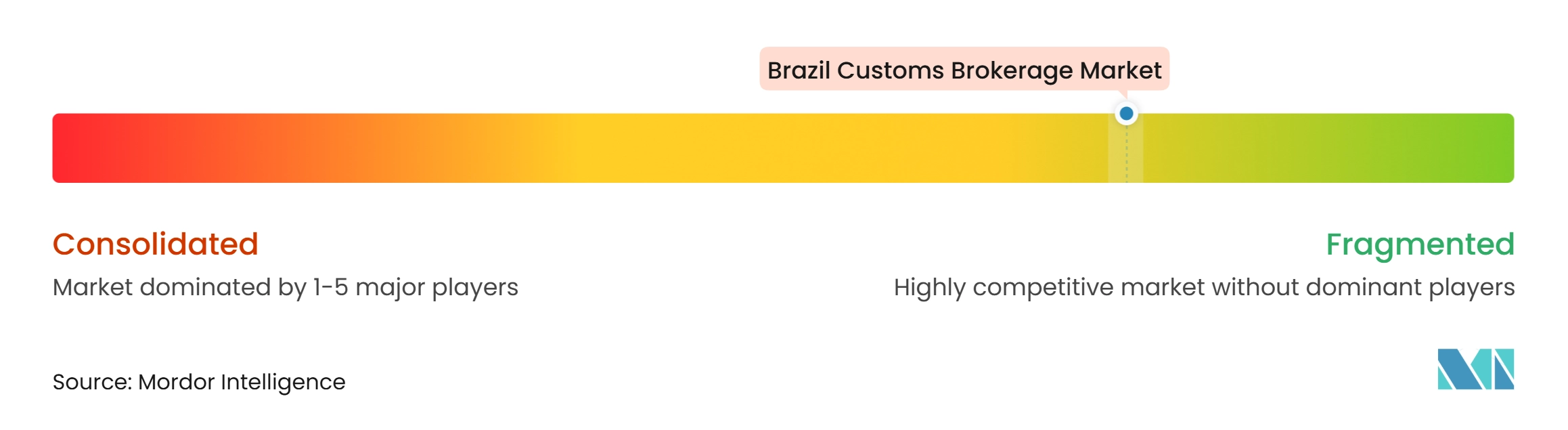
The Brazil customs brokerage market is fragmented. Global logistics providers including DHL Group, A.P. Moller - Maersk, DSV, Kuehne+Nagel, and CEVA Logistics serve large formal-trade accounts through integrated freight, warehousing, and brokerage networks. Brazilian operators such as Multilog, Allog Group, and Asia Shipping compete through local relationships, bonded-zone access, and specific trade-lane strengths. Competition is strongest where clients can choose between bundled logistics contracts and standalone brokerage expertise.
Maersk is strengthening its port-to-door offering through Brazilian investment in terminals, depots, and logistics facilities. Its April 2026 expansion in Rio Grande and Paranaguá supports customs-adjacent services for refrigerated, agricultural, and containerized cargo. DP World’s Porto Alegre freight-forwarding office adds customs clearance to a broader multimodal offering. These moves show how large providers are seeking to control more stages of an import movement. The strategy can strengthen customer retention because freight, terminal, warehouse, and customs decisions are managed within one operating network.
DSV completed the acquisition of Schenker in April 2025, expanding its global forwarding network and its local Brazilian capabilities through Schenker’s established operations. The transaction increases the scale of a major integrated competitor in customs-related logistics services. DSV reported that integration work would continue through the end of 2026. Scale alone will not determine results, because brokerage clients also evaluate local support and the ability to handle exceptions. Still, larger networks can make substantial investments in data integration and service coverage.
Brazil Customs Brokerage Industry Leaders
-
Asia Shipping
-
Multilog SA
-
Allog Group
-
DHL Group
-
DSV AS
- *Disclaimer: Major Players sorted in no particular order
Brazil Customs Brokerage Market Companies Covered in this Report
- DHL Group
- DSV AS
- Kuehne+Nagel International AG
- CEVA Logistics
- A.P. Moller - Maersk
- Expeditors International of Washington Inc.
- Asia Shipping
- UPS Supply Chain Solutions
- FedEx Logistics Inc.
- GEODIS SA
- JAS Worldwide Inc.
- Rhenus Group
- Yusen Logistics Co. Ltd
- Hellmann Worldwide Logistics
- Multilog SA
- Allog Group
- Exacta Assessoria em Logística e Comércio Internacional
- CONEXO Logistics
- Imexlog Logística Aduaneira
- Rota Brasil Consultoria Aduaneira
- SEA Despachos Aduaneiros
- Brasil Despachos Aduaneiros
Recent Industry Developments in Brazil Customs Brokerage Market
- August 2026: Brazil's Federal Revenue Service renewed Jadlog's authorization to clear international express shipments at Guarulhos Airport. The authorization supported continued customs processing for the company's cross-border courier operations.
- May 2026: Gollog introduced a customs-transit service at Maringá Airport, enabling international cargo arriving through Guarulhos to move under the Declaração de Trânsito Aduaneiro (DTA) regime for customs clearance in Maringá. The service expanded regional import-export processing options.
- April 2026: Maersk opened logistics facilities in Rio Grande and Paranaguá to support container inspection, cargo services, and cross-docking for agricultural and refrigerated freight.
- April 2026: DP World launched its Brazil–Africa Link, connecting Brazilian exporters with Angola, Mozambique, and South Africa through integrated ocean and inland logistics. Its Brazilian forwarding network also provided customs clearance services, strengthening end-to-end international trade coordination.
Brazil Customs Brokerage Market Report Scope
Segmentation Overview
| Ocean / Sea |
| Air (Express and General Cargo) |
| Cross-Border Land (Truck and Rail) |
| Pure Customs Broker |
| Freight Forwarder / 3PL-Integrated Brokers |
| Large Enterprises |
| Mid-Market |
| SMEs / Micro-shippers |
| Traditional Brokerages |
| Digital-first / API-based Brokerages |
| Retail and E-commerce |
| Automotive and EV |
| Electronics and Semiconductors |
| Pharmaceuticals and Life Sciences |
| Aerospace and Defense |
| Chemicals and Industrial Goods |
| North |
| Northeast |
| Central-West |
| Southeast |
| South |
| By Mode of Transport | Ocean / Sea |
| Air (Express and General Cargo) | |
| Cross-Border Land (Truck and Rail) | |
| By Broker Type | Pure Customs Broker |
| Freight Forwarder / 3PL-Integrated Brokers | |
| By Importer Size | Large Enterprises |
| Mid-Market | |
| SMEs / Micro-shippers | |
| By Digital Adoption | Traditional Brokerages |
| Digital-first / API-based Brokerages | |
| By End-Use Industry | Retail and E-commerce |
| Automotive and EV | |
| Electronics and Semiconductors | |
| Pharmaceuticals and Life Sciences | |
| Aerospace and Defense | |
| Chemicals and Industrial Goods | |
| By Region | North |
| Northeast | |
| Central-West | |
| Southeast | |
| South |
Key Questions Answered in the Report
What is the projected growth rate of Brazil customs brokerage services?
The Brazil customs brokerage market is projected to grow at a 5% CAGR from 2027 to 2032, reaching USD 1.31 billion by 2032.
Which transport mode leads customs brokerage activity in Brazil?
Ocean/sea leads with a 48.46% share in 2026, supported by containerized imports and port-based trade through gateways such as Santos and Paranaguá.
Why are digital customs brokerages growing in Brazil?
Digital-first/API-based Brokerages are projected to register a 7.92% CAGR through 2032 because Portal Único and DUIMP increase the value of direct data exchange and automated workflows.
Which customer group is expanding fastest for customs brokers?
SMEs and micro-shippers are forecast to register 6.61% CAGR through 2032 as more cross-border buyers enter formal import channels.
What are the main challenges facing Brazilian customs brokers?
Tariff complexity, port congestion, shortages of skilled customs staff, and digital system migration risks can slow processing and increase operating costs.
Which region is growing fastest for customs brokerage services?
North is projected to register 7.49% CAGR through 2032, supported by the Zona Franca de Manaus and new courier clearance activity at Manaus Airport.