
Brazil Crowdsourced (Gig Economy Couriers) Delivery Service Market Size and Share
Market Overview
| Study Period | 2021 - 2032 |
|---|---|
| Forecast Data Period | 2027 - 2032 |
| Base Year Market Size (2026) | USD 2.48 Billion |
| Market Size (2027) | USD 2.83 Billion |
| Market Size (2032) | USD 5.14 Billion |
| Growth Rate (2027 - 2032) | 12.68 % |
| Market Concentration | Medium |
Major Players *Disclaimer: Major Players sorted in no particular order Image © Mordor Intelligence. Reuse requires attribution under CC BY 4.0. | |
Brazil Crowdsourced (Gig Economy Couriers) Delivery Service Market Analysis by Mordor Intelligence
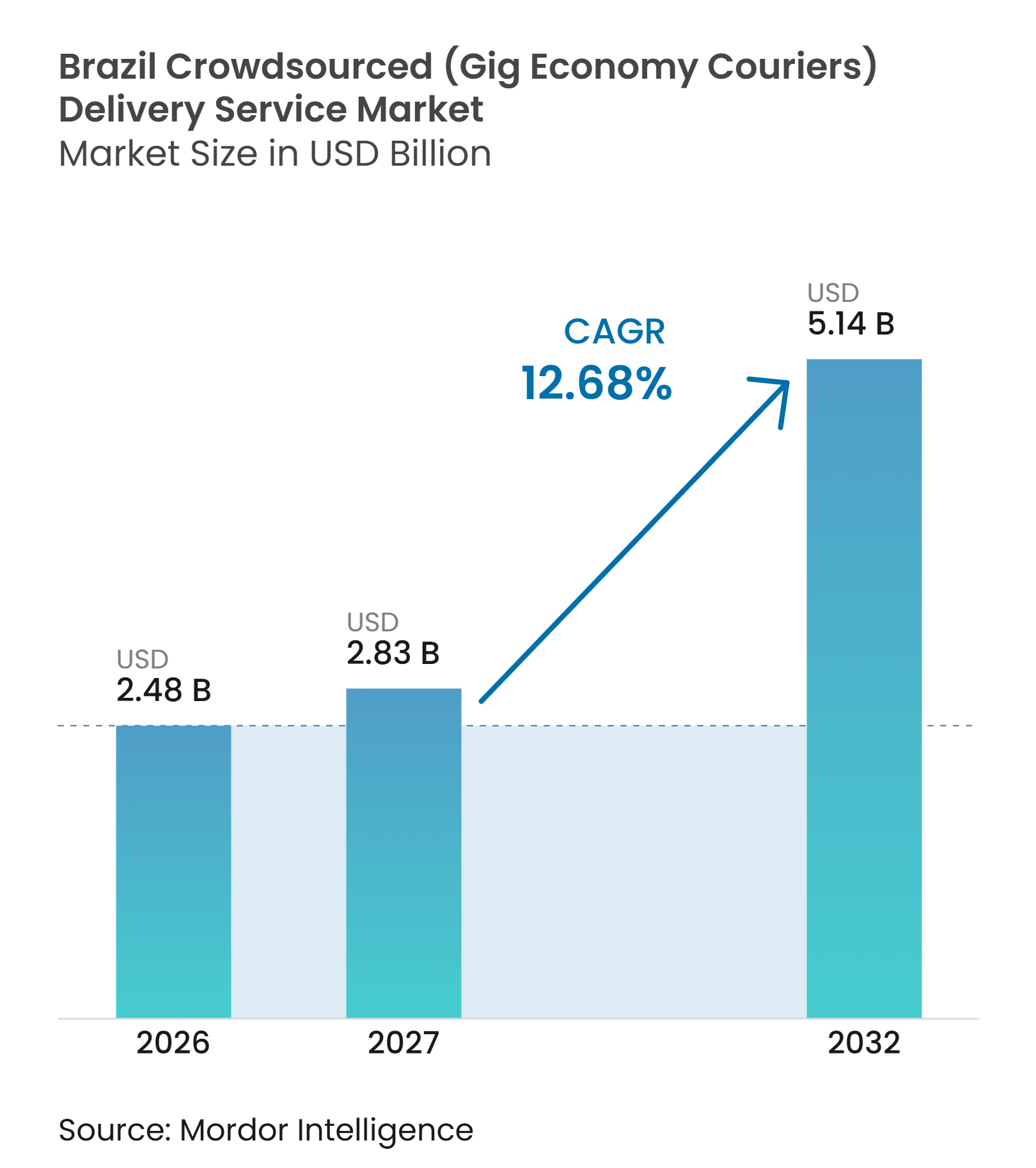
The Brazil crowdsourced (gig economy couriers) delivery service market size is valued at USD 2.48 billion in 2026 and is projected to expand from USD 2.83 billion in 2027 to USD 5.14 billion by 2032, registering a CAGR of 12.68% between 2027 and 2032.
The Brazil crowdsourced (gig economy couriers) delivery service market is supported by a large app-based workforce, with 325,000 delivery couriers recorded in 2025, up from 274,000 in 2024. E-commerce demand, mobile access, and faster fulfillment needs are increasing the volume of local orders that platforms can match with available couriers. Competition is also changing the Brazil crowdsourced delivery service market as Keeta, 99Food, Rappi, iFood, Uber, and other operators broaden courier, restaurant, and logistics networks.[1] The market is moving beyond food orders as platforms connect grocery, pharmacy, parcels, and merchant services through the same consumer applications. Regulatory proposals on courier remuneration and social security could alter cost structures, while payment integration and local delivery density continue to support demand.
Key Report Takeaways
- By delivery type, on-demand and instant delivery held 42.33% of the Brazil crowdsourced (gig economy couriers) delivery service market share in 2026, while same-day delivery is projected to grow at a 14.60% CAGR through 2032.
- By business model, B2C held 64.25% of the Brazil crowdsourced (gig economy couriers) delivery service market share in 2026, while C2C is projected to grow at a 14.56% CAGR through 2032.
- By delivery distance, short-distance and hyperlocal delivery held a 47.13% share of the Brazil crowdsourced (gig economy couriers) delivery service market size in 2026, while extended urban and peri-urban delivery is projected to grow at a 14.47% CAGR through 2032.
- By courier engagement model, independent gig couriers held a 66.32% share of the Brazil crowdsourced (gig economy couriers) delivery service market size in 2026, while part-time contracted drivers are projected to grow at a 13.33% CAGR through 2032.
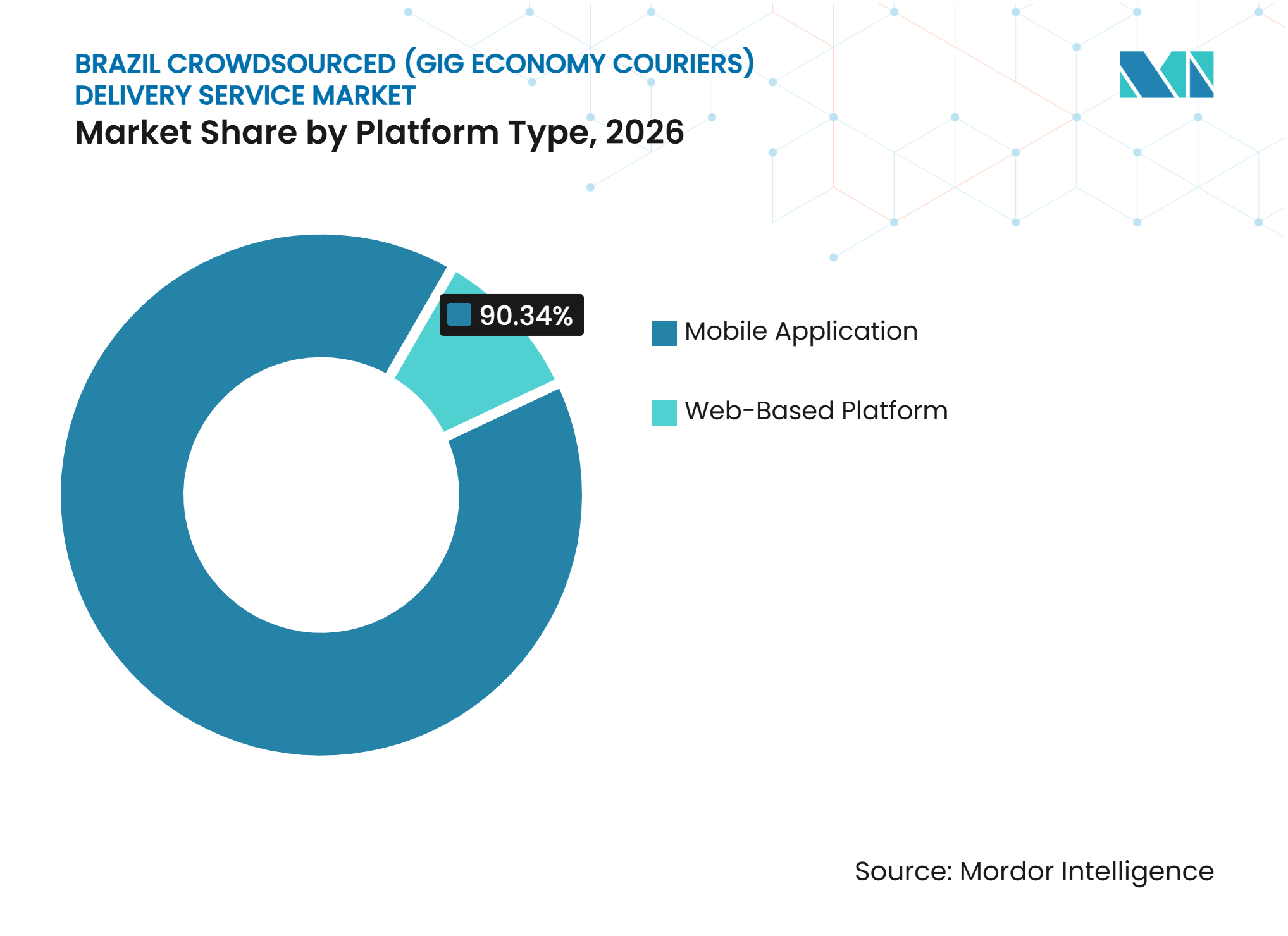
- By platform type, mobile applications held a 90.34% of the Brazil crowdsourced (gig economy couriers) delivery service market share in 2026, while web-based platforms are projected to grow at a 12.90% CAGR through 2032.
- By vehicle type, two-wheelers held 71.28% of the Brazil crowdsourced (gig economy couriers) delivery service market share in 2026, while drones and autonomous vehicles are projected to grow at a 24.24% CAGR through 2032.
- By end user, e-commerce and online retail held 37.97% share of the Brazil crowdsourced (gig economy couriers) delivery service market size in 2026, while quick commerce is projected to grow at a 17.77% CAGR through 2032.
Note: Market numbers in this report are based on Mordor Intelligence's proprietary estimation framework, which combines nine months of actuals with Q4 projections for base year 2026.
Market Trends and Insights
Drivers Impact Analysis of Brazil Crowdsourced (Gig Economy Couriers) Delivery Service Market*
| Driver | (~) % Impact on CAGR Forecast | Geographic Relevance | Impact Timeline |
|---|---|---|---|
| E-Commerce and Instant-Commerce Order Density | +4.0% | Southeast and South, spill-over to Northeast | Short term (≤ 2 years) |
| Expansion of Delivery Demand Beyond Tier-1 Cities | +2.5% | National, with early gains in mid-size interior cities | Medium term (2-4 years) |
| Multi-Platform Courier Earnings Competition | +1.5% | National, concentrated in Sao Paulo, Rio de Janeiro, and Goiania | Short term (≤ 2 years) |
| Restaurant and Retail Digitization Through Aggregators | +2.0% | National, strongest in Southeast and Northeast | Medium term (2-4 years) |
| Flexible Capacity for Peak and Hyperlocal Demand | +1.0% | Urban cores of Southeast and South | Short term (≤ 2 years) |
| Pix-Enabled Payment and Platform-Fintech Integration | +1.5% | National | Short term (≤ 2 years) |
| Source: Mordor Intelligence | |||
E-Commerce and Instant-Commerce Order Density
Brazilian e-commerce revenue attained a major share in 2025, with 94 million consumers making online purchases. This order base supports the Brazil crowdsourced delivery service market because platforms depend on frequent, localized orders to use courier capacity efficiently. Higher order frequency can reduce the distance between dispatches and improve courier earnings during active hours. It also allows platforms to operate more effectively in tighter service areas, particularly for food, grocery, and convenience categories. The same conditions can help local operators in mid-size cities achieve viable order density without a national network.[2] The Brazil crowdsourced (gig economy couriers) delivery service market, therefore, benefits when more online purchases move into shorter delivery windows.
Expansion of Delivery Demand Beyond Tier-1 Cities
Delivery operators are expanding outside Sao Paulo and Rio de Janeiro as competition in major cities increases the value of underserved areas. Keeta stated that its expansion plan covered 15 metropolitan regions by June 2026 and 1,000 cities by December 2026. This wider coverage can increase order volumes in cities where conventional delivery infrastructure is less established. The Brazil crowdsourced (gig economy couriers) delivery service market has room to grow where restaurants, retailers, and consumers can use local courier networks without long dispatch distances. Regional platforms such as Delivery Much, Aiqfome, and UaiRango retain an advantage where local knowledge and lower fees matter to merchants. National entrants can challenge those positions once they have enough restaurants and couriers to provide competitive delivery times.
Restaurant and Retail Digitization Through Aggregators
Restaurant and retail participation gives delivery applications a dependable stream of orders and expands the practical reach of the Brazil crowdsourced (gig economy couriers) delivery service market. 7 in 10 food and beverage establishments use delivery applications as a sales channel, and 78% of those businesses use aggregator platforms. When merchants join an aggregator, the platform can better anticipate demand and position couriers closer to likely pickup points. Shorter dispatch routes can reduce idle time and help operators maintain service levels during busy periods. Rappi expanded restaurant acquisition through its Brazil investment program, showing how merchant supply remained central to platform strategies.[3] Retail digitization also widens the range of items that courier networks can deliver, including groceries, pharmacy products, and convenience purchases.
Pix-Enabled Payment and Platform-Fintech Integration
Pix gives consumers and couriers a national real-time payment system that supports transactions on delivery applications. The Central Bank of Brazil operates Pix as an instant payment arrangement available through participating financial institutions. In the Brazil crowdsourced (gig economy couriers) delivery service market, simpler digital checkout can support order completion across income groups that use mobile payments. Fast transfers can also help platforms pay couriers promptly, which matters when workers use more than 1 application. Payment systems can also support credit, insurance, and benefits offered through platform ecosystems. These services can strengthen courier retention without changing the basic flexibility of app-based work.
Restraints Impact Analysis of Brazil Crowdsourced (Gig Economy Couriers) Delivery Service Market*
| Restraint | (~) % Impact on CAGR Forecast | Geographic Relevance | Impact Timeline |
|---|---|---|---|
| Courier Informality and Social-Security Gaps | -2.0% | National, acute in Northeast and North | Long term (≥ 4 years) |
| Motorcycle Safety, Insurance, and Accident Exposure | -1.5% | National, concentrated in Sao Paulo and Rio de Janeiro metro areas | Medium term (2-4 years) |
| Algorithmic Pay Volatility and Multi-App Churn | -1.0% | National | Short term (≤ 2 years) |
| Traffic, Fuel, and Low-Density Route Economics | -0.8% | National, most acute in Southeast metro areas | Medium term (2-4 years) |
| Source: Mordor Intelligence | |||
Courier Informality and Social-Security Gaps
Only 34.0% of platform delivery workers contributed to social security in 2025, compared with 63.0% of workers outside platform environments. This gap creates a regulatory concern for the Brazil crowdsourced (gig economy couriers) delivery service market because courier protections are under discussion in Congress. PLP 152/25 addresses remuneration and social security conditions for app-based delivery workers. Higher compliance costs could place greater pressure on regional operators that lack the scale of larger platforms. Formal work requirements could also reduce the ease with which platforms add courier capacity during periods of high demand. The effect would be most significant for networks that depend heavily on independent couriers.
Motorcycle Safety, Insurance, and Accident Exposure
Motorcycle safety remains an operational concern because two-wheelers are central to urban delivery in Brazil. Occupational accident notifications involving motorcycle riders totaled 25,476 between January 2020 and September 2025, according to a study. The Brazil crowdsourced delivery service market may face higher insurance and liability costs if legal standards for accidents during active delivery change. Safety concerns also affect the ability of platforms to retain couriers, especially in dense metropolitan traffic.[4] Operators can respond through insurance, safety training, and delivery policies that avoid unsafe incentives. The issue carries both cost and reputational implications for platforms with large two-wheeler fleets.
*Our forecasts treat driver/restraint impacts as directional, not additive. The impact forecasts reflect baseline growth, mix effects, and variable interactions.
Brazil Crowdsourced (Gig Economy Couriers) Delivery Service Market Segment Analysis
By Delivery Type:
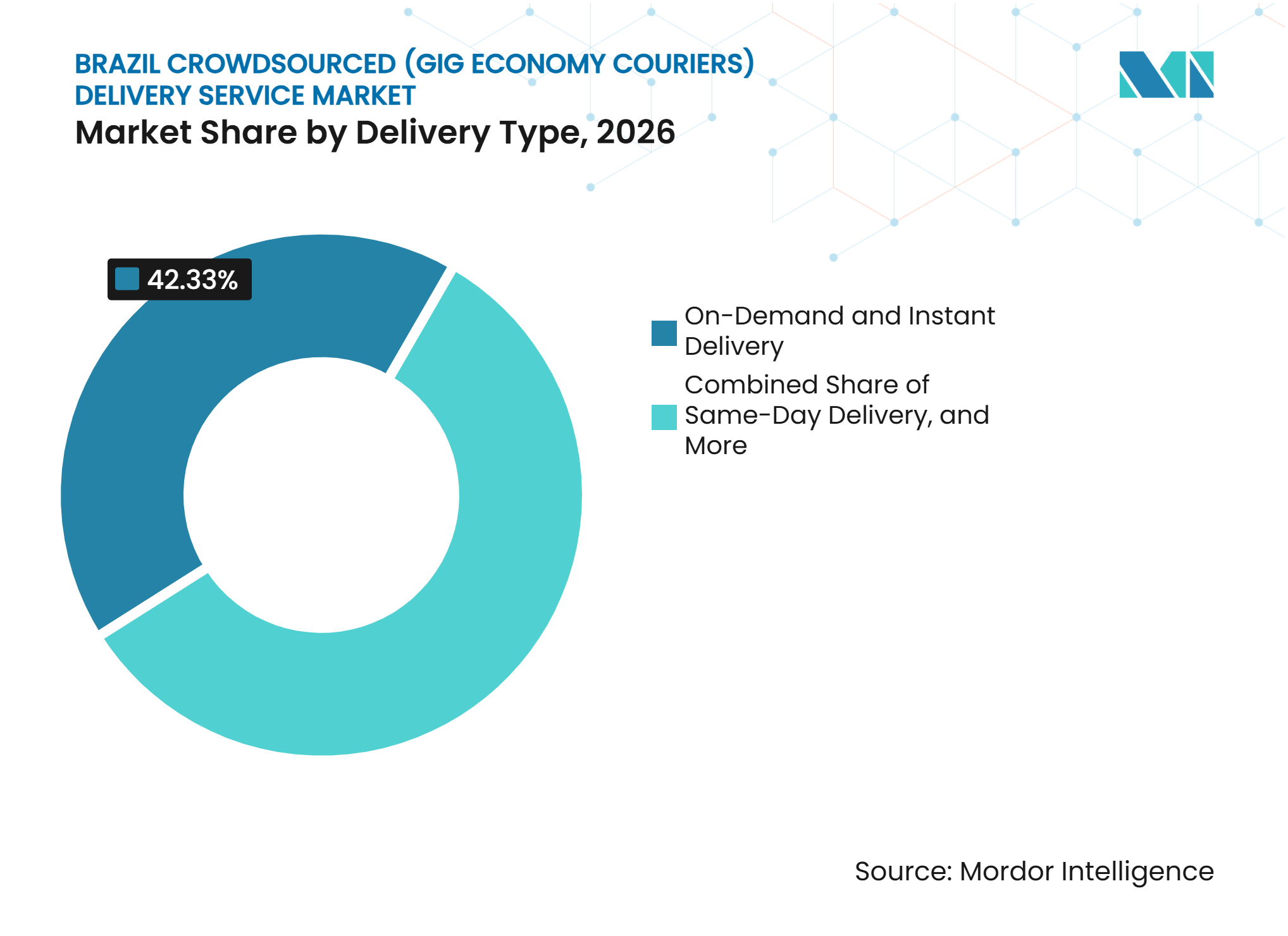
On-Demand Volume Leads Market StructureOn-demand and instant delivery accounted for 42.33% of the Brazil crowdsourced (gig economy couriers) delivery service market size in 2026. Consumer demand for delivery within 60 minutes supports this position across restaurant, grocery, and convenience orders. Rappi Turbo expanded its product range from 900 to nearly 4,000 products during the first quarter of 2025, showing how quick fulfillment was moving beyond prepared meals. The service model uses small fulfillment sites close to high-demand residential areas. These sites shorten travel time and increase the number of orders that a courier can complete during a shift.
Same-day delivery is projected to grow at a 14.60% CAGR between 2027 and 2032. Growth is linked to more fulfillment hubs in urban neighborhoods and a broader range of retail goods available for delivery. CADE cleared iFood’s acquisition of Shopper in February 2025, allowing iFood to combine grocery delivery capabilities with its larger application ecosystem. Next-day and express delivery continue to serve merchants with longer fulfillment windows. Scheduled delivery remains relevant for document, business, and specialized transport needs. Healthcare specimen and cold-chain pharmaceutical deliveries are part of other delivery types that require more specialized handling.



By Business Model:
C2C Segment Gains Ground on B2BB2C held 64.25% of the Brazil crowdsourced (gig economy couriers) delivery service market share in 2026. Marketplace activity and platform-operated last-mile networks provide the main source of B2C order volume. The model connects restaurants and retailers with consumers through the same applications used to request delivery. Its scale allows platforms to combine multiple nearby orders and use available couriers more efficiently. This supports routine food, grocery, pharmacy, and convenience deliveries.
C2C is projected to grow at a 14.56% CAGR between 2027 and 2032. Peer-to-peer resale and social commerce create frequent, smaller-value shipments that can fill courier capacity outside peak food-order periods. B2B remains important for document couriers, pharmaceutical samples, retail replenishment, and merchant logistics. Lalamove reported more than 1 million deliveries per month and 15% year-over-year growth in active corporate client volumes between 2024 and the first half of 2025. The distinction between B2B and B2C utilization is becoming blurred as merchant orders are placed through logistics interfaces but delivered to consumers. Platforms that serve both uses from the same network can improve courier utilization.
By Delivery Distance:
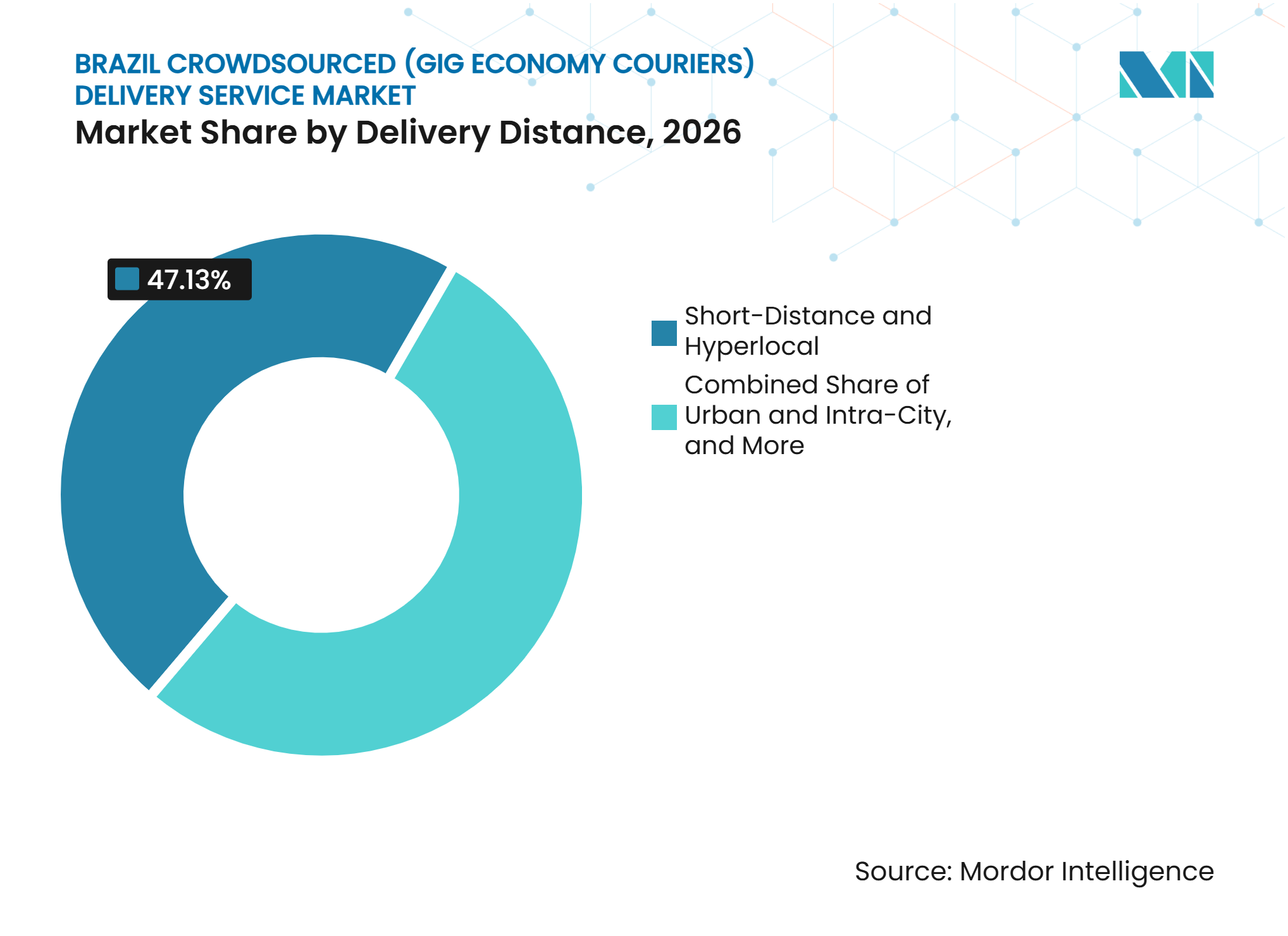
Hyperlocal Routes Anchor Service DensityShort-distance and hyperlocal delivery held 47.13% of the Brazil crowdsourced (gig economy couriers) delivery service market size in 2026. Trips under 3 kilometers suit the operating model of motorcycle and bicycle couriers in congested urban areas. Dark stores and micro-hubs reduce the distance from inventory to consumers. This supports delivery windows of 15 to 30 minutes in high-demand neighborhoods. Ze Delivery expanded its 15-minute Modo Turbo service nationwide in September 2025, reaching all Brazilian states.
Extended urban and peri-urban delivery is projected to grow at a 14.47% CAGR between 2027 and 2032. The category is expanding into suburban rings and satellite cities where conventional logistics coverage is thinner. Loggi expanded its LoggiPonto pickup network by 130% across 13 states and the Federal District in 2025. Peri-urban areas remain less served than central districts by major platforms. This creates an opportunity for hub-and-spoke networks and local merchant partnerships. Longer routes can still limit unit economics where order density remains low.

By Courier Engagement Model:
Part-Time Contractors Draw Fastest GrowthIndependent gig couriers held 66.32% of the Brazil crowdsourced (gig economy couriers) delivery service market size in 2026. Flexible courier pools allow platforms to match available labor with order volume without a fixed workforce. Research reported that 38.8% of platform delivery workers in 2025 used only 1 platform. Earnings programs, payment speed, and benefits can influence whether couriers concentrate their activity on a single application. Full-time partnered drivers remain useful for B2B accounts that require planned coverage and service-level agreements.
Part-time contracted drivers are projected to grow at a 13.33% CAGR between 2027 and 2032. The category reflects the search for a structure that can offer limited benefits while retaining operational flexibility. Brazil’s congressional debate on app-based work includes minimum pay and social security issues for delivery workers. The proposed framework also addresses service fees and per-delivery remuneration. These policy conditions can affect how platforms divide work between independent and contracted couriers. Compliance costs and workforce availability may shape the longer-term mix.
By Platform Type:
Mobile Channels Drive Order AccessibilityMobile applications held 90.34% of the Brazil crowdsourced (gig economy couriers) delivery service market share in 2026. Smartphones function as both the primary internet access point and the principal ordering channel for many consumers. Uber and iFood announced a strategic partnership in May 2025 that allowed users to access each company’s services through the other’s application. The arrangement connects ride-hailing with food, grocery, pharmacy, and convenience delivery. Keeta also reported rapid onboarding of restaurants and couriers after launching in Brazil.
Web-based platforms are projected to grow at a 12.90% CAGR between 2027 and 2032. Merchant logistics products are often used through browser dashboards that link to order management systems. These tools support retailers that need to route orders to courier networks at scale. Shippify represents an open-logistics layer that links large-volume buyers with delivery providers. Web interfaces can support multi-carrier access without requiring every merchant to operate a separate consumer application. This function is most relevant for B2B logistics and larger retail customers.
By Vehicle Type:
Drones Expand into Commercial OperationsTwo-wheelers held 71.28% of the Brazil crowdsourced (gig economy couriers) delivery service market share in 2026. Motorcycles and bicycles can navigate traffic and serve dense urban areas at a lower cost than larger vehicles. App-using motorcycle couriers earned an average of USD 404, or approximately BRL 2,221, per month from 44.9 hours of work each week in 2025. Four-wheelers and vans remain necessary for heavier, high-value, and business deliveries. They are particularly relevant for pharmaceuticals, replenishment, and cargo that cannot be handled safely on 2 wheels.
Drones and autonomous vehicles are projected to grow at a 24.24% CAGR between 2027 and 2032. ANAC published the RBAC 100 framework in June 2026, replacing a weight-based classification approach with a risk-based approach for drone operations. The regulatory direction supports commercial delivery operations that meet operational requirements. ANAC granted Speedbird Aero authorization for scalable beyond-visual-line-of-sight delivery flights in March 2026, supporting the expansion of iFood’s drone program. Drone delivery can be valuable where road congestion or geographic conditions extend travel times. Wider deployment may depend on certification, route safety, and commercial operating economics.
By End User:
Quick Commerce Outpaces Legacy Delivery SegmentsE-commerce and online retail held 37.97% of the Brazil crowdsourced (gig economy couriers) delivery service market share in 2026. Large online retailers are improving fulfillment speed through warehouses, sorting capacity, aircraft, and last-mile networks. Amazon Brazil delivered more than 50 million items to Prime members on same-day or next-day schedules in 2025 and invested USD 3.45 billion in Brazil that year. E-commerce volume supports regular demand for short-distance and citywide delivery services. It also raises customer expectations for parcel visibility and fast delivery.
Quick commerce is projected to grow at a 17.77% CAGR between 2027 and 2032. Grocery, pharmacy, beverage, and convenience orders are well suited to sub-30-minute fulfillment. iFood’s drone delivery program in Aracaju achieved delivery times of 30 minutes compared with 60 minutes by road. Foodservice and restaurant delivery remains a large use case across the Brazil crowdsourced (gig economy couriers) delivery service market. Healthcare and pharmaceutical delivery require additional attention to cold-chain handling and controlled products. Platforms are responding with services tailored to the requirements of each vertical.
Geography Analysis
The Southeast part of Brazil holds the highest share of order volume, courier supply, and platform investment in the Brazil crowdsourced delivery service market in 2026. Sao Paulo, Rio de Janeiro, and Minas Gerais offer the highest concentration of dense urban demand. Sao Paulo contains 38% of Brazil’s dark stores, while Mercado Livre’s logistics network delivers 75% of parcels within 48 hours in Brazilian state capitals and sets a demanding service benchmark in the region. High traffic density also creates significant safety and insurance exposure for courier platforms.
The Northeast is the key expansion area for the Brazil crowdsourced (gig economy couriers) delivery service market, led by Fortaleza, Recife, Salvador, and Aracaju. iFood resumed and expanded drone delivery in Aracaju in October 2025 after receiving permanent authorization for civilian beyond-visual-line-of-sight flights over pedestrian areas. The program can complete 280 deliveries per day with delivery times of 30 minutes, compared with 60 minutes by road. Amazon and LATAM Cargo also signed an agreement in March 2025 to reduce delivery times to 2 days or fewer across 11 states in the North, Northeast, and Center-West.
The South is a mature secondary area with stronger logistics infrastructure and a larger role for scheduled and B2B delivery. Uber and Loggi used Curitiba as 1 of 2 pilot cities for Envio Nacional in June 2025 before widening the service to 9 cities by October 2025. The North and Center-West are less developed for gig delivery but are gaining logistics investment. Amazon opened its first proprietary delivery station in Manaus in September 2025 and shortened lead times from up to 18 days to 5 days in cities along the Amazon River system. Smartphone access, road infrastructure, and courier availability may determine the pace of development in these regions.
Competitive Landscape
Market Concentration
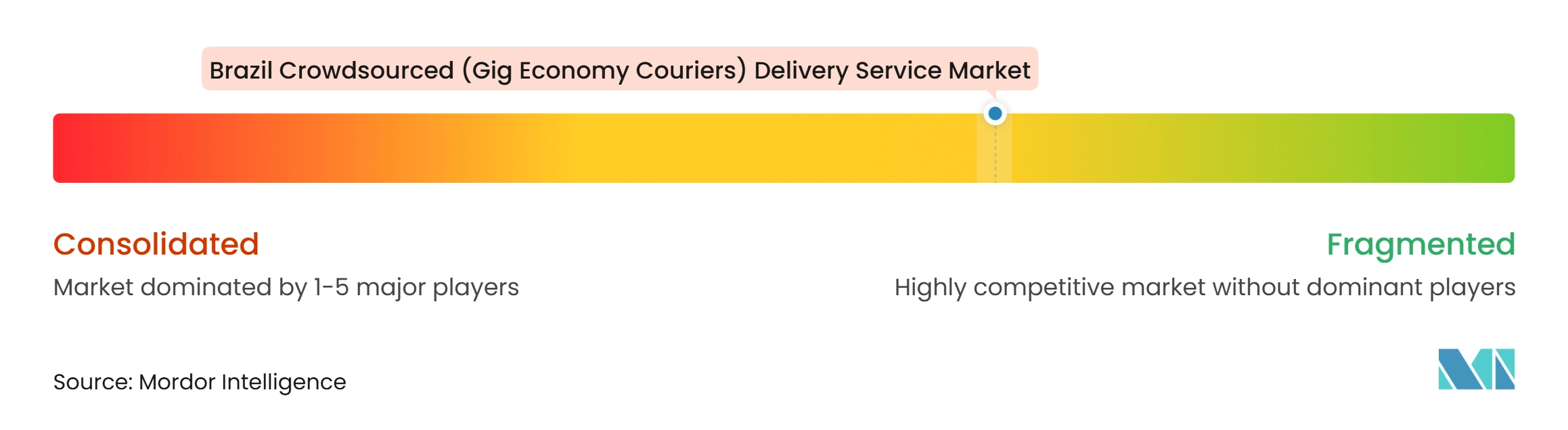
The Brazil crowdsourced (gig economy couriers) delivery service market combines concentration in food and grocery delivery with a more fragmented parcel logistics layer. iFood is a leading platform in restaurant and grocery delivery, while Loggi, Rappi, Lalamove, Shippify, Mercado Envios, and Amazon Logistics Brasil compete across parcel and merchant logistics. Keeta entered Brazil with a plan covering delivery network construction, technology deployment, and courier welfare infrastructure. The company launched without restaurant exclusivity arrangements and used a guaranteed on-time delivery policy. 99Food expanded its Brazilian operations and partnered with Yadea to support access to electric motorcycles for delivery partners.
Competition in the Brazil crowdsourced (gig economy couriers) delivery service market increasingly relies on connected consumer and merchant services. The Uber-iFood partnership links ride-hailing and delivery access across 2 high-use applications. iFood’s acquisition of Shopper added grocery delivery capabilities to its broader platform after CADE clearance. Uber and Loggi expanded Envio Nacional to 9 cities, combining last-mile and intercity parcel capabilities. These moves show how platforms are extending beyond one type of order or one delivery radius.
The Brazil crowdsourced (gig economy couriers) delivery service market still has gaps in peri-urban delivery, C2C logistics, and drone-enabled last-mile services. Aiqfome, Delivery Much, and UaiRango compete through local knowledge and lower fees in cities where national platforms have not built sufficient courier density. The market provides a framework for drone operations and can favor organizations that have advanced in airspace authorization and operating certification. Legal disputes over competitive conduct and worker conditions can add regulatory costs, so competitive strength may depend on reliable service, broad merchant supply, available couriers, and the ability to connect payments, logistics, and consumer demand.
Brazil Crowdsourced (Gig Economy Couriers) Delivery Service Industry Leaders
-
iFood
-
Keeta
-
Loggi
-
Rappi
-
99Food
- *Disclaimer: Major Players sorted in no particular order
Brazil Crowdsourced (Gig Economy Couriers) Delivery Service Market Companies Covered in this Report
- iFood
- Rappi
- 99Food
- Keeta, Meituan
- Aiqfome
- Quero Delivery
- Delivery Much
- UaiRango
- Pede.ai
- Lalamove
- Loggi
- Eu Entrego
- Shippify
- Mercado Livre, Mercado Envios
- Amazon, Amazon Logistics Brasil
- Uber
- Plus Delivery
- Pedidos10
- Rapiddo
- Ze Delivery
Recent Industry Developments in Brazil Crowdsourced (Gig Economy Couriers) Delivery Service Market
- October 2026: iFood acquired Pick n Go, a logistics startup managing over 1.5 million monthly deliveries for more than 4,000 restaurant clients, integrating the startup's fleet-management technology into iFood's new "Entrega Dedicada" dedicated-courier product. Initial rollout covers 35 cities and expands to 55 within 30 days. Pilot data showed average delivery times reduced by 3 minutes and order cancellations down 47%.
- September 2026: Correios signed a memorandum of understanding with AliExpress (Alibaba Group) in Hangzhou, China, during a Brazilian government trade mission led by the Communications Minister, formalizing expanded cooperation in logistics innovation, parcel tracking digitalization, and end-to-end delivery efficiency across Brazil.
- May 2026: iFood acquired a minority stake (under 5%) in Daki, Brazil's leading online grocery platform that had reached financial breakeven, consolidating a commercial partnership established in 2024 and expanding iFood's Q-commerce ecosystem beyond its core food delivery business.
- April 2026: Amazon signed a 10-year built-to-suit lease agreement with logistics investment fund CPLG11 (Capitania Logistica) for a 60,700 m² distribution center in Sao Jose dos Pinhais, Parana, designed to serve Amazon's last-mile delivery expansion in the South region.
Brazil Crowdsourced (Gig Economy Couriers) Delivery Service Market Report Scope
Segmentation Overview
| On-Demand and Instant Delivery |
| Same-Day Delivery |
| Next-Day and Express Delivery |
| Scheduled Delivery |
| Other Delivery Types |
| Business-to-Business (B2B) |
| Business-to-Consumer (B2C) |
| Consumer-to-Consumer (C2C) |
| Short-Distance and Hyperlocal |
| Urban and Intra-City |
| Extended Urban and Peri-Urban |
| Independent Gig Couriers |
| Part-Time Contracted Drivers |
| Full-Time Partnered Drivers |
| Mobile Application |
| Web-Based Platform |
| Two-Wheelers |
| Four-Wheelers |
| Vans and Light Commercial Vehicles |
| Drones and Autonomous Vehicles |
| Other Vehicle Types |
| E-Commerce and Online Retail |
| Quick Commerce (Q-Commerce) |
| Foodservice and Restaurant |
| Grocery and Traditional Retail |
| Healthcare and Pharmaceuticals |
| Business, Document and Professional Courier Services |
| Other Commercial and Specialized Deliveries |
| By Delivery Type | On-Demand and Instant Delivery |
| Same-Day Delivery | |
| Next-Day and Express Delivery | |
| Scheduled Delivery | |
| Other Delivery Types | |
| By Business Model | Business-to-Business (B2B) |
| Business-to-Consumer (B2C) | |
| Consumer-to-Consumer (C2C) | |
| By Delivery Distance | Short-Distance and Hyperlocal |
| Urban and Intra-City | |
| Extended Urban and Peri-Urban | |
| By Courier Engagement Model | Independent Gig Couriers |
| Part-Time Contracted Drivers | |
| Full-Time Partnered Drivers | |
| By Platform Type | Mobile Application |
| Web-Based Platform | |
| By Vehicle Type | Two-Wheelers |
| Four-Wheelers | |
| Vans and Light Commercial Vehicles | |
| Drones and Autonomous Vehicles | |
| Other Vehicle Types | |
| By End User | E-Commerce and Online Retail |
| Quick Commerce (Q-Commerce) | |
| Foodservice and Restaurant | |
| Grocery and Traditional Retail | |
| Healthcare and Pharmaceuticals | |
| Business, Document and Professional Courier Services | |
| Other Commercial and Specialized Deliveries |
Key Questions Answered in the Report
What is the Brazil crowdsourced (gig economy couriers) delivery service market?
The value is USD 2.48 billion in 2026 and is projected to reach USD 5.14 billion by 2032 at a 12.68% CAGR.
Which delivery type has the largest share in Brazil?
On-demand and instant delivery leads with 42.33% share in 2026, supported by food, grocery, and convenience orders.
Which business model is growing fastest in Brazil crowdsourced delivery?
C2C is the fastest-growing business model, with a projected CAGR of 14.56% between 2027 and 2032.
Why are mobile applications important for delivery services in Brazil?
Mobile applications hold 90.34% share in 2026 and bring ordering, payment, delivery tracking, and courier access together in 1 channel.
What vehicle type is growing fastest for last-mile delivery in Brazil?
Drones and autonomous vehicles are projected to grow at a 24.24% CAGR through 2032, supported by ANAC’s risk-based drone operating framework.
What are the main risks for app-based courier delivery in Brazil?
Social security rules, courier safety, insurance exposure, traffic, fuel costs, and variable courier pay can affect operating costs and worker availability.