
Brand Identity Services Market Size and Share
Market Overview
| Study Period | 2020 - 2031 |
|---|---|
| Market Size (2026) | USD 1.36 Billion |
| Market Size (2031) | USD 1.81 Billion |
| Growth Rate (2026 - 2031) | 5.88 % |
| Fastest Growing Market | Asia-Pacific |
| Largest Market | North America |
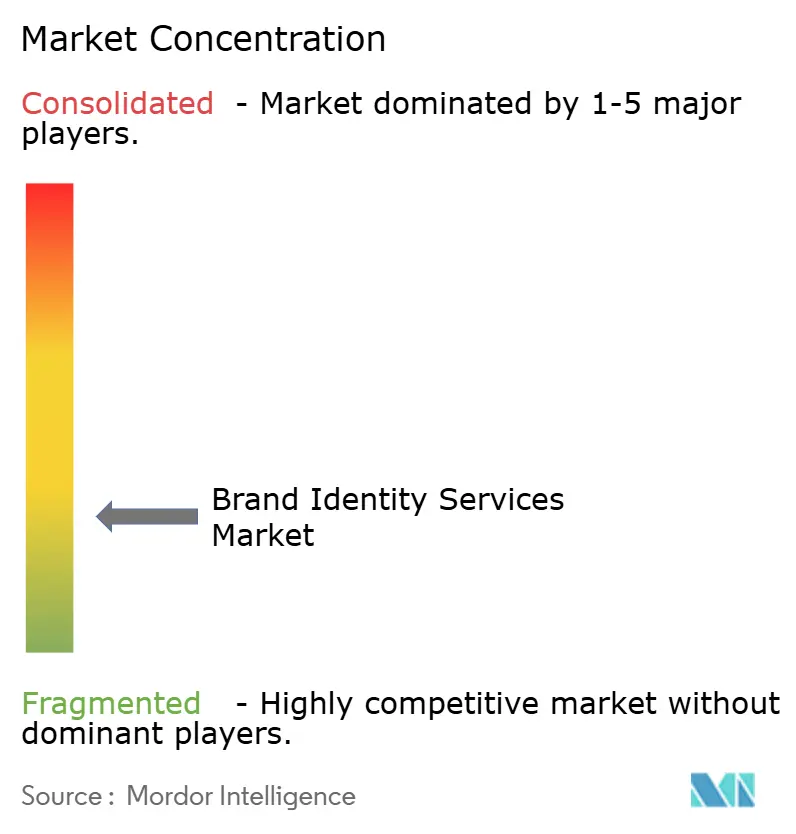
| Market Concentration | Low |
Major Players *Disclaimer: Major Players sorted in no particular order Image © Mordor Intelligence. Reuse requires attribution under CC BY 4.0. | |
Brand Identity Services Market Analysis by Mordor Intelligence
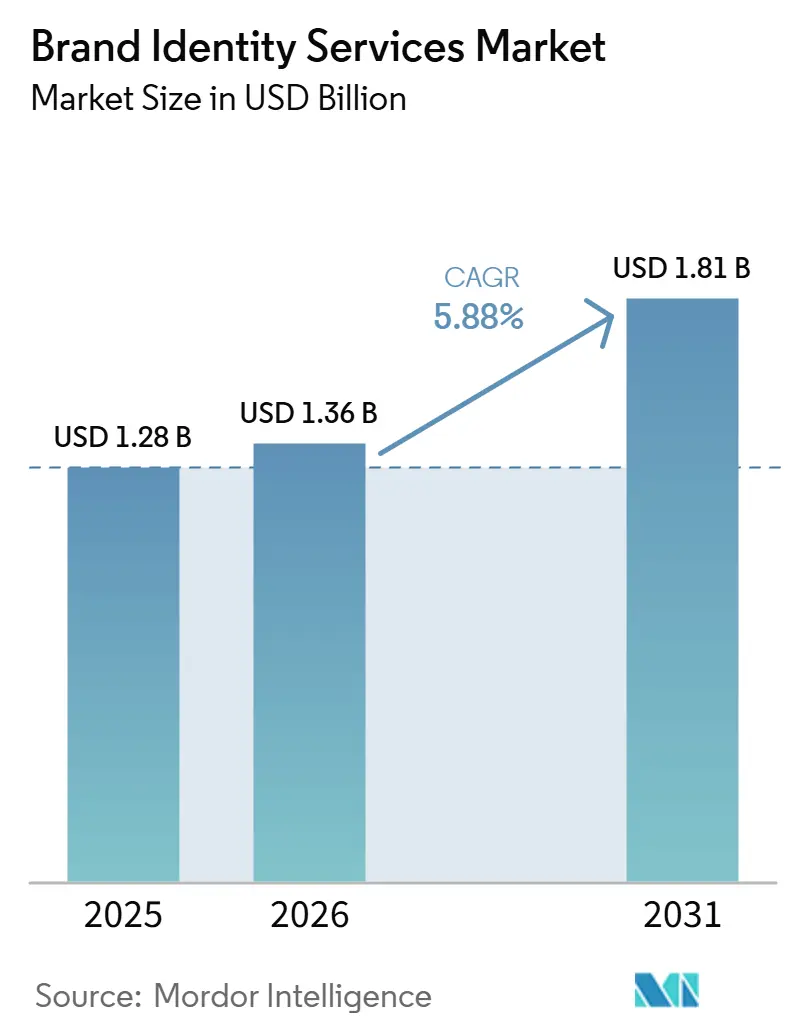
The Brand Identity Services Market size is expected to increase from USD 1.28 billion in 2025 to USD 1.36 billion in 2026 and reach USD 1.81 billion by 2031, growing at a CAGR of 5.88% over 2026-2031. The Brand Identity Services Market is supported by companies that now treat identity as an operating system for digital, physical, and AI-enabled customer interactions rather than a one-time design task. Consistency across mobile apps, social video, retail environments, connected television, and automated content production is expanding the scope of client briefs. M&A activity and portfolio simplification are also creating longer assignments that combine naming, architecture, asset migration, and internal adoption. Providers are responding by combining strategic advice with implementation capabilities and AI-ready identity rules. Opportunities are strongest where agencies can link brand work to measurable business outcomes while protecting specialist value from lower-cost template tools.
Key Report Takeaways
- By offering, brand implementation and rollout held 30.32% of 2025 revenue in the Brand Identity Services Market, while brand strategy and positioning are projected to expand at a CAGR of 6.44% through 2031.
- By organization size, large enterprises accounted for 48.52% of 2025 revenue in the Brand Identity Services Market, while small and medium-sized enterprises are expected to grow at a CAGR of 7.01% through 2031.
- By end-use industry, media and entertainment held 22.24% of 2025 revenue in the Brand Identity Services Market, while fashion and luxury is projected to advance at a CAGR of 8.42% through 2031.
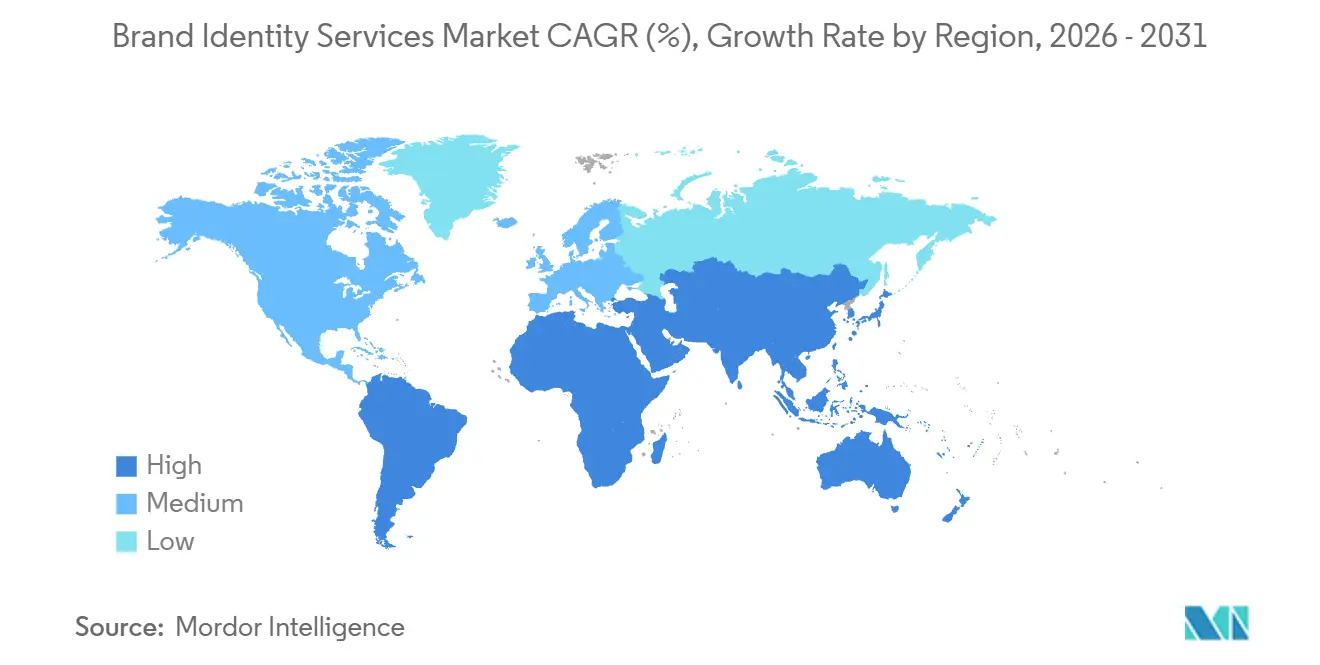
- By geography, North America accounted for 39.41% of 2025 revenue in the Brand Identity Services Market, while Asia-Pacific is forecast to grow at a CAGR of 7.51% through 2031.
Note: Market size and forecast figures in this report are generated using Mordor Intelligence’s proprietary estimation framework, updated with the latest available data and insights as of January 2026.
Market Trends and Insights
Drivers Impact Analysis of Brand Identity Services Market*
| Driver | (~) % Impact on CAGR Forecast | Geographic Relevance | Impact Timeline |
|---|---|---|---|
| Omnichannel Brand Consistency | +1.4% | Global | Medium term (2-4 years) |
| M&A and Portfolio Simplification Rebranding | +1.2% | North America and Europe | Medium term (2-4 years) |
| Always-On Content Production Systems | +0.9% | Global | Short term (≤ 2 years) |
| Measurable Identity ROI in Crowded Categories | +0.7% | North America and Europe | Medium term (2-4 years) |
| Machine-Readable Rules for AI Workflows | +0.6% | North America and Asia-Pacific | Long term (≥ 4 years) |
| AI Search Visibility and Verbal Identity | +0.4% | Global | Short term (≤ 2 years) |
| Source: Mordor Intelligence | |||
Omnichannel Brand Consistency Becomes Mission-Critical
The Brand Identity Services Market is benefiting as businesses need one recognizable system across mobile apps, social video, retail shelves, connected television, and AI-generated content. Consistency has become an operational need because customers may encounter the same company through several channels in a short period. In July 2026, The Coca-Cola Company launched a unified visual identity across more than 200 markets using the dynamic ribbon, Arden Square, and Spencerian script. The rollout showed how established companies are updating core assets so they work consistently across packaging, equipment, retail spaces, and digital experiences.[1]The Coca-Cola Company, “One Iconic Brand, One Iconic Look: Coca-Cola Sharpens Its Identity Under One Bold Visual System,” The Coca-Cola Company, coca-colacompany.com Adobe introduced Brand Intelligence in April 2026 to provide an AI-accessible identity layer within marketing workflows, indicating that identity deliverables are moving beyond static rules. This change increases the value of systems that can guide people and automated tools without losing visual or verbal consistency.[2]Adobe, “Adobe Introduces Brand Intelligence and Expands GenStudio Content Supply Chain Solution for Customer Experience Orchestration,” Adobe News, adobe.com
Rebranding Demand From M&A and Portfolio Simplification
M&A activity creates demand in the Brand Identity Services Market because a merged business needs a clear structure for employees, customers, investors, and partners. These assignments commonly include naming, portfolio architecture, visual and verbal systems, digital asset migration, and trademark clearance. The work can continue for 6 to 24 months when a company has multiple businesses, operates in multiple countries, or maintains legacy asset libraries. Interbrand described identity symbols as anchors that can help maintain customer and employee confidence during ownership changes. In July 2026, Interbrand Brasil completed the Arbex identity for the Suzano-Kimberly-Clark joint venture, covering 9,000 employees, 22 manufacturing sites, and operations in more than 70 markets. Spin-offs and carve-outs face a similar challenge because a new entity without a distinct identity can remain defined by the former parent company's legacy category.
Brand Systems Needed for Always-On Content Production
The Brand Identity Services Market is being shaped by the increasing volume of localized, personalized, and continuously published content. Marketing teams need usable rules and adaptable assets because manual production cannot keep pace with enterprise publishing schedules. The Coca-Cola Company partnered with Adobe to introduce Project Fizzion, which converts brand guidelines into adaptive assets for creative teams. The company stated that the system can help teams produce content up to 10 times faster while retaining brand integrity. Stability AI Solutions, launched in August 2025, offers enterprise partnerships that fine-tune generative models using proprietary brand assets for on-brand content production.[3]Stability AI, “The Brands Leading AI Adoption Don't Just Prompt for On-Brand Creative,” Stability AI, stability.ai Clients, therefore, need identity systems that work within content pipelines rather than only a logo, color palette, and print-ready guidelines.
Demand for Measurable Identity ROI in Crowded Categories
The Brand Identity Services Market faces greater scrutiny from executives seeking clearer links between identity work and business performance. Clients increasingly ask providers to explain how a project may support pricing power, sales win rates, branded search, direct traffic, and customer retention. Brand equity gains often emerge 12 to 36 months after launch, which does not align easily with short reporting cycles. Interbrand and Clootrack launched an AI-native brand experience operating system in July 2026 that continuously links customer experience data to brand strength measures. Providers that establish a baseline before launch can help clients monitor changes in branded search, direct traffic, and sales win rates after rollout. This approach can extend a project into an advisory relationship by reducing uncertainty around the contribution of identity investment.
Restraints Impact Analysis of Brand Identity Services Market*
| Restraint | (~) % Impact on CAGR Forecast | Geographic Relevance | Impact Timeline |
|---|---|---|---|
| AI and Template-Led Commoditization | -0.7% | Global | Short term (≤ 2 years) |
| Budget Scrutiny and Short-Term ROI | -0.5% | North America and Europe | Medium term (2-4 years) |
| Rights Clearance Risk in AI Assets | -0.3% | North America and Asia-Pacific | Medium term (2-4 years) |
| Rollout Debt in Legacy Asset Libraries | -0.2% | North America and Europe | Long term (≥ 4 years) |
| Source: Mordor Intelligence | |||
AI and Template-Led Commoditization at the Low End
AI tools and template-led platforms are putting pressure on the lower end of the Brand Identity Services Market. These products can generate logo concepts quickly and offer turnkey identity packages below USD 5,000. In China's graphic trademark design market, AI-assisted design tool penetration reached 78.6% in 2025, reducing delivery times from weeks to days. The effect is strongest in visual-only work such as logo systems, color palettes, and standard guidelines, where clients can obtain acceptable outputs at lower cost. Generalist studios face more direct price competition when their services do not extend beyond these basic deliverables. Strategic advice, cultural interpretation, rights oversight, AI governance, and complex portfolio systems remain areas where specialist providers can preserve value.
Budget Scrutiny and Hard-to-Prove Short-Term ROI
Client procurement cycles for the Brand Identity Services Market have lengthened as finance teams request structured return-on-investment frameworks before approving work. The issue is more pronounced when marketing budgets are under pressure and leaders expect near-term evidence of value. Awareness, perceived quality, customer associations, and loyalty can take 12 to 24 months to develop after a launch. This timing makes it difficult to isolate the revenue effect of identity work from pricing, promotion, and other commercial activity. Consumer goods, financial services, and retail businesses face particular scrutiny because their products can appear similar to customers. Providers who agree on business measures before beginning a project can address this concern more directly and improve the quality of competitive pitches.
Segment Analysis
*Our forecasts treat driver/restraint impacts as directional, not additive. The impact forecasts reflect baseline growth, mix effects, and variable interactions.
Brand Identity Services Market Segment Analysis
By Offering:
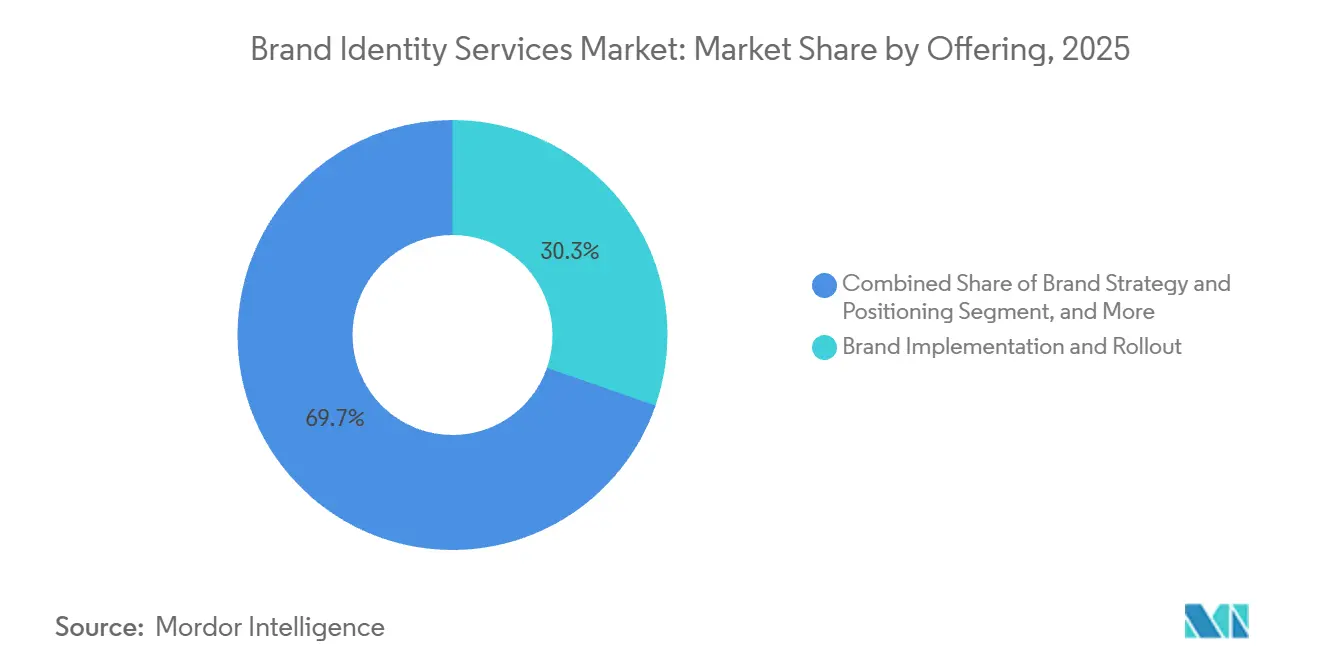
Implementation Scale Anchors Revenue as Strategy AcceleratesBrand implementation and rollout accounted for 30.32% of the Brand Identity Services Market share in 2025, making it the largest segment. This work activates an identity across global operations and often includes trademark registration, digital asset migration, packaging updates, signage replacement, and internal training. Large organizations must manage legacy files and many local applications, which can extend delivery schedules. The segment benefits from defined deliverables and repeatable production processes. These features can make rollout work less exposed to creative uncertainty than upstream strategic assignments.
Brand strategy and positioning are projected to record the highest CAGR of 6.44% in the Brand Identity Services Market size from 2026 to 2031. Organizations are increasingly seeking a positioning brief before commissioning visual work because design without strategic direction may appear polished but fail to support commercial goals. In March 2026, FutureBrand developed the name, portfolio architecture, verbal and visual identity, and motion principles for Hexagon's planned Octave software spin-off in less than 1 year. The assignment reflected the importance technology clients place on an integrated approach. Providers that lead both strategy and design can capture a larger portion of higher-value projects.[4]FutureBrand, “FutureBrand Leads End-to-End Strategy, Naming and Identity for Octave,” FutureBrand, futurebrand.com



By Organization Size:
Enterprise Demand Persists as SMEs ExpandLarge enterprises accounted for 48.52% of revenue in 2025. A full rebrand across several divisions, countries, and trademark portfolios can routinely cost more than USD 500,000. These assignments often involve multi-year rollouts, which support recurring implementation revenue. Enterprise clients also require AI-compatible systems, sonic identity, brand experience architecture, and multi-language verbal governance. These needs favor providers that can deliver strategy, design, and implementation through one coordinated team.
Small and medium-sized enterprises are expected to grow at a CAGR of 7.01% within the Brand Identity Services Market from 2026 to 2031. Digital commerce has lowered the cost of entering new categories while increasing the need for credible brand presentation. Founders increasingly view identity investment as necessary for direct-to-consumer entry and investor confidence. India's expanding SME base is an important source of demand as fashion, fintech, and consumer goods businesses build new brands. AI-supported delivery may allow premium agencies to serve mid-market clients that previously fell below their minimum project value.
By End-Use Industry:
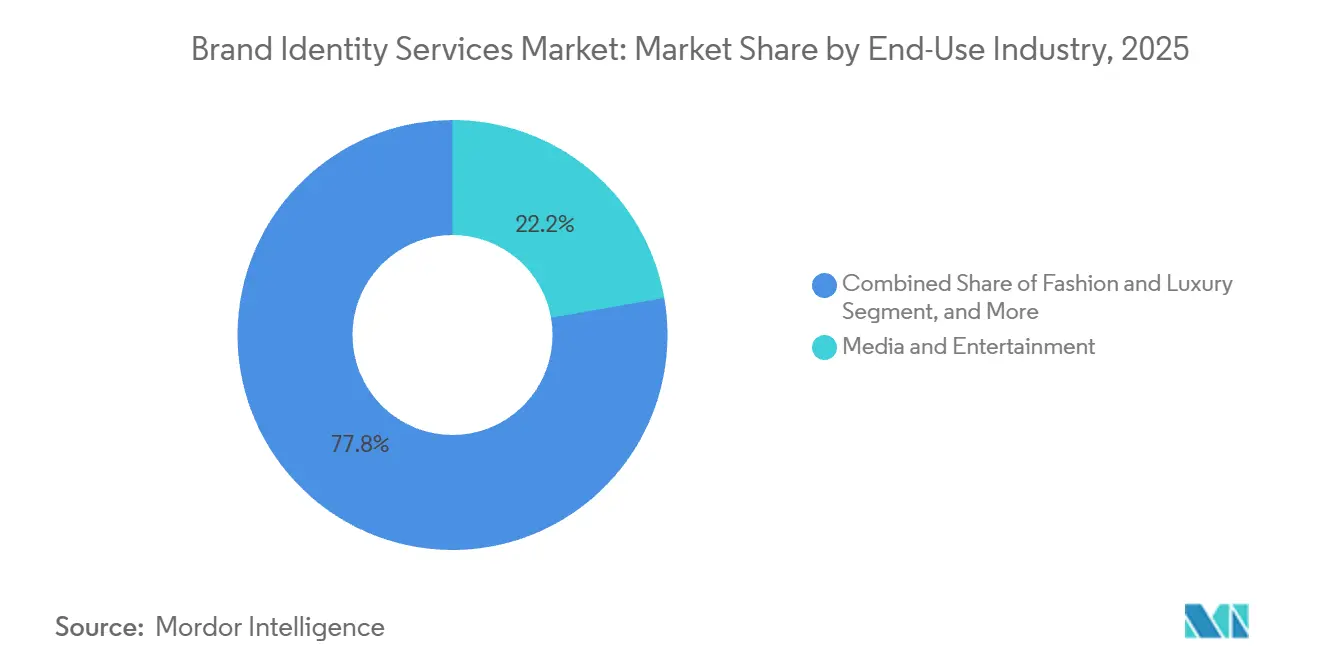
Entertainment Leads While Luxury Grows FastestMedia and entertainment held 22.24% of the Brand Identity Services Market share in 2025, the largest among end-use industries. Streaming services use identity to signal their content proposition quickly in a competitive viewing environment. A clear visual system can help a platform remain recognizable across titles, languages, campaigns, and devices. Netflix's 2026 Discover Your Future campaign used a modular design system across more than 30 languages and hundreds of titles while maintaining a unified visual language. Healthcare and life sciences also support demand as pharmaceutical and digital health businesses build formal systems for direct-to-consumer communication.
Fashion and luxury are projected to expand at a CAGR of 8.42% in the Brand Identity Services Market size from 2026 to 2031. Luxury businesses are emphasizing creativity, craftsmanship, and customer experience as they reset brand priorities. Kering's ReconKering strategy in 2026 focused on group brands' creative relevance and product excellence rather than pricing power. These shifts can require updated identity and communications systems across digital commerce, physical stores, and high-service environments. China's Textile and Apparel Brand Cultivation Action Plan for 2026-2028 targets 25 internationally recognized brands by 2028, supporting structured demand for brand-building work.
Geography Analysis
North America Brand Identity Services Market
North America accounted for 39.41% of 2025 revenue in the Brand Identity Services Market. The region benefits from a dense base of technology, consumer goods, financial services, and healthcare clients with strong differentiation needs. The United States is home to the headquarters of Fortune 500 companies in New York, Chicago, San Francisco, and Los Angeles, as well as the flagship offices of global consultancies. In July 2026, Interbrand and Clootrack launched a platform that shifts brand performance monitoring from periodic reviews to continuous analysis. Canada and Mexico also support regional demand, including export-oriented manufacturers in Mexico that need international brand systems.
Europe Brand Identity Services Market
Europe remains important to the Brand Identity Services Market, driven by corporate transformation, heritage-brand renewal, and ESG-related repositioning. The United Kingdom, Germany, and France form the core of regional demand. London hosts global consultancies such as Wolff Olins, Pentagram, Landor and Fitch, Koto Studio, and DesignStudio, supporting both client origination and project delivery. DEUTZ AG unveiled a global identity in May 2026 to support its move from engine manufacturing toward sustainable mobility and energy solutions. Eurowings also introduced a revised corporate design in 2026, repositioning itself as a European value airline.
APAC and Saudi Arabia Brand Identity Services Market
Asia-Pacific is forecast to grow at a CAGR of 7.51% within the Brand Identity Services Market from 2026 to 2031. India offers substantial potential, with unicorn-stage businesses and direct-to-consumer launches in fashion, fintech, and consumer goods increasing the need for professional brand systems. China's T/WBA 001-2025, effective in February 2026, established unified rules for product brand strategy and marketing. Interbrand's June 2026 repositioning of Saudi Electricity Company as SE Saudi Energy illustrated this direction.

Competitive Landscape
The Brand Identity Services Market is \fragmented, with global consultancies competing alongside regional specialists and smaller studios. Interbrand, Landor and Fitch, Wolff Olins, FutureBrand, Siegel+Gale, and Pentagram participate in the largest enterprise mandates. Large clients often favor providers that can coordinate several disciplines across countries and business units. Mid-tier studios compete where sector knowledge, speed, and digital-native execution matter more than a global footprint.
Leading firms are shifting from project-based identity creation to ongoing brand management relationships. Interbrand and Clootrack launched an AI-native operating system in July 2026 that connects customer experience data with the firm's brand strength framework. FutureBrand's March 2026 work for Octave combined naming, architecture, identity, motion, sonic experience, and a custom typeface into a single assignment. Pentagram developed Pfizer's first formal brand architecture and design system in July 2026, creating shared infrastructure for hundreds of product brands across therapeutic categories. These moves show that larger providers seek broader roles in how clients govern brands over time.
Open areas include AI governance for identity assets, sonic identity, and work for public-sector or sovereign clients pursuing economic development goals. Koto Studio, Red Antler, Ragged Edge, and DesignStudio compete for venture-backed consumer businesses and technology platforms that value fast, digital-first work. Subscription-based AI platforms are opening the Brand Identity Services Market to smaller companies while reducing prices for generalist studios. The strongest providers combine human judgment with automated production rather than positioning AI as a substitute for strategy.
Brand Identity Services Industry Leaders
Interbrand International LLC.
Landor & Fitch, Inc.
FutureBrand Limited
Siegel+Gale, Inc.
Wolff Olins Ltd.
- *Disclaimer: Major Players sorted in no particular order
Brand Identity Services Market Companies Covered in this Report
- Interbrand International LLC.
- Landor & Fitch, Inc.
- Wolff Olins Ltd.
- FutureBrand Limited
- Siegel+Gale, Inc.
- Lippincott, LLC.
- Pentagram LLP
- MetaDesign GmbH
- COLLINS
- Koto Studio Ltd.
- DesignStudio Ltd.
- Prophet
- Monigle
- VSA Partners
- Matchstic LLC
- Red Antler
- Ragged Edge Ltd.
- Dragon Rouge
- Saffron Brand Consultants
- Chermayeff and Geismar and Haviv

Recent Industry Developments in Brand Identity Services Market
- July 2026: Interbrand and Clootrack launched the market's first AI-Native Brand Experience Operating System, converting periodic brand strength measurement into a continuously-managed enterprise capability linked to real-time customer experience data. The platform applies Interbrand's 10-dimension Brand Strength framework, covering trust, distinctiveness, affinity, and agility, to live customer interaction streams, enabling organizations to link brand performance shifts to downstream business outcomes.
- July 2026: Pentagram developed Pfizer's first formal brand architecture and design system, building a shared infrastructure that allows hundreds of product brands across dozens of therapeutic categories to maintain audience-specific relevance within a unified Pfizer ecosystem, designed to scale alongside its evolving pipeline.
- July 2026: The Coca-Cola Company launched a new global visual identity system across more than 200 markets, built around a unified set of core design assets, the dynamic ribbon, Arden Square, and Spencerian script, designed to ensure brand consistency across packaging, retail environments, equipment, and digital experiences. Rollout began in Europe, the Middle East, and India, with South America and Asia activations planned into 2027.
- July 2026: The French Football Federation unveiled a new crest and comprehensive visual identity for France's national football teams following the 2026 FIFA World Cup, including a refreshed color palette and custom typefaces designed for digital, marketing, and event use cases across all national team programs.


Global Brand Identity Services Market Report Scope
The brand identity services market refers to professional services that help organizations create, design, and implement their visual and strategic brand elements. This includes brand strategy and positioning, visual identity design (such as logos, typography, and color palettes), and the comprehensive rollout of these assets across customer and internal touchpoints. Catering to businesses of all sizes across industries such as retail, fashion, and consumer goods, these services enable organizations to establish a distinct market presence, communicate their core values effectively, and foster strong brand recognition and customer loyalty.
The Brand Identity Services Market Report is Segmented by Offering (Brand Strategy and Positioning, Brand Identity Design, Brand Implementation and Rollout, and Other type), Organization Size (Large Enterprises, and Small and Medium-Sized Enterprises), End User Industry (Art and Culture, Retail and E-commerce, Media and Entertainment, Healthcare and Life Sciences, Fashion and Luxury, Travel and Hospitality, Consumer Goods, and Other End User Industries (BFSI, Education, Automotive, and IT and Telecom amongst Others)), and Geography (North America, South America, Europe, Asia-Pacific, Middle East, and Africa). The Market Forecasts are Provided in Terms of Value (USD).
| Brand Strategy and Positioning |
| Brand Identity Design |
| Brand Implementation and Rollout |
| Other Offerings |
| Large Enterprises |
| Small and Medium-Sized Enterprises |
| Art and Culture |
| Retail and E-commerce |
| Media and Entertainment |
| Healthcare and Life Sciences |
| Fashion and Luxury |
| Travel and Hospitality |
| Consumer Goods |
| Other End User Industries (BFSI, Education, Automotive and IT and Telecom amongst Others) |
| North America | United States |
| Canada | |
| Mexico | |
| South America | Brazil |
| Argentina | |
| Chile | |
| Rest of South America | |
| Europe | Germany |
| United Kingdom | |
| France | |
| Italy | |
| Spain | |
| Rest of Europe | |
| Asia-Pacific | China |
| Japan | |
| India | |
| South Korea | |
| Australia | |
| Rest of Asia-Pacific | |
| Middle East | United Arab Emirates |
| Saudi Arabia | |
| Qatar | |
| Rest of Middle East | |
| Africa | South Africa |
| Egypt | |
| Nigeria | |
| Rest of Africa |
| By Offering | Brand Strategy and Positioning | |
| Brand Identity Design | ||
| Brand Implementation and Rollout | ||
| Other Offerings | ||
| By Organization Size | Large Enterprises | |
| Small and Medium-Sized Enterprises | ||
| By End User Industry | Art and Culture | |
| Retail and E-commerce | ||
| Media and Entertainment | ||
| Healthcare and Life Sciences | ||
| Fashion and Luxury | ||
| Travel and Hospitality | ||
| Consumer Goods | ||
| Other End User Industries (BFSI, Education, Automotive and IT and Telecom amongst Others) | ||
| By Geography | North America | United States |
| Canada | ||
| Mexico | ||
| South America | Brazil | |
| Argentina | ||
| Chile | ||
| Rest of South America | ||
| Europe | Germany | |
| United Kingdom | ||
| France | ||
| Italy | ||
| Spain | ||
| Rest of Europe | ||
| Asia-Pacific | China | |
| Japan | ||
| India | ||
| South Korea | ||
| Australia | ||
| Rest of Asia-Pacific | ||
| Middle East | United Arab Emirates | |
| Saudi Arabia | ||
| Qatar | ||
| Rest of Middle East | ||
| Africa | South Africa | |
| Egypt | ||
| Nigeria | ||
| Rest of Africa | ||


Key Questions Answered in the Report
What is the size of the Brand Identity Services Market?
The Brand Identity Services Market is estimated at USD 1.36 billion in 2026 and is forecast to reach USD 1.81 billion by 2031, at a CAGR of 5.88%.
Which service type leads brand identity services?
Brand implementation and rollout led with 30.32% share in 2025 because global activation requires asset migration, packaging, signage, and training.
Which organization size is growing fastest for brand identity services?
Small and medium-sized enterprises are expected to grow at a CAGR of 7.01% through 2031 as digital commerce increases the need for credible identity systems.
Which end-use sector is expanding fastest?
Fashion and luxury is projected to grow at a CAGR of 8.42% through 2031 as brands update identity and communications systems across retail and digital channels.
Which region has the strongest growth outlook?
Asia-Pacific is forecast to grow at a CAGR of 7.51% through 2031, supported by startups, direct-to-consumer launches, and international expansion by domestic brands.
How is AI affecting brand identity service providers?
AI is reducing the cost of basic visual work, while increasing demand for AI-ready brand rules, governance, and content systems that require specialist support.
Page last updated on:





