
Size and Share of Boiler Feed Water Treatment Systems Market For Waste-to-Energy Plants
Market Overview
| Study Period | 2021 - 2031 |
|---|---|
| Market Size (2026) | USD 344.20 Million |
| Market Size (2031) | USD 465.63 Million |
| Growth Rate (2026 - 2031) | 6.23 % |
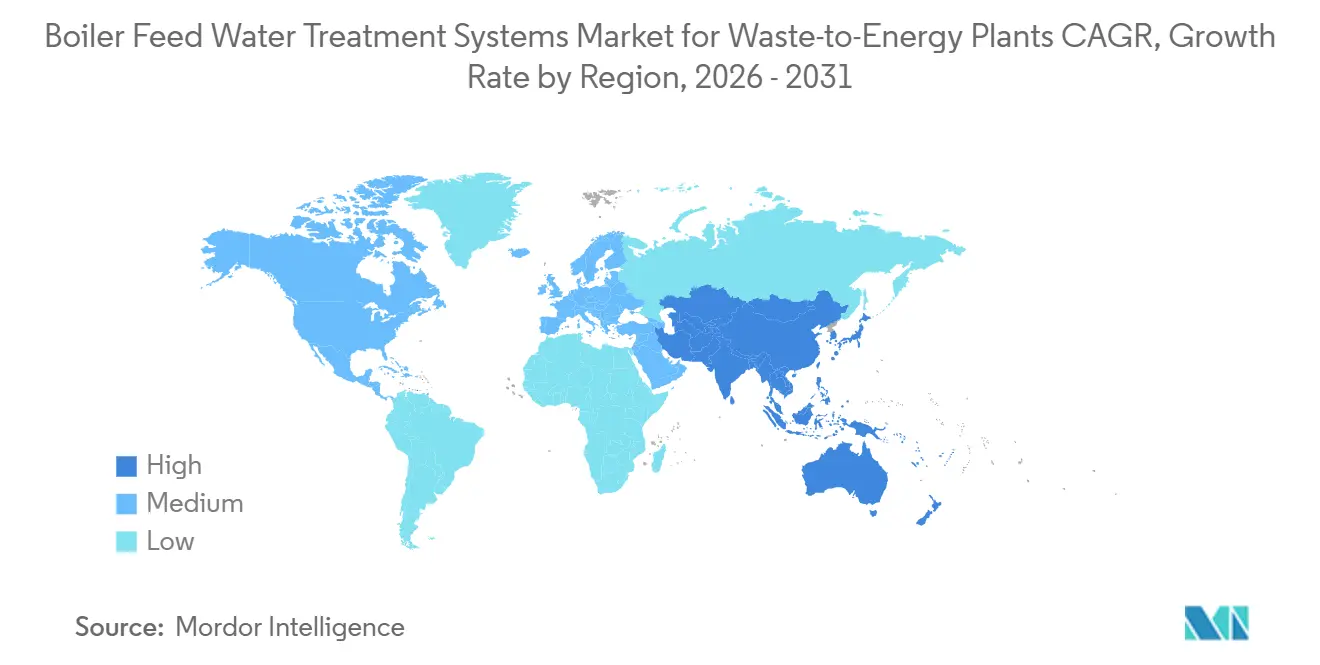
| Fastest Growing Market | Asia-Pacific |
| Largest Market | Europe |
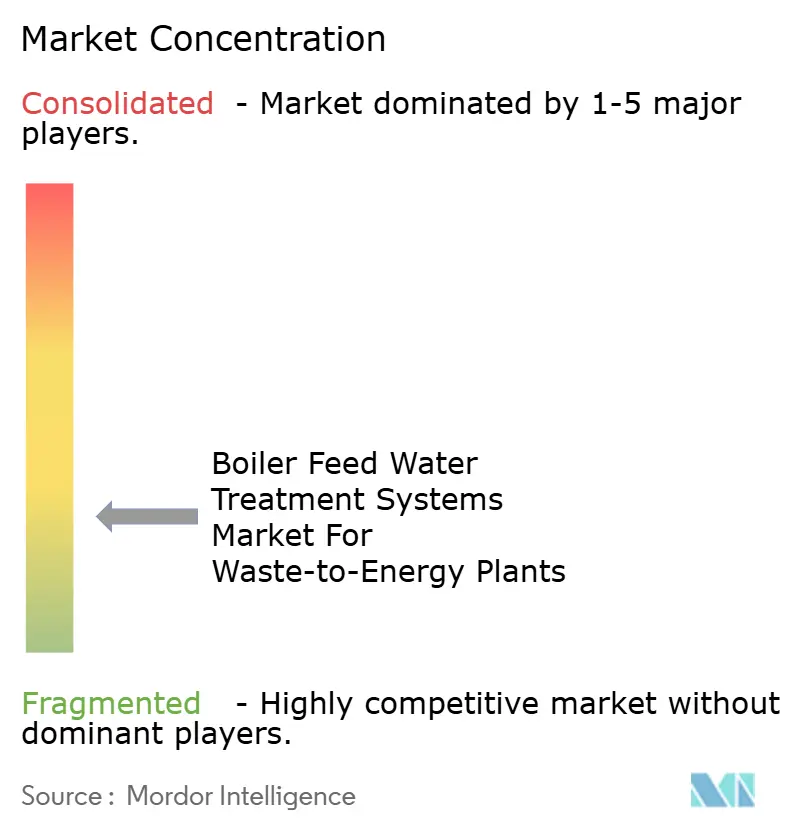
| Market Concentration | Low |
Major Players *Disclaimer: Major Players sorted in no particular order Image © Mordor Intelligence. Reuse requires attribution under CC BY 4.0. | |
Analysis of Boiler Feed Water Treatment Systems Market For Waste-to-Energy Plants by Mordor Intelligence
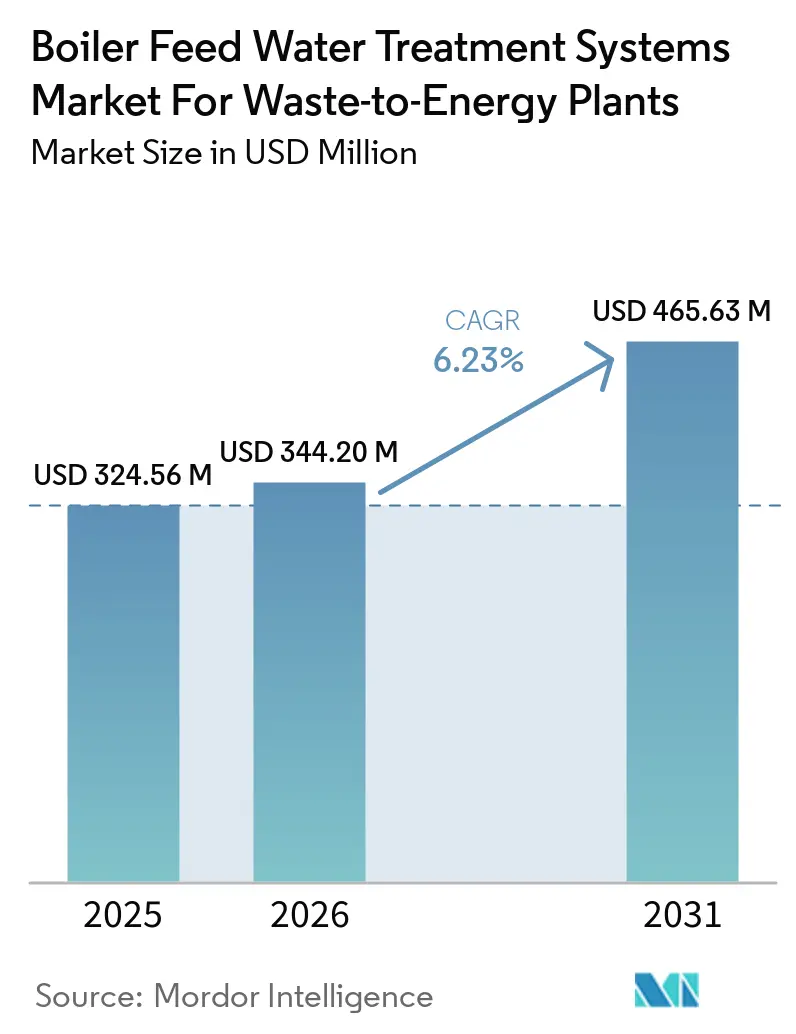
The Boiler Feed Water Treatment Systems Market for Waste-to-Energy Plants was valued at USD 324.56 million in 2025 and is estimated to grow from USD 344.20 million in 2026 to reach USD 465.63 million by 2031, at a CAGR of 6.23% during the forecast period (2026–2031). The boiler feed water treatment systems market for waste-to-energy plants is supported by the expanding operating base of thermal waste-to-energy (WTE) facilities and the need for dependable boiler operation. Each operating plant needs high-purity makeup water to manage conductivity, silica, and dissolved gases within boiler-water limits. The boiler feed water treatment systems market for waste-to-energy plants is also shaped by the shift from chemical-intensive treatment trains to reverse osmosis and electrodeionization packages. European retrofit activity creates opportunities for compact upgrades, while new facilities in Asia-Pacific create demand at the engineering stage. System suppliers are increasingly competing on modular design, water recovery, digital monitoring, and long-term service capability.
Key Report Takeaways
- By system type, reverse osmosis systems held 38.64% of the boiler feed water treatment systems market for waste-to-energy plants in 2025, while electrodeionization systems are forecast to grow at a 7.18% CAGR through 2031.
- By waste-to-energy plant type, municipal solid waste (MSW) waste-to-energy plants held 56.92% of the boiler feed water treatment systems market for waste-to-energy plants in 2025, while biomass waste-to-energy plants are forecast to grow at a 7.41% CAGR through 2031.
- By project type, new installations held 46.37% of the boiler feed water treatment systems market for waste-to-energy plants in 2025, while retrofit installations are forecast to grow at a 6.84% CAGR through 2031.
- By geography, Europe held 35.18% of the boiler feed water treatment systems market for waste-to-energy plants in 2025, while Asia-Pacific is forecast to grow at a 7.52% CAGR through 2031.
Note: Market size and forecast figures in this report are generated using Mordor Intelligence’s proprietary estimation framework, updated with the latest available data and insights as of January 2026.
Market Trends and Insights
Drivers Impact Analysis of Boiler Feed Water Treatment Systems Market For Waste-to-Energy Plants*
| Driver | (~) % Impact on CAGR Forecast | Geographic Relevance | Impact Timeline |
|---|---|---|---|
| Expansion of Waste-to-Energy Capacity and Boiler Throughput | +2.1% | Global, with concentration in Asia-Pacific and Middle-East and Africa | Short term (≤ 2 years) |
| Landfill-Diversion and Waste-Disposal Regulations | +1.4% | EU core, Southeast Asia (Indonesia, Vietnam), India | Medium term (2–4 years) |
| Demand for Higher Boiler Efficiency and Asset Reliability | +0.8% | Global, especially Europe and Japan | Medium term (2–4 years) |
| Water Reuse, Chemical Reduction and Zero-Liquid-Discharge Requirements | +0.7% | North America, Europe, water-stressed APAC markets | Medium term (2–4 years) |
| Replacement of Chemical-Intensive Resin-Bed Systems With RO-EDI Packages | +0.6% | Europe (retrofit cycle), North America, APAC new builds | Short term (≤ 2 years) |
| Digital Water Chemistry Monitoring and Predictive Maintenance | +0.4% | Global, technology-forward operators in the EU, Japan, Australia | Long term (≥ 4 years) |
| Source: Mordor Intelligence | |||
Expansion of Waste-to-Energy Capacity and Boiler Throughput
Every new waste-to-energy plant requires a boiler feed water treatment system for its operating life. The global fleet exceeded 3,100 thermal waste-to-energy plants at the end of 2025 and handles more than 640 million tons of waste each year. This installed base gives the boiler feed water treatment systems market for waste-to-energy plants a recurring equipment and service requirement. New capacity also creates a procurement cycle for high-purity water infrastructure before boiler commissioning. Configured reverse osmosis membranes and electrodeionization modules can require 16 to 20 weeks of lead time, which makes early equipment selection important. This requirement brings water treatment suppliers into the boiler feed water treatment systems market for waste-to-energy plants, further into engineering, procurement, and construction planning.
Landfill-Diversion and Waste-Disposal Regulations
Landfill restrictions support waste-to-energy investment by directing more residual waste toward recovery facilities. The European Union Landfill Directive requires member states to limit municipal waste sent to landfill to 10% by 2035[1]. New plants and capacity upgrades also require changes to boiler systems and associated water treatment equipment. The boiler feed water treatment systems market for waste-to-energy plants benefits when higher operating standards require more consistent water quality. Germany’s sewage sludge recovery rules have supported mono-incineration projects that include water-steam cycles and multistage gas treatment. These projects link waste disposal policy with demand in the boiler feed water treatment systems market for waste-to-energy plants.
Demand for Higher Boiler Efficiency and Asset Reliability
High boiler efficiency depends on stable feedwater chemistry and reliable treatment equipment. High-pressure boiler arrangements require low conductivity and silica levels that basic treatment trains cannot always sustain. This requirement favors reverse osmosis, electrodeionization, condensate polishing, and continuous chemistry control. The boiler feed water treatment systems market for waste-to-energy plants, therefore, gains from operator efforts to reduce unplanned interruptions and protect boiler tubes. Xylem states that continuous electrodeionization can provide high-purity water for boiler applications without chemical regeneration. The need is particularly important where combined heat and power systems depend on steady condensate return quality.
Water Reuse, Chemical Reduction and Zero-Liquid-Discharge Requirements
Water reuse requirements are increasing the value of treatment systems that reduce freshwater intake and liquid discharge. Zero-liquid-discharge configurations combine concentration, evaporation, and crystallization to recover process water from difficult effluent streams. The U.S. Department of Energy documented zero-liquid-discharge treatment for power plant effluents as a means of managing wastewater streams. At waste-to-energy sites, chlorine-rich municipal waste can make blowdown management more difficult because concentrated salts can increase corrosion risk. Aquatech used ultrafiltration, double-pass reverse osmosis, and electrodeionization in a zero-liquid-discharge system for a Florida biomass plant. This approach supports water recovery and strengthens the boiler feed water treatment systems market for waste-to-energy plants by reducing the operational burden of discharge management.
Restraints Impact Analysis of Boiler Feed Water Treatment Systems Market For Waste-to-Energy Plants*
| Restraint | (~) % Impact on CAGR Forecast | Geographic Relevance | Impact Timeline |
|---|---|---|---|
| High Capital Cost of Integrated High-Purity Water Systems | -1.2% | Global | Medium term (2–4 years) |
| Variable Waste Feedstock and Condensate Chemistry | -0.5% | MSW-heavy regions: Asia-Pacific Tier-2 cities, Southeast Asia, South America | Short term (≤ 2 years) |
| Skilled-Operator and Maintenance Requirements | -0.4% | Emerging markets in Middle-East and Africa, South America, and Southeast Asia | Long term (≥ 4 years) |
| Long Replacement Cycles for Properly Maintained Treatment Assets | -0.3% | Europe, Japan, North America | Long term (≥ 4 years) |
| Source: Mordor Intelligence | |||
High Capital Cost of Integrated High-Purity Water Systems
Integrated reverse osmosis, electrodeionization, and zero-liquid-discharge systems require significant initial spending. Smaller waste-to-energy operators can face capital constraints where regulated tipping fees do not rise with equipment costs. A system designed for a 300 to 500-tons-per-day municipal solid waste plant can represent 4% to 6% of total plant capital expenditure. This can lead operators to retain older ion-exchange systems rather than install new equipment. The boiler feed water treatment systems market for waste-to-energy plants is affected when capital spending is deferred, even if operating costs remain high. Envirogen’s Eco MultiPro system at the Energy Works Hull project illustrates the use of a factory-assembled reverse osmosis and electrodeionization package to reduce site constraints.
Variable Waste Feedstock and Condensate Chemistry
Municipal solid waste changes in composition over time, which can alter condensate chemistry. Plastic-rich and chloride-rich waste streams can increase chloride concentrations in flue gas condensate and complicate treatment control. These changes can introduce temporary swings in hardness, conductivity, and silica in the condensate return line. A 2025 study found that reverse osmosis rejection efficiency declined from 97% to 92% as operating temperature increased from 35 °C to 60 °C. Operators may need more frequent chemistry adjustments and more conservative membrane replacement schedules as a result. This variability raises operating costs in the boiler feed water treatment systems market for waste-to-energy plants and can slow the adoption of advanced treatment configurations.
*Our forecasts treat driver/restraint impacts as directional, not additive. The impact forecasts reflect baseline growth, mix effects, and variable interactions.
Boiler Feed Water Treatment Systems Market For Waste-to-Energy Plants Segment Analysis
By System Type:
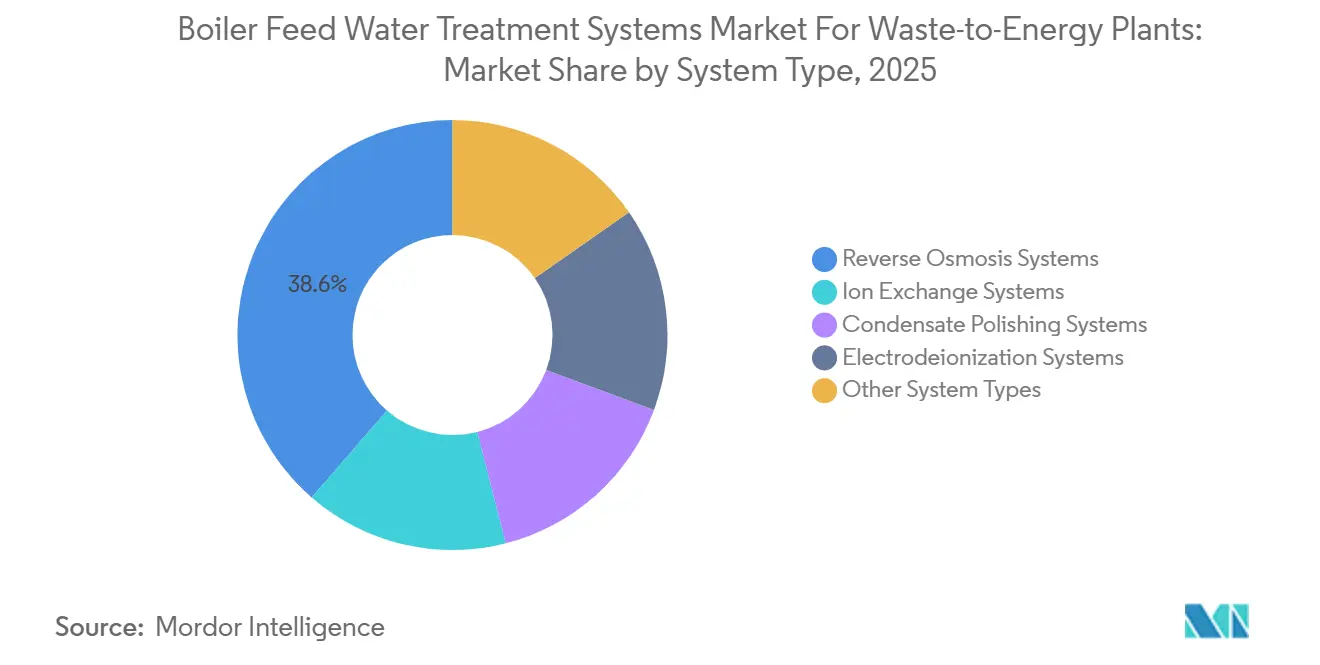
Reverse Osmosis Leads Installed Demand While Electrodeionization Systems Support New BuildsReverse osmosis systems held 38.64% of the boiler feed water treatment systems market size in 2025. They remove total dissolved solids, hardness, silica, and organic loading in a single treatment stage. This role makes reverse osmosis the usual upstream component in high-purity water treatment trains. Reverse osmosis also reduces the ionic loading that later reaches electrodeionization modules and ion-exchange resin. A 2024 techno-economic study of a 3×65-megawatt Indonesian power plant found that a two-stage reverse osmosis unit with 70% recovery reduced ion-exchange regenerant costs and achieved a 218% return on investment with a 2-year amortization period. These economics support the continuing role of reverse osmosis in the boiler feed water treatment systems market for waste-to-energy plants.
Electrodeionization systems are projected to grow at a 7.18% CAGR through 2031. They provide continuous demineralization without the acid and caustic regeneration associated with conventional ion exchange. Xylem’s Ionpure continuous electrodeionization series serves power applications at flow rates from 15 to 100 gallons per minute. This makes the technology relevant to new waste-to-energy plant designs that seek lower chemical use. Ion exchange remains important within the installed base, especially in retrofit and operations-and-maintenance settings. Condensate polishing is also needed where high-pressure combined heat and power cycles require condensate to be treated before reuse. Clarification, deaeration, chemical dosing, and online monitoring remain supporting elements of the boiler feed water treatment systems industry and the boiler feed water treatment systems market for waste-to-energy plants.

By Waste-to-Energy Plant Type:
Municipal Solid Waste (MSW) Waste-to-Energy Plants Lead While Biomass Waste-to-Energy Plants Grow FasterMunicipal solid waste (MSW) waste-to-energy plants accounted for 56.92% of the boiler feed water treatment systems market share in 2025. Their leading position reflects the large base of urban incineration infrastructure in Europe, China, and Japan. Municipal solid waste facilities can face wide variation in feedwater treatment requirements because incoming waste compositions differ. A 500-tons-per-day plant may experience substantial changes in total dissolved solids from week to week. This variation supports ongoing service, treatment chemistry, and monitoring demand beyond new plant construction. Many operators use operations-and-maintenance contracts with specialist water treatment providers rather than managing all treatment activity internally.
Biomass waste-to-energy plants are forecast to grow at a 7.41% CAGR through 2031. The global biomass-to-energy fleet exceeded 5,800 plants and 94.7 gigawatts of installed electrical capacity at the end of 2025. Biomass boilers can operate at higher steam parameters than municipal incinerators and may need more demanding water treatment. European district heating facilities increasingly recover flue gas moisture as boiler makeup water through ultrafiltration, reverse osmosis, and electrodeionization. This configuration improves water recovery but adds treatment equipment and consumables requirements for the boiler feed water treatment systems market for waste-to-energy plants. Industrial waste incineration plants also require tightly managed systems because their effluent streams can be hazardous. Refuse-derived fuel facilities and combined waste processing facilities remain smaller parts of the boiler feed water treatment systems industry.
By Project Type:
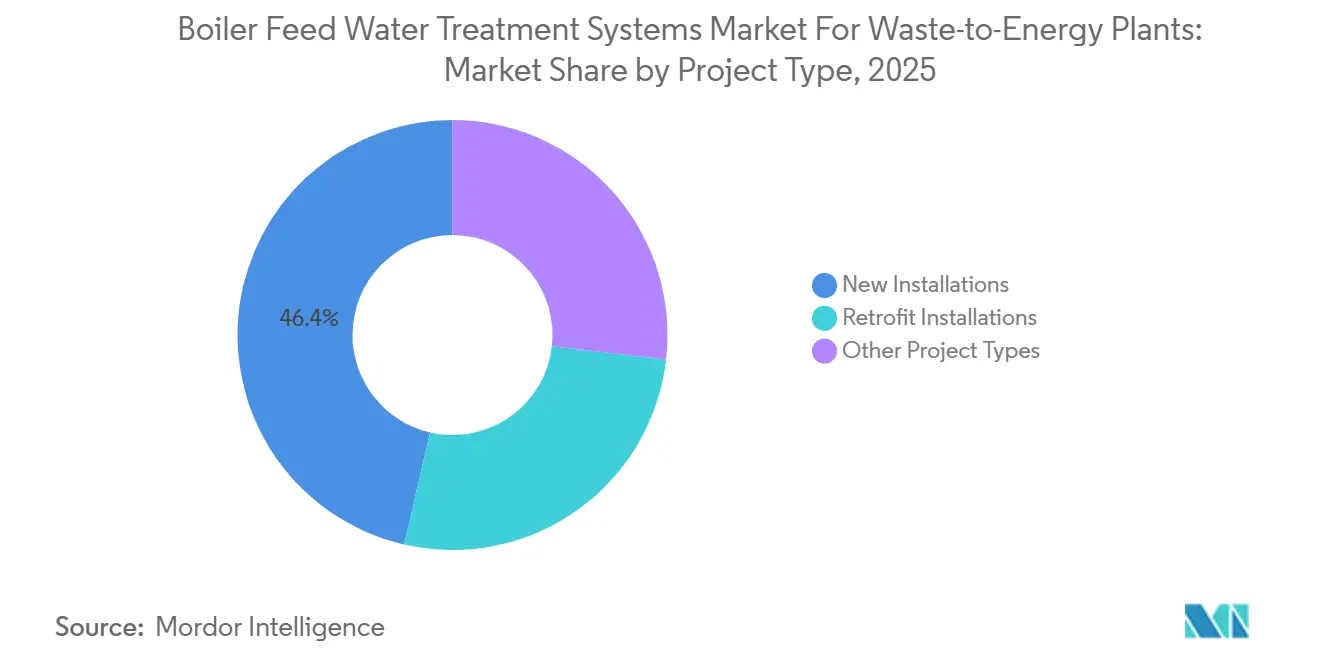
New Installations Lead While Retrofit Installations Gain MomentumNew installations held 46.37% of the boiler feed water treatment systems market share in 2025. New projects allow treatment equipment to be specified at the engineering stage and integrated with the wider boiler design. Suppliers can offer modular reverse osmosis and electrodeionization packages or complete zero-liquid-discharge systems as core plant infrastructure. Winning a new-installation contract can also establish a lasting relationship for consumables, maintenance, and treatment services in the boiler feed water treatment systems market for waste-to-energy plants. Kanadevia Inova AG began construction on a Rome facility in May 2026 that is designed to treat 600,000 tons of municipal solid waste each year. Such projects establish treatment requirements for the boiler feed water treatment systems market for waste-to-energy plants well before final commissioning.
Retrofit installations are forecast to grow at a 6.84% CAGR through 2031. Europe’s established waste-to-energy asset base creates demand for system upgrades that is separate from the new-build cycle. Existing layouts often have limited space, which favors skid-mounted equipment that can be installed without major civil work. Veolia Water Technologies states that its PROflex EDI package reduces system footprint by up to 40% compared with separate reverse osmosis and electrodeionization systems. This makes compact treatment configurations relevant to older facilities. System replacements, upgrades, and operations-and-maintenance contracts also grow where operators outsource water treatment management. The boiler feed water treatment systems market for waste-to-energy plants benefits from this recurring upgrade requirement.
Geography Analysis
Europe Boiler Feed Water Treatment Systems Market for Waste-to-Energy Plants
Europe held 35.18% of the boiler feed water treatment systems market share in 2025. The region has a dense installed base of waste-to-energy plants and regulations that require continued emissions and efficiency improvements. Germany, the United Kingdom, France, and Italy have significant treatment-system procurement activity in the boiler feed water treatment systems market for waste-to-energy plants. Paprec Énergies received a EUR 1.3 billion (approximately USD 1.50 billion) public service delegation in 2025 to build and operate a facility in Seine-et-Marne that will process 215,000 tons annually and produce 146 GWh of electricity. Veolia signed a EUR 270 million (approximately USD 0.31 billion) multi-year agreement in 2025 to modernize the LIPOR waste-to-energy plant in Greater Porto, Portugal.
APAC Boiler Feed Water Treatment Systems Market for Waste-to-Energy Plants
Asia-Pacific is expected to grow at a 7.52% CAGR through 2031. The region combines new municipal solid waste capacity in China, India, Indonesia, Japan, and South Korea with increasing attention to treatment reliability. JFE Engineering acquired a 25% stake in 2 waste-to-energy projects in Andhra Pradesh in April 2026, each with 750 tons-per-day capacity. The projects are scheduled for completion in 2028 and create a future procurement window for the boiler feed water treatment systems market for waste-to-energy plants. Thermax commissioned a steam and condensate recovery automation system for a Singapore biomass-fired boiler plant in 2026, with recovery of up to 10 tons per hour. Japan and South Korea maintain high treatment-system spending per plant because high-pressure boilers and stringent chemistry protocols are common.
The Americas and MEA Boiler Feed Water Treatment Systems Market for Waste-to-Energy Plants
North America, South America, and Middle-East and Africa present different demand conditions. North American demand is more heavily weighted toward operations-and-maintenance contracts, condensate polishing, and resin replacement at established plants. Veolia developed an industrial hazardous waste-to-energy facility in Jubail in 2025 with 121,000 tons per year of incineration capacity. This project indicates the developing waste-to-energy infrastructure pipeline in the Gulf region. Brazil and Morocco have more developed pipelines than other markets in South America and Africa. Permitting and access to financing still limit the pace of equipment procurement in these regions. The boiler feed water treatment systems market for waste-to-energy plants, therefore, has a varied regional mix of retrofit, service, and new-build demand.
Competitive Landscape
The boiler feed water treatment systems market for waste-to-energy plants is highly fragmented, with the top five players including Veolia, Lenntech B.V., Ecolab Inc., Kurita Water Industries Ltd., and The Envirogen Group. Competition is particularly active for integrated reverse osmosis and electrodeionization skids used in new-build projects. Envirogen, Veolia, and Ovivo compete on footprint, commissioning time, water quality, and ongoing support. Chemical-free treatment systems are attractive where operators seek to reduce reagent handling and related safety requirements.
Suppliers are also expanding from equipment delivery into long-term operating arrangements. In June 2026, Xylem announced a USD 850 million, 23-year Build-Own-Operate agreement with Dow for an integrated water management system[2]. The agreement shows how large water technology providers can combine capital investment, design, and operations in a single contract. Kurita expanded its advanced purification capabilities in April 2026 through an investment in Cyclopure and exclusive U.S. sales rights for the DEXSORB+ per- and polyfluoroalkyl substances (PFAS) adsorbent. Veolia’s PROflex EDI design addresses retrofit projects where existing plant geometry restricts installation space. These actions show a focus on treatment efficiency, compact design, and service-led commercial models in the boiler feed water treatment systems market for waste-to-energy plants.
Digital monitoring and condensate polishing remain areas of active product development. Continuous monitoring can give operators earlier visibility of chemistry excursions than periodic manual sampling. Ecolab’s 3D TRASAR for Boilers program provides continuous water chemistry management through its monitoring platform. Kurita’s water treatment portfolio and Ecolab’s monitoring systems reflect supplier efforts to combine chemistry management with treatment equipment. Smaller companies, including Graver Technologies and WesTech Engineering, retain roles in clarification and deep-bed filtration. Larger integrated firms may use specialist partners for those treatment stages. The boiler feed water treatment systems market for waste-to-energy plants remains competitive because system design, monitoring, consumables, and services can each determine lifecycle value.
Leaders of Boiler Feed Water Treatment Systems Market For Waste-to-Energy Plants
-
Veolia
-
Lenntech B.V.
-
Ecolab Inc.
-
Kurita Water Industries Ltd.
-
The Envirogen Group
- *Disclaimer: Major Players sorted in no particular order
Boiler Feed Water Treatment Systems Market For Waste-to-Energy Plants Companies Covered in this Report
- ANDRITZ
- Aquatech
- DuPont
- Ecolab Inc.
- Graver Technologies
- Kurita Water Industries Ltd.
- Lenntech B.V.
- Ovivo Water Inc.
- The Envirogen Group
- Thermax Limited
- Valmet
- Veolia
- WesTech Engineering, LLC
- Xylem
Recent Industry Developments in Boiler Feed Water Treatment Systems Market For Waste-to-Energy Plants
- May 2026: Kanadevia Inova AG broke ground on a two-line waste-to-energy facility in Rome, Italy, designed to process 600,000 metric tons of municipal solid waste annually and generate 65 MW of electricity, with commissioning targeted for autumn 2029. The project is expected to drive demand for boiler feed water treatment systems, including reverse osmosis, demineralization, condensate polishing, and chemical dosing systems, during the engineering and procurement phase.
- February 2026: Miura America Co. Ltd. launched Miura Reverse Osmosis (RO) systems, expanding the company's Complete Solutions and Lifecycle Partnerships portfolio to include high-purity water treatment. The industrial RO systems deliver consistent, low-total dissolved solids (TDS) feedwater for steam boiler applications, reducing scale formation and improving long-term system efficiency.
Scope of Report on Boiler Feed Water Treatment Systems Market For Waste-to-Energy Plants
Boiler feed water treatment systems are designed to remove dissolved salts, suspended solids, gases, and other impurities from water supplied to boilers in waste-to-energy plants. These systems help improve boiler efficiency, prevent scaling and corrosion, extend equipment life, and ensure reliable steam generation under demanding operating conditions.
The Boiler Feed Water Treatment Systems Market for Waste-to-Energy Plants is segmented by system type, waste-to-energy plant type, project type, and geography. By system type, the market is segmented into reverse osmosis systems, ion exchange systems, condensate polishing systems, electrodeionization systems, and other system types (including clarification and filtration systems, deaeration systems, chemical dosing systems, and online monitoring and control systems). By waste-to-energy plant type, the market is segmented into municipal solid waste (MSW) waste-to-energy plants, biomass waste-to-energy plants, industrial waste incineration plants, and other waste-to-energy plant types (including refuse-derived fuel plants and combined waste processing facilities). By project type, the market is segmented into new installations, retrofit installations, and other project types (including system replacement and upgrades and operations and maintenance contracts). The report also covers the market size and forecasts for boiler feed water treatment systems for waste-to-energy plants in 15 countries across major regions. For each segment, the market sizing and forecasts have been done on the basis of value (USD).
| Reverse Osmosis Systems |
| Ion Exchange Systems |
| Condensate Polishing Systems |
| Electrodeionization Systems |
| Other System Types (Clarification and Filtration Systems, Deaeration Systems, Chemical Dosing Systems, Online Monitoring and Control Systems) |
| Municipal Solid Waste (MSW) Waste-to-Energy Plants |
| Biomass Waste-to-Energy Plants |
| Industrial Waste Incineration Plants |
| Other Waste-to-Energy Plant Types (Refuse-Derived Fuel Plants, Combined Waste Processing Facilities) |
| New Installations |
| Retrofit Installations |
| Other Project Types (System Replacement and Upgrades, Operations and Maintenance Contracts) |
| Asia-Pacific | China |
| India | |
| Japan | |
| South Korea | |
| Rest of Asia-Pacific | |
| North America | United States |
| Canada | |
| Mexico | |
| Europe | Germany |
| United Kingdom | |
| France | |
| Italy | |
| Rest of Europe | |
| South America | Brazil |
| Argentina | |
| Rest of South America | |
| Middle-East and Africa | Saudi Arabia |
| South Africa | |
| Rest of Middle-East and Africa |
| By System Type | Reverse Osmosis Systems | |
| Ion Exchange Systems | ||
| Condensate Polishing Systems | ||
| Electrodeionization Systems | ||
| Other System Types (Clarification and Filtration Systems, Deaeration Systems, Chemical Dosing Systems, Online Monitoring and Control Systems) | ||
| By Waste-to-Energy Plant Type | Municipal Solid Waste (MSW) Waste-to-Energy Plants | |
| Biomass Waste-to-Energy Plants | ||
| Industrial Waste Incineration Plants | ||
| Other Waste-to-Energy Plant Types (Refuse-Derived Fuel Plants, Combined Waste Processing Facilities) | ||
| By Project Type | New Installations | |
| Retrofit Installations | ||
| Other Project Types (System Replacement and Upgrades, Operations and Maintenance Contracts) | ||
| By Geography | Asia-Pacific | China |
| India | ||
| Japan | ||
| South Korea | ||
| Rest of Asia-Pacific | ||
| North America | United States | |
| Canada | ||
| Mexico | ||
| Europe | Germany | |
| United Kingdom | ||
| France | ||
| Italy | ||
| Rest of Europe | ||
| South America | Brazil | |
| Argentina | ||
| Rest of South America | ||
| Middle-East and Africa | Saudi Arabia | |
| South Africa | ||
| Rest of Middle-East and Africa | ||
Key Questions Answered in the Report
What is the size of the boiler feed water treatment systems market for waste-to-energy plants?
The boiler feed water treatment systems market for waste-to-energy plants stands at USD 344.20 million in 2026 and is projected to reach USD 465.63 million by 2031.
Which system type held the largest share in 2025?
Reverse osmosis systems held 38.64% in 2025 because they reduce dissolved solids, hardness, silica, and organic loading.
Which waste-to-energy plant type is expected to grow fastest through 2031?
Biomass waste-to-energy plants are projected to grow at a 7.41% CAGR through 2031.
Why are electrodeionization systems gaining use in new facilities?
They enable continuous chemical-free demineralization and are projected to grow at a 7.18% CAGR through 2031.