
Boiler Feed Water Treatment Systems Market Size and Share
Market Overview
| Study Period | 2021 - 2031 |
|---|---|
| Market Size (2026) | USD 4.18 Billion |
| Market Size (2031) | USD 5.79 Billion |
| Growth Rate (2026 - 2031) | 6.71 % |
| Fastest Growing Market | Asia-Pacific |
| Largest Market | Asia-Pacific |
| Market Concentration | Medium |
Major Players *Disclaimer: Major Players sorted in no particular order Image © Mordor Intelligence. Reuse requires attribution under CC BY 4.0. | |
Boiler Feed Water Treatment Systems Market Analysis by Mordor Intelligence
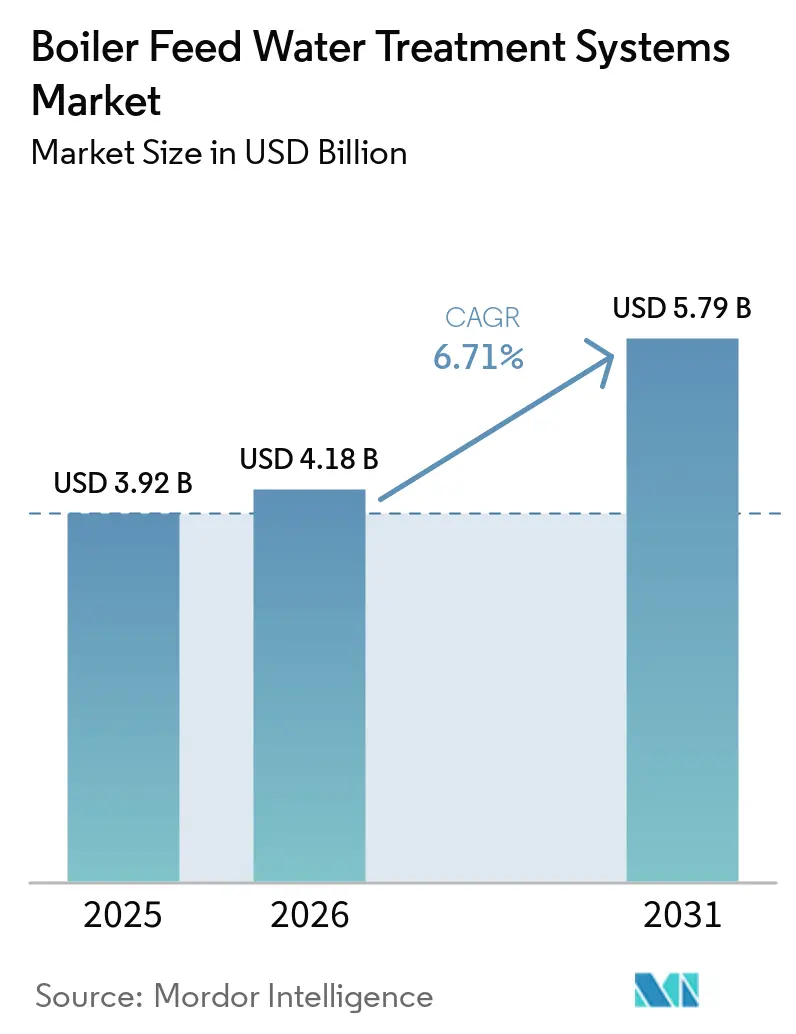
The Boiler Feed Water Treatment Systems Market was valued at USD 3.92 billion in 2025 and is estimated to grow from USD 4.18 billion in 2026 to reach USD 5.79 billion by 2031, at a CAGR of 6.71% during the forecast period (2026–2031). The boiler feed water treatment systems market is being shaped by higher purity requirements in high-pressure steam production and by industrial efforts to reuse water. New installations and upgrades require treatment trains that can manage dissolved solids, silica, oxygen, and changing feed water conditions. Suppliers are responding with integrated membrane, polishing, chemical treatment, and monitoring services rather than stand-alone equipment. The boiler feed water treatment systems market also benefits from service contracts that combine monitoring, chemical dosing, and maintenance over several years. Coal retirements in Europe and North America reduce some established demand, but upgrades and heat recovery steam generator installations create a different set of treatment needs.
Key Report Takeaways
- By system type, reverse osmosis systems held 38.58% of the boiler feed water treatment systems market in 2025, while electrodeionization systems are projected to grow at a 7.42% CAGR through 2031.
- By boiler type, water-tube boilers held 54.64% of the boiler feed water treatment systems market in 2025, while heat recovery steam generators are projected to grow at a 7.54% CAGR through 2031.
- By end-use industry, power generation held 51.95% of the boiler feed water treatment systems market in 2025, while chemicals and petrochemicals is projected to grow at a 7.88% CAGR through 2031.
- By geography, Asia-Pacific held 42.80% of the boiler feed water treatment systems market in 2025 and is projected to grow at a 7.63% CAGR through 2031.
Note: Market size and forecast figures in this report are generated using Mordor Intelligence’s proprietary estimation framework, updated with the latest available data and insights as of January 2026.
Market Trends and Insights
Drivers Impact Analysis of Boiler Feed Water Treatment Systems Market*
| Driver | (~) % Impact on CAGR Forecast | Geographic Relevance | Impact Timeline |
|---|---|---|---|
| Expansion of High-Pressure and Ultra-Supercritical Boilers | +2.0% | Asia-Pacific core (China, India, Indonesia, South Korea); spill-over to Southeast Asia and South America | Long term (≥ 4 years) |
| Industrial Water Reuse and Freshwater-Availability Constraints | +1.3% | Global, with acute demand in APAC, Middle-East, and Western US | Medium term (2–4 years) |
| Tightening Steam-Purity and Industrial Effluent Requirements | +0.9% | North America & EU core; expanding to India, China, and GCC under updated national standards | Long term (≥ 4 years) |
| Digital Water-Quality Monitoring and Predictive Maintenance | +0.8% | Global, with early adoption concentrated in North America, Japan, and Europe | Short term (≤ 2 years) |
| Boiler Retrofit Demand in Aging Industrial and Power Assets | +0.7% | North America, Europe, and mature APAC markets (Japan, South Korea) | Medium term (2–4 years) |
| Modular Treatment Skids for Distributed and Flexible Generation | +0.5% | Global, with concentrated deployment in Southeast Asia, South America, and Africa for distributed energy | Short term (≤ 2 years) |
| Source: Mordor Intelligence | |||
Expansion of High-Pressure and Ultra-Supercritical Boilers
The boiler feed water treatment systems market is supported by the continued use of high-pressure and ultra-supercritical boiler units. These units operate at very high steam pressures and temperatures. They require close control of dissolved solids, silica, and other water quality parameters. Standard ion exchange or reverse osmosis treatment may not consistently meet stringent requirements without downstream electrodeionization polishing. Higher-efficiency boiler operation increases the value of protecting boiler and turbine equipment from water chemistry failures. A chemistry event that causes turbine blade deposits can remove fuel savings, which increases demand for high-specification treatment and continuous monitoring.
Industrial Water Reuse and Freshwater-Availability Constraints
Freshwater stress is changing the design of boiler makeup water systems in the boiler feed water treatment systems market. The World Resources Institute reported that 25 countries, home to -quarter of the global population, faced extremely high baseline water stress[1]. Industrial plants are therefore assessing condensate return and suitable process wastewater as potential feed water sources. The WateReuse Association documented that Koch's Enid Advanced Treatment Facility in Oklahoma treats 5.5 million gallons per day of municipal wastewater and directs 1.4 million gallons per day of reverse osmosis permeate through a mixed-bed demineralizer for boiler feed water use. The project saves 1.5 billion gallons of freshwater annually and shows how reuse can support industrial steam systems. These projects also support recurring service work because treatment providers may operate, monitor, and optimize the systems after installation.
Tightening Steam-Purity and Industrial Effluent Requirements
The boiler feed water treatment systems market is also influenced by stricter steam purity and industrial discharge requirements. The American Society of Mechanical Engineers (ASME) guidance sets tighter feed water and boiler water control practices for modern industrial boilers. It specifies a maximum sodium level of 20 parts per billion in superheated steam for high-pressure conditions, while utility-scale plants may operate under lower limits set through International Association for the Properties of Water and Steam (IAPWS) guidance. The European EN 12953-10 standard establishes water quality requirements for shell boilers, and the VGB-S-010-00-2023 standard covers flexible and cycling operation. IAPWS updated guidance in 2024 for combined-cycle plants that must reach full load within 30 minutes after a hot shutdown. These requirements favor system upgrades that control feed water quality throughout rapid operating changes.
Digital Water-Quality Monitoring and Predictive Maintenance
Digital monitoring moves boiler feed water management from periodic sampling toward continuous control. Sensor networks and analytical models can identify chemical imbalances before scale or corrosion becomes visible. This is useful when plant loads vary or raw water quality changes. A 2026 peer-reviewed framework using digital twins, Kalman filtering, and Bayesian change-point detection reduced root mean square error for pH by 48.6% and total dissolved solids by 42.3%. The same framework reduced false alarm rates from 12.4% to 3.1%. This capability supports multi-year contracts that combine monitoring, dosing optimization, and replacement planning within the boiler feed water treatment systems market.
Restraints Impact Analysis of Boiler Feed Water Treatment Systems Market*
| Restraint | (~) % Impact on CAGR Forecast | Geographic Relevance | Impact Timeline |
|---|---|---|---|
| Thermal-Power Retirements and Renewable Generation Substitution | -1.2% | North America & EU primary; Japan and South Korea secondary | Long term (≥ 4 years) |
| High Total Cost of Ownership for Advanced Membrane and Polishing Systems | -0.8% | Global, with greater sensitivity in developing markets (Southeast Asia, South America, Sub-Saharan Africa) | Medium term (2–4 years) |
| Feedwater-Chemistry Complexity in Variable-Load Operations | -0.5% | Global, most acute in markets with high renewable penetration forcing frequent load cycling | Medium term (2–4 years) |
| Skilled-Operator Shortages and Inconsistent Water-Chemistry Governance | -0.4% | Global, concentrated in Asia-Pacific secondary markets, Eastern Europe, and Sub-Saharan Africa | Short term (≤ 2 years) |
| Source: Mordor Intelligence | |||
Thermal-Power Retirements and Renewable Generation Substitution
Thermal power retirements limit part of the boiler feed water treatment systems market in established Western regions. Finland closed its last active coal plant in April 2025 and replaced its output with electric heat pumps, waste heat, and biomass. These closures remove some large utility boiler accounts that historically purchased high volumes of treatment products and systems. Replacement combined-cycle gas facilities use heat recovery steam generators with different chemistry profiles and lower overall water volumes. Suppliers must therefore shift their portfolios from conventional coal boiler programs toward heat recovery steam generator chemistry management and related monitoring services.
High Total Cost of Ownership for Advanced Membrane and Polishing Systems
Advanced membrane and polishing systems can face cost barriers at individual facilities. High-pressure boiler projects may require ultrafiltration, reverse osmosis, and electrodeionization systems rather than a simpler treatment train. These systems can have higher initial equipment, operating, and maintenance requirements than standard treatment arrangements. Capital-constrained plant engineering teams may select lower-specification systems even when more advanced systems provide better long-term water quality control. This concern is more pronounced in developing markets that are expected to add industrial and power capacity. It can extend replacement cycles and slow the movement from chemical-only programs to integrated membrane and polishing systems in the boiler feed water treatment systems market.
*Our forecasts treat driver/restraint impacts as directional, not additive. The impact forecasts reflect baseline growth, mix effects, and variable interactions.
Boiler Feed Water Treatment Systems Market Segment Analysis
By System Type:
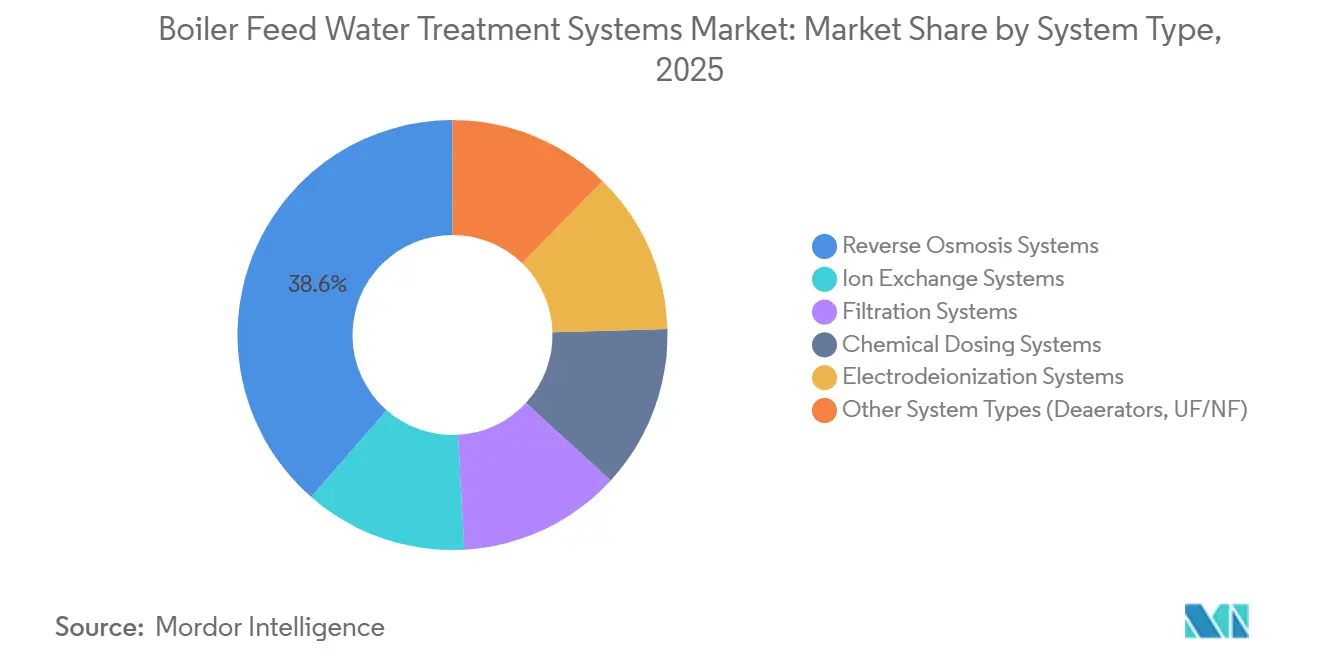
Reverse Osmosis Systems Hold the Core Position and Electrodeionization Systems Support Higher PurityReverse osmosis systems held 38.58% of the boiler feed water treatment systems market share in 2025. Their position reflects their role as the main demineralization stage across low-pressure industrial, high-pressure utility, and combined-cycle applications. Lower membrane costs over time have supported wider use in new installations and retrofit projects. Reverse osmosis also provides a common foundation for integrated treatment arrangements within the boiler feed water treatment systems market. Ion exchange and filtration systems continue to serve pretreatment and polishing needs, while chemical dosing systems support pH and oxygen control.
Electrodeionization systems are forecast to grow at a CAGR of 7.42% from 2026 to 2031. The segment supports ultra-high-purity requirements in new ultra-supercritical boiler installations. It also helps facilities reduce their dependence on hazardous chemical regenerants. Veolia offers Terion, an integrated reverse osmosis and electrodeionization system designed as a plug-and-play unit. This configuration can support installation in greenfield and retrofit settings. Deaerators and ultrafiltration or nanofiltration units remain relevant because pretreatment and oxygen removal needs continue across both existing and new boiler configurations.

By Boiler Type:
Water-Tube Boilers Anchor Demand While Heat Recovery Steam Generators Lead GrowthWater-tube boilers held 54.64% of revenue in 2025. This position reflects their use in utility-scale power plants, large chemical sites, and refineries. These facilities require large treatment systems and careful water chemistry management. Their operating conditions make reliable pretreatment, demineralization, and chemical control important in the boiler feed water treatment systems market. Fire-tube boilers serve light industrial and commercial steam applications, where chemical dosing and lower-specification softening equipment are more common.
Heat recovery steam generators are projected to expand at a CAGR of 7.54% through 2031. They operate at multiple pressure levels, creating treatment requirements that differ from those of conventional boilers. The low-pressure drum can be vulnerable to under-deposit corrosion when pH, dissolved oxygen, and copper are not controlled. This operating profile supports use of more advanced monitoring and chemical feed systems. It also provides a growth path for the boiler feed water treatment systems market as combined-cycle capacity expands. Once-through steam generators also support demand in offshore and modular power settings where conventional boiler room layouts are less practical.
By End-Use Industry:
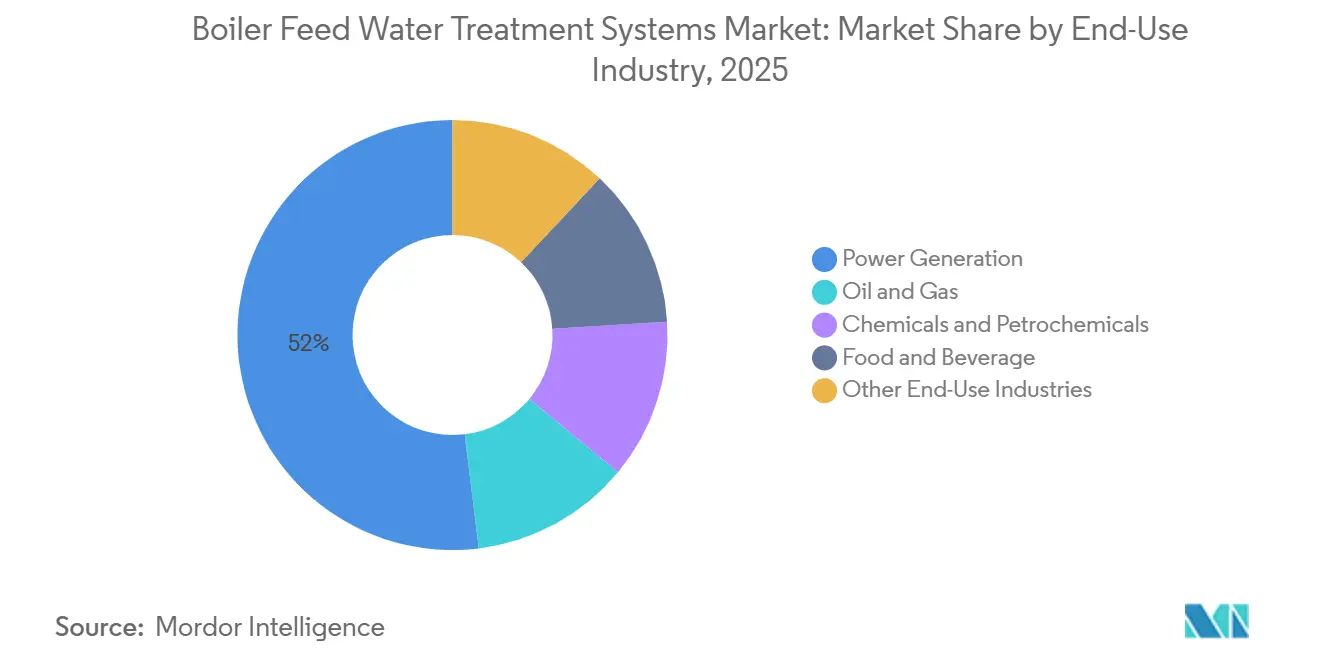
Power Generation Provides the Base While Chemicals and Petrochemicals Grows FasterPower generation accounted for 51.95% of the boiler feed water treatment systems market share in 2025. Large utility plants need continuous treatment because their boilers have high capacity and strict feed water specifications. Ultra-supercritical plants also create recurring requirements for chemicals, membranes, and monitoring. The boiler feed water treatment systems market benefits when operators seek to protect equipment from deposits, corrosion, and unplanned outages. Coal retirement in some Western markets is a constraint, but thermal capacity additions in India and Southeast Asia maintain the power generation customer base.
Chemicals and petrochemicals is forecast to grow at a CAGR of 7.88% from 2026 to 2031. New capacity in the Middle-East requires high-purity steam for process operations and heat integration. India is receiving investment in new petrochemical complexes that require high-purity steam systems from the start of operations. Oil and gas, food and beverage, pharmaceuticals, pulp and paper, metals, and textiles provide the remaining demand. Food and beverage applications need high-purity and chemical-free treatment where steam contacts products during heating. This broad end-use industry base allows the boiler feed water treatment systems market to serve both utility and process-steam applications.
Geography Analysis
APAC Boiler Feed Water Treatment Systems Market
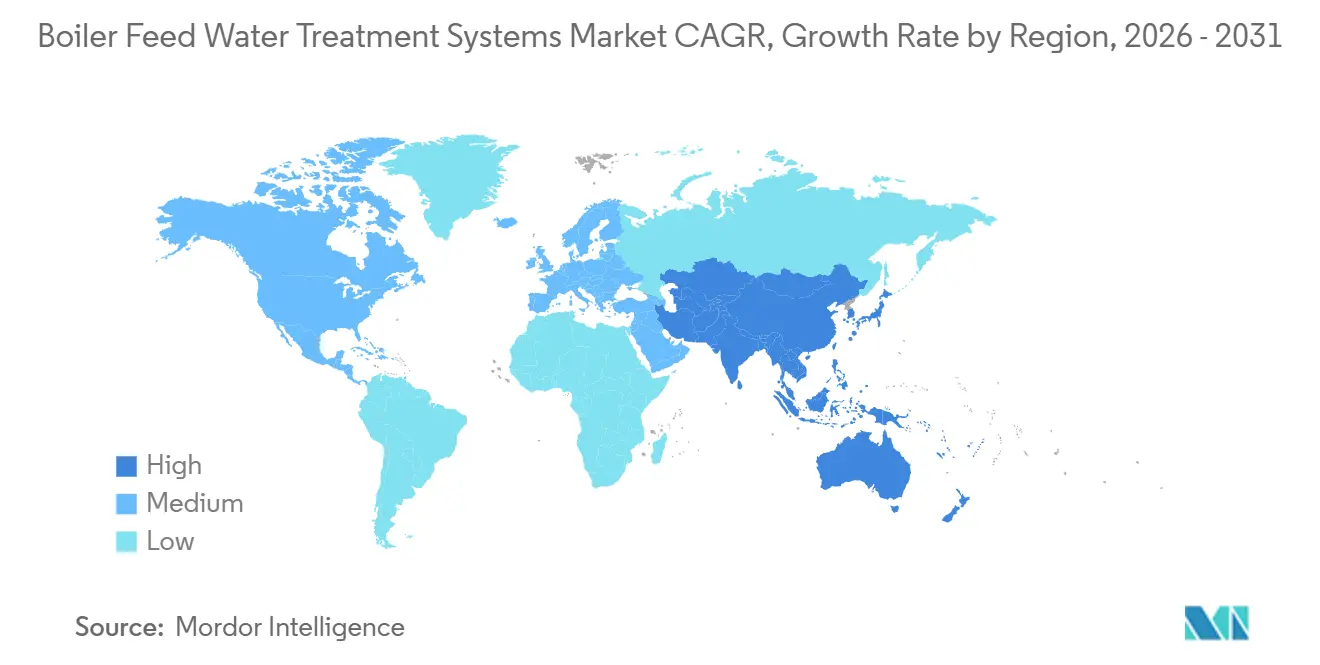
Asia-Pacific held 42.80% of revenue in 2025 and is projected to grow at a CAGR of 7.63% through 2031, making it the leading regional contributor in the boiler feed water treatment systems market. China, India, and Indonesia support demand through thermal fleet modernization and industrial expansion. Vietnam and Thailand represent earlier-stage demand as thermal and industrial capacity expands. India’s water quality standards and industrial corridor investments support treatment upgrades at industrial plants. Japan and South Korea maintain demand for advanced chemistry management and digital monitoring.
North America Boiler Feed Water Treatment Systems Market
North America has a large installed base of utility boilers and industrial steam users. U.S. coal retirements are reducing utility-scale demand, while combined-cycle gas turbine expansion supports heat recovery steam generator treatment requirements. Updated power generation standards and ASME and IAPWS guidance sustain demand for advanced systems at operating and new utility plants. Industrial facilities in California, Texas, and Arizona are adopting water reuse systems that combine ultrafiltration, reverse osmosis, and electrodeionization. Canada’s oil sands and refinery operations continue to require high-specification feed water treatment.
Europe, Middle East and South America Boiler Feed Water Treatment Systems Market
Europe has a mature industrial base, where modernization of aging treatment equipment is more important than major new plant construction. Germany, the United Kingdom, France, and Nordic countries require advanced chemistry programs that align with the European Union Industrial Emissions Directive revisions. Combined-cycle gas turbine capacity additions also support heat recovery steam generator treatment requirements. Gulf Cooperation Council countries are expanding refining and petrochemical capacity while managing freshwater scarcity, which creates project opportunities in the boiler feed water treatment systems market. South America, led by Brazil’s oil and gas activity and Argentina’s petrochemical investments, has project-based demand with a less consistent annual pattern.
Competitive Landscape
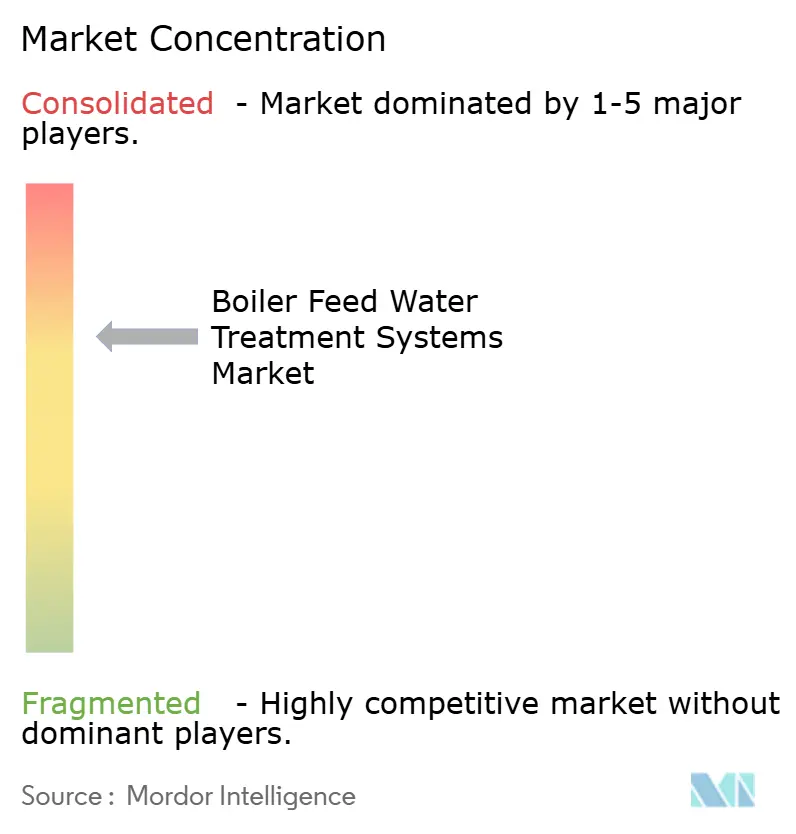
The boiler feed water treatment systems market is moderately concentrated, with the top five players including Thermax Limited, Ecolab Inc., Veolia, Kurita Water Industries Ltd., and Solenis. Regional companies such as Thermax and WABAG compete through engineering capability, locally manufactured systems, and local supply chains. Competition remains fragmented in specialty chemistry formulations, membrane equipment, and regional engineering work. This structure gives customers choices between global service platforms and regional project providers.
Leading suppliers are moving toward contracts that combine chemical supply, monitoring systems, and digital analysis across several years. This model shifts more water chemistry work from plant maintenance teams to service providers. It can increase customer retention because vendors become more involved in daily water quality control. Veolia’s Terion system combines reverse osmosis and electrodeionization in an integrated configuration for facilities seeking modular deployment. Kurita’s Cetamine film-forming amine technology has been applied in a triple-pressure heat recovery steam generator and supports its differentiation in high-pressure boiler applications[2].
Monitoring-as-a-service and modular treatment skids remain areas where suppliers can extend their offerings for distributed and off-grid generation. Companies that integrate dosing optimization with real-time effluent monitoring may compete for midsize industrial accounts. Compliance with International Organization for Standardization (ISO) 9001 quality management requirements and ASME Section VII guidance is becoming a basic procurement requirement for utility and large petrochemical customers. These requirements raise the capability threshold for new providers.
Boiler Feed Water Treatment Systems Industry Leaders
-
Thermax Limited
-
Ecolab Inc.
-
Veolia
-
Kurita Water Industries Ltd.
-
Solenis
- *Disclaimer: Major Players sorted in no particular order
Boiler Feed Water Treatment Systems Market Companies Covered in this Report
- Accepta Ltd.
- Aquatech
- ChemTreat
- Ecolab Inc.
- IEI
- Kemira
- Kurita Water Industries Ltd.
- Solenis
- Thermax Limited
- Veolia Environnement S.A.
- WABAG
- Xylem
Recent Industry Developments in Boiler Feed Water Treatment Systems Market
- May 2026: Kanadevia Inova AG broke ground on a two-line waste-to-energy facility in Rome, Italy, designed to process 600,000 metric tons of municipal solid waste annually and generate 65 MW of electricity, with commissioning targeted for autumn 2029. The project is expected to drive demand for boiler feed water treatment systems, including reverse osmosis, demineralization, condensate polishing, and chemical dosing systems, during the engineering and procurement phase.
- February 2026: Miura America Co. Ltd. launched Miura Reverse Osmosis (RO) systems, expanding the company's Complete Solutions and Lifecycle Partnerships portfolio to include high-purity water treatment. The industrial RO systems deliver consistent, low-Total Dissolved Solids (TDS) feed water for steam boiler applications, reducing scale formation and improving long-term system efficiency.
Global Boiler Feed Water Treatment Systems Market Report Scope
Boiler feed water treatment systems are used to remove dissolved salts, suspended solids, gases, and other impurities from water supplied to industrial boilers. These systems improve boiler efficiency, prevent scaling and corrosion, extend equipment life, and ensure reliable steam generation across a wide range of industrial applications.
The Boiler Feed Water Treatment Systems Market is segmented by system type, boiler type, end-use industry, and geography. By system type, the market is segmented into reverse osmosis systems, ion exchange systems, filtration systems, chemical dosing systems, electrodeionization systems, and other system types (including deaerators and ultrafiltration (UF)/nanofiltration (NF) systems). By boiler type, the market is segmented into water-tube boilers, fire-tube boilers, heat recovery steam generators, and other boiler types (including once-through steam generators). By end-use industry, the market is segmented into power generation, oil and gas, chemicals and petrochemicals, food and beverage, and other end-use industries (including pharmaceuticals, pulp and paper, metals and mining, textile, and sugar and ethanol). The report also covers the market size and forecasts for boiler feed water treatment systems in 15 countries across major regions. For each segment, the market sizing and forecasts have been done on the basis of value (USD).
| Reverse Osmosis Systems |
| Ion Exchange Systems |
| Filtration Systems |
| Chemical Dosing Systems |
| Electrodeionization Systems |
| Other System Types (Deaerators, UF/NF) |
| Water-Tube Boilers |
| Fire-Tube Boilers |
| Heat Recovery Steam Generators |
| Other Boiler Types (Once-Through Steam Generators) |
| Power Generation |
| Oil and Gas |
| Chemicals and Petrochemicals |
| Food and Beverage |
| Other End-Use Industries (Pharmaceuticals, Pulp and Paper, Metals and Mining, Textile, Sugar & Ethanol) |
| Asia-Pacific | China |
| India | |
| Japan | |
| South Korea | |
| ASEAN Countries | |
| Rest of Asia-Pacific | |
| North America | United States |
| Canada | |
| Mexico | |
| Europe | Germany |
| United Kingdom | |
| France | |
| Italy | |
| NORDIC Countries | |
| Rest of Europe | |
| South America | Brazil |
| Argentina | |
| Rest of South America | |
| Middle-East and Africa | Saudi Arabia |
| South Africa | |
| Rest of Middle-East and Africa |
| By System Type | Reverse Osmosis Systems | |
| Ion Exchange Systems | ||
| Filtration Systems | ||
| Chemical Dosing Systems | ||
| Electrodeionization Systems | ||
| Other System Types (Deaerators, UF/NF) | ||
| By Boiler Type | Water-Tube Boilers | |
| Fire-Tube Boilers | ||
| Heat Recovery Steam Generators | ||
| Other Boiler Types (Once-Through Steam Generators) | ||
| By End-Use Industry | Power Generation | |
| Oil and Gas | ||
| Chemicals and Petrochemicals | ||
| Food and Beverage | ||
| Other End-Use Industries (Pharmaceuticals, Pulp and Paper, Metals and Mining, Textile, Sugar & Ethanol) | ||
| By Geography | Asia-Pacific | China |
| India | ||
| Japan | ||
| South Korea | ||
| ASEAN Countries | ||
| Rest of Asia-Pacific | ||
| North America | United States | |
| Canada | ||
| Mexico | ||
| Europe | Germany | |
| United Kingdom | ||
| France | ||
| Italy | ||
| NORDIC Countries | ||
| Rest of Europe | ||
| South America | Brazil | |
| Argentina | ||
| Rest of South America | ||
| Middle-East and Africa | Saudi Arabia | |
| South Africa | ||
| Rest of Middle-East and Africa | ||
Key Questions Answered in the Report
What is the size of the boiler feed water treatment systems market?
The boiler feed water treatment systems market stands at USD 4.18 billion in 2026 and is projected to reach USD 5.79 billion by 2031.
Which system type led the market demand in 2025?
Reverse osmosis systems led with 38.58% of revenue in 2025.
Which boiler type is expected to grow fastest through 2031?
Heat recovery steam generators are projected to grow at a 7.54% CAGR through 2031.
Which end-use industry led the market demand in 2025?
Power generation held 51.95% of revenue in 2025 because utility plants need continuous, tightly controlled feed water treatment.