
Blue-Green Algae Biofertilizers Market Size and Share
Market Overview
| Study Period | 2022 - 2032 |
|---|---|
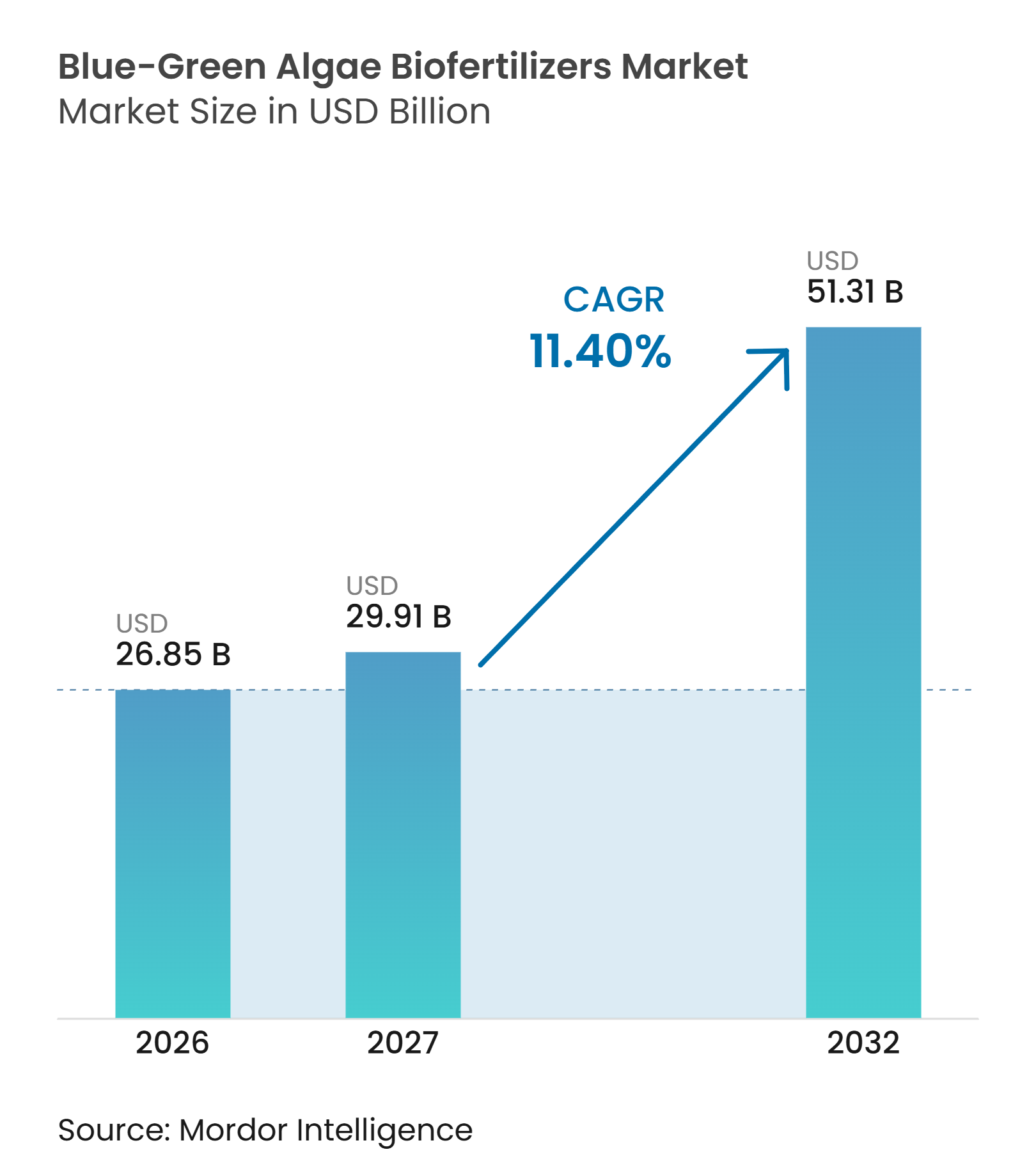
| Market Size (2027) | USD 29.91 Billion |
| Market Size (2032) | USD 51.31 Billion |
| Growth Rate (2027 - 2032) | 11.40 % |
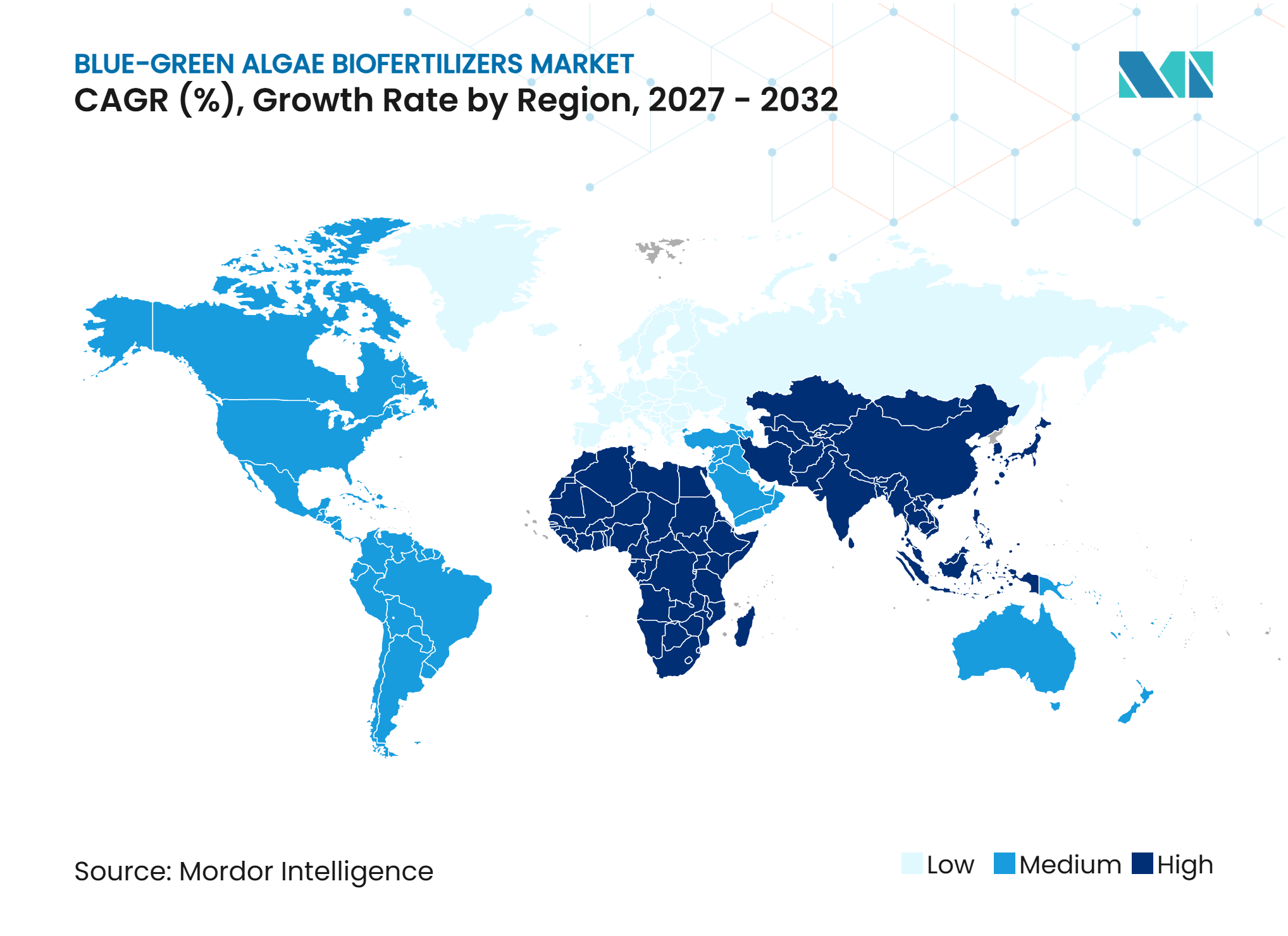
| Fastest Growing Market | Africa |
| Largest Market | Asia-Pacific |
| Market Concentration | Low |
Major Players *Disclaimer: Major Players sorted in no particular order Image © Mordor Intelligence. Reuse requires attribution under CC BY 4.0. | |
Blue-Green Algae Biofertilizers Market Analysis by Mordor Intelligence
The blue-green algae biofertilizers market size is projected to expand from USD 26.85 billion in 2026 and USD 29.91 billion in 2027 to USD 51.31 billion by 2032, and the market is projected to grow at a CAGR of 11.40% between 2027 and 2032. The Blue-Green Algae Biofertilizers Market is supported by depleted soils, rising fertilizer import costs, and tighter controls on nutrient runoff. Cyanobacteria can fix nitrogen in paddy systems and reduce urea demand by 20 to 25 kg per hectare during a crop cycle. This makes biological inputs more relevant where growers need to manage input costs without compromising soil function. Regulation is also shaping demand, as product standards can boost confidence in microbial inputs. The Blue-Green Algae Biofertilizers Market offers room for suppliers that can combine reliable formulations, agronomic support, and locally suitable strains.
Key Report Takeaways
-
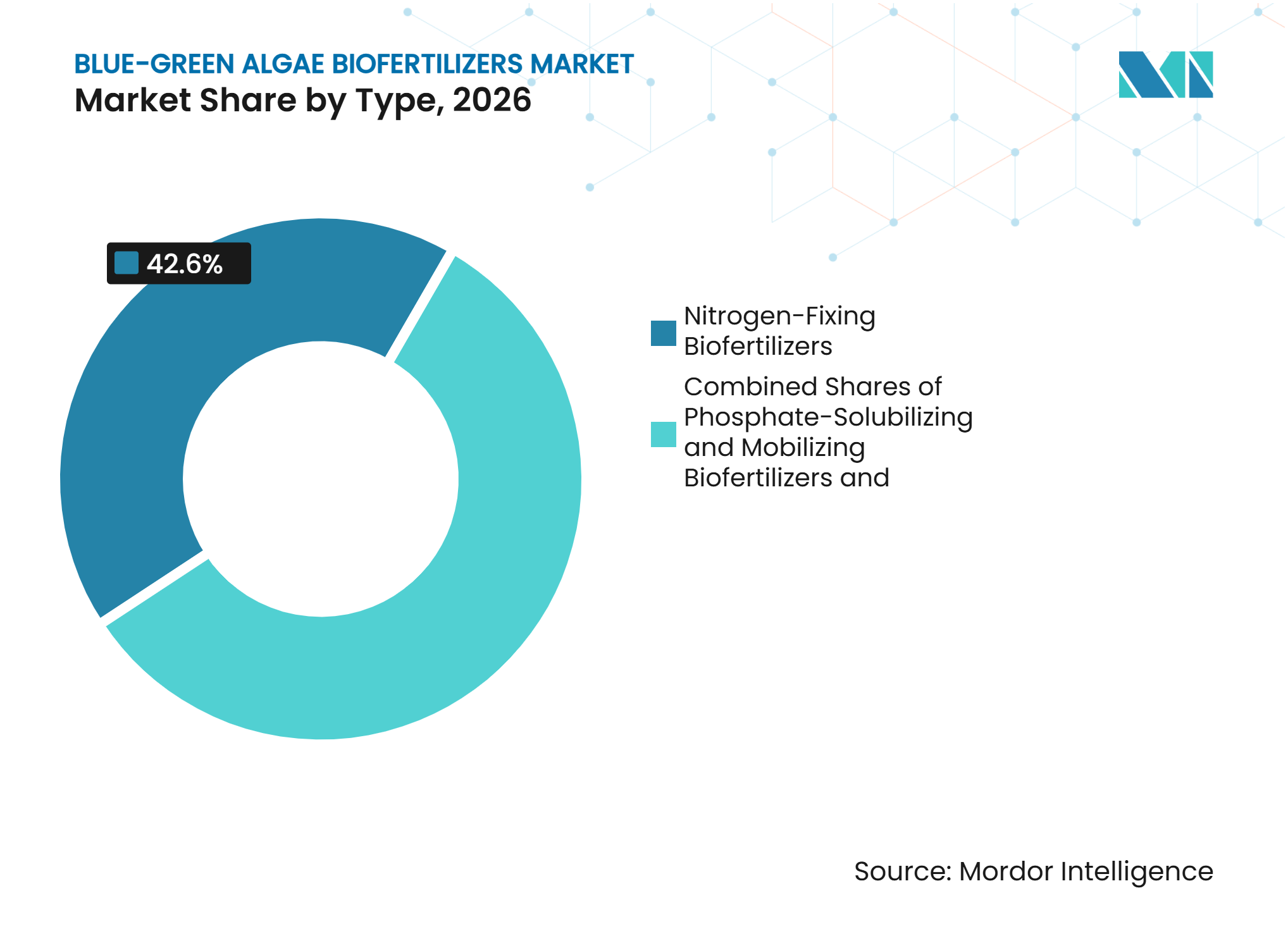
By type, Nitrogen-Fixing Biofertilizers were the largest segment and held 42.6% of the Blue-Green Algae Biofertilizers Market share in 2026, while Phosphate-Solubilizing and Mobilizing Biofertilizers are projected to grow at an 11.5% CAGR from 2027 to 2032.
-
By form, Powder Biofertilizers were the largest segment, accounting for 54.2% of the Blue-Green Algae Biofertilizers Market size in 2026, while Liquid Biofertilizers are projected to grow at an 11.9% CAGR from 2027 to 2032.
-
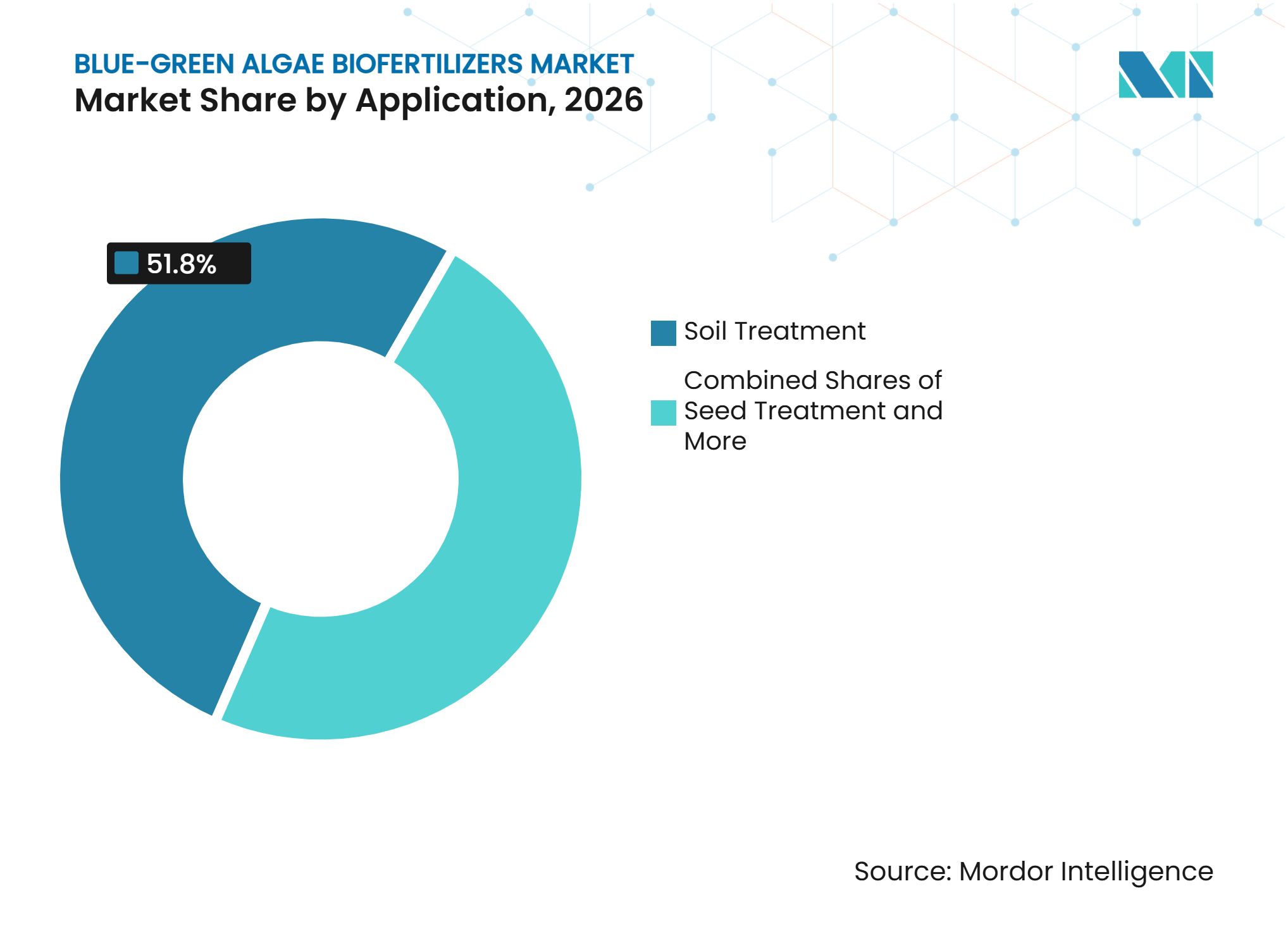
By application, Soil Treatment was the largest segment, holding a 51.8% market share in 2026, while Seed Treatment is projected to grow at an 11.8% CAGR from 2027 to 2032.
-
By crop type, Cereals and Grains were the largest segment and held a 47.8% market share in 2026, while Fruits and Vegetables are projected to grow at a 12.3% CAGR from 2027 to 2032.
-
By geography, Asia-Pacific was the largest segment, holding a 38.4% market share in 2026, while Africa is projected to grow at a 12.1% CAGR from 2027 to 2032.
Note: Market numbers in this report are based on Mordor Intelligence's proprietary estimation framework, which combines nine months of actuals with Q4 projections for base year 2026.
Market Trends and Insights
Drivers Impact Analysis of Blue-Green Algae Biofertilizers Market*
| Driver | (~) % Impact on CAGR Forecast | Geographic Relevance | Impact Timeline |
|---|---|---|---|
| Sustainable and Organic Farming Adoption | +2.5% | Global, with early gains in India, Europe, and East Africa | Medium term (2-4 years) |
| Soil Degradation and Nutrient-Use Inefficiency | +2.0% | Asia-Pacific, with expansion to South America and the Middle East and Africa | Long term (≥ 4 years) |
| Expansion of Rice and Cereal Production | +2.1% | Asia-Pacific and Sub-Saharan Africa | Short term (≤ 2 years) |
| Government Support for Biological Agricultural Inputs | +1.8% | Global, with early gains in India, Europe, and Brazil | Medium term (2-4 years) |
| Circular Nitrogen Production From Air, Water, and Carbon Dioxide | +1.5% | Europe, North America, and Japan | Long term (≥ 4 years) |
| Controlled-Environment and Precision Agriculture Integration | +1.2% | North America, Europe, and East Asia | Medium term (2-4 years) |
| Source: Mordor Intelligence | |||
Sustainable and Organic Farming Adoption
Sustainable farming is becoming more compatible with the use of biofertilizers, as public programs reduce the cost of transitioning away from synthetic inputs. India had brought 1.7 million hectares under organic farming by October 2025 through Paramparagat Krishi Vikas Yojana (PKVY). The program provided direct benefit transfers of INR 15,000 (USD 179) per hectare for bio-inputs, including biofertilizers[1]. The National Mission on Natural Farming (NMNF) targets 750,000 hectares across 15,000 clusters with 10,000 Bio-Input Resource Centers. These facilities can improve access to products near farms and reduce dependence on distant distribution networks. India’s Fertilizer Control Order provides quality standards for biofertilizers, which can strengthen buyer trust in the Blue-Green Algae Biofertilizers Market.
Soil Degradation and Nutrient-Use Inefficiency
Declining soil quality is increasing interest in inputs that support nutrient cycling rather than simply adding nutrients. The Food and Agriculture Organization of the United Nations (FAO) reported in 2025 that 1.7 billion people live in areas where land degradation has reduced crop yields by at least 10%[2]. A 2025 Nature Communications study found that nitrogen use efficiency for major crops remained below 50%, while phosphorus use efficiency ranged from 19% to 44% by crop. Cyanobacteria can reduce dependence on added nitrogen through biological fixation and may help improve soil aggregation through polysaccharide production. The Blue-Green Algae Biofertilizers Market may therefore gain relevance in systems where nutrient imbalances and weaker soil structure coexist.
Expansion of Rice and Cereal Production
Flooded rice fields provide conditions that are favorable to heterocystous nitrogen-fixing cyanobacteria. The alternating anaerobic and aerobic conditions in paddy soil help these organisms establish more easily than in many upland cropping systems. A 2025 Journal of Applied Phycology study found that nitrogen-fixing cyanobacteria could replace synthetic nitrogen fertilizer in rice cultivation while reducing greenhouse gas emissions. FAOSTAT records global rice production at 757 million metric tons, concentrated in China, India, Vietnam, Indonesia, and Thailand. A 2025 study published in the Journal of Applied Phycology by Springer Nature reported that wheat co-cultivated with Nostoc calcicola produced 44% more dry mass in pot trials. These results broaden the potential demand for Blue-Green Algae Biofertilizers beyond traditional paddy production, although commercial outcomes will depend on local field conditions.
Government Support for Biological Agricultural Inputs
Government programs are increasingly integrating biological inputs into broader soil health and food security plans. The Alliance for Food Sovereignty in Africa called in 2025 for national plans to replace 50% of synthetic fertilizer use with biological inputs by 2030[3]. The proposal included redirecting subsidies toward local production, including Senegal’s CFA 40 billion (USD 67 million) synthetic-input allocation. A 2025 International Fund for Agricultural Development (IFAD) report described biofertilizer support under Burkina Faso’s National Agroecology Development Strategy. In Kenya, the Stockholm Environment Institute identified faster certification by the Kenya Bureau of Standards as a priority to reduce the time required to introduce biofertilizers. These measures can make the Blue-Green Algae Biofertilizers Market more accessible, especially where extension services and local manufacturing grow alongside certification systems.
Restraints Impact Analysis of Blue-Green Algae Biofertilizers Market*
| Restraint | (~) % Impact on CAGR Forecast | Geographic Relevance | Impact Timeline |
|---|---|---|---|
| Limited Farmer Awareness and Application Knowledge | -1.2% | Global, particularly Sub-Saharan Africa and South Asia | Medium term (2-4 years) |
| Variable Field Performance Across Soil, Climate, and Crop Conditions | -1.0% | Global | Long term (≥ 4 years) |
| Short Shelf Life and Microbial Viability Loss During Storage | -0.8% | Asia-Pacific, Africa, and South America | Short term (≤ 2 years) |
| Competition From Subsidized and Fast-Acting Synthetic Fertilizers | -1.5% | India, China, and Sub-Saharan Africa | Medium term (2-4 years) |
| Source: Mordor Intelligence | |||
Limited Farmer Awareness and Application Knowledge
Blue-green algae biofertilizers require different handling from conventional synthetic products. Application timing, soil moisture, compatibility with crop protection products, and strain selection can all affect outcomes. IFAD identified limited farmer awareness and training as 1 of 2 primary obstacles to biofertilizer development in Burkina Faso. The report noted that domestic production units struggled to find buyers willing to pay unsubsidized prices when extension services were weak. The Stockholm Environment Institute similarly emphasized training agro-dealers and building last-mile distribution before expanding production in Kenya. First-season support is especially important in the Blue-Green Algae Biofertilizers Market because poor implementation can create a negative experience that limits repeat purchases.
Variable Field Performance Across Soil, Climate, and Crop Conditions
Field results can vary substantially across products, crop systems, soils, and climates. A 2025 Agriculture study of Anabaena cylindrica formulations for wheat found differences in performance across carrier types, inoculant doses, and soil conditions. The highest results were observed at the highest concentrations and under controlled greenhouse conditions. A 2025 Frontiers in Plant Science review identified biomass costs, inconsistent field performance, and regulatory uncertainty as continuing constraints on wider use. Soils with low pH, high microbial competition, or unsuitable water conditions may reduce biological nitrogen fixation. More long-duration field trials and clearer product guidance are needed before commercial growers can assess the risk of the Blue-Green Algae Biofertilizers Market at scale.
*Our forecasts treat driver/restraint impacts as directional, not additive. The impact forecasts reflect baseline growth, mix effects, and variable interactions.
Blue-Green Algae Biofertilizers Market Segment Analysis
By Type:
Nitrogen Fixation Retained the Largest Position While Phosphate Mobilization Will Expand FastestNitrogen-Fixing Biofertilizers were the largest segment, accounting for 42.6% of the Blue-Green Algae Biofertilizers Market share in 2026. Its position reflects long-standing use of heterocystous cyanobacteria in paddy inoculation across South and Southeast Asia. In flooded rice systems, nitrogen fixation can provide 20 to 25 kg per hectare in a crop cycle, reducing the need for urea without requiring major changes in crop management. Nitrogen-fixing products remain relevant because they address the nutrient most commonly supplied through synthetic fertilizers and align with established paddy practices. Their commercial value will depend on strain quality, viable-cell counts, and field guidance that helps growers match products to local soil conditions.
Phosphate-Solubilizing and Mobilizing Biofertilizers are the fastest-growing segment at an 11.5% CAGR through 2032. The growth reflects the need to address phosphorus constraints alongside nitrogen limitations in depleted soils. Nature Communications reported in 2025 that phosphorus use efficiency ranged from 19% to 44% across major crop groups, and a 2025 Plants study found that cyanobacterial consortia improved tomato growth, yield, and fruit quality. Potash-Solubilizing and Mobilizing Biofertilizers are relevant in potassium-deficient soils, while Multi-Strain and Consortium Biofertilizers combine more than 1 soil or crop function. Other functional products produce exopolysaccharides or growth regulators for specialized crop needs.



By Form:
Powder Retained the Largest Position While Liquid Products Will Expand FastestPowder biofertilizers were the largest form segment and accounted for 54.2% of the Blue-Green Algae Biofertilizers Market size in 2026. Powder products can have a longer ambient-temperature shelf life, lower shipping costs, and compatibility with broadcast equipment. Research shows that dry mixing ratios, packaging choice, and paddy straw carriers can improve viable-cell counts during storage, making powder a practical choice in markets without reliable cold chains. This format can move through ordinary agricultural distribution channels used by both smallholder and commercial farms. Its continued role will depend on suppliers maintaining consistent biological quality from production through use.
Liquid Biofertilizers are the fastest-growing segment at a 11.9% CAGR through 2032. Liquid products can be added through drip irrigation and fertigation systems, allowing controlled application in horticulture and larger cereal operations. This format also works with variable-rate practices, in which growers use field data to adjust the volume applied. Granular Biofertilizers provide a localized inoculant zone around seed, while Carrier-Based Biofertilizers use peat, lignite, or agricultural waste to improve storage and early soil colonization. Encapsulated and Gel-Based Biofertilizers use materials such as sodium alginate to protect cells during storage and establishment, although higher production costs may limit their use to performance-led applications.
By Application:
Soil Treatment Retained the Largest Position While Seed Treatment Will Expand FastestSoil Treatment was the largest application segment, accounting for 51.8% of the Blue-Green Algae Biofertilizers Market share in 2026. It remains the common delivery method for cyanobacterial inoculants used in paddy, cereal, and commercial crop systems. Surface and upper-layer soil applications allow cyanobacteria to establish before or during early crop development, giving photosynthetic and nitrogen-fixing populations time to build in the growing environment. The approach is compatible with systems in which inoculants are applied during land preparation and planting. Its scale is tied to seasonal rice production and to local suppliers' ability to provide uniform products at the start of the planting cycle.
Seed Treatment is the fastest-growing application segment, with a 11.8% CAGR through 2032. Its growth is tied to protective carriers, including 1,3-beta-glucan and encapsulation matrices, that can maintain microbial viability during commercial seed treatment. TrueAlgae, a GreenTech Ventures, Inc. company, and DPH Biologicals announced a research collaboration in March 2025 for an algae-metabolite seed treatment targeting Iron Deficiency Chlorosis, which affects crops on more than 30% of global farmland. Foliar Treatment is gaining attention in horticulture, where rapid nutrient delivery and stress-response support matter. Fertigation, hydroponic, controlled-environment, green manuring, and paddy-field inoculation applications widen the market but require different products, distribution models, and price points.

By Crop Type:
Cereals and Grains Retained the Largest Position While Fruits and Vegetables Will Expand FastestCereals and Grains were the largest crop-type segment, holding a 47.8% market share in 2026. Rice is the leading individual crop because flooded paddies support cyanobacterial establishment and nitrogen fixation. A 2025 Paddy and Water Environment study documented indigenous diazotrophic cyanobacteria across elevation gradients in Indian rice systems, while wheat, maize, and barley provide additional opportunities outside flooded fields. The Blue-Green Algae Biofertilizers Market benefits from the large acreage and recurring nutrient needs of cereal crops. Products used outside paddy systems need stronger validation across soil types and weather conditions.
Fruits and Vegetables are the fastest crop-type segment at a 12.3% CAGR through 2032. Export horticulture can reward residue-free production and consistent crop quality, which supports demand for biological inputs. The 2025 tomato work on cyanobacterial consortia reported improved yields and fruit quality. Pulses and Legumes may benefit from phosphorus solubilization and improved soil structure despite their rhizobial nitrogen fixation, while BiotecBlue was testing microalgal inputs in corn, banana, vegetable, and coffee crops in Brazil. Commercial Crops, Turf, Ornamentals, and other crops are smaller channels that value soil health and biofilm functions, where growers pay for specialized products.
Geography Analysis
Asia-Pacific
Asia-Pacific was the largest regional segment, accounting for 38.4% of the Blue-Green Algae Biofertilizers Market share in 2026. The region combines large paddy areas, established use of cyanobacteria, and formal quality requirements under India’s Fertilizer Control Order. India’s National Mission on Natural Farming targets 15,000 agricultural clusters and 10,000 Bio-Input Resource Centers, while Indonesia and Sri Lanka have reported rice systems that combine Nostoc biofertilizers with reduced synthetic nitrogen. Japan’s 2025 Scientific Reports study showed that Trichormus sp. PCC7120 extracts supported rice cultivation without synthetic nitrogen fertilizer. These regional applications support continued use across rice systems, although consistent field performance remains critical.
Africa
Africa will be the fastest regional segment at a 12.1% CAGR through 2032. The region’s opportunity is linked to soil degradation, fertilizer affordability, and policy interest in locally produced inputs. The Alliance for Food Sovereignty in Africa called for a replacement of synthetic fertilizer with biological inputs by 2030. Burkina Faso includes biofertilizers in its National Agroecology Development Strategy, Kenya’s roadmap recommends more efficient Kenya Bureau of Standards certification, and CABI, with the International Center for Genetic Engineering and Biotechnology (ICGEB), is supporting VH Biofertilizer registration in Zambia, Kenya, and Benin. Itracom Fertilizers Uganda signed a USD 180 million agreement in August 2025 for a 250,000-metric-ton annual organic fertilizer facility in Kampiringisa, which could improve regional supply.
Europe, North America, South America, and the Middle East
Europe’s demand is shaped by the European Union Farm to Fork Strategy, which targets a 20% reduction in chemical fertilizer use and a 50% reduction in nutrient losses by 2030. AE AGRIBIOLOGICALS, S.L., a DE SANGOSSE Group company, obtained a European Union conformity certificate in May 2025 for microalgae biomass under Component Material Category 2 of the Fertilizing Products Regulation, creating a route toward Conformité Européenne (CE) marking. North America is an innovation center where Heliae Development, LLC has tested PhycoTerra products in more than 1,000 field trials and TrueAlgae, a GreenTech Ventures, Inc. company, is developing seed-treatment applications. South America is supported by Brazil’s biological input activity and BiotecBlue’s work with farm and brewery effluents, while the Middle East is interested in soil restoration products for arid land.
Competitive Landscape
Market Concentration
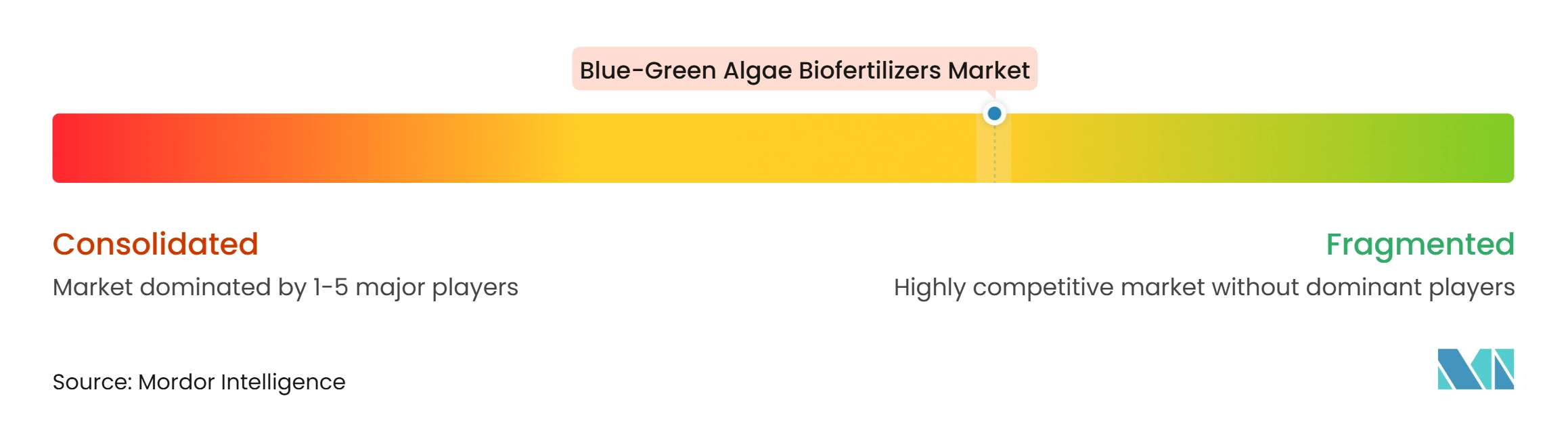
The Blue-Green Algae Biofertilizers Market is low. Global agricultural biologicals groups, government-owned fertilizer entities, and specialized biotechnology companies compete across different crop and regional niches. Competition centers on strain performance, shelf life, product registration, and agronomic support. Novonesis A/S reported 7% organic sales growth in 2025 and launched 33 new products during the year.
Rizobacter Argentina S.A., a Bioceres Crop Solutions Corp. company, reported more than 20% of global inoculant production market share in its filing with the United States Securities and Exchange Commission. This position is important because the capabilities and distribution experience in inoculant production can be applied to algae-based biological products. Novonesis A/S introduced the ProPort System for seed treaters, enabling the combination of biological products to meet specific nutrient and stress needs. TrueAlgae, a GreenTech Ventures, Inc. company, and DPH Biologicals are pursuing algae-metabolite seed treatments for Iron Deficiency Chlorosis. These moves show how companies are combining biological active ingredients with more precise delivery systems.
Heliae Development, LLC and TrueAlgae, a GreenTech Ventures, Inc. company, are associated with proprietary approaches to algae-derived and metabolite-based products. Nostoc Biotech Group is building strain libraries for crop-specific products, which may appeal to partners seeking specialized cyanobacterial capabilities. The competitive gap remains most visible in low-cost, shelf-stable consortium products for tropical markets. Products that combine nitrogen fixation with phosphate solubilization could have a clearer value proposition where soil depletion affects several nutrients. The Blue-Green Algae Biofertilizers Market favors companies that can support product reliability after sale rather than only manufacture biological material.
Blue-Green Algae Biofertilizers Industry Leaders
-
Novonesis A/S
-
National Fertilizers Limited
-
T. Stanes and Company Limited
-
Kemin Industries, Inc.
-
Lallemand Inc.
- *Disclaimer: Major Players sorted in no particular order
Blue-Green Algae Biofertilizers Market Companies Covered in this Report
- AE AGRIBIOLOGICALS, S.L. (DE SANGOSSE Group)
- Novonesis A/S
- National Fertilizers Limited
- T. Stanes and Company Limited
- Camson Bio Technologies Limited
- Algenol Biotech LLC
- Kemin Industries, Inc.
- Nostoc Biotech Group
- Soil Technologies Corp.
- Symborg, S.L.
- Heliae Development, LLC
- Rizobacter Argentina S.A. (Bioceres Crop Solutions)
- Gujarat State Fertilizers and Chemicals Limited
- Madras Fertilizers Limited
- Lallemand Inc.
Recent Industry Developments in Blue-Green Algae Biofertilizers Market
- May 2026: Rizobacter Argentina S.A., a Bioceres Crop Solutions Corp. company, completed a USD 42.7 million note exchange and consent solicitation, covering 86% of outstanding principal across multiple bond series, as part of a broader liability management and maturity extension strategy. The transaction stabilizes the company’s financial position and signals continued access to Argentine and international capital markets for a firm that holds more than 20% global market share in inoculant production.
- August 2025: Itracom Fertilizers Uganda signed a USD 180 million agreement with the Ugandan Ministry of Agriculture to establish a 250,000 metric tons per year organic fertilizer manufacturing facility in Kampiringisa on 133 acres of government-provided land. The plant, backed by a presidential directive, will replicate the operational model of Itracom Fertilizers Uganda facilities in Burundi with 350,000-metric-ton capacity and Tanzania with 1 million-metric-ton capacity, with an offtake agreement guaranteeing purchase of domestically manufactured fertilizer.
- August 2025: The Alliance for Food Sovereignty in Africa launched a policy brief at the Africa Food Systems Forum in Senegal calling on African governments to replace 50% of synthetic fertilizer use with biofertilizers and biostimulants by 2030 and to redirect national subsidy budgets, including Senegal’s CFA 40 billion (USD 67 million) allocation for synthetic inputs, toward locally produced biological alternatives.
Global Blue-Green Algae Biofertilizers Market Report Scope
Blue-green algae biofertilizers are biological fertilizers containing nitrogen-fixing cyanobacteria that convert atmospheric nitrogen into forms accessible to plants. They improve soil fertility, enhance nutrient availability, and support crop growth, particularly in paddy cultivation.
The Blue-Green Algae Biofertilizers Market is Segmented by Type (Nitrogen-Fixing, Phosphate-Solubilizing, Potash-Solubilizing, Multi-Strain, Other), Form (Powder, Liquid, Granular, Carrier-Based, Encapsulated/Gel), Application (Soil, Seed, Foliar, Fertigation, Hydroponic, Green Manuring), Crop Type (Cereals, Pulses, Oilseeds, Fruits/Vegetables, Commercial, Turf), and Geography (North America, South America, Europe, Asia-Pacific, Middle East, Africa). Forecasts in Value (USD).
Segmentation Overview
| Nitrogen-Fixing Biofertilizers |
| Phosphate-Solubilizing and Mobilizing Biofertilizers |
| Potash-Solubilizing and Mobilizing Biofertilizers |
| Multi-Strain and Consortium Biofertilizers |
| Other Functional Blue Green Algae Biofertilizers |
| Powder Biofertilizers |
| Liquid Biofertilizers |
| Granular Biofertilizers |
| Carrier-Based Biofertilizers |
| Encapsulated and Gel-Based Biofertilizers |
| Soil Treatment |
| Seed Treatment |
| Foliar Treatment |
| Fertigation |
| Hydroponic and Controlled-Environment Application |
| Green Manuring and Paddy-Field Inoculation |
| Cereals and Grains |
| Pulses and Legumes |
| Oilseeds |
| Fruits and Vegetables |
| Commercial Crops |
| Turf, Ornamentals, and Other Crops |
| North America | United States |
| Canada | |
| Mexico | |
| Rest of North America | |
| South America | Brazil |
| Argentina | |
| Colombia | |
| Chile | |
| Rest of South America | |
| Europe | Germany |
| France | |
| United Kingdom | |
| Italy | |
| Spain | |
| Netherlands | |
| Russia | |
| Rest of Europe | |
| Asia-Pacific | China |
| India | |
| Japan | |
| South Korea | |
| Indonesia | |
| Thailand | |
| Vietnam | |
| Australia | |
| New Zealand | |
| Rest of Asia-Pacific | |
| Middle East | Saudi Arabia |
| United Arab Emirates | |
| Israel | |
| Turkey | |
| Rest of Middle East | |
| Africa | South Africa |
| Egypt | |
| Nigeria | |
| Kenya | |
| Rest of Africa |
| By Type | Nitrogen-Fixing Biofertilizers | |
| Phosphate-Solubilizing and Mobilizing Biofertilizers | ||
| Potash-Solubilizing and Mobilizing Biofertilizers | ||
| Multi-Strain and Consortium Biofertilizers | ||
| Other Functional Blue Green Algae Biofertilizers | ||
| By Form | Powder Biofertilizers | |
| Liquid Biofertilizers | ||
| Granular Biofertilizers | ||
| Carrier-Based Biofertilizers | ||
| Encapsulated and Gel-Based Biofertilizers | ||
| By Application | Soil Treatment | |
| Seed Treatment | ||
| Foliar Treatment | ||
| Fertigation | ||
| Hydroponic and Controlled-Environment Application | ||
| Green Manuring and Paddy-Field Inoculation | ||
| By Crop Type | Cereals and Grains | |
| Pulses and Legumes | ||
| Oilseeds | ||
| Fruits and Vegetables | ||
| Commercial Crops | ||
| Turf, Ornamentals, and Other Crops | ||
| By Geography | North America | United States |
| Canada | ||
| Mexico | ||
| Rest of North America | ||
| South America | Brazil | |
| Argentina | ||
| Colombia | ||
| Chile | ||
| Rest of South America | ||
| Europe | Germany | |
| France | ||
| United Kingdom | ||
| Italy | ||
| Spain | ||
| Netherlands | ||
| Russia | ||
| Rest of Europe | ||
| Asia-Pacific | China | |
| India | ||
| Japan | ||
| South Korea | ||
| Indonesia | ||
| Thailand | ||
| Vietnam | ||
| Australia | ||
| New Zealand | ||
| Rest of Asia-Pacific | ||
| Middle East | Saudi Arabia | |
| United Arab Emirates | ||
| Israel | ||
| Turkey | ||
| Rest of Middle East | ||
| Africa | South Africa | |
| Egypt | ||
| Nigeria | ||
| Kenya | ||
| Rest of Africa | ||
Key Questions Answered in the Report
What is the projected value of blue-green algae biofertilizers by 2032?
The category is projected to reach USD 51.31 billion by 2032, growing from USD 29.91 billion in 2027 at an 11.40% CAGR.
Which blue-green algae biofertilizer type had the largest share?
Nitrogen-Fixing Biofertilizers was the largest type segment, with 42.6% share in 2026.
Which formulation is projected to grow fastest through 2032?
Liquid Biofertilizers will be the fastest form segment, with a forecast 11.9% CAGR through 2032.
Why are cyanobacterial biofertilizers useful for rice production?
Flooded paddy conditions support cyanobacterial establishment, and nitrogen fixation can reduce urea use in a crop cycle.
Which region had the largest share in 2026?
Asia-Pacific was the largest regional segment, with 38.4% share in 2026, supported by paddy cultivation and formal biofertilizer standards.
Which region will grow fastest through 2032?
Africa will be the fastest regional segment, with a forecast CAGR of 12.1%, supported by policy activity, local production plans, and soil-health needs.