
Blow Molded Plastics Market Size and Share
Market Overview
| Study Period | 2021 - 2031 |
|---|---|
| Market Size (2026) | USD 98.22 Billion |
| Market Size (2031) | USD 126.35 Billion |
| Growth Rate (2026 - 2031) | 5.17 % |
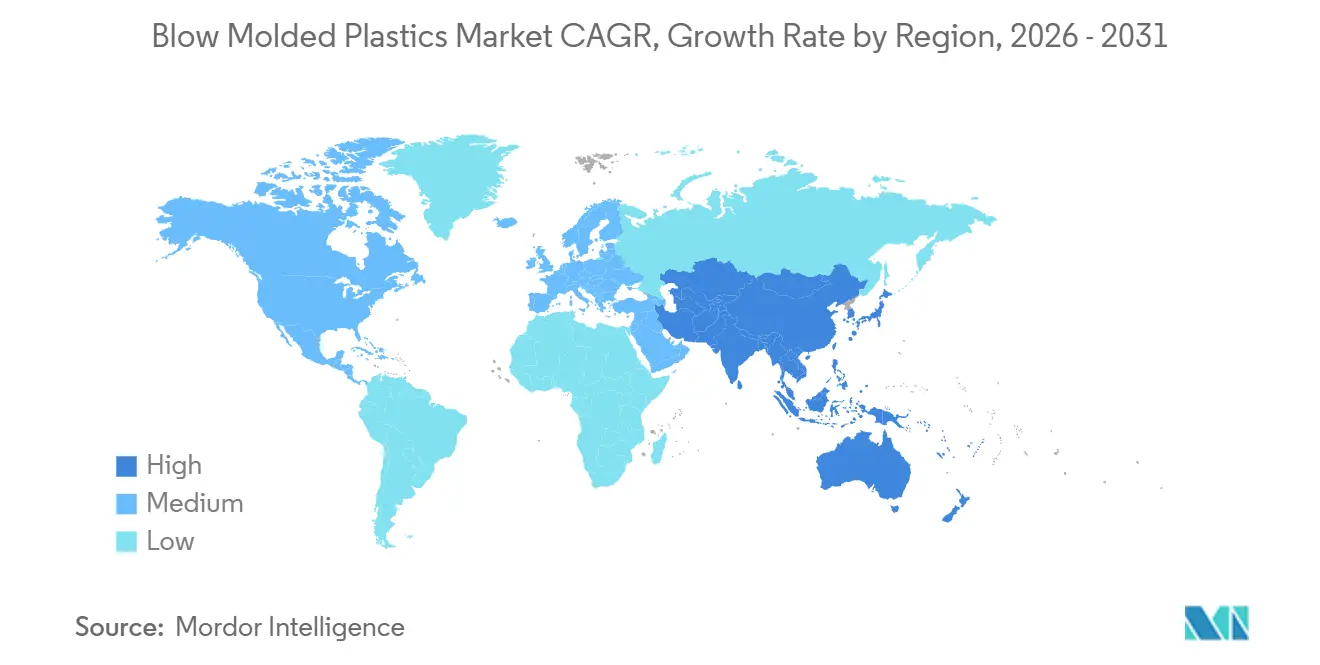
| Fastest Growing Market | Asia-Pacific |
| Largest Market | Asia-Pacific |
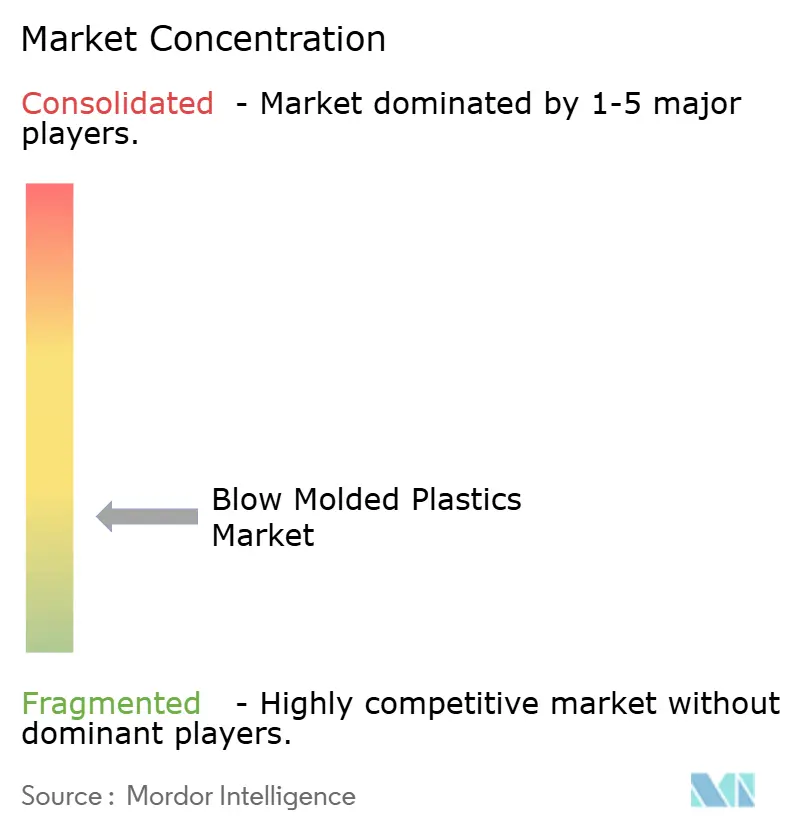
| Market Concentration | Low |
Major Players *Disclaimer: Major Players sorted in no particular order Image © Mordor Intelligence. Reuse requires attribution under CC BY 4.0. | |
Blow Molded Plastics Market Analysis by Mordor Intelligence
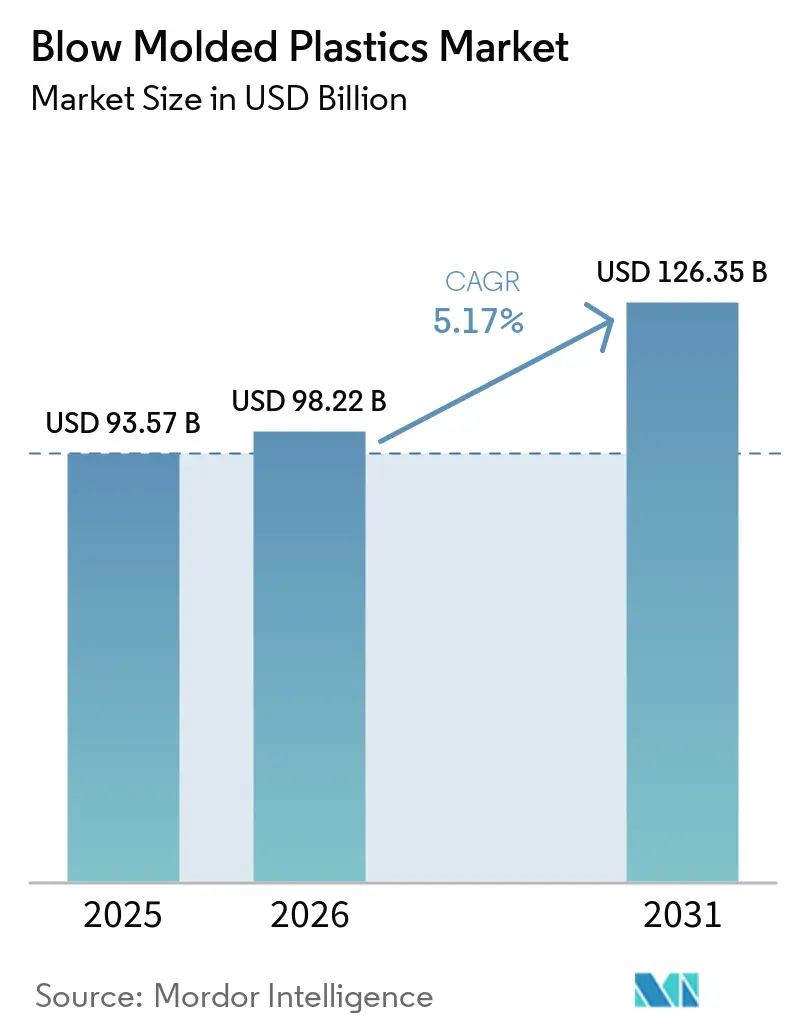
The Blow Molded Plastics Market was valued at USD 93.57 billion in 2025 and is estimated to grow from USD 98.22 billion in 2026 to reach USD 126.35 billion by 2031, at a CAGR of 5.17% during the forecast period (2026–2031). Demand is supported by packaging, automotive, and pharmaceutical uses, where lightweight and precisely formed containers are replacing glass and metal in selected formats. The blow molded plastics market benefits when brands seek lower freight loads, better line handling, and designs that fit high-volume filling operations. Producers are also adapting their material choices as recycled-content requirements become more important in Europe and North America. This shift creates opportunities for converters that can pair container performance with verified recycled or bio-based resin content. Competition remains balanced between global suppliers with broad plant networks and regional converters that compete through local service, tooling responsiveness, and customer proximity
Key Report Takeaways
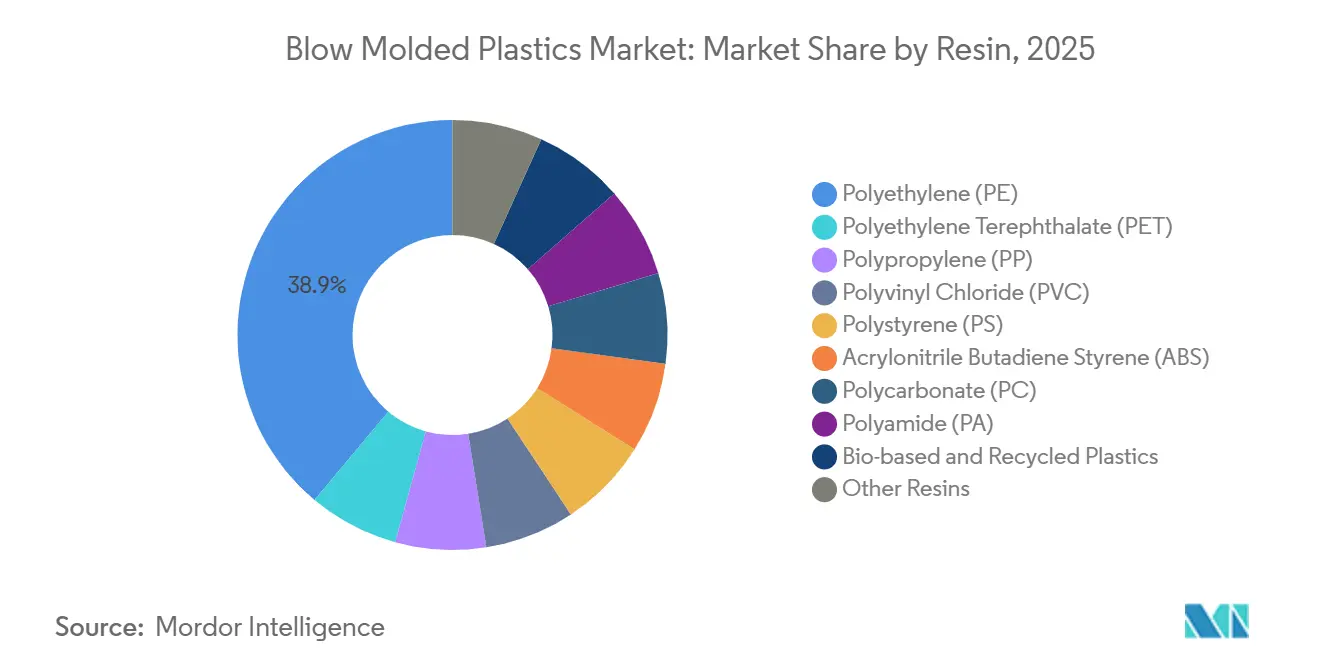
- By resin, polyethylene held 38.92% of the blow molded plastics market share in 2025, while bio-based and recycled plastics are forecast to grow at an 8.02% CAGR through 2031.
- By molding method, extrusion blow molding held 47.21% of the blow molded plastics market share in 2025, while injection stretch blow molding is forecast to grow at a 6.45% CAGR through 2031.
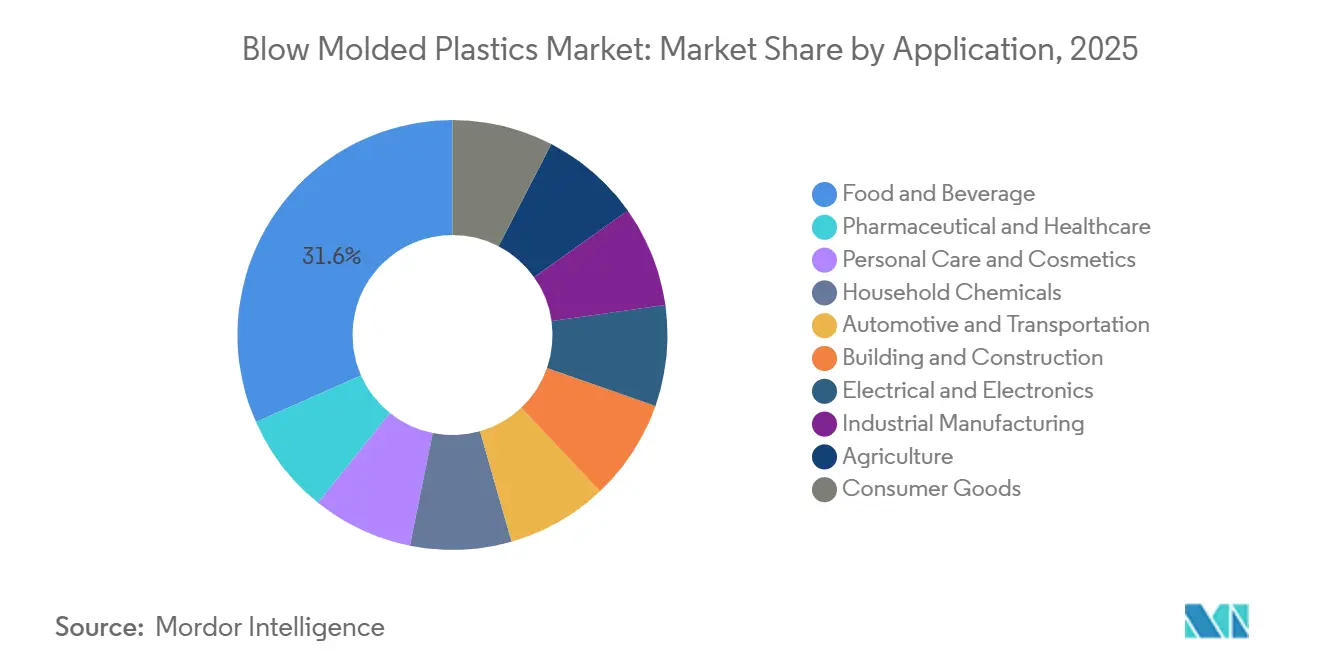
- By application, food and beverage held 31.64% of the blow molded plastics market share in 2025, while pharmaceutical and healthcare is forecast to grow at a 6.81% CAGR through 2031.
- By geography, Asia-Pacific held 48.33% of the blow molded plastics market share in 2025 and is forecast to grow at a 5.96% CAGR through 2031.
Note: Market size and forecast figures in this report are generated using Mordor Intelligence’s proprietary estimation framework, updated with the latest available data and insights as of January 2026.
Market Trends and Insights
Drivers Impact Analysis of Blow Molded Plastics Market*
| Driver | (~) % Impact on CAGR Forecast | Geographic Relevance | Impact Timeline |
|---|---|---|---|
| Growing Replacement of Glass and Metal with Lightweight Plastic Packaging | +1.4% | Global, strongest in Asia-Pacific and North America | Short term (≤ 2 years) |
| Expanding Demand from the Food & Beverage Packaging Industry | +1.1% | Global, highest absolute volumes in Asia-Pacific and South America | Medium term (2–4 years) |
| Increasing Use of Blow Molded Plastics in Pharmaceutical and Healthcare Packaging | +1.0% | Global, led by North America, Europe, and Asia-Pacific | Long term (≥ 4 years) |
| Rising Automotive Lightweighting and Electric Vehicle Component Production | +0.8% | Asia-Pacific (China, South Korea), Europe, North America | Medium term (2–4 years) |
| Growing Adoption of Recycled and Bio-Based Resins in Blow Molding Applications | +0.7% | Europe (policy-driven), North America, spill-over to APAC core | Long term (≥ 4 years) |
| Source: Mordor Intelligence | |||
Growing Replacement of Glass and Metal with Lightweight Plastic Packaging
Blow molded containers are gaining use in beverage, household chemical, and industrial packaging where operators value lower weight, dependable handling, and reduced breakage. The blow molded plastics market is supported by containers that can reduce shipment loads and work reliably on high-speed filling lines across consumer and industrial production sites. The blow molded containers can achieve 20% to 30% weight reductions compared with glass equivalents. This benefit can lower freight costs, reduce breakage losses, and improve handling during packaging and distribution operations. Polyethylene Terephthalate (PET) is extending into selected premium beverage formats, while narrow-neck production methods are being used to lower bottle weight. The move toward lighter containers gives converters a reason to invest in material-efficient designs without changing the basic functionality expected by brand owners.
Expanding Demand from the Food and Beverage Packaging Industry
Food and beverage accounted for 31.64% of demand in 2025 and remained the largest application base for the blow molded plastics market. Carbonated drinks, bottled water, dairy products, condiments, and functional beverages require large volumes of rigid packaging across established and developing consumer markets. Multi-layer co-extrusion allows producers to add oxygen, ultraviolet, and moisture barriers within a bottle wall during one manufacturing process. These structures can extend the shelf life of sensitive products while retaining the container characteristics required by retailers and brand owners. The EU Packaging and Packaging Waste Regulation is increasing interest in designs that support recyclability and reuse objectives. Brands are also using the International Sustainability and Carbon Certification Standard to verify recycled-resin content claims, which raises documentation requirements for packaging suppliers.
Increasing Use of Blow Molded Plastics in Pharmaceutical and Healthcare Packaging
The pharmaceutical and healthcare application is forecast to grow at a 6.81% CAGR through 2031. The blow molded plastics market gains from expanded generic drug volumes, biologic formulations, and requirements for containers with dependable closure, tamper-evident features, and consistent dimensions. The U.S. Drug Supply Chain Security Act has increased the need for packaging that supports precise identification and serialization. The World Health Organization estimated global pharmaceutical production at USD 1.48 trillion in 2024, and oral dosage forms represented the largest packaging volume subsegment[1]. Biologic products also require high-clarity and low-extractable packaging, which increases the role of technically demanding bottles and vials. Gerresheimer began operations at its Zhenjiang Dagang plant in China in July 2026, doubling injectable primary packaging capacity at that location.
Rising Automotive Lightweighting and Electric Vehicle Component Production
Automotive demand is broadening from conventional fuel tanks to battery cooling circuits, heating and ventilation ducts, and thermal-management components. The blow molded plastics market, therefore, has an additional route to growth as battery electric vehicle platforms require hollow, space-efficient, and durable plastic parts. Battery covers, fluid-management ducts, and heating and ventilation parts use shapes that do not have direct equivalents in many legacy vehicle designs. Fuel economy and emissions requirements also encourage manufacturers to use lower-weight polypropylene (PP), polyamide (PA), and polycarbonate (PC) parts across underbody, powertrain, and exterior applications.
Restraints Impact Analysis of Blow Molded Plastics Market*
| Restraint | (~) % Impact on CAGR Forecast | Geographic Relevance | Impact Timeline |
|---|---|---|---|
| Rising Plastic Waste Management and Recycling Infrastructure Challenges | -1.1% | Global, most acute in South Asia, Southeast Asia, and MEA | Long term (≥ 4 years) |
| Volatility in Petrochemical Feedstock and Plastic Resin Prices | -0.9% | Global, highest exposure in Asia-Pacific and North America | Short term (≤ 2 years) |
| Growing Competition from Flexible Packaging, Paper-Based Packaging, and Alternative Materials | -0.8% | Europe (policy-driven), North America, spill-over to APAC core | Medium term (2–4 years) |
| Source: Mordor Intelligence | |||
Rising Plastic Waste Management and Recycling Infrastructure Challenges
Collection and sorting capacity does not always match the circular-economy commitments made by packaging suppliers, brand owners, and public authorities. Multi-layer bottles can deliver strong barrier properties but remain harder to recycle at scale than simpler structures. This creates a tradeoff between product protection and end-of-life processing in the blow molded plastics market. The constraint is especially relevant to EVOH-barrier food bottles and multilayer High-Density Polyethylene (HDPE) automotive fuel tanks that serve demanding technical applications. South Asia and Southeast Asia face added pressure because collection systems may not meet the requirements of export customers seeking minimum recycled content. The EU Packaging and Packaging Waste Regulation requires packaging to be recyclable by 2030, increasing the compliance burden for converters that sell into regulated markets.
Volatility in Petrochemical Feedstock and Plastic Resin Prices
Resin price volatility is an immediate margin concern for converters in 2026. The geopolitical disruption in early 2026 led to higher PE, PP, and Polyvinyl Chloride (PVC) prices for processors. Natural-gas volatility during 2025 also affected ethylene and propylene costs for blow molding grades. Most independent molders operate under packaging contracts that do not always allow rapid price adjustments when input costs change. They have less feedstock protection than integrated resin producers, which can create periods of earnings pressure. This exposure can delay investment decisions and make resin procurement a central operating issue for the blow molded plastics market.
*Our forecasts treat driver/restraint impacts as directional, not additive. The impact forecasts reflect baseline growth, mix effects, and variable interactions.
Blow Molded Plastics Market Segment Analysis
By Resin:
Polyethylene Leads While Recycled and Bio-based and Recycled Plastics Grow FasterPolyethylene held 38.92% of revenue in 2025 and represented the largest resin segment in the blow molded plastics market. Its cost profile, chemical resistance, and compatibility with extrusion blow molding and co-extrusion support high-volume packaging and industrial applications. HDPE is used widely in industrial containers, household chemical bottles, and bulk packaging drums. LDPE and LLDPE support softer formats that require squeezing, flexibility, or controlled dispensing. PET remains another important resin because of its clarity, barrier performance, and recycling options, which suit beverage, personal care, and pharmaceutical bottles. The installed base of Injection Stretch Blow Molding (ISBM) equipment in the Asia-Pacific and North America also supports PET processing.
Bio-based and recycled plastics are projected to expand at an 8.02% CAGR through 2031 within the blow molded plastics market. PP serves specialized automotive and medical uses within the blow molded plastics market, while PVC is used in industrial containers. ABS and PC are used in electronic and safety-critical applications that require more specific properties. PA has an expanding role in electric vehicle fluid-management systems because it handles heat and chemicals more effectively than PE or PP in demanding settings. LyondellBasell’s 2025 FDA letters for recycled PP and HDPE offer a formal pathway for selected food-contact and personal-care applications. Verified content standards can help suppliers show that recycled and bio-based resin claims are supported by traceable documentation.

By Molding Method:
Extrusion Blow Molding Leads as ISBM ExpandsExtrusion blow molding held 47.21% of molding-method revenue in 2025, giving it the leading position in the blow molded plastics market. The method serves containers ranging from personal care bottles to industrial drums and larger bulk-packaging formats. It also supports multi-layer structures and has a long-established role in automotive fuel tanks and heating and ventilation components. Injection blow molding serves pharmaceutical and cosmetic packaging, where dimensional consistency and wall thickness are important. Co-extrusion is gaining use in food packaging that needs oxygen, ultraviolet, and moisture barriers. These methods give packaging producers options across a wide range of container sizes, material combinations, and performance requirements.
Injection stretch blow molding is forecast to grow at a 6.45% CAGR through 2031. It is particularly suited to PET formats in the blow molded plastics market, where material distribution and lower container weight are important. A study by Polyplastics, Colgate-Palmolive, and PTI found that TOPAS COC copolymer in HDPE can allow ISBM to reduce container weight and cycle time by more than 25% against conventional extrusion blow molding. The reported result also supports recyclable containers designed for household and personal care uses. Lower unit weight and shorter cycle time can influence decisions between new ISBM capacity and incremental upgrades to existing extrusion blow molding equipment. This makes ISBM relevant to brand owners who have explicit lightweighting and logistics targets.
By Application:
Food and Beverage Retains Scale While Pharmaceutical and Healthcare Grow FastestFood and beverage accounted for 31.64% of revenue in 2025, the largest application share in the blow molded plastics market. Carbonated drinks, bottled water, dairy products, condiments, and functional beverages create the highest global volumes. Urban consumption growth supports these uses across Asia, Africa, and Latin America, where packaged-product availability is expanding. Personal care and cosmetics are another major outlet, and PET bottles made through ISBM are replacing selected premium glass formats. Household chemicals, construction, and industrial manufacturing support demand for HDPE drums, intermediate bulk containers, and bulk storage formats. Agriculture contributes to demand through agrochemical jugs and irrigation components, especially in South America and Middle-East and Africa.
The pharmaceutical and healthcare is projected to grow at a 6.81% CAGR through 2031. Aging populations, broader access to generic medicines, and biologic formulations support this demand in the blow molded plastics market. The U.S. FDA, European Medicines Agency, and India’s Central Drugs Standard Control Organisation require container-closure integrity, extractable and leachable control, and tamper evidence for regulated products. Blow molded HDPE and PP bottles are engineered to meet these requirements in many pharmaceutical applications. Automotive and transportation uses also gain from EV thermal-management and fluid-containment components. PVC fittings and HDPE containment products support construction demand, while consumer goods cover toys, sporting equipment, and specialty packaging.
Geography Analysis
APAC Blow Molded Plastics Market
Asia-Pacific held 48.33% of global revenue in 2025 and is forecast to grow at a 5.96% CAGR through 2031. This performance gives the region the leading share and growth rate in the blow molded plastics market. China’s petrochemical clusters in Guangdong and Zhejiang support efficient raw material flows to downstream converters and packaging operations. India’s pharmaceutical manufacturing expansion supports demand for precise and tamper-evident containers. Japan and South Korea maintain a premium role in high-specification pharmaceutical and semiconductor component packaging.
North America and Europe Blow Molded Plastics Market
North America has an established base of molding assets, contract packaging operations, automotive production, and pharmaceutical packaging investment. Graham Packaging announced a USD 35 million expansion and modernization project for its Hammond, Louisiana, facility, with upgrades targeted for completion by 2027. Europe is becoming more value-intensive as Packaging and Packaging Waste Regulation (PPWR) requirements redirect investment toward monomaterial and recycled-content structures. Germany, France, Italy, and the UK are important markets for these changes. Suppliers that can provide compliant rigid containers can strengthen their position with consumer goods companies.
EMEA and South America Blow Molded Plastics Market
South America and Middle-East and Africa offer distinct sources of demand for the blow molded plastics market. Brazil and Argentina support South American consumption through food processing and agrochemical packaging. Saudi Arabia and South Africa lead in Middle-East and Africa, where Gulf Cooperation Council petrochemical integration supports resin-to-packaging conversion. Urbanization and consumer goods penetration create longer-term demand across Sub-Saharan Africa. Recycling and collection gaps can complicate sustainability compliance for multinational converters. Greif completed the acquisition of Envaplast in Spain in June 2026, adding a manufacturing platform that supports its Europe and Middle-East and Africa polymer-packaging expansion.
Competitive Landscape
The blow molded plastics market is highly fragmented, with the top five players including Amcor plc, Altium Packaging, Graham Packaging, ALPLA, and Plastipak Holdings, Inc. Large suppliers differentiate through design capability, multi-technology plant networks, related recycling infrastructure, and broad customer coverage. Regional suppliers compete through tooling speed, local service, and proximity to brand-owner packaging operations. These positions allow competitors to address both large standardized programs and smaller application-specific requirements. The competitive picture is therefore not dominated by a single supplier or a small group with disclosed combined shares.
Strategic activity is reshaping pharmaceutical packaging in the blow molded plastics market. Gerresheimer agreed in 2026 to sell its global Primary Packaging Plastics business and U.S. subsidiary Centor to Apax Funds at a combined enterprise value of EUR 1.5 billion (approximately USD 1.71 billion). The transaction covers 15 pharmaceutical plastics packaging sites in 9 countries and is targeted for completion by the early financial year 2027. This creates an independent platform focused on a faster-growing application area. Additionally, Silgan Holdings signaled interest in Gerresheimer in March 2026. Such activity shows that packaging companies are looking across material categories and regions when assessing growth opportunities.
Product development is increasingly focused on balancing barrier performance and recyclability. Plastipak commercially launched O2Blox in June 2026, a nylon-free PET oxygen-barrier technology recognized by the Association of Plastic Recyclers (APR) and RecyClass for bottle-to-bottle recyclability[2]. The technology is being scaled with Eckes-Granini Group for oxygen-sensitive beverage applications and can support structures containing up to 100% post-consumer recycled PET. Pharmaceutical-grade recycled resin processing, food-contact bio-based materials, and EV thermal-management components remain areas where validated capacity is limited. Quality systems and regulatory approvals can also determine which converters are eligible for pharmaceutical procurement. These barriers favor suppliers that can demonstrate documentation, processing consistency, and validated manufacturing capability.
Blow Molded Plastics Industry Leaders
-
Amcor plc
-
Altium Packaging
-
Graham Packaging
-
ALPLA
-
Plastipak Holdings, Inc.
- *Disclaimer: Major Players sorted in no particular order
Blow Molded Plastics Market Companies Covered in this Report
- ALPLA
- Altium Packaging
- Amcor plc
- Comar, LLC
- Gerresheimer AG
- Graham Packaging
- Greif Inc.
- Inpress Plastics Ltd.
- Mauser Packaging Solutions
- Plastipak Holdings, Inc.
- Pretium Packaging, L.L.C.
- Retal Industries Ltd.
- Serioplast S.p.A.
- Silgan Holdings Inc.
Recent Industry Developments in Blow Molded Plastics Market
- July 2026: Greif Inc. completed the acquisition of Envaplast, a Spanish manufacturer of small polymer containers serving the agrochemical market. The acquisition expands Greif's polymer packaging manufacturing footprint across Europe, Middle-East and Africa (EMEA), strengthening its position in blow molded plastic container solutions for industrial packaging applications.
- November 2025: Plastipak Holdings, Inc. invested USD 53.8 million to expand its blow molding plant in Pineville, Louisiana. The expansion added 200,000 square feet of space to its Rapides Parish manufacturing facility, including additional warehouse space and up to five new production lines, to streamline operations.
Global Blow Molded Plastics Market Report Scope
Blow molded plastics are hollow plastic products manufactured by inflating heated thermoplastic materials inside a mold to achieve the desired shape. They are widely used to produce lightweight, durable, and cost-effective containers, tanks, bottles, and industrial components for packaging, automotive, healthcare, construction, and consumer applications.
The Blow Molded Plastics Market is segmented by resin, molding method, application, and geography. By resin, the market is segmented into polyethylene (PE), polyethylene terephthalate (PET), polypropylene (PP), polyvinyl chloride (PVC), polystyrene (PS), acrylonitrile butadiene styrene (ABS), polycarbonate (PC), polyamide (PA), bio-based and recycled plastics, and other resins. By molding method, the market is segmented into extrusion blow molding (EBM), injection blow molding (IBM), injection stretch blow molding (ISBM), and co-extrusion blow molding. By application, the market is segmented into food and beverage, pharmaceutical and healthcare, personal care and cosmetics, household chemicals, automotive and transportation, building and construction, electrical and electronics, industrial manufacturing, agriculture, and consumer goods. The report also covers the market size and forecasts for blow molded plastics in 16 countries across major regions. For each segment, the market sizing and forecasts have been done on the basis of value (USD).
Segmentation Overview
| Polyethylene (PE) |
| Polyethylene Terephthalate (PET) |
| Polypropylene (PP) |
| Polyvinyl Chloride (PVC) |
| Polystyrene (PS) |
| Acrylonitrile Butadiene Styrene (ABS) |
| Polycarbonate (PC) |
| Polyamide (PA) |
| Bio-based and Recycled Plastics |
| Other Resins |
| Extrusion Blow Molding (EBM) |
| Injection Blow Molding (IBM) |
| Injection Stretch Blow Molding (ISBM) |
| Co-Extrusion Blow Molding |
| Food and Beverage |
| Pharmaceutical and Healthcare |
| Personal Care and Cosmetics |
| Household Chemicals |
| Automotive and Transportation |
| Building and Construction |
| Electrical and Electronics |
| Industrial Manufacturing |
| Agriculture |
| Consumer Goods |
| Asia-Pacific | China |
| India | |
| Japan | |
| South Korea | |
| Rest of Asia-Pacific | |
| North America | United States |
| Canada | |
| Mexico | |
| Europe | Germany |
| United Kingdom | |
| France | |
| Italy | |
| Russia | |
| Rest of Europe | |
| South America | Brazil |
| Argentina | |
| Rest of South America | |
| Middle-East and Africa | Saudi Arabia |
| South Africa | |
| Rest of Middle-East and Africa |
| By Resin | Polyethylene (PE) | |
| Polyethylene Terephthalate (PET) | ||
| Polypropylene (PP) | ||
| Polyvinyl Chloride (PVC) | ||
| Polystyrene (PS) | ||
| Acrylonitrile Butadiene Styrene (ABS) | ||
| Polycarbonate (PC) | ||
| Polyamide (PA) | ||
| Bio-based and Recycled Plastics | ||
| Other Resins | ||
| By Molding Method | Extrusion Blow Molding (EBM) | |
| Injection Blow Molding (IBM) | ||
| Injection Stretch Blow Molding (ISBM) | ||
| Co-Extrusion Blow Molding | ||
| By Application | Food and Beverage | |
| Pharmaceutical and Healthcare | ||
| Personal Care and Cosmetics | ||
| Household Chemicals | ||
| Automotive and Transportation | ||
| Building and Construction | ||
| Electrical and Electronics | ||
| Industrial Manufacturing | ||
| Agriculture | ||
| Consumer Goods | ||
| By Geography | Asia-Pacific | China |
| India | ||
| Japan | ||
| South Korea | ||
| Rest of Asia-Pacific | ||
| North America | United States | |
| Canada | ||
| Mexico | ||
| Europe | Germany | |
| United Kingdom | ||
| France | ||
| Italy | ||
| Russia | ||
| Rest of Europe | ||
| South America | Brazil | |
| Argentina | ||
| Rest of South America | ||
| Middle-East and Africa | Saudi Arabia | |
| South Africa | ||
| Rest of Middle-East and Africa | ||
Key Questions Answered in the Report
What is the size of the blow molded plastics market?
The blow molded plastics market stands at USD 98.22 billion in 2026 and is forecast to reach USD 126.35 billion by 2031.
Which resin led demand for blow molded plastics in 2025?
Polyethylene led resin demand with a 38.92% revenue share in 2025, supported by its cost efficiency and chemical resistance.
Which molding method is expected to grow fastest through 2031?
Injection stretch blow molding is forecast to grow at a 6.45% CAGR through 2031 because of its PET-processing efficiency and lightweighting potential.
What application is expected to grow fastest through 2031?
The pharmaceutical and healthcare is forecast to grow at a 6.81% CAGR through 2031, supported by generic medicines, biologics, and regulated packaging needs.