
Biometrics and Spatial Privacy Identity Management Market Size and Share
Market Overview
| Study Period | 2020 - 2031 |
|---|---|
| Market Size (2026) | USD 44.22 Billion |
| Market Size (2031) | USD 88.91 Billion |
| Growth Rate (2026 - 2031) | 14.99 % |
| Fastest Growing Market | Asia-Pacific |
| Largest Market | North America |
| Market Concentration | Medium |
Major Players *Disclaimer: Major Players sorted in no particular order Image © Mordor Intelligence. Reuse requires attribution under CC BY 4.0. | |
Biometrics and Spatial Privacy Identity Management Market Analysis by Mordor Intelligence
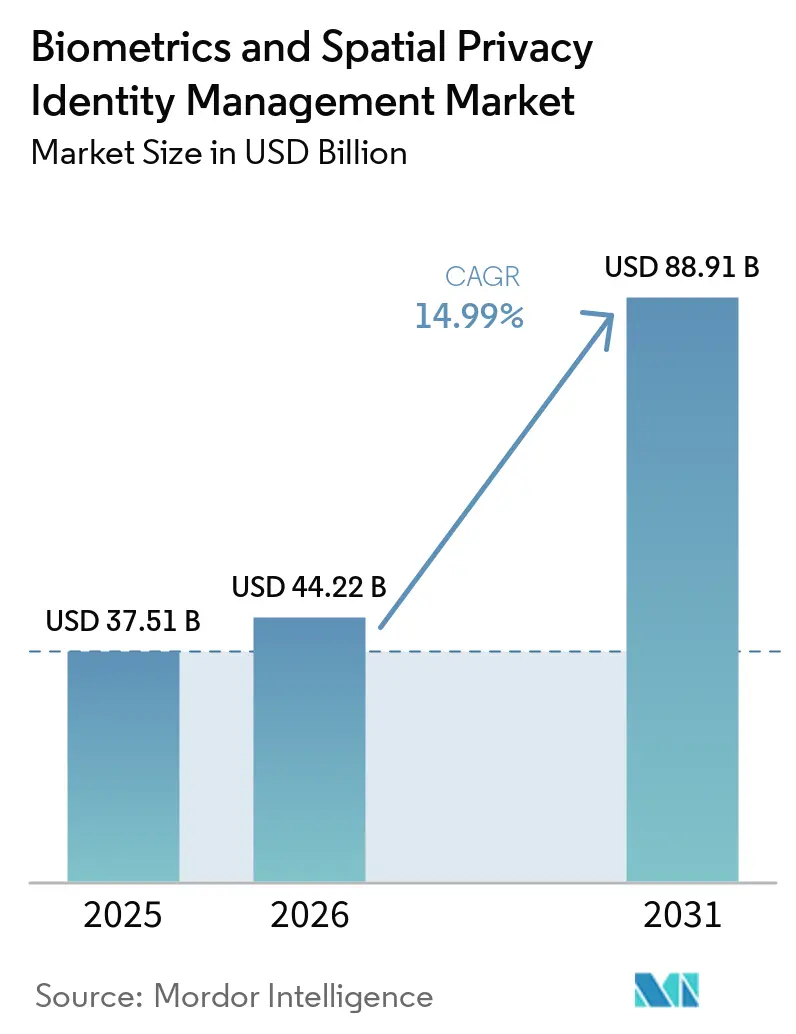
The Biometrics and Spatial Privacy Identity Management Market size is expected to increase from USD 37.51 billion in 2025 to USD 44.22 billion in 2026 and reach USD 88.91 billion by 2031, registering a CAGR of 14.99% between 2026 and 2031. Demand is shifting from scanners and terminals toward software that connects enrollment, verification, and fraud controls across several systems. Government digital identity programs are making biometric enrollment part of national infrastructure and are extending common technical requirements into commercial services. Rising synthetic identity fraud is increasing demand for continuous behavioral analysis instead of checks performed only during onboarding. Privacy rules are also changing purchasing decisions because buyers need secure template handling, local processing, and controls over how identity and location data are used. The Biometrics and Spatial Privacy Identity Management Market therefore favors suppliers that can combine trusted biometric assurance with privacy safeguards, cloud delivery, and interoperable identity workflows.
Key Report Takeaways
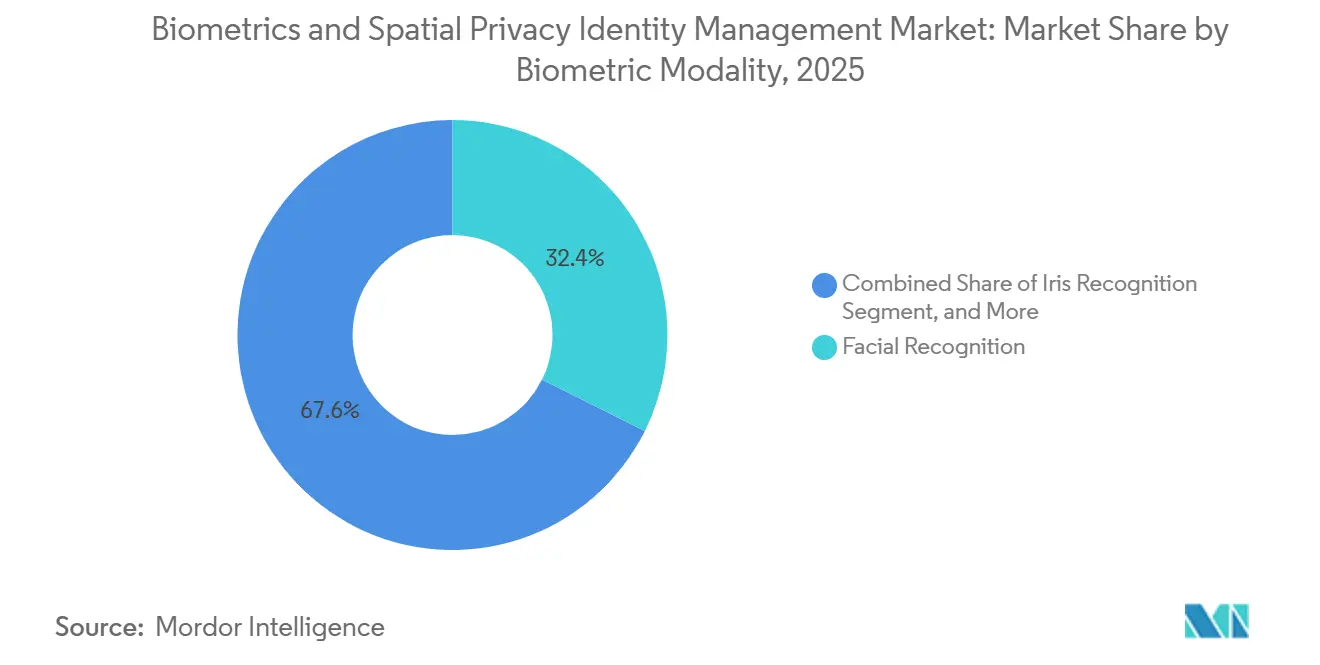
- By biometric modality, facial recognition led with 32.36% of the biometrics and spatial privacy identity management market share in 2025, while behavioral biometrics is projected to expand at a 15.31% CAGR through 2031.
- By component, software held 42.64% share in 2025 and is expected to expand at a 16.02% CAGR through 2031.
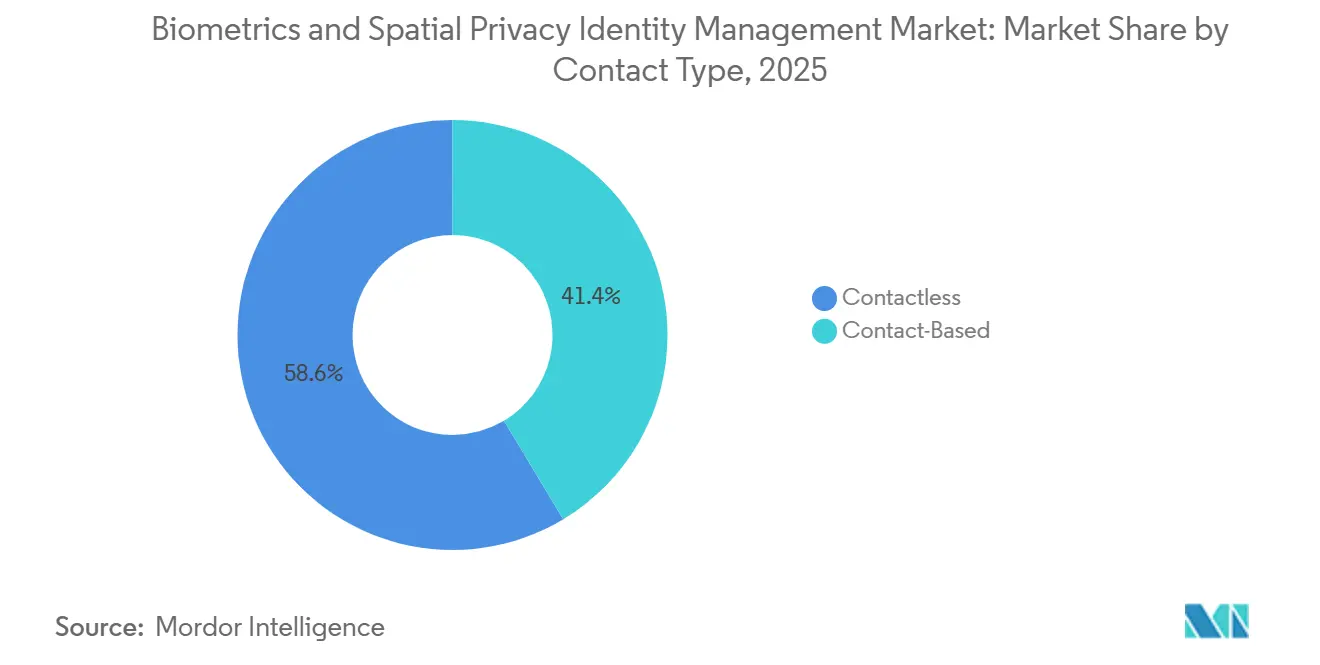
- By contact type, contactless biometrics accounted for 58.62% share in 2025 and is forecast to expand at a 15.72% CAGR through 2031.
- By application, physical and logical access control held 28.32% share of the biometrics and spatial privacy identity management market in 2025, while digital identity verification and eKYC are projected to expand at a 16.11% CAGR through 2031.
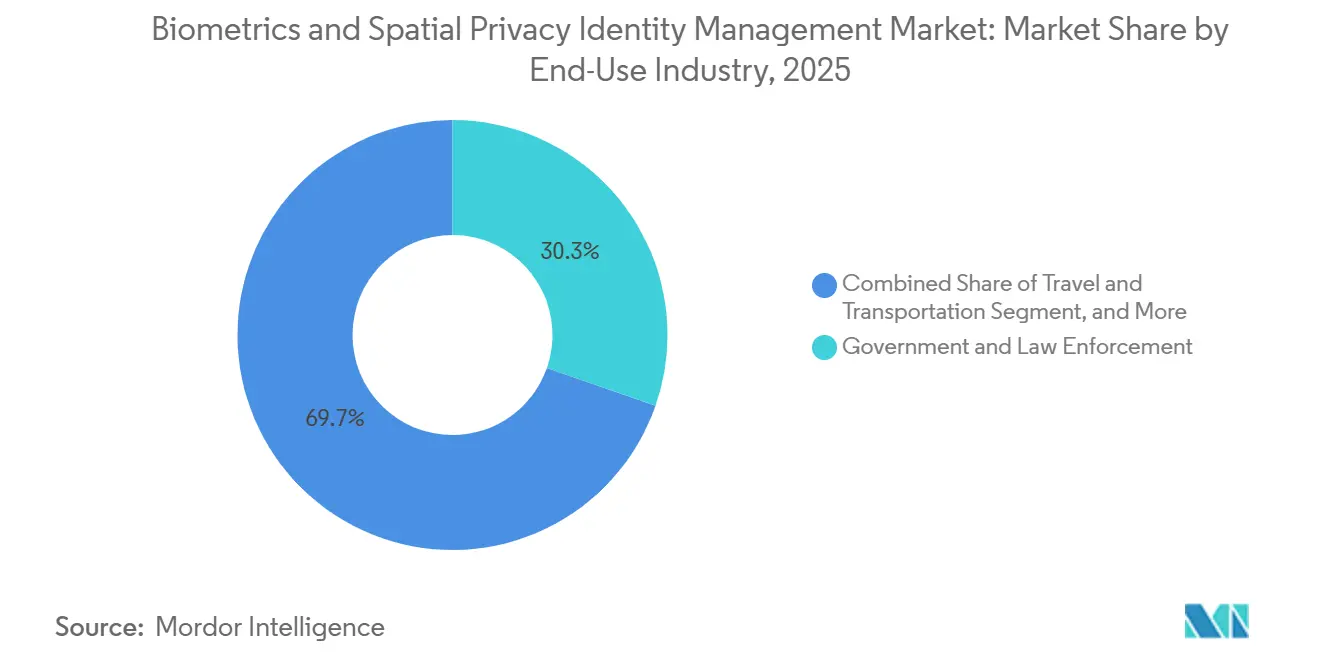
- By end-use industry, government and law enforcement held 30.34% share in 2025, while banking, financial services, and insurance are forecast to expand at a 15.84% CAGR through 2031.
- By deployment mode, cloud accounted for 60.64% share in 2025 and is projected to expand at a 16.06% CAGR through 2031.
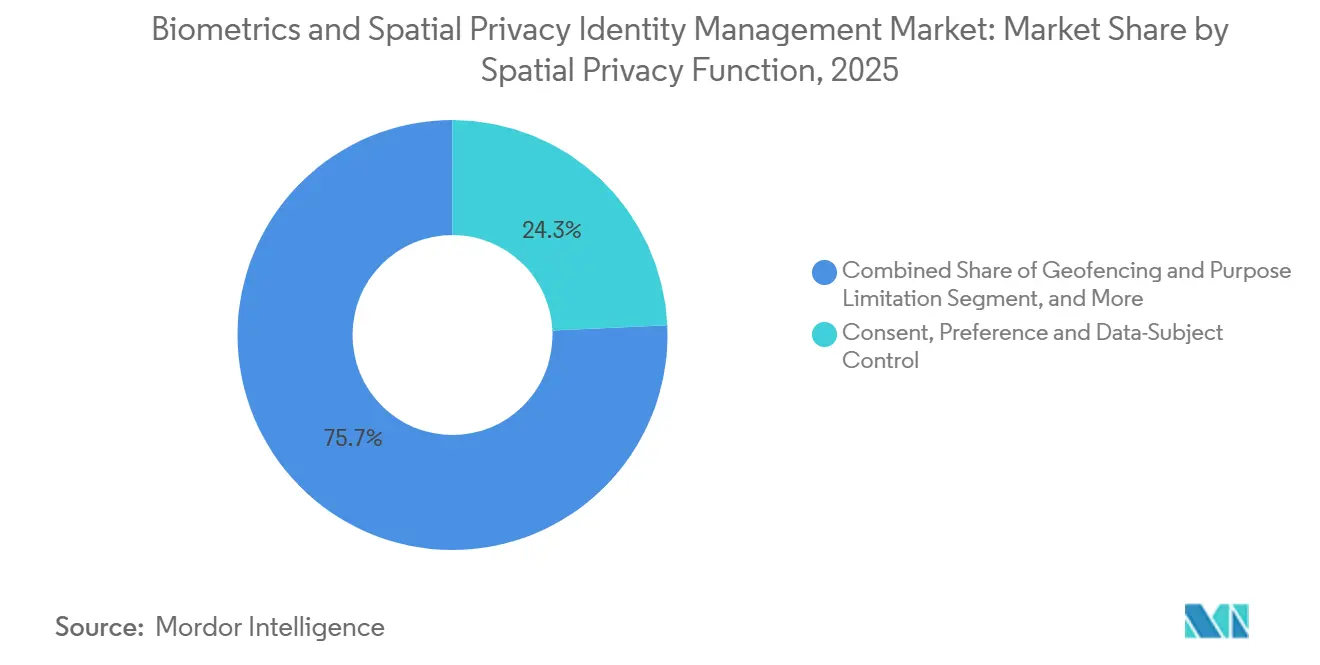
- By spatial privacy function, consent, preference, and data-subject control held 24.28% share in 2025, while differential privacy for mobility data is forecast to expand at a 16.13% CAGR through 2031.
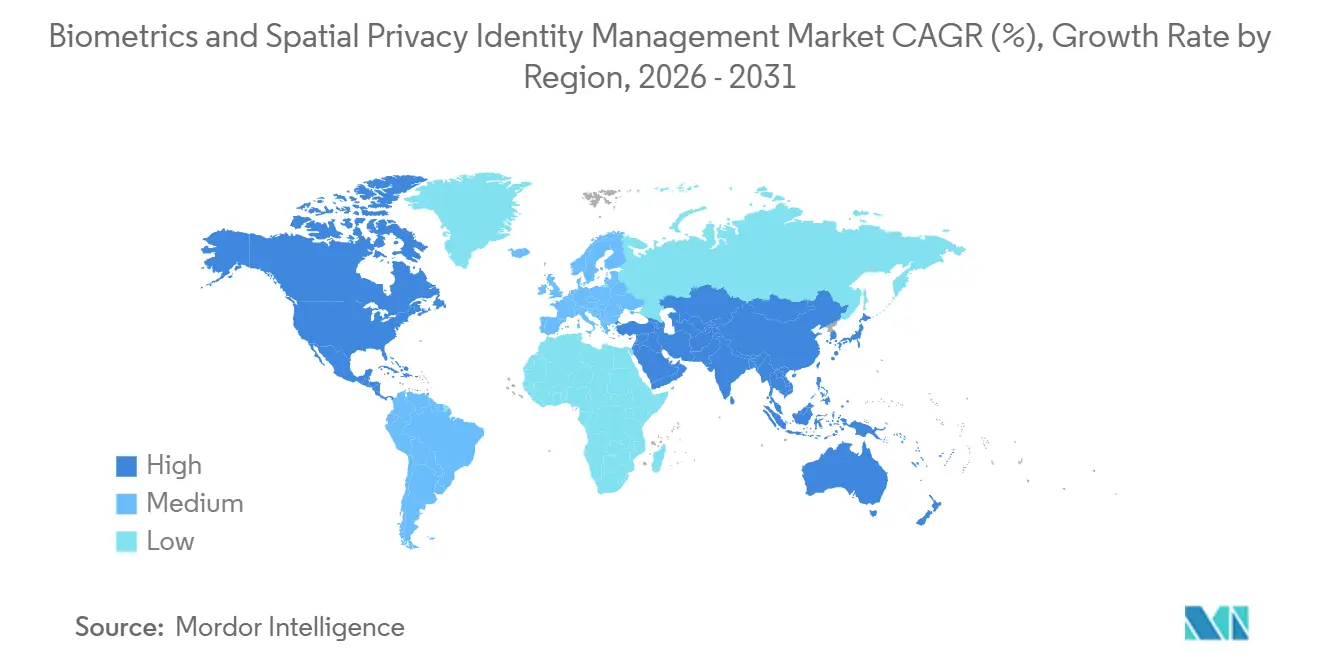
- By geography, North America held 34.38% share in 2025, while Asia-Pacific is projected to expand at a 15.89% CAGR through 2031.
Note: Market size and forecast figures in this report are generated using Mordor Intelligence’s proprietary estimation framework, updated with the latest available data and insights as of January 2026.
Market Trends and Insights
Drivers Impact Analysis of Biometrics and Spatial Privacy Identity Management Market*
| Driver | (~) % Impact on CAGR Forecast | Geographic Relevance | Impact Timeline |
|---|---|---|---|
| Government Digital Identity Mandates | +3.2% | Global, with Europe and India as primary anchors and spillover to GCC and Africa | Medium term (2-4 years) |
| Digital Fraud and Synthetic Identity Escalation | +2.8% | Global, with North America and South America most affected | Short term (≤ 2 years) |
| Contactless Border and Airport Modernization | +2.1% | Europe, Asia-Pacific, North America, and the Middle East | Medium term (2-4 years) |
| Passwordless Authentication and Payment Tokenization | +1.9% | Global, with Asia-Pacific and North America leading consumer adoption | Short term (≤ 2 years) |
| Privacy-Preserving Biometrics for Regulated Deployments | +1.6% | Europe, with spillover to Asia-Pacific and the Middle East | Medium term (2-4 years) |
| Edge AI and Multimodal Sensor Fusion | +1.4% | Global, led by Asia-Pacific manufacturing and the United States AI ecosystem | Long term (≥ 4 years) |
| Source: Mordor Intelligence | |||
Government Digital Identity Mandates
Sovereign digital identity programs are moving biometrics from a verification tool into core civil infrastructure. Regulation (EU) 2024/1183 requires each European Union member state to make at least 1 European Digital Identity Wallet available by December 2026.[1] The regulation and its implementation work make secure identity attributes central to wallet enrollment and use. India’s Aadhaar enrollment and update rules in 2026 also strengthened requirements around enrollment quality and verification. These programs create standards that private banks, travel providers, and service platforms must often support after public systems are deployed. This raises recurring demand across the Biometrics and Spatial Privacy Identity Management Market rather than limiting spending to a single government contract.
Digital Fraud and Synthetic Identity Escalation
Synthetic identity fraud is increasing the need for behavioral and multimodal verification. LexisNexis Risk Solutions reported that synthetic identity represented 11% of reported fraud globally in 2026, while South America recorded the highest regional concentration at 48.3%. Veriff reported that 4.18% of global identity-verification attempts in 2025 were fraudulent and that AI-generated media appeared in attacks 300% more often than in 2024. This threat is difficult to address through document checks alone because fabricated documents can be designed to pass a static review. Behavioral signals and continuous session monitoring add evidence that a document cannot provide. Visa’s August 2026 agreement to acquire BioCatch shows that payment networks view these controls as a core part of fraud prevention.
Contactless Border and Airport Modernization
Airports and border agencies are replacing manual checks with biometric registration and digital travel processes. The European Union Entry/Exit System completed its roll-out across Schengen external borders on April 10, 2026. The system records facial images and fingerprints of third-country nationals in place of manual passport stamping. The International Civil Aviation Organization launched a next-generation Public Key Directory in March 2026 to support cryptographic verification of travel documents. IATA also reported that contactless travel demonstrations showed digital identity can support international journeys at scale.[2] Airport operators therefore need identity orchestration, biometric capture, and managed services across the passenger journey, not only gates and kiosks.
Passwordless Authentication and Payment Tokenization
Passkeys are linking device biometrics to payment approval and reducing reliance on one-time passwords. Visa expanded its Payment Passkey service from India to additional markets through July 2026. The service enables an online cardholder to approve a transaction through device biometrics. Web Authentication Level 3 reached Candidate Recommendation status in January 2026 and formalized the technical basis for public key credentials in web authentication.[3] EMVCo guidance also describes how passkeys can work within payment systems. Each payment endpoint that adopts this method can add recurring demand for the authentication software and identity services used across the Biometrics and Spatial Privacy Identity Management Market.
Restraints Impact Analysis of Biometrics and Spatial Privacy Identity Management Market*
| Restraint | (~) % Impact on CAGR Forecast | Geographic Relevance | Impact Timeline |
|---|---|---|---|
| Biometric Consent and Data-Residency Restrictions | -2.3% | Europe, Asia-Pacific, and the Middle East | Medium term (2-4 years) |
| Spoofing, Deepfakes and Presentation-Attack Risk | -1.9% | Global, particularly BFSI, digital identity, and eKYC | Short term (≤ 2 years) |
| Legacy-System Integration and Interoperability Cost | -1.5% | North America and Europe | Medium term (2-4 years) |
| Accuracy, Bias and Unequal Performance Across Populations | -1.1% | Global, with scrutiny concentrated in the United States and Europe | Long term (≥ 4 years) |
| Source: Mordor Intelligence | |||
Biometric Consent and Data-Residency Restrictions
Privacy requirements can limit the use of biometric systems and raise the cost of deployment. The General Data Protection Regulation treats biometric data as a special category, while the European Union AI Act restricts real-time remote biometric identification in publicly accessible spaces under Article 5.India’s data protection rules also add consent obligations for biometric processing. Data-residency rules in China, India, and GCC countries can require in-country storage and processing. This can be difficult for smaller suppliers that lack local infrastructure. Buyers in Germany, France, and the Netherlands have consequently placed greater weight on on-premises and hybrid designs, limiting the margin expansion otherwise associated with cloud deployment.
Spoofing, Deepfakes and Presentation-Attack Risk
Deepfake-enabled presentation attacks are raising the performance standard for identity verification. Veriff found that digitally presented AI-generated or manipulated media appeared 300% more often in fraud attempts during 2025 than in 2024. iProov’s Dynamic Liveness solution became the first to reach CEN/TS 18099 High and Ingenium Level 4 for injection attack detection in February 2026. Peer-reviewed research has also found that multimodal liveness methods can improve resilience against spoofing and deepfake attacks on edge devices. These defenses are harder to integrate as the number of biometric signals increases. The resulting expense may favor certified platforms and make it harder for point-solution providers to compete in high-assurance use cases.
*Our forecasts treat driver/restraint impacts as directional, not additive. The impact forecasts reflect baseline growth, mix effects, and variable interactions.
Biometrics and Spatial Privacy Identity Management Market Segment Analysis
By Biometric Modality:
Facial Recognition Leads as Behavioral Analytics Gains GroundFacial recognition held 32.36% of the Biometrics and Spatial Privacy Identity Management Market share in 2025. Its position reflects passive enrollment, established camera networks, and use in border management and consumer authentication. Existing facial databases also give large deployments a practical advantage during upgrades. Iris recognition remains important in high-security government and health care access settings, while voice recognition is used in contact centers and smart-speaker authentication. Vein and palm recognition are finding use in retail checkout and hospitals where contactless alternatives are preferred.
Behavioral biometrics is projected to expand at a 15.31% CAGR through 2031, the fastest rate among modalities. It evaluates session behavior that static document reviews may miss, and Visa’s planned USD 2.4 billion acquisition of BioCatch in August 2026 supports its commercial importance. Multimodal systems combine face, fingerprint, iris, or behavioral signals when higher assurance is required. These systems can command premium pricing because they reduce reliance on a single biometric trait. Research on adaptive multimodal liveness detection also supports their use where spoofing resistance is a priority.

By Component:
Software and Services Reshape Revenue MixSoftware accounted for 42.64% of the biometrics and spatial privacy identity management market share in 2025. It is also forecast to expand at a 16.02% CAGR through 2031. Identity orchestration platforms connect data, verification engines, and decision rules across different systems. Algorithm licensing and managed-service models are gaining relevance as customers seek flexible integration, while services remain important because large deployments need implementation, support, and ongoing management.
Hardware remains necessary for enrollment kiosks, biometric cards, and access-control terminals. However, it is ceding a greater share of value to the software that manages identity workflows above the device layer. Cloud delivery supports subscription pricing, application programming interface integration, and regular algorithm updates. This provides suppliers with a more durable revenue base than a one-time hardware sale. Fingerprint Cards’ June 2026 distribution agreement for AllKey Ultra shows how hardware vendors are adding biometric processing and secure-element functions to their products. The Biometrics and Spatial Privacy Identity Management Market is therefore becoming more dependent on software-led system design.
By Contact Type:
Contactless Adoption Extends Beyond Airport InfrastructureContactless biometrics held 58.62% of the biometrics and spatial privacy identity management market share in 2025 and is forecast to expand at a 15.72% CAGR through 2031. Hygiene preferences and quicker user flows have made contactless capture a normal requirement across many deployments. Facial capture is widely used in airports, while contactless fingerprint and palm systems are also used in selected settings. The European Union Entry/Exit System requires facial images and fingerprints at Schengen borders. Airport programs in Indonesia, the Philippines, Singapore, and Dubai are supporting wider contactless-corridor deployment, while contact-based biometrics still serves high-security access control and government document enrollment.
Fingerprint sensors embedded in smart cards can support on-card matching without sending a biometric template to a central system. IDEX Biometrics received a USD 1.75 million binding order in May 2026 for biometric payment-card sensors. This shows that card-based applications remain commercially relevant. ISO/IEC 19794 data-interchange standards support compatibility between enrollment and verification systems. The two contact types will continue to serve different operational and regulatory needs across the Biometrics and Spatial Privacy Identity Management Market.
By Application:
Digital Identity Verification Outpaces Access Control GrowthPhysical and logical access control held 28.32% of the biometrics and spatial privacy identity management market share in 2025. Long-established enterprise spending on fingerprints, badges, and access systems supports replacement and upgrade demand. Digital identity verification and eKYC is projected to expand at a 16.11% CAGR through 2031. Digital wallet onboarding, eKYC obligations, and anti-money-laundering controls are supporting this higher rate, while payment and transaction authentication is gaining use as passkeys replace one-time passwords. This brings biometric verification into a higher-frequency use case than conventional building access, and border control and immigration demand was strengthened by full EU Entry/Exit System deployment in April 2026.
This created needs for both biometric hardware and software upgrades at airports and land crossings. Law enforcement and public safety faces tighter limits in Europe because of restrictions on real-time biometric identification in public spaces. Health care patient identification and retail loyalty systems remain smaller applications. Their adoption depends on lower deployment cost and clearer privacy rules. The Biometrics and Spatial Privacy Identity Management Market has room for these uses as buyers gain confidence in consent controls.
By End-Use Industry:
Government Anchors Demand as BFSI AcceleratesGovernment and law enforcement commanded 30.34% of the biometrics and spatial privacy identity management market share in 2025. Civil identification, border management, and automated fingerprint identification systems create long-term procurement relationships. India’s Aadhaar system has enrolled more than 1.4 billion residents and continues to support large-scale identity verification needs. Travel and transportation is adding demand as airports modernize their border processes, while health care uses identity verification for patient matching and drug dispensing.
Banking, financial services, and insurance is expected to expand at a 15.84% CAGR through 2031. The rate reflects synthetic fraud, stronger authentication requirements, and payment passkey adoption. Behavioral biometrics gives banks a way to monitor activity during a session, rather than at login alone. FIS Global stated in 2025 that behavioral biometric systems can verify users in under 2 seconds with 99% accuracy. Retail and e-commerce are creating further volume through biometric payment approval and loyalty identity. These uses differ from government contracts because they depend on consumer acceptance and transaction volume.
By Deployment Mode:
Cloud Deployment Reshapes Identity ArchitectureCloud held 60.64% of the biometrics and spatial privacy identity management market share in 2025 and is projected to expand at a 16.06% CAGR through 2031. Its position reflects the need for elastic verification capacity and regular algorithm updates. Cloud-native platforms also support application programming interface connections across multi-vendor identity environments. This approach separates algorithm licensing from device procurement and can support consumption-based pricing for larger verification volumes. Cloud is therefore central to the broader software transition within the Biometrics and Spatial Privacy Identity Management Market.
On-premises deployment remains important where biometric data cannot readily be transferred across borders. Germany, France, China, and India have regulations that support local storage or restrict cross-border processing. Privacy rules can reduce the margin advantage associated with a fully cloud-based model, while hybrid deployment retains sensitive matching locally and uses cloud functions for enrollment, algorithm management, and audit logs. This is useful for regulated organizations that need more control without building every function internally. The resulting mix means suppliers must support several delivery models rather than rely on cloud alone.
By Spatial Privacy Function:
Differential Privacy Emerges as Compliance ArchitectureConsent, preference, and data-subject control accounted for 24.28% of the biometrics and spatial privacy identity management market share in 2025. It is the most widely deployed response to consent management obligations under privacy rules and digital identity frameworks. Location obfuscation, geofencing, and purpose limitation address privacy risks associated with location data. K-anonymity and crowd-blending can protect people in mobility data sets, while secure multi-party computation and private set intersection serve uses where organizations cannot share raw identity or location data. These functions are becoming more relevant as systems need to protect both identity attributes and location information.
Differential privacy for mobility data is forecast to expand at a 16.13% CAGR through 2031. The function allows data to retain analytical value while reducing the likelihood that an individual can be identified. It is relevant to smart-city and mobility platforms subject to data-minimization requirements, and IDEMIA Public Security and Proof announced a March 2026 privacy-preserving credential partnership. The European Union AI Act’s transparency requirements also add pressure to design privacy controls into biometric systems. This makes privacy engineering a practical product requirement in the Biometrics and Spatial Privacy Identity Management Market.
Geography Analysis
The Americas Biometrics and Spatial Privacy Identity Management Market
North America held 34.38% of the Biometrics and Spatial Privacy Identity Management Market share in 2025. United States demand is supported by biometric programs at air, land, and sea ports of entry. Federal identity systems, commercial platform suppliers, and a large banking sector create a diverse buyer base. Payment passkeys are also being introduced to reduce dependence on one-time-password authentication. Canada and Mexico add volume through cross-border travel programs and national identity modernization. South America has a smaller base, but biometric voter registration in Brazil and high reported synthetic fraud levels support demand for both public and commercial identity controls.
EMEA Biometrics and Spatial Privacy Identity Management Market
Europe is shaped by large public system deployments and detailed privacy requirements. The EU Entry/Exit System completed its roll-out in April 2026, and the European Digital Identity Wallet framework requires wallet availability by December 2026. Germany, France, and the United Kingdom have substantial government identity spending and enterprise adoption in banking and financial services. Russia has a more limited role because sanctions and geopolitical conditions restrict links with Western vendor systems. The Middle East has a different policy approach, with the United Arab Emirates and Saudi Arabia pursuing national digital identity programs. Africa remains early in its adoption cycle, although South Africa, Nigeria, and Egypt support voter and civil identity programs.
APAC Biometrics and Spatial Privacy Identity Management Market
Asia-Pacific is expected to expand at a 15.89% CAGR through 2031, the fastest regional rate. India provides a large enrollment base through Aadhaar and its continuing regulatory development. China supports high volumes in transportation, financial services, and public-sector facial recognition, while privacy rules affect vendor deployment models. Japan and South Korea are mature markets for contactless border control and biometric payment cards. Southeast Asian airports are also using full contactless corridors rather than incremental upgrades. Manila’s planned deployment of 78 biometric eGates within a USD 3 billion modernization program illustrates this model.
Competitive Landscape
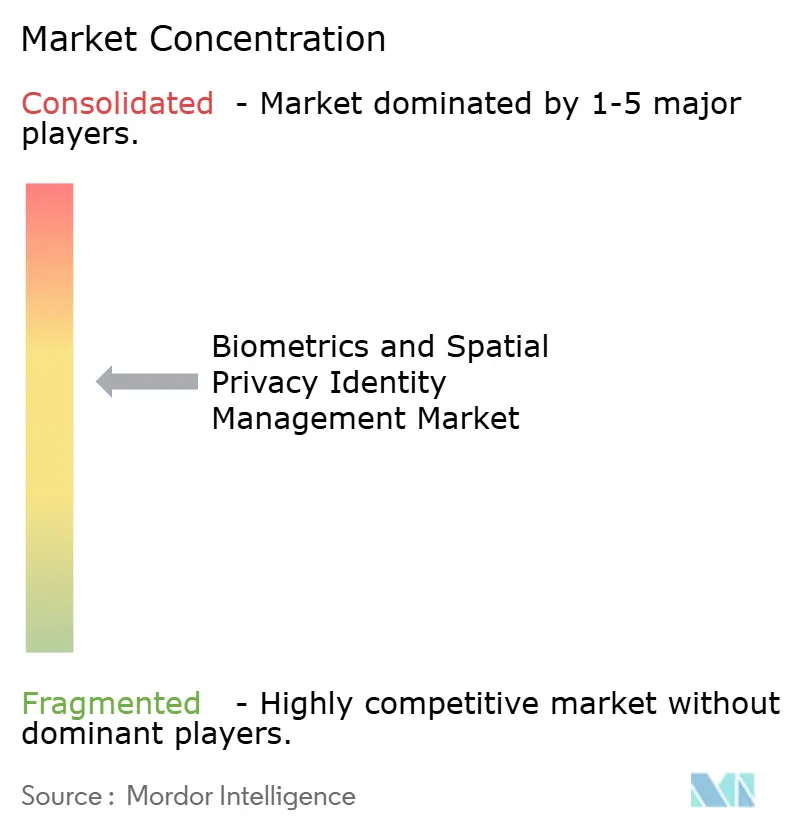
The biometrics and spatial privacy identity management market is moderately concentrated among large integrated suppliers and fragmented among specialists. IDEMIA, Thales, and NEC compete in identity orchestration, border control, and public security deployments. They face modality specialists, regional systems integrators, and software-only providers. Scale matters because buyers increasingly want one supplier to coordinate biometric capture, verification, privacy controls, and support. Suppliers also need experience with local data rules and government procurement standards.
Mergers and acquisitions are changing the competitive structure in the biometrics and spatial privacy identity management market. Amadeus announced in April 2026 that it intends to acquire IDEMIA Public Security for EUR 1.2 billion (USD 1.39 billion), with a potential earn-out of up to EUR 150 million (USD 173.6 million). The transaction would join aviation, border control, and hospitality identity capabilities, subject to regulatory approvals and a planned mid-2027 close. IN Groupe completed its acquisition of IDEMIA Smart Identity in July 2025 for EUR 1 billion (USD 1.1 billion), according to the supplied information.
Certification depth is becoming as important as biometric accuracy for regulated contracts in the biometrics and spatial privacy identity management market. iProov’s February 2026 CEN/TS 18099 High and Ingenium Level 4 results are examples of the assurance thresholds that can affect access to European identity tenders. Vendors without validated liveness detection may struggle to support compliant onboarding flows. Few suppliers offer end-to-end identity management with differential privacy or zero-knowledge proof capabilities. This leaves room for specialists who meet privacy and certification requirements in the biometrics and spatial privacy identity management market.
Biometrics and Spatial Privacy Identity Management Industry Leaders
-
IDEMIA France SAS
-
Fingerprint Cards AB
-
Suprema Inc.
-
Aware, Inc.
-
Cognitec Systems GmbH
- *Disclaimer: Major Players sorted in no particular order
Biometrics and Spatial Privacy Identity Management Market Companies Covered in this Report
- Fingerprint Cards AB
- IDEMIA France SAS
- Precise Biometrics AB
- NEXT Biometrics Group ASA
- IDEX Biometrics ASA
- BIO-key International, Inc.
- Suprema Inc.
- Aware, Inc.
- ImageWare Systems, Inc.
- Innovatrics, s.r.o.
- Cognitec Systems GmbH
- FacePhi Biometría, S.A.
- Veridium IP Limited
- iProov Limited
- FaceTec, Inc.
- nVIAsoft Corporation
- Neurotechnology, UAB
- Herta Security, S.L.
- RecFaces, LLC
- IdentyTech Solutions America Inc.
- M2SYS LLC
- Fulcrum Biometrics, LLC
- Iris ID Systems, Inc.
- SecuGen Corporation
Recent Industry Developments in Biometrics and Spatial Privacy Identity Management Market
- August 2026: Visa announced an agreement to acquire behavioral biometrics and fraud detection pioneer BioCatch in a USD 2.4 billion all-cash transaction. BioCatch serves 350 banking clients globally with 760 million users and reported USD 185 million in annual recurring revenue during 2025; the deal is expected to close in the second quarter of 2027. The acquisition signals that major payment networks are pricing continuous behavioral authentication as core fraud-prevention infrastructure rather than an add-on service, positioning behavioral biometrics within Visa’s merchant and issuer risk management products.
- April 2026: eu-LISA confirmed the completion of the EU Entry/Exit System’s progressive roll-out across all Schengen Area external borders as of April 10, 2026. The system digitally registers facial images and fingerprints of all third-country nationals and replaces manual passport stamping at hundreds of land, air, and sea ports of entry across the Schengen zone.
- March 2026: ICAO launched a next-generation Public Key Directory system enabling real-time cryptographic verification of machine-readable travel documents, with new capabilities for airlines and airports to access verified biometrics in advance for pre-clearance and seamless boarding workflows.
- March 2026: IDEMIA Public Security and Proof announced a strategic partnership to deliver privacy-preserving verifiable digital credentials spanning physical, logical, and digital identity domains. The joint solution embeds biometric assurance with PKI-based cryptographic signature frameworks for use in financial KYC, payments fraud prevention, and regulated enterprise authentication.
Global Biometrics and Spatial Privacy Identity Management Market Report Scope
The Biometrics and Spatial Privacy Identity Management Market refers to the industry focused on technologies, platforms, and services that enable secure identity verification, authentication, access control, and privacy protection through biometric modalities and spatially aware computing environments.
The Biometrics and Spatial Privacy Identity Management Market Report is Segmented by Biometric Modality (Fingerprint Recognition, Facial Recognition, Iris Recognition, Voice Recognition, Vein and Palm Recognition, Behavioral Biometrics, Multimodal Biometrics, and Other Biometric Modalities), Component (Hardware, Software, and Services), Contact Type (Contact-Based, and Contactless), Application (Digital Identity Verification and eKYC, Physical and Logical Access Control, Payment and Transaction Authentication, Border Control and Immigration, Law Enforcement and Public Safety, and Other Applications), End-Use Industry (Government and Law Enforcement, Banking, Financial Services and Insurance, Healthcare, Travel and Transportation, Retail and E-Commerce, and Other End-Use Industries), Deployment Mode (On-Premises, and Cloud), Spatial Privacy Function (Location Obfuscation and Generalization, Differential Privacy for Mobility Data, K-Anonymity and Crowd-Blending, Geofencing and Purpose Limitation, Secure Multi-Party Computation and Private Set Intersection, and Consent, Preference and Data-Subject Control), and Geography (North America, South America, Europe, Asia-Pacific, Middle East, and Africa). The Market Forecasts are Provided in Terms of Value (USD).
| Fingerprint Recognition |
| Facial Recognition |
| Iris Recognition |
| Voice Recognition |
| Vein and Palm Recognition |
| Behavioral Biometrics |
| Multimodal Biometrics |
| Other Biometric Modalities |
| Hardware |
| Software |
| Services |
| Contact-Based |
| Contactless |
| Digital Identity Verification and eKYC |
| Physical and Logical Access Control |
| Payment and Transaction Authentication |
| Border Control and Immigration |
| Law Enforcement and Public Safety |
| Other Applications |
| Government and Law Enforcement |
| Banking, Financial Services and Insurance |
| Healthcare |
| Travel and Transportation |
| Retail and E-Commerce |
| Other End-Use Industries |
| On-Premises |
| Cloud |
| Location Obfuscation and Generalization |
| Differential Privacy for Mobility Data |
| K-Anonymity and Crowd-Blending |
| Geofencing and Purpose Limitation |
| Secure Multi-Party Computation and Private Set Intersection |
| Consent, Preference and Data-Subject Control |
| North America | United States |
| Canada | |
| Mexico | |
| South America | Brazil |
| Argentina | |
| Rest of South America | |
| Europe | Germany |
| United Kingdom | |
| France | |
| Russia | |
| Rest of Europe | |
| Asia-Pacific | China |
| India | |
| Japan | |
| South Korea | |
| Rest of Asia-Pacific | |
| Middle East | Saudi Arabia |
| United Arab Emirates | |
| Israel | |
| Rest of Middle East | |
| Africa | South Africa |
| Nigeria | |
| Egypt | |
| Rest of Africa |
| By Biometric Modality | Fingerprint Recognition | |
| Facial Recognition | ||
| Iris Recognition | ||
| Voice Recognition | ||
| Vein and Palm Recognition | ||
| Behavioral Biometrics | ||
| Multimodal Biometrics | ||
| Other Biometric Modalities | ||
| By Component | Hardware | |
| Software | ||
| Services | ||
| By Contact Type | Contact-Based | |
| Contactless | ||
| By Application | Digital Identity Verification and eKYC | |
| Physical and Logical Access Control | ||
| Payment and Transaction Authentication | ||
| Border Control and Immigration | ||
| Law Enforcement and Public Safety | ||
| Other Applications | ||
| By End-Use Industry | Government and Law Enforcement | |
| Banking, Financial Services and Insurance | ||
| Healthcare | ||
| Travel and Transportation | ||
| Retail and E-Commerce | ||
| Other End-Use Industries | ||
| By Deployment Mode | On-Premises | |
| Cloud | ||
| By Spatial Privacy Function | Location Obfuscation and Generalization | |
| Differential Privacy for Mobility Data | ||
| K-Anonymity and Crowd-Blending | ||
| Geofencing and Purpose Limitation | ||
| Secure Multi-Party Computation and Private Set Intersection | ||
| Consent, Preference and Data-Subject Control | ||
| By Geography | North America | United States |
| Canada | ||
| Mexico | ||
| South America | Brazil | |
| Argentina | ||
| Rest of South America | ||
| Europe | Germany | |
| United Kingdom | ||
| France | ||
| Russia | ||
| Rest of Europe | ||
| Asia-Pacific | China | |
| India | ||
| Japan | ||
| South Korea | ||
| Rest of Asia-Pacific | ||
| Middle East | Saudi Arabia | |
| United Arab Emirates | ||
| Israel | ||
| Rest of Middle East | ||
| Africa | South Africa | |
| Nigeria | ||
| Egypt | ||
| Rest of Africa | ||
Key Questions Answered in the Report
What is the size of the biometrics and spatial privacy identity management market?
The market is valued at USD 44.22 billion in 2026 and is forecast to reach USD 88.91 billion by 2031 at a 14.99% CAGR.
Which biometric modality has the largest share?
Facial recognition led biometric modality revenue with 32.36% share in 2025.
Which application is projected to expand fastest?
Digital identity verification and eKYC is projected to expand at a 16.11% CAGR through 2031.
Why are behavioral biometrics becoming more important?
Synthetic identity fraud and AI-generated media are increasing the need for continuous, session-level fraud detection.
Which region is expected to expand fastest?
Asia-Pacific is projected to expand at a 15.89% CAGR through 2031, supported by government enrollment and airport modernization.
How do privacy rules affect biometric identity systems?
Consent requirements, data residency, and restrictions on public-space biometric identification favor privacy-preserving, local, and hybrid architectures.