
Biometric Injection Attack Detection Market Size and Share
Market Overview
| Study Period | 2020 - 2031 |
|---|---|
| Market Size (2026) | USD 26.85 Million |
| Market Size (2031) | USD 143.31 Million |
| Growth Rate (2026 - 2031) | 39.79 % |
| Fastest Growing Market | Asia-Pacific |
| Largest Market | North America |
| Market Concentration | Medium |
Major Players *Disclaimer: Major Players sorted in no particular order Image © Mordor Intelligence. Reuse requires attribution under CC BY 4.0. | |
Biometric Injection Attack Detection Market Analysis by Mordor Intelligence
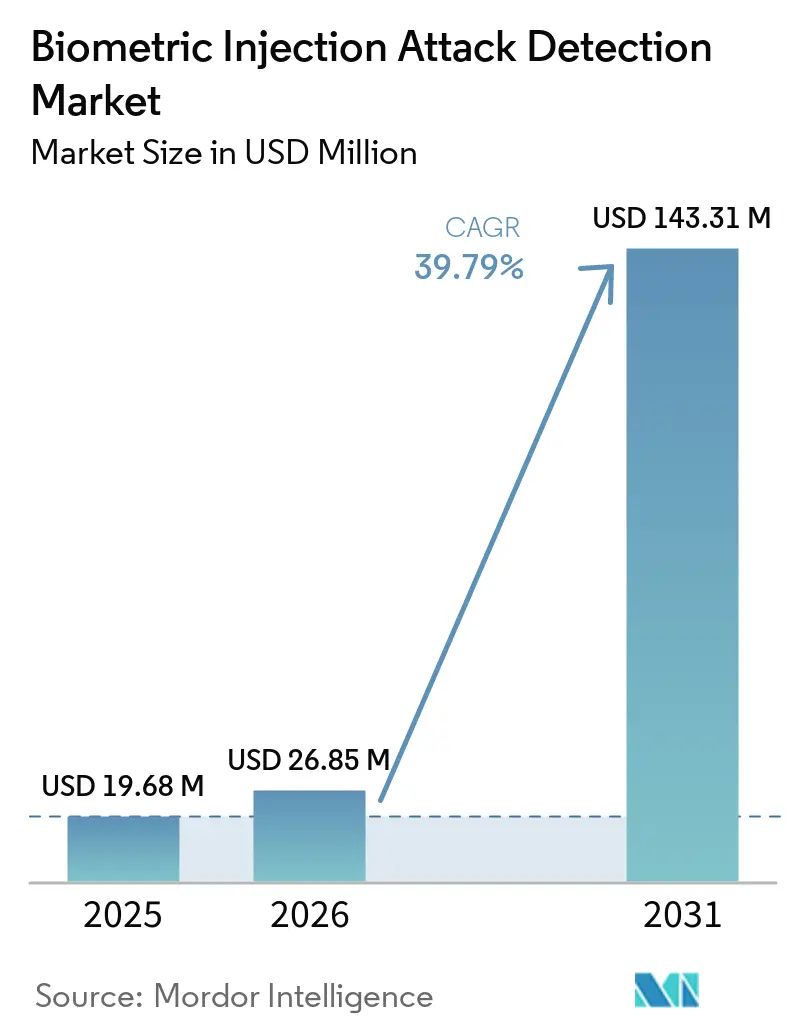
The biometric injection attack detection market size is expected to grow from USD 19.68 million in 2025 to USD 26.85 million in 2026 and is forecast to reach USD 143.31 million by 2031 at 39.79% CAGR over 2026-2031. Generative AI tools have made synthetic media attacks easier to repeat and deploy across digital identity flows. Injection attacks bypass the capture sensor by introducing synthetic media directly into the biometric pipeline, which limits the protection offered by legacy presentation attack detection controls. Remote onboarding, digital account opening, and public digital identity programs are expanding the number of biometric sessions that require stronger capture-chain protection. Buyers are placing more weight on independently tested resilience, particularly where regulatory standards and high-assurance identity rules apply. The biometric injection attack detection market, therefore, favors platforms that can update detection models quickly, document their performance, and fit into existing identity verification systems.
Key Report Takeaways
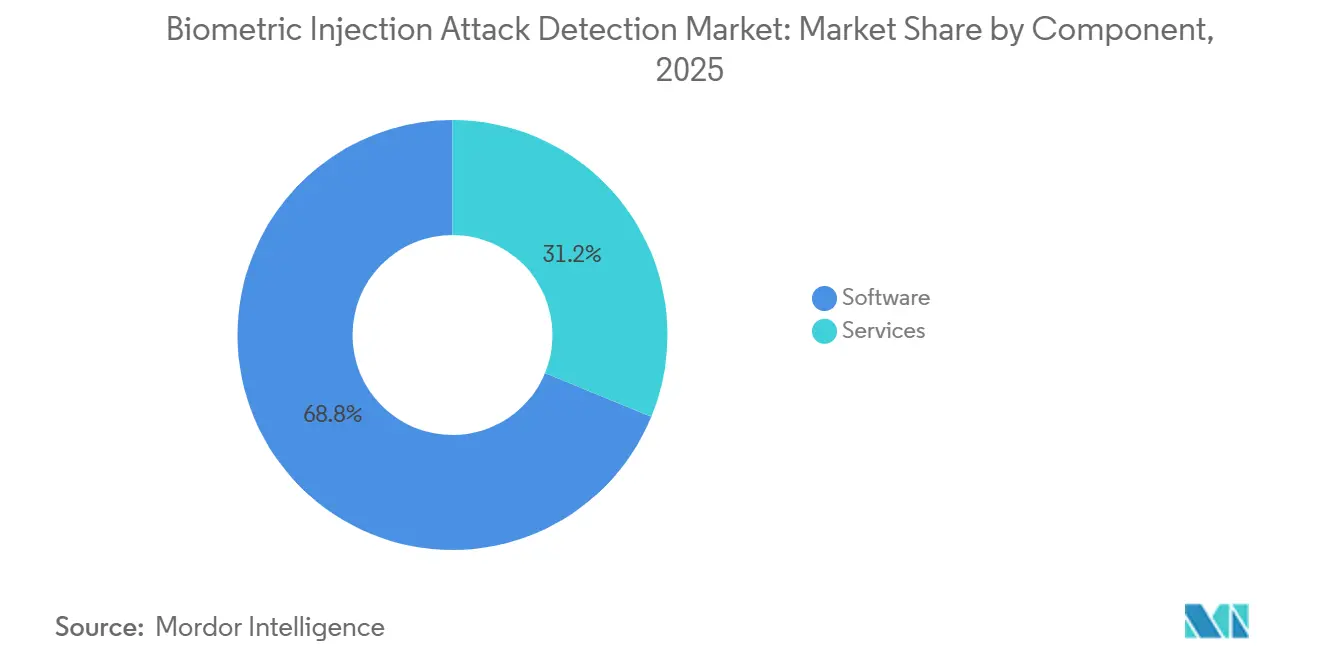
- By component, software held 68.79% of the biometric injection attack detection market share in 2025, while services are projected to expand at a 42.96% CAGR through 2031.
- By biometric modality, face biometrics held 76.93% of the biometric injection attack detection market share in 2025, while voice biometrics are projected to expand at a 43.62% CAGR through 2031.
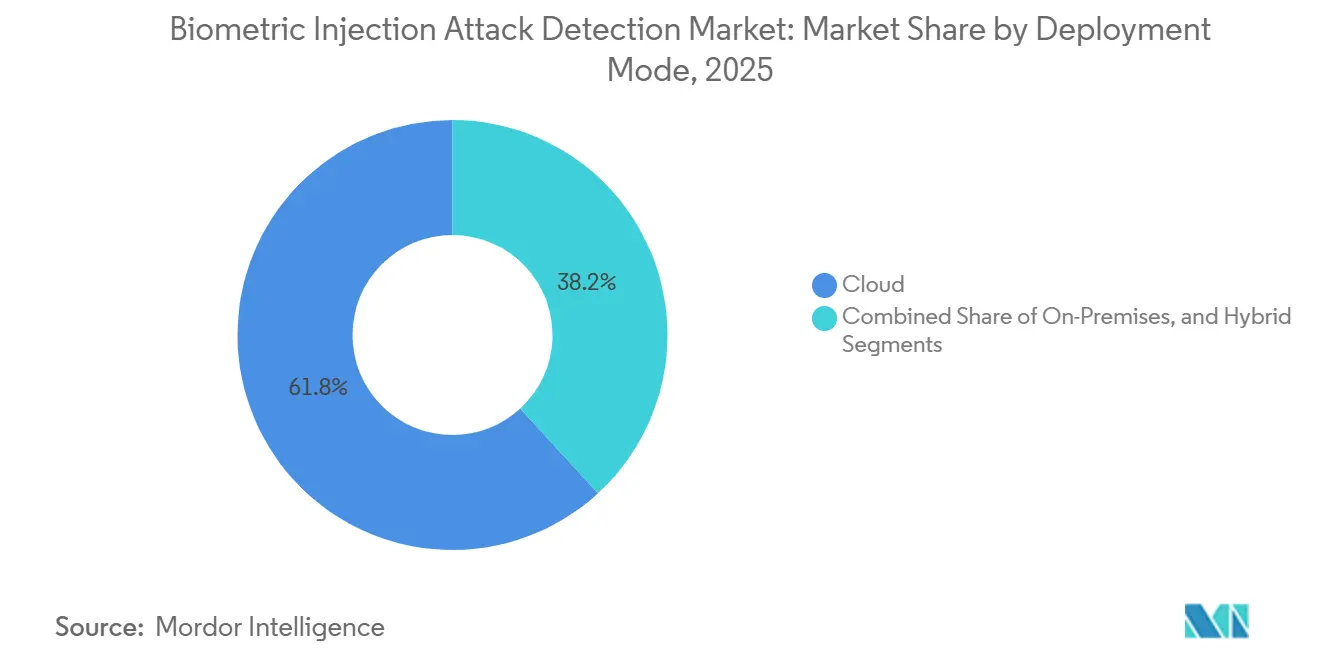
- By deployment mode, cloud accounted for 61.84% of the biometric injection attack detection market size in 2025 and is projected to expand at a 45.78% CAGR through 2031.
- By industry vertical, BFSI held 29.64% of the biometric injection attack detection market share in 2025, while government and public administration are projected to expand at a 44.93% CAGR through 2031.
- By geography, Europe held 34.96% share of the biometric injection attack detection market in 2025, while Asia-Pacific is projected to expand at a 46.21% CAGR through 2031.
Note: Market size and forecast figures in this report are generated using Mordor Intelligence’s proprietary estimation framework, updated with the latest available data and insights as of January 2026.
Global Biometric Injection Attack Detection Market Trends and Insights
Drivers Impact Analysis*
| DRIVER | (~) % IMPACT ON CAGR FORECAST | GEOGRAPHIC RELEVANCE | IMPACT TIMELINE |
|---|---|---|---|
| Generative AI Deepfake Fraud | +12.5% | Global | Short term (≤ 2 years) |
| Remote Identity Verification and Digital Onboarding | +10.2% | Global, with early concentration in North America and Europe | Short term (≤ 2 years) |
| Injection Resilience Regulations and Certifications | +7.8% | Europe, with spill-over to North America and APAC | Medium term (2-4 years) |
| Account Takeover and Synthetic Identity Fraud | +5.4% | Global, concentrated in BFSI-heavy markets | Short term (≤ 2 years) |
| Capture-Chain Evidence in Procurement | +2.9% | North America and Europe | Medium term (2-4 years) |
| Reusable Injection Toolchains | +1.8% | Global, concentrated in high-volume digital onboarding markets | Long term (≥ 4 years) |
| Source: Mordor Intelligence | |||
Escalation of Generative AI Deepfake Fraud
Deepfake-enabled fraud has shifted from isolated, targeted activity to a more accessible form of attack. iProov reported a 741% annual increase in biometric injection attacks in its 2026 threat intelligence report. The company also reported that attacks targeting iOS devices increased 1,151% in the second half of 2025 compared with the same period in 2024.[1]iProov, “iProov Issues Annual Threat Intelligence Report,” iProov, iproov.com Entrust found that deepfakes appeared in 1 in 5 biometric fraud attempts across more than 1 billion identity verification events in 195 countries. Its report also recorded a 40% year-over-year rise in injection attacks. AU10TIX reported that AI-generated fraud exceeded physical document forgery for the first time in its Q1 2026 benchmark, showing that synthetic content has become an operational fraud tool. This shift supports the biometric injection attack detection market because attack volume can grow with onboarding activity rather than only with the number of technically skilled attackers.
Expansion of Remote Identity Verification and Digital Onboarding
Remote onboarding is now used across financial services, telecommunications, and public administration. Each new remote identity journey can create another point where synthetic media may enter a biometric process. LexisNexis Risk Solutions reported that deepfake fraud attacks rose 180% year over year, and 1 in every 100 failed identity verification checks involved a deepfake document, image, or liveness video. Regula reported a 62% year-over-year increase in its end-user base to more than 240 million users during 2026, which it attributed to wider digital onboarding in regulated sectors. The Monetary Authority of Singapore's September 2025 circular treated endpoint-level injection protection as a separate requirement alongside liveness detection. The biometric injection attack detection market gains relevance when onboarding expands faster than organizations can introduce coverage across each endpoint and capture environment.
Regulatory and Certification Requirements for Injection Resilience
Regulatory requirements are moving injection resilience from an optional security measure toward a compliance requirement. CEN/TS 18099:2024 established a dedicated method for evaluating biometric injection attack detection systems, separate from presentation attack detection standards. NIST finalized SP 800-63-4 in July 2025 and included injection prevention and forged-media detection at higher identity assurance levels. EU Implementing Regulation 2025/1942 made ETSI TS 119 461 v2.1.1 the conformity assessment standard for remote identity proofing for providers serving EU-regulated entities. FinCEN's November 2024 alert placed deepfake media within customer due diligence obligations for U.S. anti-money laundering programs.[2]Financial Crimes Enforcement Network, “FinCEN Alerts,” U.S. Department of the Treasury, fincen.gov These measures increase the value of documented testing, repeatable controls, and certification evidence in the biometric injection attack detection market.
Growth of Account Takeover and Synthetic Identity Fraud
Account takeover and synthetic identity fraud support demand in financial services and government identity systems. Javelin reported USD 27.3 billion in losses from traditional identity fraud in 2025, affecting 18 million victims. The same study recorded a 31% increase in the number of victims of new-account fraud, reaching 5.4 million cases. LexisNexis Risk Solutions classified synthetic identity theft as 11% of fraud cases in 2025, an eightfold year-over-year increase. Synthetic identities may not trigger a direct victim report, allowing losses to build for longer before detection. The biometric injection attack detection market addresses this exposure by helping organizations validate the integrity of biometric evidence before it is used for account opening or authentication.
Restraints Impact Analysis*
| RESTRAINT | (~) % IMPACT ON CAGR FORECAST | GEOGRAPHIC RELEVANCE | IMPACT TIMELINE |
|---|---|---|---|
| Fragmented Standards and Uneven Certification Maturity | -3.2% | Global, most acute outside Europe and North America | Medium term (2-4 years) |
| Integration Complexity Across Devices, Browsers, and SDKs | -2.1% | Global, highest friction in mid-market and SME segments | Short term (≤ 2 years) |
| Desktop Browser Integrity Challenges | -1.3% | North America and Europe, high desktop onboarding prevalence | Medium term (2-4 years) |
| Accredited Laboratory Capacity Constraints | -0.8% | Global, most acute in APAC and MEA | Medium term (2-4 years) |
| Source: Mordor Intelligence | |||
Fragmented Standards and Uneven Certification Maturity
A single global certification framework for injection attack detection is not yet in operation. Buyers in more regulated jurisdictions can seek certified solutions, while buyers in less defined settings may accept alternatives without equivalent evidence. CEN/TS 18099 provides a defined injection test method, while FIDO requirements, ETSI obligations, and NIST guidance address related but not identical assurance needs.[3]FIDO Alliance, “Biometric Certification Resource Documentation,” FIDO Alliance, fidoalliance.org Assurance testing must also be repeated as attack methods evolve, adding cost and scheduling pressure for smaller buyers. The expected publication of ISO/IEC 25456 in 2027 may clarify the global direction, but procurement urgency outside the European regulatory perimeter remains lower in the interim. This uneven maturity can limit comparable evaluation and slow wider purchasing decisions in the biometric injection attack detection market.
Integration Complexity Across Devices, Browsers, and SDKs
Injection controls must work across mobile operating systems, web browsers, desktop applications, and kiosk hardware. These environments offer different APIs, permission settings, and available device signals. A software development kit that performs well in a controlled mobile setting may need different implementation work for a browser-based onboarding flow. Mid-market and smaller organizations may have fewer security engineering resources to manage that work. Network intelligence and behavioral signal fusion can improve coverage, but they can also add processing demands during time-sensitive onboarding. This complexity can leave organizations with different levels of protection across their identity channels.
*Our forecasts treat driver/restraint impacts as directional, not additive. The impact forecasts reflect baseline growth, mix effects, and variable interactions.
Segment Analysis
By Component: Software Anchors IAD Platform Architectures
Software held 68.79% of the biometric injection attack detection market share in 2025. Buyers favor API-based detection logic because it can connect with identity orchestration systems without requiring hardware upgrades. The software model supports server-side updates when attackers introduce new injection methods. It also allows an organization to apply detection logic across document verification, liveness detection, behavioral biometrics, and fraud-scoring workflows. Incode launched Deepsight in December 2025 as a multimodal engine that combines behavioral, integrity, and perception analysis.[4]Incode Technologies, “Incode Launches Deepsight to Protect Against Deepfakes and Injection Attacks,” Incode, incode.com The company said the product entered deployment with TikTok, Scotiabank, and Nubank at launch.
Services are projected to expand at a 42.96% CAGR from 2026 to 2031. Managed detection, integration support, and post-certification testing can help buyers who lack internal biometric engineering teams. This need is particularly relevant when organizations must operationalize controls across several identity channels. Certification cycles also create recurring support needs, as engagement with accredited laboratories and retesting may be necessary. Service providers can help buyers retain readiness as testing rules and attack patterns change. The component mix, therefore, combines embedded platform capability with external expertise for implementation and continuing assurance.


By Biometric Modality: Face Recognition Leads as Voice Gains Strategic Ground
Face biometrics held 76.93% of the biometric injection attack detection market share in 2025. Facial liveness remains central to remote onboarding for financial services, public identity programs, and digital platforms. iProov identified face-swap deepfakes as the leading attack type in its 2026 threat intelligence report. The company reported that Dynamic Liveness became the first solution to obtain both CEN/TS 18099 High and Ingenium Level 4 certification.[5]iProov, “Dynamic Liveness Achieves CEN/TS 18099 High and Ingenium Level 4,” iProov, iproov.com The evaluation blocked all tested attacks while recording a BPCER of 1.3%. These certifications place greater focus on independently measured performance for facial systems.
Voice biometrics are projected to expand at a 43.62% CAGR from 2026 to 2031. Generative text-to-speech tools increase the feasibility of voice-injection attacks against call-center KYC and phone-based government services. Fingerprint and iris systems remain relevant in high-security physical access settings with controlled capture conditions. Those controlled settings can reduce the opportunity for direct pipeline injection compared with remote sessions. Multimodal designs combine face, voice, and behavioral signals so that compromising one modality does not automatically determine the final decision. Pairing multimodal fusion with cryptographic attestation provides a more advanced response to attackers who adapt to recognized detection patterns.
By Deployment Mode: Cloud Consolidates Position Across Both Metrics
Cloud accounted for 61.84% of the biometric injection attack detection market size in 2025. It is also projected to expand at a 45.78% CAGR from 2026 to 2031. Cloud systems can centralize threat intelligence from high-volume identity session data. They can also update detection models on the server after a new attack instrument is identified. This reduces the need for each client to redeploy an update before protection changes take effect. The ability to shorten the time from detection to mitigation supports cloud adoption in the biometric-injection-attack detection market.
On-premises deployment remains relevant for defense agencies, central banks, and critical infrastructure operators with sovereign data requirements. Controlled capture environments may also reduce particular forms of injection exposure for these organizations. Hybrid architectures serve enterprises that must retain select identity-session elements on-premises while leveraging cloud-scale intelligence for fraud scoring. Shared cloud platforms can create a concentration risk if a service disruption or model-poisoning event affects many tenants at once. That dependency does not arise in the same way with an on-premises model. Deployment decisions, therefore, reflect both the need for rapid updating and the need for data control and operational resilience.
By Industry Vertical: BFSI Leads, Government Adoption Accelerates Fastest
BFSI held 29.64% of the biometric injection attack detection market share in 2025. KYC and anti-money laundering obligations combine with frequent attacks on digital account opening and authentication. FinCEN's November 2024 alert placed deepfake media within customer due diligence expectations for U.S. financial institutions. This treatment makes injection resilience relevant to compliance as well as to fraud prevention. Account takeover can affect both onboarding and later re-authentication journeys. Financial institutions, therefore, need controls that assess whether the biometric evidence entering a workflow is genuine.
Government and public administration are projected to expand at a 44.93% CAGR from 2026 to 2031. National digital identity programs and border digitization projects process high-assurance identity claims at a substantial scale. These systems can face state-sponsored threats that combine advanced synthetic media with organized deployment capacity. Such use cases need testing approaches suited to government assurance requirements. Healthcare and life sciences, IT and telecommunications, and retail and e-commerce are also expanding their digital service delivery. Their biometric exposure can increase before sector-specific requirements mature at the same pace.
Geography Analysis
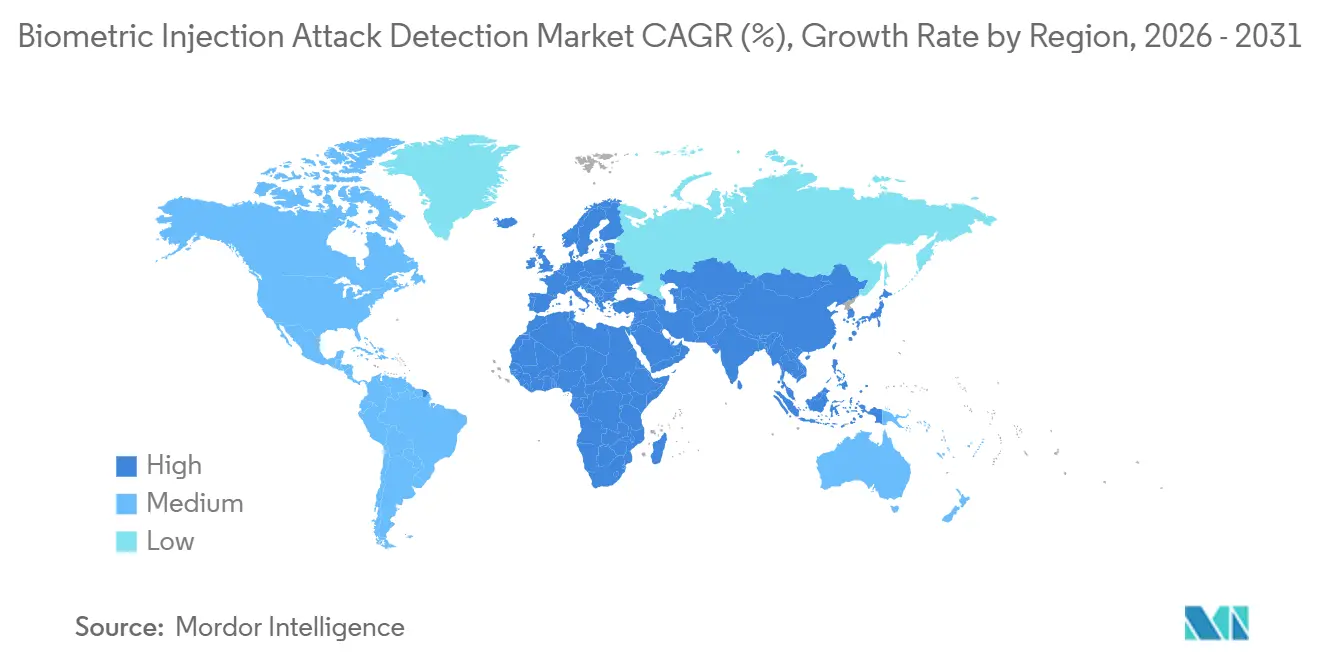
Europe held 34.96% of the biometric injection attack detection market share in 2025. The region is the primary regulatory center for dedicated injection-attack detection standards. CEN/TS 18099:2024 was approved in October 2024 as the first technical specification focused on detecting biometric data injection attacks. Germany's Federal Office for Information Security developed Technical Guideline TR-03147 to guide threat modeling of injection attacks in identity programs.[6]German Federal Office for Information Security, “Technical Guideline TR-03147,” BSI, bsi.bund.de The eIDAS 2.0 framework requires EU member states to issue EUDI Wallets by the end of 2026.
ETSI TS 119 461 v2.1.1 adds mandatory testing requirements for relevant remote identity-proofing activities in Europe. Innovatrics has advanced toward Level 3 High injection attack detection certification to align with eIDAS 2.0 assurance requirements. North America remained the second-largest geography, led by the United States. In July 2025, NIST SP 800-63-4 established explicit controls for injection attacks at higher identity assurance levels. The guidance is relevant to state digital government systems and commercial financial services frameworks. Account takeover affected 6 million U.S. consumers in 2025, while the number of new-account fraud victims rose 31%.
Asia-Pacific is projected to expand at a 46.21% CAGR from 2026 to 2031. Digital financial inclusion and mobile-led onboarding increase the volume of identity transactions in the region. iProov reported a 720% increase in biometric identity attacks in Southeast Asia during Q3 2025. The company stated that criminal networks tested virtual-camera and synthetic face-swap methods on regional platforms before wider deployment. Facephi entered Japan through Hancom in February 2026, with Hancom AUTH deployed by Cyberlinks for eKYC and non-face-to-face authentication. South America and the Middle East and Africa remain earlier-stage areas, where identity digitization in Brazil, Argentina, the UAE, and Saudi Arabia can support future procurement as local frameworks align with international standards.

Competitive Landscape
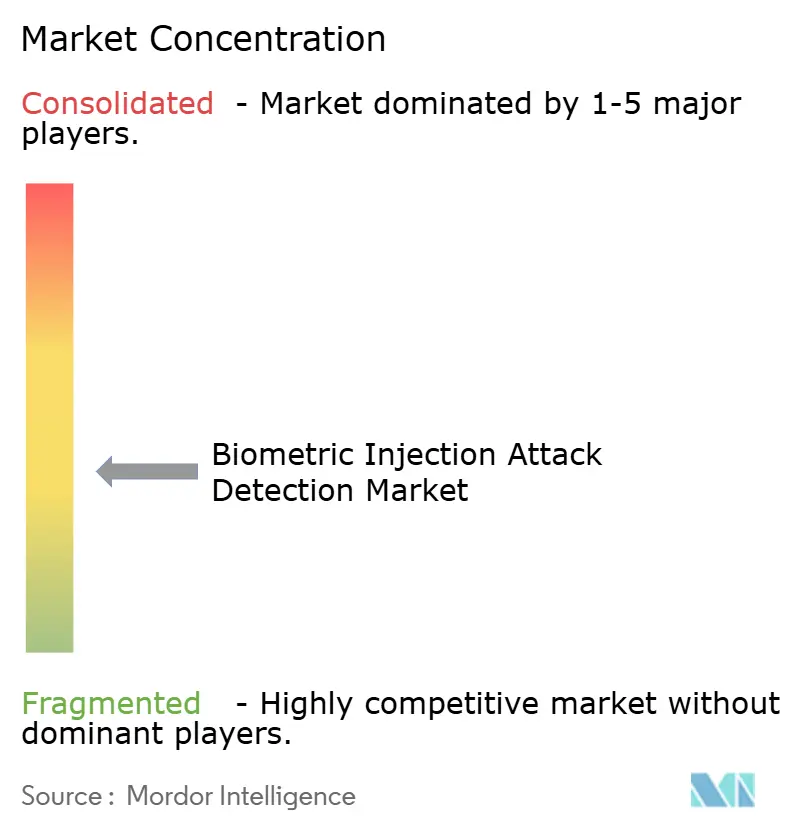
The biometric injection attack detection market is fragmented across identity verification platforms, biometric technology developers, fraud orchestration providers, and specialized testing organizations. No participant held a dominant position in the supplied market assessment. Competition centers on modality coverage, independently tested injection resilience, and the ability to integrate with mobile SDKs, browser APIs, and identity orchestration platforms. Certification is becoming a clear procurement qualifier as buyers seek evidence beyond vendor performance claims. The FIDO Alliance provides biometric certification resources that set requirements for relevant assurance testing. These conditions favor vendors that can demonstrate repeatable testing results and broad deployment capabilities.
FaceTec's 3D liveness patent position was strengthened in June 2026 when the U.S. Patent and Trademark Office's Patent Trial and Appeal Board upheld 4 foundational patents. Daon introduced its Quantum Identity architecture in August 2026 with 5 issued U.S. patents covering quantum morphing detection, quantum liveness, and transaction-specific injection and replay resistance. iBeta launched injection attack detection testing against CEN/TS 18099 in June 2026 and positioned the service for ISO/IEC 25456 readiness. These actions show that intellectual property, certification readiness, and accredited testing capacity are becoming important competitive tools. Limited ISO/IEC 17025-accredited laboratory capacity may delay compliance programs when mandatory requirements expand. This capacity constraint can make testing organizations important gatekeepers in certification-dependent procurement.
The biometric injection attack detection market has open opportunities in comparable cross-vendor testing, desktop-web capture-chain protection, and detection across voice, iris, and multimodal systems. Browser settings can offer fewer device-integrity signals than mobile applications, which leaves desktop protection as a difficult area. Vendors are also expanding into Asia-Pacific ahead of closer alignment with European standards. IDnow and Trustfull formed a partnership in April 2026 that combined biometric identity verification with real-time digital and behavioral signals from email, phone, device, IP, and browser data. Incode's Deepsight launch showed the parallel strategy of placing injection detection inside a broader identity intelligence platform. The competitive field remains distributed because buyers require different combinations of modality coverage, deployment options, standards evidence, and regional support.
Biometric Injection Attack Detection Industry Leaders
Aware, Inc.
BioID GmbH
Daon, Inc.
Facephi Biometria, S.A.
FaceTec, Inc.
- *Disclaimer: Major Players sorted in no particular order

Recent Industry Developments
- July 2026: Innovatrics announced that its Identity Verification Toolkit had completed a 16-day black-box penetration assessment by Citadelo focused on video-injection attacks. Its Face Liveness solution also renewed ISO/IEC 30107-3 Level 2 PAD certification, while the company reported progress toward higher-assurance PAD and IAD testing aligned with eIDAS 2.0 requirements.
- June 2026: The U.S. Patent and Trademark Office's Patent Trial and Appeal Board upheld the patentability of all challenged claims in four FaceTec 3D-liveness patents, U.S. Patent Nos. 10,776,471; 11,157,606; 11,693,938; and 11,874,910 in inter partes reviews initiated by Jumio.
- April 2026: IDnow and Trustfull formed a partnership combining IDnow’s biometric identity verification with Trustfull’s real-time risk signals from email, phone, device, IP-address, and browser data. The partnership supported continuous risk assessment beyond a point-in-time KYC decision.
- February 2026: iProov announced that Dynamic Liveness became the first solution to achieve both an Ingenium Level 4 evaluation and the CEN/TS 18099 High technical specification for injection-attack detection. The ISO/IEC 17025-accredited assessment ran for 40 days, found no successful injection-attack method, and reported a 1.3% bona fide presentation classification error rate.


Global Biometric Injection Attack Detection Market Report Scope
The biometric injection attack detection market encompasses specialized security technologies designed to detect and prevent digital injection attacks in which adversaries bypass physical biometric sensors by injecting synthetic or manipulated biometric data directly into the authentication pipeline via virtual cameras, emulators, screen recorders, API manipulation, or compromised middleware. These solutions monitor the biometric data capture chain for signs of digital tampering, replay attacks, deepfake-generated biometric templates, and synthetic identity fraud by analyzing metadata signatures, encryption integrity, data flow anomalies, and capture device attestation to ensure biometric samples originate from legitimate hardware sensors rather than software-based injection points, enabling organizations to protect remote onboarding, mobile authentication, and digital identity verification systems from emerging AI-powered fraud threats including deepfakes, voice cloning, and generative AI-synthesized biometric artifacts.
The Biometric Injection Attack Detection Market Report is Segmented by Component (Software, and Services), Biometric Modality (Face, Voice, Multimodal Biometrics, and Other Single-Modality Biometrics), Deployment Mode (Cloud, On-Premises, and Hybrid), Industry Vertical (Government and Public Administration, Industrial Manufacturing, Retail and E-Commerce, Transportation and Logistics, Energy and Utilities, Oil and Gas, IT and Telecommunication, Media and Entertainment, Education and Research Institutions, Healthcare and Life Sciences, Banking, Financial Services, and Insurance (BFSI), and Other Industry Verticals), and Geography(North America, South America, Europe, Asia-Pacific, and Middle East and Africa). The Market Forecasts are Provided in Terms of Value (USD).
| Software |
| Services |
| Face |
| Voice |
| Multimodal Biometrics |
| Other Single-Modality Biometrics |
| Cloud |
| On-Premises |
| Hybrid |
| Government and Public Administration |
| Retail and E-Commerce |
| Transportation and Logistics |
| IT and Telecommunication |
| Media and Entertainment |
| Healthcare and Life Sciences |
| Banking, Financial Services, and Insurance (BFSI) |
| Other Industry Verticals |
| North America | United States | |
| Canada | ||
| Mexico | ||
| South America | Brazil | |
| Argentina | ||
| Rest of South America | ||
| Europe | Germany | |
| United Kingdom | ||
| France | ||
| Italy | ||
| BENELUX | ||
| Rest of Europe | ||
| Asia-Pacific | China | |
| Japan | ||
| India | ||
| South Korea | ||
| Australia | ||
| Rest of Asia-Pacific | ||
| Middle East and Africa | Middle East | United Arab Emirates |
| Saudi Arabia | ||
| Rest of Middle East | ||
| Africa | South Africa | |
| Nigeria | ||
| Egypt | ||
| Rest of Africa | ||
| By Component | Software | ||
| Services | |||
| By Biometric Modality | Face | ||
| Voice | |||
| Multimodal Biometrics | |||
| Other Single-Modality Biometrics | |||
| By Deployment Mode | Cloud | ||
| On-Premises | |||
| Hybrid | |||
| By Industry Vertical | Government and Public Administration | ||
| Retail and E-Commerce | |||
| Transportation and Logistics | |||
| IT and Telecommunication | |||
| Media and Entertainment | |||
| Healthcare and Life Sciences | |||
| Banking, Financial Services, and Insurance (BFSI) | |||
| Other Industry Verticals | |||
| By Geography | North America | United States | |
| Canada | |||
| Mexico | |||
| South America | Brazil | ||
| Argentina | |||
| Rest of South America | |||
| Europe | Germany | ||
| United Kingdom | |||
| France | |||
| Italy | |||
| BENELUX | |||
| Rest of Europe | |||
| Asia-Pacific | China | ||
| Japan | |||
| India | |||
| South Korea | |||
| Australia | |||
| Rest of Asia-Pacific | |||
| Middle East and Africa | Middle East | United Arab Emirates | |
| Saudi Arabia | |||
| Rest of Middle East | |||
| Africa | South Africa | ||
| Nigeria | |||
| Egypt | |||
| Rest of Africa | |||


Key Questions Answered in the Report
What is the biometric injection attack detection market size?
The biometric injection attack detection market size is expected to grow from USD 19.68 million in 2025 to USD 26.85 million in 2026 and is forecast to reach USD 143.31 million by 2031 at 39.79% CAGR over 2026-2031.
What is biometric injection attack detection?
It identifies attempts to inject synthetic media directly into a biometric pipeline, rather than attacking the capture sensor.
Which component leads adoption?
Software held 68.79% share in 2025 because it can be integrated into identity systems and updated on the server.
Which biometric modality is growing fastest?
Voice biometrics are projected to expand at a 43.62% CAGR through 2031 as synthetic speech creates added risk for call-center and phone-based services.
Why do financial institutions use these controls?
BFSI held 29.64% share in 2025 because KYC requirements and account takeover risks increase the need to verify biometric evidence.
Which region is expanding fastest?
Asia-Pacific is projected to expand at a 46.21% CAGR through 2031, supported by mobile onboarding and digital financial inclusion.
Page last updated on:


 Your data is secure and never sold or shared.


