
Biomass Boiler Market Size and Share
Market Overview
| Study Period | 2022 - 2032 |
|---|---|
| Market Size (2027) | USD 12.71 Billion |
| Market Size (2032) | USD 19.67 Billion |
| Growth Rate (2027 - 2032) | 9.13 % |
| Fastest Growing Market | Asia-Pacific |
| Largest Market | Asia-Pacific |
| Market Concentration | Medium |
Major Players *Disclaimer: Major Players sorted in no particular order Image © Mordor Intelligence. Reuse requires attribution under CC BY 4.0. | |
Biomass Boiler Market Analysis by Mordor Intelligence
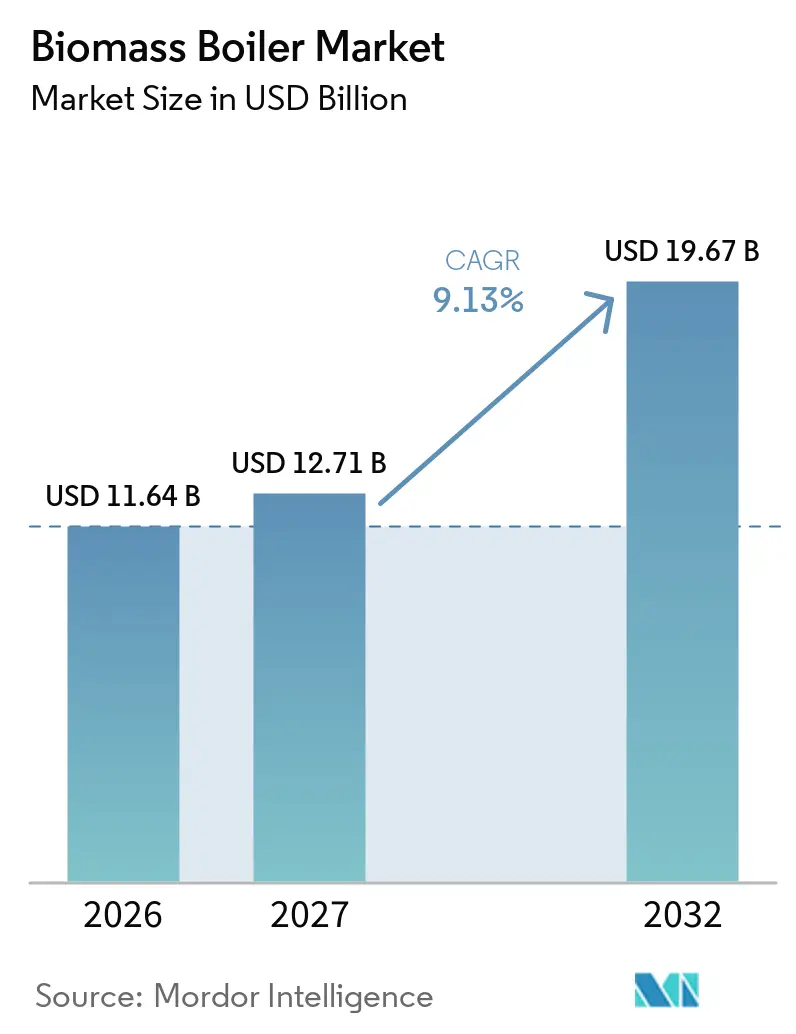
The Biomass Boiler Market size is expected to increase from USD 11.64 billion in 2026 to USD 12.71 billion in 2027 and reach USD 19.67 billion by 2032, growing at a CAGR of 9.13% over 2027-2032. Industrial users are replacing fossil fuel equipment where high-temperature steam demand limits the practical use of electric heat pumps. Renewable heat demand is expected to expand as energy users pursue lower direct emissions and less exposure to imported fuels. Policy support, carbon costs, and access to local residues shape project economics across the biomass boiler market. Suppliers are responding through fuel-flexible designs, flue-gas treatment, and digital services that support stable operation. Feedstock availability and compliance costs remain decisive factors for biomass boiler market project timing and investment returns.
Key Report Takeaways
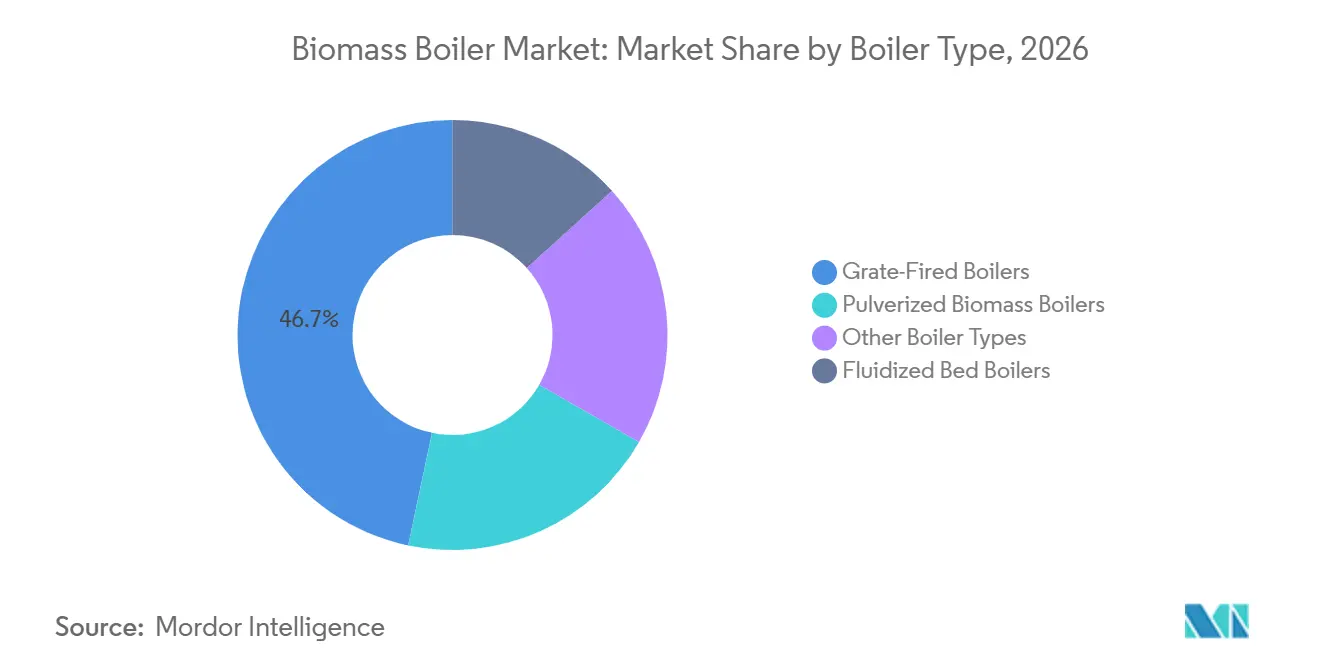
- By boiler type, grate-fired systems held 46.7% revenue share in 2026, while fluidized bed boilers are forecast to grow at a 9.6% CAGR through 2032.
- By technology, stoker-fired systems held 41.3% revenue share in 2026, while circulating fluidized bed technology is forecast to grow at a 10.2% CAGR through 2032.
- By application, industrial process heating held 38.3% revenue share in 2026, while combined heat and power is forecast to grow at a 10.1% CAGR through 2032.
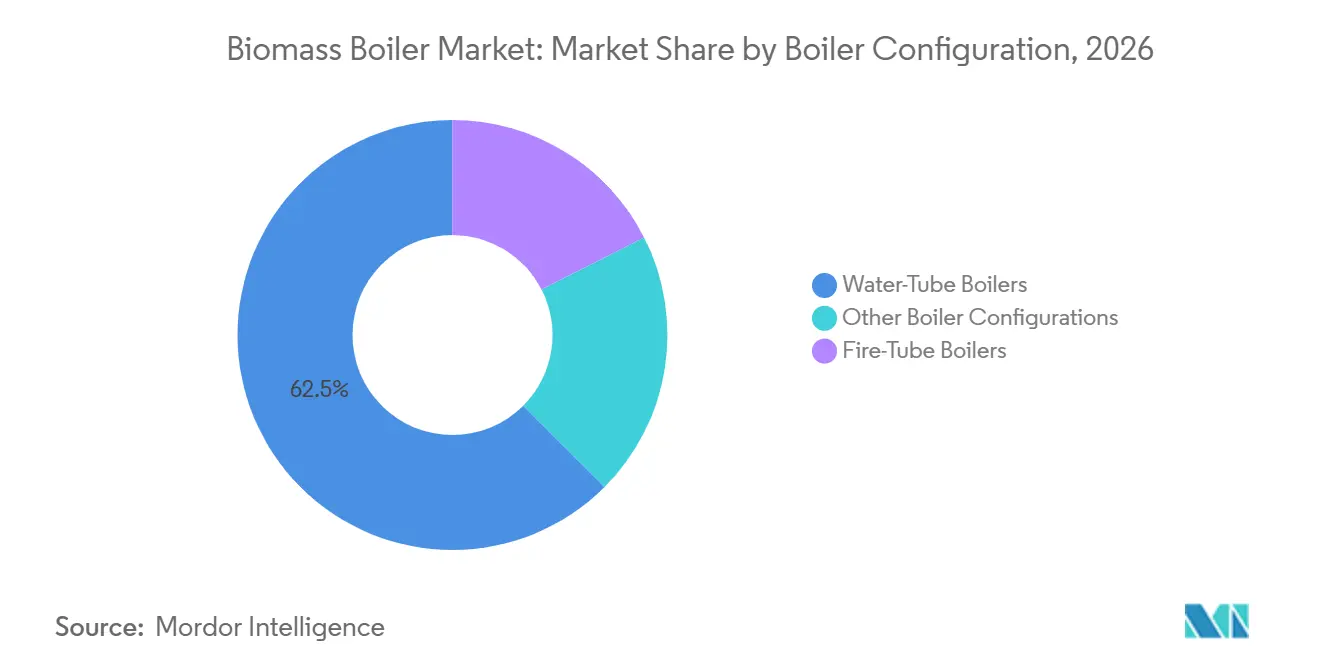
- By boiler configuration, water-tube boilers held 62.5% revenue share in 2026 and are forecast to grow at a 9.7% CAGR through 2032.
- By geography, Asia-Pacific held 39.2% revenue share in 2026 and is forecast to grow at a 9.9% CAGR through 2032.
Note: Market numbers in this report are based on Mordor Intelligence's proprietary estimation framework, which combines nine months of actuals with Q4 projections for base year 2026.
Market Trends and Insights
Drivers Impact Analysis of Biomass Boiler Market*
| Driver | (~) % Impact on CAGR Forecast | Geographic Relevance | Impact Timeline |
|---|---|---|---|
| Industrial Heat Decarbonization And Fossil-Fuel Substitution | +2.6% | Global, concentrated in EU, UK, India, and East Asia | Medium term (2-4 years) |
| Renewable Heat Incentives And Carbon Pricing | +2.0% | EU, UK, and China | Short term (≤ 2 years) |
| CHP And District-Heating Modernization | +1.5% | Northern and Central Europe, Scandinavia, and northern China | Medium term (2-4 years) |
| Fuel-Flexible Combustion For Variable Biomass Streams | +0.9% | Global, with Asia-Pacific as a core region and spillover to Middle East and Africa | Long term (≥ 4 years) |
| Local Residue Valorization And Waste-Diversion Economics | +0.8% | Southeast Asia, South America, and sub-Saharan Africa | Medium term (2-4 years) |
| Digital Combustion Optimization And Predictive Maintenance | +0.7% | Global, with early adoption in Northern Europe and Japan | Long term (≥ 4 years) |
| Source: Mordor Intelligence | |||
Industrial Heat Decarbonization and Fossil-Fuel Substitution
Industrial process heat accounts for 20% of global energy-related carbon dioxide emissions.[1] Biomass boilers are one of the commercially established options for high-temperature heat where electrification is less suitable. The International Energy Agency expects industrial renewable heat consumption to increase nearly 50% between 2025 and 2030, with bioenergy remaining the largest renewable heat source. This supports procurement in the biomass boiler market by manufacturers with direct-emission reduction targets. DS Smith activated a EUR 90 million biomass boiler at its Rouen paper mill in June 2025, supported by EUR 15 million from ADEME, and expects annual carbon dioxide reductions of 99,000 tons.[2] In China, biomass boiler steam cost averaged CNY 144 per ton in 2025, compared with CNY 333 per ton for gas boilers, strengthening the case for fuel substitution when gas supplies tighten.[3]
Renewable Heat Incentives and Carbon Pricing
Financial support remains important for the biomass boiler market where biomass equipment competes with gas boilers that have lower initial costs. Great Britain’s Non-Domestic Renewable Heat Incentive generated 120.2 TWh by March 2025.[4] Solid biomass boilers represented 77% of the program’s 22,703 accredited installations, while annual payments exceeded GBP 1 billion in 2024 to 2025. The program closed to new applicants in 2023, which leaves the United Kingdom without a successor mechanism from 2026. France relaunched the Biomasse Chaleur Industrie Agriculture Tertiaire (BCIAT) industrial biomass heat grant program in April 2025, and grants may exceed EUR 30 million per project. Carbon pricing and grant support together can shorten the payback period for industrial projects in the biomass boiler market.
CHP and District-Heating Modernization
District-heating systems in Northern and Central Europe are replacing coal-based heat with biomass combined heat and power facilities. Fortum committed EUR 85 million to convert its Zabrze plant in Poland from coal to biomass and refuse-derived fuel. Sumitomo SHI FW will convert the Częstochowa circulating fluidized bed boiler from 70% coal firing to 100% certified biomass under a EUR 100 million project. Such projects can provide heat and power from a single fuel input while expanding biomass boiler market opportunities for municipal utilities. Gren contracted a 50 MW biomass boiler plant for Riga district heating in March 2025, with commissioning planned for spring 2027. Coal conversion activity therefore expands the addressable opportunity for the biomass boiler market beyond stand-alone industrial heat.
Digital Combustion Optimization and Predictive Maintenance
Biomass fuels vary in moisture, calorific value, and composition over time. Digital controls help biomass boiler market operators manage this variability without compromising combustion stability or emission performance. A 2025 Engineering study reported that an MFRNet framework can reconstruct combustion conditions in an industrial-scale biomass grate furnace with lower computing requirements. Sumitomo SHI FW deployed its IZANA analytics platform at Alva’s Keljonlahti circulating fluidized bed boiler in Finland during November 2025. The system supports fouling management, leakage detection, and combustion optimization during the transition from peat to biomass. These services give OEMs recurring revenue and make operational data a stronger part of competition in the biomass boiler market.
Restraints Impact Analysis of Biomass Boiler Market*
| Restraint | (~) % Impact on CAGR Forecast | Geographic Relevance | Impact Timeline |
|---|---|---|---|
| Biomass Collection, Aggregation, And Preprocessing | -1.2% | Global, with the highest impact in Southeast Asia and sub-Saharan Africa | Long term (≥ 4 years) |
| Fuel Storage, Drying, Handling, And Feeding | -0.8% | Global, concentrated in regions without established logistics infrastructure | Medium term (2-4 years) |
| Boiler OEMs, EPC Contractors, And System Integrators | -0.5% | North America and EU, where skilled contractor scarcity is significant | Short term (≤ 2 years) |
| Emissions Control, Ash Handling, And Aftermarket Services | -0.7% | EU, UK, and China | Medium term (2-4 years) |
| Source: Mordor Intelligence | |||
Biomass Collection, Aggregation, And Preprocessing
Feedstock supply chains remain a structural challenge for the biomass boiler market, especially outside Scandinavia and Central Europe. Organized wood-fuel systems are less developed in many regions with large agricultural residue supplies. Fuel collection, aggregation, drying, and preprocessing can require investment alongside biomass boiler market equipment. This increases upfront funding needs and can lengthen the time needed to reach financial close. Seasonal availability and uneven fuel quality also affect delivered fuel costs. Portable preprocessing depots may reduce supply-chain costs, but this approach remains uncommon on a commercial scale.
Emissions Control, Ash Handling, And Aftermarket Services
Tightening nitrogen oxide and particulate limits add capital and operating requirements for biomass boiler projects in Europe and China. A 2025 scientific study found that biomass co-firing in industrial circulating fluidized bed boilers can increase fine-ash adhesion, requiring more soot blowing and bed management than coal firing. Full biomass operation can require flue-gas recirculation, selective catalytic or non-catalytic reduction systems, and bicarbonate injection. These additions broaden engineering, procurement, and construction scope in the biomass boiler market. Germany’s national rules also require detailed ash management and characterization practices. Higher maintenance needs during the first 3 to 5 years can create unplanned outages and weaken expected project returns.
*Our forecasts treat driver/restraint impacts as directional, not additive. The impact forecasts reflect baseline growth, mix effects, and variable interactions.
Biomass Boiler Market Segment Analysis
By Boiler Type:
Grate-Fired Systems Lead While Fluidized Beds Grow FasterGrate-fired systems held 46.7% of the biomass boiler market share in 2026. Their installed base is broad across industrial steam, utilities, and district-heating applications. They can process bark, wood chips, and agricultural residues with limited preprocessing. This capability supports reliable operation where fuel quality varies. The biomass boiler market benefits from replacement and upgrading demand in established industrial and district-heating applications.
Fluidized bed boilers are forecast to grow at a 9.6% CAGR from 2027 to 2032. They can accommodate fuel moisture between 20% and 55%, with changes in calorific value and particle size. This fuel tolerance is useful where supply depends on mixed regional biomass streams. Existing circulating fluidized bed pressure parts can sometimes remain in place during coal-to-biomass conversions. This can lower capital costs and shorten project schedules for the biomass boiler industry.

By Technology:
Stoker-Fired Systems Lead While Circulating Fluidized Bed (CFB) Technology Gains GroundStoker-fired technology held 41.3% of revenue in 2026. It is widely used in small- and medium-capacity industrial and district-heating facilities. Lower capital costs and straightforward operation support its position across Central Europe, Southeast Asia, and North America. Established installer networks also make the technology easier to procure and maintain. Other technology options, including pyrolysis-coupled systems, remain in early commercial deployment.
Circulating fluidized bed technology is forecast to grow at a 10.2% CAGR from 2027 to 2032. It is suited to utility-scale and industrial plants that need multi-fuel capability and strict nitrogen oxide control. Sumitomo SHI FW secured 2025 contracts to convert coal plants to certified biomass in Poland and Slovakia. A 2025 Fuel study modeled a 90 MW circulating fluidized bed plant across fuel mixes ranging from all coal to all biomasses. This flexibility supports the biomass boiler market where existing coal assets can be adapted rather than fully replaced.
By Application:
Industrial Heat Leads While Combined Heat and Power Expands FastestIndustrial process heating accounted for 38.3% of the biomass boiler market share in 2026. Continuous heat demand creates favorable operating conditions for biomass-fired systems. Ahlstrom announced a biomass boiler investment at its Rottersac food-packaging site in France during September 2025. The project is expected to reduce site emissions by 80% and save 34 kilotons of carbon dioxide each year after commissioning. Paper, packaging, food processing, and similar facilities can use captive residue streams to improve fuel security.
Combined heat and power are forecast to grow at a 10.1% CAGR from 2027 to 2032. Coal retirements in Europe and China are creating demand for integrated heat and power from biomass. The Zabrze, Częstochowa, and Riga projects show how municipal networks are moving toward renewable heat infrastructure. Commercial and institutional heating is also developing in places that maintain renewable heat incentives. The biomass boiler market also serves smaller agricultural drying and aquaculture applications.
By Boiler Configuration:
Water-Tube Systems Support High-Capacity ProjectsWater-tube boilers made 62.5% of revenue in 2026. Their design supports the high-pressure and high-temperature operation required by large industrial steam and combined heat and power plants. ANDRITZ is supplying an EcoFluid bubbling fluidized bed power boiler to Green Bay Packaging’s Morrilton, Arkansas facility. The project forms part of a USD 1 billion facility investment and is targeted for commissioning in late 2027. The European Commission reported that bioenergy provides 75% of renewable heat in European Union heating and cooling.
Fire-tube boilers serve smaller commercial and light-industrial users, generally below 10 MW. These customers often favor lower initial costs and simpler maintenance. Their share is expected to decline modestly as project activity moves toward larger, higher-pressure combined heat and power and district-heating systems. Combined-circulation and once-through systems serve narrow needs in pharmaceuticals and specialty chemicals. Water-tube systems also align more readily with digital control infrastructure used across the biomass boiler market.
Geography Analysis
APAC Biomass Boiler Market
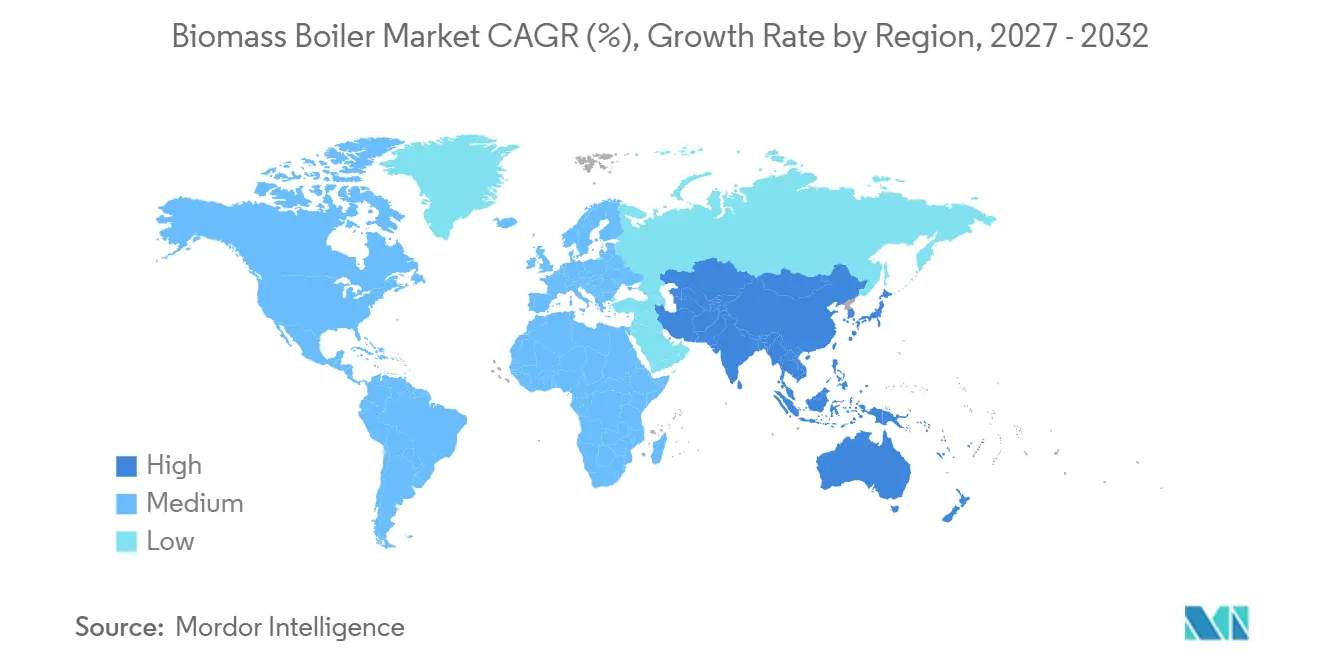
Asia-Pacific held 39.2% of the biomass boiler market size in 2026 and is forecast to grow at a 9.9% CAGR from 2027 to 2032. The region benefits from abundant agricultural residues, industrial expansion, and government support. China incorporated biomass boilers into clean-heating programs across 88 northern cities. The country produces more than 800 million metric tons of straw each year. India is the region’s fastest-growing country, supported by sugar, ethanol, and agro-processing operations with captive residue streams.
Europe and North America Biomass Boiler Market
Europe is the second-largest regional market and has a mature installed base. The EU Emissions Trading System and national decarbonization requirements are supporting coal-to-biomass retrofits. Poland, Germany, Sweden, Finland, and the Baltic states lead procurement activity. France’s Biomass Chaleur Industrie Agriculture et Tertiaire (BCIAT) program supports industrial biomass investments through large project grants. North America is the third-largest regional market, led by the U.S. pulp, paper, and forest-products sectors, while Canada adds demand through wood-product industries in British Columbia and Ontario.
South America and MEA Biomass Boiler Market
South America is centered on Brazil, where sugarcane bagasse has long supported industrial boiler use. Argentina and Colombia offer further potential through agro-industrial development and renewable energy goals. South Africa, Kenya, Nigeria, and Egypt are primary entry points in the Middle East and Africa. Energy security is becoming as important as decarbonization in developing biomass boiler market opportunities.
Competitive Landscape
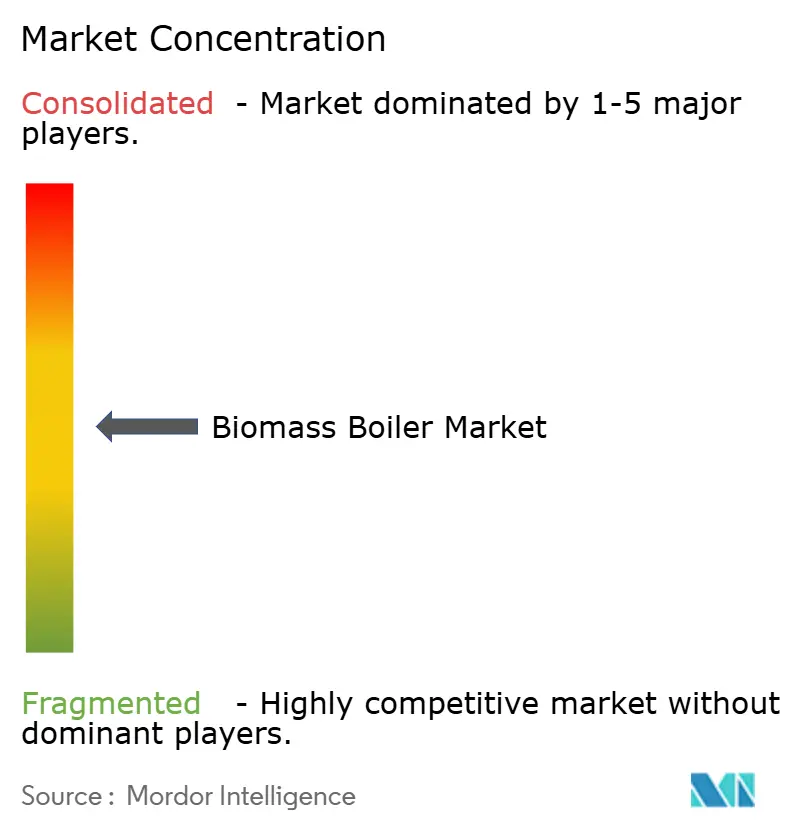
The biomass boiler market is moderately consolidated in utility-scale projects and fragmented at smaller capacities. Valmet, ANDRITZ, and Sumitomo SHI FW compete for major contracts through circulating and bubbling fluidized bed portfolios. At the high end, differentiation depends on project delivery, fuel flexibility, flue-gas cleaning, and permitting capability. Long-term service contracts and automation platforms give suppliers a continuing role after commissioning. Operating data and plant performance are increasingly important in supplier selection.
Valmet is pairing equipment deliveries with automation and flue-gas handling systems. Its July 2025 contract with Kraftringen Energi covers a bubbling fluidized bed boiler and flue-gas handling for a new combined heat and power plant in Örtofta, Sweden. The plant is carbon-capture-ready, with installation scheduled to begin in June 2026 and operations planned for 2028. Sumitomo SHI FW deployed the IZANA analytics suite at Alva’s Finnish facility to manage a shift from peat to 100% biomass. Its record of more than 550 delivered circulating fluidized bed systems can lower perceived commissioning risk.
Asian manufacturers are increasing price competition in mid-market projects across Southeast Asia and Africa. Modular systems may reduce site installation work and broaden access for emerging-market operators. European Union emission rules and Germany’s national standards limit suppliers that compete on price alone. The biomass boiler market rewards companies that combine performance guarantees, digital services, and project-financing support.
Biomass Boiler Industry Leaders
-
Valmet Oyj
-
ANDRITZ AG
-
Babcock & Wilcox Enterprises, Inc.
-
Sumitomo SHI FW
-
Thermax Limited
- *Disclaimer: Major Players sorted in no particular order
Biomass Boiler Market Companies Covered in this Report
- ANDRITZ AG
- Aalborg Energie Technik A/S
- Babcock & Wilcox Enterprises, Inc.
- Binder Energietechnik GmbH
- Compte R
- DP CleanTech
- Fröling Heizkessel- und Behälterbau GmbH
- Hargassner Ges mbH
- HoSt Bioenergy Systems
- Hurst Boiler & Welding Co., Inc.
- Justsen Energiteknik A/S
- ÖkoFEN Forschungs- und Entwicklungsgesellschaft m.b.H.
- Schmid Energy Solutions
- Sumitomo SHI FW
- Taishan Group
- Thermax Limited
- Valmet Oyj
- Viessmann Climate Solutions SE
- VYNCKE N.V.
- Wuxi Zozen Boiler Co., Ltd.
Recent Industry Developments in Biomass Boiler Market
- December 2025: Valmet contracted to decarbonize Fortum's Zabrze CHP plant in Poland. Valmet is converting (or has converted) the Zabrze CHP boiler island from coal to biomass as part of Fortum’s EUR 85 million coal exit, reducing approximately 280,000 tonnes of annual fossil CO₂.
- November 2025: Sumitomo SHI FW IZANA digital platform deployed at Alva’s Circulating Fluidized Bed (CFB) boiler, Finland. Alva, the municipal utility of Jyväskylä, selected SFW's full IZANA analytics suite covering fouling management, leakage detection, and combustion optimization to manage the Keljonlahti CFB boiler's transition from peat to 100% biomass.
- October 2025: Fortum commits EUR 85 million to coal exit at Zabrze Combined Heat and Power (CHP), Poland. The investment converts the Zabrze plant to biomass and Refuse-Derived Fuel (RDF), eliminating approximately 0.1 GW of coal capacity and 280,000 tonnes of direct fossil CO₂ annually.
- October 2025: Sumitomo SHI FW contracted for Mondi SCP CFB biomass boiler, Slovakia. SFW’s full Engineering, Procurement, and Construction (EPC) CFB biomass boiler delivery at Mondi's Ružomberok mill will boost energy self-sufficiency from 75% to 90% and supply fossil-free district heat, with commercial operations targeted for 2027.
Global Biomass Boiler Market Report Scope
The biomass boiler market covers the global industry for manufacturing, selling, and installing heating and power systems that burn organic matter such as wood pellets, wood chips, agricultural residues, and urban waste to generate hot water, steam, or electricity.
The global biomass boiler market is segmented by boiler type, technology, application, boiler configuration, and geography. By boiler type, the market is segmented into grate-fired boilers, fluidized bed boilers, pulverized biomass boilers, and other boiler types. By technology, the market is segmented into bubbling fluidized bed (BFB), circulating fluidized bed (CFB), stoker-fired technology, and other combustion technologies. By application, the market is segmented into power generation, industrial process heating, district heating, combined heat and power (CHP), commercial and institutional heating, and other applications. By boiler configuration, the market is segmented into water-tube and fire-tube boilers. The report also covers the market size and forecasts for the global biomass boiler market across 29 countries in key regions. For each segment, the market sizing and forecasts have been provided on the basis of value (USD).
Segmentation Overview
| Grate-Fired Boilers |
| Fluidized Bed Boilers |
| Pulverized Biomass Boilers |
| Other Boiler Types |
| Bubbling Fluidized Bed (BFB) |
| Circulating Fluidized Bed (CFB) |
| Stoker-Fired Technology |
| Other Combustion Technologies |
| Power Generation |
| Industrial Process Heating |
| District Heating |
| Combined Heat and Power (CHP) |
| Commercial and Institutional Heating |
| Other Applications |
| Water-Tube Boilers |
| Fire-Tube Boilers |
| Other Boiler Configurations |
| North America | United States |
| Canada | |
| Mexico | |
| Europe | Germany |
| France | |
| Italy | |
| Spain | |
| United Kingdom | |
| Poland | |
| Netherlands | |
| Russia | |
| Rest of Europe | |
| Asia-Pacific | China |
| India | |
| Japan | |
| South Korea | |
| Australia | |
| Indonesia | |
| Malaysia | |
| Thailand | |
| Philippines | |
| Rest of Asia-Pacific | |
| South America | Brazil |
| Argentina | |
| Colombia | |
| Rest of South America | |
| Middle East and Africa | Saudi Arabia |
| United Arab Emirates | |
| South Africa | |
| Kenya | |
| Egypt | |
| Nigeria | |
| Rest of Middle East and Africa |
| By Boiler Type | Grate-Fired Boilers | |
| Fluidized Bed Boilers | ||
| Pulverized Biomass Boilers | ||
| Other Boiler Types | ||
| By Technology | Bubbling Fluidized Bed (BFB) | |
| Circulating Fluidized Bed (CFB) | ||
| Stoker-Fired Technology | ||
| Other Combustion Technologies | ||
| By Application | Power Generation | |
| Industrial Process Heating | ||
| District Heating | ||
| Combined Heat and Power (CHP) | ||
| Commercial and Institutional Heating | ||
| Other Applications | ||
| By Boiler Configuration | Water-Tube Boilers | |
| Fire-Tube Boilers | ||
| Other Boiler Configurations | ||
| By Geography | North America | United States |
| Canada | ||
| Mexico | ||
| Europe | Germany | |
| France | ||
| Italy | ||
| Spain | ||
| United Kingdom | ||
| Poland | ||
| Netherlands | ||
| Russia | ||
| Rest of Europe | ||
| Asia-Pacific | China | |
| India | ||
| Japan | ||
| South Korea | ||
| Australia | ||
| Indonesia | ||
| Malaysia | ||
| Thailand | ||
| Philippines | ||
| Rest of Asia-Pacific | ||
| South America | Brazil | |
| Argentina | ||
| Colombia | ||
| Rest of South America | ||
| Middle East and Africa | Saudi Arabia | |
| United Arab Emirates | ||
| South Africa | ||
| Kenya | ||
| Egypt | ||
| Nigeria | ||
| Rest of Middle East and Africa | ||
Key Questions Answered in the Report
What is driving biomass boiler adoption?
Industrial heat decarbonization, fossil-fuel replacement, renewable heat grants, and coal-to-biomass conversions support demand. Fuel flexibility and digital operating services also influence project selection.
How large is the biomass boiler sector in 2026?
The sector is valued at USD 11.64 billion in 2026 and is forecast to reach USD 19.67 billion by 2032. The forecast reflects a 9.13% CAGR during 2027 to 2032.
Which biomass boiler application is growing fastest?
Combined heat and power is forecast to grow at a 10.1% CAGR through 2032 as district-heating systems replace coal assets. It allows a single fuel input to produce heat and power.
Which technology has the highest projected growth?
Circulating fluidized bed technology is forecast to grow at a 10.2% CAGR through 2032 because it can manage mixed fuels and support emission control. Existing coal infrastructure can also support retrofit plans.
Which region leads biomass boiler demand?
Asia-Pacific held 39.2% revenue share in 2026 and is forecast to expand at a 9.9% CAGR through 2032. Agricultural residues and clean-heating programs strengthen regional demand.
What are the main risks for biomass boiler projects?
Feedstock collection, storage, fuel quality, emission-control requirements, ash handling, and maintenance needs can raise project costs. These factors can delay financial close and affect operating performance.