
Biofuel Additives Market Size and Share
Market Overview
| Study Period | 2021 - 2031 |
|---|---|
| Market Size (2026) | USD 18.02 Billion |
| Market Size (2031) | USD 25.08 Billion |
| Growth Rate (2026 - 2031) | 6.84 % |
| Fastest Growing Market | Asia-Pacific |
| Largest Market | North America |
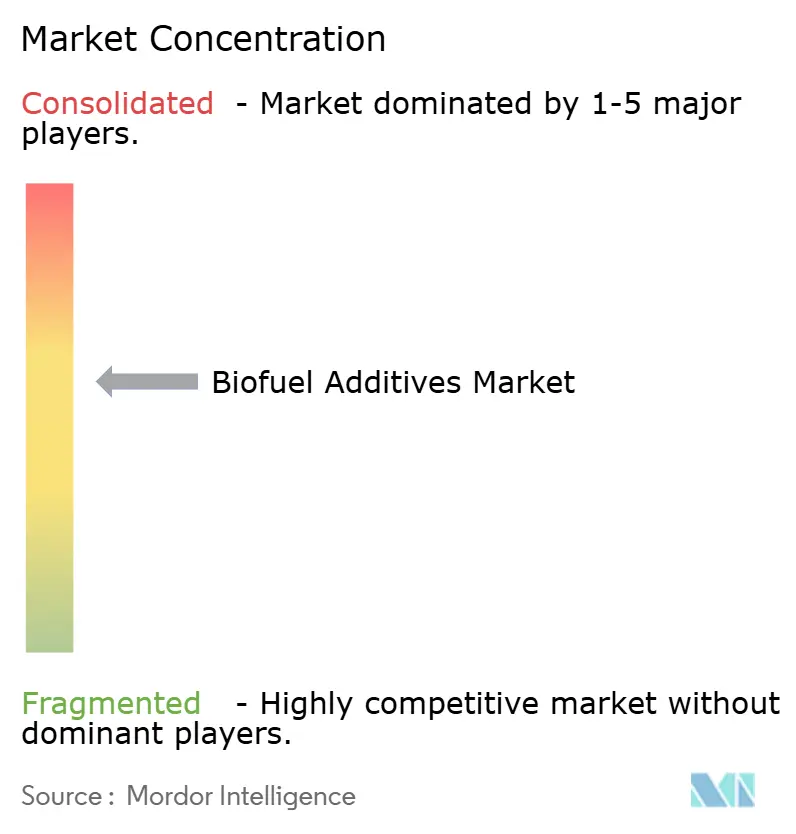
| Market Concentration | Medium |
Major Players *Disclaimer: Major Players sorted in no particular order Image © Mordor Intelligence. Reuse requires attribution under CC BY 4.0. | |
Biofuel Additives Market Analysis by Mordor Intelligence
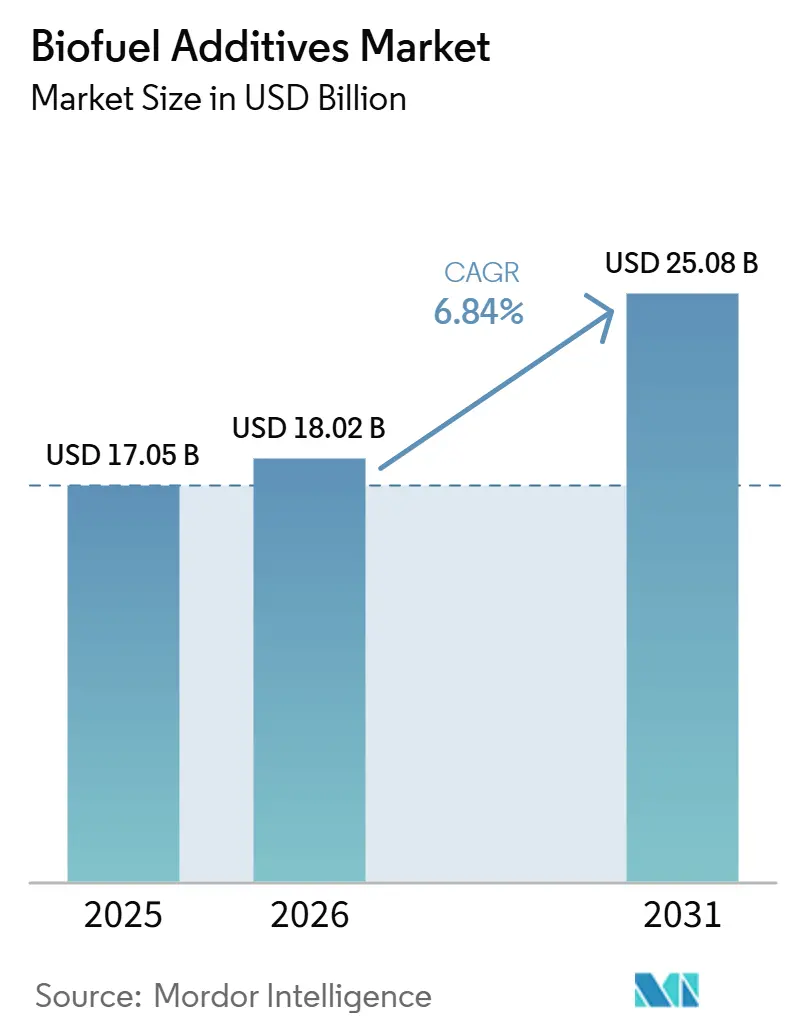
The Biofuel Additives Market size is projected to be USD 17.05 billion in 2025, USD 18.02 billion in 2026, and reach USD 25.08 billion by 2031, and is expected to grow at a CAGR of 6.84% from 2026 to 2031. The biofuel additives market is driven by blending mandates in the United States, Europe, and India, which require refiners and fuel marketers to use additive packages that maintain fuel quality and operational reliability. The planned end of double counting for advanced feedstocks in Europe from 2026 is increasing the need for compliant biofuel volumes, lifting demand for antioxidants, cold flow improvers, and corrosion inhibitors. Rising feedstock diversity is increasing additive intensity per liter, as variable fuel streams require stronger control over oxidation, cold performance, water handling, and material compatibility. The renewable diesel and sustainable aviation fuel segments are supporting market growth, where suppliers with proprietary formulations and co-development relationships with refiners can maintain higher-value positions. The market faces cost pressure in price-sensitive regions and slower aviation qualification cycles, keeping competition centered on performance, compliance, and formulation economics.
Key Report Takeaways
- By type, antioxidants led with 22.64% share in 2025, while cold flow improvers are forecast to expand at a 7.58% CAGR through 2031.
- By biofuel type, biodiesel held 63.41% share in 2025, while bioethanol is projected to grow at a 7.19% CAGR through 2031.
- By application, diesel fuel additives accounted for 47.22% share in 2025, while aviation fuel additives are advancing at an 8.12% CAGR through 2031.
- By end-user industry, transportation held a 58.14% share in 2025, while power generation is projected to grow at a 7.26% CAGR through 2031.
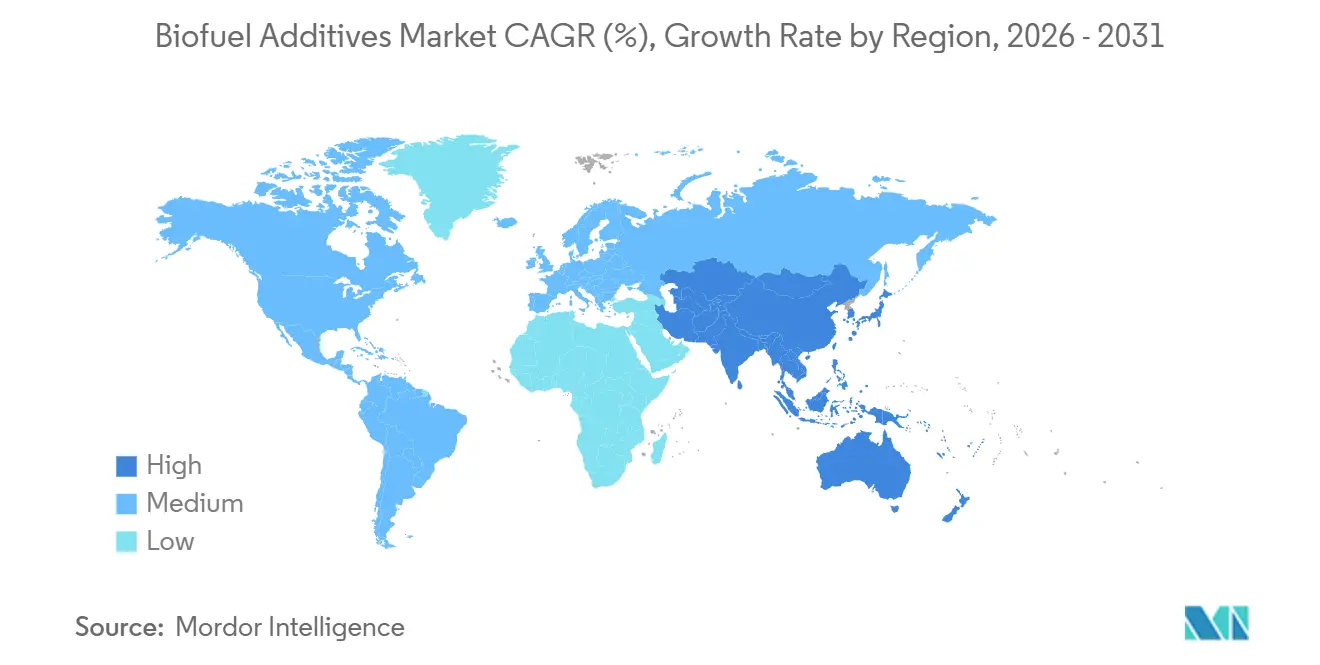
- By geography, North America accounted for 35.18% of the biofuel additives market size in 2025, and Asia-Pacific is forecast to grow at a 7.63% CAGR through 2031.
Note: Market size and forecast figures in this report are generated using Mordor Intelligence’s proprietary estimation framework, updated with the latest available data and insights as of January 2026.
Market Trends and Insights
Drivers Impact Analysis of Biofuel Additives Market*
| Drivers | (~) % Impact on CAGR Forecast | Geographic Relevance | Impact Timeline |
|---|---|---|---|
| Stringent Emission Limits Driving Blending Mandates | +2.1% | Global, concentrated in North America and Europe | Medium term (2-4 years) |
| Fuel Stability Needs in Biofuel Blends | +1.5% | Global | Short term (≤ 2 years) |
| Renewable Diesel and Sustainable Aviation Fuel (SAF) Demand | +1.3% | North America and Europe, with spillover to the Asia-Pacific | Medium term (2-4 years) |
| Rising Engine Deposit Concerns | +0.8% | Asia-Pacific core, with spillover to the Middle East and Africa | Short term (≤ 2 years) |
| Lower-Purity Feedstock Availability | +0.5% | Asia-Pacific core | Long term (≥ 4 years) |
| Digitalized Fuel Formulation and Precision Dosing | +0.3% | North America and Europe | Long term (≥ 4 years) |
| Source: Mordor Intelligence | |||
Stringent Emission Limits Accelerate Biofuel Additive Adoption
The biofuel additives market is closely tied to emissions regulation cycles, not just to headline biofuel output. Germany adopted Renewable Energy Directive III (RED III) transposition in April 2026, which doubled the advanced biofuels sub-quota from 1% to 2% for the 2026 compliance year and set a path to 3% by 2030[1]Verbio SE, “RED III Decision: Strong Market Incentives for Cost-Efficient Achievement of Climate Targets and Secure Energy Supply,” EQS News, eqs-news.com. Higher use of used cooking oil, lignocellulosic ethanol, and Hydrotreated Vegetable Oil (HVO) raises the need for tailored antioxidant and stabilizer systems that differ from standard Fatty Acid Methyl Ester (FAME) packages. The move away from double-counting also pushes suppliers toward physical blending rather than statistical compliance, which directly increases additive demand. This keeps the biofuel additives market linked to compliance quality, storage stability, and operational reliability across the fuel chain.
Fuel Stability Needs in Biofuel Blends Create Structural Additive Demand
The biofuel additives market depends on fuels that remain stable during storage, handling, and combustion. FAME-based biodiesel oxidizes easily because it contains more unsaturated fatty acids, which can form sediments and gums that plug filters and injectors. ASTM D6751 and EN 14214 maintain oxidative stability as a required performance threshold, making antioxidant dosing difficult to avoid. Higher ethanol blend ratios also increase water absorption and the risk of phase separation in fuel systems not designed for higher alcohol content. As a result, corrosion inhibitors and demulsifiers are taking on a more permanent role in the biofuel additives market, particularly where older tanks and pipelines remain in service.
Renewable Diesel and Sustainable Aviation Fuel (SAF) Demand Open High-Margin Additive Segments
Renewable diesel and sustainable aviation fuel are opening high-value demand pools in the biofuel additives market. Global SAF output rose from 1 million tons in 2024 to 1.9 million tons in 2025 and is set to reach 3 million tons in 2026, underscoring the need for qualified additive systems. Unlike standard biodiesel formulations, aviation-compatible products must undergo lengthy approval processes under ASTM D4054 and Defence Standard (DEF STAN) 91-091. Suppliers that validate early on a new SAF feedstock route can maintain an advantage for several years, as later entrants face a slower qualification cycle. Evonik's 2026 launch of high-performance isodewaxing catalysts also indicates that advanced catalyst and additive chemistry are converging in renewable fuels.
Rising Engine Deposit Concerns Drive Demand for Detergent and Dispersant Chemistry
Deposit formation is becoming a more visible issue as engine hardware advances faster than fuel chemistry in the biofuel additives market. Higher ethanol blends can strip protective oil films and raise deposit risk in gasoline engines not optimized for those conditions. In biodiesel applications, injector fouling in heavy-duty engines adds to the demand for stronger detergent and dispersant packages. Recent academic work also points to multifunctional nano-additive systems as a potential approach to simultaneously reducing deposits and emissions. This keeps formulation development focused on deposit control that works across changing blend ratios, newer injection systems, and tighter emissions requirements.
Restraints Impact Analysis of Biofuel Additives Market*
| Restraints | (~) % Impact on CAGR Forecast | Geographic Relevance | Impact Timeline |
|---|---|---|---|
| Additive Cost Sensitivity in Price-Sensitive Markets | -1.2% | Global, especially South America, the Middle East, and Africa | Short term (≤ 2 years) |
| Compatibility Challenges Across Legacy Engines and Infrastructure | -0.9% | Asia-Pacific core and Rest of World | Medium term (2-4 years) |
| Slow Certification Pathways for Aviation Additives | -0.7% | North America and Europe | Long term (≥ 4 years) |
| Slower Adoption Outside Core Regulated Markets | -0.5% | South America, the Middle East, and Africa | Long term (≥ 4 years) |
| Source: Mordor Intelligence | |||
Additive Cost Sensitivity Constrains Uptake in Emerging Economies
Additive costs continue to constrain the biofuel additives market in regions where blending is voluntary or fuel margins are thin. Premium biodiesel additive packages can account for 3%-5% of blended fuel costs, making consistent treatment difficult to justify for price-sensitive fleets[2]Netherlands Organisation for Applied Scientific Research, “Barriers to Advanced Biofuels,” TNO, publications.tno.nl. This cost challenge intensifies when blenders must adjust treat rates as feedstocks and blend ratios change. Many specialty intermediates are sourced from Europe and North America, transferring logistics and currency risks to emerging markets. This creates a two-tier biofuel additives market, with premium formulations concentrated in highly regulated regions and cost-optimized packages carrying higher volumes in other regions.
Compatibility Challenges Across Feedstock and Fleet Diversity Slow Deployment
Compatibility remains a practical challenge because biofuel feedstocks and fleet conditions vary widely across the biofuel additives market. A single additive package rarely performs consistently across used cooking oil, animal tallow, sugarcane ethanol, lignocellulosic residues, and algae-based inputs. Higher ethanol blends can damage older seals, metal components, and fiberglass tanks not designed for higher alcohol content. Legacy diesel fleets pose an additional challenge, as HVO and FAME biodiesel require different lubricity treatments, yet many operators continue to use the same diesel chemistry for both. These gaps slow adoption in the biofuel additives market, as technical support, operator training, and product liability practices remain inconsistent outside core regulated regions.
*Our forecasts treat driver/restraint impacts as directional, not additive. The impact forecasts reflect baseline growth, mix effects, and variable interactions.
Biofuel Additives Market Segment Analysis
By Type:
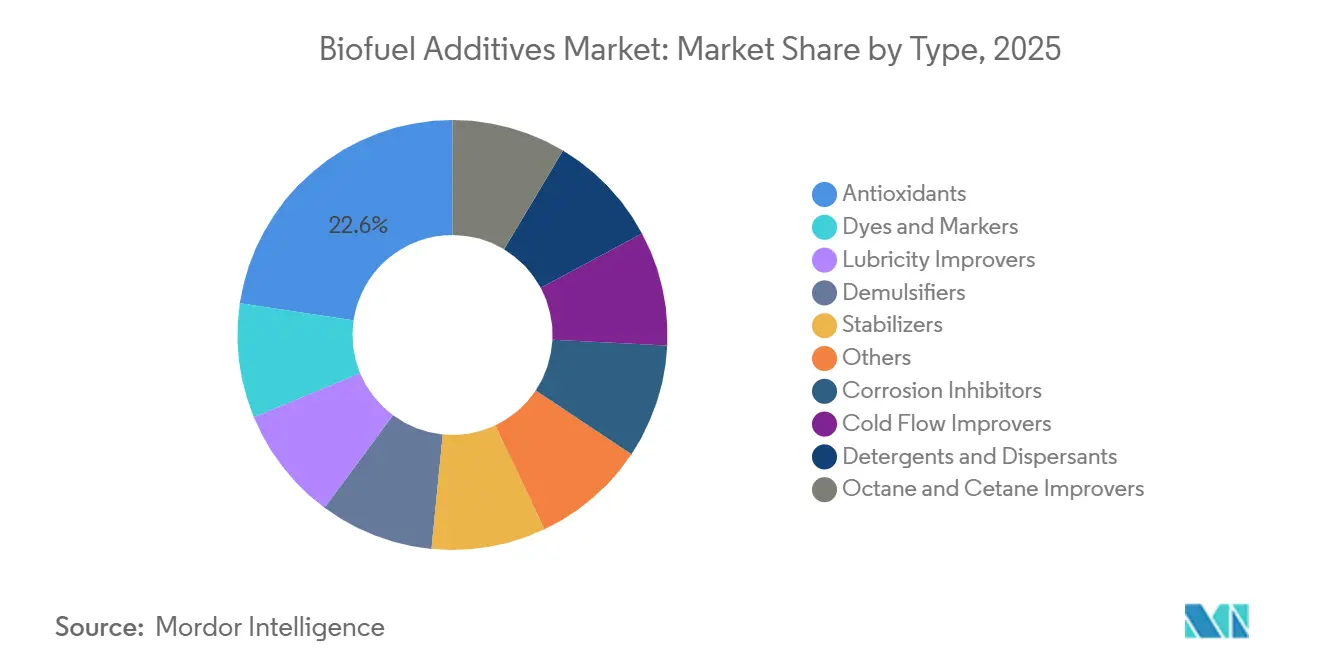
Antioxidant Dominance Reflects Biodiesel's Stability ChallengeAntioxidants accounted for 22.64% of the biofuel additives market in 2025, making them the largest additive type. This position reflects the stability challenge in biodiesel, where oxidative degradation can reduce storage life and increase the risk of gums and sediments. ASTM D6751 and EN 14214 keep antioxidant use closely tied to fuel quality compliance rather than discretionary spending. The segment also includes synthetic phenolic chemistries and newer bio-based alternatives, giving suppliers room to adjust formulations based on policy and sustainability preferences.
Cold flow improvers are forecast to grow at a 7.58% CAGR through 2031, indicating that mandates are extending into cold-weather and high-altitude operating conditions. As blend levels rise, operability at lower temperatures becomes more important for distributors, fleet operators, and storage sites. Corrosion inhibitors are also gaining ground as higher ethanol ratios alter fuel-water behavior, while detergents, dispersants, and lubricity improvers remain important where deposit control and paraffinic renewable diesel performance are priorities. Demand across the biofuel additives market remains broad, supported by demulsifiers, dyes, markers, stabilizers, and octane or cetane improvers, even as the leading sub-segments attract most of the attention.



By Biofuel Type:
Biodiesel scale anchors demand while bioethanol acceleratesBiodiesel held a 63.41% share in 2025, anchoring the biofuel additives market to a fuel stream with a large installed production and usage base. Its scale reflects mature policy treatment and widespread use across road transport, marine activity, and stationary power applications. The need for oxidation control and cold performance support keeps biodiesel additive demand stable even when fuel economics shift, providing suppliers with a broad, recurring base of antioxidant, cold-flow, and storage-stability products.
Bioethanol is projected to grow at a 7.19% CAGR through 2031, making it the fastest-growing biofuel type in the market. India's move to nationwide 20% ethanol blending from April 2026 is increasing the importance of corrosion control and water management in storage and distribution systems. As higher ethanol blends become more widespread, dye and marker packages, demulsifiers, and octane-oriented formulations become more relevant within country-specific fuel standards. This is an area where suppliers can improve margins through customized packages rather than a single global formula.
By Application:
Diesel leads volumes while aviation lifts growthDiesel fuel additives held a 47.22% share in 2025, making diesel the leading application in the biofuel additives market. Freight, agriculture, construction, and marine operations continue to rely heavily on diesel-powered equipment, and biodiesel blends generally require support for cold flow, lubricity, and oxidation control. This combination sustains diesel additive demand across both regulated and developing fuel systems and supports steady use of multifunctional packages that help blenders manage performance without multiple separate inputs.
Aviation fuel additives are forecast to grow at an 8.12% CAGR through 2031, making aviation the fastest-growing application in the biofuel additives market. Sustainable Aviation Fuel (SAF) growth is driving demand for qualified formulations, and the long approval cycle under aviation fuel standards strengthens the position of suppliers with already-compliant products. Heavy fuel oil, shipping fuel, and gasoline applications remain relevant, as marine fuel regulations, growing interest in renewable marine fuels, and ethanol-blended gasoline programs continue to require targeted performance chemistry. This mix keeps demand spread across several fuel pathways, even as aviation grows faster from a smaller base.
By End-User Industry:
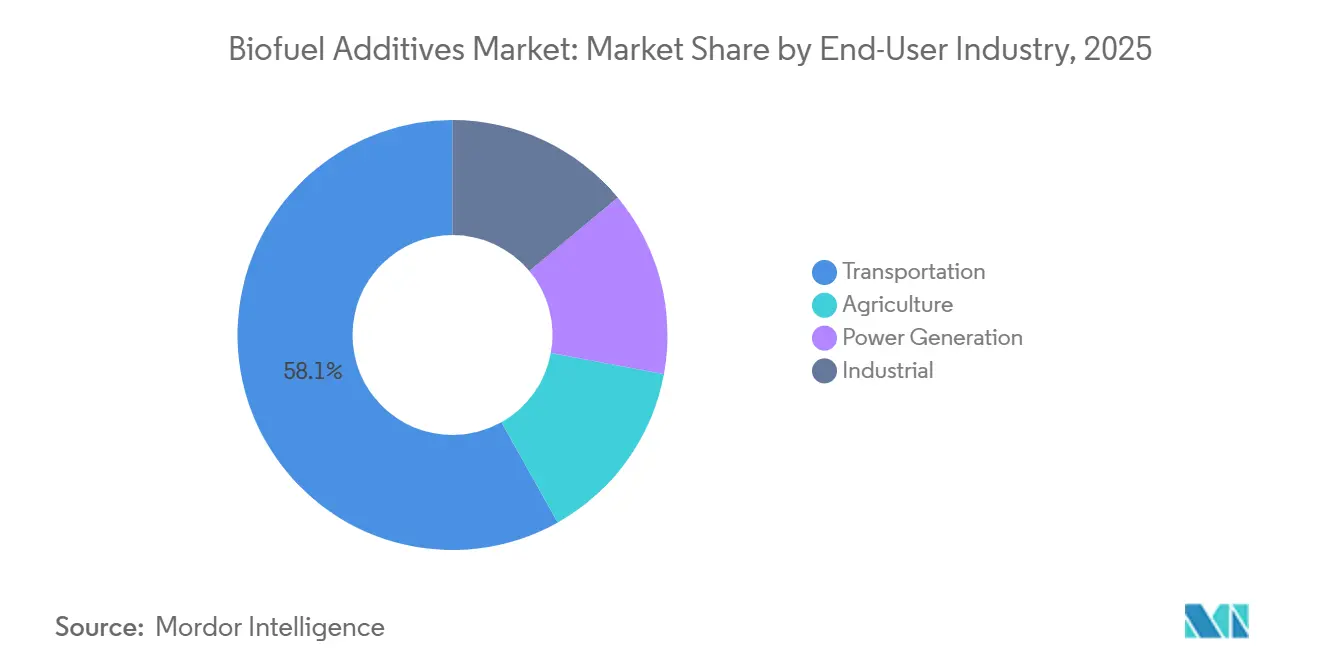
Transportation dominates while power generation gains momentumTransportation accounted for 58.14% of the biofuel additives market in 2025, confirming mobility as the primary demand center. Large-fleet buyers typically select additives based on engine protection and fuel-quality standards, making performance reliability more important than upfront cost. As a result, antioxidant, detergent, and cold-flow products remain closely tied to procurement decisions across road, off-road, and aviation fleets. Large transport customers also influence formulation choices through warranty, storage, and compliance requirements.
Power generation is projected to grow at a 7.26% CAGR through 2031, making it the fastest-growing end-user segment in the biofuel additives market. Backup generation and peaking applications are driving demand for fuels that can be stored for extended periods without quality loss, increasing the value of stability-focused additive packages. Industrial users sustain baseline demand in construction, mining, and manufacturing, while agriculture remains steady as rural equipment fleets adapt to higher biodiesel blend programs. Across the biofuel additives market, this end-user mix reduces reliance on any single operating environment and creates recurring demand for suppliers.
Geography Analysis
North America Biofuel Additives Market
North America held 35.18% of the biofuel additives market share in 2025, maintaining its lead among regional markets. The region benefits from strong enforcement of the Renewable Fuel Standard, large renewable diesel refining capacity, and a mature base of blenders and distributors. This structure supports recurring demand for antioxidants, cold-flow improvers, and other additive packages that help fuels meet compliance and storage requirements. In the United States, new clean fuel incentives are shaping feedstock economics and increasing the value of carbon-intensity-aligned formulation support. North America serves as the reference market for commercial-scale technical support and early adoption of premium additive systems.
APAC Biofuel Additives Market
Asia-Pacific is forecast to grow at a 7.63% CAGR through 2031, making it the fastest-growing regional market for biofuel additives. India's move to 20% ethanol blending from April 2026 is increasing demand for corrosion inhibitors, dye and marker systems, and water-handling chemistries across storage and distribution networks. China adds further momentum, as broader ethanol-blending efforts raise the need for country-specific additive packages across a large vehicle base. Japan and South Korea are expanding sustainable aviation fuel programs, widening the addressable market for higher-value products tied to the growth of renewable jet fuel. Feedstock diversity across Asia-Pacific makes technical service and localized formulation capability more important than in more standardized markets.
EMEA and South America Biofuel Additives Market
Europe continues to generate high absolute volumes in the biofuel additives market, supported by a policy framework that rewards advanced blending, renewable diesel uptake, and compliance discipline. Germany's transposition of the Renewable Energy Directive III (RED III) in 2026 strengthened demand for premium formulations by raising advanced biofuel requirements and ending double counting from the 2026 compliance year. South America remains anchored by Brazil's mature ethanol system and the progression of its biodiesel mandate, while the Middle East and Africa are smaller markets gaining policy attention for energy diversification and emissions control. Across these regions, the biofuel additives market shows a clear divide between mature regulatory systems that support premium chemistry and emerging systems that prioritize lower-cost treatment options.

Competitive Landscape
The biofuel additives market is moderately consolidated, with a limited number of specialty chemical companies holding the strongest positions. Innospec, Afton Chemical, BASF, Evonik, Lubrizol, Infineum, Chevron Oronite, and Clariant are among the most prominent players, combining formulation expertise with global customer reach. Competition is based less on scale and more on proprietary antioxidant systems, cold flow packages, detergent chemistry, and approval history in regulated fuel applications. The long certification cycle in aviation and marine fuels also protects established suppliers, as customers are less willing to switch once a formulation is qualified. This dynamic keeps the market open to regional price challengers but limits disruption in premium segments where compliance and technical service are critical.
BASF has been using partnerships and product launches to strengthen its position in the biofuel additives market. In April 2026, BASF and Brenntag Energy Services announced a distribution agreement for Keropur fuel performance additive packages across continental Europe and Turkey. In September 2025, BASF announced the Keropur AP 225-20 Gasoline Performance Additive Series for the new U.S. TOP TIER+ standard, with deliveries scheduled for the first half of 2026. These developments reflect how suppliers are expanding their commercial reach while aligning product portfolios with increasingly stringent fuel performance requirements. Innospec also reported strong Fuel Specialties performance in its full-year 2025 results, supporting the view that compliance-linked formulations can defend margins in this market.
Evonik's April 2026 launch of high-performance isodewaxing catalysts highlights a second route to competitive advantage in the biofuel additives market, where catalyst and additive expertise are increasingly overlapping in renewable fuel production. This competitive dynamic also explains why suppliers are investing in multifunctional packages that can manage oxidation, cold flow, and deposit control with fewer dosing steps. Regional specialty chemical producers in India and China are moving closer to finished formulations, which is expected to increase price competition in cost-sensitive tiers. The biofuel additives market continues to favor suppliers that can combine regulatory familiarity, application testing, and co-development work with refiners and fuel marketers.
Biofuel Additives Industry Leaders
Infineum International Limited
Lubrizol
BASF
Afton Chemical
Chevron Oronite Company LLC
- *Disclaimer: Major Players sorted in no particular order
Biofuel Additives Market Companies Covered in this Report
- Afton Chemical
- Arkema
- BASF
- Biofuel Systems Group Ltd.
- Chemiphase International Ltd.
- Chevron Oronite Company LLC
- Clariant AG
- Dorf Ketal Chemicals
- Eastman Chemical Company
- Evonik Industries AG
- E-ZOIL
- Fuel Quality Services Inc.
- Infineum International Limited
- Innospec Inc.
- Lubrizol
- Nalco Champion
- NewMarket Corporation
- Solvay S.A.
- TotalEnergies Additives and Special Fuels

Recent Industry Developments in Biofuel Additives Market
- April 2026: Brenntag Energy Services and BASF announced a distribution agreement for Keropur fuel performance additive packages across continental Europe and Turkey. The agreement covers gasoline and diesel additives for fuel retailers, terminals, and wholesale fuel suppliers. This expands market penetration at a time when Renewable Energy Directive III (RED III) compliance is driving additive demand across the region.
- September 2025: BASF announced the upcoming launch of its Keropur AP 225-20 Gasoline Performance Additive Series, certified for the new U.S. TOP TIER+ standard. The product meets EPA's Lowest Additive Concentration requirements and was pending California Air Resources Board (CARB) approval. Deliveries were scheduled to commence in H1 2026, with customers to be notified of final product specifications in Q4 2025.


Global Biofuel Additives Market Report Scope
Biofuel additives are chemical compounds blended with ethanol, biodiesel, or renewable diesel to enhance combustion efficiency, cold-weather performance, and storage stability. They prevent fuel degradation, reduce harmful exhaust emissions, and mitigate corrosion in engine components.
The biofuel additives market is segmented by type, biofuel type, application, end-user industry, and geography. By type, the market is segmented into antioxidants, corrosion inhibitors, cold flow improvers, detergents and dispersants, octane and cetane improvers, dyes and markers, lubricity improvers, demulsifiers, stabilizers, and others. By biofuel type, the market is segmented into bioethanol and biodiesel. By application, the market is segmented into diesel fuel additives, heavy fuel oil additives, shipping fuel additives, gasoline fuel additives, aviation fuel additives, and others. By end-user industry, the market is segmented into transportation, power generation, industrial, and agriculture. The report also covers market size and forecasts for biofuel additives across 16 countries in major regions. The market sizes and forecasts are provided in terms of value (USD).
| Antioxidants |
| Corrosion Inhibitors |
| Cold Flow Improvers |
| Detergents and Dispersants |
| Octane and Cetane Improvers |
| Dyes and Markers |
| Lubricity Improvers |
| Demulsifiers |
| Stabilizers |
| Others |
| Bioethanol |
| Biodiesel |
| Diesel Fuel Additives |
| Heavy Fuel Oil Additives |
| Shipping Fuel Additives |
| Gasoline Fuel Additives |
| Aviation Fuel Additives |
| Others |
| Transportation |
| Power Generation |
| Industrial |
| Agriculture |
| Asia-Pacific | China |
| India | |
| Japan | |
| South Korea | |
| Rest of Asia-Pacific | |
| North America | United States |
| Canada | |
| Mexico | |
| Europe | Germany |
| United Kingdom | |
| France | |
| Italy | |
| Russia | |
| Rest of Europe | |
| South America | Brazil |
| Argentina | |
| Rest of South America | |
| Middle-East and Africa | Saudi Arabia |
| South Africa | |
| Rest of Middle-East and Africa |
| By Type | Antioxidants | |
| Corrosion Inhibitors | ||
| Cold Flow Improvers | ||
| Detergents and Dispersants | ||
| Octane and Cetane Improvers | ||
| Dyes and Markers | ||
| Lubricity Improvers | ||
| Demulsifiers | ||
| Stabilizers | ||
| Others | ||
| By Biofuel Type | Bioethanol | |
| Biodiesel | ||
| By Application | Diesel Fuel Additives | |
| Heavy Fuel Oil Additives | ||
| Shipping Fuel Additives | ||
| Gasoline Fuel Additives | ||
| Aviation Fuel Additives | ||
| Others | ||
| By End-User Industry | Transportation | |
| Power Generation | ||
| Industrial | ||
| Agriculture | ||
| By Geography | Asia-Pacific | China |
| India | ||
| Japan | ||
| South Korea | ||
| Rest of Asia-Pacific | ||
| North America | United States | |
| Canada | ||
| Mexico | ||
| Europe | Germany | |
| United Kingdom | ||
| France | ||
| Italy | ||
| Russia | ||
| Rest of Europe | ||
| South America | Brazil | |
| Argentina | ||
| Rest of South America | ||
| Middle-East and Africa | Saudi Arabia | |
| South Africa | ||
| Rest of Middle-East and Africa | ||


Key Questions Answered in the Report
What is current market size of Biofuel Additives Market?
The Biofuel Additives Market size is projected to be USD 17.05 billion in 2025, USD 18.02 billion in 2026, and reach USD 25.08 billion by 2031, and is expected to grow at a CAGR of 6.84% from 2026 to 2031.
Which product type leads demand?
Antioxidants are the leading type, with a 22.64% share in 2025, because biodiesel stability requirements make controlling oxidation difficult.
Which biofuel stream creates the greatest additive demand?
Biodiesel led with a 63.41% share in 2025, which reflects its broad installed base and recurring need for oxidation, cold flow, and storage stability support.
Which application is growing the fastest?
Aviation fuel additives are growing at the fastest rate, with a 8.12% CAGR through 2031, as SAF volumes rise and qualified formulations become more important.
Page last updated on:





