
Bioethanol Yeast Market Size and Share
Market Overview
| Study Period | 2021 - 2031 |
|---|---|
| Market Size (2026) | USD 398.84 Million |
| Market Size (2031) | USD 604.43 Million |
| Growth Rate (2026 - 2031) | 8.67 % |
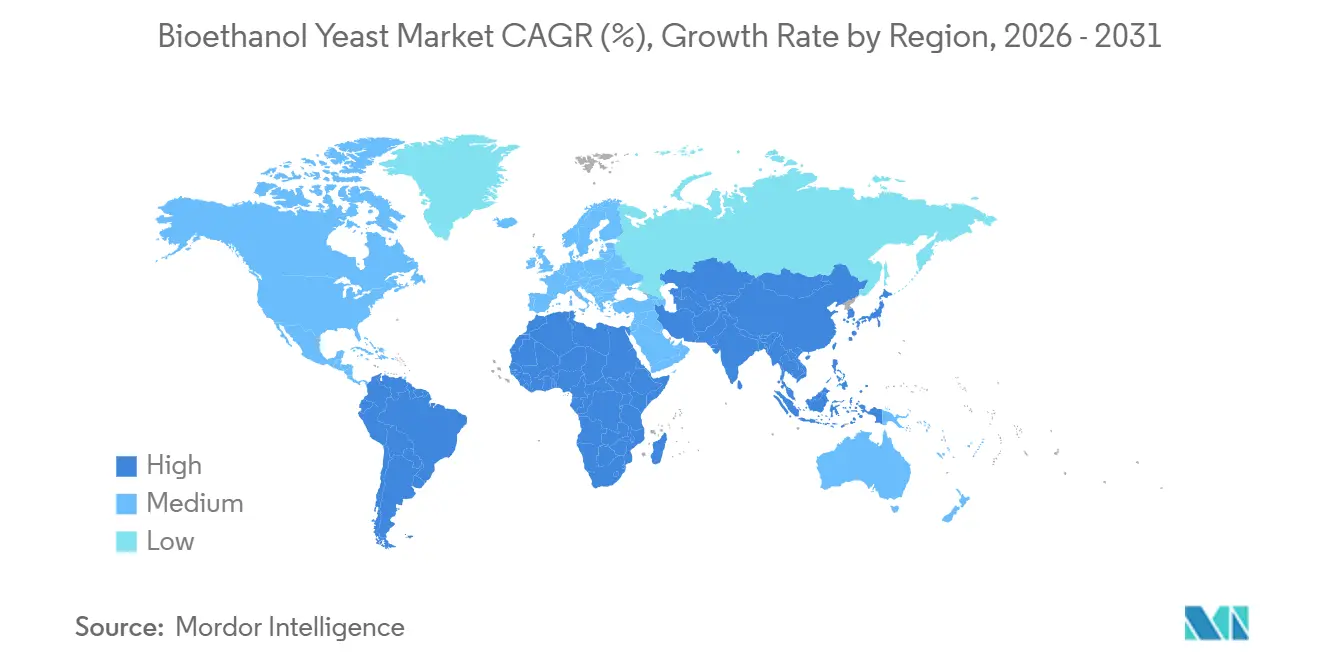
| Fastest Growing Market | Asia-Pacific |
| Largest Market | North America |
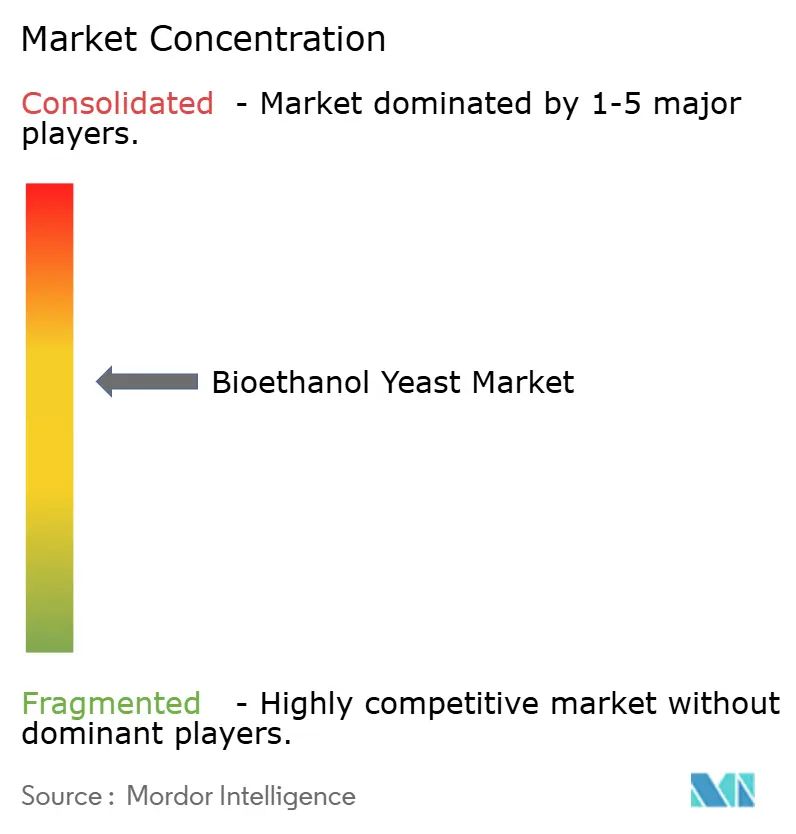
| Market Concentration | Medium |
Major Players *Disclaimer: Major Players sorted in no particular order Image © Mordor Intelligence. Reuse requires attribution under CC BY 4.0. | |
Bioethanol Yeast Market Analysis by Mordor Intelligence
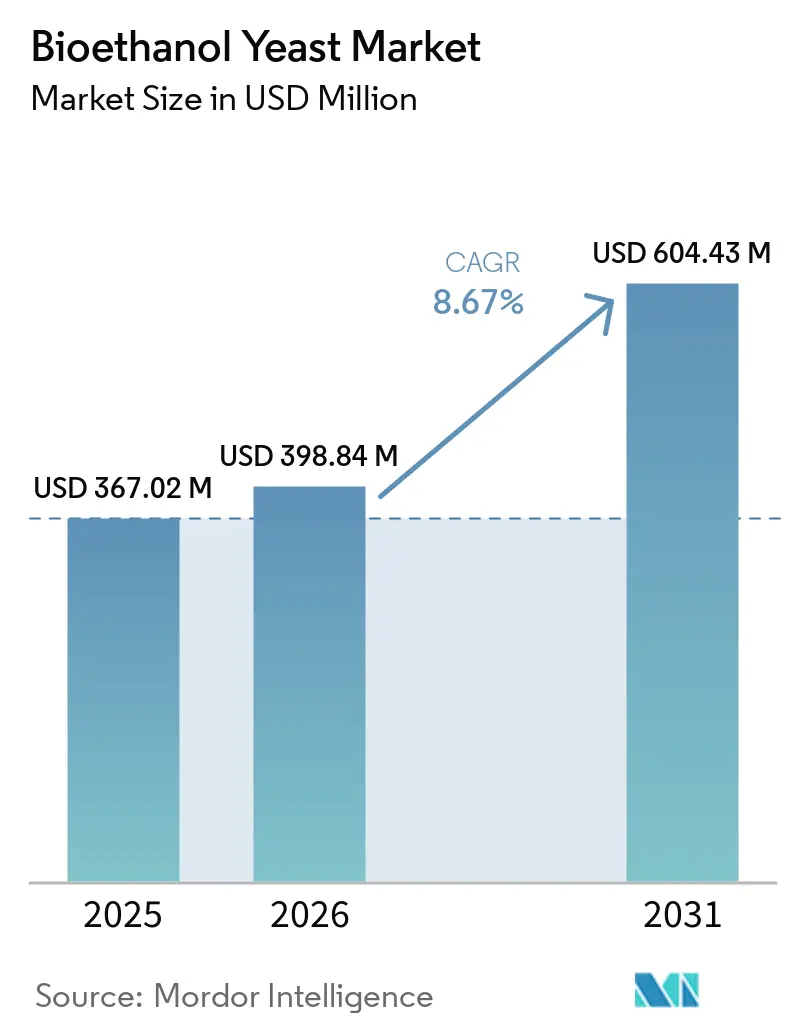
The bioethanol yeast market is projected to increase from USD 367.02 million in 2025 to USD 398.84 million in 2026 and reach USD 604.43 million by 2031, registering a CAGR of 8.67% during 2026-2031. Ethanol blending mandates across several countries are a key driver of market growth, as they create consistent demand for ethanol among refiners and fuel suppliers and reduce their exposure to discretionary fuel purchasing patterns. As bioethanol production expands, manufacturers require larger volumes of reliable yeast cultures to support continuous plant operations and ensure efficient fermentation. Bioethanol producers increasingly prefer high-performance yeast strains that can sustain ethanol yields under high-gravity fermentation conditions, tolerate operational stress, and reduce production cycle times. This preference is shifting demand toward specialized yeast products supported by technical services and integrated fermentation solutions. However, the market remains sensitive to fluctuations in feedstock prices, changes in transportation fuel demand, and revisions to national ethanol blending policies, which can influence bioethanol production volumes and yeast consumption.
Key Report Takeaways
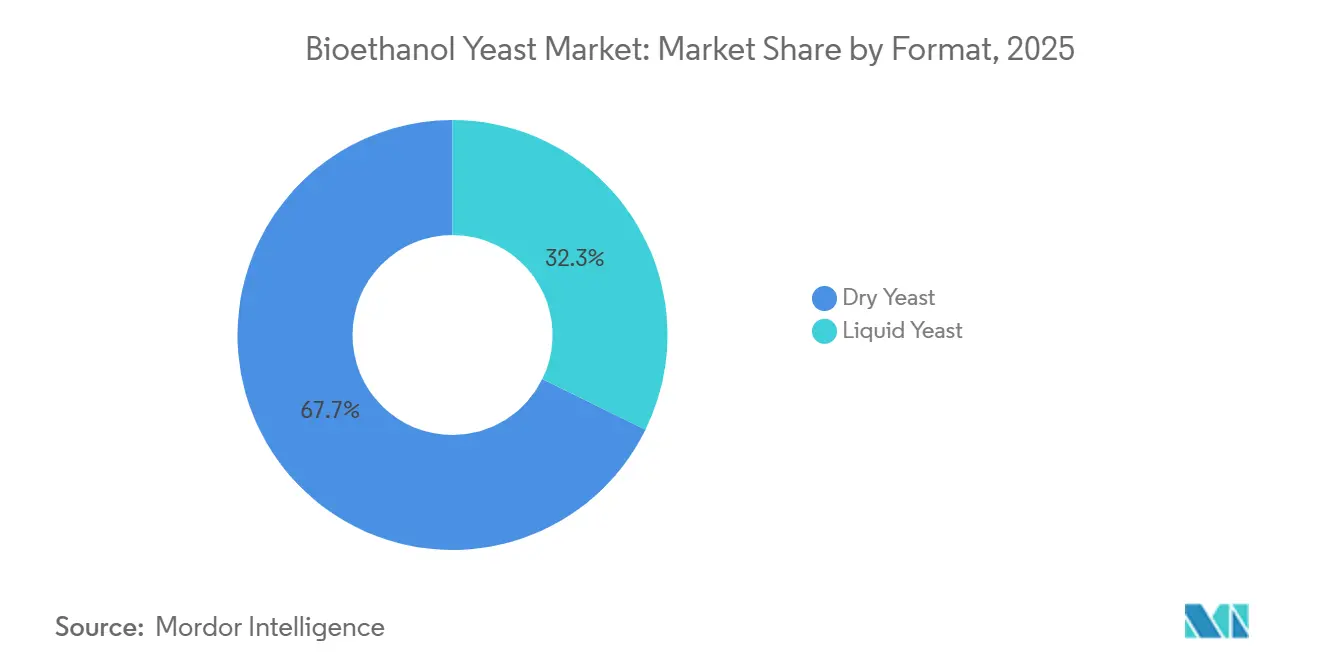
- By format, dry yeast held 67.73% of the global bioethanol yeast market share in 2025, while liquid yeast is forecast to grow at a 9.21% CAGR through 2031.
- By feedstock type, corn held 42.14% of the global bioethanol yeast market share in 2025, while sugarcane is forecast to grow at a 9.56% CAGR through 2031.
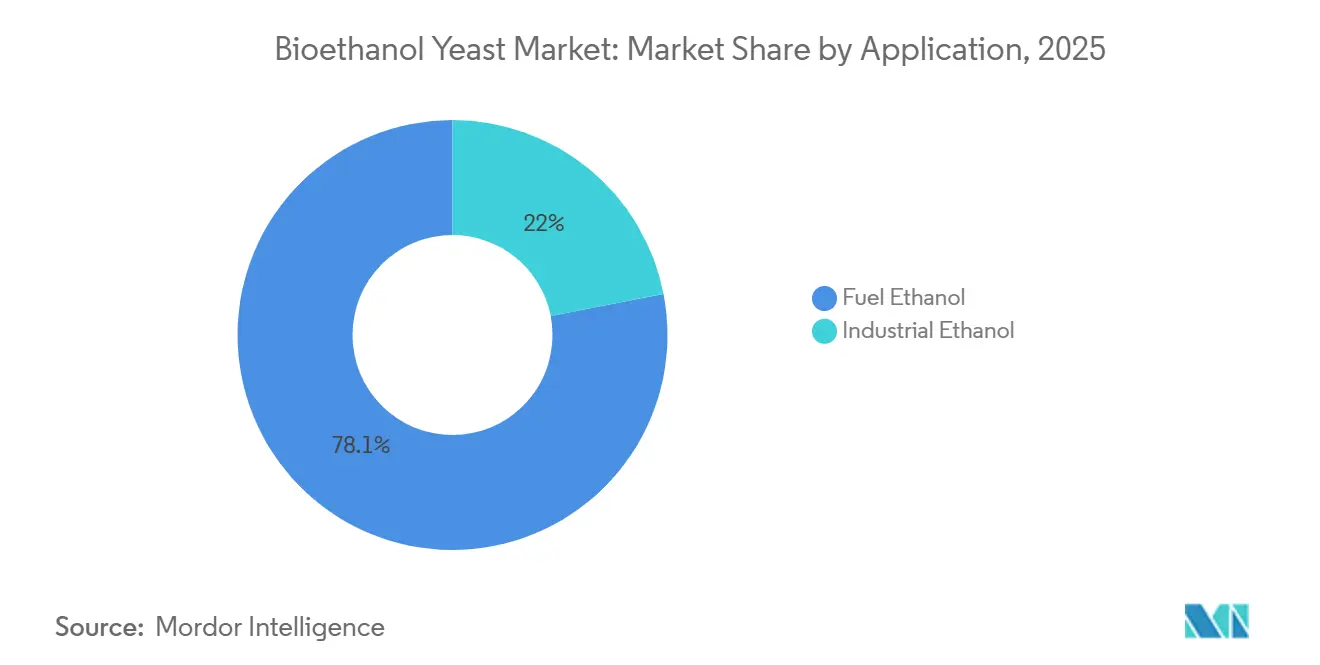
- By application, fuel ethanol held 78.07% of the global bioethanol yeast market share in 2025, while industrial ethanol is forecast to grow at a 9.03% CAGR through 2031.
- By geography, North America held 38.67% of the global bioethanol yeast market share in 2026, while Asia-Pacific is forecast to grow at a 9.75% CAGR through 2031.
Note: Market size and forecast figures in this report are generated using Mordor Intelligence’s proprietary estimation framework, updated with the latest available data and insights as of January 2026.
Market Trends and Insights
Drivers Impact Analysis of Bioethanol Yeast Market*
| Driver | (~) % Impact on CAGR Forecast | Geographic Relevance | Impact Timeline |
|---|---|---|---|
| Rising global bioethanol production | +2.1% | Global, with highest output increments in North America and South America | Short term (≤ 2 years) |
| Expansion of ethanol-blending mandates | +2.0% | Asia-Pacific, North America, Europe | Short term (≤ 2 years) |
| Growing adoption of high-performance yeast strains | +1.3% | North America and Latin America (largest plant base) | Medium term (2–4 years) |
| Shift toward high-efficiency fermentation processes | +1.0% | North America, Europe | Medium term (2–4 years) |
| Expansion of second-generation bioethanol | +1.1% | South America (Brazil), Europe, APAC (India, Australia) | Long term (≥ 4 years) |
| Advancements in yeast strain engineering | +0.8% | Global, led by Research and Development centres in Denmark, Canada, France, and Australia | Long term (≥ 4 years) |
| Source: Mordor Intelligence | |||
Rising Global Bioethanol Production
Growing bioethanol production and trade across countries are increasing the need for specialized fermentation yeast. As ethanol plants produce larger volumes and operate at higher capacity, they require reliable yeast that can improve fermentation speed, increase ethanol yield, and support consistent production quality. According to the Organization for Economic Co-operation and Development (OECD), global ethanol trade is projected to rise from 11.0 billion liters in 2024 into 11.9 billion liters by 2034[1]. However, trade's share of total ethanol production is expected to decline from 8.8% to 8.2% over the same period, indicating that domestic consumption and production will continue to grow in major markets. This expansion in ethanol production and cross-border trade is expected to create steady demand for bioethanol yeast, particularly high-yield and high-efficiency strains that help producers reduce production time, optimize plant operations, and improve overall process economics.
Expansion of Ethanol-Blending Mandates
Government mandates requiring fuel suppliers to blend more ethanol into gasoline are creating steady, long-term demand for bioethanol and the specialized yeast used to produce it. In the United States, the Environmental Protection Agency (EPA) finalized a requirement of 25.82 billion Renewable Identification Numbers (RINs) for 2026 and retained a conventional biofuel target of 15 billion gallons for both 2026 and 2027[2]. India’s rollout of E20 petrol, which contains 20% ethanol, in 2026 is also increasing the country’s ethanol production needs. Similarly, the European Union’s Renewable Energy Directive III (RED III) aims for renewable energy to account for 29% of transport energy use by 2030. These policies provide ethanol producers with clearer demand expectations and encourage them to invest in efficient, high-performance yeast strains for both conventional feedstocks, such as corn and sugarcane, and advanced feedstocks, including agricultural residues.
Expansion of Second-Generation Bioethanol
The growth of second-generation (2G) bioethanol production is increasing the demand for specialized yeast strains capable of efficiently converting lignocellulosic materials, such as sugarcane bagasse and agricultural residues, into ethanol. Unlike conventional feedstocks, these materials contain a mix of sugars and compounds that can inhibit fermentation, making yeast selection critical to production efficiency. The Saccharomyces Genome Database (SGD) highlights ongoing research on yeast performance and strain selection for bioethanol applications. A 2026 study published in Bioprocess and Biosystems Engineering found that Kluyveromyces marxianus Y-6860 achieved ethanol productivity of 3.25 g/L/h, compared with 2.17 g/L/h for Saccharomyces cerevisiae PE-2, in glucose-xylose-enriched sugarcane bagasse slurry[3]. This result demonstrates the value of high-performance yeast strains in improving 2G ethanol output. As cellulosic ethanol production capacity expands, demand is expected to increase for yeast strains with stronger multi-sugar utilization, higher tolerance to fermentation inhibitors, and improved ethanol productivity.
Growing Adoption of High-Performance Yeast Strains
The increasing use of high-performance yeast strains is driving growth in the global bioethanol yeast market. Ethanol producers are adopting these advanced strains to increase ethanol production, shorten fermentation time, and maintain stable operations without making significant investments in new equipment. A 2025 review published in FEMS Yeast Research noted that recent developments in yeast technology have improved ethanol yields, reduced glycerol formation, increased yeast robustness, and enabled very high-gravity fermentation. For example, Novonesis’ Innova Delta can increase ethanol yield by up to 3%, reduce fermentation time by up to 25%, and perform effectively in high-solids and other demanding fermentation conditions. As bioethanol plants aim to improve production efficiency and lower operating costs, demand is expected to increase for yeast strains that offer higher yields, faster fermentation, greater stress tolerance, and consistent performance.
Restraints Impact Analysis of Bioethanol Yeast Market*
| Restraint | (~) % Impact on CAGR Forecast | Geographic Relevance | Impact Timeline |
|---|---|---|---|
| High sensitivity to fermentation conditions | -1.2% | Global, most acute in tropical climates (South Asia, Southeast Asia, West Africa) | Short term (≤ 2 years) |
| High cost of specialized yeast strains | -0.8% | Emerging markets in Asia, Africa; cost-sensitive corn ethanol operators in North America | Medium term (2–4 years) |
| Competition from alternative fermentation technologies | -0.5% | Europe, North America (advanced biorefineries) | Long term (≥ 4 years) |
| Dependence on bioethanol industry economics | -0.9% | Global, particularly correlated with crude oil price cycles | Short to medium term |
| Source: Mordor Intelligence | |||
High Sensitivity to Fermentation Conditions
The high sensitivity of yeast to fermentation conditions can restrain the global bioethanol yeast market by affecting fermentation consistency, ethanol yield, and plant productivity. Industrial yeast is exposed to ethanol toxicity, osmotic pressure, temperature fluctuations, pH changes, nutrient limitations, and contaminants, all of which can reduce yeast viability and fermentation efficiency. Research published in Fungal Biology notes that these stresses can negatively affect ethanol yields and overall production efficiency, while FEMS Yeast Research highlights the additional challenges created by high-gravity fermentation and lignocellulosic inhibitors. Consequently, ethanol producers may require strain-specific optimization, process control, and technical support, increasing operational complexity and potentially limiting adoption where fermentation conditions are difficult to manage.
High Cost of Specialized Yeast Strains
The higher cost of specialized bioethanol yeast strains can limit their use, especially among ethanol producers operating on tight budgets and margins. These advanced strains cost more because manufacturers invest in research, strain selection, adaptive evolution, genetic engineering, and testing to ensure the yeast performs effectively under demanding fermentation conditions. In return, they can improve ethanol output and production efficiency. For example, a 2025 study published in Applied Microbiology and Biotechnology found that an engineered Saccharomyces cerevisiae strain produced 17% more ethanol than a wild-type strain during high-gravity fermentation. However, producers must assess whether the higher ethanol yield and efficiency benefits can offset the added cost of the yeast. This can be challenging for smaller producers and companies in emerging ethanol markets, where lower-cost conventional yeast may remain the preferred option. As a result, the market may remain divided between buyers who prioritize higher performance and those who prioritize cost.
*Our forecasts treat driver/restraint impacts as directional, not additive. The impact forecasts reflect baseline growth, mix effects, and variable interactions.
Bioethanol Yeast Market Segment Analysis
By Format:
Dry Yeast Leads Through Storage Flexibility While Liquid Yeast Gains At Large PlantsDry Yeast accounted for 67.73% of the bioethanol yeast market in 2025, maintaining its leading position in the format segment. Its extended shelf life enables producers to store yeast for longer periods without compromising operational continuity. Ease of storage, transportation, and handling further supports its widespread use across ethanol production facilities. The format is particularly well-suited to large-scale operations that require a stable and readily available yeast supply. Its established application in commercial fermentation processes continues to support demand across the bioethanol industry.
Liquid Yeast is projected to grow at a 9.21% CAGR through 2031, making it the fastest-growing format segment. Its ready-to-use characteristics reduce preparation requirements and enable faster initiation of fermentation. Producers are increasingly adopting liquid yeast to improve fermentation efficiency, maintain consistent yeast performance, and optimize ethanol yields. The format can also support more controlled fermentation processes, particularly in facilities focused on operational efficiency. Growing investment in advanced fermentation technologies is expected to further support the expansion of the Liquid Yeast segment.
By Feedstock Type:
Corn Provides Scale While Sugarcane Supports Faster GrowthCorn accounted for 42.14% of the bioethanol yeast market in 2025, establishing it as the leading feedstock segment. Its widespread availability, high starch content, and well-developed supply chain make corn a preferred raw material for fuel ethanol production. Corn-based ethanol facilities require high-performance yeast solutions capable of efficiently converting starch-derived sugars into ethanol. The extensive presence of large-scale ethanol plants in key corn-producing countries continues to support consistent demand for bioethanol yeast. Ongoing investments in improving ethanol yields and fermentation efficiency are also expected to strengthen the segment’s market position.
Sugarcane is projected to register a CAGR of 9.56% through 2031, making it the fastest-growing feedstock segment in the global bioethanol yeast market. The increasing use of sugarcane for ethanol production, particularly in major producing countries, is driving demand for specialized yeast strains. These strains must perform effectively under high-temperature fermentation conditions and tolerate elevated ethanol concentrations. Expanding ethanol blending mandates and growing investments in sugarcane-based biofuel production are further supporting segment growth. The availability of sugarcane juice and molasses as readily fermentable feedstocks is also expected to contribute to the increasing adoption of bioethanol yeast.
By Application:
Fuel Ethanol Retains Volume Leadership While Industrial Ethanol Adds Higher-Value DemandFuel Ethanol accounted for 78.07% of the global bioethanol yeast market in 2025, maintaining its position as the dominant application segment. The segment benefits from strong demand for renewable transportation fuels and the continued implementation of ethanol-blending mandates across several countries. Bioethanol producers increasingly use specialized yeast strains to improve fermentation efficiency, enhance ethanol yields, and reduce production costs. The expansion of large-scale ethanol production facilities in key markets is expected to sustain demand for bioethanol yeast in fuel ethanol applications.
Industrial Ethanol is projected to grow at a CAGR of 9.03% through 2031, making it the fastest-growing application segment in the global bioethanol yeast market. Ethanol is widely used as a solvent, chemical intermediate, and feedstock in pharmaceutical, chemical, personal care, and other industrial applications. Growing industrial activity and rising demand for bio-based chemicals are increasing the need for efficient industrial ethanol production processes. This trend is expected to create additional opportunities for high-performance bioethanol yeast solutions that support consistent fermentation and improved production output.
Geography Analysis
North America Bioethanol Yeast Market
North America accounted for 38.67% of the bioethanol yeast market in 2026, supported by the region’s extensive corn-based ethanol production infrastructure, particularly in the United States. Established fermentation facilities, integrated supply chains, and supportive policies under the Renewable Fuel Standard continue to provide a stable foundation for ethanol production. U.S. producers are increasingly selecting yeast technologies based on their ability to improve ethanol yield, shorten fermentation cycles, and reduce unwanted by-products. The growing focus on production efficiency and operating cost optimization is further supporting the adoption of advanced yeast strains. Canada and Mexico also contribute to regional demand through expanding ethanol production and blending initiatives.
APAC Bioethanol Yeast Market
Asia Pacific is projected to be the fastest-growing regional market, expanding at a 9.75% CAGR through 2031, driven by increasing ethanol blending mandates and investments in domestic production capacity. India’s nationwide E20 implementation in 2026 is expected to significantly strengthen ethanol demand and increase the need for high-performing fermentation solutions. In November 2025, Novonesis launched Innova Delta in India to support fermentation under local thermal and osmotic conditions. China offers a more moderate growth opportunity because of its relatively low ethanol blending rate, although policy developments could improve long-term demand. Japan, Australia, and Southeast Asian countries provide additional growth avenues as they advance renewable fuel programs and diversify energy sources.
EMEA and South America Bioethanol Yeast Market
Europe, South America, and the Middle East & Africa offer diverse opportunities for bioethanol yeast adoption, shaped by feedstock availability, decarbonization policies, and the maturity of ethanol production infrastructure. Europe’s Renewable Energy Directive III (RED III) is increasing the focus on greenhouse gas performance and advanced feedstocks, supporting demand for yeast solutions that improve the efficiency of lower-carbon ethanol pathways. South America remains a key regional market, led by Brazil’s well-established sugarcane ethanol industry and its large-scale fermentation capacity. The Middle East and Africa represent comparatively emerging markets, where future demand will depend on infrastructure development, feedstock availability, and supportive regulatory frameworks. Growing interest in renewable fuels and energy security could further support ethanol production initiatives across these regions.
Competitive Landscape
The bioethanol yeast market is moderately consolidated, with major companies such as Novonesis A/S, Lallemand Inc., Lesaffre, AngelYeast Co., Ltd., and Associated British Foods plc. These companies compete by offering specialized yeast strains and improved fermentation technologies. They also provide technical support and integrated solutions to help ethanol producers improve production outcomes. Many leading suppliers now sell yeast along with enzymes, nutrients, and process optimization services. Regional suppliers remain important in price-sensitive markets and for standard bioethanol applications.
Novonesis and MicroBioGen are expected to strengthen their market position through the planned December 2025 launch of Innova Nitro. This product targets high-gravity fermentation, enabling producers to generate more ethanol per batch. Innova Nitro is designed to support ethanol concentrations of up to 16% by weight in less than 52 hours. Lesaffre has also expanded its product range with Virtuo Edge, a dry hybrid yeast for ethanol production. The company markets Virtuo Edge across Europe, Asia Pacific, and China.
Companies increasingly compete by improving fermentation efficiency, supporting high-gravity production, and enabling the use of different feedstocks. Suppliers are developing advanced yeast strains that can use multiple sugars from lignocellulosic feedstocks. These capabilities can help ethanol producers improve yields and reduce production costs. Non-GMO yeast strains are also important in markets that restrict genetically modified organisms. Although price remains important for commodity applications, high-performance products, technical support, and certification capabilities are becoming key competitive factors.
Bioethanol Yeast Industry Leaders
-
Novonesis A/S
-
LALLEMAND Inc.
-
Lesaffre
-
AngelYeast Co., Ltd.
-
Associated British Foods plc
- *Disclaimer: Major Players sorted in no particular order
Bioethanol Yeast Market Companies Covered in this Report
- Novonesis A/S
- LALLEMAND Inc.
- Lesaffre
- AngelYeast Co., Ltd.
- Associated British Foods plc
- AB Mauri
- International Flavors and Fragrances Inc.
- DSM-Firmenich AG
- Leiber GmbH
- Alltech, Inc.
- Oriental Yeast Co., Ltd.
- Biorigin
- Cargill, Incorporated
- Archer Daniels Midland Company
- POET, LLC
- Green Plains Inc.
- Alto Ingredients, Inc.
- MicroBioGen Pty Ltd
- Xylogenics, Inc.
- Ferm Solutions, Inc.
Recent Industry Developments in Bioethanol Yeast Market
- December 2025: Novonesis introduced Innova Nitro, a yeast technology designed to enhance ethanol plant throughput and fermentation efficiency. The technology enables ethanol producers to achieve ethanol concentrations of up to 16% by volume in fermentation cycles lasting less than 52 hours.
- November 2025: Novonesis has launched Innova Delta, a next-generation non-GMO yeast solution for India’s ethanol industry. The solution is designed to deliver up to 3% higher ethanol yields and reduce fermentation time by up to five hours.
- April 2025: MicroBioGen and Novonesis announced the expansion of their long-term yeast partnership beyond bioethanol into biochemicals and other applications. The collaboration combined MicroBioGen’s yeast strain portfolio with Novonesis’ research and commercialization capabilities to develop new yeast innovations for the global bioethanol market.
- October 2024: Novonesis launched Innova Eclipse, an advanced yeast technology designed for ethanol production. The technology improves fermentation performance and helps producers achieve higher yields and shorter fermentation times.
Global Bioethanol Yeast Market Report Scope
Bioethanol yeast comprises specialized strains of yeast that convert sugars and starch-derived feedstocks into ethanol through fermentation, supporting the production of renewable fuel and industrial-grade ethanol. These yeast cultures play a critical role in improving fermentation efficiency, ethanol yield, and process stability across bioethanol production facilities. Based on format, the market is segmented into Dry Yeast and Liquid Yeast; based on feedstock type, into Sugarcane, Wheat, Corn, and Others; and based on application, into Industrial Ethanol and Fuel Ethanol. The demand for bioethanol yeast is influenced by the increasing focus on renewable energy sources, government biofuel blending mandates, and the need to reduce dependence on fossil fuels. Geographically, the market is segmented into North America, Europe, Asia Pacific, Latin America, and the Middle East and Africa. Market forecasts are provided in terms of value (USD).
Segmentation Overview
| Dry Yeast |
| Liquid Yeast |
| Sugarcane |
| Wheat |
| Corn |
| Others |
| Industrial Ethanol |
| Fuel Ethanol |
| North America | United States |
| Canada | |
| Mexico | |
| Rest of North America | |
| Europe | Germany |
| United Kingdom | |
| Italy | |
| France | |
| Spain | |
| Rest of Europe | |
| Asia-Pacific | China |
| Japan | |
| India | |
| Australia | |
| Rest of Asia-Pacific | |
| South America | Brazil |
| Argentina | |
| Rest of South America | |
| Middle East and Africa | South Africa |
| Saudi Arabia | |
| United Arab Emirates | |
| Rest of Middle East and Africa |
| By Format | Dry Yeast | |
| Liquid Yeast | ||
| By Feedstock Type | Sugarcane | |
| Wheat | ||
| Corn | ||
| Others | ||
| By Application | Industrial Ethanol | |
| Fuel Ethanol | ||
| By Geography | North America | United States |
| Canada | ||
| Mexico | ||
| Rest of North America | ||
| Europe | Germany | |
| United Kingdom | ||
| Italy | ||
| France | ||
| Spain | ||
| Rest of Europe | ||
| Asia-Pacific | China | |
| Japan | ||
| India | ||
| Australia | ||
| Rest of Asia-Pacific | ||
| South America | Brazil | |
| Argentina | ||
| Rest of South America | ||
| Middle East and Africa | South Africa | |
| Saudi Arabia | ||
| United Arab Emirates | ||
| Rest of Middle East and Africa | ||
Key Questions Answered in the Report
How large is the global bioethanol yeast market in 2026?
The global bioethanol yeast market size is estimated at USD 398.84 million in 2026 and is forecast to reach USD 604.43 million by 2031.
Which format leads bioethanol production?
Dry yeast held 67.73% share in 2025 because its 24-month ambient shelf life supports broad distribution.
Which feedstock is growing fastest for bioethanol yeast?
Sugarcane is forecast to grow at a 9.56% CAGR through 2031, supported by Brazilian ethanol production and second-generation capacity plans.
Which application is expanding fastest?
Industrial ethanol is projected to grow at a 9.03% CAGR through 2031 as demand increases for high-purity ethanol in pharmaceutical and chemical uses.