
BFSI Enterprise Content Management (ECM) Market Size and Share
Market Overview
| Study Period | 2020 - 2031 |
|---|---|
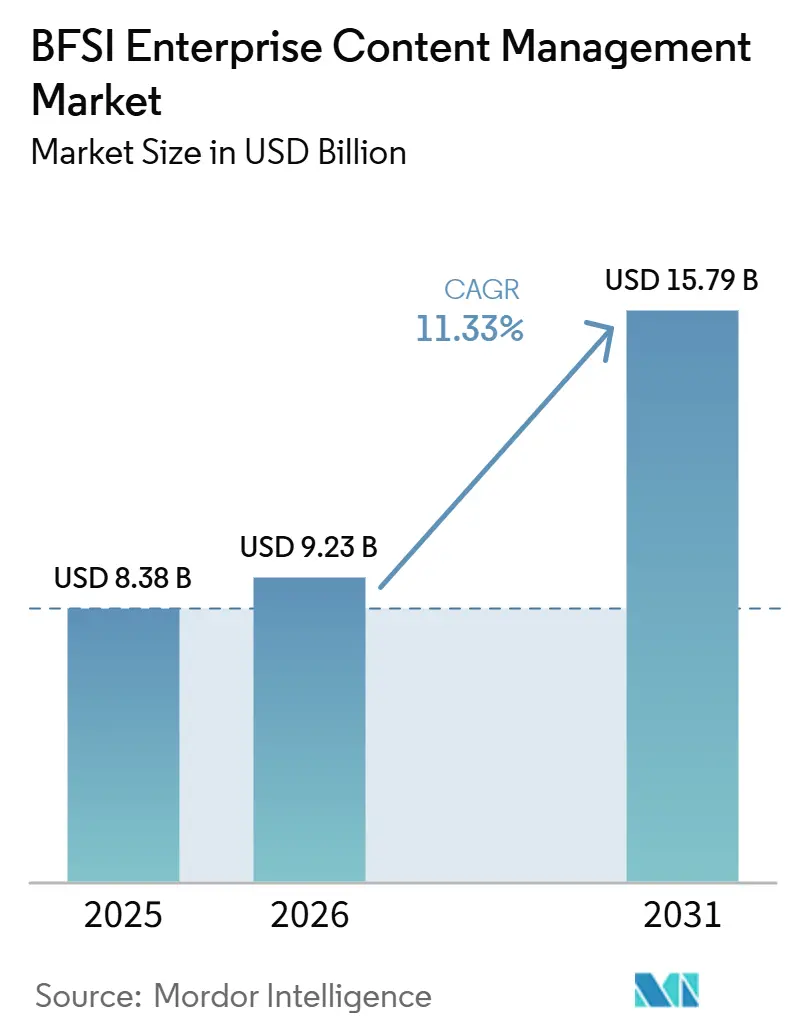
| Market Size (2026) | USD 9.23 Billion |
| Market Size (2031) | USD 15.79 Billion |
| Growth Rate (2026 - 2031) | 11.33% CAGR |
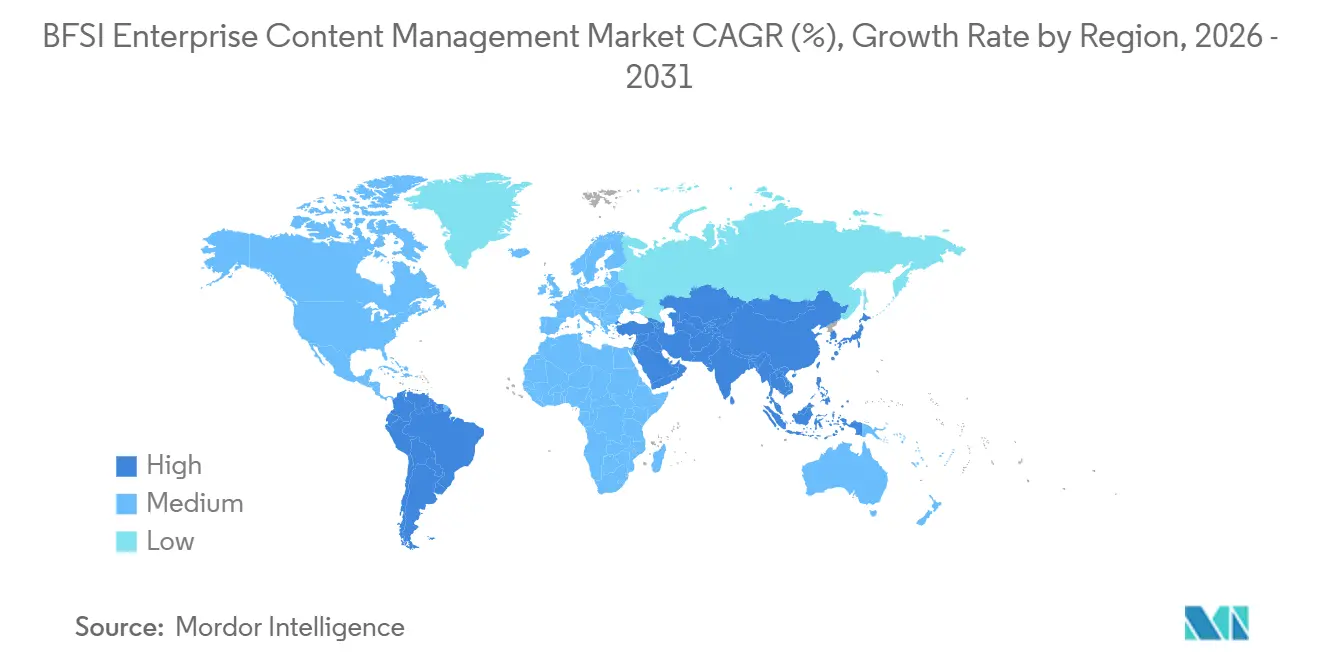
| Fastest Growing Market | Asia-Pacific |
| Largest Market | North America |
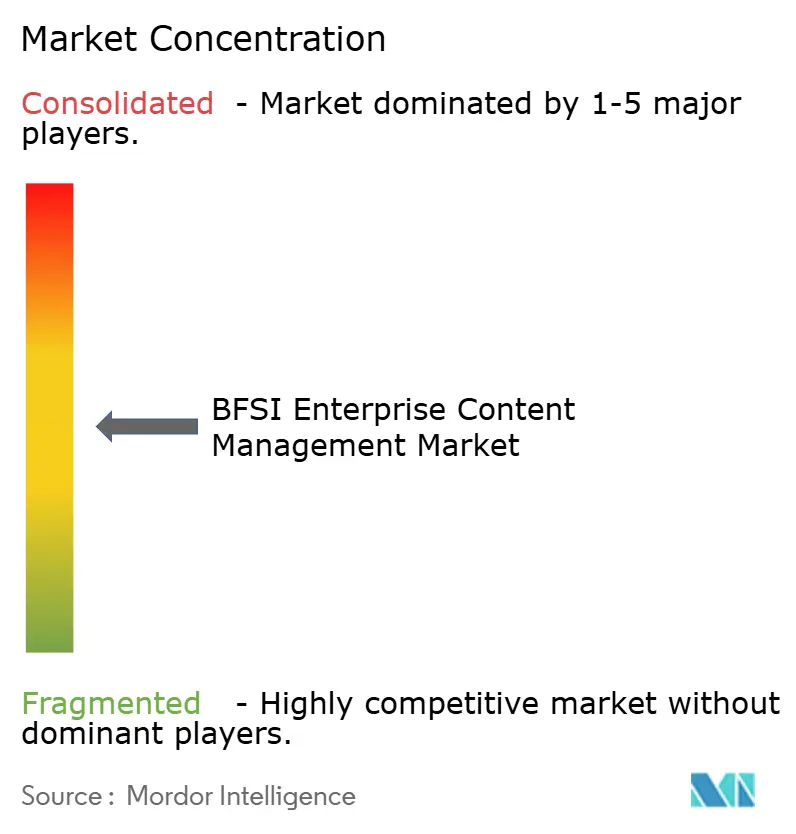
| Market Concentration | Medium |
Major Players *Disclaimer: Major Players sorted in no particular order Image © Mordor Intelligence. Reuse requires attribution under CC BY 4.0. | |
BFSI Enterprise Content Management (ECM) Market Analysis by Mordor Intelligence
The BFSI Enterprise Content Management (ECM) market size is expected to grow from USD 8.38 billion in 2025 to USD 9.23 billion in 2026 and is forecast to reach USD 15.79 billion by 2031 at 11.33% CAGR over 2026-2031. Growth is being supported by the steady shift of banks, insurers, and asset managers toward digital document flows that are easier to search, govern, and retrieve across customer interactions. Information governance rules are also pushing content systems from a back-office support tool into a required layer for records control, audit readiness, and policy enforcement. Buying priorities are moving beyond repository functions into workflow routing, case handling, and AI-led content intelligence that can classify and surface records faster. Vendors are responding by deepening integrations with banking systems, adopting cloud delivery, and building AI features into core platforms rather than relying on separate tools. The strongest opportunities lie in platforms that combine governed storage, faster process execution, and stronger compliance controls within a single operating environment.
Key Report Takeaways
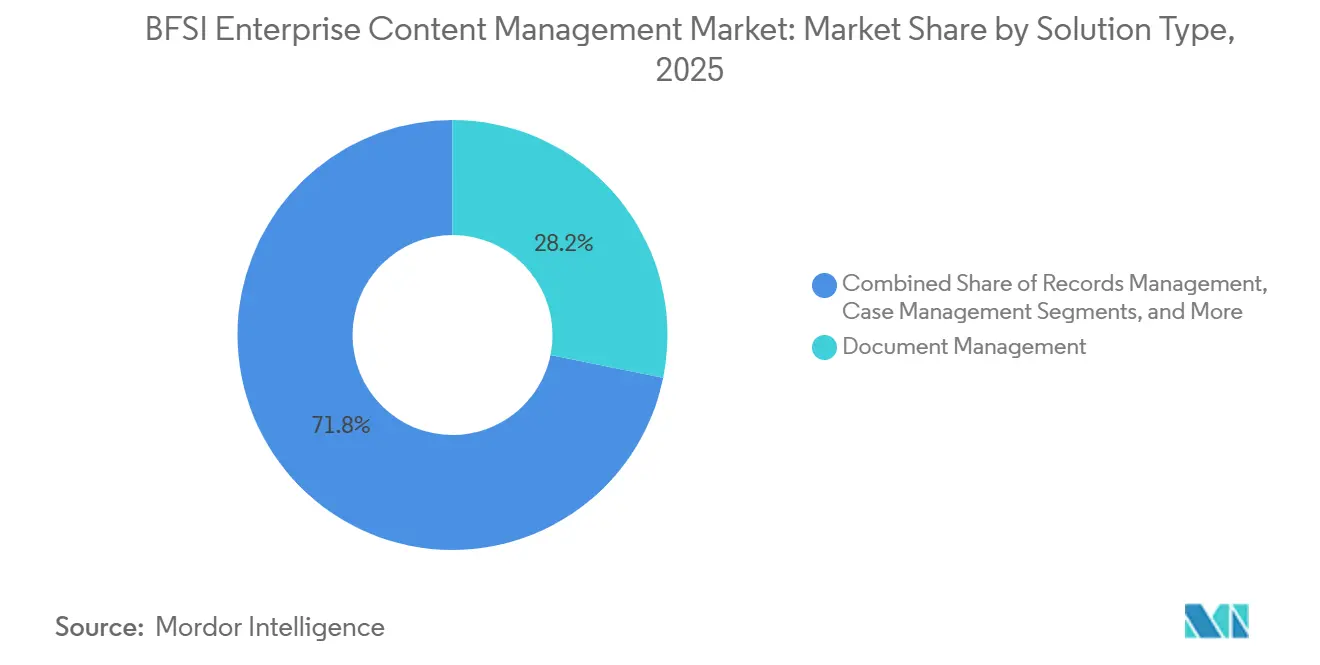
- By solution type, Document Management held 28.19% of the BFSI Enterprise Content Management (ECM) market share in 2025, while Workflow and Business Process Management are projected to expand at 12.41% CAGR through 2031.
- By deployment mode, cloud accounted for 70.51% of the BFSI Enterprise Content Management (ECM) market share in 2025 and is also projected to record the highest growth at 13.23% CAGR through 2031.
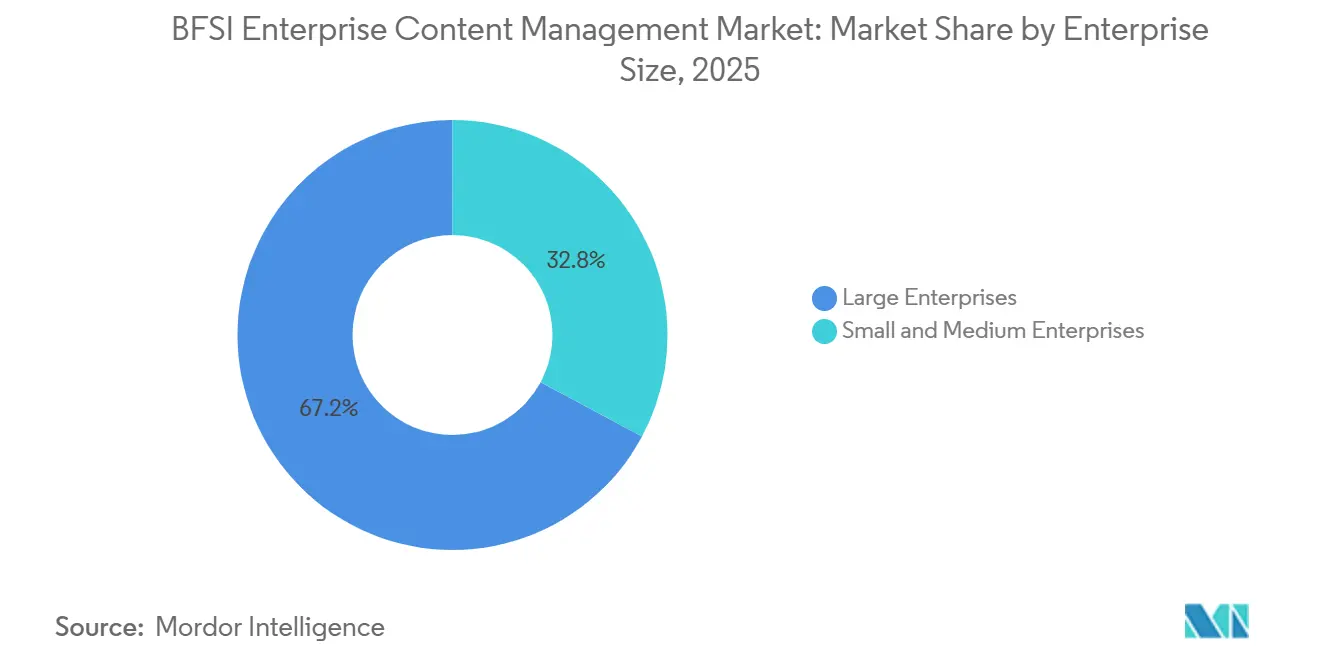
- By enterprise size, large enterprises held 67.18% of the BFSI Enterprise Content Management (ECM) market share in 2025, while SMEs are projected to grow at 13.57% CAGR through 2031.
- By geography, North America held 40.06% of the BFSI Enterprise Content Management (ECM) market share in 2025, while the Asia-Pacific is projected to expand at 12.89% CAGR through 2031.
Note: Market size and forecast figures in this report are generated using Mordor Intelligence’s proprietary estimation framework, updated with the latest available data and insights as of January 2026.
Global BFSI Enterprise Content Management (ECM) Market Trends and Insights
Drivers Impact Analysis*
| Driver | (~) % Impact on CAGR Forecast | Geographic Relevance | Impact Timeline |
|---|---|---|---|
| Rising Digital Onboarding and Paperless Banking Adoption | +2.5% | Global, with early gains in North America, Western Europe, and South and Southeast Asia | Short term (≤ 2 years) |
| Expanding Regulatory Pressure for Audit-Ready Content Retention | +2.2% | Global, with highest intensity in the EU, United States, and United Kingdom | Medium term (2-4 years) |
| Growth in Cloud-Native ECM Modernization Programs | +1.8% | North America and Europe, with spillover to Asia-Pacific and the Middle East | Medium term (2-4 years) |
| AI-Based Document Classification and Intelligent Search Adoption | +1.5% | Global, with concentration in North America, China, and India | Long term (≥ 4 years) |
| Demand for Unified Customer File and Case Management Across Channels | +1.0% | Global, with accelerating adoption in Asia-Pacific and the Middle East | Medium term (2-4 years) |
| Need for Cross-Border Compliance Automation in Multinational Banks | +0.8% | EU, North America, and GCC financial centers | Long term (≥ 4 years) |
| Source: Mordor Intelligence | |||
Rising Digital Onboarding and Paperless Banking Adoption
The move away from branch-heavy and paper-heavy banking is creating steady demand across the BFSI Enterprise Content Management (ECM) market. Banks now need customer files that can be captured once, classified correctly, and made available across onboarding, review, and service workflows without creating gaps in the audit trail. The Financial Markets Standards Board issued a 2025 standard on client onboarding documentation and processes, which supports a more disciplined approach to record collection, verification, and retention in financial institutions. This is pushing the BFSI Enterprise Content Management (ECM) market toward platforms that integrate intake, validation, and downstream governance into a single, managed flow. Institutions that digitize front-end onboarding without upgrading document control in the middle office still face delays, duplicate checks, and fragmented records.
Expanding Regulatory Pressure for Audit-Ready Content Retention
Regulatory pressure is making auditable content retention a core buying factor in the BFSI Enterprise Content Management (ECM) market. The EU Anti-Money Laundering Regulation and DORA are raising the standard for documenting and governing customer due diligence files, metadata, access controls, and infrastructure choices across financial institutions. This shift is no longer just about storing records for longer periods, because firms also need systems that can show who handled a file, where it resides, and how it moved through approval steps. The BFSI Enterprise Content Management (ECM) market is therefore favoring vendors that can support immutable trails, stronger policy enforcement, and architecture choices that align with jurisdiction-specific operating rules. Certifications such as ISO 27001 and SOC 2 Type II now matter less as a point of distinction and more as a minimum requirement for platform consideration.
Growth in Cloud-Native ECM Modernization Programs
Cloud modernization is one of the clearest growth engines in the BFSI Enterprise Content Management (ECM) market. Institutions are moving beyond simple hosting changes and choosing platforms that embed workflow controls, security updates, search, summarization, and AI features into the core environment. Fiserv launched Content Next in September 2025 as a multi-tenant cloud-based ECM and workflow offering for financial institutions, developed with OpenText and designed to embed AI-powered natural-language search, classification, summarization, and automated processing. The same announcement stated that automated content systems can reduce manual processing time by up to 60%, while automated content workflows can reduce operational costs by 25% to 40%, which strengthens the business case for the BFSI Enterprise Content Management (ECM) market. As a result, cloud buying in the BFSI Enterprise Content Management (ECM) market is increasingly tied to operational efficiency and platform flexibility, rather than just infrastructure savings.
AI-Based Document Classification and Intelligent Search Adoption
AI is changing what buyers expect from the BFSI Enterprise Content Management (ECM) market. Hyland introduced the Enterprise Context Engine for financial services in April 2026, linking regulatory obligations to controls, policies, and compliance structures so that document handling can support live governance rather than static indexing. A 2026 Springer study showed that retrieval-augmented large language model frameworks can classify long, varied banking documents without labeled training data, supporting the wider use of zero-shot document intelligence in the BFSI Enterprise Content Management (ECM) market. Industrial Bank stated in April 2026 that it deployed DeepSeek-V4 across 46 business domains, indicating that large Asia-Pacific institutions are also building proprietary content intelligence stacks alongside the BFSI Enterprise Content Management (ECM) market.[1]Industrial Bank, “Xingye Bank Among First to Deploy DeepSeek-V4, Powering Intelligent Xingye with Fully Domestic AI,” Industrial Bank Official Website, cib.com.cn This means vendors now need to offer better classification, stronger record-level reasoning, and secure deployment options if they want a stronger position in the BFSI Enterprise Content Management (ECM) market.
Restraints Impact Analysis*
| Restraint | (~) % Impact on CAGR Forecast | Geographic Relevance | Impact Timeline |
|---|---|---|---|
| Legacy Core Banking Integration Complexity | -2.0% | Global, with highest intensity in North America and Western Europe | Long term (≥ 4 years) |
| High Data Migration and Records Normalization Effort | -1.3% | Global, with compound pressure in institutions managing cross-border records | Medium term (2-4 years) |
| Data Sovereignty Constraints on Public Cloud Deployment | -0.8% | EU, Germany, France, and GCC jurisdictions with strict data localization rules | Long term (≥ 4 years) |
| Change Management Friction in Branch-Heavy Institutions | -0.5% | South and Southeast Asia, South America, and Sub-Saharan Africa | Medium term (2-4 years) |
| Source: Mordor Intelligence | |||
Legacy Core Banking Integration Complexity
Legacy core banking environments remain a major barrier for the BFSI Enterprise Content Management (ECM) market. Many institutions still run content processes across legacy core systems, newer digital layers, and undocumented interfaces built over long periods. That forces ECM programs to operate across both old and new environments simultaneously, slowing implementation and making testing more difficult. The BFSI Enterprise Content Management (ECM) market also faces friction when modern platforms require clean API connections, while existing record flows still rely on batch logic and custom mappings. Even when buyers want faster modernization, integration complexity can delay value capture and extend project timelines beyond what mid-sized institutions are comfortable funding.
High Data Migration and Records Normalization Effort
Data migration and records normalization create another meaningful drag on the BFSI Enterprise Content Management (ECM) market. Financial institutions often hold decades of customer files across duplicate archives, inconsistent naming standards, and mixed retention rules, making them hard to reconcile before migration. This makes it harder to configure a new platform, because content must be cleaned, tagged, and linked to the right jurisdiction, business line, and customer relationship before it becomes useful. The BFSI Enterprise Content Management (ECM) market is also affected when a single customer file must satisfy multiple overlapping compliance obligations simultaneously, underscoring the importance of metadata discipline and record lineage. Migration effort, therefore, becomes more than a technical conversion task because it also determines how quickly institutions can trust the new environment for audits, service requests, and case handling.
*Our forecasts treat driver/restraint impacts as directional, not additive. The impact forecasts reflect baseline growth, mix effects, and variable interactions.
Segment Analysis
By Solution Type: Workflow Automation Closes the Gap on Document Management
Document Management retained 28.19% of the BFSI Enterprise Content Management (ECM) market share in 2025, making it the largest solution category in this market. Its lead reflects the basic need to centralize loan files, account opening records, insurance policy documents, and regulatory correspondence in governed repositories across the BFSI Enterprise Content Management (ECM) market. Records Management and Web Content Management serve narrower use cases, with one focused more on retention and archiving, and the other more closely tied to customer-facing digital communication. Digital Asset Management is also becoming more relevant for insurers and investment firms that manage branded content, multimedia files, and product materials across several channels.
Workflow and Business Process Management is expected to post the fastest growth at a 12.41% CAGR through 2031, indicating where the BFSI enterprise content management industry is moving. As digital onboarding tools improve, attention is shifting to routing, approvals, exception handling, and audit trail creation inside the BFSI Enterprise Content Management (ECM) market. Oracle states that its Financial Services Enterprise Case Management platform supports structured investigation workflows across alert types, which fits the need for stronger case control in regulated financial operations.[2]Oracle Corporation, “About Oracle Financial Services Enterprise Case Management,” Oracle Documentation, docs.oracle.com Hyland said in June 2026 that its Agentic Bank solution can reduce follow-up document requests by up to 50% and move loan applications to underwriter-ready status in days rather than weeks, highlighting how workflow-led products are expanding in the BFSI Enterprise Content Management (ECM) market.



By Deployment Mode: Cloud Consolidates While Architecture Splits by Jurisdiction
Cloud accounted for 70.51% of the BFSI Enterprise Content Management (ECM) market in 2025, underscoring its status as the preferred deployment model for most new projects. In the BFSI Enterprise Content Management (ECM) market, cloud platforms appeal to buyers because they reduce infrastructure costs, accelerate updates, and make AI capabilities easier to deploy at scale. Hyland's June 2026 Azure partnership and Fiserv's Content Next launch both show that the market is moving past basic storage and toward governed AI orchestration inside cloud environments. This keeps the cloud at the center of modernization decisions across the BFSI Enterprise Content Management (ECM) market.
On-premises and hybrid models still matter in the BFSI enterprise content management industry, but their roles are becoming more specialized. Institutions operating under strict data localization or residency rules are more likely to keep sensitive records in sovereign or private environments while using compliant cloud layers for analytics and process automation. This means the BFSI Enterprise Content Management (ECM) market is not dividing into old and new technology camps, because many firms are choosing mixed architectures that reflect their regulatory footprint. Vendors that can demonstrate data isolation, support multiple clouds, and consistently manage policies across environments are better positioned to win these deployments.
By Enterprise Size: SME Demand Gains Pace as Delivery Economics Improve
Large enterprises accounted for 67.18% of the BFSI Enterprise Content Management (ECM) market in 2025, reflecting the scale of their compliance burden and the complexity of their content estates. The BFSI Enterprise Content Management (ECM) market has long been shaped by global banks, major insurers, and diversified financial groups that treat ECM as a core system of record rather than a stand-alone document tool. OpenText reported new BFSI wins in Q3 FY2026 at KeyBank, M&T Bank, Atruvia, and Bank Aston, showing how deeply large institutions remain tied to established platform suppliers. Procurement cycles in this part of the BFSI Enterprise Content Management (ECM) market are usually long, cross-functional, and closely linked to risk and architecture teams.
SMEs are projected to grow at a 13.57% CAGR through 2031, making them the fastest-growing segment in the BFSI Enterprise Content Management (ECM) market. Cloud delivery and consumption-based pricing are lowering entry barriers for community banks, regional insurers, credit unions, and non-bank lenders that previously lacked the capital and IT capacity for large deployments. Fiserv said its Content Next platform allows branch administrators and compliance officers to configure access controls, workspace roles, and routing rules without IT support, which helps explain why smaller users are becoming more important in the BFSI Enterprise Content Management (ECM) market. Growth is also being helped by wider compliance coverage, because smaller financial institutions are under greater pressure to formalize document governance and move away from ad hoc file handling.
Geography Analysis
North America held a 40.06% share of the BFSI Enterprise Content Management (ECM) market in 2025, making it the largest regional contributor. The region benefits from a concentration of large financial institutions, strong IT spending, and a regulatory environment that keeps record-keeping high on the investment agenda. The United States remains the main source of demand, while Canada and Mexico are also advancing as banks modernize document operations to meet open banking and cross-border compliance requirements. Europe is a more tightly constrained environment for the BFSI Enterprise Content Management (ECM) market, because DORA, the EU AMLR, and AI-related rules shape both platform features and deployment choices. Within the BFSI Enterprise Content Management (ECM) market, the United Kingdom, Germany, and France remain the main European demand centers, while South America, led by Brazil and Argentina, represents a smaller but developing opportunity linked to electronic documentation and public-sector digital reform.
Asia-Pacific is projected to grow at a 12.89% CAGR through 2031, making it the fastest-growing geography in the BFSI Enterprise Content Management (ECM) market. Industrial Bank said in April 2026 that it deployed DeepSeek-V4 across 46 business domains, which shows that leading institutions in the region are investing directly in proprietary content intelligence as part of the BFSI Enterprise Content Management (ECM) market. China, India, Japan, South Korea, and Australia are all contributing to momentum as banks expand digital services, strengthen KYC and recordkeeping, and seek more efficient document workflows. The BFSI Enterprise Content Management (ECM) market in Asia-Pacific, therefore, rewards vendors that can combine localized compliance support with scalable cloud and AI capabilities.
South America, the Middle East, and Africa are smaller parts of the BFSI Enterprise Content Management (ECM) market, but demand is still rising as institutions improve records handling and case workflows. Newgen announced in November 2025 that it had deployed an AI-first Electronic Document and Record Management System for Vision Bank in Abu Dhabi, with full lifecycle automation and integration into the bank's core systems. Tieto said in 2026 that Danmarks Nationalbank selected its Public 360° SaaS platform for electronic case and document management, indicating that public financial institutions are also upgrading their control over regulated records.[3]Tieto, “Denmark's National Bank Selects Tieto for Case and Document Management,” Tieto Newsroom, tieto.com Across the BFSI Enterprise Content Management (ECM) market, regional adoption is moving at different speeds, but the shared requirement is auditable control over content, workflows, and retention rules.

Competitive Landscape
The BFSI Enterprise Content Management (ECM) market is moderately concentrated at the top, with OpenText, Hyland, IBM, Microsoft, and Oracle holding strong positions in large-enterprise accounts. In the BFSI Enterprise Content Management (ECM) market, these vendors benefit from broad product coverage, deep enterprise integrations, and long-standing relationships with regulated institutions. OpenText highlighted BFSI wins at KeyBank, M&T Bank, Atruvia, and Bank Aston, which shows the continued strength of incumbent suppliers in the BFSI Enterprise Content Management (ECM) market. Hyland's financial services Enterprise Context Engine and related ontologies move the platform closer to a live compliance-mapping layer rather than a passive repository, an important competitive step in the BFSI Enterprise Content Management (ECM) market. This means the BFSI Enterprise Content Management (ECM) market increasingly rewards vendors that can connect governed content directly to operating controls and decision workflows.
Competitive pressure is also coming from specialists and ecosystem-led challengers in the BFSI Enterprise Content Management (ECM) market. Newgen has been building traction in selected banking environments, and its Vision Bank deployment shows the value of targeted solutions for regulated document lifecycles and Islamic finance workflows. M-Files said in March 2026 that it added new experiences for Microsoft 365 Copilot and Copilot Agent Builder, allowing governed document context to feed AI reasoning inside an environment that many institutions already use. In the BFSI Enterprise Content Management (ECM) market, this kind of ecosystem alignment can shorten buying cycles and improve adoption without a full platform replacement.
The main white space in the BFSI Enterprise Content Management (ECM) market sits around cross-jurisdiction governance and AI-native case management for mid-market institutions. Vendors that combine sovereign cloud options, domain-specific ontologies, and pre-built banking integrations are more likely to convert that demand into new contracts across the BFSI Enterprise Content Management (ECM) market. Generalist infrastructure providers and hardware-centered document vendors face a harder task because they must still prove BFSI-specific governance depth and workflow understanding. Competition in the BFSI Enterprise Content Management (ECM) market is active rather than fragmented, as large incumbents still hold an advantage in enterprise trust, while specialists and partners continue to win in selected use cases.
BFSI Enterprise Content Management (ECM) Industry Leaders
OpenText Corporation
IBM Corporation
Microsoft Corporation
Oracle Corporation
Hyland Software, Inc.
- *Disclaimer: Major Players sorted in no particular order

Recent Industry Developments
- June 2026: Hyland and Microsoft announced a strategic partnership bringing the Content Innovation Cloud to Microsoft Azure. The collaboration enables governed enterprise content and agentic AI orchestration with data residency options across regions, including a joint go-to-market motion and availability through the Microsoft Azure Marketplace, lowering procurement barriers for financial institutions already holding Microsoft cloud commitments.
- June 2026: Hyland launched the Enterprise Agent Mesh, the Control Tower operational command center, and the Agentic Bank preconfigured solution at CommunityLIVE 2026. Agentic Bank includes underwriting and onboarding agents projected to move loan applications to underwriter-ready status in days rather than weeks and reduce follow-up document requests by up to 50%, directly targeting the mid-office workflow bottleneck in lending operations.
- April 2026: Hyland introduced the Enterprise Context Engine for financial services, now available in general availability, along with industry-specific ontologies linking regulatory obligations to controls and compliance structures, and a headless API mode enabling third-party banking applications to embed Hyland's content governance layer without content migration.
- March 2026: M-Files launched new experiences for Microsoft 365 Copilot and Microsoft 365 Copilot Agent Builder, enabling context-rich document management where M-Files classification metadata feeds directly into Copilot AI reasoning for financial services workflows. M-Files remained the first and only document management system to leverage SharePoint Embedded within the Microsoft 365 ecosystem.


Global BFSI Enterprise Content Management (ECM) Market Report Scope
The BFSI Enterprise Content Management (ECM) Market comprises software platforms and associated services that enable banks, financial institutions, insurance companies, and other financial service providers to capture, manage, store, secure, process, and archive enterprise content, documents, and records throughout their lifecycle. These solutions support document management, records management, workflow automation, customer onboarding, claims processing, loan origination, compliance management, audit readiness, and secure information governance. Increasing regulatory and compliance requirements, growing digital transformation initiatives, rising demand for paperless banking operations, and the need to manage sensitive financial information securely drive the market. ECM solutions enable BFSI organizations to improve operational efficiency, enhance customer experience, strengthen regulatory compliance, reduce processing costs, and ensure secure access to business-critical information across the enterprise.
The BFSI Enterprise Content Management (ECM) Market Report is Segmented by Solution Type (Document Management, Records Management, Workflow and Business Process Management, Case Management, Digital Asset Management, Web Content Management, and Other Solutions), Deployment Mode (On-Premises, Cloud, and Hybrid), Enterprise Size (Small and Medium Enterprises, and Large Enterprises), and Geography (North America, South America, Europe, Asia-Pacific, Middle East, and Africa). The Market Forecasts are Provided in Terms of Value (USD).
| Document Management |
| Records Management |
| Workflow and Business Process Management |
| Case Management |
| Digital Asset Management |
| Web Content Management |
| Other Solutions |
| On-Premises |
| Cloud |
| Hybrid |
| Small and Medium Enterprises |
| Large Enterprises |
| North America | United States |
| Canada | |
| Mexico | |
| South America | Brazil |
| Argentina | |
| Rest of South America | |
| Europe | United Kingdom |
| Germany | |
| France | |
| Rest of Europe | |
| Asia Pacific | China |
| Japan | |
| India | |
| South Korea | |
| Australia | |
| Rest of Asia Pacific | |
| Middle East | United Arab Emirates |
| Saudi Arabia | |
| Rest of Middle East | |
| Africa | South Africa |
| Kenya | |
| Rest of Africa |
| By Solution Type | Document Management | |
| Records Management | ||
| Workflow and Business Process Management | ||
| Case Management | ||
| Digital Asset Management | ||
| Web Content Management | ||
| Other Solutions | ||
| By Deployment Mode | On-Premises | |
| Cloud | ||
| Hybrid | ||
| By Enterprise Size | Small and Medium Enterprises | |
| Large Enterprises | ||
| By Geography | North America | United States |
| Canada | ||
| Mexico | ||
| South America | Brazil | |
| Argentina | ||
| Rest of South America | ||
| Europe | United Kingdom | |
| Germany | ||
| France | ||
| Rest of Europe | ||
| Asia Pacific | China | |
| Japan | ||
| India | ||
| South Korea | ||
| Australia | ||
| Rest of Asia Pacific | ||
| Middle East | United Arab Emirates | |
| Saudi Arabia | ||
| Rest of Middle East | ||
| Africa | South Africa | |
| Kenya | ||
| Rest of Africa | ||


Key Questions Answered in the Report
What is the current and forecast value of the BFSI enterprise content management space?
The BFSI Enterprise Content Management (ECM) market size stands at USD 9.23 billion in 2026 and is forecast to reach USD 15.79 billion by 2031, growing at 11.33% CAGR over 2026-2031.
Which solution category leads demand in this sector?
Document Management was the largest solution category in 2025 with 28.19% share, reflecting the need to centralize and govern loan files, account records, policy documents, and correspondence.
Which deployment model is gaining the most traction among financial institutions?
Cloud leads adoption with 70.51% share in 2025 and is also the fastest-growing deployment mode at 13.23% CAGR through 2031 because buyers want scalable, AI-ready, lower-burden platforms.
Why are banks and insurers investing more in content management platforms now?
Institutions are dealing with digital onboarding, tighter audit expectations, and the need to connect governed records with workflows, case handling, and AI-based document classification.
Which customer group is creating the fastest growth opportunity?
SMEs are expected to grow at 13.57% CAGR through 2031 as cloud pricing and self-service administration make advanced document control more accessible to smaller banks, insurers, and lenders.
Which region is expanding the fastest and what is driving it?
Asia-Pacific is projected to grow at 12.89% CAGR through 2031, supported by digital banking growth, stronger document governance needs, and rising investment in AI-led content intelligence.
Page last updated on:






