
Benzyl Chloroformate Market Size and Share
Market Overview
| Study Period | 2021 - 2031 |
|---|---|
| Market Size (2026) | USD 97.33 Billion |
| Market Size (2031) | USD 126.42 Billion |
| Growth Rate (2026 - 2031) | 5.37 % |
| Fastest Growing Market | Asia-Pacific |
| Largest Market | Asia-Pacific |
| Market Concentration | Low |
Major Players *Disclaimer: Major Players sorted in no particular order Image © Mordor Intelligence. Reuse requires attribution under CC BY 4.0. | |
Benzyl Chloroformate Market Analysis by Mordor Intelligence
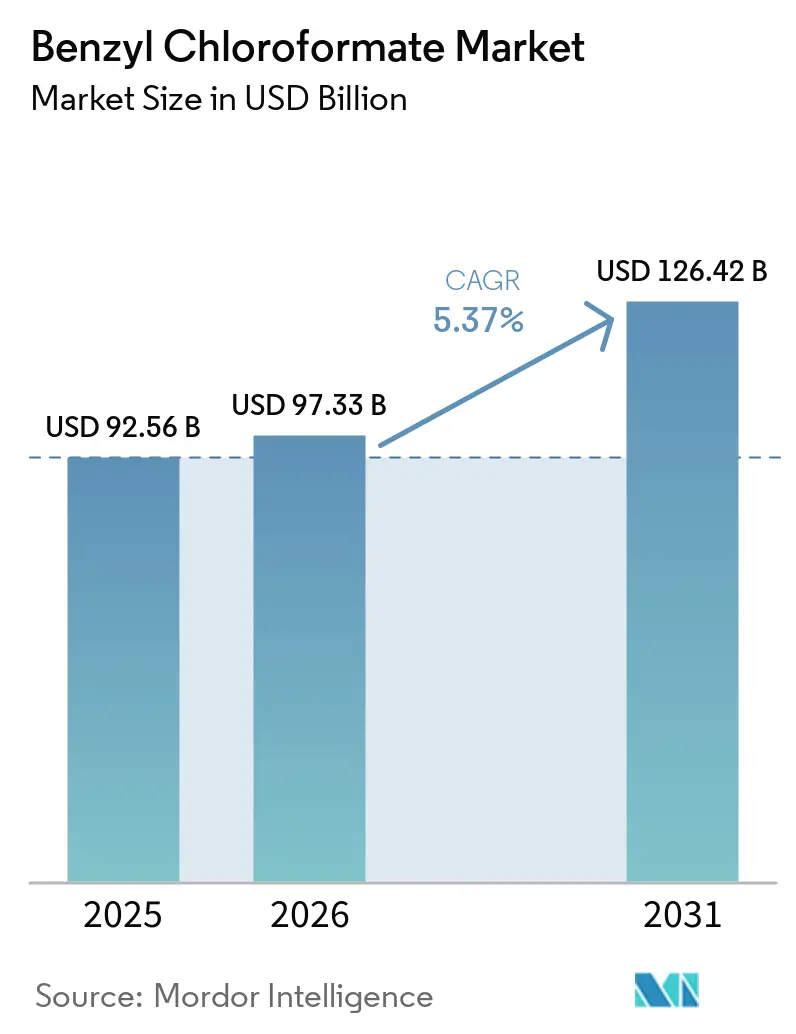
The benzyl chloroformate market size was valued at USD 92.56 billion in 2025 and is estimated to grow from USD 97.33 billion in 2026 to USD 126.42 billion by 2031, at a CAGR of 5.37% during the forecast period (2026-2031). Benzyl chloroformate remains relevant due to its role in introducing the benzyloxycarbonyl protecting group in multistep amine synthesis. Its use is closely linked to peptide pharmaceutical output and carbamate agrochemical production. Demand grows in value terms as pharmaceutical-grade and high-purity materials command a premium over technical-grade materials. The benzyl chloroformate market also faces concentrated phosgene supply, making qualified production infrastructure important for the continuity of supply. Stricter handling regulations can raise costs, while continuous-flow production could support safer and more controlled output over time.
Key Report Takeaways
- By product type, liquid benzyl chloroformate held 70.56% of the benzyl chloroformate market share in 2025 and is forecast to grow at a 5.75% CAGR through 2031.
- By purity grade, pharmaceutical grade held 54.62% of the benzyl chloroformate market share in 2025, while high-purity grade is forecast to grow at a 5.95% CAGR through 2031.
- By application, pharmaceutical intermediates accounted for 51.23% of the benzyl chloroformate market size in 2025 and are forecast to grow at a 6.31% CAGR through 2031.
- By geography, Asia-Pacific held 38.67% of the benzyl chloroformate market share in 2025 and is forecast to expand at a 6.15% CAGR through 2031.
Note: Market size and forecast figures in this report are generated using Mordor Intelligence’s proprietary estimation framework, updated with the latest available data and insights as of January 2026.
Global Benzyl Chloroformate Market Trends and Insights
Drivers Impact Analysis*
| Drivers | (~) % Impact on CAGR Forecast | Geographic Relevance | Impact Timeline |
|---|---|---|---|
| Pharmaceutical Peptide and Active Pharmaceutical Ingredient (API) Synthesis Demand | +1.8% | Global | Medium term (2-4 years) |
| Agrochemical Intermediate Demand | +1.0% | APAC core, spillover to Latin America and MEA | Short term (≤ 2 years) |
| Growth of High-Purity Specialty Reagents | +0.9% | North America and Europe | Medium term (2-4 years) |
| Expansion of Contract Development and Manufacturing | +1.2% | Global, with APAC core | Medium term (2-4 years) |
| Continuous-Flow Process Intensification for Safer Chloroformate Production | +0.4% | North America and Europe | Long term (≥ 4 years) |
| Source: Mordor Intelligence | |||
Pharmaceutical Peptide and Active Pharmaceutical Ingredient (API) Synthesis Demand
Peptide therapies are increasing the demand for amine-protecting reagents used across synthesis workflows. Glucagon-Like Peptide-1 (GLP-1) receptor agonists for type 2 diabetes and obesity are a major driver of this demand. U.S. Patent 12,304,938 identifies benzyloxycarbonyl among the protected intermediates used in a tirzepatide synthesis process, supporting the continued use of benzyl chloroformate in pharmaceutical synthesis routes. Manufacturing expansions can also encourage multiyear reagent agreements for pharmaceutical-grade and high-purity material, which can limit the growth potential of technical-grade products in the benzyl chloroformate market.
Agrochemical Intermediate Demand
Carbamate insecticides and herbicides employ chloroformate chemistry in key synthetic steps, and benzyl chloroformate supports the production of N-carbamate building blocks for several active ingredients. Research published in 2026 showed that chloroformate-surrogate approaches can produce carbamate insecticides such as propoxur and carbofuran at high yields[1]“Mild and Efficient Synthesis of Carbamates Using Dioxazolones as Bench-Stable Isocyanate Surrogates,” RSC Advances, rsc.org.. This supports the use of chloroformate routes, in which manufacturers seek alternatives to direct isocyanate handling. Revisions to maximum residue limits in the European Union may require agrochemical companies to reformulate products, thereby maintaining demand for relevant intermediates outside new-product development cycles.
Growth of High-Purity Specialty Reagents
Biopharmaceutical programs are applying tighter purity requirements to materials used throughout the synthesis process. Antibody-drug conjugates, highly potent active pharmaceutical ingredients, and advanced peptide products contribute to this requirement. Reagent specifications that had accepted 97-98% assay are being replaced by 99%+ requirements in selected applications. Lot traceability and validated impurity profiles, therefore, matter more for supplier qualification. The 2025 U.S. policy on a Strategic Active Pharmaceutical Ingredients Reserve encouraged stronger domestic supply chain qualification, thereby supporting demand for audited and Good Manufacturing Practice (GMP)-aligned sources in the benzyl chloroformate market.
Expansion of Contract Development, Manufacturing, and Continuous-Flow Production
Contract Development and Manufacturing Organization (CDMO) capacity additions are creating sustained demand for qualified benzyl chloroformate. AmbioPharm announced a 68,000-sq-ft expansion in North Augusta, South Carolina, in March 2026 for commercial solid-phase peptide synthesis. Cambrex completed early engineering work for a USD 120 million Active Pharmaceutical Ingredient (API) plant in Charles City, Iowa, in March 2026, with a planned 20% increase in large-scale capacity. Continuous-flow methods can provide more controlled phosgenation and can improve the safety profile of chloroformate production. These developments can increase consumption of GMP reagents and improve the appeal of liquid-phase production in the benzyl chloroformate market.
Restraints Impact Analysis*
| Restraints | (~) % Impact on CAGR Forecast | Geographic Relevance | Impact Timeline |
|---|---|---|---|
| Hazardous Phosgene and Moisture-Sensitive Handling Requirements | -0.9% | Global | Short term (≤ 2 years) |
| Registration, Evaluation, Authorisation and Restriction of Chemicals (REACH), Classification, Labelling and Packaging (CLP), Seveso, and Dangerous-Goods Compliance Costs | -0.7% | Europe and North America | Medium term (2-4 years) |
| Limited Cold-Chain and Compatible-Equipment Infrastructure | -0.5% | APAC, South America, and MEA | Medium term (2-4 years) |
| Source: Mordor Intelligence | |||
Hazardous Phosgene and Moisture-Sensitive Handling Requirements
Benzyl chloroformate is produced from phosgene, which creates substantial safety requirements during production. Phosgene is classified as immediately dangerous to life or health at 2 ppm. Benzyl chloroformate also decomposes upon exposure to moisture and can release hydrochloric acid. These properties require dedicated reactors, dry handling procedures, and trained personnel. Paushak Limited operates commercial phosgene capacity in India as part of its Responsible Care program. The resulting licensing and capital requirements limit supply flexibility, while supporting margins for established producers in the benzyl chloroformate market.
Regulatory, Equipment, and Cold-Chain Constraints
European regulations for hazardous substances require ongoing classification, labeling, safety data sheet preparation, and notification. The revised Classification and Labelling Inventory has been applied across the European Union since May 2025[2]“Chemicals and Pesticides,” Fact Sheets on the European Union, europarl.europa.eu.. Seveso III obligations also affect facilities that store or use significant quantities of dangerous substances. These requirements raise fixed costs for European producers and importers. Limited cold-chain networks and incompatible equipment present a separate challenge in parts of the Asia-Pacific, South America, the Middle East, and Africa. As a result, demand in these regions may exist without consistent delivery conditions for a moisture-sensitive material.
*Our forecasts treat driver/restraint impacts as directional, not additive. The impact forecasts reflect baseline growth, mix effects, and variable interactions.
Segment Analysis
By Product Type: Liquid Formulation Supports Commercial Reagent Handling
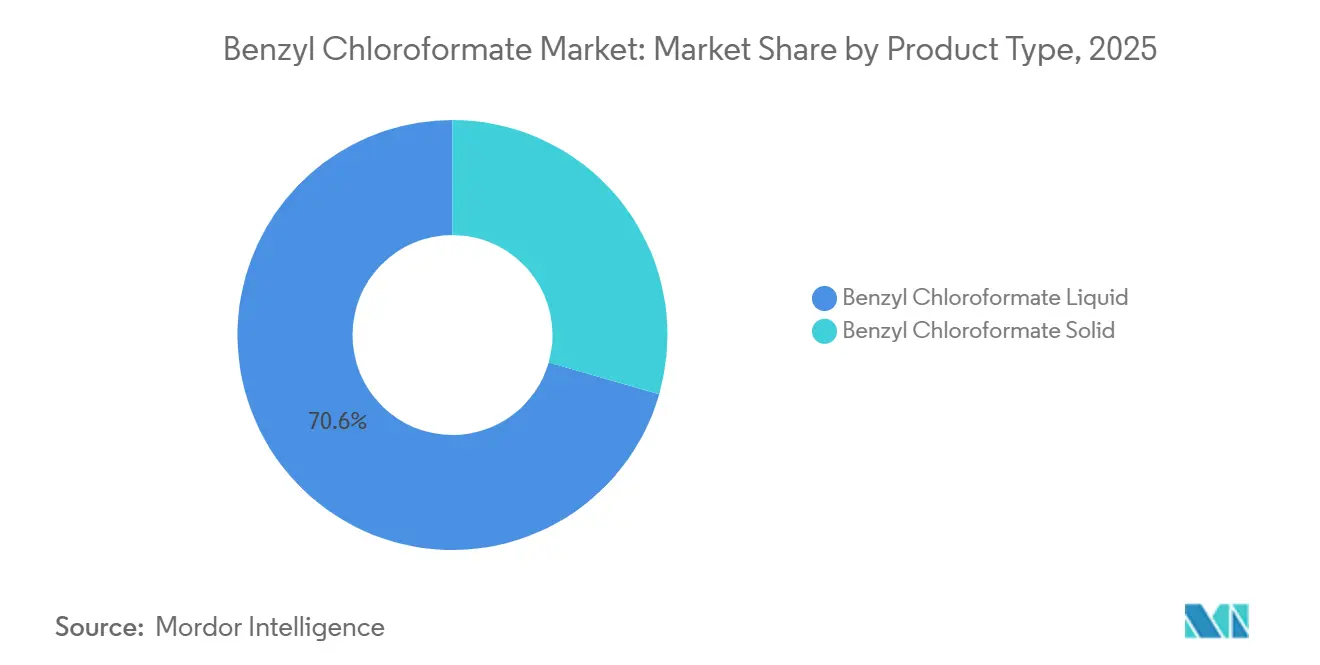
Liquid benzyl chloroformate accounted for 70.56% of the benzyl chloroformate market in 2025. Commercial users commonly receive it as a 30-35% solution in toluene or as a neat liquid. These formats support measured dispensing through pump and syringe systems and reduce the inert-atmosphere precautions associated with solid materials at elevated temperatures. The format is also suited to continuous-flow systems and automated peptide synthesis equipment, making liquid formulations well-suited to commercial production settings.
Liquid benzyl chloroformate is forecast to grow at a 5.75% CAGR through 2031. Peptide programs moving into larger-scale production favor facilities built around liquid-handling equipment. Cambrex identified continuous-flow chemistry as a core technical capability in its March 2026 expansion update. Continuous-flow phosgenation has been validated as a scalable approach to chloroformate synthesis, and this production architecture aligns with liquid-phase output. It also supports the liquid segment's operating advantage in the benzyl chloroformate market. The solid form remains relevant where storage, process design, or handling preferences require it.



By Purity Grade: High-Purity Demand Builds on Pharmaceutical-Grade Adoption
Pharmaceutical-grade benzyl chloroformate accounted for 54.62% of the benzyl chloroformate market share in 2025. It is supported by validated legacy API processes that document performance against established specifications. Changing the grade or supplier can require considerable time and regulatory effort, creating durable demand at existing pharmaceutical accounts. The high-purity grade is forecast to grow at a 5.95% CAGR through 2031, driven by Contract Development and Manufacturing Organizations (CDMOs) handling highly potent APIs and complex peptides that are qualifying new programs for this grade.
High-purity products meet impurity specifications that may exceed standard pharmacopeial thresholds, favoring suppliers that can demonstrate traceability and lot-level impurity control. Pharmaceutical-grade products continue to benefit from the established base of approved manufacturing processes. Technical grade is used in agrochemical and polymer applications where pharmacopeial traceability is not required and competes mainly on price. This distinction creates audited and commodity supply tiers within the benzyl chloroformate market, with supplier qualification remaining a key factor in the premium tier.
By Application: Pharmaceutical Intermediates Set the Growth Pace
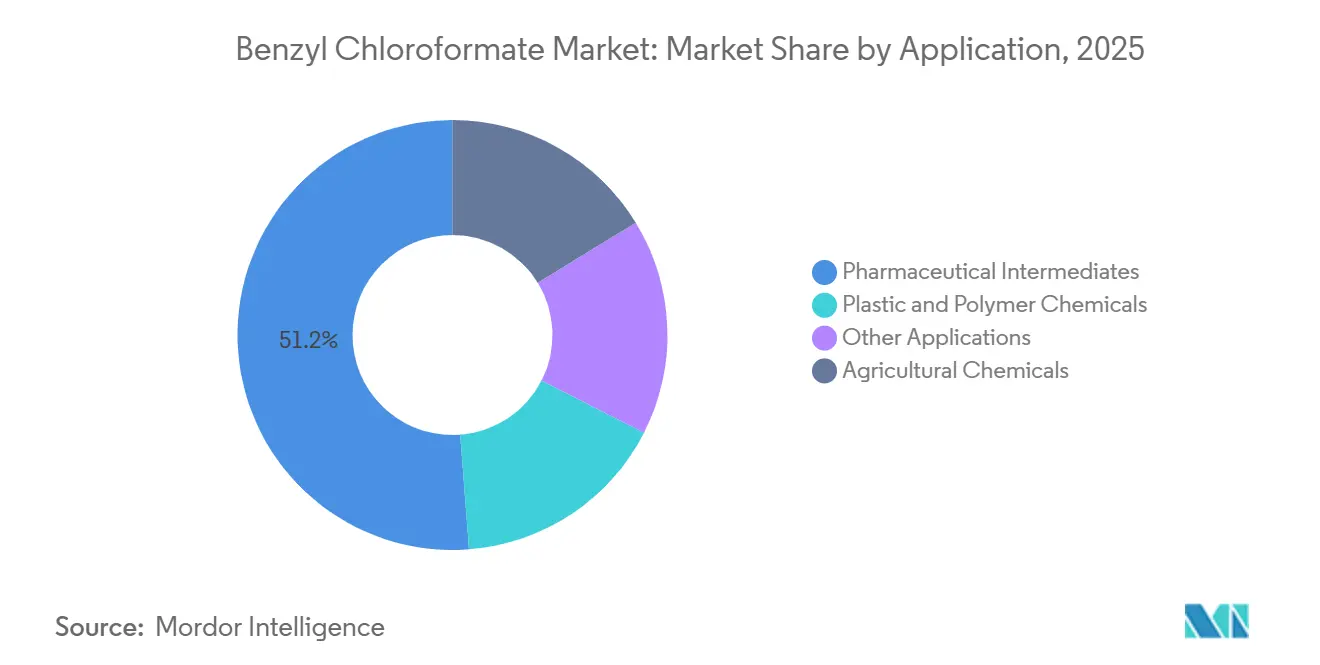
Pharmaceutical intermediates accounted for 51.23% of the benzyl chloroformate market size in 2025 and recorded the highest projected CAGR at 6.31% through 2031. Benzyl chloroformate introduces the carbobenzyloxy (Cbz) group in both solid-phase and liquid-phase peptide synthesis and is also used to selectively form carbamates for small-molecule APIs. U.S. Patent 12,304,938 lists benzyloxycarbonyl as a protected intermediate in a tirzepatide process. The segment's scale directs supplier attention toward pharmaceutical qualification and reliable reagent supply.
Phosgene-feedstock disruptions can affect API manufacturing schedules when key reagent lots are unavailable. Large CDMOs can reduce this exposure by maintaining dual-source arrangements with qualified suppliers. Agricultural chemicals are the second-largest application and benefit from carbamate reformulation cycles. Plastic and polymer chemicals provide a smaller but stable source of demand. Other applications include dye intermediates and specialty fine-chemical synthesis. Non-pharmaceutical demand is more price-sensitive than pharmaceutical demand. The benzyl chloroformate market, therefore, remains strongly linked to pharmaceutical program schedules and CDMO capacity utilization.
Geography Analysis
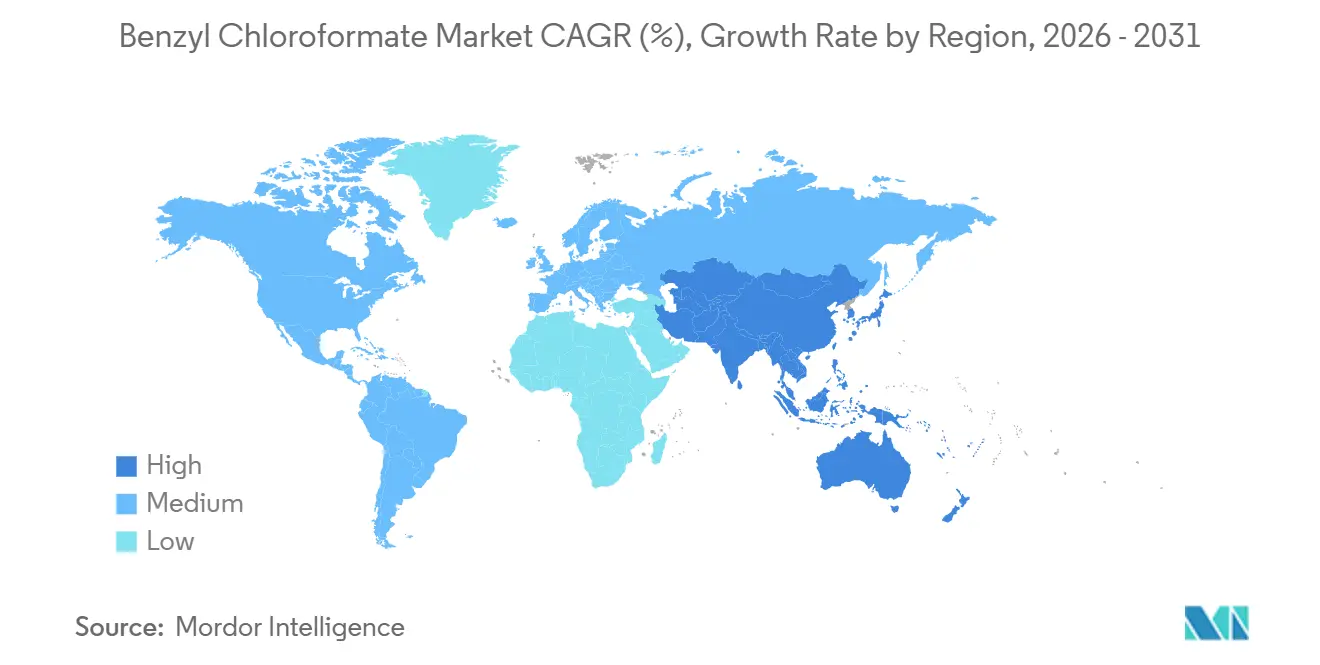
Asia-Pacific accounted for 38.67% of the benzyl chloroformate market share in 2025 and is forecast to grow at a 6.15% CAGR through 2031. China is the primary production base, supplying domestic and export customers across Southeast Asia and South Asia. India provides a complementary supply through government-licensed phosgene infrastructure. Paushak Limited has an annual phosgene capacity of 14,400 MT and recorded revenue of INR 250 crore (USD 30 million) during FY25-FY26. Japan and South Korea sustain demand through precision pharmaceutical and specialty-reagent programs.
North America and Europe are the second- and third-largest regional demand pools. Their position is driven by the concentration of CDMOs and pharmaceutical innovators with stringent audit and purity requirements. Evonik committed USD 100 million in July 2026 to upgrade its API manufacturing facility in Lafayette, Indiana. Cambrex is advancing a USD 120 million facility in Iowa, while Wilmington PharmaTech announced a USD 50 million expansion in Delaware. European classification and chemical management requirements encourage sourcing from established suppliers with documented compliance systems.
South America, the Middle East, and Africa remain smaller contributors to the benzyl chloroformate market. Brazil and Argentina support demand through agricultural chemical formulation for soybean and corn pest management. Carbamate crop-protection products require chloroformate intermediates during production. Saudi Arabia's pharmaceutical manufacturing initiatives are generating early demand for specialty chemical intermediates. Delivery remains difficult across areas with limited cold-chain logistics, as benzyl chloroformate requires storage at 0-8°C. Infrastructure constraints, rather than underlying demand, continue to limit regional market development through the middle of the forecast period.

Competitive Landscape
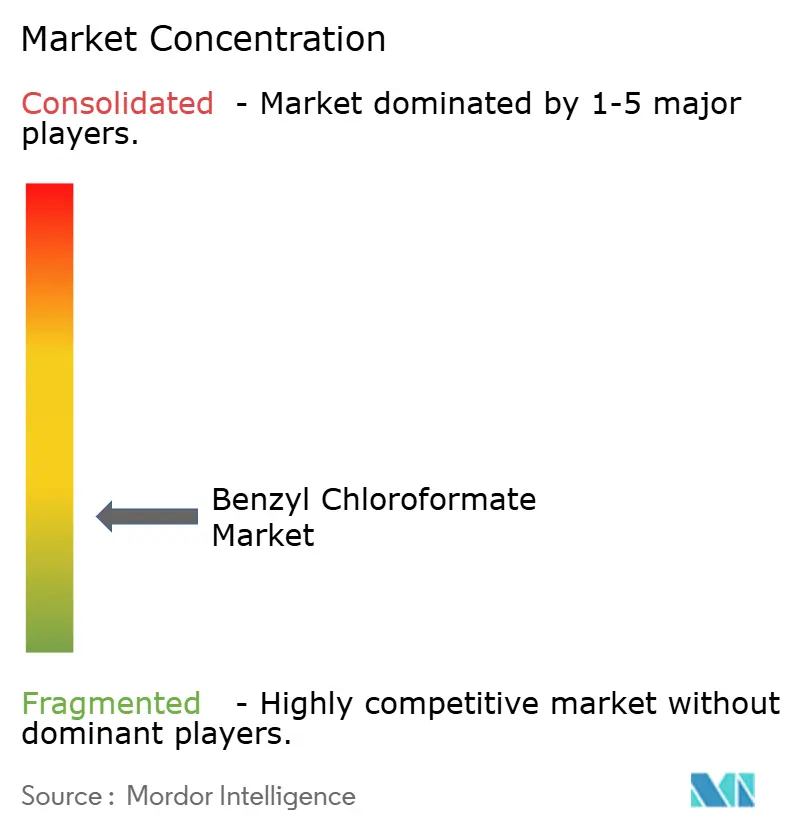
The benzyl chloroformate market is fragmented, with competition across two distinct supplier groups. Merck KGaA, through MilliporeSigma and Sigma-Aldrich, and Thermo Fisher Scientific serve research and regulated pharmaceutical customers through validated reagent catalogs. Dedicated phosgene-chemistry producers in India and China compete on cost, scale, and manufacturing flexibility. This structure gives buyers options based on quantity, grade, and audit requirements, while limiting pricing power for distributors that face established Asian production cost positions.
Merck KGaA opened a EUR 25 million facility (approximately USD 29 million) in Darmstadt in July 2026 for Good Manufacturing Practice (GMP)-compliant testing and stability studies. The company also announced the acquisition of Bio-Techne for USD 11.3 billion in 2026, broadening its life sciences services and reagent portfolio. Evonik's USD 100 million Lafayette upgrade supports high-potency and general-purpose Active Pharmaceutical Ingredient (API) manufacturing. Siegfried AG added 100 m³ of reactor capacity in Minden, Germany, in June 2026. These investments expand the manufacturing networks that consume specialty synthesis reagents.
Suppliers with domestic or nearshore capabilities have an opportunity to provide GMP-certified, high-purity supply to North American buyers, driven by supply resilience policies and qualification requirements. Continuous-flow manufacturing can offer tighter process control and more consistent impurity profiles than batch production. Producers with validated flow-process capability may secure supply agreements from Contract Development and Manufacturing Organizations (CDMOs) investing in flow chemistry. Chemlin Chemical, Jiangsu Hualun, and J&K Scientific are active in technical-grade supply, while Choice Organochem and Loba Chemie compete in India through pharmaceutical and laboratory channels.
Benzyl Chloroformate Industry Leaders
BASF
Paushak Ltd.
Merck KGaA
Thermo Fisher Scientific Inc.
Tokyo Chemical Industry Co., Ltd.
- *Disclaimer: Major Players sorted in no particular order

Recent Industry Developments
- July 2026: Evonik committed USD 100 million over a 5-year program to modernize key equipment at its Lafayette, Indiana, facility. The investment supports U.S.-based peptide and small-molecule CDMO services, including the production of pharmaceutical-grade synthesis reagents such as Benzyl Chloroformate.
- July 2026: Merck KGaA opened a EUR 25 million (USD 29 million) facility in Darmstadt, Germany. The site expands GMP-compliant drug-substance and drug-product release testing, as well as stability studies, for European biopharmaceutical customers utilizing reagents such as Benzyl Chloroformate.


Global Benzyl Chloroformate Market Report Scope
Benzyl chloroformate is a liquid chemical used in laboratories to protect amine groups during peptide and pharmaceutical synthesis. It plays a functional role in organic chemistry by enabling selective reactions, making it a widely used reagent in the production of active pharmaceutical ingredients (APIs) and specialty chemicals.
The benzyl chloroformate market is segmented by product type, purity grade, application, and geography. By product type, the market is segmented into benzyl chloroformate solid and benzyl chloroformate liquid. By purity grade, the market is segmented into technical grade, pharmaceutical grade, and high-purity grade. By application, the market is segmented into agricultural chemicals, pharmaceutical intermediates, plastic and polymer chemicals, and other applications. The report also covers market size and forecasts for benzyl chloroformate across 15 countries in major regions. The market sizes and forecasts are provided in terms of value (USD).
| Water Dispersible |
| Acid Dispersible |
| Surface Modified Dispersible |
| Lithium-Ion Battery |
| Refractory Materials |
| Electronics Ceramics |
| Flame Retardants |
| Catalysis |
| Polymer Additives |
| Rheology Control |
| Other Applications |
| Automotive |
| Electronics and Semiconductors |
| Construction |
| Consumer Goods |
| Oil Refineries and Chemical Processing |
| Other End-User Industries |
| Asia-Pacific | China |
| India | |
| Japan | |
| South Korea | |
| ASEAN Countries | |
| Rest of Asia-Pacific | |
| North America | United States |
| Canada | |
| Mexico | |
| Europe | Germany |
| United Kingdom | |
| France | |
| Italy | |
| NORDIC Countries | |
| Rest of Europe | |
| South America | Brazil |
| Argentina | |
| Rest of South America | |
| Middle East and Africa | Saudi Arabia |
| South Africa | |
| Rest of Middle East and Africa |
| By Product Type | Water Dispersible | |
| Acid Dispersible | ||
| Surface Modified Dispersible | ||
| By Application | Lithium-Ion Battery | |
| Refractory Materials | ||
| Electronics Ceramics | ||
| Flame Retardants | ||
| Catalysis | ||
| Polymer Additives | ||
| Rheology Control | ||
| Other Applications | ||
| By End-User Industry | Automotive | |
| Electronics and Semiconductors | ||
| Construction | ||
| Consumer Goods | ||
| Oil Refineries and Chemical Processing | ||
| Other End-User Industries | ||
| By Geography | Asia-Pacific | China |
| India | ||
| Japan | ||
| South Korea | ||
| ASEAN Countries | ||
| Rest of Asia-Pacific | ||
| North America | United States | |
| Canada | ||
| Mexico | ||
| Europe | Germany | |
| United Kingdom | ||
| France | ||
| Italy | ||
| NORDIC Countries | ||
| Rest of Europe | ||
| South America | Brazil | |
| Argentina | ||
| Rest of South America | ||
| Middle East and Africa | Saudi Arabia | |
| South Africa | ||
| Rest of Middle East and Africa | ||


Key Questions Answered in the Report
What is current market size of Benzyl Chloroformate Market?
The benzyl chloroformate market size was valued at USD 92.56 billion in 2025 and is estimated to grow from USD 97.33 billion in 2026 to USD 126.42 billion by 2031, at a CAGR of 5.37% during the forecast period (2026-2031).
Which benzyl chloroformate form has the largest share?
Liquid benzyl chloroformate led with a 70.56% share in 2025 and is forecast to grow at a 5.75% CAGR.
Why do pharmaceutical intermediates drive demand?
Pharmaceutical intermediates held 51.23% in 2025 and are expected to grow at a 6.31% CAGR through 2031.
Which purity grade is growing fastest?
High-purity grade is the fastest-growing purity tier, with a projected 5.95% CAGR through 2031.
Page last updated on:





