
Battery Thermal Management Materials Market Size and Share
Market Overview
| Study Period | 2021 - 2031 |
|---|---|
| Market Size (2026) | USD 5.05 Billion |
| Market Size (2031) | USD 8.63 Billion |
| Growth Rate (2026 - 2031) | 11.34 % |
| Fastest Growing Market | Asia-Pacific |
| Largest Market | Asia-Pacific |
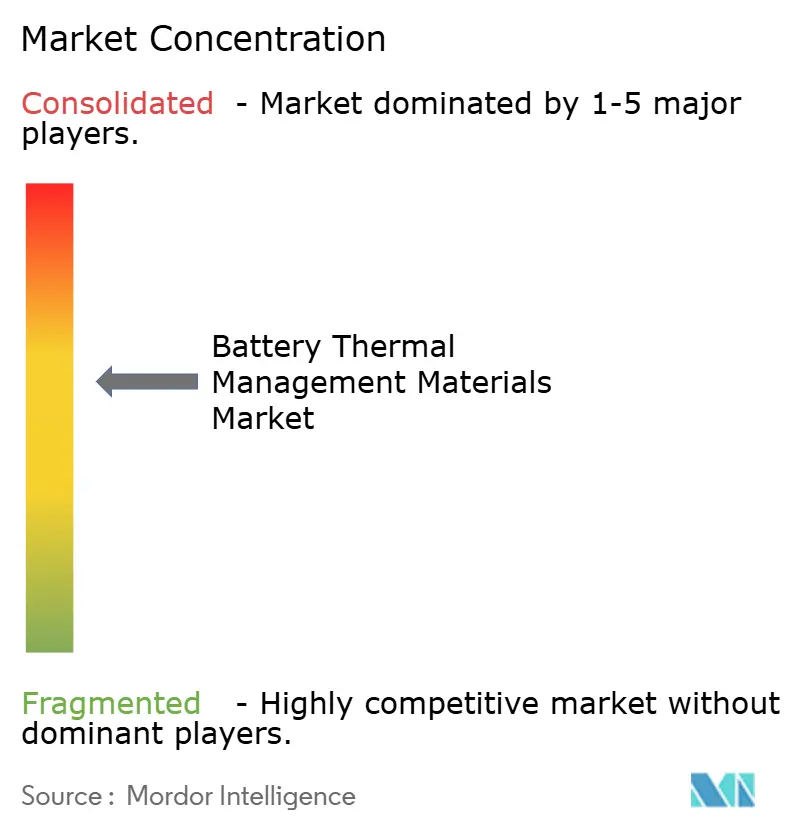
| Market Concentration | Medium |
Major Players *Disclaimer: Major Players sorted in no particular order Image © Mordor Intelligence. Reuse requires attribution under CC BY 4.0. | |
Battery Thermal Management Materials Market Analysis by Mordor Intelligence
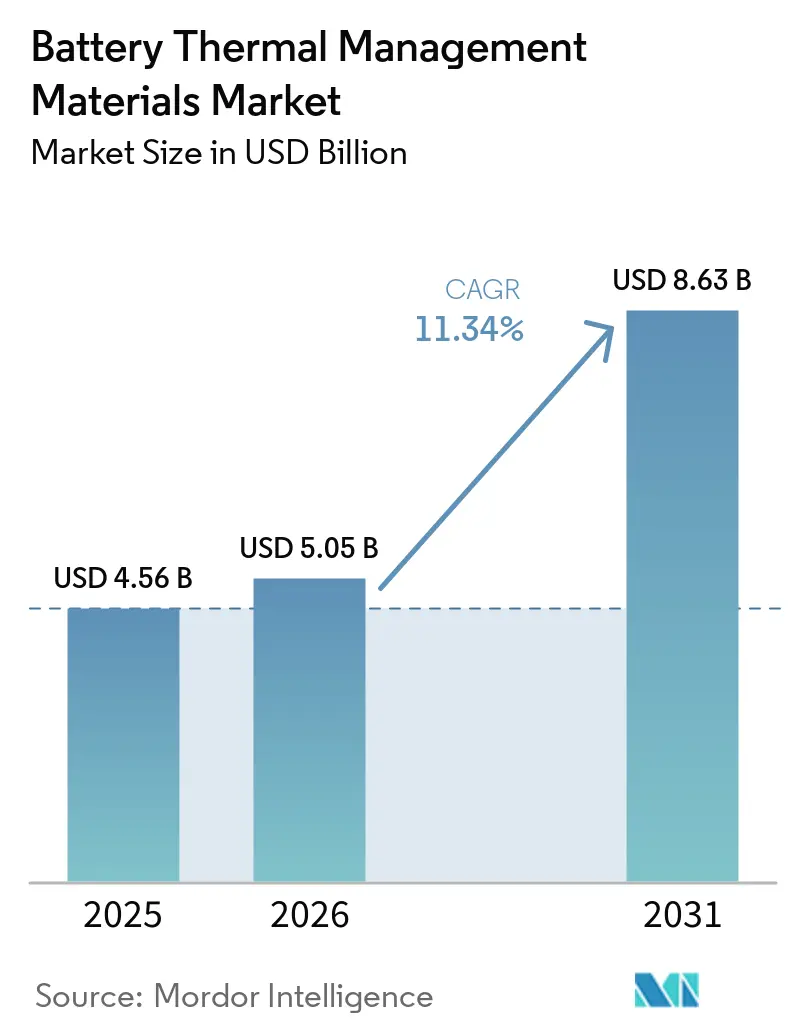
The battery thermal management materials market size was valued at USD 4.56 billion in 2025 and is estimated to grow from USD 5.05 billion in 2026 to reach USD 8.63 billion by 2031, at a CAGR of 11.34% during the forecast period (2026-2031). The battery thermal management materials market is driven by increasing electric vehicle production, expanding battery manufacturing capacity, and the deployment of grid-connected energy storage systems. These trends increase the number and size of battery systems requiring heat control across battery applications. Higher cell energy density and faster charging speeds raise thermal performance requirements for battery packs, particularly for manufacturers using large prismatic cells and compact pack layouts. Safety regulations also increase the use of fire barriers, aerogels, and thermal interface materials in pack design, as materials must meet more stringent testing requirements. Cell-to-pack and cell-to-chassis designs simplify pack structures and favor suppliers that provide multiple qualified materials for a single battery program and support validation during design changes. However, these designs can reduce material loading per kilowatt-hour by eliminating module housings, creating downward pressure on the battery thermal management materials market.
Key Report Takeaways
- By material type, thermal interface materials held 37.45% of the battery thermal management materials market share in 2025, while phase change materials are forecast to grow at a 12.56% CAGR through 2031.
- By application, electric vehicles accounted for 55.86% of the battery thermal management materials market size in 2025, while energy storage systems are forecast to grow at a 13.13% CAGR through 2031.
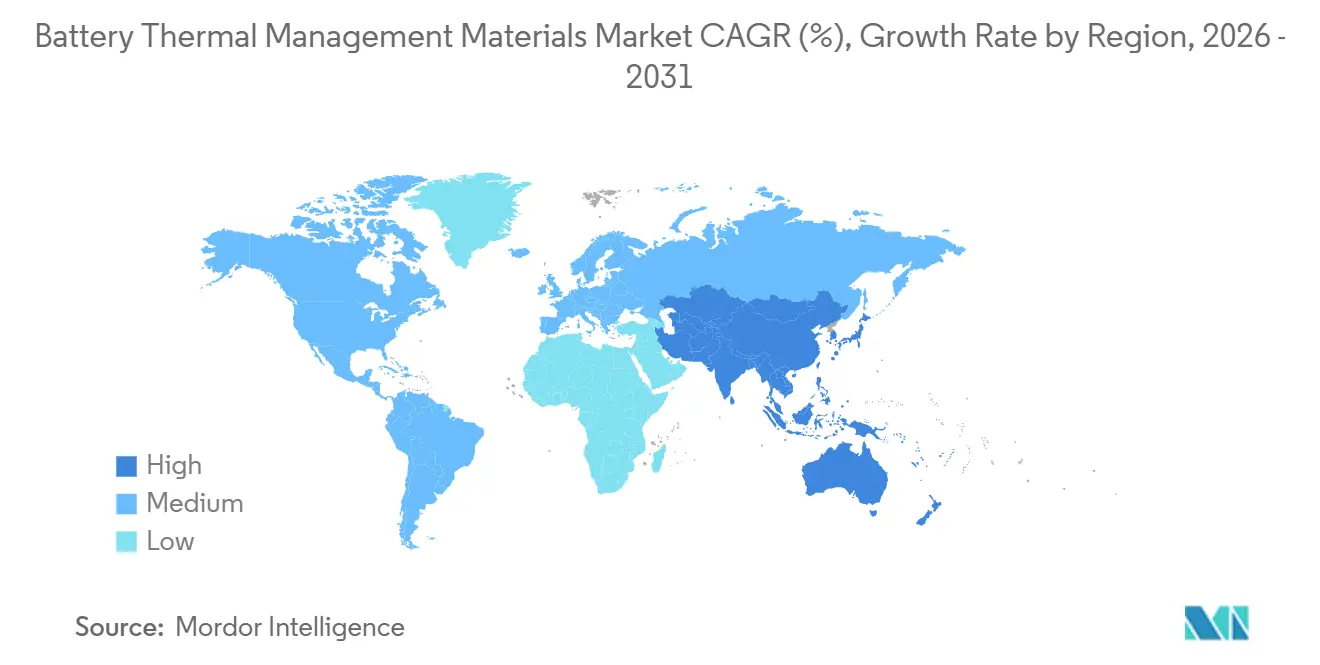
- By geography, Asia-Pacific held 45.13% of revenue in 2025 and is forecast to expand at a 12.62% CAGR through 2031.
Note: Market size and forecast figures in this report are generated using Mordor Intelligence’s proprietary estimation framework, updated with the latest available data and insights as of January 2026.
Market Trends and Insights
Drivers Impact Analysis of Battery Thermal Management Materials Market*
| Drivers | (~) % Impact on CAGR Forecast | Geographic Relevance | Impact Timeline |
|---|---|---|---|
| Rising Electric Vehicle Production and Battery Manufacturing Capacity | +3.2% | Global, with China, South Korea, and Japan as primary pull-through markets. North America and Europe are secondary. | Short term (≤ 2 years) |
| Higher Battery Energy Density and Faster Charging Requirements | +2.5% | Global, concentrated in high-voltage markets, including the European premium Electric Vehicle (EV) segment and China’s fast-charge platform push. | Medium term (2-4 years) |
| Thermal-Runaway Prevention and Battery-Safety Requirements | +2.0% | Global, with compliance-led demand in China and North America. | Short term (≤ 2 years) |
| Growth of Energy Storage Systems and Renewable-Power Integration | +2.1% | Asia-Pacific is central, followed by European and Middle Eastern grid-scale storage projects. | Medium term (2-4 years) |
| Cell-to-Pack and Cell-to-Chassis Architectures Increasing Material Intensity | +1.2% | Asia-Pacific leads adoption, especially in China. North America and Europe are increasing their deployment. | Long term (≥ 4 years) |
| Source: Mordor Intelligence | |||
Rising Electric Vehicle Production and Battery Manufacturing Capacity
Electric vehicle production is a key driver of demand in the battery thermal management materials market, as each battery pack requires materials at the cell, module, and pack interfaces. Battery installations reached 1,187 GWh in 2025, up from 901.4 GWh in 2024, increasing demand for gap fillers, potting compounds, thermal adhesives, and protective barriers. China remained the main production and sales hub for electric vehicles in 2025, influencing material procurement, design decisions, and supplier qualification. Excess gigafactory capacity in China may pressure material prices; however, additional battery capacity continues to support demand in the battery thermal management materials market. North American and European original equipment manufacturers (OEMs) are localizing battery assembly, creating demand for suppliers with qualified regional production capabilities and technical support. Companies with application laboratories and qualification data in Asia can support customers adapting Asian battery pack designs for facilities in other regions.
Higher Battery Energy Density and Faster Charging Requirements
Higher energy density and faster charging increase heat generation within battery packs, requiring materials with higher thermal conductivity, thinner bondlines, and reliable temperature-cycling performance. Cell-to-pack designs increase volumetric energy density by reducing cell-to-cell spacing and eliminating the heat-buffering effect of module housings. The transition to 800 V vehicle platforms increases thermal gradients during ultra-fast charging events that can last less than 15 minutes. Research on paraffin-impregnated nanoporous copper current collectors demonstrated self-regulated overheating protection in lithium iron phosphate (LFP) and nickel manganese cobalt (NMC) pouch cells. This research indicates a shift in thermal control from pack-level gap fillers toward cell-level protection. In the battery thermal management materials market, dual-function products that combine structural bonding and heat transfer can reduce the number of layers and assembly steps without compromising thermal control.
Thermal-Runaway Prevention and Battery-Safety Requirements
Battery safety requirements make thermal protection a market-entry requirement rather than an optional design feature in the battery thermal management materials market. China’s GB 38031-2025 standard took effect in July 2026 for newly declared vehicle models and requires a two-hour no-fire and no-explosion outcome after thermal runaway begins. This requirement increases performance standards for passive barrier materials beyond conventional mica and ceramic blanket formats. In North America, ANSI/CAN/UL 9540A, Fifth Edition, revised evaluation methods for thermal-runaway fire propagation in energy storage systems, while ANSI/CAN/UL 1487 established a standard for battery containment enclosures in 2025[1]. International Electrotechnical Commission (IEC) 62619:2022 includes single-cell thermal-runaway propagation testing for industrial secondary lithium cells and batteries, shaping specifications for aerogels and intumescent products. Suppliers whose formulations meet automotive, stationary storage, and Chinese requirements can reduce OEMs' approval costs across multiple battery programs.
Growth of Energy Storage Systems and Renewable-Power Integration
Grid-scale energy storage adds a distinct demand stream to the battery thermal management materials market, with technical requirements that differ from those of traction batteries. Stationary systems use large battery assemblies and operate for extended periods at partial states of charge, increasing thermal cycling fatigue in potting compounds, encapsulants, and insulation materials. Large-format prismatic LFP cells require precise gap-filler dispensing and uniform bondline thickness across the cell surface to prevent localized thermal resistance. Current mainstream 314 Ah formats and emerging 587 Ah formats create additional heat-management requirements compared with the smaller cells used in many vehicle battery packs. Inadequate thermal control can accelerate solid electrolyte interphase growth and lithium plating, linking thermal material performance to battery life and operating economics. Materials designed for extended cycling, container-level containment, and stable heat transfer are gaining importance in the battery thermal management materials market.
Restraints Impact Analysis of Battery Thermal Management Materials Market*
| Restraints | (~) % Impact on CAGR Forecast | Geographic Relevance | Impact Timeline |
|---|---|---|---|
| High Cost and Technical Complexity of Advanced Thermal Materials | -1.8% | Global, with the sharpest effect in price-sensitive EV markets in China and Southeast Asia. | Short term (≤ 2 years) |
| Qualification Cycles and Diverse OEM Battery-Pack Requirements | -1.4% | Global, with added complexity in Europe because of platform diversity and regulatory requirements. | Medium term (2-4 years) |
| Recyclability Challenges for Cured Thermal Interface Materials (TIMs), Encapsulants, and Adhesive-Bonded Packs | -0.9% | Primarily, Europe and North America are shaped by battery end-of-life requirements. | Long term (≥ 4 years) |
| Source: Mordor Intelligence | |||
High Cost and Technical Complexity of Advanced Thermal Materials
Advanced thermal materials often cost more than conventional silicone pads and may require specialized processing, limiting adoption in price-sensitive battery programs. Aerogel composites, high-conductivity gap fillers, and micro-encapsulated phase change materials rely on material systems and production methods with higher manufacturing and application requirements. Advanced gap fillers require thermally conductive fillers, such as boron nitride, aluminum nitride, and silicon carbide, to achieve high thermal conductivity. In cell-to-pack assembly, thermally conductive structural adhesives require precise dispensing equipment and tighter process controls than simpler pad insertion. Vehicle manufacturers in China may select polyurethane materials instead of silicone-based gap fillers when thermal performance requirements permit. These factors create cost and performance tiers within the battery thermal management materials market and affect the adoption of higher-performance formulations.
Qualification Cycles and Diverse OEM Battery-Pack Requirements
Battery pack designs vary across OEMs, creating a fragmented qualification landscape and extending suppliers’ time to revenue. Each platform may require thermal cycling, vibration, shock, aging, and regulatory testing before a material enters production. The lack of harmonized qualification protocols means that a material approved for one OEM process may require complete testing for another OEM, even when the stated performance requirements are similar[2]. This process requires separate validation, documentation, and customer approval beyond routine customization. Smaller suppliers incur higher costs when maintaining parallel qualification programs across multiple platforms. Large, diversified suppliers can distribute these costs across a broader customer base, supporting their competitive position in the battery thermal management materials market.
*Our forecasts treat driver/restraint impacts as directional, not additive. The impact forecasts reflect baseline growth, mix effects, and variable interactions.
Battery Thermal Management Materials Market Segment Analysis
By Material Type:
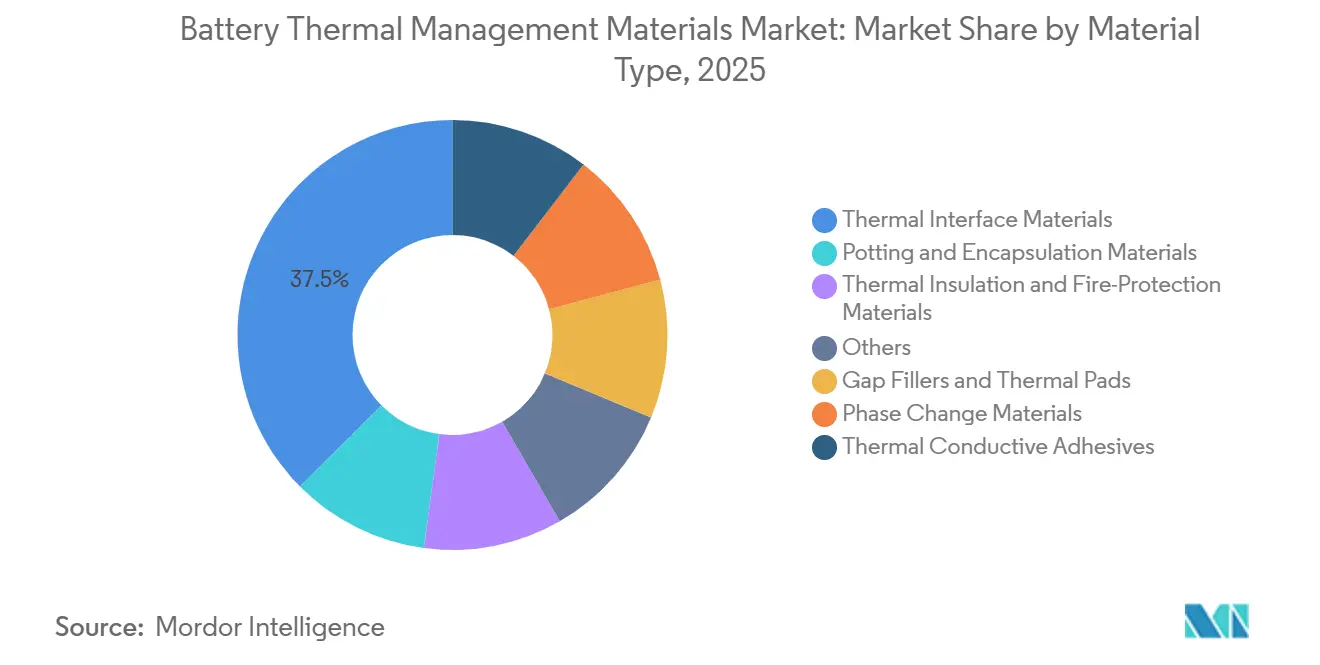
Interface Materials Led While Dual-Function Products Gain ImportanceThermal interface materials accounted for 37.45% of revenue in 2025, making them the largest material category in the battery thermal management materials market. These materials are deployed at cell-to-cooling-plate contact points in liquid-cooled battery packs. They transfer heat across uneven surfaces while preventing air gaps that can reduce cooling efficiency. Thermally conductive adhesives are increasingly replacing certain gap fillers in cell-to-pack systems because they provide structural bonding and heat transfer in a single dispensed layer, eliminating the assembly stage required for pad insertion. In May 2026, Henkel introduced Bergquist TGF 2030APS, a silicone-free, two-component thermal gap filler with thermal conductivity of 1.7 W/m·K and dispensing rates above 40 cm³/s. The company also introduced Loctite TLB 9270APS, a polyurethane thermally conductive adhesive with thermal conductivity of 2 W/m·K for cell-to-pack designs.
Gap fillers and thermal pads remain relevant in applications where pack rework and non-destructive cell access are important. Meanwhile, potting and encapsulation products are gaining adoption in stationary energy storage applications, where protection from mechanical damage and chemical ingress can take priority over disassembly. Phase change materials are forecast to grow at a CAGR of 12.56% through 2031 because they absorb and release latent heat without requiring active pumping systems. According to research on passive battery thermal management, composite phase change material (PCM) coatings containing expanded graphite reduced average peak cell temperature increases by 7°C at a thickness of 3 mm during standard drive cycles. The battery thermal management materials industry requires products that balance thermal conductivity, dispensing speed, curing behavior, rework requirements, and passive safety performance. This requirement supports broad product portfolios and closer collaboration with battery pack designers during early-stage development.

By Application:
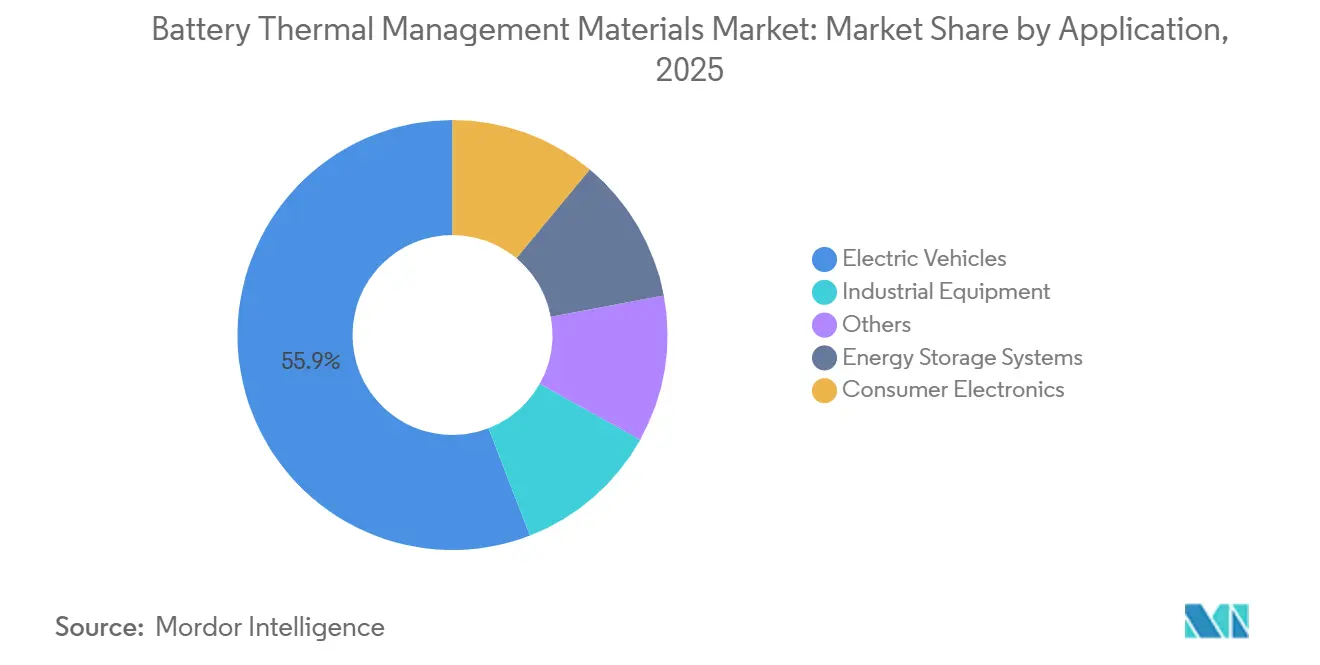
Electric Vehicles Lead Revenue and Energy Storage AcceleratesElectric vehicles accounted for 55.86% of revenue in 2025 and represented the largest application segment in the battery thermal management materials market. A vehicle battery pack may use thermal interface materials, conductive adhesives, potting compounds, phase-change materials, and fire barriers, with each serving a distinct thermal, mechanical, or safety function. Individual OEM qualification processes can create supplier relationships and switching costs because changing a material may require renewed validation. H.B. Fuller described a UL 94 V-0-rated polyurethane foam encapsulant that prevented thermal runaway from one cylindrical cell from spreading to adjacent cells during validated testing. Cells directly integrated into the chassis also require thermal adhesives that meet environmental and mechanical requirements. Consumer electronics represent a smaller, high-throughput channel with shorter qualification cycles.
Energy storage systems are forecast to be the fastest-growing application segment, with a projected CAGR of 13.13% through 2031. Stationary batteries require materials that can withstand thousands of operating hours and contain thermal events within the enclosure boundary rather than within a vehicle cabin. IEC 62619:2022 includes single-cell thermal-runaway propagation testing for industrial secondary lithium cells and batteries, supporting the use of ceramic papers, aerogel composites, and intumescent materials in inter-cell barriers. The battery thermal management materials market must address the distinct cycling, vibration, containment, and maintenance requirements of stationary systems compared with those of road vehicles. Industrial equipment, including forklift fleets, automated guided vehicles, and stationary industrial power systems, remains the smallest application group but is expanding as electrification reaches logistics and material-handling equipment.
Geography Analysis
APAC Battery Thermal Management Materials Market
Asia-Pacific holds 45.13% of the battery thermal management materials market in 2025 and is forecast to grow at a CAGR of 12.62% through 2031. The region combines battery production, electric vehicle (EV) assembly, cell research, and energy storage deployment, generating material demand and supporting a broad base of qualified manufacturers. China accounts for 62% of global light-duty EV sales and 71% of global EV production in 2025. This scale drives demand for thermal interface materials, phase-change products, and fire-protection grades across EV, stationary storage, and industrial applications. China’s GB 38031-2025, which took effect in July 2026 for new vehicle declarations, requires batteries to prevent fire and explosion for two hours after thermal runaway begins.
East and South Asia Battery Thermal Management Materials Market
South Korea provides an additional regional demand base through its battery materials ecosystem and domestic thermal management product specialists. Wacker Chemie AG has expanded specialty silicone production in Tsukuba, Japan, and Jincheon, South Korea, enabling the company to serve Asian automotive customers with locally produced thermal interface material grades and shorter supply routes. India is an emerging demand center, as its electric two- and three-wheeler fleets require battery thermal management solutions that meet safety requirements. Expanding domestic battery assembly capacity also creates demand beyond imported battery packs. Asia-Pacific cell manufacturers are adopting cell-to-pack and cell-to-chassis architectures more rapidly than many Western markets, shortening material qualification timelines and supporting suppliers with established regional application laboratories.
The Americas and EMEA Battery Thermal Management Materials Market
North America and Europe represent the next-largest geographic revenue blocks, although their demand drivers differ. Europe’s battery-electric vehicle share of new car sales reached 18% in 2025, up from 14% in 2024. The EU Battery Regulation 2023/1542 increases demand for materials that support safety, disassembly, and end-of-life battery handling. In North America, ANSI/CAN/UL 9540A and ANSI/CAN/UL 1487 requirements for grid-scale energy storage containment support demand. South America, the Middle East, and Africa remain smaller markets, with demand concentrated in Brazil, Argentina, Saudi Arabia, and South Africa, where energy storage and electrification projects provide diversification opportunities for global suppliers.
Competitive Landscape
The battery thermal management materials market is moderately consolidated, with Henkel, Dow, Shin-Etsu Chemical, Wacker Chemie, and 3M holding positions across several material categories. Their positions are supported by product portfolios, OEM qualification records, and application laboratories in major manufacturing regions. Regional suppliers also operate in the market, particularly in the Asia-Pacific region, where Chinese and South Korean companies offer formulations tailored to local customer requirements and lower qualification costs. Competition is based on thermal performance, processing reliability, safety testing, qualification history, local technical support, and the ability to supply compatible materials.
Major suppliers are expanding their portfolios beyond thermal interface materials to include gap fillers, structural adhesives, specialty tapes, potting products, and fire barriers. For OEMs, qualifying multiple materials from one supplier can be faster and more durable than approving each material from separate suppliers. Therefore, portfolio breadth can support supplier differentiation in the battery thermal management materials market. In July 2026, Henkel launched Bergquist Gap Filler TGF 6500LVO, with a thermal conductivity of 6.5 W/m·K for high-power automotive electronics. In February 2026, Henkel introduced digital e-mobility modeling and simulation capabilities through its Battery Test Center in Düsseldorf.
Wacker Chemie’s specialty silicone production facilities in Japan and South Korea support local supply for Asian automotive customers and reduce exposure to long-distance supply chain risks. Suppliers are also developing materials that combine heat transfer, structural support, and fire containment in fewer layers. Products compatible with recycling processes remain relevant because cured materials and adhesive-bonded battery packs can complicate disassembly under end-of-life battery requirements. In 2024, Dow and Carbice presented a partnership to develop carbon nanotube-enhanced thermal interface materials for electric vehicles, industrial equipment, and semiconductors. LG Chem presented a dual-layer battery safety system at InterBattery 2026, combining thermoplastic barriers with Nexula aerogel insulation. This development indicates that battery chemistry companies are expanding into thermal protection materials. The battery thermal management materials market is likely to favor companies that combine materials expertise, local validation support, and product designs that address end-of-life requirements.
Battery Thermal Management Materials Industry Leaders
-
Henkel AG & Co. KGaA
-
3M
-
Dow
-
DuPont
-
PARKER HANNIFIN CORP
- *Disclaimer: Major Players sorted in no particular order
Battery Thermal Management Materials Market Companies Covered in this Report
- 3M
- Asahi Kasei Corporation
- Aspen Aerogels, Inc.
- Dow
- DuPont
- Elkem ASA
- GrafTech International
- H.B. Fuller Company
- Henkel AG & Co. KGaA
- Momentive
- PARKER HANNIFIN CORP
- Saint-Gobain
- Shin-Etsu Chemical Co., Ltd.
- Sika AG
- Wacker Chemie AG
Recent Industry Developments in Battery Thermal Management Materials Market
- July 2026: Henkel launched Bergquist Gap Filler TGF 6500LVO, a two-component, low-volatile silicone thermal gap filler with a thermal conductivity of 6.5 W/m·K. The product targets ADAS, ECUs, and EV power-conversion components that require heat dissipation in space-constrained assemblies. It operates at temperatures up to 150°C and is designed for siloxane-sensitive production environments. The launch addresses demand for thermal management materials in compact electronic assemblies.
- June 2026: South Korea’s NanoTIM Co. signed a memorandum of understanding with China’s Anhui Xingaole New Material Technology Co. (AGW) to collaborate on thermal runaway prevention materials and fire-suppression systems for EV batteries in China. The companies aim to pursue OEM partnerships through AGW’s domestic automotive customer network.
Global Battery Thermal Management Materials Market Report Scope
Specialized substances absorb, transfer, or block heat in battery packs. They maintain battery temperatures within an operating range of 20°C to 40°C, helping mitigate overheating and fire risks and supporting battery service life.
The battery thermal management materials market is segmented by material type, application, and geography. By material type, the market is segmented into thermal interface materials, gap fillers and thermal pads, phase change materials, thermal conductive adhesives, potting and encapsulation materials, thermal insulation and fire-protection materials, and others. By application, the market is segmented into electric vehicles, energy storage systems, consumer electronics, industrial equipment, and others. The report also covers market size and forecasts for battery thermal management materials across 16 countries in major regions. The market sizes and forecasts are provided in terms of value (USD).
Segmentation Overview
| Thermal Interface Materials |
| Gap Fillers and Thermal Pads |
| Phase Change Materials |
| Thermal Conductive Adhesives |
| Potting and Encapsulation Materials |
| Thermal Insulation and Fire-Protection Materials |
| Others |
| Electric Vehicles |
| Energy Storage Systems |
| Consumer Electronics |
| Industrial Equipment |
| Others |
| Asia-Pacific | China |
| India | |
| Japan | |
| South Korea | |
| Rest of Asia-Pacific | |
| North America | United States |
| Canada | |
| Mexico | |
| Europe | Germany |
| United Kingdom | |
| France | |
| Italy | |
| Russia | |
| Rest of Europe | |
| South America | Brazil |
| Argentina | |
| Rest of South America | |
| Middle East and Africa | Saudi Arabia |
| South Africa | |
| Rest of Middle East and Africa |
| By Material Type | Thermal Interface Materials | |
| Gap Fillers and Thermal Pads | ||
| Phase Change Materials | ||
| Thermal Conductive Adhesives | ||
| Potting and Encapsulation Materials | ||
| Thermal Insulation and Fire-Protection Materials | ||
| Others | ||
| By Application | Electric Vehicles | |
| Energy Storage Systems | ||
| Consumer Electronics | ||
| Industrial Equipment | ||
| Others | ||
| By Geography | Asia-Pacific | China |
| India | ||
| Japan | ||
| South Korea | ||
| Rest of Asia-Pacific | ||
| North America | United States | |
| Canada | ||
| Mexico | ||
| Europe | Germany | |
| United Kingdom | ||
| France | ||
| Italy | ||
| Russia | ||
| Rest of Europe | ||
| South America | Brazil | |
| Argentina | ||
| Rest of South America | ||
| Middle East and Africa | Saudi Arabia | |
| South Africa | ||
| Rest of Middle East and Africa | ||
Key Questions Answered in the Report
What is current market size of Battery Thermal Management Materials Market?
The battery thermal management materials market size was valued at USD 4.56 billion in 2025 and is estimated to grow from USD 5.05 billion in 2026 to reach USD 8.63 billion by 2031, at a CAGR of 11.34% during the forecast period (2026-2031).
Which material category led revenue in 2025?
Thermal interface materials led with 37.45% of revenue in 2025 because they are used at cell-to-cooling-plate interfaces.
What is driving demand for battery thermal management materials?
Electric vehicle production, battery manufacturing capacity, faster charging, energy storage deployment, and battery-safety rules are increasing demand.
Why are energy storage systems important for thermal material suppliers?
Energy storage systems are projected to expand at a 13.13% CAGR and require durable materials for long operating cycles and enclosure-level thermal containment.