
Battery-Grade High-Purity Manganese Sulfate Monohydrate (HPMSM) Market Size and Share
Market Overview
| Study Period | 2021 - 2031 |
|---|---|
| Market Size (2026) | USD 0.54 Billion |
| Market Size (2031) | USD 1.15 Billion |
| Growth Rate (2026 - 2031) | 16.45 % |
| Fastest Growing Market | Europe |
| Largest Market | Asia-Pacific |
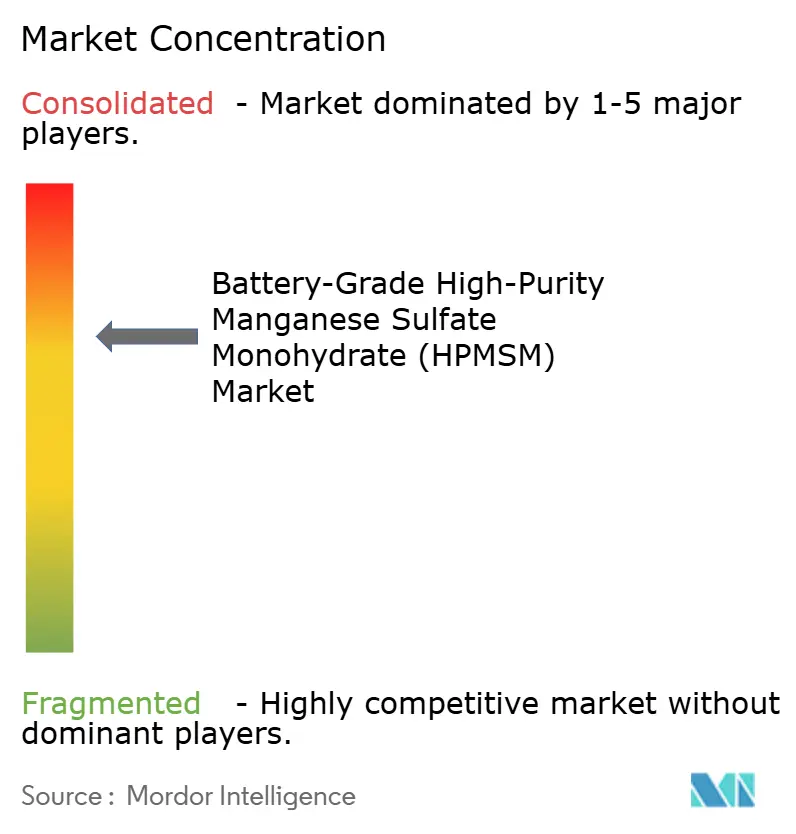
| Market Concentration | Medium |
Major Players *Disclaimer: Major Players sorted in no particular order Image © Mordor Intelligence. Reuse requires attribution under CC BY 4.0. | |
Battery-Grade High-Purity Manganese Sulfate Monohydrate (HPMSM) Market Analysis by Mordor Intelligence
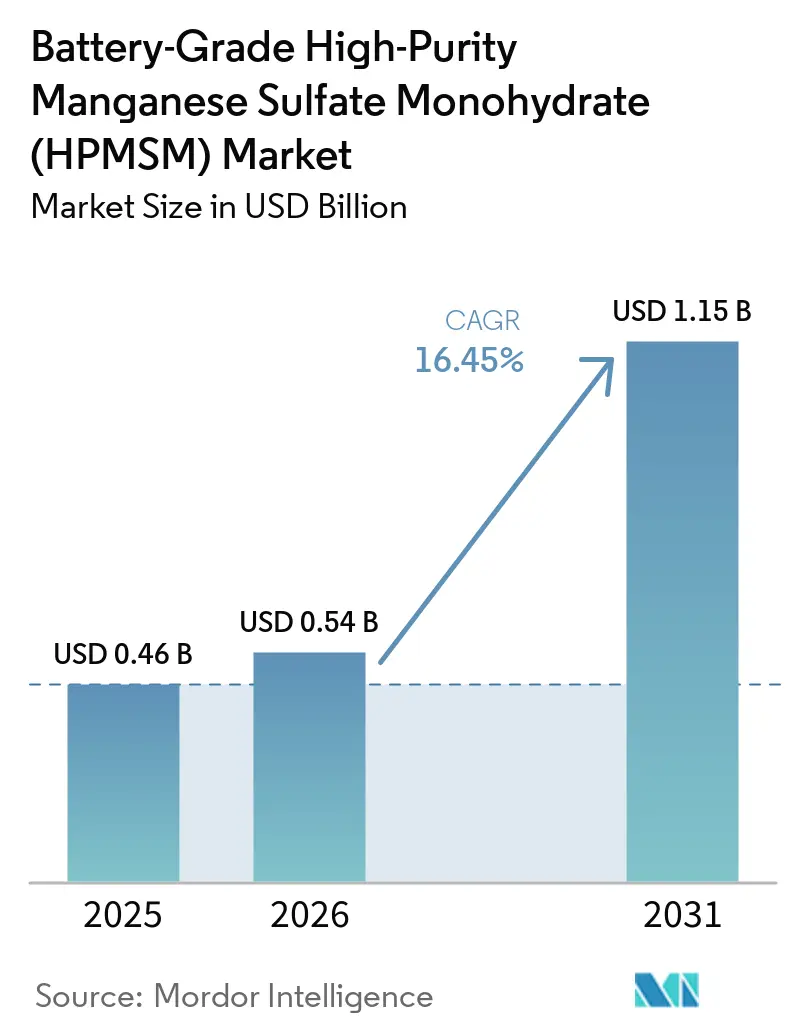
The Battery-Grade High-Purity Manganese Sulfate Monohydrate (HPMSM) Market was valued at USD 0.46 billion in 2025 and is estimated to grow from USD 0.54 billion in 2026 to reach USD 1.15 billion by 2031, at a CAGR of 16.45% during the forecast period (2026–2031). The battery-grade high-purity manganese sulfate monohydrate (HPMSM) market is supported by its role as a precursor for NMC (Nickel Manganese Cobalt) and LMFP (Lithium Manganese Iron Phosphate) cathode materials. Battery makers are seeking lower cobalt and nickel use, which increases the importance of manganese-rich cathode designs. Global battery electric and plug-in hybrid vehicle sales exceeded 21 million units in 2025, reinforcing a broader demand base for battery materials. Growth opportunities also depend on qualified supply outside China, because buyers increasingly value traceability, lower carbon intensity, and regional sourcing. Long supplier approval cycles and uncertainty over the pace of LMFP and LMR (Lithium Manganese-Rich) adoption continue to shape investment decisions in the battery-grade high-purity manganese sulfate monohydrate (HPMSM) market.
Key Report Takeaways
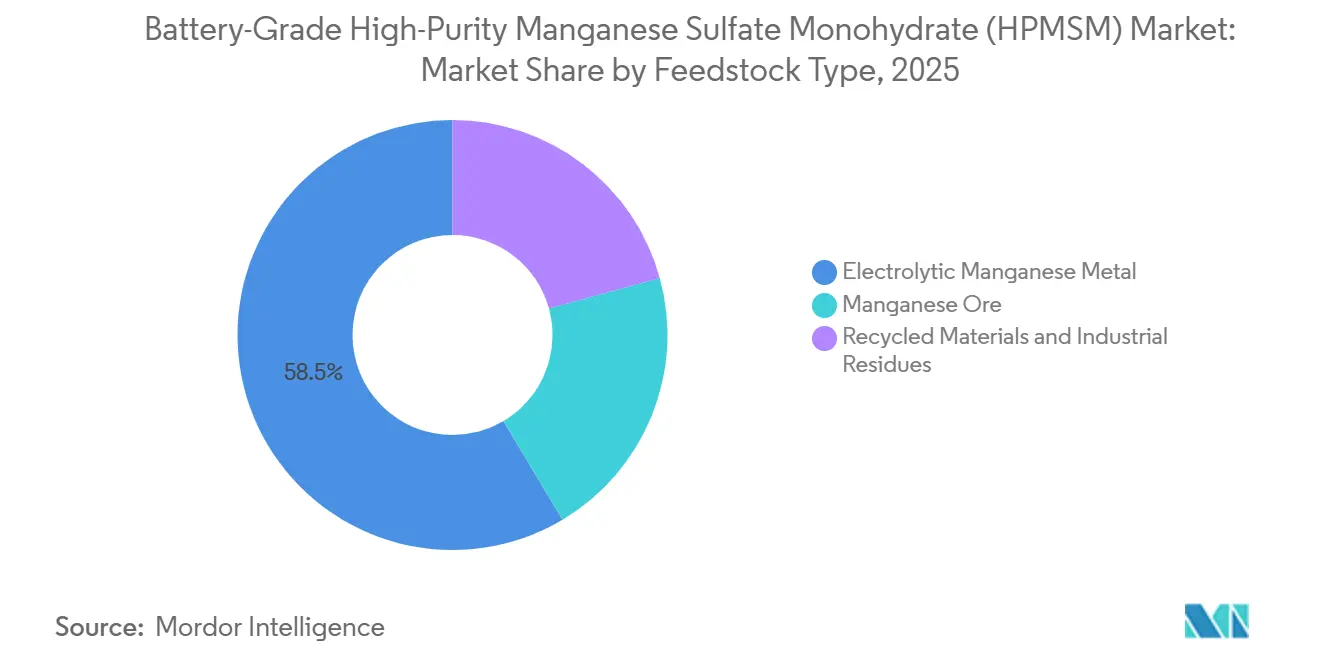
- By feedstock type, electrolytic manganese metal held 58.54% of the battery-grade high-purity manganese sulfate monohydrate (HPMSM) market share in 2025, while recycled materials and industrial residues are forecast to grow at an 18.85% CAGR through 2031.
- By battery application, NMC (Nickel Manganese Cobalt) held 61.73% of the battery-grade high-purity manganese sulfate monohydrate (HPMSM) market share in 2025, while LMFP (Lithium Manganese Iron Phosphate) is forecast to expand at an 18.31% CAGR through 2031.
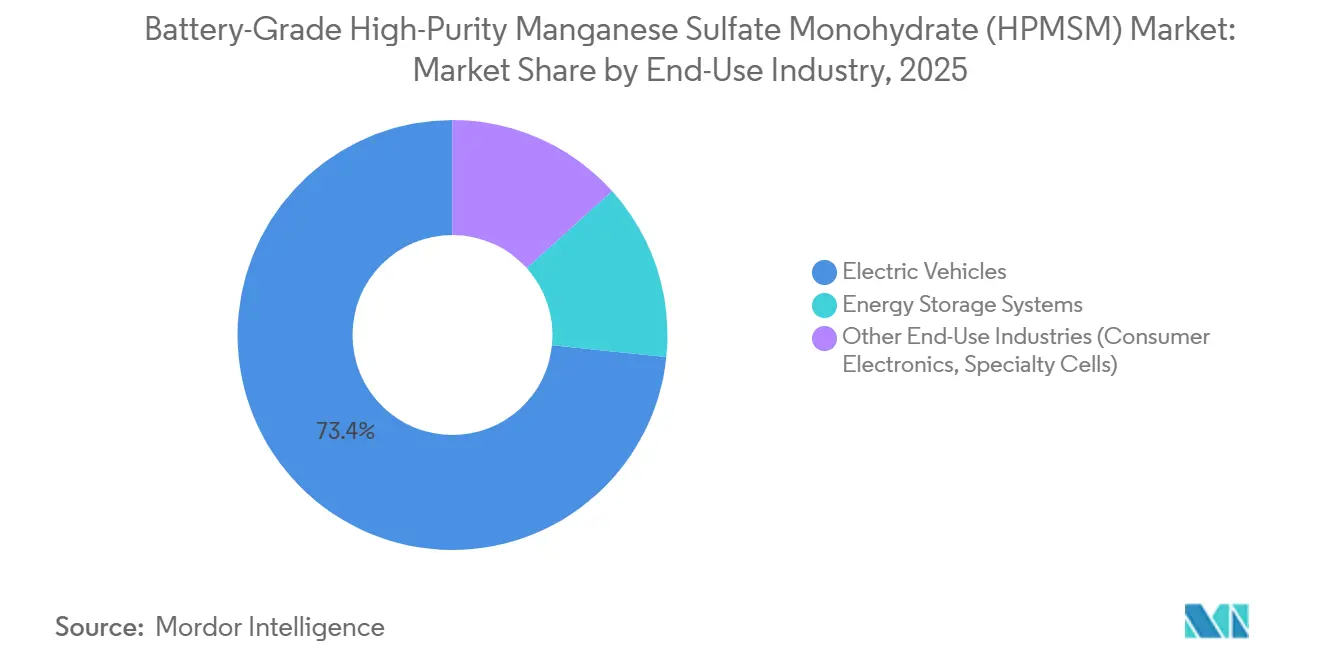
- By end-use industry, electric vehicles held 73.36% of the battery-grade high-purity manganese sulfate monohydrate (HPMSM) market share in 2025, while energy storage systems are forecast to expand at a 19.60% CAGR through 2031.
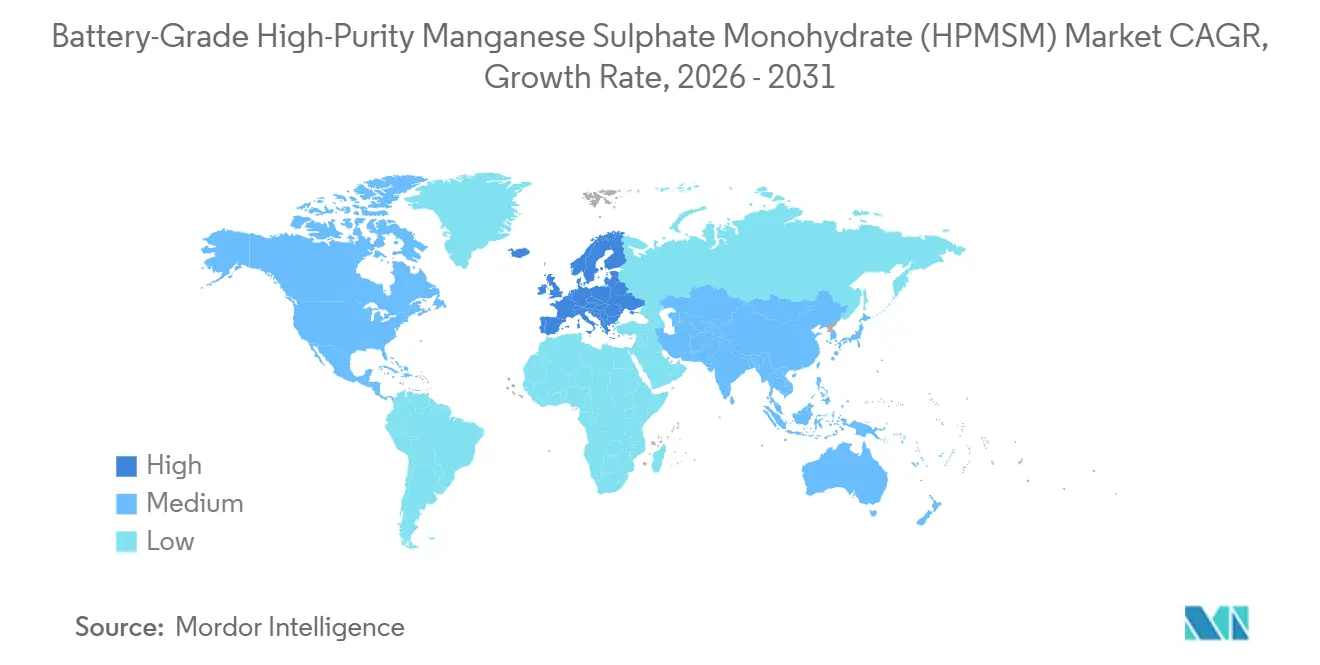
- By geography, Asia-Pacific held 52.28% of the battery-grade high-purity manganese sulfate monohydrate (HPMSM) market share in 2025, while Europe is forecast to expand at a 19.31% CAGR through 2031.
Note: Market size and forecast figures in this report are generated using Mordor Intelligence’s proprietary estimation framework, updated with the latest available data and insights as of January 2026.
Market Trends and Insights
Drivers Impact Analysis of Battery-Grade High-Purity Manganese Sulfate Monohydrate (HPMSM) Market*
| Driver | (~) % Impact on CAGR Forecast | Geographic Relevance | Impact Timeline |
|---|---|---|---|
| Manganese-Rich Battery Chemistry Adoption | +4.0% | Global | Long term (≥ 4 years) |
| EV and Energy-Storage Battery Manufacturing Expansion | +3.5% | Global, with demand core in APAC, North America & EU | Short term (≤ 2 years) |
| Strategic Localization of Critical-Mineral Refining | +2.5% | North America & EU | Medium term (2–4 years) |
| Cost and Safety Advantages Versus Nickel- and Cobalt-Intensive Cathodes | +2.0% | Global | Medium term (2–4 years) |
| Qualification Demand for Traceable, Low-Carbon HPMSM | +1.8% | North America & EU; spill-over to Japan, South Korea | Medium term (2–4 years) |
| Metal-to-Crystal Brownfield Conversion | +1.0% | APAC, Africa | Short term (≤ 2 years) |
| Source: Mordor Intelligence | |||
Manganese-Rich Battery Chemistry Adoption
The battery-grade high-purity manganese sulfate monohydrate (HPMSM) market benefits as LMFP, higher-manganese NMC, and LMR chemistries move through commercial development. LMFP cathodes contain 60% to 80% manganese by mass, which raises manganese demand per unit of cathode production. POSCO Future M completed LMR cathode development and achieved pilot production in 2025. The company targeted a mass-production decision by the end of 2025, indicating that higher manganese formulations extend beyond LMFP. Manganese-containing materials appear in more than 70% of lithium-ion cathode technology formats. This broad technical presence means incremental chemistry changes can increase HPMSM use without requiring battery manufacturers to replace every established cell platform.
EV and Energy Storage Battery Manufacturing Expansion
Battery manufacturing plans are bringing HPMSM sourcing and supplier qualification work forward before many new cell plants enter full operation. The battery-grade high-purity manganese sulfate monohydrate (HPMSM) market, therefore, depends on procurement decisions that can precede physical capacity additions by several years. Electric vehicle demand remains an important source of cathode procurement, especially for high-energy applications using NMC materials. Energy storage provides a separate demand path because stationary operators focus on cost, durability, and supply assurance. This combination reduces reliance on vehicle production as the only planning variable for prospective HPMSM producers. Projects that can serve mobility and grid storage customers may gain more diversified offtake relationships than suppliers focused on a single use case.
Strategic Localization of Critical Mineral Refining
North America and Europe are directing capital toward new refining capacity because the present battery-grade manganese supply remains highly concentrated. Element 25 received a USD 166 million U.S. Department of Energy grant for a planned 65,000 tons per annum (tpa) HPMSM facility in Louisiana. General Motors also committed USD 85 million in financing, including a 32,500 tpa seven-year offtake, while Stellantis made a USD 30 million equity investment. The EU Critical Raw Materials Act took effect in May 2024 and sets a 65% ceiling for reliance on any single third country for strategic minerals by 2030[1]. These measures strengthen the commercial case for the battery-grade high-purity manganese sulfate monohydrate (HPMSM) market outside China. They also place more weight on permitting, financing, and securing customer contracts than on open-market price competition alone.
Cost and Safety Advantages Versus Nickel and Cobalt Intensive Cathodes
Manganese has a lower material cost than nickel and cobalt, which supports cathode redesign for price-sensitive vehicles and stationary batteries. LMFP cell pack costs are estimated at EUR 67 to EUR 75 per kWh, compared with EUR 82 per kWh for NMC. The olivine structure of LMFP is like Lithium Iron Phosphate (LFP) in its thermal behavior and may reduce cooling and battery-management requirements. Lower cobalt content also addresses procurement concerns connected with supply risk and responsible sourcing requirements. POSCO Future M described an LMR roadmap in which manganese represented 65% of cathode active material. These cost and safety characteristics widen the potential role of the battery-grade high-purity manganese sulfate monohydrate (HPMSM) market across vehicle, maritime, grid, and industrial backup-power applications.
Restraints Impact Analysis of Battery-Grade High-Purity Manganese Sulfate Monohydrate (HPMSM) Market*
| Restraint | (~) % Impact on CAGR Forecast | Geographic Relevance | Impact Timeline |
|---|---|---|---|
| China-Centric Processing and Low-Cost Supply | -1.8% | Global | Long term (≥ 4 years) |
| High Qualification and Impurity-Control Requirements | -1.5% | Global | Medium term (2–4 years) |
| Ex-China Project Financing and Scale-Up Risk | -1.2% | North America, EU & Africa | Medium term (2–4 years) |
| Chemistry Mix Volatility and Qualification Delays | -0.9% | Global | Short term (≤ 2 years) |
| Source: Mordor Intelligence | |||
China-Centric Processing and Low-Cost Supply
China accounted for 95% of global HPMSM production in 2024, while Belgium and Japan supplied the remaining production[2]. Its processing clusters combine manganese inputs, sulfuric acid availability, and hydropower in Guizhou, Guangxi, and Hunan. This integrated position creates a cost benchmark that many greenfield projects outside China cannot readily match. The battery-grade high-purity manganese sulfate monohydrate (HPMSM) market outside China consequently relies on policy support, procurement preferences, and sustainability requirements to support investment. China also has established capacity that can respond to changes in downstream demand. That capacity can limit the price signals needed for new non-Chinese facilities during periods of slower cathode production.
High Qualification and Impurity-Control Requirements
Battery manufacturers require strict qualification procedures because impurities can affect cathode consistency and cell performance. Calcium, iron, and sulfate-related trace contaminants must be controlled at parts-per-million levels for battery-grade output. A change in feedstock or production conditions can require suppliers to repeat the approval process. Qualification can take from 6 months to more than 1 year, extending the interval before a new plant earns commercial revenue. This requirement raises working-capital needs and favors companies with adequate financial resources during commissioning. It also keeps the battery-grade high-purity manganese sulfate monohydrate (HPMSM) market focused on verified purity, process control, and customer-specific approval rather than nameplate capacity alone.
*Our forecasts treat driver/restraint impacts as directional, not additive. The impact forecasts reflect baseline growth, mix effects, and variable interactions.
Battery-Grade High-Purity Manganese Sulfate Monohydrate (HPMSM) Market Segment Analysis
By Feedstock Type:
Electrolytic Manganese Metal Anchors Supply, Recycled Materials and Industrial Residues Redefine the Cost CeilingElectrolytic manganese metal captured 58.54% of feedstock demand in 2025, giving it the largest position in the battery-grade high-purity manganese sulfate monohydrate (HPMSM) market share. The electrolytic manganese metal route is established because it supports controlled crystallization and consistent purity for battery applications. Producing 1 metric ton of HPMSM requires close to one-third of a metric ton of electrolytic manganese metal, together with sulfuric acid and energy. The route is therefore sensitive to metal, acid, and power costs. Manganese ore is used mainly by integrated producers that can manage more complex impurity removal. Metal-to-crystal conversions use existing facilities and can lower the development burden for selected brownfield projects. Feedstock choice remains central to process reliability, cost control, and approval performance in the battery-grade high-purity manganese sulfate monohydrate (HPMSM) market.
Recycled materials and industrial residues are forecast to grow at an 18.85% CAGR from 2026 to 2031. The EU Battery Regulation requires 8% recycled manganese in new batteries by 2031. That requirement creates a separate procurement opportunity for traceable secondary material. Tracegrow launched REDO-M in November 2025 using EU-sourced recycled alkaline batteries and industrial by-products. The University of Oulu confirmed the product’s purity, according to the company announcement. The STREAMS project also demonstrated manganese sulfate recovery from mining by-products at Eti Bakır’s Mazıdağı facility. Secondary feedstocks can help cathode producers address domestic-content and recycled-content requirements. Their role depends on reliable collection systems, impurity control, and production at an adequate commercial scale. These routes may receive purchasing preference where buyers value documented origin and circular-material content.

By Battery Application:
NMC’s Demand Base Persists, LMFP Rewires Manganese EconomicsNMC held 61.73% of battery application demand in 2025, accounting for the largest share in the battery application segment. Its position reflects long-established qualification programs with automakers and suitability for high-voltage 800V vehicle platforms. NMC reformulation requires extensive testing after a cathode grade enters a production vehicle. This creates switching costs that support existing NMC demand even as other chemistries gain adoption. Lithium Manganese Oxide (LMO), Lithium Manganese Nickel Oxide (LMNO), and sodium-ion applications represent an expanding group of battery uses. Sodium-ion batteries entered commercial use in Chinese light electric vehicles during 2024 and 2025. These batteries use manganese oxide rather than HPMSM in many cases, but they show the broader importance of manganese in cathode development. NMC remains a durable demand base for the battery-grade high-purity manganese sulfate monohydrate (HPMSM) market while battery producers test new manganese-rich formulations. Its continuing role also provides suppliers with demand from high-energy vehicle applications.
LMFP is forecast to grow at an 18.31% CAGR from 2026 to 2031. It offers 10% to 20% more energy density than standard LFP, stronger low-temperature performance, and no cobalt input. The EU-funded OLiMPUS project selected Integrals Power as its LMFP cathode supplier for planned European cell production. The project is intended to support electric vehicle and maritime applications through 2030. It targets mass production of European LMFP cells by 2032. Each GWh of LMFP installed requires 1.5 to 2 times more HPMSM than a comparable NMC cell. The application’s growth can therefore raise manganese sulfate procurement faster than a pure GWh deployment measure suggests. It may also increase the value of qualified supply because LMFP relies on higher manganese intensity. The resulting demand profile makes the battery-grade high-purity manganese sulfate monohydrate (HPMSM) market more responsive to chemistry mix than to battery capacity alone.
By End-Use Industry:
Electric Vehicles Dominance Entrenched, Energy Storage Systems Unlock an Independent Growth CurveElectric vehicles held 73.36% of end-use industry demand in 2025, making them the largest end-use industry of the battery-grade high-purity manganese sulfate monohydrate (HPMSM) market size. Passenger vehicle adoption in China, Germany, and the United States supported cathode procurement from cell gigafactories. Within electric vehicles, higher-manganese NMC, LMFP, and LMR increase manganese intensity per battery in certain applications. This change can raise HPMSM demand even when manufacturers manage battery pack size. Consumer electronics and specialty cells provide a stable base through LMO use in power tools, medical devices, and small-format batteries. Electric vehicles remain the central commercial channel for qualified suppliers because of their scale and established purchasing requirements. Supplier approval for automotive applications can also create an entry barrier that protects qualified producers. The battery-grade high-purity manganese sulfate monohydrate (HPMSM) market, therefore, remains closely tied to vehicle chemistry choices as well as vehicle sales.
Energy storage systems are forecast to grow at a 19.60% CAGR from 2026 to 2031. Stationary battery customers favor LMFP, where long cycle life, thermal stability, and cost per cycle are important. The segment provides demand that is separate from consumer vehicle production schedules. Energy storage operators may accept non-Chinese HPMSM at a moderate premium when it meets domestic-content or lower-carbon procurement standards. This feature can give new suppliers an earlier commercial route than automotive contracts alone. Long-term grid storage contracts can run for 5 to 10 years, which improves revenue visibility for new processing facilities. Energy storage customers may also value multiple qualified supply sources to reduce disruption risk. These factors make stationary storage important to the battery-grade high-purity manganese sulfate monohydrate (HPMSM) market as suppliers build initial offtake volumes. The segment’s growth may support producers that combine dependable purity with regional compliance documentation.
Geography Analysis
APAC Battery-Grade HPMSM Market
Asia-Pacific held 52.28% of the global HPMSM market in 2025. China’s processing clusters in Guizhou, Guangxi, and Hunan underpin the region’s leading position. China supplied 95% of global HPMSM output in 2024. South Korea’s manganese sulfate imports for battery applications rose more than 50-fold in the first 9 months of 2025. China supplied 92% of those imports by weight in 2024, compared with 32% in 2022. Korea considers this dependence an economic security concern and operates a KRW 10 trillion annual supply-chain stabilization fund. Japan retains commercial production through Nippon Denko, one of the few non-Chinese producers. India represents a future demand source as domestic cell capacity develops under Production-Linked Incentive support.
Europe Battery-Grade HPMSM Market
Europe is forecast to grow at a 19.31% CAGR from 2026 to 2031, the highest regional rate in the battery-grade high-purity manganese sulfate monohydrate (HPMSM) market. The region is seeking new supply to support planned cell manufacturing capacity and reduce reliance on a single source. The European Court of Auditors stated in February 2026 that the Critical Raw Materials Act was unlikely to deliver the targeted supply security. That gap may sustain procurement demand for compliant material through the forecast period. Euro Manganese’s Chvaletice project in the Czech Republic targets 150,000 tpa of HPMSM capacity. The project published a preliminary economic assessment in May 2026 and targets a feasibility study in H1 2027. Tracegrow’s recycled REDO-M product provides another route for regional cathode supply. Europe’s opportunity rests on project execution, responsible sourcing, and reliable qualification by cell producers.
North America, Europe and Africa Battery-Grade HPMSM Market
North America is building an early manufacturing base from a position with no domestic HPMSM production. Element 25’s Louisiana project targets 65,000 tpa and has support from General Motors, Stellantis, and the U.S. Department of Energy. South32’s Hermosa project in Arizona targets 60,000 tpa in an integrated mine-to-HPMSM configuration. In Africa, Manganese Metal Company commissioned a 6,000 tpa year battery-grade crystallization plant in Mbombela in 2026. Giyani’s K.Hill project in Botswana is designed to send 70% of HPMSM output to North America and 30% to Europe. The project targets first production in 2029. These projects position Africa as a potential supplier to Western battery value chains, subject to financing, commissioning, and customer qualification.
Competitive Landscape
The battery-grade high-purity manganese sulfate monohydrate (HPMSM) market is moderately concentrated, with the top five players including Guizhou Dalong Huicheng New Material Co., Ltd., ISKY Chemicals Co., Ltd., Guizhou Redstar Co., Ltd., China Minmetals Corporation, and South Manganese Investment Limited. Price competition is intense among Chinese suppliers because substantial capacity is already established. Non-Chinese producers seek differentiation through regional origin, lower-carbon production, fluorine-free or selenium-free processes, and verified emissions accounting. Vibrantz Technologies holds a European position with existing original equipment manufacturer qualifications. Its 5,000 tpa capacity is limited relative to projected European requirements. The battery-grade high-purity manganese sulfate monohydrate (HPMSM) market, therefore, has a concentrated revenue base but emerging competition around qualification and supply-chain credentials.
New entrants are competing through proven process performance, traceable feedstocks, and bankable customer contracts. Euro Manganese is developing Chvaletice through tailings reprocessing, which provides a traceable material pathway for European buyers. The project’s May 2026 assessment described a 150,000 tpa HPMSM target and a feasibility study planned for H1 2027. Element 25 has aligned its Louisiana project with committed automotive financing and offtake support. Manganese Metal Company and JordProxa announced a first commissioning milestone for Africa’s first commercial HPMSM crystallization plant in July 2026. These moves show that developers are using capital partnerships, regional location, and operating proof to compete. The battery-grade high-purity manganese sulfate monohydrate (HPMSM) market rewards suppliers that can turn these commitments into customer-approved production. Scale alone is less useful when a supplier cannot meet impurity specifications or secure long-term offtake.
Competition will remain shaped by the contrast between the established Chinese scale and smaller regional projects. Chinese firms benefit from existing infrastructure and customer relationships, while external projects seek policy-supported demand. European and North American purchasers may pay a premium for material that meets origin, carbon, and regulatory requirements. However, project developers still face extended qualification periods before commercial sales begin. Financing risk is also significant because revenue can lag commissioning by many months. The strongest competitive positions combine reliable purity, documented traceability, sufficient working capital, and contracted demand. This structure leaves room for selected new facilities, but it does not remove China’s pricing influence. The battery-grade high-purity manganese sulfate monohydrate (HPMSM) market is likely to retain a concentrated supply structure while its qualified regional supply base grows.
Battery-Grade High-Purity Manganese Sulfate Monohydrate (HPMSM) Industry Leaders
-
Guizhou Dalong Huicheng New Material Co., Ltd.
-
ISKY Chemicals Co., Ltd.
-
Guizhou Redstar Co., Ltd
-
China Minmetals Corporation
-
South Manganese Investment Limited
- *Disclaimer: Major Players sorted in no particular order
Battery-Grade High-Purity Manganese Sulfate Monohydrate (HPMSM) Market Companies Covered in this Report
- Changsha Lantian Chemicals Co., Ltd.
- Changsha Rongqing Chemical Co., Ltd.
- China Minmetals Corporation
- Element 25
- Euro Manganese Inc.
- Giyani Metals Corp.
- Guangxi Detian Chemical Cycle Co., Ltd.
- Guizhou Dalong Huicheng New Material Co., Ltd.
- Guizhou Manganese Mineral Group Co., Ltd.
- Guizhou Redstar Co., Ltd
- Guizhou Union Manganese Corporation Co., Ltd.
- ISKY Chemicals Co., Ltd.
- Manganese X Energy Corp.
- South Manganese Investment Limited
- Vibrantz
- Xiangtan Electrochemical Scientific Co., Ltd.
Recent Industry Developments in Battery-Grade High-Purity Manganese Sulfate Monohydrate (HPMSM) Market
- July 2026: Manganese Metal Company and JordProxa announced the first successful hot-commissioning milestone for Africa's first commercial high-purity manganese sulfate monohydrate (HPMSM) crystallization plant. The plant is designed to convert pure manganese metal into 6,000 tpa of battery-grade HPMSM.
- June 2026: AE Fuels Corporation announced positive results from mini-pilot testing conducted by Australia's national science agency, Commonwealth Scientific and Industrial Research Organisation (CSIRO). The program successfully demonstrated a scalable purification pathway for producing high-purity manganese sulfate monohydrate (HPMSM), achieving manganese recoveries of 95-99%, strong impurity control, successful continuous purification performance, and batch crystallization of the resulting strip liquor.
Global Battery-Grade High-Purity Manganese Sulfate Monohydrate (HPMSM) Market Report Scope
Battery-grade high-purity manganese sulfate monohydrate (HPMSM) is a refined manganese chemical used as a critical precursor material in the production of lithium-ion battery cathodes. It provides the high purity and consistent quality required for advanced battery chemistries, supporting improved energy density, battery performance, and long cycle life.
The Battery-Grade High-Purity Manganese Sulfate Monohydrate (HPMSM) Market is segmented by feedstock type, battery application, end-use industry, and geography. By feedstock type, the market is segmented into electrolytic manganese metal, manganese ore, and recycled materials and industrial residues. By battery application, the market is segmented into NMC (nickel manganese cobalt), LMFP (lithium manganese iron phosphate), and other battery applications (including LMO, LMNO, and sodium-ion). By end-use industry, the market is segmented into electric vehicles, energy storage systems, and other end-use industries (including consumer electronics and specialty cells). The report also covers the market size and forecasts for battery-grade high-purity manganese sulfate monohydrate (HPMSM) in 15 countries across major regions. For each segment, the market sizing and forecasts have been done on the basis of value (USD).
Segmentation Overview
| Electrolytic Manganese Metal |
| Manganese Ore |
| Recycled Materials and Industrial Residues |
| NMC (Nickel Manganese Cobalt) |
| LMFP (Lithium Manganese Iron Phosphate) |
| Other Battery Applications (LMO, LMNO, Sodium-Ion) |
| Electric Vehicles |
| Energy Storage Systems |
| Other End-Use Industries (Consumer Electronics, Specialty Cells) |
| Asia-Pacific | China |
| India | |
| Japan | |
| South Korea | |
| Rest of Asia-Pacific | |
| North America | United States |
| Canada | |
| Mexico | |
| Europe | Germany |
| United Kingdom | |
| France | |
| Italy | |
| Rest of Europe | |
| South America | Brazil |
| Argentina | |
| Rest of South America | |
| Middle-East and Africa | Saudi Arabia |
| South Africa | |
| Rest of Middle-East and Africa |
| By Feedstock Type | Electrolytic Manganese Metal | |
| Manganese Ore | ||
| Recycled Materials and Industrial Residues | ||
| By Battery Application | NMC (Nickel Manganese Cobalt) | |
| LMFP (Lithium Manganese Iron Phosphate) | ||
| Other Battery Applications (LMO, LMNO, Sodium-Ion) | ||
| By End-Use Industry | Electric Vehicles | |
| Energy Storage Systems | ||
| Other End-Use Industries (Consumer Electronics, Specialty Cells) | ||
| By Geography | Asia-Pacific | China |
| India | ||
| Japan | ||
| South Korea | ||
| Rest of Asia-Pacific | ||
| North America | United States | |
| Canada | ||
| Mexico | ||
| Europe | Germany | |
| United Kingdom | ||
| France | ||
| Italy | ||
| Rest of Europe | ||
| South America | Brazil | |
| Argentina | ||
| Rest of South America | ||
| Middle-East and Africa | Saudi Arabia | |
| South Africa | ||
| Rest of Middle-East and Africa | ||
Key Questions Answered in the Report
What is the size of the battery-grade high-purity manganese sulfate monohydrate (HPMSM) market?
The battery-grade high-purity manganese sulfate monohydrate (HPMSM) market stands at USD 0.54 billion in 2026 and is projected to reach USD 1.15 billion by 2031.
Which battery application led the demand in 2025?
NMC held 61.73% of battery application demand in 2025. Its established vehicle qualifications support its leading position.
Which battery application is forecast to grow fastest through 2031?
LMFP (Lithium Manganese Iron Phosphate) is forecast to grow at 18.31% CAGR through 2031. Its higher manganese intensity can increase HPMSM demand per GWh of installed capacity.
Why is Europe important for battery-grade manganese sulfate suppliers?
Europe is forecast to grow at a 19.31% CAGR through 2031. Regional supply-security rules and battery manufacturing plans support demand for compliant material.