
Baking Powder Market Size and Share
Market Overview
| Study Period | 2022 - 2032 |
|---|---|
| Market Size (2027) | USD 1.41 Billion |
| Market Size (2032) | USD 1.74 Billion |
| Growth Rate (2027 - 2032) | 4.30 % |
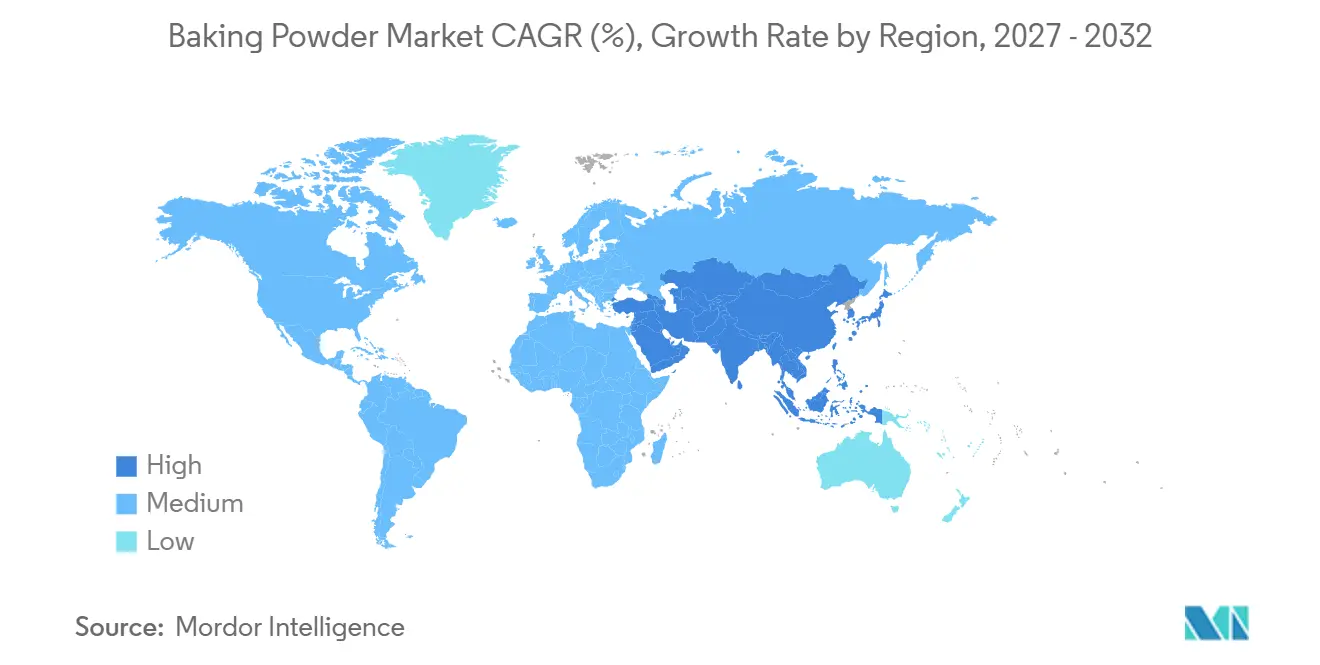
| Fastest Growing Market | Asia-Pacific |
| Largest Market | Asia-Pacific |
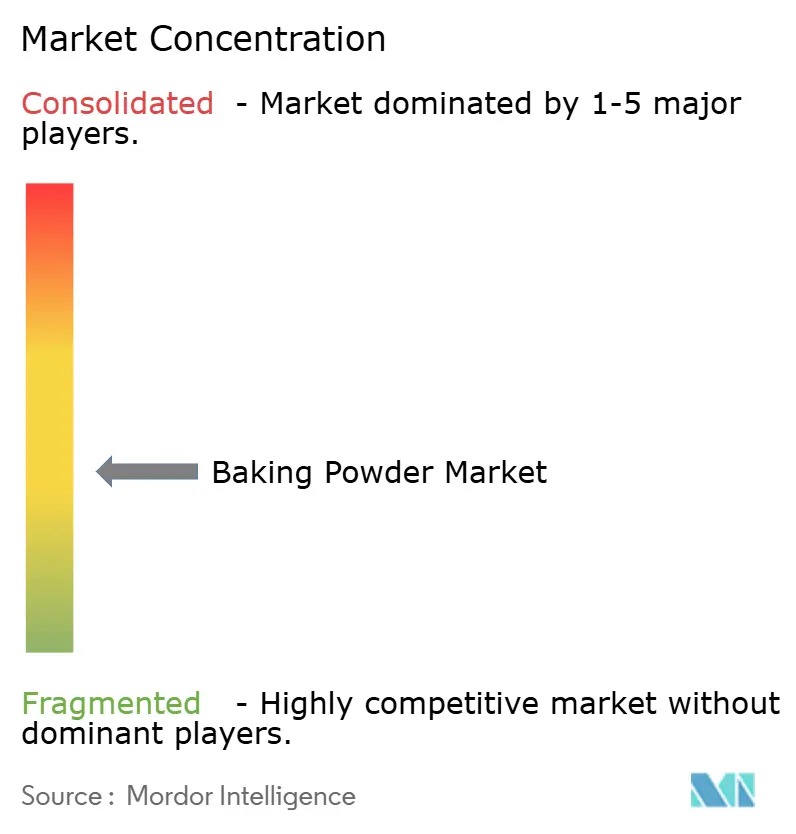
| Market Concentration | Medium |
Major Players *Disclaimer: Major Players sorted in no particular order Image © Mordor Intelligence. Reuse requires attribution under CC BY 4.0. | |
Baking Powder Market Analysis by Mordor Intelligence
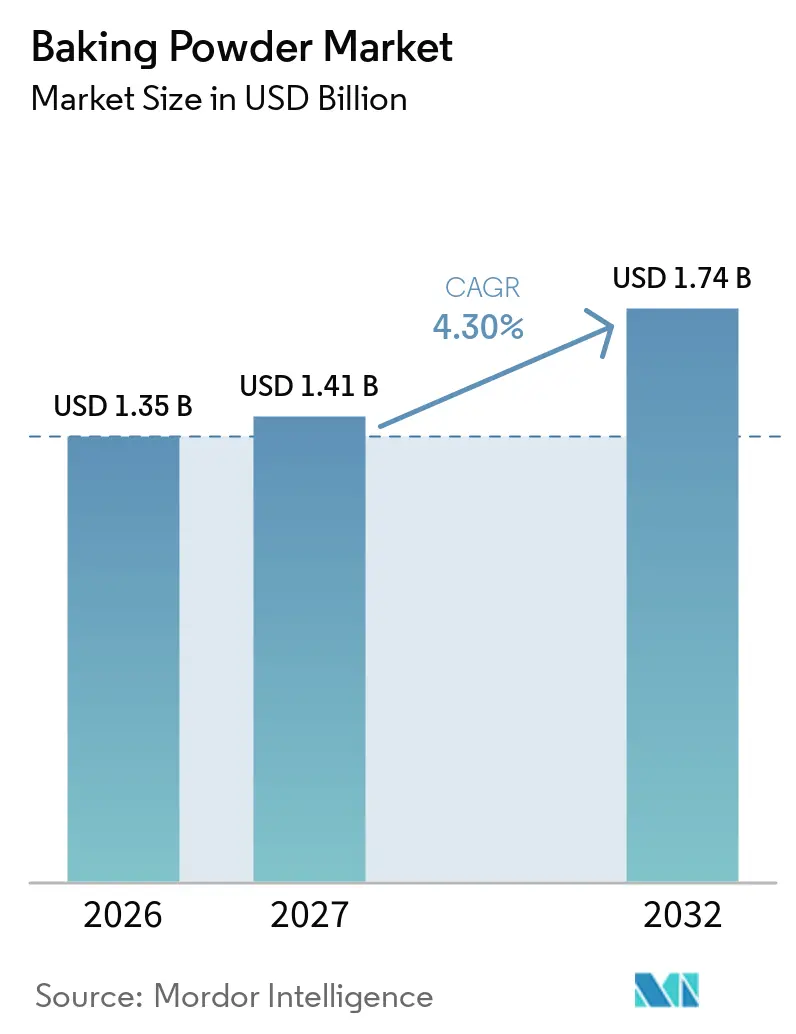
The baking powder market size is expected to grow from USD 1.35 billion in 2026 to USD 1.41 billion in 2027, and is forecast to reach USD 1.74 billion by 2032, at a 4.30% CAGR over 2027-2032. Packaged bakery production, foodservice recovery, and the growing consumption of Western-style baked goods create strong demand for baking powder. The expansion of retail distribution channels and the increasing availability of packaged bakery products further contribute to market growth. Home baking trends and demand for specialized formulations, including aluminum-free and sodium-reduced products, also support market growth. The development of innovative formulations and manufacturers’ focus on regulatory compliance present opportunities for sustained market expansion.
Note: Market numbers in this report are based on Mordor Intelligence's proprietary estimation framework, which combines nine months of actuals with Q4 projections for base year 2026.
Market Trends and Insights
Drivers Impact Analysis of Baking Powder Market of Baking Powder Market*
| Driver | (~) % Impact on CAGR Forecast | Geographic Relevance | Impact Timeline |
|---|---|---|---|
| Growth of home baking and recreational baking | +0.7% | Global | Short term (≤ 2 years) |
| Packaged bakery expansion drives industrial leavening demand | +0.9% | Global | Medium term (2-4 years) |
| Western-style bakery adoption in emerging markets | +0.9% | Asia-Pacific, Middle East and Africa, South America | Long term (≥ 4 years) |
| Sodium-reduced formulations open a premium specialty segment | +0.5% | Global | Medium term (2-4 years) |
| Growing demand for sodium-reduced formulations | +0.5% | North America and Europe | Long term (≥ 4 years) |
| Increasing demand for specialty formulations | +0.4% | Global | Long term (≥ 4 years) |
| Source: Mordor Intelligence | |||
Growth of Home Baking and Recreational Baking
Home baking supports demand for retail baking powder, as consumers use baking ingredients to prepare homemade cakes, pastries, cookies, and other baked products. For instance, in 2025, according to the Oldways Whole Grains Council's Consumer Insights Survey, 24% of respondents reported increasing their home baking activity over the past five years. This share rose to 34% among parents [1]. These findings highlight sustained interest in home baking, particularly among households with children, supporting demand for convenient baking ingredients and products that provide consistent leavening results.
Packaged Bakery Expansion Drives Industrial Leavening Demand
The expansion of India’s bakery industry supports demand for baking powder in commercial and industrial food production. For instance, in July 2025, according to the Ministry of Food Processing Industries (MoFPI), India’s bakery market, which includes biscuits, confectionery, cakes, and pastries, accounted for INR 1.17–1.20 lakh crore value in FY2024. Biscuits accounted for approximately 55% of the market [2]. The report also emphasized the importance of ingredient sourcing, mixing, baking, cooling, and packaging facilities across the bakery production value chain. As bakery production expands, demand for consistent leavening ingredients, including baking powder, used in biscuits, cakes, pastries, and other baked products, increases.
Western-Style Bakery Adoption in Emerging Markets
Growing consumer interest in Western-style bakery products is supporting the expansion of China’s bakery market. For instance, in January 2026, according to the United States Department of Agriculture Foreign Agricultural Service’s report, China’s bakery market was estimated at USD 50–83 billion in 2025, with more than 338,000 bakery outlets operating nationwide as of April 2025. Per capita baked-food consumption was approximately 7–8 kg annually, compared with 40 kg in the United States and 25 kg in Japan, indicating significant potential for further growth in consumption. The report also highlighted the growing popularity of bakery products among younger consumers [3]. Demand remains robust across Western-style restaurants, pizza chains, and Chinese-style quick-service restaurants. Mozzarella, cream cheese, and cheddar are the most widely used varieties.
Sodium-Reduced Formulations Open a Premium Specialty Segment
Growing consumer interest in Western-style bakery products is driving the expansion of the bakery industry across emerging markets. Changing food preferences, greater exposure to international bakery concepts, and the rising popularity of modern bakeries and café chains are increasing demand for cakes, pastries, cookies, breads, and other baked goods. Rising urbanization, higher disposable incomes, and evolving lifestyles are further driving consumer adoption of convenient, premium bakery products, creating opportunities for baking powder manufacturers to supply reliable leavening ingredients to commercial bakeries, café chains, and food producers for a wide range of bakery applications.
Restraints Impact Analysis of Baking Powder Market of Baking Powder Market*
| Restraint | (~) % Impact on CAGR Forecast | Geographic Relevance | Impact Timeline |
|---|---|---|---|
| Substitution by biological leavening agents | -0.8% | Global | Short term (≤ 2 years) |
| Raw material volatility and manufacturing cost pressures | -0.7% | Global | Medium term (2-4 years) |
| Regulatory restrictions on baking powder ingredients | -0.4% | North America and Europe | Long term (≥ 4 years) |
| Moisture sensitivity during storage and distribution | -0.3% | Asia-Pacific, Middle East and Africa | Medium term (2-4 years) |
| Source: Mordor Intelligence | |||
Substitution by Biological Leavening Agents
Yeast, sourdough, and fermentation-based systems compete with chemical leavening agents in artisanal and clean-label bakery applications. These alternatives appeal to consumers and bakers seeking natural ingredient profiles and distinctive flavor characteristics. Innovative yeast-based products that combine natural leavening with flavor development further intensify competition with baking powder. As a result, the adoption of baking powder remains limited in applications that prioritize fermentation characteristics and clean-label positioning. However, chemical leavening retains an advantage in commercial baking applications that require faster preparation, consistent product quality, and simplified production processes.
Raw-Material Volatility Pressures Margins
Tartrate-based baking powder relies on cream of tartar, a byproduct of wine fermentation. Consequently, variations in grape harvests and regional wine production can affect its availability and pricing. Supply fluctuations can raise sourcing costs and make it difficult to maintain consistent formulations and product quality. Higher input costs may also prompt commercial customers to shift toward more cost-effective phosphate-based or other baking powder alternatives. Additionally, moisture sensitivity poses challenges for storage and distribution, as inadequate packaging can cause premature activation and reduce leavening performance. These factors can increase operational costs and affect the reliability of supply for baking powder manufacturers.
*Our forecasts treat driver/restraint impacts as directional, not additive. The impact forecasts reflect baseline growth, mix effects, and variable interactions.
Baking Powder Market Segment Analysis
By Product Type:
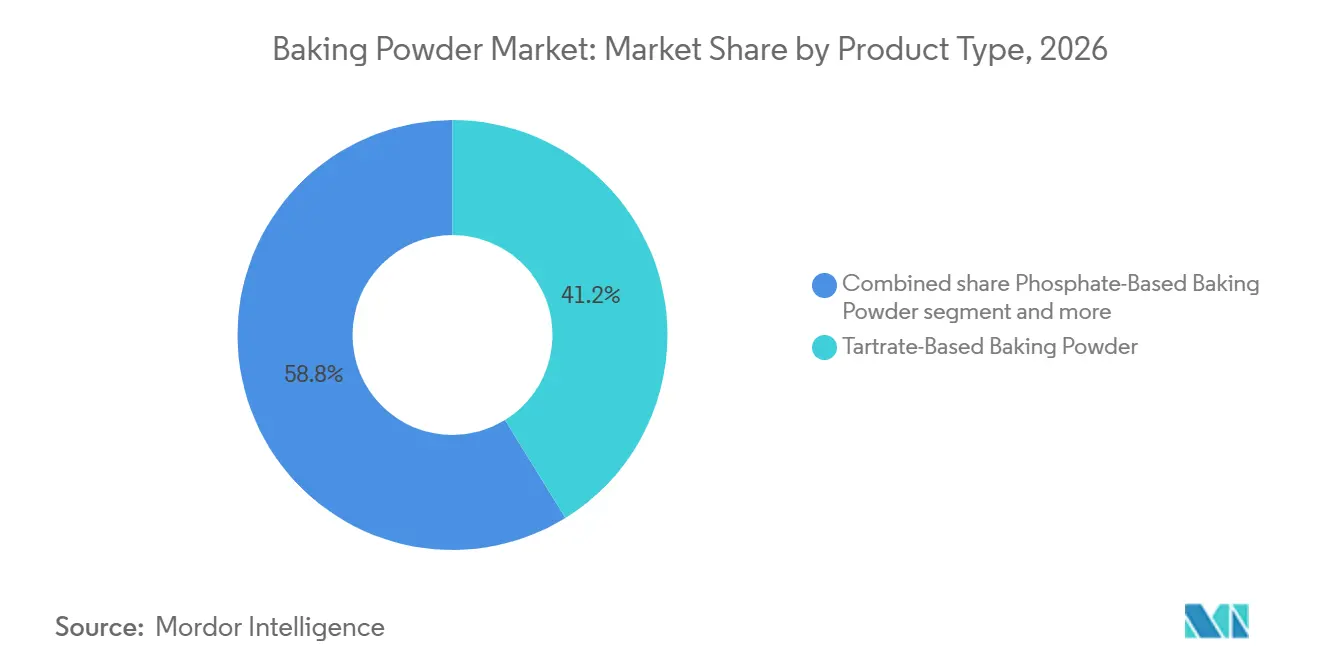
Tartrate Systems Support Clean-Label FormulationTartrate-based baking powders held 41.21% of the baking powder market in 2026 and are forecast to expand at a CAGR of 6.10% through 2032. Rising demand for clean-label bakery products is creating opportunities for tartrate-based baking powder formulations. Cream of tartar serves as the acid component, enabling aluminum-free and phosphate-free formulations that appeal to manufacturers seeking simpler ingredient declarations. These formulations also support sodium reduction and phosphate replacement while maintaining the leavening functionality required for bakery applications. Manufacturers can strengthen adoption in commercial bakery production by ensuring consistent product volume, texture, and leavening performance across various recipes.
Phosphate-based baking powder remains essential in commercial bakery production, particularly for cakes, muffins, biscuits, and other products that require controlled carbon dioxide release and consistent leavening performance. Double-acting phosphate systems deliver reliable results under varying production conditions, including dough-resting processes and high-speed baking operations. Meanwhile, sulfate-based and other baking powder formulations are used in applications that require specific reaction characteristics. These diverse baking requirements sustain demand for different acidulant systems, as manufacturers select formulations based on product texture, processing conditions, shelf-life requirements, and labeling preferences.

By Form:
Double-Acting Products Retain Industrial RelevanceDouble-acting baking powder held 71.12% of the baking powder market share in 2026, reflecting its strong use in commercial production. It releases gas in two stages, giving bakers greater flexibility during mixing, filling, and baking. The need for predictable volume and crumb structure at scale supports its leading position. Commercial customers also value consistent results across varying batch sizes and operating schedules. This form remains closely associated with industrial production of cakes, pastries, muffins, and biscuits. Its established role in high-volume processing makes rapid substitution challenging. The product enables bakeries to manage routine variations in preparation schedules without altering the desired finished texture. Suppliers compete based on reliability, low defect rates, technical support, and compliance documentation rather than product availability alone.
Single-acting baking powder is forecast to expand at a CAGR of 6.22% through 2032, supported by smaller-batch baking and appliance-specific preparation. The increasing adoption of compact kitchen appliances, particularly air fryers, is creating opportunities for baking powder manufacturers to develop application-specific formulations. Innovations tailored to air-fryer baking address consumer demand for convenient preparation, shorter cooking times, and consistent results under varying baking conditions. These specialized products can support the preparation of cakes, muffins, cookies, and other baked goods in compact appliances, expanding baking powder applications beyond conventional oven baking and creating new retail opportunities. Manufacturers can differentiate their offerings through formulations designed to deliver appropriate rise, texture, and moisture retention in air-fryer environments.
By End Use:
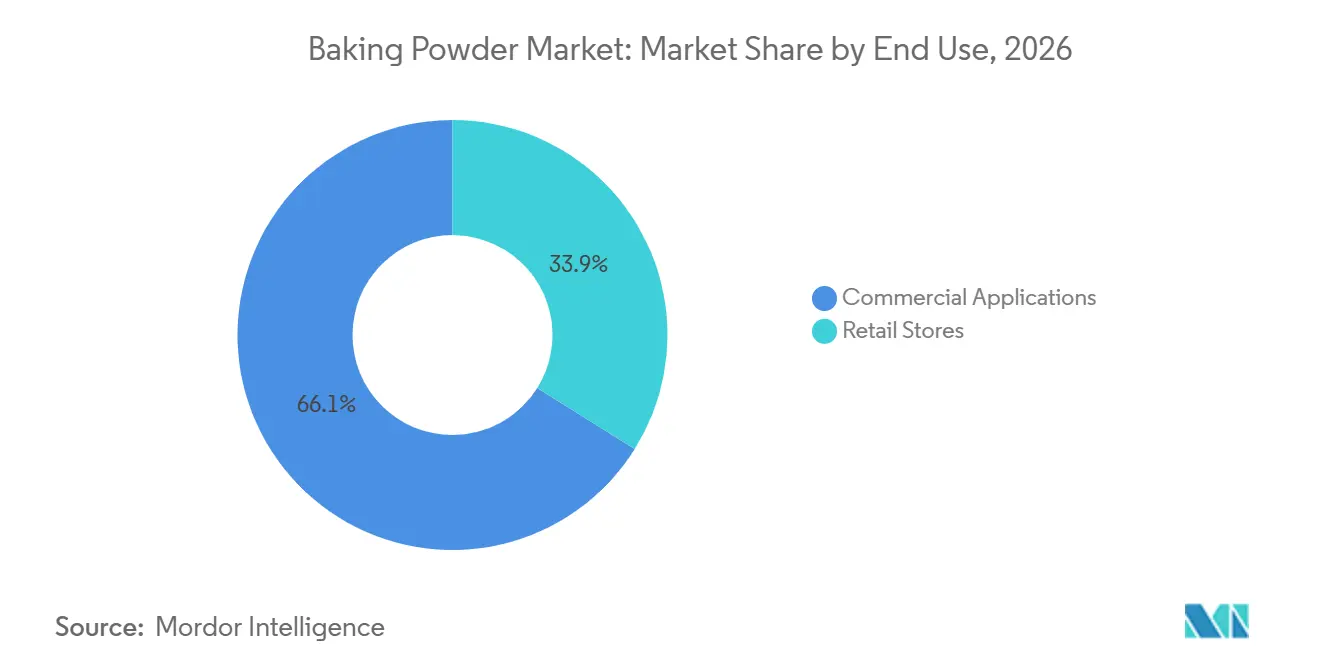
Commercial Demand Anchors Volume While Retail Broadens ValueCommercial applications held 66.11% of the baking powder market in 2026. Industrial bakeries, food manufacturers, and foodservice operators require reliable leavening ingredients for the large-scale production of cakes, pastries, cookies, biscuits, and muffins. These customers prioritize consistent product specifications, traceability, and compliance with food additive regulations to ensure product quality and food safety. This demand creates opportunities for baking powder manufacturers that offer standardized formulations, documented quality controls, and technical support. Suppliers that maintain consistent leavening performance across production batches and varying processing conditions can further strengthen customer relationships.
Retail stores are forecast to expand at a CAGR of 6.42% through 2032. Supermarkets, specialty stores, convenience stores, and online platforms provide consumers with access to aluminum-free, organic, sodium-reduced, and appliance-specific baking powder products. Online retail is particularly effective for products that require clear explanations of their ingredients or intended applications. The baking powder market benefits when specialty products reach consumers beyond the shelf-space constraints of mainstream retail stores. Retail expansion can also support smaller pack sizes and premium products that offer higher margins. Merchandising can differentiate products designed for cakes, quick breads, or compact appliances while addressing the core consumer need for reliable leavening performance.
Geography Analysis
Asia-Pacific
Asia-Pacific accounted for 33.12% of the baking powder market share in 2026 and is projected to expand at a CAGR of 7.17% through 2032. Urbanization, evolving food preferences, and the expansion of organized bakeries are driving demand for baking powder across foodservice and packaged bakery applications in Asia-Pacific. The region comprises established bakery markets and emerging economies where modern bakery formats and baked snack consumption continue to gain popularity. Suppliers are expanding their regional distribution networks to improve product availability and provide technical support to local manufacturers. These developments create opportunities for baking powder companies to serve diverse bakery applications while addressing variations in consumer preferences, ingredient regulations, and storage conditions across regional markets.
Europe
Europe's established bakery industry, coupled with a strong focus on ingredient transparency and food safety, is driving demand for reformulated baking powder products. Manufacturers and retailers increasingly emphasize aluminum-free, phosphate-reduced, and other clean-label alternatives alongside conventional leavening systems. Product innovation also creates opportunities to address evolving consumer preferences and emerging baking applications. European Union food additive regulations and scientific assessments by the European Food Safety Authority encourage manufacturers to maintain compliant formulations and provide transparent ingredient documentation. Suppliers can meet established bakery requirements by ensuring that reformulated products deliver consistent leavening performance, taste, volume, and texture.
North America, South America, And Middle East and Africa
Growing commercial bakery production, foodservice expansion, and demand for packaged bakery products are creating opportunities for baking powder manufacturers across North America, South America, and the Middle East and Africa. In North America, established consumer brands and organized bakery operators support demand. In South America, expanding bakery capacity and local ingredient supply networks create growth opportunities. In the Middle East and Africa, urbanization and the expansion of quick-service restaurants and commercial bakeries drive demand for standardized baking ingredients. Suppliers that meet regional requirements, including halal compliance, suitable packaging, reliable distribution, and local technical support, are better positioned to serve these diverse markets.
Competitive Landscape
The baking powder market is moderately fragmented, with multinational ingredient manufacturers, established consumer brands, regional suppliers, and private-label producers competing for market share. Companies compete based on product quality, pricing, distribution networks, formulation capabilities, and customer support. Regional manufacturers maintain their market presence by providing customized formulations, competitive pricing, and proximity to customers. Private-label suppliers further increase competition, particularly across price-sensitive retail channels. Varying requirements across retail, foodservice, and industrial bakery applications enable both large manufacturers and specialized suppliers to compete effectively.
Product innovation and strategic acquisitions are enabling baking ingredient manufacturers to expand their portfolios and strengthen their market presence. Companies are enhancing their capabilities across bakery ingredient categories, including leavening agents, dough improvers, enzymes, sourdoughs, and specialty formulations. The introduction of alternative ingredient solutions is increasing competition between chemical- and fermentation-based leavening systems. These developments are prompting baking powder manufacturers to strengthen their formulation capabilities, enhance application support, and offer products that meet multiple customer requirements. A broader portfolio also enables suppliers to build stronger relationships with commercial bakeries and food manufacturers by supporting product development, reformulation, and evolving bakery requirements.
Sodium-reduced, aluminum-free, and phosphate-free formulations are creating product differentiation opportunities in the baking powder market. Manufacturers that combine reliable leavening performance with transparent ingredient labeling, quality certifications, and regulatory compliance can strengthen their competitive positioning. The market remains fragmented, with global manufacturers competing alongside regional producers and private-label suppliers. Companies compete based on formulation capabilities, raw material management, consistent product quality, pricing, and customer support. Smaller suppliers can differentiate themselves by providing specialized solutions and responsive service to commercial bakery customers.
Baking Powder Industry Leaders
-
Dawn Food Products, Inc
-
Dr. Oetker
-
The Kraft Heinz Company
-
Weikfield Foods Private Limited
-
Bob's Red Mill Natural Foods, Inc.
- *Disclaimer: Major Players sorted in no particular order
Baking Powder Market Companies Covered in this Report
- Dawn Food Products, Inc
- Dr. Oetker
- The Kraft Heinz Company
- Weikfield Foods Private Limited
- Bob's Red Mill Natural Foods, Inc.
- Blue Bird Foods (India) Private Limited
- Puratos Group
- Angel Yeast Co., Ltd.
- Unilever PLC
- Swiss Bake Ingredients Private Limited
- Kudos Blends Limited
- McKenzie's Foods
- Bakels Group
- Kwality Foods
- Frutex Australia Pty Ltd
- Hassani Group
- Daisy Health Foods
- Trumps Products Pty Ltd
- Lallemand Inc.
- PRAN-RFL Group (PRAN Agro Limited)
Recent Industry Developments in Baking Powder Market
- May 2026: Budenheim introduced LEVALL® NEXT LEVEL 12, a leavening agent that reduces sodium in baking powder by up to 30% compared with standard leavening agents. The product provides controlled performance and a delayed reaction, making it suitable for pancake applications.
- April 2025: Kudos BlendsIntroduced an advanced baking powder portfolio in Australia and New Zealand. The range included aluminum- and phosphate-free formulations, as well as products designed to reduce sodium in cake preparations.
Global Baking Powder Market Report Scope
Baking powder is a chemical leavening agent that releases carbon dioxide when exposed to moisture and heat, enabling baked products to rise and develop a light texture. The baking powder market is segmented by product type, form, end use, and geography. By product type, the market is segmented into tartrate-based, phosphate-based, sulfate-based, and other baking powder types. Based on form, the market is divided into single-acting and double-acting baking powder. By end use, the market includes commercial applications and retail stores. Commercial applications are further segmented into cakes and pastries, cookies and biscuits, muffins and scones, and other bakery products. Retail stores include supermarkets and hypermarkets, convenience stores, specialty stores, and online retail stores. Geographically, the report covers North America, Europe, Asia-Pacific, South America, and the Middle East and Africa. It provides market sizes and forecasts for each region and the respective countries. Market sizing and forecasts are presented in terms of value (USD).
Segmentation Overview
| Tartrate-Based Baking Powder |
| Phosphate-Based Baking Powder |
| Sulfate-Based Baking Powder |
| Other Baking Powder Types |
| Single-Acting Baking Powder |
| Double-Acting Baking Powder |
| Commercial Applications | Cakes and Pastries |
| Cookies and Biscuits | |
| Muffins and Scones | |
| Other Bakery Products | |
| Retail Stores | Supermarkets and Hypermarkets |
| Convenience Stores | |
| Specialty Stores | |
| Online Retail Stores |
| North America | United States |
| Canada | |
| Mexico | |
| Rest of North America | |
| Europe | United Kingdom |
| Germany | |
| France | |
| Italy | |
| Spain | |
| Netherlands | |
| Poland | |
| Belgium | |
| Sweden | |
| Rest of Europe | |
| Asia-Pacific | China |
| Japan | |
| India | |
| Australia | |
| Indonesia | |
| South Korea | |
| Thailand | |
| Singapore | |
| Rest of Asia-Pacific | |
| South America | Brazil |
| Argentina | |
| Colombia | |
| Chile | |
| Peru | |
| Rest of South America | |
| Middle East and Africa | South Africa |
| Saudi Arabia | |
| United Arab Emirates | |
| Nigeria | |
| Egypt | |
| Morocco | |
| Turkey | |
| Rest of Middle East and Africa |
| By Product Type | Tartrate-Based Baking Powder | |
| Phosphate-Based Baking Powder | ||
| Sulfate-Based Baking Powder | ||
| Other Baking Powder Types | ||
| By Form | Single-Acting Baking Powder | |
| Double-Acting Baking Powder | ||
| By End Use | Commercial Applications | Cakes and Pastries |
| Cookies and Biscuits | ||
| Muffins and Scones | ||
| Other Bakery Products | ||
| Retail Stores | Supermarkets and Hypermarkets | |
| Convenience Stores | ||
| Specialty Stores | ||
| Online Retail Stores | ||
| By Geography | North America | United States |
| Canada | ||
| Mexico | ||
| Rest of North America | ||
| Europe | United Kingdom | |
| Germany | ||
| France | ||
| Italy | ||
| Spain | ||
| Netherlands | ||
| Poland | ||
| Belgium | ||
| Sweden | ||
| Rest of Europe | ||
| Asia-Pacific | China | |
| Japan | ||
| India | ||
| Australia | ||
| Indonesia | ||
| South Korea | ||
| Thailand | ||
| Singapore | ||
| Rest of Asia-Pacific | ||
| South America | Brazil | |
| Argentina | ||
| Colombia | ||
| Chile | ||
| Peru | ||
| Rest of South America | ||
| Middle East and Africa | South Africa | |
| Saudi Arabia | ||
| United Arab Emirates | ||
| Nigeria | ||
| Egypt | ||
| Morocco | ||
| Turkey | ||
| Rest of Middle East and Africa | ||
Key Questions Answered in the Report
What is the market size of the baking powder?
The baking powder market size is 1.35 billon in 2026 is forecast to reach USD 1.74 billion by 2032, expanding at a CAGR of 4.30%. Growth is tied to commercial bakery output, retail specialization, and continued adoption of baked snacks in developing economies.
Which baking powder product type leads demand?
Tartrate-based baking powders lead with a 41.21% share in 2026 and are also forecast to expand at a CAGR of 6.10% through 2032. Their aluminum-free and phosphate-free formulation position supports interest in cleaner labels and sodium-reduction programs.
Why do commercial bakeries use double-acting baking powder?
Double-acting products held 71.12% share in 2026 as 2-stage gas release supports dependable results in industrial production. This flexibility helps manage mixing, filling, and baking sequences while maintaining consistent volume and crumb texture.
How are sodium-reduced bakery products affecting formulation choices?
Suppliers are developing ingredient systems that reduce sodium while retaining baking performance, supported by research and new company product platforms. The practical requirement is to preserve texture, volume, and reliable process performance in existing recipes.